





Kids ask about 107 questions an hour. Then school happens. Philosopher Lani Watson explains what we lose when we stop asking, and how to get it back.
What We Discuss with Lani Watson:
- How a recurring question after giving birth — “Should it hurt this much?” — kept Lani’s attention on her worsening pain and pushed clinicians to respond, revealing a severe ileus needing urgent treatment that simply saying “I’m in pain” might have left overlooked.
- Why there’s no such thing as “just asking questions” — every question involves choices about what, who, when, and how to ask, so loaded headlines and rhetorical what-ifs can steer attention and smuggle in assumptions while dodging accountability.
- Why kids who ask around 107 questions an hour grow into adults afraid of sounding stupid: schools reward answering over asking, but the Right Question Institute’s question formulation technique and grading that values questions can help reverse it.
- How aporia, the Socratic realization that you don’t know what you thought you knew, can spark curiosity, humility, and openness, especially when stress spikes our need for cognitive closure and makes quick, easy answers hard to resist.
- How to build a questioning practice: chain “why” past the edge of what you know, ask doctors “What else could it be?”, find something new in a familiar commute or corner, let a buzzing phone wait, and ask who’s asking, who isn’t, and which questions you avoid.
- And much more…
Like this show? Please leave us a review here — even one sentence helps! Consider including your Twitter handle so we can thank you personally!
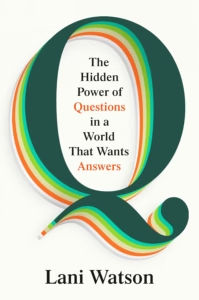 We ask ourselves questions all day long, from the moment we wake up to the moment we lie awake wondering why we said that thing in the meeting. Yet most of us rarely stop to ask what our questions are actually doing — steering attention, hiding assumptions, and quietly shaping what everyone in the room notices or misses. “Ah,” you might say, “but I’m just asking questions!” As it turns out, there’s no such thing.
On this episode, philosopher Lani Watson, author of Q: The Hidden Power of Questions in a World That Wants Answers, joins us to explore how questions work as a form of power. Here, we learn how Lani’s persistent question after giving birth helped uncover a dangerous complication her pain alone hadn’t flagged, why curious kids who ask over a hundred questions an hour grow into adults afraid of sounding stupid, how loaded headlines and “just asking questions” rhetoric hijack our attention, why humans may be the only animals that systematically ask each other questions, and how patients, parents, teachers, and anyone nodding along in a meeting they don’t understand can start asking better ones. Listen, learn, and enjoy!
Please Scroll Down for Featured Resources and Transcript!
Please note that some links on this page (books, movies, music, etc.) lead to affiliate programs for which The Jordan Harbinger Show receives compensation. It’s just one of the ways we keep the lights on around here. We appreciate your support!
- Sign up for Six-Minute Networking — our free networking and relationship development mini-course — at jordanharbinger.com/course!
- Do you even Reddit, bro? Join us at r/JordanHarbinger!
This Episode Is Sponsored By:
- Sequencing: 10% off: sequencing.com, code JHS
- Wayfair: Start renovating: wayfair.com
- Xero: Find out more: xero.com
- Cometeer: Sign up here for a free 8-pack and travel mug: cometeer.com/jordan
Thanks, Lani Watson!
Click here to let Jordan know about your number one takeaway from this episode!
And if you want us to answer your questions on one of our upcoming weekly Feedback Friday episodes, drop us a line at friday@jordanharbinger.com.
Resources from This Episode:
- Q: The Hidden Power of Questions in a World That Wants Answers by Lani Watson | Amazon
- Lani Watson | Philosophy of Questions
- Ileus | Cleveland Clinic
- Women’s Pain Is Often Not Believed: Here’s How to Make Your Voice Heard When Seeking Help | The Conversation
- Cal Fussman | How to Ask Big Questions for Big Answers | The Jordan Harbinger Show
- The Socratic Method | Internet Encyclopedia of Philosophy
- Bill Nye | Radical Curiosity Saves the World | The Jordan Harbinger Show
- States of Curiosity Modulate Hippocampus-Dependent Learning via the Dopaminergic Circuit | Neuron
- Maximally Informative Foraging by Caenorhabditis elegans | eLife
- James Randi (1928–2020) | Nature
- Here’s Why Britain Is Freaking Out About Sandwiches | TIME
- Just Asking Questions: How Healthy Skepticism Morphed into Toxic Denialism | Big Think
- The Great Ape Dictionary | University of St Andrews
- The Discover Interview: Jane Goodall | Discover
- A Talking Ape’s Death Signals the End of an Era | Science News
- Dogs Understand Words from Soundboard Buttons, Study Reveals | UC San Diego Today
- Why Chimpanzees Can’t Learn Language: 1 | Psychology Today
- Caregivers Provide More Labeling Responses to Infants’ Pointing Than to Infants’ Object-Directed Vocalizations | Journal of Child Language
- Children’s Questions: A Mechanism for Cognitive Development | Monographs of the Society for Research in Child Development
- What Is the QFT? | Right Question Institute
- Groups as Epistemic Providers: Need for Closure and the Unfolding of Group-Centrism | Psychological Review
- Questioning Strengths Assessment | Philosophy of Questions
- The Experimental Generation of Interpersonal Closeness: A Procedure and Some Preliminary Findings | Personality and Social Psychology Bulletin
- To Fall in Love with Anyone, Do This | The New York Times
- How Doctors Think by Jerome Groopman | Amazon
- Do You Want Everything Done? Clarifying Code Status | Agency for Healthcare Research and Quality
- Salmond Forced to Change Biased Scottish Independence Referendum Question | New Statesman
- Can You Really Tell an Entire Story in a Headline? | Columbia Journalism Review
- Leading Question | Cornell Law School Legal Information Institute
- 5 Whys: Finding the Root Cause | Institute for Healthcare Improvement
- Bright Colors: Eat Me at Your Own Risk | Frontiers for Young Minds
- Annie Jacobsen | The Genes and Germs of Biological Warfare | The Jordan Harbinger Show
1419: Lani Watson | The Power of Questions in a World Seeking Answers
This transcript is yet untouched by human hands. Please proceed with caution as we sort through what the robots have given us. We appreciate your patience!
Jordan Harbinger: Coming up next on The Jordan Harbinger Show.
Lani Watson: There is no such thing as just asking a question because you are always importing some kind of judgment, some kind of assumption, some kind of presupposition. Even if they're completely harmless, completely innocent, there is always some subjectivity. You're choosing what to ask, who to ask, when to ask, how to ask.
You're making a decision about whether or not to ask. There are just so many judgments that go into asking any question. And all of those judgments are open to scrutiny, can be criticized, can be taken to task on any one of those judgments.
There's just no such thing as just asking a question. It's a form of power and you can't exercise power in a way that is completely devoid of scrutiny or criticism.
Jordan Harbinger: Welcome to the show. I'm Jordan Harbinger. On The Jordan Harbinger Show, we decode the stories, secrets, and skills of the world's most fascinating people.
Our mission is to help you become a better informed, more critical thinker through long form conversations with a variety of amazing folks, from spies to CEOs, athletes, authors, thinkers, performers, even the occasional economic hitman, terrorist, kidnapping survivor, or dictator's former insider. And if you're new to the show or you're looking for a handy way to tell your friends about it, I suggest our episode starter packs. These are collections of some of our favorite episodes on topics like persuasion and negotiation, psychology and geopolitics, disinformation, China, North Korea, crime and cults, and more.
It'll help new listeners get a taste of everything we do here on the show. Just visit jordanharbinger.com/start, or search for us in your Spotify app to get started. Today on the show, should it hurt this much?
After giving birth, philosopher Lani Watson kept asking that question. She was in severe pain and she describes how asking it repeatedly helped her draw attention to a problem that needed real treatment. It's a serious example of something we do all day without thinking much about it.
We ask questions. A question can help someone notice what they've missed. It can also steer your attention, smuggle in an assumption, or make you defend a position you never agreed to in the first place.
I'm just asking questions can involve a surprising amount of bullshit. Lani is the author of Q: The Hidden Power of Questions in a World That Wants Answers. Today, we'll explore how questions shape what we pay attention to before anyone even answers, why we go from relentlessly curious kids to adults afraid of sounding stupid, and how to recognize loaded questions while getting better at asking our own.
There are practical ideas here for conversations. Classrooms and those moments when everybody in the room is nodding and you're pretty sure that nobody understands what's actually happening. Here we go with Lani Watson.
Lani, thanks for joining me. I appreciate it.
Lani Watson: It's great to be here, Jordan.
Jordan Harbinger: Normally I'm like, oh, a philosophy book about questions. It's going to be so 30,000 foot. I like practical stuff, but actually I found it quite usable and practical.
And I thought it was going to be a little bit just too much of an overview on syntax or something, but you really do argue that questions are not neutral, little bits of conversation. They're kind of a form of power. What's the most dramatic example, maybe that's a good place to start, of a question changing someone's life?
Lani Watson: Yeah, well, I mean, a lot of my early research was looking at the kind of the semantics and the syntax and the linguistics. And for me, isn't where the power lies with questions. It's not about what they look like on a page or how we write them down or even how we use them linguistically.
It's about what we actually do with them in our lives. So, yeah, dramatic version of that, probably the most dramatic version in my life has been when I gave birth. And I talk about this towards the end of the book.
Shortly after I'd given birth, I had a huge amount of pain in my abdomen. And that's maybe expected, right, following birth. But this was sort of extreme pain that got worse and worse over time, over a few hours and during the night.
And I started having this question recurring in my mind, which was just, should it hurt this much? Should it hurt this much? Should it really, really hurt this much?
And ultimately, that question became a source of great power for me because it kept drawing my attention back to this pain, even though I was hugely distracted by having a newborn child right next to me. This pain was really drawing my attention through that question. Ultimately, I was expressing that question to the people around me, to my wife and to the midwives and the doctors.
And in the end, it was very clear that it should not be hurting this much. And I ended up going through several procedures and we were in hospital for the next week. But that question really acted as a form of power for me because partly it was that powerful pull, the attention that I was giving my pain through that question and then drawing to the pain through that question, asking that question to others.
And then it's a form of advocacy that was helping to communicate the problem clearly and get some answers.
Jordan Harbinger: Yeah, I don't know if the UK has this. Maybe I'm actually now that I think about it, you probably do. Does the UK have that same thing where like women are not necessarily believed in medical situations?
In the United States, I know it's a common sort of rhetoric or a common gripe that women will say like, yeah, we're just not believed. Women will say like, hey, this hurts. And doctors are like, yeah, well, you just gave birth.
And it's like, no, no, no, this hurts a lot. Yeah, well, you just gave birth. And it's like, listen, a-hole, this hurts a lot.
And I think there's probably something going on. And you have to deal with this sort of I'm the doctor and you're wrong and I don't believe you. And you're just a wimp because you're whining and you're a lady.
And like there's this whole sort of narrative here that this is what's going on. And I guess probably in the UK, you kind of have the same thing.
Lani Watson: Yeah. And I think especially, like you say, around child care and labor and everything, there's this expectation, right, you're just going to experience pain. And so it's difficult to distinguish, OK, what's OK pain?
What's the type of pain you should be experiencing and what's not? And just reporting pain to a medical professional in that situation is very unlikely to get you noticed. But I think rather than saying this hurts, asking, should it hurt this much?
Even that switch exercises a form of power out because it requires someone to respond. And they're either going to say, yes, it should hurt that much, in which case you can start questioning that or they're going to say, no, actually, it shouldn't hurt that much and we need to find some answers. So that's a kind of a good example of how switching from just a statement to a question can exercise a power that you might not otherwise have.
Jordan Harbinger: So you eventually had a severe ileus, something I had to look up. So maybe give us a clue as to what that is. And you needed urgent surgery.
So good thing you said something. And I guess this is a nonsense question at that. But what did your question accomplish that merely saying, hey, I'm in pain did not accomplish?
Lani Watson: Yeah, I think I've said the ileus is like a blockage in your digestive system. And basically the whole system shuts down. And obviously that's very serious.
We need our digestive system to be working. And so that can result in bowel perforation, which can be fatal. So, yeah, it's quite important to act quickly in that situation and to make sure that kind of was checked as soon as possible and any kind of blockage cleared.
So I think I do think that asking the question rather than expressing that, first of all, recognizing it and the question that I was asking internally was helping me to really recognize I wouldn't be asking that question if I wasn't really worried about something that was my logic, my thinking. And then secondly, asking it out loud and allowing people to hear it multiple times draws that attention and allows people to go, OK, this isn't a rhetorical question. This needs an answer and we need to do something in order to find that answer.
So that question requires someone to then act in a way that simply saying I'm in pain might not.
Jordan Harbinger: Yeah, I never thought about this, but you're right. If I say this hurts, they're just like, OK, but if you're like, should it hurt this much? It forces a response and they go, huh, usually people complain and they take a Tylenol and it goes away.
You're saying that didn't do anything and it's keeping you awake. No, it actually should not. Now that I think about it and I'm not just blowing you off.
No, it should not hurt this much. All right. It's tempting to make this sound inspirational.
Just ask questions and you'll be heard or whatever. But people are dismissed by institutions all the time, like we talked about with medical care. What made persistence work in your case?
What should somebody do if their answer or the response they get remains dismissive?
Lani Watson: The book has the power of questions in the title, Hidden Power of Question. I'm almost tempted to write another book. The second book is The Power of Asking Twice, because I do think there's a huge amount of power in just asking again.
That can come in all different forms. Again, it comes back partly to that attentional piece, like you're just drawing attention back to that issue or that concern and not being satisfied with an answer. But then the second thing to do is to question that response, move beyond the first question and question the response.
And again, that can be a way of drawing attention to, I'm not necessarily satisfied with that answer. Are you sure? Could it be something else?
Could there be something else causing this? Is there another explanation? How do you know?
Any question like that, again, it forces the conversation to move beyond just the kind of sentence stopper answers and require another one.
Jordan Harbinger: So is the lesson that a good question gets a better answer or maybe it almost feels like it forces the other person to start asking questions as well, like should it hurt this much? And then the doctor has to go or the nurse, huh, should it hurt this much? OK, well, how do I know if it's supposed to hurt this much or not?
OK, does it keep you awake at night? OK, well, it's not supposed to hurt that much. It just sort of forces the gears to start turning in their brain instead of getting the autopilot response like, yes, of course it hurts.
You had a kid last week. Get over it or whatever they're saying.
Lani Watson: Exactly. Exactly. Yeah.
Jordan Harbinger: So you say questions steer attention before answers ever arrive. So what are we all paying attention to right now? Because somebody asked us a question.
And what are we usually missing? Because nobody did.
Lani Watson: It's a great example, right? Because we're in a conversation right now. We're in an interview in a podcast conversation.
So you're asking me questions and that's directing the listener's attention and my attention towards different aspects of the topic in the conversation. And depending on which questions you're asking, those different topics are going to arise. And that is one way to, in the case of interviewing, that's a kind of curation.
You're curating the conversation through directing attention to the topics via the questions that you're asking.
Jordan Harbinger: Yeah, I never really had thought about this before we did our pre-interview call. I don't know, whatever, two months ago, because one thing you'd actually said was tomorrow when you wake up, ask how many questions you have in the morning. It's basically ask yourself how many times you ask yourself something in the morning.
It was a ton. So some people may be zero. I don't know.
They're just totally zombified and autopilot. But I guess it depends on how you interpret it. For me, I gave up counting because I was like, oh, there's maybe like hundreds of questions before I even hit the gym or go to my Chinese lesson or whatever the first thing is in the morning.
So why is something that we do constantly, so ask ourselves the question, why is that so hard to define? Because, again, I lost count. It just was, all right, I get it.
There's a lot. I left it there.
Lani Watson: Right. Yeah, it's a great exercise. And I've done it myself over many years and got frustrated every time and given up because I'm trying to count either the questions that I'm asking during the course of a single hour or a day, or even I've tried to just catch the first question that I ask in the day or the last question I ask before I go to sleep.
It's so difficult because they're so elusive and hard to pin down. That's one of the things that I find so fascinating about this topic. Right.
Because it is such a familiar thing to us all. We all ask questions. Everyone on Earth ask questions.
Doesn't matter if you're speaking Chinese or you're speaking English, whatever, wherever you come from, you're asking questions all the time. And yet we don't actually know exactly what they are. And so when we start to count them, we start to lose track, not only because there's so many, but because we don't actually know what counts as a question.
Jordan Harbinger: Yeah, the books kind of cast a wide net, right? It says a question is an information seeking act. It's like, all right, fine.
But why is that more useful than saying a question is a sentence with a question mark at the end or a rising intonation at the end? Because it does seem like that's the basic definition. And then once you start counting them, you're like, oh, wait, that was a question, too.
And it almost seems like, all right, it's impossible to track these things because it's impossible to define what a question is or it's very difficult to define what a question is.
Lani Watson: Yeah. So I think it's useful to think of a question as an information seeking act beyond this kind of linguistic idea that a question is kind of a series of words written down with a question mark at the end, rising intonation, whatever. These are all like great markers that can help us to identify questions, but I don't think they tell us what a question is.
And that's because I think in those cases, we're focusing on what a question looks like, what a question sounds like, rather than what it actually does. As I said earlier, what a question does is important if we want to try and understand the power that we have when we ask questions. So I like to think of a question as an act because an act is something that we do and we can use in our lives rather than just like a kind of piece of linguistic kind of scaffolding.
Jordan Harbinger: Okay.
Lani Watson: Yeah. So that's the basic reason why I think it's useful to think of questions in terms of their function, what they do rather than their form, what they look like.
Jordan Harbinger: Yeah, that makes sense. So give me an example of something that looks like a question but may not actually be genuinely information seeking. And then give us an example of something that is information seeking, even though maybe it's not the typical question format.
Lani Watson: Yeah. So, I mean, rhetorical questions are like a really interesting borderline case. But a lot of people think if I, for example, set up a scenario where I'm saying, okay, I've just spotted someone I don't like and I don't really want to interact with them, but they've just caught my eye.
So I feel like there's a kind of norm of politeness that requires me to say, oh, how are you?
Jordan Harbinger: Oh, yeah. Or are you kidding me? I'm not actually asking if someone's kidding me, right?
I'm just annoyed.
Lani Watson: Yeah. Those kinds of tag questions like, oh, this is great, isn't it? You put that question at the end, but you're really making a statement and asking for some kind of, you know, agreement.
There are lots of grey areas where we might think that there's a case to be made for a question in any kind of grey area. But there are certainly things that look like questions that a lot of people don't think in the end are questions, precisely because they're not functioning to seek information.
Jordan Harbinger: Yeah. You know who's good at this is autistic people. I've got a couple of friends where if you say, this is great, isn't it?
He'll turn to you and go, yeah, I'm glad we're on the same page about this. And it's like, yeah, no, Tom, no, me too. It's like, it is like you kind of tell like, oh, I probably wasn't supposed to say anything about that.
And then I realized, no, that was me just wasting both of our time asking a question, but not really because I was just saying this thing that never mind, let's just keep eating. Do you realize like how many like little social things that we do or like fake questions we ask that are just not even at all information seeking? They're just pre-programmed nonsense that humans do.
Lani Watson: The other side of the coin, right, is questions that don't look anything like the kind of classic sentence written down with the question mark, but that do actually function as questions. And a good example of that might be looking both ways to cross the road. I think that does count as a question.
A lot of people that I've asked agree like that does seem to generally intuitively people think of that as a question, but it clearly doesn't have any linguistic form at all. So we can't pin it down to particular sentence type or a type of intonation or a type of symbol, grammatical symbol use.
Jordan Harbinger: Yeah. OK. You use the Greek concept of aporia.
So realizing you do not know what you thought you knew, we experienced that as a failure. Right. Oh, I thought I knew this thing, but I don't.
So I feel bad about myself for some reason, even if it's a small and consequential thing. Why do we experience that as a failure instead of the beginning of curiosity, for example? It seems like that would be more productive.
Lani Watson: Yeah. I'm a big fan of aporia and this is a concept that comes from the ancient Greek. It's often translated as confusion or bafflement.
But it is this feeling of, oh, I thought I knew that and I didn't. And this is associated with the philosopher Socrates, who is my main guy when it comes to the philosophy of questions. And he's well known for his approach, which was based around Socratic questioning, this famous technique.
And that technique typically led to at the end of that process of questioning, he was typically drawing people into that state of aporia, that state of confusion or bafflement. And these were often people who were like senators or figures of authority that a visitor, famous visitors to Athens, and they were claiming to know things. They were claiming to know about virtue or friendship or love or justice or the good life.
And Socrates was saying, I want to know about these things, too. Can you help me? And he would ask them questions.
And ultimately they would all end up, Socrates included, in this state of confusion and bafflement. Now, the reason why I think the senators and the people in these dialogues typically storm off at the end and they're very frustrated and Socrates does not get a good rap from doing this. But I think Socrates clearly thought that this was a valuable process and a valuable state to get into.
And I think it's true that partly because once you're in that state, if you're in the right frame of mind, if you're in what I call the questioning mindset, then you not only allow yourself to then become curious about something like, oh, I thought I knew that thing and now I don't. I can be curious now. I can engage my curiosity.
I can engage all the exciting neurochemistry that goes along with that and I can start seeking. That's an exciting place to be. And then at the same time, we enter into a place of humility.
Right. So it's very hard if you're sitting in that confused and baffled moment to be hubristic and to be arrogant about something. Right.
You're actually actively admitting, I don't know what I thought I knew. And that kind of lessens the risk of those kind of traits. And then finally, we get this kind of openness, open mindedness to the options, because suddenly if I don't know what I thought I knew, then the options are open that it could be any one of a number of alternative answers that is actually correct.
I think of that as a way of kind of de-risking the search for knowledge because you're then stripping out a lot of the biases and the assumptions and the presuppositions that might have come from believing that you knew something that you perhaps then realize you don't. So we get this big package, we get this curiosity, we get this humility and we get this openness simply from allowing ourself to enter into that state of aporia.
Jordan Harbinger: Socrates asked powerful people to explain themselves and they found that incredibly annoying. Sounds like some management styles have survived remarkably well. We'll be right back.
This episode is sponsored in part by Sequencing.com. When a doctor asks about family history, I have more to say than I'd like. My mom has Alzheimer's.
There's a history of schizophrenia on her brother's side. So understanding genetics is personal for me. I want to know what information could actually help me make decisions.
That's what interests me about Sequencing.com. It looks at your DNA, all of it. For genetic factors linked to health conditions, take inherited high cholesterol.
You can eat well, exercise, still have an inherited risk worth discussing with your doctor. The value is having more information for that conversation. Should you consider a different screening?
Is something in your family history worth investigating? Genetic risk isn't a diagnosis or a prediction of your future, but it can help you ask more informed questions. And getting it done was surprisingly easy.
I just did the cheek swab. I mailed them back. No appointment.
There was no blood draw, no rearranging my whole day. They kept me posted every step of the way on the progress too, so I wasn't wondering whether my sample had arrived or what was happening next. Your DNA doesn't ever change, but our understanding of it does.
And with an optional Sequencing.com membership, your DNA is reanalyzed every month as the research advances so the same test can keep providing new insights for years to come. Your data stays yours. They never sell it ever.
And right now, Sequencing.com is offering our listeners 10 percent off your full genome test plus free shipping.
Go to Sequencing.com and use promo code JHS for 10 percent off. That's Sequencing.com promo code JHS. That's S-E-Q-U-E-N-C-I-N-G.com promo code JHS.
This episode is also sponsored by Wayfair. We got storage sheds for our backyard from Wayfair because Jen loves keeping the house festive. We also get our holiday decorations from Wayfair.
So Wayfair supplies both the decorations and the infrastructure required to support them. Pretty good business model. But I love it.
It's fun having the house decorated when friends and family come over and the sheds give everything a place afterward. So getting ready for guests doesn't mean finding somewhere to hide holiday bins for the other eight months, 10 months, whatever, per year. For all things hosting, Wayfair delivers high quality, customer trusted products for your home so you can host and celebrate without the stress.
You can shop thousands of products across every style and budget, whether you're adding holiday decor, getting ready for guests or finding somewhere to store everything in January. We use Wayfair for the fun stuff and the practical stuff. I recommend checking it out.
Think about what would make hosting easier at your house. Apparently at ours, the answer was just more storage. Jen heard room for more decorations.
When refreshing your home this holiday season, Wayfair delivers exactly what you need. Head to Wayfair.com to shop all things home. That's W-A-Y-F-A-I-R.com.
Using our promo code doesn't just get you a discount. It helps out the show as well. I don't get a cut of sales, but it does tell the advertiser you're actually listening to us.
So if you do sign up or buy anything, please use our codes. They're all in the deals page at JordanHarbinger.com/deals. You get a great deal and you help keep the show going strong.
Thank you for your support. Now back to Lani Watson. So a lot of people ask why I'm still curious about lots of different things, even at age 46.
And I don't know the answer to that. But now that we're having this conversation, of course, after reading the book, I was kind of like, wait a minute. I think this is part of it, because I guess at some point early in me recording the show, I realized, OK, well, I'm not expected to know everything from all these people that I'm talking to that are all really brilliant.
So I have permission to just be like, what is aporia? I've never heard of this. How does this work?
And nobody reasonable who's listening is like, oh, this guy is such an idiot. He doesn't know what anything is. Right.
Maybe an expert on the subject would be a little disappointed that I've had more background or something. But nobody really expects me to become an expert in whatever Greek philosophy or the history of the alphabet or something I'm talking about on the show. And it's almost like this weird, I don't even know what you call it, virtuous cycle.
You aren't expected to know something because it's complex. So then you get permission to be curious about it. The curiosity feels good.
Getting the answer or the anticipating of getting the answer feels good. Then you decide, I don't care if people think I'm an idiot. I want to know more about this.
And so you have this cycle where you're allowing yourself to be more curious. So I almost think, and again, I could be wrong about this, but probably most people would be more curious if you didn't feel like crap every time you didn't know something. Right.
Of course, you're not curious if people make you feel stupid, including yourself, make you feel stupid for not knowing something. But if you feel good looking for an answer, then why wouldn't you be curious? I don't know.
Again, maybe this is just how I'm wired, but I kind of think we give ourselves such a hard time about not knowing things. That's what actually kills our curiosity, because kids are so curious. Right.
Because they have to learn to feel dumb not knowing something or they have to learn that frustration is bad. Trying to do two plus two. So you actually say research showing that the anticipation of finding something out can activate reward circuitry more than simply receiving an answer.
So I'd love to talk about that because it seems why is the chase often more pleasurable than the answer? You think that getting the answer would be the part that triggers the dopamine or whatever.
Lani Watson: Yeah. Essentially what's going on there is that's your dopaminergic circuits and they're connected to your hippocampus. Hippocampus is really important area for learning and memory.
Right. So you become curious about a piece of information and your brain, therefore, sort of releases this bit of dopamine, activates those reward circuits connected to the areas of learning and memory because you want to be better positioned to take on the information if you find it. And you are, it seems, based on the experiments they've done on that, you're better able to process, take on the information and then you remember it better later when you're in that state.
And we can tell that there's a good reason for that. Right. If you think about it from an evolutionary perspective, because imagine we're back in the day, I go all the way back to the nematode worms, you know, 500 million years ago.
Right. But they have this incredible foraging behavior, which is exploratory information seeking, which essentially shows that even these extremely simple organisms that have tiny number of cells, they are capable of foraging in a way that doesn't just lead them to a food source. If they find a food source, they will continue to seek the rest of the environment, the immediate environment for further information.
And we can tell that's very valuable. Right. Because if you just go for the first food source, you might be missing something better, something more nutritious, something more sustainable.
You might be missing something poisonous nearby, whatever it may be. So we need the information first, even before we get to the food. And that's what our brains, I think, are wired to do, is to seek and value information and the search for information.
And it's your brain's way of saying, keep doing that, it's going to keep you safe because you're going to get more information that way. When we get the information, we don't get that same hit because the brain isn't worried about whether we end up with the right answer. It's worried about whether we keep searching for the information.
Jordan Harbinger: This was an interesting point, because don't these worms have 300 neurons or something? Right. And in our brains, I don't know, whatever, trillions or something, it's just like a crazy, sophisticated computer compared to this thing that's like a light switch.
Basically, this worm and a couple of light switches. Right. I guess is a neuron a light switch?
So he has 300 light switches and we have trillions. I'm not sure how any of these things work, obviously, as you can tell. But you're right.
That's fascinating. I never really thought about this, because if you'd asked me before I read the book, I would be like, no, getting an answer makes me feel good. And you're right.
No. It actually is the process. And it has to be the process because people go, how do you remember everything on your show?
And the answer is, I don't. I'd be lucky if I remember one thing from every guest I've had on the show. And generally, I'm going to guess I don't usually remember like years, 10 years later.
What do I remember from episode 324? Probably nothing, really. But I definitely had a good time doing it.
Right. And even if I do a show and afterwards, I only remember a couple of things. For me, the dopamine is like I read the book and then I talked to the person.
The conversation went well. That's all process related, if I think about it. And maybe this isn't an exact sort of apples to apples comparison, but it really does seem like it's the process for me.
The other thing that I find fascinating that definitely maps to my personal experience is a really simple thing like two plus two. Right. There's no thrill for me getting something simple, maybe because I learned that as a kid.
Maybe I had a great reaction to that. But once it's old news, it's not really that exciting. But a weird or odd question grabs us immediately to the point where people always kind of crap on me for loving A.I. so much. But it's like if I'm in my car and I'm driving and I go, how do they make bridges in water? And then the concrete dries. They have to move all the water.
Like, how does that work? And I can ask Grok because it's built into my car while I'm driving. I will do that for so long that Grok will say, hey, man, you have to log in and pay for the premium account because you're out of free whatever tokens for this car ride.
And I'm like, dang it. And I'm not going to pay for Grok. But I'll just run that thing into the ground until the next day when it resets.
My car knows, I should say, that I'm a huge weirdo because if you could see the question list in that car, I even had to ask it. I was like, can my wife see all the questions I've asked in this car? And it's like, no, I don't keep a log of that.
And I was like, oh, thank God. Right. Because if you read that, you'd be like, lock this man up.
This guy has problems. Right. But these odd questions, they just they keep me endlessly entertained and engaged.
Lani Watson: But that is joy of childhood. Right. And that you're clearly continuing to revel in and embrace.
And like, I'm sure because your job, like, encourages and incentivizes that and a lot of the problems that for a lot of people that they are just not incentivized or encouraged or rewarded for being in that curiosity driven state, curiosity fueled state for asking all those types of questions. And when we're children, we ask them notoriously all the time. And that like endless why phase that a lot of children go through, it's really important.
And that is the kind of curiosity fueled dopamine and a learning tool that is absolutely essential to how we learn and develop as children. But it doesn't become less. The exact same neurochemistry is operating in your brain right now.
It doesn't become less useful for learning as we get older. It's just that we stop being incentivized to use it largely, I think, because of the education system.
Jordan Harbinger: I think you're probably right. My son loves asking questions. And another parent said, wow, you have an endless sort of ability to answer all of his questions, because I noticed a lot of parents, they work all day.
Right. So they're super tired at the end and they pick up their kids from school and I'll go and pick up the kids and they'll say, mom, what about this? What about that?
And you can just sit and be like, I don't know. I'm like, no, I want to find out the answer if I don't know the answers. Again, I've got Google at my fingertips or ChatGPT, so I will routinely do it.
The only problem is when he likes to do it at 9:30 p.m. and I'm like, go the F to sleep. I'm on to you. But that's a good question.
Save it for tomorrow. And he's like, I want to know right now. And I'm like, me too.
Fine. So it works every time. But it's either the education system trains it out of them.
And if that doesn't work, it's your first job because you go, hey, boss, I'm curious why this and this and this. And it's like I hired you to staple those and put them in a pile. I'm not going to waste both of our time talking with you about how the loader works or how we track the items in the warehouse like that's not your job.
So eventually you just go, no one's ever going to tell me how anything works until they need me to do it. So I'm just going to stop caring. And that's an unfortunate place to be.
You'd think you'd want to hire somebody who wants to know how your entire business works so that in 10 years they can manage the thing for you while you sit on a beach and drink pina coladas like isn't that the dream? Right. So I want my son and I want other people to know everything about how stuff works around here, even if that means I've got to give them a raise because they're more qualified at the end of a year of asking questions.
But you compare questions to a mental search light. They direct attention toward one thing and away from another thing. I thought that was a really good way to explain close up magic or magic in general.
I do a lot of debunking of scammy stuff. And some of the chief debunkers are guys like James Randi, R.I.P., who was a really good magician. And he was like, scientists, we can't explain this telepathy.
And he's like, that's because you're looking for the truth. And this person is deceiving you. You're not looking for ways that they deceive you.
The scientists are going, how could he possibly know this? We can't think of a way. And he's like, that's because you're not a magician.
I can think of six ways that he has the answer to what's in that person's mind, supposedly that you guys aren't paying attention to. And he found all kinds of things like people breathing in different ways as a signal to what's on the card. And like when you control for that kind of thing, suddenly their ESP or whatever it is goes away.
Right. So it explains close up magic, clickbait, political interviews, meetings going off the rails. Give us some examples of this, I think, because if you really do look at questions as a mental search light, you realize, oh my gosh, the clickbait headline that what is it that got scientists befuddled about the Antarctic?
And you're like, crap, I've got to read this now. I really don't want to. I don't have time, but I have to.
Lani Watson: Think put to a nefarious use in social media and online and even in just traditional media, right? Headlines that pose a question. Part of the thing there is that the question is raising, like it contains a bunch of presuppositions to raising a topic it's raising.
And my favorite example of this was a headline in the Daily Mail a few years ago that said, is there no one left in Britain who can make a sandwich? And this was a complaint about a factory, a sandwich factory that had brought in some people from another country to do the sandwich making job in the factory. And of course there are lots of reasons why that was happening.
But the Daily Mail's take on it was that, what was the Daily Mail's take on it? I don't know.
Jordan Harbinger: Something, something brown people, something in Britain.
Lani Watson: Yeah, exactly. Yeah. And like the great British institution of sandwiches is under siege because of immigrants, basically.
And it's like, so not even remotely headline news, but the idea that this could be a front page headline on the Daily Mail, the whole point of that question is just to raise this issue when it otherwise wouldn't have been raised. And you've got to think there's just only a number of opportunities, even in a 24 hour news cycle, there's only a certain number of opportunities to put a topic in front of your audience. And you are choosing all the time, which topics to put in front of your audience.
And those questions, the piece that followed that question did not answer that.
Jordan Harbinger: Of course, why would it? They don't care. They've already got your attention.
Lani Watson: The point was to just raise this problem, this perceived problem of sandwich making and immigration, and then use it as a platform to say a bunch of other stuff. But your attention is hooked by that question. And then you end up thinking about that thing that you otherwise wouldn't have done.
Jordan Harbinger: It's ironic because you would think of all the things British people can complain about when it comes to immigration, the food thing. British food only has one direction it can go and that's up. If people are coming from a foreign country and changing the food, the correct response is thank you.
I've been to the UK. It's a great place. We are famous for a lot of things.
The domestic cuisine is not necessarily one of those things. That's fad. When I lived there, I ate a lot of things wrapped in newspaper that were very expensive and not very good for you or tasty.
So eventually I was like, I don't eat Indian food, but I'm going to try it. And I was like, oh, no wonder this is popular because the other alternative is a frozen pizza from Tesco at this hour. I'm taking the curry.
There's a phenomenon. And again, I don't know if this is mostly an American thing or if you've got your media people doing this also, but they'll say something completely ridiculous or insane. And they'll go, I'm just asking questions, but it's not really a question.
Do you know what I'm talking about? Are you familiar with this?
Lani Watson: Yeah, very, very much. I do take it to task little in the book. And the basic point is that there is no such thing as just asking a question.
That's the key takeaway from that whole debate. There is no such thing as just asking a question because you are always importing some kind of judgment, some kind of assumption, some kind of presupposition. Even if they're completely harmless, completely innocent, there is always some subjectivity.
You're choosing what to ask, who to ask, when to ask, how to ask. You're making a decision about whether or not to ask. There are just so many judgments that go into asking any question and all of those judgments are open to scrutiny, can be criticized, can be taken to task on any one of those judgments.
There's just no such thing as just asking a question. It's a form of power and you can't exercise power in a way that is completely devoid of scrutiny or criticism.
Jordan Harbinger: Yeah, that's an interesting way to look at it. And it also helps you debunk the trick because you'll hear people go, what if the gay agenda is to make more of our kids gay in schools by putting gay people in books? I'm just asking questions.
And it's like, no, no, no. What you're saying is you think there's a possibility that this is a thing. You didn't just creatively come up with that in a vacuum, right?
You're asserting that this is maybe even the likely thing that's happening, in your opinion. And then if somebody goes, that's ridiculous, you don't have any evidence for that, then they can raise their hands in the air and play dumb and go, I'm just asking questions. You're the one that's attacking me for my, I don't know, a freedom of speech or something like that, right?
They'll lean into something like this. I know that sounds like a ridiculous example, but if you've ever watched American media, I promise you that some variation of that exact question is in there because I didn't make that up. It's in my notes, which means I probably saw it after reading the book and wrote it down in there.
Yeah. So what is one question people should actually learn to ask themselves when someone else is trying to direct their attention?
Lani Watson: Yeah, I think firstly, when I talk about a questioning mindset, what I mean is it's a lens that allows you to approach the world and the people in it with questions in mind, a kind of questions first mindset. And I think that's an important place to start with any kind of dialogue or conversation. If you're confronted with the question, start with more questions, start with asking yourself questions about, yeah, all of those things.
Why is this question being asked? Who is asking it? When?
Why? Why am I being asked this question? Why is it being directed at me?
Why is my attention being drawn in that direction? What am I missing? What is my attention being taken away from as a result of it being pointed in that direction?
And so on. That's a lot of questions to have them in your mind when you're in that situation. And then, of course, you can express those questions.
And I think, what if you just don't ask that question? What changes? But I think basically having a kind of question first approach to any interaction that involves questions or not is a good way to start pausing, giving yourself a pause and an opportunity to think it through.
Jordan Harbinger: It makes me feel like now, in order to go to the sponsor breaks for the show, I have to be like, will you be a good person and support the amazing sponsors who support this show? And that's, oh, gosh. Then the listener's asking, will I be a good person and support the sponsors?
I don't know. Look, guys, I'm just asking questions. Don't hold me to it.
You mentioned this worm has the proto questioning or whatever when it's searching for its environment. So I assume that means other animals that are much more evolved or more advanced also ask questions. And I'm not just talking about gorillas that know sign language, but are there other examples that you found?
I don't know. Parrots, I guess, could ask questions because they can talk. But is it the same thing?
I don't know.
Lani Watson: I love thinking about sort of animal question, different species that ask questions. For me, there's a kind of an evolutionary story that takes us from the proto questioning of the nematode worm, which is a kind of hardwired exploratory information seeking, but it's hardwired. And we get a sort of leap from that hardwired information seeking to something that is more autonomous.
And we have control over it, some kind of agency over that information seeking. And when we get that from an evolutionary point of view, I think we start to have questioning and specifically what I call private questioning, which just means questioning that's going on only in the mind or in the body of an organism or a creature. And so I think that happens.
That's a long way back in history. And pretty much a large number of the species on Earth are doing this private questioning, which means they're just able to intentionally search for information under their own control. The amazing thing about the story for me, the evolutionary story, is that we then have another leap, which goes from private to social questioning.
And social questioning is simply asking another creature a question and trying to get information out of them. And what's fascinating about that leap, as far as I've discovered, is that humans are the only creatures on Earth, the only animals on Earth that have actually made that leap in any systematic way. And so you have your very intelligent apes, dolphins and other mammals.
You've got your dogs and your cats. You've got your parrots. But none of those species in the wild appear to do the thing that we do, which is turn to each other and ask each other questions.
Jordan Harbinger: I'm surprised that apes don't do it somehow. Do you want this banana? Will you trade this banana for the melon that you're holding?
They don't do that?
Lani Watson: So apes interact all the time, of course, and they do different types of behaviours and gestures. There's a great centre in St. Andrews in Scotland, just down the road from me, called the Wild Minds Lab. And they've got a great ape dictionary that has documented all the different great ape gestures.
So things like give me that or stop doing that or carry me or groom me or whatever they are, all these different gestures. None of those gestures are what look like an information seeking act. None of them are.
Can you tell me this piece of information? Where are the bananas that you're eating? Or where did you find that particularly delicious termite hill?
Or even how did you learn to use that stick to fish termites out of that mound? They gather that information. They do lots of private questioning.
They watch each other. They learn from each other. But they don't request information from each other in the wild.
And my backup for this is Jane Goodall, who was interviewed by Life magazine, famous primatologist, spent 40 years in Tanzania with the group of chimpanzees. And she was asked, what's the difference between humans and apes? And her response was, it's the ability to ask questions.
Jordan Harbinger: Wow. So there you have it. Nobody knows more about apes than Jane Goodall, RIP.
You mentioned in the wild, but what about when they're in captivity? Because don't they teach them sign language and things like that? And can they use that to ask questions?
Or is that, does it still not happen?
Lani Watson: Yeah, there's actually some recent, quite recent research in the States with a group of captive chimpanzees who have learned to use language, learn to use sign language, learn to use keyboards and so on. And there does seem to be some evidence that within that group, they are able to engage in questioning with human caregivers and also perhaps even with each other.
I know that chimpanzees, so I spoke to a woman, Heidi, who worked with Kanzi, very famous linguistic, who was the first bonobo to use sign language. And she was very unsure whether he was really capable of actually asking questions. They have the keyboard, right?
The keyboard that they've learned to use has a question mark on it. Just doesn't get used. There's not really a, there's a sort of, give me that.
There's lots of commands and demands and imperatives, but there's not, again, there's not a like, hang on, where did you get your hat from? Or where do you go when you leave the room or that kind of questioning isn't taking place. So I think there are some instances where we could think there is social questioning going on with captive chimpanzees who have been taught to use language, but it's only with that kind of human touch, as I put it, that we see social questioning like that emerge.
And the same is true, I think, with parrots. And I also think the same is true with dogs.
Jordan Harbinger: I'm just asking questions can do a lot of work for somebody who's already decided what they want you to believe. I'm just selling ads, but at least I'm labeling them. We'll be right back.
This episode is brought to you by Xero. That's Xero with an X. Running a small business means there's always something competing for your attention.
Managing your finances shouldn't make your day more complicated. Xero brings accounting, payments, payroll, and analytics together in one connected platform. So you spend less time piecing together the numbers and more time actually building your business.
We've been using Xero for nearly a decade now, and honestly, we don't know what we'd do without it at this point. That's meant clear reports, dashboards we can actually read, forecasts and AI powered insights that help us understand our own cashflow and see how the business is really doing. It was simple and easy to use from day one, and it still is.
In fact, 91% of customers surveyed agree that Xero is easy to use. And when you choose Xero, you're joining 5 million customers worldwide, including us. That's Xero with an X at Xero.com.
The 91% claim is based on a 2024 Xero survey conducted in the US, UK, and Australia. This episode is sponsored in part by Cometeer. A while back, we invested in a fancy espresso machine and a grinder.
Think if we'd make incredible coffee at home. We even bought the fanciest beans from our local roasters. Somehow it never really came out right.
Now that the equipment is collecting dust, what we made just doesn't compare to Cometeer. And Cometeer takes seconds. And here's why.
Cometeer sources coffee from the best roasters in the world, like Onyx and Counterculture, brews it to perfection, like, you know, they actually know what they're doing, and then flash freezes it at negative 321 degrees Fahrenheit with liquid nitrogen to lock in peak flavor and freshness. It comes on dry ice right to your door in recyclable aluminum capsules. Just melt it to make hot coffee, iced coffee, or espresso style drinks like lattes in seconds.
No machine, no plastic brew path required. The former president of Nespresso invested after one sip. Having tasted it, I also get it.
It's an entirely new way to make coffee, and it's become our every morning routine. Professionals handle the brewing. We get to enjoy the coffee.
We even gifted it to friends, a busy college student who needs a study pick-me-up, and our cousin who just started a new job as a lawyer. Try it yourself. Get $20 off at Cometeer.com/Jordan or use code Jordan. If you liked this episode of the show, I invite you to do what smart and considerate listeners do, which is take a moment, support the sponsors, they keep the lights on around here, all of the deals and discount codes are searchable and clickable on the website at JordanHarbinger.com/deals. We've recently redid that page. Please let me know what you think.
It should be super functional now. Thank you for supporting those who support the show. Now back to Lani Watson.
I saw all the rage maybe last year where these keyboards where your dog could jump on it. And it was like, I'm hungry. And people are like, oh my God, we've unlocked the ability for animals to talk and it's—have we, though?
Or do they just know like green button means he'll take me for a walk. There's a question mark, but forget it, dog. You'd have to teach an ape syntax and grammar or something.
I mean, it's just not happening. Even the sign language, whenever you see the videos of that, it's always hello, I'm hungry or like sleep time or whatever. It's very basic.
It's something that an 18 month old baby can communicate as well or better than these apes with sign language.
Lani Watson: There's the example I give in the book of Herbert Terrace, he studied primates and he had a conversation with Nim Chimpsky, another very famous linguistic ape, and his observation was that Nim was a quote unquote boring conversationalist because he only ever sort of requested items. He said, give me that, give me that, give me that. And according to Herbert Terrace, this was not an interesting conversation because he wasn't interested in anything beyond just simple requests for objects.
I don't know if that's entirely charitable, but that was how he reported it.
Jordan Harbinger: This is his conversation with Noam Chomsky or is it a, sorry, did I misunderstand you?
Lani Watson: The linguistic chimp has been named Nim Chimpsky.
Jordan Harbinger: Oh, I thought you were just saying Noam Chomsky with a weird British accent.
Lani Watson: Oh, I'm really glad you clarified.
Jordan Harbinger: I was like, wow. It doesn't surprise me because he is a cantankerous old a-hole for his reputation. I didn't realize it was actually a chimp.
Okay. Yeah. He just wants, he wants food.
He wants more food. He wants to know if you're going to leave him alone or whatever. And like, I would expect Noam Chomsky to be slightly more of a conversationalist than this particular chimp.
Yeah. So, okay. Proto-questioning is what a worm does when it's looking around its environment.
Private questioning is the dialogue that's going on in your head or the animal's head. That's where we leave most animals. Then there's social questioning and spoken questioning.
How is social questioning different from spoken questioning? Aren't social questions spoken most of the time? Or are you just saying that you can do it with gestures and silence?
Lani Watson: Yeah, it's a really good question. I leave it open, to be honest. It might be that social questioning and spoken questioning evolved at exactly the same time, because I think both of these leaps in the evolutionary story are distinctively human.
What I'm leaving open there, I suppose, is the possibility that the way language evolved was first through gestural communication, and it might be that some of the first things we did when we had gestures were to start making information requests of each other. We pointed over there to try and indicate that we want to know where you got that juicy horde of berries from. We are pointing over here to try and giving you a facial expression to show that we're confused and we want some information about how you managed to get fire out of some wood, that kind of thing.
So I guess I'm just leaving open the possibility that we developed this capacity to engage each other in information sharing before we had language. Largely because we obviously do share information without language all the time.
Jordan Harbinger: I don't know. When you see caveman depictions that are cartoonish in nature, usually there's a lot of grunts and gestures and it's like, okay, I can see that being like, okay, like give me your stick or whatever, like the grunt and the point and the, you know, and babies do this, right? They can't talk most of the time.
So they start pointing at things or they use one word. My son used to say in Chinese, he used to say na, which is pick up or grab, and he would just point at something and he would go na, and it basically means he wants something or he wants you to pick it up or he wants you to pick it up and give it to him, or he would look at something and he would point and you could name things and he would try and say it. And that was the beginning of his language journey, right?
So, so this develops pretty quickly in humans, as you would expect. This is a big developmental deal, right? The pointing and the caregiver naming the thing the child points at.
This is kind of a big develop. I remember them saying like, always name the thing. Don't ignore that.
They're sponging it up.
Lani Watson: Yeah, that's one of the fascinating kind of bits of research about that developmental journey, that pointing behaviour is directly correlated with language development so that when we start pointing, it is predictive of when we start speaking as infants. And that's precisely because when you start pointing, typically caregivers respond to points by naming objects, especially at that young age. And then after a certain point, after about two or three, when a child starts asking about an object, typically they're beyond the point of wanting to know what the object is called and they start wanting to know what it does.
So they've moved from trying to get information simply to learn the language and the words for everything to then trying to learn how the world works around them and then to caregivers naturally adapt to that and start explaining this is how the microwave works or the high chair gets put together, whatever it is. But yeah, early on when they're pointing, it's typically about just learning words.
Jordan Harbinger: You say that young children ask an extraordinary number of questions. One study found it was like a hundred and seven per hour in conversations with adults, even by my son's standards, and he has a lot of questions, that still seems like a lot. And then it just falls off really hard when school begins.
We touched on this earlier in the show, but my son still asks a lot of questions, but he also gets in trouble a lot at school, probably for talking and asking questions when he's not supposed to be. So what's going on with the education system?
Lani Watson: The education system is incentivizing and rewarding an answer, an answering approach. So children really quickly adapt to that. When they enter school, they go into school, having gone through this developmental journey, learning to use questions in all these different ways and getting more sophisticated in their question asking.
And then suddenly they enter an environment where they're meant to be learning, right? But in fact, they're incentivized not for learning, but for knowing the answer at the end of that journey. And so you're rewarded.
Your vast majority of questions in a classroom are asked by teachers rather than by students. And as a result, students become habituated answerers, and they've just learned that that's the role of their school life, is to answer questions. And that becomes more formalized the more we go through a kind of education with exams and assessments.
And ultimately, that's what the grades are about in the end. Whether you've got the answers right on those exams determines your educational success.
Jordan Harbinger: So in teachers' defense, they already have impossible workloads, packed curricula, testing mandates, they have classrooms full of kids, especially in public schools, where it's just out of control, class sizes. What is a realistic change here that's not like, hey, teachers, you've got to be more magical and figure out how to do this too?
Lani Watson: Exactly. A huge part of the picture is that teachers actually are extremely good at facilitating learning. That's part of their job, and they're doing a really good job with the questions they're asking about facilitating learning.
The problem is that you end up in that dynamic that no matter how great your teacher questions are, you are putting your student in a position of answering and therefore habituating them as an answerer, not an asker. There are a couple of kind of simple shifts, and they do not have to be revolutionary changes to everything that we do in education. There's a fantastic technique called the question formulation technique, which is developed by a place called the Right Question Institute in Boston.
And they've done a huge amount of work with teachers and educators all around the world, teaching this technique. And it really just involves simply helping students to learn how to ask questions in the classroom. And there are lots of reports from teachers using that technique.
Students need to master it. They need to practice it a few times. It takes maybe half an hour to using the technique the first time around, but they get really familiar with it quickly.
And then it does a couple of things. Firstly, it gets them asking questions and have all the learning benefits of asking their own questions that we've already talked about. But secondly, it also does this great thing of leveling the playing field within the classroom, because suddenly it's not about just simply knowing the answers and whether or not you've got the answers right.
It's actually about whether or not you've just got any questions and that the technique really emphasizes that ask any questions, just ask as many questions as you can within a three minute period or whatever it is. And that kind of just changes the dynamic and changes the expectation for students. It's a really simple technique.
I really advocate it. I've seen lots of different techniques used in classrooms to try and help students unlock their own questions. But that one is the one I really advocate for.
The next thing you have to do, I do think, is to make a shift in the way that you assess and evaluate, because even the best technique in the world for getting students to ask their own questions is going to come up against a brick wall if ultimately the incentive structure is still all about answers. And again, you don't have to make everything about assessing for questions. You can just introduce a couple of assessments that involve, okay, like in this grade, part of your mark is going to be how many questions did you ask in class, that's going to be part of what we expect from you in the class, and that's going to be part of how you're assessed.
Or you can take it further and you can get students asking their own questions and then answering them in exams and grade them on both. So I think you do need to do both. The teaching and the assessment have to be question oriented, but it doesn't have to be a revolution.
Jordan Harbinger: Yeah, this is interesting. So the question formulation technique, rules are deceptively simple, right? You generate questions, you don't answer or judge the question yet.
You write them down exactly as they come and you turn any statement into a question. You've got to suspend that judgment though. That's the tricky part as people get older, right?
Because my son doesn't have this, right? He's not like, oh, is this a dumb question? I often think this is probably a dumb question, but here it goes.
And I think a lot of other adults think this might be a dumb question. I'm not going to say anything at all. And so suspending judgment is the key here.
And it's easier said than done.
Lani Watson: It is easier said than done. And I think one of the reasons that technique works is because you really emphasize the first rule, which is ask as many questions as you can. And if you're really under that kind of pressure, you're like, no, the goal here is even set a target.
Let's get 50 questions in three minutes. You start to get carried away by just upping that number. It's much more difficult to stop and judge them.
The other side of that, I fall foul of this all the time, even when I'm using this technique, is that I say something like, oh, that's a great question. That's a judgment too.
Jordan Harbinger: Yeah, right.
Lani Watson: And it can be inhibiting, right? Because if you say to one student, oh, that's a great question. Another student might sit back and go, maybe I don't have a great question.
I'm not going to speak yet.
Jordan Harbinger: But it's true. We do judge people by their questions, even when we totally pretend that we don't. So it makes sense why people are afraid of asking a stupid question because.
Yeah, I've been through this so many times in my life. Someone will say a word and I'll go, I don't know what that means. Should I ask what that means?
Everyone's going to think that I'm an idiot for not. So I often will now as an adult who doesn't care about other people's opinion as much as I used to, I'll say, I actually don't know what that word means. And so I'm a little bit lost.
And what's funny is almost always after the talk or the thing is over, I mean, I'll do it like on parents night at my kid's school. Okay. I don't care.
After that, people will come up and go, thank you for asking that because I don't know, but I thought it was because I moved here from India and we just don't use that word. And I was like, no, this is an English word that I've just never heard in my life. And a bunch of parents are like, I've never heard this, but I'm from Ukraine and that's my excuse.
And it's like, no, no, people don't know what this word means. It turns out to be this specialty question that people who, I don't know, have a PhD in education use all the time and nobody else uses. You only have to have people say, thank you for asking that enough times where you just realize, okay, it's not just me, but it's still hard.
Right. Because you're like, I don't want to be the idiot who doesn't know what, I don't know, matriculation means or something. Right.
That's a bad example. Because of course I know what that means, but there's a lot of words like that, that are out there in that tier, those $10 words where you just go, I know there's other people who don't know what this word means. I can't be the only one.
Lani Watson: No, right. And the thing is, what's really important about an example like that is that not only is it right, like hopefully people have had that experience themselves. They've asked a question.
They've been bold. They've been courageous. They've gone, I'm going to risk looking stupid here.
And they've had someone come up and say, thank you for asking that. Undoubtedly there are people in the room, even if they don't express it, that feel like that. But what's also useful about your example is that people are differentially empowered to ask questions.
And if you're coming from a different country, for example, you're in an English speaking school and English isn't your first language, you're going to be even less likely to ask that question. There's an extra barrier. And partly because you think, actually, no, I'm in a room where other people, it's not fair for me to ask that question because I'm the only one that doesn't know it because I'm coming from India or Poland or wherever.
So in fact, being the native English speaker in the room, being empowered to ask the question, it's a very useful thing to do for multiple reasons.
Jordan Harbinger: It's funny you mentioned Poland. I've got a buddy who got a Polish passport. His grandfather was Polish or something, so he applied and got it.
And he asked some question and somebody said, oh, I can't believe you don't know what that means, right? Just being a jerk about him. And he goes, look, man, I'm a foreigner.
I'm Polish. And everyone was like, oh my God, I'm so sorry. And he's like, I'm just going to let them feel bad about this because he shouldn't have made me feel bad about asking this question.
And I was like, dude, you got your Polish passport. What is it like a month ago? You got this thing 60 days ago and you're already leaning into it.
But I'm like, you know what? That's a perfectly good use. Of your second passport to use it to shame people who are trying to make you feel bad about something you shouldn't feel bad about.
It's a great use of a second citizenship. You discuss the need for cognitive closure, the desire to resolve uncertainty really fast. So how to stress identity and fear make us reach for answers before we've asked the right question.
And more importantly, is there a simple experiment listeners can try this week to notice their own need for closure? Because I know that I have this too. It's just I don't want open loops in my head.
Lani Watson: Right. Yeah. It's a good example based on what we've just been talking about, because sometimes I talk about the need for cognitive closure and people will stop me and say, hang on, what exactly is that?
What are you talking about? And I haven't done the good job of explaining it. Bam, that's it right there.
Yeah, exactly. It's just that feeling, it's that itch, it's that need to shut things down and want to get to an answer. We all feel that all the time with respect to different things.
But there is this research that shows that particularly under conditions of stress, that need for cognitive closure goes up and it's correlated with all these different types of characteristics that associate psychological characteristics associated with ingroup favoritism and regarding others as a threat, people that don't look like us as a threat and the endorsement of autocratic leadership. That's a quote correlated with this rise in need for cognitive closure, which is associated with a rise in stress. It all makes perfect sense, right, when you put all the pieces of that together.
That, yeah, once we are stressed and uncertain and uncomfortable, we suddenly want to reach for answers. We want to close down cognitive loops. And there are so many people out there willing to fill that gap, give you that answer and satisfy that need, that psychological need for closure for you.
So what I'm trying to advocate is that we try to feel more comfortable with that need for cognitive closure. A simple experiment and one thing that I've tried to do a lot, and I do find it a lot harder than I wish I did, is simply hearing my phone buzz.
Jordan Harbinger: Oh, I can't do it. No, I can't do it. I know where you're going with this.
Lani Watson: Leave it, leave it. Because one of the things about the phone buzz, right, of course the buzz draws your attention, but what actually sustains your attention after that is the series of questions. If you had no questions, if you knew, if it's an alarm on your phone and it goes off and you know, okay, so it draws your attention, but then you turn off end of the situation.
Jordan Harbinger: Oh, this is such a good example. Right. If the alarm goes off and I go, oh, it's my wake up alarm, but I'm already brushing my teeth.
I just, I can just no look, squeeze my phone and it turns off. But if I hear, I'm like, who's texting me? What do they want?
What time is it again? Wow, it's pretty late. Is it important or is it just somebody in a different time zone?
I mean, all these are all real questions I would ask. And then it's like, why do I have my notifications on? That's my final question until I look at my phone.
Right.
Lani Watson: That is a great question. We should all be asking.
Jordan Harbinger: Yes. That's the most important question of the episode. Why do you have your freaking phone notifications on?
Oh, so you can get a push notification from Target telling you that the popsicles you usually buy are 25 cents off. Thanks. That was worth waking up from a nap.
Lani Watson: But yes, that's my everyday experiment. And I am trying it and failing every day to leave those questions unanswered for as long as I can. But you will notice that need for cognitive closure when you do that.
Jordan Harbinger: Yes, that's a really good exercise. And so should we seek to resist the cognitive closure or do we try and go upstream? Because for me, I'm like, turn your dang notifications off.
Right. That's the solution to that. But I guess in places where you can't do the equivalent of turning your notifications off, you should just resist the need to have certainty or answer the question.
What does that do for us when we're exercising that muscle?
Lani Watson: We come back to that aporia, that notion of allowing yourself to sit in a bit of uncertainty, to sit in a bit of confusion and bafflement, and to then give yourself the platform to be more curious, to be more open, to be more humble when you then go on to search for answers, to search for knowledge, to search for truth, whatever it is. I think it's really important, especially in the world we live in, where the answers are coming thick and fast and constant and nonstop, that we allow ourselves the opportunity to just embrace a bit of uncertainty and a bit of confusion about what's what and what's real and what's not real. That could end up being both a breathing space, but also a route towards a kind of more open and questioning approach.
Jordan Harbinger: What about people who play devil's advocate, right? This is sort of the other side of the coin for just asking questions or another shade of just asking questions. Is this useful at all or is it intellectual vanity dressed up as courage?
Lani Watson: Yeah, I think so. I have an assessment, it's free to take online. It's called the Questioning Strengths Assessment and it's a psychometric assessment and it basically gives you a profile at the end that tells you what type of questioner you are.
And there are eight different questioning strengths in this assessment and you're given a kind of profile from where you're more familiar, the types of questions you're more likely to ask to the least likely to ask. One of those strengths is called the provocateur. And I think of this as a kind of a questions only version of a devil's advocate.
And the provocateur is a person who quite often people don't feel comfortable and don't feel at ease in the provocateur mode, right? They are not willing to ask the provocative questions or the challenging questions in the room. But what happens then is if you don't have enough provocateurs in the room, it might be a team, it might be in your family, it might be in your relationship, wherever.
Then you end up without those questions being asked too much groupthink, too much opportunity to maintain the status quo. I absolutely do think we need provocateurs. We need devil's advocate questions in the room.
You can go too far like anything. But yeah, I think they're important.
Jordan Harbinger: Have you seen this famous sort of 36 questions that lead to love study, right, where they did this, they created a study and then all these headlines were like 36 questions that will make someone fall in love with you. And the person who wrote it is like, actually. And they're like, silence guy who actually knows what he's talking about.
We want to manufacture a bunch of fake news that says that this is a machine for manufacturing love. Get out of here with your nuance and scientific accuracy.
Lani Watson: Yeah, yeah, that's I mean, it's a great experiment that they conducted. These strangers, they were psychology students in these professors classroom and they had never met before. They went through this, what they call the closeness generating procedure, which was 36 questions that increased in kind of intimacy basically throughout the experiment.
And those 36 questions seemed to result in these strangers who didn't know each other at the start becoming closer. They reported more a feeling of closeness at the end of that experiment compared to a control group where they were just asking kind of small talk questions. So, yeah, that kind of got blown up and subsequently in some journalistic reporting around questions that lead to love.
In defense of the journalists, there were a couple of instances where I think one of the original pairs of the psychology students ended up getting married. Yeah. And there was a journalist also who did the 36 questions and they ended up getting married too.
So that was quite an interesting result from that. But yeah, certainly the authors of the study never claimed that it leads to love, just a greater closeness.
Jordan Harbinger: Ask why a few times and you may discover that nobody actually knows why you're doing it that way. Somehow it takes either a four year old or a very expensive consultant to point this out. We'll be right back.
By the way, if you can't remember the name of a sponsor or find a code, email us jordan@jordanharbinger.com. We're happy to surface codes for you. It is that important that you support those who support the show.
Now, for the rest of my conversation with Lani Watson. I wonder if I can ask you some simpleton stuff like this, what's a good question to ask someone you've known for a long time when you realize, huh, I only know about this person's job and their kids or weird logistical stuff because we're friends with parents at school and Jen will go, oh, I noticed you talked with Ken for a while. What does he do?
And I'm like, oh, shoot, I have no idea. She's like, what did you talk about? I'm like investing Pokemon cards that our kids wanted, keeping kids from drowning in pools, his golf club membership.
She's like, you didn't ask him what he does for work. And I'm like, oh, crap. No.
So actually, maybe I did it backwards. Right. Usually you only know about their work and their kids or logistics.
I happen to know about all these other random things, but I don't know any basic stuff. And Jen's like, it's going to be embarrassing. We've known these people for a year.
You don't even know what he does. It's like, yeah, I've got to figure that out. But I think most people are probably of the opposite problem.
They know surface level stuff. How do you kind of dive deeper with somebody where maybe there's an established line of, I don't know, could you call it intimacy with school parents? It's like, how do I poke a hole in that membrane or should I not do that?
Lani Watson: I think it's a tricky one. Like I've seen, you know, people suggest the advice that like the small talk questions, we should move beyond them. What do you do for a living or where do your kids go to school or whatever?
I'm not in favor of that. I think those questions are there for a reason, like they're a really useful bit of social super glue that helps us to establish common ground, like they persist for a reason and we use them for a reason. But there's definitely a point in a relationship where you do want to move beyond those types of questions.
And that can be a very creative, like interesting project. I think people should think up their own questions. Certainly, I'm certainly an advocate of helping people to come up with their own questions in those situations.
But some that I've really enjoyed asking recently, I've started asking these questions that kind of just shift a little bit the topic. So you might be talking about someone's job, but you could ask, what color is your job? What color was your day to day?
And people start to think about things from a slightly sideways direction. And you can get into some really interesting conversations like, oh, I think my job is purple because this, that and the other. And or you can say like, well, if you were going to give a shape to your relationship with your oldest child, what shape would it be?
And has it changed over time? Is it a triangle or is it a square?
Jordan Harbinger: These are interesting. These are like those synesthesia type questions, right?
Lani Watson: Yeah, exactly. Yeah. And it just moves the conversation into it like a slightly more interesting territory, but in a way that's not at all threatening.
Right. It's not, oh, I should say blue. And I should say it's a circle here.
There's no expectation.
Jordan Harbinger: There's no judgment.
Lani Watson: Yeah.
Jordan Harbinger: Yeah, that's interesting. There's also let's do something super practical. Medical care again, back to the top of the show.
You cite physician Jerome Groopman's three useful patient questions. I thought this was brilliant. So for the audience, the questions are, what else could it be?
Is there anything that doesn't fit? And the last one is, is it possible I have more than one problem? So why are these questions so valuable?
Because I know I get a lot of complaints like I've been to the doctor a hundred times and nobody can identify why I have, I don't know, headaches or back issues or breast pain or whatever it is. So what else could it be? Is there anything that doesn't fit?
And is it possible I have more than one problem? Why are these questions something that we should be asking our medical care team?
Lani Watson: Yes, so Groopman does a great job of explaining why questions like that can be used as a form of advocacy and as a form of drawing attention to the right places, partly because his work is a lot about these kind of cognitive leaps that you can make as a doctor. As anyone, right, we all subject to making mistakes in our thinking and these questions can act as a way of correcting or drawing attention to some of those gaps in thinking. So, for example, he says one thing that is common within diagnosis is that you find a diagnosis that fits the range of symptoms and then you stop looking, you stop asking questions about the condition because you think you've found the answer.
And so a question like, what else could it be, is a great way to just correct for that potential bias towards a kind of solution and stopping the inquiry by just pushing it a little step further, like, OK, we found a possible explanation for all of these symptoms. Is there any other diagnosis that also matches all of those symptoms that we should be looking at? So it's a kind of way of correcting for these thinking mistakes that I think he does a really good job of explaining why those types of questions can be powerful in that way.
Jordan Harbinger: Yeah, the medical stuff in the book is really useful for people who are maybe struggling with communicating with medical professionals or having to deal a lot with medical professionals in general. You've heard clinicians describe doctors asking patients, do you want to die when really what they meant was, do you want resuscitation measures that may cause harm and may not work? Some of it is just really blunt bedside manner and others is just a failure of question design in many ways.
And I know attorneys like this, too, where it's like you're going to let your client think this possible worst case scenario over the weekend. It's like, well, I'm really busy. I can't get back to him right now.
And I'm like, you realize this person's not going to sleep until they hear from you on this, even if you tell them the worst thing. And also maybe send one sentence email, man, this guy's not going to. And I remember being like, I can't believe and they don't train us on this in law school.
Right. It's just kind of we rely on the humanity and the social intuition of lawyers, which is a losing battle a lot of the time. So it's very interesting.
I know doctors get a little bit of training on this, possibly even a lot. But I don't know. We've all had doctors that are like the guy.
And you've seen the doctor on Family Guy. You're going to die when you see this DVD. We've all had doctors similar, maybe not quite as bad as that particular guy.
So I think this communication section in the book is actually really useful.
Lani Watson: Yeah, I do think bedside manner is part of the picture. But there's two sides to this medical questions issue, which one is exactly that asking questions that are insensitive or not the right time or too abrupt or whatever can be genuinely problematic. Right.
It's a way of distorting an already distorted power dynamic that's going against the patients. And it can be really a blocker to communication and it can be a blocker to therefore a patient communicating their own symptoms to a doctor or whatever. All of that is important.
And then the other side to it is just simple information exchange. You need to be in a position where you feel you can ask questions both as a patient and as a clinician in order to make sure that the right information is available at the right time and including an emergency situation where it's absolutely vital that the right questions get asked so that the right information is available. And if the right questions aren't asked, even if it's incredibly blunt questions, they need to be asked in order to make sure that the right information is circulating.
Jordan Harbinger: Yeah, there's so many topics to dive into. I mean, as an attorney, right, you can look at how questions function in courtrooms. We get these voting packets where you read the voting language.
And I'm like, oh, I'm sure they went over this language a million times. Right. Because there's a huge difference between and this is an example from your book.
Do you agree that Scotland should be an independent country versus should Scotland be an independent country? It's like one, you're disagreeing if you vote no. The other one is you just ask yes or no.
And you see these things play out in voting packets or referenda and stuff like that. It's really quite interesting. How can listeners protect themselves from weaponized questions in news headlines, political arguments, social media?
My old producer, Jason, used to have this. I have two producers named Jason, which makes this extra confusing. But my old Feedback Friday producer, Jason DeFillippo, he had this rule that probably has a name.
It's an Internet-based rule. But if you ever see a headline that says, are immigrants to blame or have we found the cure for cancer? The rule is if it's ever a question, the answer is always no.
And have you heard this before?
Lani Watson: Yeah, it's called Betteridge's Law.
Jordan Harbinger: Yes. OK, that's right. Yeah.
The answer is always no. Are immigrants to blame? No.
Have we found the cure for cancer? No. But you're going to tell me a little bit more about it.
OK, fine. So what should the reader notice before the question has already planted its premise?
Lani Watson: Yeah, so I think notice is absolutely the key technique here. It's so simple. But the thing about questions is that they are ubiquitous.
We use them all the time. So familiar, as we talked about earlier, count your own questions and you start to realize just quite how ubiquitous they are in your own head, let alone in the world around you. And so it's hard to notice all of those questions.
But it's important, and especially in contexts where, yeah, there is a power dynamic and it's being exercised. So that includes in courtrooms. And yeah, I talk in the book about courtroom questioning and the power dynamic in a courtroom, right, is a very clear power dynamic where you've got a witness in the stand and you've got a barrister and the barrister is certainly in the position of power.
And then that power is compounded because they are the one that is able to ask questions exclusively in that courtroom. And then the questions are weaponized in all sorts of ways. And often barrister's lawyers are fantastic questioners and are doing a fantastic job, but not always.
And they can be weaponized. So I think firstly noticing where questions might be used in a way that either subverts the range of possible answers or simply going back to that mental spotlight is shining the spotlight on something and not on something else. Noticing is the key strategy for me.
Jordan Harbinger: So let's leave listeners with techniques they can actually use. So what's the simplest way to build a curiosity habit?
Lani Watson: Yeah, so I love the idea of building curiosity into your daily life. Something like taking your walk to work, your commute to work. It's a familiar route or a familiar view from your office window or from your bedroom window, whatever it is.
Just take that time, a moment to try and find something new in that experience, something completely novel that you haven't seen before, that you haven't heard before, that you haven't smelt before, whatever it is, and lean into identifying. It's a kind of, you know, childlike exploratory, exploring novelty and seeking novelty.
Jordan Harbinger: Asking what's that smell and leaning into it on my way to work doesn't sound like a great idea, but I get where you're coming from. Especially if you live in San Francisco, you definitely want to be careful with this one.
Lani Watson: Yeah, fair, yeah. And then this sounds like such a crazy thing to do, but I honestly do enjoy doing this, is that look at the corner of the room, just look at the corner of the room you're in, like a boring corner of the room and try to find something interesting about it. Like, I'm just looking at the corner of my room right now.
It's a room I know very well. What can I find interesting about this corner of the room? I'm noticing suddenly that the ceiling is actually painted a slightly different white from the corner scene.
What's that about? Who made that decision? It wasn't me and so on.
And then you can spiral into questions from there. That's another kind of way to just introduce a simple curiosity habit into your life.
Jordan Harbinger: Yes. Why chaining? How does asking why at least five times help reveal things?
I've started to use this and it's really interesting. Give us an example of this.
Lani Watson: Yeah, so why chaining is, it's exactly that technique that we talked about with young children. It's exactly what they do. They ask why and then you give them an answer.
They ask why again and again. We stopped doing that as adults, but we can reintroduce that technique into our adult lives. I've seen this done in professional settings and team settings and as long as you can get past the fact that it can be quite irritating, it can reveal a lot because you just go deep, you go really deep, really quickly.
And most importantly, the technique is often talked about in terms of five whys, but I often find even before five whys that I've already got to that aporia, I've already got to that state of bafflement where I've got to the edge, I've got to the edge of something I know. And that's really where the journey actually starts. That's the exciting part because if you only stop when you know something, where are you going from that?
You've got to go past that point to the point where you actually don't know something and then you can explore and find things really new.
Jordan Harbinger: Why don't we do this one live? Give me an example and I'll just ask, we'll just do why, why, why, why, why and see what happens. Okay.
Why is your hair blue?
Lani Watson: Oh, right. Yeah, because my complexion didn't suit pink.
Jordan Harbinger: Okay. Why would you want pink or blue?
Lani Watson: Yeah, that's because I love color. My natural hair color is not particularly exciting or bright, so I love to have color in my life.
Jordan Harbinger: Okay. Why do you like to have color in your life?
Lani Watson: I think because it's something about it makes me happy. Bright colors make me happy.
Jordan Harbinger: Okay. So I'm a little bit stuck because if I say why do bright colors make you happy? The answer is because they do.
So if I say why do bright colors make you happy, what could your answer be besides I don't know or because they do, or is that where we actually want to land?
Lani Watson: I think bright colors, I actually think there's some kind of neurological reason for that. I kind of think that I actually see in a certain way that makes bright colors appeal to me at some kind of dopaminergic level. And then yeah, after that point you can get to another why, but that's like the why is now.
Why would the brain have been decided that way?
Jordan Harbinger: But that's actually quite interesting because I was just thinking about this, right? Because my kid just got into Pokemon. They don't really have a lot of black and white Pokemon or there are some that are darker colors.
They're black, white and gray, but they're decidedly less interesting than the ones that have a rainbow, shiny foil and a bunch of bright colors. And you kind of think, okay, in nature, this thing would be poisonous. But when you're just looking at it, it's really interesting.
Right. So kids often have that. Otherwise, because stuff for kids is bright pink and bright blue and bright, whatever.
Stuff for kids is usually not the same boring crap they have for adults that looks like you could wear it to a board meeting at IBM.
Lani Watson: And actually it's one of my favorite things about having bright blue hair is the response I get from children. It's so positive. Like all the time, the children walking past going, mommy, look at that woman with bright blue hair.
Jordan Harbinger: It's not polite. Exactly. Yeah.
So that is actually a much more interesting question. Why did we evolve, potentially, if that's if we indeed did do that, to like bright colors or to find bright colors interesting? And it's possibly because things that are brightly colored in nature are actually quite lethal most of the time.
Lani Watson: Yeah. And it's like, why? Why is that?
Jordan Harbinger: Because we're not supposed to eat them and we need some kind of warning. But if you're colorblind, that warning doesn't apply to you and nature wants you to die. Yeah.
This is, man, this is really interesting. So if, okay, if listeners remember only one thing from this conversation, what question should they start asking more often and what might change if they do?
Lani Watson: I think the question I would encourage people to ask more often is who's asking and who isn't. Those, I think, are two questions that go together that really help to reveal the power dynamics around questions. And I guess a third, if I'm allowed, that goes hand in hand, that is what questions am I not asking and why?
Because that can also reveal a lot about the power dynamics that surround your own approach to questioning in your own life. And that's a really good place to start developing a questioning practice.
Jordan Harbinger: Lani Watson, thank you so much.
Lani Watson: Thank you very much, Jordan. It's been great.
Jordan Harbinger: Why? No. Imagine a deadly infection that makes you feel fantastic.
So instead of staying home, you go dancing. Then you board a crowded flight. Annie Jacobsen explores a bioweapons nightmare rooted in chilling research.
And the question becomes how far has it spread before anyone realizes what's happening?
Annie Jacobsen: While a lot of this reads like science fiction, it is science fact based. Biological weapons are illegal. Biological war is illegal.
Unlike nuclear weapons, everybody agreed this is odious to the conscience of mankind. I found what's called a threat spectrum within the Defense Department that demonstrates weapons of mass destruction and where they sit on the scale of destructiveness. And of course, nuclear weapons are the most destructive, but biological weapons are considered the greatest overall threat.
Stopping a biological catastrophe is making sure that an outbreak is mitigated. Time is of the essence when you have the disbursement of a genetically modified pathogen. And if all hands are on deck and you can keep that outbreak localized, you can prevent it from becoming an epidemic.
But in the case of an airborne pathogen, then you have a situation where it's almost impossible to control. The point of my writing this book is not panic, it's pressure because this is a human made problem. This is not an asteroid coming to earth like nuclear.
This is a human made potential catastrophe. Therefore, the optimist in me must believe that there is a human solution.
Jordan Harbinger: You'll hear how secret Soviet research helped set the stage for this nightmare and why our defenses may be dangerously unprepared. That's episode 1367 of The Jordan Harbinger Show with Annie Jacobsen. Big thank you to Lani Watson.
Her book is Q: The Hidden Power of Questions in a World That Wants Answers. One question from the end of this conversation is worth taking with you. What questions am I not asking and why?
Or pick one question you've been sitting on, write it down, figure out who could actually answer it and find an appropriate moment to ask. That is a small way to put Lani's ideas here into practice. All things Lani will be, of course, on the website.
Advertisers, deals and discounts, ways to support the show, also on the website at jordanharbinger.com/deals. Please consider supporting those who support the show.
Don't forget about Six-Minute Networking as well. Always free at sixminutenetworking.com. I'm at Jordan Harbinger on Twitter and Instagram.
You can also connect with me on LinkedIn. And this show is created in association with PodcastOne. My team is Jen Harbinger, Jase Sanderson, Robert Fogarty, Tadas Sidlauskas, Ian Baird, and Gabriel Mizrahi.
Remember, we rise by lifting others. The fee for the show is you share it with friends when you find something useful or interesting. In fact, the greatest compliment you can give us is to share the show with those you care about.
So if you know somebody who's interested in questions or should be asking more of them, share this episode with them. In the meantime, I hope you apply what you hear on the show so you can live what you learn and we'll see you next time.
Sign up to receive email updates
Enter your name and email address below and I'll send you periodic updates about the podcast.


 Tiktok
 Spotify
 Apple Podcasts
 Overcast