




Gouged author Lindsay Owens explains how corporate America reinvented the ripoff with algorithms and surveillance pricing, and how shoppers can fight back.
What We Discuss with Lindsay Owens:
- How price-fixing went digital. RealPage software allegedly let landlords share sensitive data and follow the same rent recommendations, complete with a hard price floor, a soft ceiling, and advice to leave units empty rather than offer discounts.
- What happened when 400+ shoppers filled identical 23-item Instacart carts at the same stores. 75% of items varied in price from person to person, by as much as 23%, and the average 7% gap costs a family of four roughly $1,200 a year.
- Why surveillance pricing, which taps your location, device, purchase history, clicks, and even what you confess to AI shopping agents, doesn’t just soak the rich — it monetizes urgency, like a sick kid, a funeral flight, or a last-minute prom dress.
- How repair locks on everything from McFlurry machines to John Deere tractors create a daisy chain of price gouging on purchases, parts, labor, and replacements — and why threatening to void your warranty over third-party repair is illegal.
- How to fight back by turning the experiment around: compare prices logged in vs. out, in the app vs. on the website vs. in store, and with or without loyalty cards. Have friends check the same fare, limit tracking, and speak up — backlash made Coke and Instacart retreat.
- And much more…
Like this show? Please leave us a review here — even one sentence helps! Consider including your Twitter handle so we can thank you personally!
When was the last time you knew exactly what something cost? For over a century, the humble price tag promised that two people buying the same thing at the same time would pay the same amount. Now algorithms help set rents, electronic shelf labels shift grocery prices on the fly, and apps quietly study your clicks, location, and loyalty card history to figure out just how much you’ll tolerate — and the answer is rarely good news for your wallet.
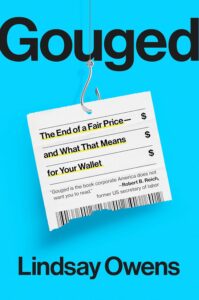
Lindsay Owens, a former congressional staffer and author of Gouged: The End of a Fair Price — and What That Means for Your Wallet, argues that corporate America hasn’t gotten greedier; it’s simply gotten better tools. Lindsay walks us through the alleged RealPage rent-coordination scheme, the Instacart experiment her team ran that found identical groceries priced differently for different shoppers, and the airline AI partner whose own playbook includes an “exploitation phase.” She also explains why McDonald’s McFlurry machines and John Deere tractors share the same repair problem, how insurers use drone footage to drop customers, and how you can turn the experiment back on the companies running it. Whether you’re a renter, a frequent flyer, a budget-conscious parent, or just tired of being nickel-and-dimed, this conversation will change how you look at every price you pay. Listen, learn, and enjoy!
Please Scroll Down for Featured Resources and Transcript!
Please note that some links on this page (books, movies, music, etc.) lead to affiliate programs for which The Jordan Harbinger Show receives compensation. It’s just one of the ways we keep the lights on around here. We appreciate your support!
- Sign up for Six-Minute Networking — our free networking and relationship development mini-course — at jordanharbinger.com/course!
- Subscribe to our once-a-week Wee Bit Wiser newsletter today and start filling your Wednesdays with wisdom!
- Do you even Reddit, bro? Join us at r/JordanHarbinger!
This Episode Is Sponsored By:
- The Perfect Jean: 15% off first order: theperfectjean.nyc, code JORDAN15
- BetterHelp: 10% off first month: betterhelp.com/jordan
- HomeServe: Find the plan that’s right for you: homeserve.com
- Hostinger: 10% off: hostinger.com/jordan, code JORDAN
Thanks, Lindsay Owens!
Click here to let Jordan know about your number one takeaway from this episode!
And if you want us to answer your questions on one of our upcoming weekly Feedback Friday episodes, drop us a line at friday@jordanharbinger.com.
Resources from This Episode:
- Gouged: The End of a Fair Price — and What That Means for Your Wallet by Lindsay Owens | Amazon
- Lindsay Owens, Ph.D., President and CEO | Groundwork Collaborative
- FBI Raids Atlanta Corporate Landlord in Probe of Rental Market Price Fixing | The Atlanta Journal-Constitution
- Justice Department Sues RealPage for Algorithmic Pricing Scheme That Harms Millions of American Renters | U.S. Department of Justice
- AI Is Helping Gas Stations Collude to Raise California Fuel Prices, Lawsuit Says | ABC7 Los Angeles
- Price Tag | Wikipedia
- Electronic Shelf Labels Leave Concerns Around Surveillance Pricing in Grocery Stores | WAMC
- Same Cart, Different Price: Instacart’s Price Experiments Cost Families at Checkout | Groundwork Collaborative
- Instacart’s AI-Enabled Pricing Experiments May Be Inflating Your Grocery Bill, CR and Groundwork Collaborative Investigation Finds | Consumer Reports
- Instacart Buys AI-Powered Pricing and Promotions Platform Eversight | Grocery Dive
- Instacart Ends a Program Where Users Could See Different Prices for the Same Item at the Same Store | KPRC Click2Houston
- Big Data Is Already Jacking Up Your Airline Fares | The Lever
- AI Pricing in Airlines Sparks Backlash Over ‘Exploitation Phase’ Fares | Hospitality.today
- Enshittification: Why Everything Suddenly Got Worse and What to Do About It by Cory Doctorow | Amazon
- Cory Doctorow | Why Everything Got Worse and What to Do About It | The Jordan Harbinger Show
- Thank You for Smoking | Prime Video
- The Price of Loyalty: How Rewards Programs Trap Consumers, and How States Can Take Action to Protect Them | Berkeley Center for Consumer Law & Economic Justice
- The Great Lightbulb Conspiracy | IEEE Spectrum
- Brilliant News: Light Bulb That’s Been Burning Since 1901 Is Still On | NPR
- Airlines to Settle Price-Fixing Charges | Deseret News
- The McDonald’s Ice Cream Machine Saga and Calls for Right to Repair | Hackaday
- John Deere Tractors Stolen by Russia in Ukraine Remotely Disabled | The Drive
- FTC Report Highlights Consumer Harms of Manufacturer Repair Restrictions | MacRumors
- HP Inc Settles Printer Toner Lockout Lawsuit with a Promise to Make Firmware Updates Optional | The Register
- Nathan Proctor, Senior Director, Campaign for the Right to Repair | PIRG
- Massachusetts Passes Right-to-Repair Protections | The Truth About Cars
- Why Are FIFA World Cup 2026 Tickets So Expensive? | Al Jazeera
- Is Dynamic Pricing Coming to Las Vegas Hotel Shops? | InsideHook
- Did Target Really Predict a Teen’s Pregnancy? The Inside Story | KDnuggets
- FTC Surveillance Pricing Study Indicates Wide Range of Personal Data Used to Set Individualized Consumer Prices | Federal Trade Commission
- Walmart’s CEO Rules Out Personalised Pricing, Including by Its AI Assistant | The Next Web
- Insurance Companies Are Using Drones to Survey Homes: Report | NewsNation
- Pre-Existing Conditions | U.S. Department of Health and Human Services
- Here’s What Happened When We Put 7 Uber Drivers in the Same Room | More Perfect Union
- Uber for Nursing: How an AI-Powered Gig Model Is Threatening Health Care | Roosevelt Institute
- Coca Cola Costly Misstep: When Prices Rose with the Heat | Harvard Business MBA Solved Case Study
- Walmart and Target Are Allegedly Forcing Employees to Remove Tags on Apparel to Make It Easier to Jack Up Prices Based on Tariffs | Fortune
- Special Message to the Congress on Protecting the Consumer Interest | The American Presidency Project
- ‘Business Equivalent of Taking Heroin’: Why Costco Refuses to Raise Prices Even If No One Will Notice | Yahoo Finance
- New York Becomes Third State to Pass Surveillance Pricing Ban | EPIC
- Seattle City Council Passes Ban on AI Grocery ‘Surveillance Pricing’ | FOX 13 Seattle
- Your Data, Their Profit: The Consumer Cost of AI Surveillance Pricing | U.S. Senate Committee on the Judiciary
1409: Lindsay Owens | How Your Own Data Is Used to Overcharge You
This transcript is yet untouched by human hands. Please proceed with caution as we sort through what the robots have given us. We appreciate your patience!
Jordan Harbinger: Welcome to the show. I'm Jordan Harbinger. On The Jordan Harbinger Show, we decode the stories, secrets, and skills of the world's most fascinating people.
Our mission is to help you become a better informed, more critical thinker through long-form conversations with a variety of amazing folks, from spies to CEOs, athletes, authors, thinkers, and performers, even the occasional tech luminary, cybercrime investigator, or terrorist kidnapping survivor. And if you're new to the show or you want to tell your friends about the show, I suggest our episode starter packs. These are collections of some of our favorite episodes on topics like persuasion and negotiation, psychology and geopolitics, disinformation, China, North Korea, crime and cults, and more that'll help new listeners get a taste of everything we do here on the show.
Just visit jordanharbinger.com/start or search for us in your Spotify app to get started. Today on the show, personalized pricing sounds like a deal tailored just for you. Sometimes the tailored part is how thoroughly you get screwed.
Today, our guest Lindsay Owens explains how the same groceries can carry different prices for different shoppers, why buying a product may no longer mean you can actually repair it, and how to push back when companies turn your own personal data against your wallet. Here we go with Lindsay Owens. This whole idea is interesting because, you know, we've heard that, you know, if you log on to a website using a VPN, right, VPN companies are like, if you use a VPN when you buy a flight, maybe it'll be cheaper.
And I was like, is that a thing? Is that real? And your book is like, hey, not only is this maybe real, but a bunch of other stuff that you don't even know about is going on where you're kind of getting custom pricing, which sounds really good, but is actually terrible most of the time.
So the book starts in this interesting way. The FBI raids a luxury apartment company in Atlanta because the government thinks landlords used a pricing algorithm essentially to coordinate rent hikes. Now this sounds kind of like a modern crime thriller.
And by the way, I'm shocked the FBI gave two you-know-whats about any of this, but I'm glad they did. It sounds like a modern crime, but except the victims are just ordinary renters. So start with that morning.
Who is Cortland Management? What's the government investigating? What's this crime scheme that allegedly happened?
Lindsay Owens: Yeah, the FBI conducts a dawn raid in Atlanta, Georgia of Cortland Management. Cortland Management is a big apartment developer that's also your landlord. They sort of stick around after they build the complex and go ahead and manage the units in the complex.
And at the end of the Biden administration, the Department of Justice realized that RealPage, this Texas-based real estate tech company, kind of a data company, if you will, might be facilitating something that looked like a price-fixing cartel across landlords. And it's a pretty stunning story because when you think about price-fixing, when you think about cartels, you usually think about like five or six CEOs holed up in a hotel room, hatching a deal, clinking their glasses, smoking some cigars. Everybody locks arms.
You've got to make sure you really got everyone on board. You can't have any defectors, right, because then they'll peel off, offer lower prices, and then you're screwed, right? Price-fixing doesn't really work unless everybody agrees to go in on it together.
But in the real estate market, it's almost impossible to imagine all the landlords. There's so many landlords. There's so many units.
Jordan Harbinger: It would be impossible. And then there's going to be a landlord who's like, dude, I got 12% occupancy. I'm dying.
I'm lowering my prices. I don't care what you guys do. Oh, and I'm calling the media because isn't this illegal?
Like you just couldn't do it.
Lindsay Owens: Totally. And like if you and I were landlords and you called me and said, what if we decided to do some price-fixing? I'd be like, Jordan, like, no, that's not okay.
But if you called me and said, I just downloaded this new app. It's called RealPage. And it's really interesting.
It's giving me a lot of information about our city. It's giving me a lot of information about our buildings. I think you can learn a lot from it.
It just so happens to also spit out prices. Right.
Jordan Harbinger: It suggests rent based on data from other people using RealPage, which sounds innocuous until you realize what's happening is it's saying, hey, if everybody clicks OK on this, you all have the same higher prices and make more money. Not that that's what this is for. We're just a data tool, which I'm sure is their defense in court.
Lindsay Owens: Absolutely. They're just recommenders. They're just sharing.
But yeah, that's exactly right. And it sort of sanitizes the idea of price fixing or collusion, makes it feel like you're just getting up to speed on better information. But it wasn't just the algorithm, although, by the way, the algorithm is just bananas.
There's this 100 page Department of Justice complaint. And, you know, I read through it and it details all of the specs in the algorithm. And, you know, in every turn, the specs are designed to just hose renters.
There's a hard floor that they don't recommend prices below. But then there's a soft ceiling because, look, the sky's the limit. By all means, if you want to go further than we recommend, we wouldn't want to stop you.
Jordan Harbinger: Right. And go ahead, because it doesn't hurt anybody else using our software. If you're more expensive, it only hurts other people using our software.
If you're less expensive.
Lindsay Owens: One of the things that they really guard against is price drops and discounting ever. They really don't want that. And so they really recommend leaving units empty rather than lowering prices, which would create, in their view, a cascade of lower prices.
Jordan Harbinger: That's called the market responding to the demand. That's a supply and demand curve from Econ 101, folks. And God, we don't want that.
Right. I remember learning about price fixing in cartels. And the professor draws the infamous two lines that cross and they go, but when there's a cartel, this thing has this weird little mechanical thing here that pins it.
Right. And it's like, oh, OK. And then you have to cross it there at a price that's less efficient.
And what less efficient in this case means is there's 10 units sitting empty in a neighborhood that a bunch of people would love to move into, but their budget is lower and none of them can move in there. So they all live with their parents or worse, while those units collect dust. And that's an inefficiency so that the landlord can make more money by leaving those units empty, which is this is like what the market is supposed to not let happen.
And that's what usually doesn't happen unless you have software like this that's artificially, well, cheating, really. Yeah.
Lindsay Owens: On the business side, it's a strategy called price over volume, right? Sometimes you would drop prices to be in the volume business to get more entrants into the market, more heads and beds in the real estate sector. But here they're really trying to keep prices high at all costs.
And that is fundamental to what RealPage was alleged to be doing. You know, the other thing I'll say is it wasn't just the technology. They had human muscle arm twisting.
They have these pricing advisors who would call you and make sure you were taking the recommendations, help you get familiar with the app so that you would take the recommendations. They had support groups for landlords where they could share competitively sensitive information and encourage them to, quote, follow the science.
Jordan Harbinger: Yeah. OK, that goes from, hey, look, some people could just ignore these to no, no, they're bugging you to follow them. Right.
And they're explaining to you why it's good for you to do so. There's probably less teeth, but I don't know. It seems like if you're not following the recommendation, the real nail in the coffin would be if you don't follow the recommendations, is there any sort of penalty or anything like that?
Like, is it, oh, we're going to ban you from using our software if you don't actually take our, because then I don't see how they win this case.
Lindsay Owens: Actually, we didn't see any examples of, like, true sanctions in the way that you're describing. But there were some interesting quotes in the complaint about things like, you know, well, if you're not going to take the price, maybe RealPage just isn't for you. Right.
Almost kind of shaming, like, you know, you're not going to show up at the gym. Maybe this program isn't for you.
Jordan Harbinger: Huh. What a weird, empty threat. We're not going to let you pay for our software anymore if you don't do this thing.
Like, yes, you are. And we both know that. And stop calling me.
Why don't we explain this a little bit without legal jargon? Of course, if landlords all use the same pricing software, why isn't that just sophisticated market research? You know, where does it become coordination rather than competition?
Lindsay Owens: Yeah, I think when software is facilitating the sharing of competitively sensitive information and the coordination and alignment of price, then you are entering territory that would be seen as collusion. The statute around price fixing and collusion is sort of technology agnostic, right? If you're coordinating in a back room using an abacus, yeah, that's price fixing.
If you're coordinating on your couch in your jammies with an app that has an algorithm, that can be price fixing, too. And look, a lot of these companies have been hard to ultimately prosecute. I'm not going to sugarcoat it.
They have made the types of arguments that you make. Oh, we're just recommending. We're just facilitating.
Right now, this happened after I finished writing the book. There is a class action suit in California where it is alleged that a tech company called Kalibrate, this is like the real page of the gas station industry, has been helping 1,700 gas retailers coordinate on pricing. And in the class action complaint, it suggests that prices might be as much as 30 cents a gallon higher because of Kalibrate.
Jordan Harbinger: Yep, that totally makes sense. I always wondered how gas stations get pricing, and I figured it's called in from the home office. But gosh, that's a lot of management.
Surely they have software that does this. I wonder if the software is one product for Shell and one product for Rotten Robbie, or is it one product kind of for everybody? And how do they silo that?
And the answer sounds like they don't silo that. They just tell everybody what it should cost. And that's price fixing.
Lindsay Owens: Yeah, it's a whole host of different gas station companies, larger companies that are in this complaint. So, yeah, across the industry.
Jordan Harbinger: Yeah. Wow. So your book's claim is not merely, hey, man, stuff's expensive.
It's that the idea of a public, stable, knowable price is kind of disappearing. So what's replacing that? Just dynamic pricing based on algorithmic factors?
Lindsay Owens: Yeah, the book's central thesis is these price hikes aren't random. They're rigged. And that's because corporate America has reinvented the ripoff.
It's not like that corporate America just got interested in overcharging you. They've always been interested in making a buck, right?
Jordan Harbinger: They didn't get more greedy.
Lindsay Owens: That was already in place. It's the software that's improved, right? Yeah, it's the technologies and the tools at their disposal that have really changed the game.
And I do think that we are pretty close to entering a world in which the price tag is extinct. I don't know, maybe it's an endangered species, but not yet extinct, right? And it is a little hard to wrap your head around.
How did this happen? I just assumed I would have a price tag for my shopping life, right? We've had it for over 100 years.
John Wanamaker put the first price tag in his department store in Philadelphia, Pennsylvania in the late 1800s. He was influenced by Quakers locally who thought that the Puritans were greedy hagglers and that they were discriminating against people, charging some people more than other people. So they said, we're going to stop haggling, we're going to do a fixed price.
And then Wanamaker took it a step further and stuck it on a sticker, right? And put it on items in his department store. And it's been with us for a really long time.
And I think it is increasingly difficult to get what the price tag offered. So the price tag offered a few things. One, transparency.
The number was on a sticker right before your eyes. And now price tags are often missing or changing. It's so much more opaque.
The second thing is it offered stability and predictability. You could pull out the Sunday paper, get the circular, and you knew, OK, a pound of beef is going to be this much this week. Apples are going to be that much this week.
And now prices are changing so frequently because of electronic shelf labels and grocery stores. And then obviously it's very easy to change prices in e-commerce. And so pricing is much more volatile.
And on the one hand, maybe that's fine. On the other hand, volatility does some things that are frustrating. One, it makes prices unpredictable.
And if you're someone who's on a budget, it's helpful to know how much something is going to cost from one week to the next, because you need to know how much you need to be able to bring in to cover it. But it also makes comparison shopping really hard, because how are you supposed to look at item A and store A and then go to item B and store B and then come back if by the time you get back, the price has changed again?
Jordan Harbinger: This is interesting.
Lindsay Owens: Comparison shopping is the whole way that prices are kept competitive in the market. So this is like a big change in our economy more broadly, not just something that is exhausting shoppers.
Jordan Harbinger: Yeah, that's a good point. So plenty of people are going to hear this and they're going to say, look, prices have always moved. You said it yourself.
Airlines change fares. Stores run sales. It sounds like what you're saying is, yeah, but now instead of happening every week or every day, you're getting a price change that might change one second later, depending on how much traffic is on the road or whatever, in the case of surge pricing.
But it's not just the frequency that's materially different. We'll get to that as well. It's how these prices are changed as well.
Right. It's not just, hey, we decided to move the price of eggs in real time with demand as it goes throughout the, I don't know, hourly demand for eggs or petroleum or something like that. There's other factors that they're considering that I think most people would find kind of invasive, I guess.
I don't know. So you and your organization tested whether an online grocery store price is actually the same price for everyone. This is the Instacart experiment here.
So walk me through this. You recruited, I think it was like 400 some people, had them shop the same, I don't know, 20 item baskets at the same stores at the same time. What were you trying to find out here?
Lindsay Owens: Yeah, you have it exactly right. It was a little over 400 people, four different locations. Log on to the Instacart app, fire it up, set a pickup location in Seattle or Washington, D.C. or Ohio, buy the same 23 items in your cart. The family size bag of Ruffles, the Frosted Flakes, the apples, the deli meat. Right. And then once it was in your cart, take a screenshot and send it to my organization so that we can do some math.
That was the study. Right. It was really, really simple.
I think I come from academia. It's important when you design studies to have an elegance, a simplicity, because I think it's easier to explain and also make sure that you know the variation that you're seeing is coming from true underlying changes rather than some sort of machinations on your end of the experiment. So we crunched the numbers and what we found was pretty stunning.
For 75 percent of items in the cart, prices varied from shopper to shopper for the same item. If you and I were shopping in Seattle, Washington, same pickup location, same items, it's 75 percent of the items in the cart. You and I were charged different amounts.
Jordan Harbinger: Right.
Lindsay Owens: It's crazy. The second thing we found is the differences were in some cases quite substantial, as much as 23 percent. So you could be charged 23 percent more for the same dozen eggs, Lucerne eggs than I would be charged.
And then the final thing we found was, you know, across all baskets in the study, the average variation was about 7 percent. And we just ran that through Instacart's own assessment of how much a household of four spends on groceries in a year and said, look, a 7 percent premium is twelve hundred bucks a year, which is a month's rent for some families in some cities. And so I think this idea that maybe, oh, like the prices are fluctuating a little, like you said, maybe that's fine.
But then when you think about it, if you're on the losing end of that fluctuation, you don't you don't go to the grocery store one time. You don't buy one grocery. You buy a whole basket.
You go every week, maybe twice a week for the rest of your freaking life. Yes. So like this can really add up.
Jordan Harbinger: Yes. And you're not only sometimes on the losing end. You're always on the losing end of this.
And if it's significant enough and repetitive enough, it's like gas. Like if I go and I buy a piece of jewelry for my wife and it's a hundred dollars more at this Tiffany and this mall than a hundred dollars less at another location, that's a bummer. I probably should have figured that out and had them match their other location.
But whatever. I mean, poor Jen is not getting jewelry that often. I'll just eat that one.
But if I pay a hundred dollars more every two weeks for groceries or every week for groceries, depending on the size of your family in the area where you live, now we're talking about a lot of money over the course of my lifetime. We're talking about retiring a year later or something at that point. Right.
Due to what I'm paying for food to feed my little rugrats. So this stuff, the frequency and the the type of purchase really matters here. It's a really big deal.
Lindsay Owens: And also there's just this violation of this norm in society, which is that if you and I were standing in line at the grocery store and we had the same basket of goods, it would ring up the same. And if it didn't, we would be pulling out our receipts asking, what is going on here? Right.
Jordan Harbinger: Yeah. If the person behind me has the same stuff in their cart and they pay less or more, we all have questions. But Instacart knows I'm not standing next to, except when you're running the things, I'm not standing next to the other 20 people or 400 people shopping in the same line.
So they go, Jordan's not going to know if we charge him more because he drove here in a car that cost more than that guy's car or whatever the thing was. Maybe they're spying on my emails and they know they saw my tax return. I don't know.
You found a huge variation. But what did Instacart have to say for themselves? I assume you were like, hey, guys, do you want to explain this before I publish it?
What did they say?
Lindsay Owens: Yeah. So we did this study with More Perfect Union and Consumer Reports and Consumer Reports is a journalism outlet as well. And so they did ask Instacart for comment and gave them opportunity to comment.
And also the study really like broke containment and really caused a stir. And so Instacart also responded to like a variety of press outlets in the immediate aftermath. And, you know, initially what they said is, look, this is not surveillance pricing or personalized pricing.
We're not varying the prices based on characteristics of you. This is not dynamic pricing. They said we're not varying the price differences that these guys found.
We're not because of changes in demand. They said these are just our routine run of the mill product pricing tests that we've run and that have been run in the grocery store since the beginning of time. And that's really there.
Nothing to see here. Right. Right.
And then, of course, two weeks later, you know, amidst growing outcry and backlash, the Trump administration engaged their FTC, attorneys general in red and blue states engaged. Instacart ultimately put a blog post up two days before Christmas and said, look, we got this one wrong. Two people buying the same thing at the same time should get the same price.
And we're no longer going to let retailers use Eversight, which Eversight was the A.I. company that built the like giant lab that Instacart was using to run experiments on all of us while we grocery shopped. OK, we're no longer going to let retailers use the Eversight platform to run experiments in this way. So at the end of last year, they agreed to stop the lab, close the lab.
Jordan Harbinger: Huh.
OK, so that's a victory unless they are like, actually, now we're acquiring that company and running them in-house. But don't tell anyone.
Lindsay Owens: No, they did acquire them.
Jordan Harbinger: Are you serious?
Lindsay Owens: They bought them in 2021. Yeah. I mean, this is like why we knew that...
Jordan Harbinger: I was just kidding.
Lindsay Owens: We would find something. I mean, this is big business now, right?
Jordan Harbinger: I was literally just trolling saying, oh, yeah, now that they lost this huge client, they're going to acquire the company and then bring it all in-house. And that's what they did. Allegedly, they acquired them and God knows what's going on with the pricing.
That is so insane. The optics of that are so bad. My goodness.
Lindsay Owens: Pricing is a highly engineered science now, and there are all sorts of startups building new pricing technologies, new A.I. companies. And the goal is to sell your services to the large retailers and then maybe eventually get snapped up by one of the large retailers. And that's what Eversight was able to do with Instacart.
There's an Israeli artificial intelligence company that I talk quite a bit about in the book, Fetcherr, who built a partnership with Delta to help Delta get better at charging us more for every route.
Jordan Harbinger: If everyone's landlord uses the same app to set the rent, the market has spoken, starts to sound a lot like one asshole with a spreadsheet. We'll be right back. This episode is sponsored in part by The Perfect Jean.
You ever put on jeans and you sit in the car and you feel like you're wearing denim butt cuffs and somehow we accept that one day eventually the jeans will break in, but it doesn't have to be that way. The Perfect Jean gives you that classic denim look with soft fabric and four way stretch automatically. What I notice is that I can sit down without immediately adjusting my waistband.
There's room through the thighs. I'm comfy. My butt still looks good.
I mean, that's the most important thing, right? When I get home and don't immediately change into sweats, that tells me something. And our listeners get 15 percent off their first order, plus free shipping at theperfectjean.nyc or just Google The Perfect Jean. Use code Jordan Harbinger 15 for 15 percent off. They have six different fits for different builds, including skinny, athletic, slim, slim thick, thick thick and more with Thanksgiving coming up, looking good in the family photo and having room for pie feels like a reasonable ask. Exchanges and returns are free to try out The Perfect Jean.
Again, our listeners get 15 percent off their first order, plus free shipping at theperfectjean.nyc or Google The Perfect Jean and use code Jordan Harbinger 15 for 15 percent off.
This episode is also sponsored in part by BetterHelp. Someone replies OK to your text and now you're analyzing and overanalyzing the reply. Are they annoyed?
Now you're scrolling through old messages. Meanwhile, they probably just answered while unloading the dishwasher. If I could delete one thing from my brain, that habit of filling in the blanks with the worst possible explanation would be on the list.
And during the holidays, there's a lot of blanks to fill. Family group text, changing plans, somebody who hasn't answered about dinner. It's exhausting when every little thing feels like something you need to figure out.
Therapy can help you examine those assumptions and how they affect you. BetterHelp therapists are licensed, experienced professionals with at least three years and 1000 hours of hands on experience. And if your therapist doesn't feel like the right fit, you can switch at any time.
BetterHelp is now in network with more than 125 health plans, with many co-pays as low as 15 dollars for eligible members. And if you don't have eligible insurance or you live outside the US, you can still get 20 percent off your first month.
Sign up and get 20 percent off at BetterHelp.com/Jordan. That's Better H-E-L-P.com/Jordan.
Please use our codes. That way sponsors know you're actually listening. All of the codes are listed on the deals page at jordanharbinger.com/deals.
It's a double win. You get a great deal and you help keep the show going strong. Thank you for your support.
Now, back to Lindsay Owens. This was talked about on my show. Cory Doctorow talked about this in his enshittification episode.
And unfortunately, the clip that came of that was everyone was like, the Jews are doing it. Right. Because it's an Israeli company.
And it's like, OK. But yeah, to your point, that's social media for you. But to your point.
Yeah. Delta was using this platform to actually what does it do? How does it work?
Lindsay Owens: Well, according to Fetcherr's own white paper, the technology has two phases. The first phase is the exploration phase. You give them access to your company, your consumers, your competitors.
They sort of root around in the back end, figuring out what pricing makes sense for different routes, for different fares, for different seat classes, all of that. So that's the exploration phase. And then according to themselves, their second phase is the exploitation phase, which is really just stunning that that's what they themselves called this in there.
That's literally called the exploitation phase. Yeah.
Jordan Harbinger: Yeah. Oh, my God. That's so bad.
My God.
Lindsay Owens: Now that our AI has figured out everything it can about you and your customers and your competitors, we are going to help you overcharge your customers. Every single one. The goal initially was to figure out how much you could take on each Delta route before a customer would consider looking at Southwest, consider looking at American.
It was a very simple premise. But in Fetcherr's materials online, they had a blog post where they talked about the future of the company being in setting personalized prices. And this came up on a Delta Investor Day call.
And one of the analysts on the call raised his hand and asked a question and said, oh, man, personalize that. I mean, that is the holy grail of supply and demand, figuring out each individual's demand curve. And Delta's president said, basically, it is indeed the holy grail.
Yeah, we like what we see. We like it a lot. When we helped expose this, working with a couple of journalists, there was considerable public backlash.
Again, lawmakers engaged. This time, the CEOs of American and Southwest weighed in and the American CEO in particular said, no, no, no. Cut it out.
This is too far. We don't think this is appropriate. We're not going to do this.
And I think amidst that competitor pressure, Delta ultimately folded, kind of denied that they were ever planning to use it, but promised that they wouldn't use it moving forward. We were never going to do that. This is just a business call.
Jordan Harbinger: We're spitballing. It's locker room talk. Isn't that what you say when you say something that totally screws you?
Yeah. In the media. Totally.
Geez. That's financial locker room talk.
Lindsay Owens: So, man. But by the way, when you're in an earnings call, like you're supposed to tell the truth to your investors. You, by law, you have to tell your investors the truth about things that materially impact the company.
So it is curious.
Jordan Harbinger: So he did tell the truth and then decided that that truth was really inconvenient and changed it. Just kidding, everyone. Not kidding to the point where I was lying on an investor call, but otherwise, just kidding.
So if a company says these experiments help it learn what customers value or that we're trying to keep prices affordable for everyone, which means nothing. Why isn't that sort of a legitimate business practice? And I assume it's because the prices only go up.
They don't necessarily. Well, do prices go down for people who can't afford something? Because this sounds very Thank You for Smoking if you've ever seen that movie.
Right. But what if they argue, and I'm sure they've tried this or will, this algorithm isn't to make guys who are in the top 1% pay more. This is for the 99%.
Look, this person wants to visit their sick grandma in Florida and they were going to get a standard price. But our algorithm decided they needed $100 cheaper because they're stretching their dollars these days. That's what they're going to argue this is for.
They're not going to say, oh yeah, we saw this guy logged in from Los Gatos, California, and his property taxes are 16 grand a year. Add 25% to the cost of his flight to Puerto Vallarta. He's not going to blink.
They're not going to say that. They're going to say it's for the college student who wants to go and visit their sick grandmother.
Lindsay Owens: So we haven't really talked yet about personalized pricing. This is the idea that companies collect data about you, your circumstances, your purchase history, what you click on, what you hover over, what you put in your cart, maybe some information about your location from where you log on, the type of device you're logging on from, all that kind of stuff. And they use it to ascertain your willingness to pay, your personal willingness to pay, and then set a price just for you.
And there are some interesting things about that. But one of them is that there is a belief that willingness to pay will line up nicely with income. So if you're a high income individual, you will be willing to pay more for certain items.
And so you could see a world in which personalized pricing has like a Robin Hood effect. We just like really soak the rich and use it to subsidize the coach seats in the back of the plane.
Jordan Harbinger: Yes. Commies right now listening, and I love all my listeners, but they're stoked about this, right? They're like, Jordan, this dumb ass is going to go buy a flight on his iPhone 18 or Jen's going to get that duo foldy one, right?
They're going to go look at these idiots wasting all this money on technology. Of course, we're going to charge them more for their flights to LA from San Jose. Why wouldn't we?
And we're going to give this other guy a lower price. But I think you're about to tell me it only works in one direction or that it will.
Lindsay Owens: Well, I think it can work to take more money from the wealthy, but I think the goal is to take more money from all of us. And the truth is that willingness to pay doesn't always line up with income. Look, I am a toddler mom.
There are certain times where I am worried about my sick kid and I would be willing to pay anything to break the fever.
Jordan Harbinger: That's a good point.
Lindsay Owens: You used the example of the funeral.
If you've got to get home to a funeral, you aren't very price sensitive because you've got to get home to a funeral. Right.
Jordan Harbinger: Yeah.
Lindsay Owens: So I don't think willingness to pay and income are perfectly correlated. And I actually think, you know, one of the really dangerous sort of outcomes here is this idea that companies can monetize your desperation, your urgency when you need something now. I mean, even in a more innocuous setting, imagine like a teenager gets invited to prom at the last minute, goes onto the Walmart app, fires it up, tells Sparky, the Walmart chatbot, hey, I just got invited to prom.
Show me the like four dresses that I can pick up in store today.
Jordan Harbinger: Right. Yeah.
Lindsay Owens: You know, you can imagine a world in which that information gets filtered through Walmart's formula and they come back and say, oh, she'll pay whatever we give her because she wants to go to prom.
Jordan Harbinger: This was $99 on clearance because it's prom night. Now it's $250 not on clearance because it's prom night. Right.
The story's not quite as neat. That's an interesting point that I hadn't thought of. This all feels different than a sale or a coupon because you're being experimented on.
It's not just like, hey, what if we just give everyone $10 off? Or what if we give people that read this magazine $10 off? That's just somehow different than I want Jordan to pay a different price than Lindsay.
It's an experiment. We're not necessarily telling you what all goes into it. It's all going to be in a big report later and anonymized.
That just feels more icky, way more icky than the coupon thing.
Lindsay Owens: Yeah. No one told us that we were guinea pigs in a lab. I have been a guinea pig in many labs getting through college.
You could participate in experiments for like a free dinner or like a $20 gift card. I also then did it all again in grad school. But I knew what I was doing.
I signed up for it. I got rewarded for it with freebies and dinner and gift cards. And that's not what this is.
Right. This is people exploiting, you know, a desperate set of parents working so hard to save up to give their kids a concert ticket or something. Right.
And then charging them more.
Jordan Harbinger: This is fascinating to me. So your book recommends a simple, really simple experiment, actually. Before buying online, just don't log in, get the price, then log in and get the price and the app, compare like an app on your phone price with the website price.
And maybe if you can, the in-store price. What does that reveal?
Lindsay Owens: Yeah. So if companies are using your data against you, if they're spying on you in order to overcharge you, one of the things you can do is try to like throw them off your scent by changing certain elements of yourself. So you could try incognito mode.
You can try a VPN if you think location is driving a big part of the pricing decisions. You can try changing device type. Sometimes a Mac user versus an Android user will see pretty big differences in pricing.
You can also try logging into a loyalty program or not. Logging in with your frequent flyer number or your grocery loyalty card number or not. One of the interesting things I write about in the book is loyalty programs sometimes result in a loyalty penalty.
Once you've given them all your information, they know your habits. They know your every move. They know you're a sure thing.
You're a totally caffeine addled, sleep deprived toddler mom, and there's no way she's skipping her iced latte tomorrow. So why would we ever give her a discount ever again? Yeah.
We've got her where we want her.
Jordan Harbinger: I definitely, and I can't prove this, but I suspect that I've been a victim of this many, many times, especially with flights. So I'll book a flight or I'll go to book a flight and I'm like, gosh, this is pretty expensive. And then I'll log in a couple of hours later from a different device.
And I'm like, okay, I should finally book this. Let me see if I can just sit down and do this now that I have a minute. I'm like, wait, the price is lower, but it's closer.
And then I'm like, oh, okay, well, good. I'm glad I waited. So I put my phone down because I'm at home anyway.
And I'm like, you know, I was in the kitchen checking the price. So I go to my desktop and I logged back in and I'm like, good, it's $900 instead of 1100. And then I go to the website and it's $1,100 again.
And I'm like, no, did I just miss that? So then I go pick up my phone again and I look and no, no, it's $900 on my phone and it's $1,100 on the website. And I remember being like, I should report this clear error to them using their chat bot after I booked the $900 flight.
So I booked the $900 flight and it's fine. It all works out. And then I'm like, oh, I wonder, I'll just check the price again on the website just to see, because I bet it really was $900, you know, after all.
So I checked the next day. No, it's $1,100. So the website price on my desktop was $200 higher multiple times, multiple different times of day from different devices.
It was just a different price and it was significantly higher.
Lindsay Owens: It's really astounding. And the other recommendation I offer in the book is they determine their prices in part by running experiments on you. So the best way to try to figure out what's going on is to turn the experiment back around on them.
And I do think like calling your buddy and saying, hey, like, what are you seeing for that flight price right now? Or sitting on the couch with your spouse and looking it up on two different devices and seeing who gets the better deal and going with the better deal. I don't think that this is a good thing, right?
Like, I don't want to become The Points Guy for like buying milk on Instacart.
Jordan Harbinger: The friction is ridiculous. I'm really going to go get a Target order from my wife and see if it's $20 cheaper if I throw everything in my basket. No, I'm not doing that.
And they know that.
Lindsay Owens: Yeah, they absolutely know that. And they're relying on your exhaustion and inertia. And at the end of the day, if you do all of this stuff, you will lose a different resource.
You may not lose as much money, but you will lose your time and your time is valuable.
Jordan Harbinger: And your sanity. Checking fricking prices 10 times.
Lindsay Owens: Yeah, and your sanity. For a flight, yeah. A modicum of sanity, yeah.
Jordan Harbinger: Right. It's so irritating that this is even a thing. One example from the book is the Phoebus cartel.
So this is an international lightbulb cartel. I'd not heard of that. It's an early cartoonishly clear example.
So who were these companies? What was this all about? Why was a longer lasting lightbulb some kind of existential threat?
Lindsay Owens: Yeah, this is a just totally crazy story that's in the book. So right now in Livermore, California, there is a lightbulb in a firehouse that has been burning nonstop for over 100 years.
Jordan Harbinger: Get out of here.
Wow. Where do I get one?
Lindsay Owens: Right.
So it turns out that lightbulb technology was incredible really early on. And that was amazing. What an innovation.
Like we got electricity and then now these lightbulbs are just they're burning, they're cranking. This is so great. Well, it was a problem for people who sold lightbulbs, because if you only need one lightbulb in your kitchen and one lightbulb outside and one lightbulb in your bedroom, once you've picked up five, you're done buying lightbulbs for your entire life if they're going to burn for over 100 years.
Jordan Harbinger: I'm here for that.
Lindsay Owens: Yes. So what the major electrical companies did, and these were companies across Europe, Germany, the Netherlands, France, Asia, Japan, the United States, the CEOs of the major electricity companies got together.
They flew to Geneva, Switzerland in December. Snowy Geneva, Switzerland. Sounds very romantic and idyllic.
It would have been nice to be there, I'm sure, in 1924. And they penned a memo outlining their plans to short circuit the lifespan of the lightbulb, to basically throttle lightbulb lifespan and say, OK, we are only going to have burn life half as long as it is right now.
And they also gave themselves a name, the Phoebus Cartel. Phoebus is the god of light. So I guess they thought they were really cute and clever, hatching their little plan to be a cartel.
And they agreed to lock arms and do this all together. They didn't leave anything to chance. They actually had an enforcement mechanism.
They had a lab in Germany where each member of the Phoebus Cartel had to send their lightbulbs. And there are pictures in this archive in Germany that this media scholar found of all of these lightbulbs just like twisted into the base and snaking through all these shelves. And it was basically the lab where they evaluated and tested how long each lightbulb was burning to make sure that nobody was cheating and offering a longer burning lightbulb.
Jordan Harbinger: What a boring job that is. Some dude just sitting in there all day waiting for a lightbulb to burn out, wearing sunglasses and reading, I guess. I don't know.
That is so lame. So this is the real Illuminati. That's a dad joke, everyone.
But this is the real Illuminati, right? They're actually planning to make their product worse. And they succeeded because I've never I remember when LEDs came out, it was like, look how long these things last.
And it turns out actually lightbulbs could do that, too. I mean, I know it's an energy efficiency thing, but lightbulbs could do that, too. They just decided they didn't want to do that.
Lindsay Owens: It's an interesting story because the cartel didn't end because somebody cracked down on it and prosecuted them for price fixing. The cartel ended when the companies, because they were located in different countries, couldn't cooperate anymore together. And that was World War II when cooperation across Europe and across nations was no longer feasible because they were at war with each other.
So that was the end of the Phoebus cartel.
Jordan Harbinger: Yeah, I guess you don't need it when you can't trade with other countries anyways, right? You don't need Japanese lightbulbs to also last half as long if nobody can get Japanese lightbulbs because Japan is on fire. Right.
So there's these three C's, coordination, collusion and cartels. How did computers change that old model from executives meeting in smoke-filled rooms in Geneva to competitors effectively signaling through software? I mean, I assume now they don't need to meet at all and they don't even have to have people do it.
I mean, those websites where you check 20 different airlines flights, right, they could kind of do this on the back end and you would never know.
Lindsay Owens: Yeah. So the first example of algorithmic price fixing that I came across in the research for my book was actually an airline example. And it was the big airline companies sending each other smoke signals, digital smoke signals, through two giant mainframe computers at the Airline Tariff Publishing Company, which is outside Dulles Airport in Virginia.
And they basically sent each other information about their routes and how much they were going to charge. And they would include these little footnotes signifiers that would explain, okay, we're going to do this price for this route. And then after this date, we're going to raise the price, things like that.
So they were sending each other these messages and they were able to coordinate in that way. And they even had systems of retribution. If not everybody lined up according to the first dispatch that went over the transom that said, hey, this is going to be the price.
Then companies would retaliate against each other and they would say, hey, your big route Delta is Atlanta to JFK. I'm going to come in and like undercut you in that route. And then Delta's like, oh, wait, that's not good for me.
All right, fine. I'll go with this stupid price that American wants from Dallas to Seattle.
Jordan Harbinger: Sure.
Lindsay Owens: This was early on. The Department of Justice caught on to this in the 90s and put together a settlement that said, as soon as you disclose a price, you have to charge that price. You can't disclose a price and then wait for everyone to coordinate.
And so the airline companies came up with this crazy workaround, which I call the weekend warrior workaround in the book, where they basically decided, OK, most people at the time were buying their airline tickets through travel agents and travel agents didn't work on the weekend, which must be nice.
Jordan Harbinger: Yeah, sure.
Lindsay Owens: And so what they would do is they would post their price late on a Friday night. It was available. If you were to buy a ticket on a Saturday, you would get that price.
But because almost no one was buying tickets over the weekend, it allowed for them to still coordinate over the weekend. And if their price wasn't matched, they would pull down that price on Monday morning. So it was a sort of way to get around the spirit of the law while complying with the letter of the law.
Jordan Harbinger: Yeah, that's interesting.
Of course, then the trick was to just buy your airline tickets on the weekend and you might actually get a good price, I suppose, or maybe not.
Lindsay Owens: Yeah, if you knew what the airlines were up to, then as a consumer, there was an arbitrage opportunity with weekend airline prices. Absolutely.
Jordan Harbinger: The lightbulb cartel had quality control to make sure the product wasn't too good. Imagine getting written up because your shit actually worked. We'll be right back.
This episode is sponsored in part by HomeServe, your water heater doesn't care that you have to be at work in 20 minutes. Your furnace doesn't care if it's the coldest night of the year. And that pipe, perfectly happy to burst on a Saturday right before you leave for vacation.
Now you're calling around, you're hoping somebody can come out. You're wondering how expensive this ish is about to get. Suddenly, your whole day revolves around something you barely didn't even think about yesterday.
HomeServe offers protection plans starting at $4.99 a month with different options for certain plumbing, electrical, heating, cooling repairs. You choose a plan that fits your needs and budget. Once coverage is in effect, if something covered by your plan breaks down, call their 24-7 hotline to start the repair process.
That's what I think is so great. Having a number to call and a plan in place so I don't need to search emergency plumber again.
Your next costly home repair could be coming. Act now and get protected before a breakdown with a plan through HomeServe. For 50% less your first year, go to HomeServe.com/Jordan to find the plan that's right for you. That's HomeServe.com/Jordan for 50% less. Savings compared to renewal price. Void in California and Florida.
This episode is also sponsored by Hostinger. We hired a professional web design team for our website. They did a great job, but it took months.
Later, we wanted to make it easier to use and the redesign ideas weren't really getting us there, so we had Hostinger's AI builder recreate some pages. Wow, that got us excited about the redesign again. You can see for yourself JordanHarbinger.com/deals and JordanHarbinger.com/newdeals. We're rolling out the changes now, so catch it soon. You might see the before and after. If you've been putting off a website for your business, portfolio, or side project, this makes getting started feel manageable.
You describe what you want. The AI builds a working site in minutes, no coding required. It's actually quite amazing.
And Hostinger has tools for what comes next. AI help with SEO, website copy, email marketing, plus your domain, website, and email in one account. Fewer subscriptions and logins to juggle.
Snag Hostinger services at their lowest prices before the sale ends. Create your website today for just $1.99. Go to Hostinger.com/Jordan10 and use code Jordan10 for an additional 10% off Black Friday and Cyber Monday pricing. If you liked this episode of the show, I invite you to do what other smart and considerate listeners do.
Support the sponsors. They do make the show possible. They're all on the deals page at JordanHarbinger.com/deals. And if you can't remember the code or it's not working, anything along those lines, email us at Jordan@JordanHarbinger.com. We are happy to surface codes for you. It is that important that you support those who support the show.
Now back to Lindsay Owens. The book doesn't only cover dynamic pricing and we'll probably come back to this, but the right to repair is something people have been reading about a lot in the news lately. And this example starts with a question every parent slash late night drive through customer has asked at some point, why is the McFlurry machine always broken?
I'm not exaggerating that, like this is a meme now that they're always broken.
Lindsay Owens: Yeah. McDonald's actually tweeted about it once. This is a great example of corporate humor, which I think is a nice parallel to dad humor.
They said, we have a joke about our McFlurry machine, but we're not sure it will work.
Jordan Harbinger: Oh, nice. Yeah.
That's pretty good actually.
Lindsay Owens: Yeah.
It's not bad, right? I mean, it's like high quality dad joke territory. It's a question that many people have wondered.
McDonald's is a sure thing when it comes to French fries. If you drive into a McDonald's, there's going to be a French fries, but somehow the McFlurry machine is broken an astoundingly large percentage of the time.
Jordan Harbinger: Yes.
Lindsay Owens: There's a website called McBroken that tracks broken McFlurry outages across the country. You can log on. I logged on as I was writing the book and I got a banner ad for Wendy's for the Frosty, which I thought was very clever.
Jordan Harbinger: That's very smart on Wendy's part.
Lindsay Owens: Jonesing for a McFlurry and it's only a hundred miles away?
Wendy's is right around the corner.
Jordan Harbinger: Clever girl, that Wendy.
Lindsay Owens: Well, it turns out that McDonald's for a very long time hasn't really owned the McFlurry machines.
They're effectively leasing them.
Jordan Harbinger: Really?
Lindsay Owens: They buy them and they put them in their restaurants, but they can't fix them.
They can't repair them. And so they have to call the repair outlet, Taylor Commercial Foods, and Taylor comes out and repairs them. And of course that takes a lot of time.
You have to get their service guys out there. The price of it is very expensive. Taylor charges an arm and a leg because they know you, if you're a McDonald's franchise owner, you want to get your McFlurry machine back up and running.
So it really starts a conversation about repair issues, you know, in this country, but I think of it more accurately as a sort of daisy chain of price gouging, because it can overcharge you on the original purchase. And then if you can't fix it yourself without going through them, they can overcharge you for parts, proprietary parts. They can overcharge you for labor.
They have a monopoly over the labor if you can't repair it. And sometimes if you can't repair it at all, you're forced into contemplating buying a second one where they can overcharge you yet again. And so this idea that you don't actually own things you buy, you're just sort of leasing them in part because new technologies and software locks in particular restrain your ability to repair what you own.
I think is a real concern. And I do think it is a form of price gouging. And so I covered it in the book as such.
Jordan Harbinger: Yeah, I know there's a lot of people talking about the right to repair with phones, for example. So you've got your iPhone 16 and you're like, this thing is fine, but the battery dies really quick because it's been cycled a thousand times and I use it all the time. I just want to replace the battery.
And Apple's like, no, no, you're not going to do that. Well, okay. How much is it to replace the battery?
Well, you can't. And if you get it done by a third party, it's going to void the warranty. And I don't know if they do allow it now, but it's like a thousand dollars and you might as well buy a new phone because you can only do it through them.
I don't really know how that works, but there's also game consoles. You can't do anything with those cars, even smart devices generally. And one funny example, like, well, I don't know if that's the right word.
One example that I wasn't expecting was tractors, because I remember when Russia invaded Ukraine, they were stealing a lot of farm equipment. And John Deere was like, not on our watch. So they just bricked all this really expensive farm equipment that was essentially smart and was able to work.
And they're like, oh, you're going to take this combine? Well, okay. Now all of the software is offline and you have a bunch of heavy metal parts you could maybe use to put in other machines if they fit, but not this one.
This thing is donezo, right? It's not going to work. The Russians are pretty smart.
Maybe they found a way around that. But I thought to myself, wait a minute, over the air, John Deere from the US or whatever just said, we're turning off everything that's in this geographical area forever and you can't use it. I didn't know they could do that.
Lindsay Owens: Yeah. John Deere is a topic in the book. And I think a particularly egregious form of repair locks or not giving over full ownership to people who buy their tractors, because obviously your iPhone is important, you make your calls, you play your games, but if you're a farmer, your tractor is a huge piece of your livelihood.
And if it's out of service and you can't fix it yourself and you've got to wait for a special repair person to come out, or you've got to like try to get a combine a hundred miles up the highway in Iowa to get to the nearest dealer, it can cost you a lot of money. And there's one study that I talk about in the books that says repair issues are costing farmers up to $3,000 a year in some cases. So it is really frustrating.
And John Deere has been really brazen. I mean, they've basically said farmers don't own the equipment. They're basically renting it from us.
This is our proprietary software under the hood of a tractor. There have been some improvements in recent years. There've been some like memorandums of understandings that John Deere has signed, making things a little better, particularly for large farm equipment.
But this has been, I think, a particularly sordid part of John Deere's recent consumer history. Their, I think, exploitation of their customers.
Jordan Harbinger: So what should someone do when a company says, look, if you use an independent repair shop to fix the screen or the battery or whatever, your warranty is void. Is that legal? And where should we be cautious doing something like that?
Lindsay Owens: Yeah, that is not legal, but that doesn't mean that companies don't do it all the time. And we have seen other forms of parts pairing where companies will block certain repair parts if they're not authorized. So there have been these examples in the book of the Keurig machine, like not working with non-Keurig pods or general electric refrigerators, not allowing you to change the filter for the water or things like that.
And yes, that's really a problem. And the threat to void your warranty is an illegal threat. It doesn't mean it's an empty threat.
It just means it's an illegal threat. It's just worth consumers knowing that.
Jordan Harbinger: Famously, Hewlett-Packard did this with printers, right? It was, you need to buy our ink. And people were like, nah, it's really expensive.
I get it for half the price from this other company. And then HP would be like, your printer doesn't work anymore. Yeah.
Not it doesn't work with that ink. Your printer doesn't work anymore at all. And I'm thinking, like, how did you not get sued into oblivion for that?
Lindsay Owens: Yeah, it's some sort of dystopian nightmare from a James Bond movie or something where, like, the printer explodes remotely because you installed the wrong ink. It is, I think, dizzying and really unsettling in going through the book to see all of these examples back to back, because I think it really shows that corporate America's approach to pricing and nickel and diming you at every turn, not just on the printer, but also on the ink, but also on the paper, is just so incredibly brazen. And obviously this is possible in part because big companies like Hewlett-Packard have monopolies over large portions of the market.
Right. But it is really frustrating. I think right to repair is one of the most egregious examples in the book.
That being said, there is a really flourishing movement in the US, consumer movement run by the US Public Interest Research Group, PIRG, a guy named Nathan Proctor, who's had some real success in organizing farmers to fight back against John Deere. The state of Massachusetts has passed laws requiring car companies to let third party repair men and women fix your car and to give you access to the same repair information, manuals, things like that, that you would need to fix your stuff. There's still quite a bit of progress, I think, still to be made in this space.
Jordan Harbinger: I want to go back to dynamic pricing because I think it's so interesting. I think since it affects everyone as well, we've heard surge pricing for Uber where there's a lot of cars on the road or there's a lot of drivers being requested. New Year's, they used to send out that email.
They might still, I don't go out anymore because I'm old, but they sent out that email that was like, hey, if you order an Uber at like 11:30 at night on New Year's, it's going to be like a hundred dollars to go anywhere, just so you know. So if you're going somewhere, don't try and get home at 12:15, don't try and leave for somewhere at 11:30, you're going to end up getting a massive, massive surge price. And it's like, okay, well that exists.
I think most of us are familiar with this. Maybe some of us hate it. Maybe some of us don't care.
I'm wondering when we see this for food, because you know, fast food menus, when we were kids used to have the thing you would have to slide in there and it would have maybe the price printed on it and you could flip it over. Now it's just a TV that changes automatically depending on the time. So really, if you wanted to eat breakfast at 6 a.m., maybe McDonald's has it for $6. But if you want to eat breakfast at 8 a.m. and there's usually more people in there, maybe it's $9 at that time. I mean, what's stopping them from doing this? Nothing.
I'm kind of surprised they don't do it already.
Lindsay Owens: The big question is, when is dynamic pricing acceptable and when is it exploitative or extractive? And it's a really hard question to answer. And I don't know that I have the exact right answer, but historically, dynamic pricing has been used to manage supply and demand and to allocate scarce resources.
And so it was a strategy for rationing scarce resources. So you have only 100 seats on a plane. When there are five seats left, the price goes up because you made your decision that you're going to sell the last five seats to the highest bidder.
When you have only one seat left, the price is going to rocket up because that's the absolute last seat on the plane. And you're going to sell that to the person who needs it the most as reflected by how much they're willing to pay for it. We can set aside the fact that there are problems with that method.
We saw that, I think, this summer with FIFA when they said, hey, we're going to do dynamic pricing for the World Cup for the first time in the World Cup's history in any country and auction the tickets to the highest bidder. And that meant prices rocketed. It also meant some of the most passionate, loyal fans were priced out and had to watch it on their couch or at a sports bar.
But this is the kind of thing we see with taxis. Everyone's leaving a concert. There's more people who want rides than there are taxis.
We're going to increase the fare. Hopefully that will induce more drivers to come over to the amphitheater and grab more customers. We're managing this post-concert crush.
So that's kind of what we think of dynamic pricing traditionally as being used for. I think now what we see is dynamic pricing moving into a whole host of venues and arenas that have nothing to do with managing scarce resources. Right.
Wendy's is not running out of French fries. If they are going to use electronic menu boards to charge you more for French fries, that's not about managing scarce resources. That's just about ascertaining when they think they can really go for broke and charge you the most.
Maybe they're going to charge you more for a Frosty on a hot day. It's hard to know exactly how these algorithms are going to be programmed. We don't always get a glimpse under the hood.
But this is, I think, the real concern. Price variation in captivity is another concern. So we know that in the Las Vegas casinos, in their sundry stores, they've started to do dynamic pricing.
Caesars Palace and the Bellagio aren't running out of sunscreen. They're just thinking to themselves, wow, it's a really hot day. It takes like a million years to get out of a casino because it's such a maze.
Then you have to walk across the strip in like 115 degree heat and finally get to the CVS. Obviously, you'll pay five extra dollars for the sunscreen at Caesars Palace or whatever. So I think increasingly companies are using these tools when they know they can get away with it, not just when they're trying to allocate resources efficiently.
Jordan Harbinger: Right. And it's not just the dynamic pricing, I think. I guess I just didn't have the term for it, but the surveillance pricing, right?
The company knowing your weak spots. So imagine walking into a grocery store. You've got a QR code tattooed on your forehead.
Unpack that metaphor from the book. What data can companies use to infer what someone may be willing or able to pay? We talked earlier about the device you use when you're shopping online or the IP address in your zip code, matching your zip code.
There's this famous case that got in the news where I guess some gal had gone shopping at Target and they send a bunch of pregnancy stuff to her house, coupons to her house, and the dad flipped out and it turned out she was pregnant. I don't even know if that's a real story or not, but the idea was they knew more about her than she did or that her dad did.
Lindsay Owens: Yeah, they figured out she was pregnant before she did is the story. Yeah. Unfortunately, these days, the types of data that companies are collecting includes almost everything, right?
It's geographic data. It's potentially data about your race or your household income, which they can use from zip code and other estimations. It's your purchase history.
It's what you browse. It's what you hover over. Look, with agentic commerce, this is shopping that's happening with an AI assist, either using an enterprise agent, going into Walmart and using Sparky, their bot, or firing up Meta's Muse and asking it to do some shopping on your behalf.
Let's add confessions to the list of data that companies can collect about you, things that you tell your agent that you might not tell a storekeeper how desperate you are for your wrinkles to go away. And now and now they know how interested you are in buying the most expensive premium serum or whatever. Oh, my God.
The types of data that companies are collecting about us is really extensive. This is not new at all. This is the dawn of the Internet.
The data that companies have collected for advertising purposes, a company called DoubleClick, the idea was they monitor what you clicked on and then send it back to you, right? Oh, you're interested in this purse. The next day, suddenly there's a banner ad for the purse in the newspaper article you're reading online, the digital article you're reading online.
The difference now is that in addition to serving you up an ad that's tailored to your preferences, they can also serve up a price that is tailored to your preferences. And that is really what surveillance pricing is. It's this intersection of two things Americans hate, being spied on and being ripped off.
Jordan Harbinger: Yes. Wow. The perfect storm.
Tell us the home insurance story. This one is particularly, it feels extra invasive.
Lindsay Owens: Yeah, insurance companies have always used surveillance technologies to personalize pricing. It's the whole science of underwriting, right? It's figuring out exactly how risky you are to insure and therefore how much I need to charge you in premiums, what I need to set your deductible at to make sure that I make a profit off you.
And the credit industry is another one. Your credit score is a form of personalized pricing that determines what you will pay for debt, to take out a mortgage, for example. But I think insurance companies have gone too far.
Frankly, and it's getting more and more invasive. So I talk in the book about a couple of examples. I talk about car insurance companies riding copilot, collecting all your driving data and using that to decide how much they're going to charge you in premiums.
And then I also talk about property insurance companies who are now using satellite imagery to determine how risky your property is to insure. So flying drones overhead or balloons with cameras or just using satellite imagery to see how much brush you have around that could end up in a brush fire. If you've got moss growing on your roof, all sorts of things like that.
And one of the guys that I profiled in the book was dropped from his insurance company with Travelers Insurance. And when he finally got to the bottom of why he was dropped, a drone had flown over his roof and decided that his moss was some sort of insurance risk and they dropped him altogether.
Jordan Harbinger: Wow. So they don't say, hey, we did drone surveillance and we noticed you have a lot of dry brush that could cause a fire. You should take care of that.
They let you keep the hazard and then they just figure out that they're not going to cover you quietly and try not to tell you why. So they're not doing you a service.
Lindsay Owens: Or charge you more.
Jordan Harbinger: Yeah, right. Exactly. They're not doing you a service in any way at all.
They're keeping the information to themselves because I don't love anybody spying on me, but I could sort of get behind it if they're like, hey, Jordan, routine yearly safety assessment for insurance purposes. And by the way, if we find anything, we give you ideas on what to fix and how to fix it in a cost effective way because we don't want your house burning down. You don't want your house burning down.
We're aligned here. The drone will be overhead at 2 p.m. Don't freak out. I'm here for that.
Right. Hey, Jordan, you have moss on your roof. You know, that indicates that there's maybe moisture.
It's heavy. You should have somebody scrape that off and we don't have to raise your premiums or we do have to raise your premiums, but you should have somebody scrape it off anyways. Then I'm not pissed off.
But if you just cancel my policy and I have to find out that it's because you thought my roof was going to cave in, it's like, when were you a-holes going to tell me that? That's over my kid's room.
Lindsay Owens: I mean, we, I think, have gotten accustomed to insurance companies getting a lot of data on us to use in their underwriting decisions. And I think there is a question of when is enough enough. And the example that I talk about in the book, which I think is really illustrative, is the Affordable Care Act.
When Congress passed the Affordable Care Act, they stopped one practice of insurance company underwriting and overcharging, which was charging you more for your family's health history. It used to be that you could refuse to insure someone who had a history of cancer or you could charge them more because you thought they were going to be more expensive to insure because they were more likely to get some type of cancer. And Congress said, no, you can risk rate based on age, you can charge older people more because older people are more expensive to insure, but you can't delve into our personal health history in that way and price discriminate against us based on pre-existing conditions. And I think it's a good example of a decision that we made in society to delineate and put some outer bounds on what insurance companies could charge and what data they could use for their underwriting.
Jordan Harbinger: A baseball team called the Savannah Bananas can give you a straight price and skip the BS fees. Meanwhile, serious adults in suits need three screens to explain why emailing you a ticket costs extra. We'll be right back.
All right, y'all, I'm at Jordan Harbinger on Twitter and Instagram. You can also connect with me on LinkedIn. Now, for the rest of my conversation with Lindsay Owens.
What about this taking effect, I guess, on the other side of things? You mentioned that the system sort of moves from your wallet to your paycheck. I'm paraphrasing.
But seven Uber drivers stood together in L.A., activated their apps at the same time, saw some of the exact same rides, like the same customer's ride, offered at different rates. What's going on there?
Lindsay Owens: Yeah, so this was an interesting experiment that basically determined that the same technology that Uber is using to charge different riders, different fares for the same ride. This is sort of surveillance pricing in the ride sharing sector can be turned around on workers. And of course, in the pricing sector, they want to charge you as much as they possibly can for every ride.
But on the labor side of the ledger, they want to pay you as little as they can for every ride.
Jordan Harbinger: Because that spread is their profit margin.
Lindsay Owens: Yeah, absolutely.
It's the flip side, right? The goal is revenues in both cases. In one case, you boost revenues by hiking prices.
In another case, you boost revenues by skimping on wages. So the experiment revealed that different drivers were being offered different prices for the same ride, for the same trip. And this likely had to do with different features of the driver, that Uber has gotten good at figuring out which drivers really are desperate for a trip and will accept a trip at a lower price.
That was the allegation. And there was another example of nurses using a software program for selecting shifts, travel nurses. And this software basically auctions off shifts.
But instead of a traditional auction where the highest bidder wins, this is a reverse auction where the lowest bidder wins. And whoever was willing to accept the shift for the least amount of pay would get the shift. So it just starts to show how these same technologies can show up in the labor setting and in our workplaces as well.
Jordan Harbinger: Yikes.
That's kind of a race to the bottom because you're going to get people... Look, nurses are already overworked, right? So you're going to get somebody who is desperate and really needs to take a shift because they need the money, but maybe is really tired because they had to work two shifts to get the money that they needed because they're accepting less per shift.
We don't want those people taking care of our kids and elderly parents and us while we're, I don't know, in a medically induced coma in a hospital.
Lindsay Owens: Totally.
Jordan Harbinger: That's really dystopian and scary.
Lindsay Owens: Yeah, it's incredibly concerning.
Jordan Harbinger: Yes, incredibly concerning is a good way to say it because some people might say like, OK, app work, it's voluntary, it's not a career. Workers can decline a given ride. OK, but that doesn't really answer the concern.
And when it's something like a nurse, like a health care worker, I don't care that you can decline to do it. No, I'd rather have people who are in charge of my life be adequately compensated and also awake and aware and willing to be at work at that time, et cetera, et cetera.
Lindsay Owens: Yeah, absolutely.
Jordan Harbinger: So I appreciate that we are not going to pretend every listener can solve this by becoming some kind of privacy monk, right? I'm not going to compare shopping carts. I'm not going to use a VPN for everything.
It's unfair to make individuals responsible for outsmarting the system. So, unfortunately, still, I have to ask, what's the realistic personal security plan maybe that you're following so that you at least have a fighting chance of not paying twice as much for eggs or flights?
Lindsay Owens: Yeah, I make a few suggestions in the book for what you can do to protect yourself in this situation until companies get their act together, until Congress and lawmakers force companies to get their act together and we can restore a fair price in this country. And I do offer policy suggestions as well. But what can you do personally?
Couple of things. One, update how you comparison shop. It is not enough to compare the same item across brands anymore.
You need to compare pricing for the same item within brands, logged in versus logged out in the brick and mortar store versus on the website versus in the app with the loyalty program attached, without the loyalty program attached. I think all of those are ways to sort of retool how you think about doing comparison shopping. It's a little different than maybe what you learned from your parents, but it's a good way to start.
My staff, we are always cranking these little experiments in our office and we find variation all the time. And, you know, once you've figured out some of the variation, you can use it to go for the lower priced options. The second thing I'll say is they figure out how much they can charge us by experimenting on us, turn the experiment back on them.
You've got three friends leaving a concert, all three of you fire up the Uber app, see who gets the better deal. That's a little mini experiment that you can run. You're going to go on a family vacation and have everyone in the family log in and see what their airline price is.
That's a little experiment that you can run. So those are some of the examples I give in the book. Look, from the bottom of my heart, I don't believe it should be every individual's job to duck and dodge and bob and weave and beat the machine.
I think being an exhausted and embattled shopper is just a terrible place to be in this country. Aside from work, consumption is a big part of how we participate in the United States economy, right? And for it to be so embattled, for us to be under siege as shoppers, tricked, trapped, hosed, bilked, whatever you want to call it, nickel and dimed, you know, I think is just not good for society.
And frankly, it's not good for our economy either. Pricing competition and transparency in pricing is really important for keeping markets fair and honest. And so this, I think, is a bigger problem than just our wallets.
It's a problem with the future health of our economy.
Jordan Harbinger: What about those store-specific apps? Like, should I be shopping on Target.com using my Safari browser or do I use Target's app? Or does it depend?
Because sometimes the convenience of the app is it works, it's designed to be used for that, and you got your cart button. Or is that actually also spying on me so the convenience maybe isn't worth the data trade? What do you think?
Lindsay Owens: Yeah, in-store apps can be pretty treacherous because they are really data harvesting operations. Your in-store app has your location because it's using your location to set your pickup location. For example, they record your history, what you purchase every day or every week, and they can use that.
They can turn that around on you to change pricing. One thing I've noticed is using the Target app, the price at my home store location, the location that I set as my home store in the app often is different from the pricing at my pickup location. And then a price adjustment is made.
But that's obviously very confusing to log onto the Target app and think that your basket total is one thing. And then to actually make the purchase, go and pick it up and have the cart total be totally different than what you're expecting. I do think in-app purchasing can be treacherous, but also, look, it's convenient.
It is great to be able to buy your Starbucks coffee, tap it when you're sitting in your garage, and then five minutes later, when you get to the Starbucks, there it is made for you. You pick it up, you get out of there. I understand the convenience, but you may be paying for that convenience in other ways.
Jordan Harbinger: I assume also, I mean, you tell me where it's like, ask app not to track. I assume we always ask app not to track, right? Because then that's asking for all kinds of data from other apps that make it more expensive.
Maybe do we turn off location access for these things, too?
Lindsay Owens: All of that is a great idea.
Jordan Harbinger: OK.
Lindsay Owens: Minimizing your digital breadcrumb trail is a big part of the way that you can obscure a company's ability to weaponize your digital breadcrumb trail. So, yes, turning off location, turning off sharing, tracking, all of that, using incognito mode, using a VPN, all of those things are possible. But look, your cookies are helpful to you, too, right?
It's how a company pre-populates your checkout information so you don't have to like go find your wallet and pull out your credit card and do all of that. So there are tradeoffs here. And it is frustrating that companies are really weaponizing these data collection plays to overcharge us because often the solution for us is to make our lives much more inconvenient.
Jordan Harbinger: Exactly. Yeah. And a VPN, by the way, for people just to have modest expectations here, it's not a magic cloak.
You're logged in, potentially, even though you're using a VPN. So the company might still know who you are. The cookie might still be in your browser if you're not using incognito mode.
There's device fingerprints, things that they can tell from your phone, purchase history. So just because you're in Albuquerque today doesn't mean your flight's going to be cheaper. If you really wanted to take advantage of this, you would be VPNing through Albuquerque, through an incognito window, not logged in, not using the app, maybe not using a device that will share any sort of ID.
I don't even know. You'd have to use Linux or something instead of your Mac or your phone. Out there listening, there's some sort of hacker type or IT security type who's like, yeah, I've got my machine that's a virtual machine that pretends to be in a different place, be a different machine, be different, everything.
That guy's got it figured out. But for the rest of us, you know damn well you're just using your phone to make this purchase. And maybe you just have to pay the higher price.
But you can at least give it a shot by running experiments against these companies and sort of figuring this out, seeing if you can at least get a couple of bucks off by running your own experiments. And if anybody has experiments that work, definitely tell me because I'm buying flights and I go to Target and all this stuff. And if you find a way to make things cheaper besides not living in California, which I am aware of that one already, then let me know and share it on the subreddit for everyone else to check it out as well.
So what's the solution here? I mean, restore the public price that's displayed to the public rather than a teaser followed by a bunch of fees. I mean, is that what we're looking for?
We need laws to do this for us, I would imagine. We can't just politely ask.
Lindsay Owens: Yeah, I talk about two things in the book. One thing I say, which I really believe in, I think I used to not believe in it as much, but now I've seen it with my own eyes, is I think consumer backlash is a really powerful mechanism for letting companies know when they've touched the stove and when they've gone too far. In the book, I tell the story of Coke.
The CEO of Coke in the 90s gave an interview to a Brazilian news outlet where he let slip that Coke was building in its lab the ability to install thermometers in Coke vending machines to charge you more for a Coke on a hot day. And this was the shot heard around the world, even before the age of viral internet sensations. It was on the cover of every major newspaper in the country, coast to coast.
Pepsi said, hey, wait a minute, we would never do this. We're quenching your thirst, not exploiting it. But that consumer outcry convinced Coke to close the lab and they did not install thermometers in vending machines.
After we disclosed that Instacart was running experiments on millions of Americans while they were shopping for groceries, two weeks later, Instacart announced that they were closing the lab and no longer letting retailers use the Eversight AI platform to run these experiments. If you go on TikTok right now, you will see shoppers taking reels in Walmart where in the clothing section there are no price tags at all and they're blowing the whistle. And I do think that form of consumer protest, if you say something, see something, is actually useful to call out because it can make a real difference.
But also, I think the rules of the road should be fair. And we have got to level the playing field between shoppers and retailers in this country in the age of e-commerce and increasingly barreling down on us, the age of agentic commerce. AI is going to upend shopping as we know it.
And we've done it before. In the 60s, JFK put forward a consumer bill of rights and he said, look, all of these new products that are coming out, some of them are not safe. We're going to build a consumer product safety commission where we can recall products so that toasters don't short and blow up your entire kitchen, right, in a kitchen fire.
And when we see a toaster that's doing that, we can issue a recall to make sure that everyone in the country knows to send their toaster back and get a refund because that's going to be a fire hazard. So I think we've updated the sort of rights and guarantees that we have felt like shoppers are owed in a previous era. And I think it's time for a refresh of those rights and guarantees.
So in the book, I lay out what I call a shopper's bill of rights, the things that we should be owed in commerce because it's an important part of this economy. So things like the right to a refund, a timely refund on the same payment method that you purchased it in without having to fight a bot for a month to get your refund. The right to repair that you can crack open the hood of your tractor and fix it yourself.
Right. The right to a fair price that companies cannot spy on you and use your data to overcharge you. So I lay out a host of rights in the book that I really think Congress and state and local lawmakers should take on to ensure that shoppers have more power and more transparency in markets.
Jordan Harbinger: This is more philosophical than maybe you're used to. But what do you think we lose as citizens, not just consumers, when every one of us inhabits sort of this different, invisible marketplace? Anything?
Lindsay Owens: Absolutely. I mean, I think the reason that so many Americans are frustrated by these practices isn't the economics of it, actually. I don't even think it's the policy of it, the technical aspect of it.
It's that it really taps into a foundational core human value, which is fairness. We develop a deep and abiding understanding of fairness when we are teeny tiny. A kid at a birthday party gets a bigger cupcake than us and we're ticked off.
It's in the reptilian brain. And I think price discrimination is unfair. That's what the Quakers said in the 1800s.
It's not OK for the Puritans to be charging people who are wearing nicer tunics more for the same bushel of wheat than people who aren't. And so I do think when we bake inequity and unfairness into something as fundamental to the economy as commerce and consumption, shopping, that's a real problem.
Jordan Harbinger: The book can leave, and this episode for that matter, can leave people feeling, well, first of all, watched and surveilled, but also a little outmatched. So what do you think is the most hopeful proof that you have that ordinary people can still force a giant company to change? I mean, you gave some examples with Coke, Instacart, anything else come to mind?
Because I'm starting to be like, you know what, screw it. I guess I'm just paying more for things. Right.
And if it's really expensive, I'll run some experiments. But gosh, that sounds like such a pain. Am I going to remember to do that?
I don't think I'm alone in thinking that.
Lindsay Owens: Yeah, the consumer backlash stories that I mentioned are good examples of hope, but there are a couple of others. The first is there are some good guys out there. There are some good companies.
My favorite example in the book is the Savannah Bananas.
Jordan Harbinger: Yeah, my friend owns that.
Lindsay Owens: Oh, cool. You should tell the story. How do they do pricing?
Jordan Harbinger: I don't know. That's a good question. You wrote about it, so I'm going to defer to you.
I actually don't know how Jesse does pricing. Yeah, no clue.
Lindsay Owens: The Savannah Bananas have a focus on the experience of fans. They want fans to have a positive experience. They do not auction off their tickets.
When there are two seats left to a Savannah Bananas baseball game, they do not go to the highest bidder. They have a lottery system and everyone has a fair shot at getting a seat at a Savannah Bananas game for a fair price. They have all-in and upfront pricing.
They're not using hidden fees on the back end, service fees, delivery fees to send you an email with a QR code. I mean, it is crazy that people are still calling that a delivery fee. Right.
They don't hide their fees. They even have concessions included in their home stadium in Savannah, from what I understand. I haven't visited it myself, but I think there are companies that are bucking the trend.
By the way, very profitable franchise. I think more profitable than some MLB teams, from what I understand. That's funny.
But it's a pretty interesting example. I think there are some other places in the economy where you see different approaches as well. Costco, I mean, not perfect, but Costco uses cost plus pricing.
How much does it cost to buy the item, to get it on the shelf? And then they have a fixed margin that they put on top of it, which gives you some real transparency. Now, if you shop at Costco on Instacart, you're going to pay more because Instacart has their pricing shenanigans.
But Costco, I think, offers an interesting model as well. It's comparison shopping is hard at Costco because pack sizes can really vary compared to what you might find in a standard grocery store.
Jordan Harbinger: But it's hard to it's hard to compare the Target six pack with these 78 pack that you get at Costco that needs a dolly to be moved out to the parking lot. Yeah.
Lindsay Owens: Yeah. One of the things that I talk about in Shopper's Bill of Rights is unit pricing. Unit pricing is really helpful for customers to know what is the price for one can.
That helps me compare the six pack to the 72 pack. Right. And putting unit price labels and clearly disclosing them, some states require it, but it's not a federal right.
And I think that would be really helpful for shoppers as well. So, yes, there are some good guys, but also there is some movement in the policy space. So this year alone, we've seen dozens of new pieces of legislation taking aim at corporate price gouging through things like algorithmic pricing experiments, surveillance pricing, dynamic pricing, using electronic shelf labels in the grocery store.
Maryland, Connecticut and New Jersey have passed laws. They're limited, but that's something New York state passed a law through its legislature. They're waiting for the governor to sign it.
I do not know what she is waiting for. Sign that bill. Yeah, but she's been taking her sweet time. Passed months ago.
Seattle City Council recently passed the first city legislation forbidding large grocers to run pricing experiments like we found in Instacart. So there's some movement, I think, at the local level. There's some interest in this in Congress on both sides of the aisle.
I testified at a hearing for Josh Hawley, who held the first ever congressional hearing on this issue and is working with Democrats on the problem. So I'm not here to sell false hope. I was a staffer in Congress for many years.
I know how long those guys take to get anything done. I know it's a tough thing to ask someone to pin their hopes on Congress, but I do think we're seeing movement in the states and cities at a faster clip. And that's, I think, promising.
Jordan Harbinger: Lindsay Owens, I know you've got to go to the airport with your dynamically priced flights. So thank you very much for coming on the show. I appreciate you.
Yeah. Coming in from your dynamically priced hotel room as well, I think it worked out for the best. And I really enjoyed this as much as you can enjoy knowing that you're getting raked over the coals by every company that you buy from.
But knowledge is power, I suppose. So here we are.
Lindsay Owens: It's validating. Feels like something's not quite right with what's going on in pricing. And you were right.
You were absolutely right, if that's what you thought.
Jordan Harbinger: Right. It's not just your imagination, people. You are being ripped off.
But all is not lost. Lindsay Owens, thank you very much.
Lindsay Owens: Thanks so much for having me, Jordan.
Jordan Harbinger: A stolen Van Gogh may be worth millions, but the moment it leaves the museum, it becomes nearly impossible to sell. Arthur Brand, the real life Indiana Jones of the art world, reveals how masterpieces circulate among mob bosses, forgers and thieves, and how befriending his own art thief nemesis helped bring one home.
Arthur Brand: Sometimes I think I'm the only civilian who's really trying to go out there and try to recover stolen art. The regular art market is like 70, 80 billion, and part of that is illegally, you know, art theft from museums, from private individuals, forgeries, illicit antiquities. In many countries, people dig in the ground, you know, or with a metal detector.
It's quite a big thing. And it is not surprising because there are a lot of art collectors in the world. Almost everybody has a painting or a little statue at his home.
So it's a big market. And when there is a big market and a lot of money and it's not a real science, so it's not that difficult to fake something, you attract a certain kind of people. And that's who we are fighting.
That shows you who the players are in this field. It's scary. They want you and me to believe it's about beauty, but it's not.
It's only about greed. The bottom line in the art world is money. But generally said, 30% of all the artworks in the world are fake.
So when we have a lead, the police or myself, it's very hard to prove that they have it in their possession. You can raid their homes. It's never there.
They don't leave this stolen figure under their bed. So the problem is, if you raid their homes, you will not find it and they will burn it. There have been many examples of pieces that have never come back.
It has always been there. I always say on Monday, art was invented. On Tuesday, the first art was stolen.
On the third day, the first art was faked.
Jordan Harbinger: Hear how one of the world's most wanted works of art ended up at his door in an IKEA bag smeared with blood on episode 1354 of The Jordan Harbinger Show with art detective Arthur Brand. My big takeaway from Lindsay, a fair price has to be a price you can actually see, compare and question. If every shopper gets a private number behind a curtain, shop around, stops being useful advice and starts being a second job.
We shouldn't need a cybersecurity background to buy eggs. All things Lindsay Owens will be in the show notes on the website, advertisers, deals, discounts, ways to support the show, all at jordanharbinger.com/deals. Please consider supporting those who support the show.
Don't forget about Six-Minute Networking as well. Still free over at sixminutenetworking.com. And this show was created in association with PodcastOne.
My team is Jen Harbinger, Jase Sanderson, Robert Fogarty, Tadas Sidlauskas, Ian Baird and Gabriel Mizrahi. Remember, we rise by lifting others. The fee for the show is you share it with friends when you find something useful or interesting.
In fact, the greatest compliment you can give us is to share the show with those you care about. If you know somebody who's interested in data, privacy, e-commerce or the economy, definitely share this episode with them. I think they'll find it interesting.
In the meantime, I hope you apply what you hear on the show so you can live what you learn. And we'll see you next time.
Sign up to receive email updates
Enter your name and email address below and I'll send you periodic updates about the podcast.


 Tiktok
 Spotify
 Apple Podcasts
 Overcast