




Dr. Leslie John explains why oversharing is underrated, how opening up builds trust faster than waiting for it, and where candor tips into TMI.
What We Discuss with Dr. Leslie John:
- Why waiting to feel trusted before opening up gets things backward — a slightly edgy reveal is a social risk that signals trust, and trust begets trust (a lever CIA recruiters and con artists both know how to pull).
- How two people in love lost 20 years to the fear of saying the wrong thing, and why we tally the risks of revealing but rarely the cost of silence (the first “I love you” is returned about 80% of the time).
- What Miss USA’s ravenous pageant answer, an onstage bladder mishap, and a sassy Harvard job interview reveal about the sweet spot between TMI and its overlooked twin, TLI (too little information), and the respect hiding behind the cringe.
- How to tell genuine, gradually escalating intimacy from love bombing and catfishing, why you need a full competence bank account before making vulnerability withdrawals at work, and why transparency is the safer bet.
- How to build the revealing muscle with sincere, specific compliments (and less gossip), and why the cure for a disclosure hangover is usually to lean back in and check with the person — not retreat into a catastrophic replay.
- And much more…
Like this show? Please leave us a review here — even one sentence helps! Consider including your Twitter handle so we can thank you personally!
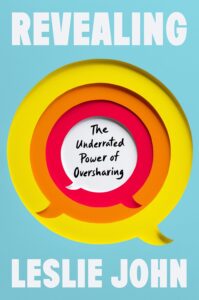 Why do we replay the one awkward thing we said for weeks, but never lose sleep over the dozens of things we left unsaid? We treat TMI as the greatest social sin, so we stay guarded and wait until we feel safe before we open up. The irony is that trust rarely arrives on its own schedule — it usually shows up only after someone takes the first small risk.
Dr. Leslie John is the James E. Burke Professor of Business Administration at Harvard Business School and the author of Revealing: The Underrated Power of Oversharing. Leslie explains why a slightly edgy disclosure makes others trust us more, how two people in love lost 20 years to the fear of saying the wrong thing, and why we weigh the risks of revealing while ignoring the quiet cost of silence. She also covers how to tell real intimacy from love bombing and catfishing, why a sincere compliment is the easiest place to start, and how to recover from a disclosure hangover — whether you’re starting a new job, going on a first date, or in a relationship that could use a little more candor. Listen, learn, and enjoy!
Please Scroll Down for Featured Resources and Transcript!
Please note that some links on this page (books, movies, music, etc.) lead to affiliate programs for which The Jordan Harbinger Show receives compensation. It’s just one of the ways we keep the lights on around here. We appreciate your support!
- Sign up for Six-Minute Networking — our free networking and relationship development mini-course — at jordanharbinger.com/course!
- Subscribe to our once-a-week Wee Bit Wiser newsletter today and start filling your Wednesdays with wisdom!
- Do you even Reddit, bro? Join us at r/JordanHarbinger!
This Episode Is Sponsored By:
- The Cybersecurity Tapes: Listen here: thecybersecuritytapes.com
- AT&T: Get an iPhone 17 Pro for $0: att.com/iphone or visit an AT&T store for details
- BetterHelp: 10% off first month: betterhelp.com/jordan
- Hims Weightloss: Get a personalized, affordable plan that gets you: hims.com/harbinger
Thanks, Dr. Leslie John!
Click here to let Jordan know about your number one takeaway from this episode!
And if you want us to answer your questions on one of our upcoming weekly Feedback Friday episodes, drop us a line at friday@jordanharbinger.com.
Resources from This Episode:
- Revealing: The Underrated Power of Oversharing by Leslie John | Amazon
- Leslie John | Official Website
- Leslie John | Harvard Business School
- The Surprising Benefits of Oversharing | Harvard Business School Working Knowledge
- Disclosing Information about the Self Is Intrinsically Rewarding | PNAS
- Johnathan Walton | How to Spot Scammers, Grifters, and Thieves | The Jordan Harbinger Show
- An Alternative Framework for Agent Recruitment: From MICE to RASCLS | Studies in Intelligence
- Andrew Bustamante | The Psychology of Espionage Part One | The Jordan Harbinger Show
- Andrew Bustamante | The Psychology of Espionage Part Two | The Jordan Harbinger Show
- Alexander Lukashenko | Britannica
- State Security Committee of the Republic of Belarus | Wikipedia
- Dangerous Liaisons: Honey Trap Spies | Spyscape
- Sean Wiswesser | Inside Putin’s Russian Intelligence Machine | The Jordan Harbinger Show
- What to Know About Romance Scams | Federal Trade Commission
- Javier Leiva | Modern Romance Scam Tactics and Ways to Fight Back | The Jordan Harbinger Show
- Ask Molly: Age Limit for Employment | CIA
- How Deep Is CIA Cover? | Slate
- Jonna Mendez | The Moscow Rules | The Jordan Harbinger Show
- Jonna Mendez | A Woman’s Life in the CIA | The Jordan Harbinger Show
- Missed Connection | Wikipedia
- Let’s Get Serious: Communicating Commitment in Romantic Relationships | Journal of Personality and Social Psychology
- What Is Galvanic Skin Response? | Noldus
- Research: Why Leaders Should Be Open About Their Flaws | Harvard Business Review
- The “Beautiful Mess” Effect | BPS Research Digest
- Asking Questions Increases Likability | Association for Psychological Science
- Melissa Dahl | The Not-So-Cringeworthy Truth about Awkwardness | The Jordan Harbinger Show
- Vulnerability Hangover: Why You Shut Down After Opening Up | Rula
- Make ‘Em Laugh with ‘Yes, And’: Improv’s Most Important Rule | Backstage
- This Is the Vulnerable Truth about Vulnerability | Deep Dive | The Jordan Harbinger Show
- Conversation Cards | Amazon
- Great Questions List | StoryCorps
- Hungry Hawaiian Named Miss Universe | The Spokesman-Review
- Why Patients Lie to Their Doctors | University of Utah Health
- Are STIs and STDs the Same Thing? | Cleveland Clinic
- May Physician’s Offices Use Patient Sign-in Sheets or Call Out the Names of Their Patients in Their Waiting Rooms? | U.S. Department of Health and Human Services
- Humblebragging: A Distinct, and Ineffective, Self-Presentation Strategy | Journal of Personality and Social Psychology
- Country Comparison Bar Charts | Geert Hofstede
- Hiding Personal Information Reveals the Worst | PNAS
- Costly Signaling Theory in Evolutionary Psychology | Wikipedia
- The Effect of a Pratfall on Increasing Interpersonal Attractiveness | Psychonomic Science
- The Big Lies People Tell in Online Dating | Gizmodo
- Tinder Rolls Out New Safety Features, Including an Incognito Mode | TechCrunch
- Dr. Max Butterfield | Challenging Viral Dating Myths with Science | The Jordan Harbinger Show
- What Is Love Bombing? | Cleveland Clinic
- Romance Scammers’ Favorite Lies Exposed | Federal Trade Commission
- When to Open Up at Work — and When Not To | Harvard Business Review
- Why a Simple Act of Kindness Is Not as Simple as It Seems: Underestimating the Positive Impact of Our Compliments on Others | Personality and Social Psychology Bulletin
- Mom Was Right — If You Don’t Have Anything Nice to Say About Someone, Don’t Say Anything at All: The Boomerang Effect of Gossip Is Discovered | ScienceDaily
- Prolific Gossipers Are Disliked and Seen as Weak | BPS Research Digest
- Stanford Study Outlines Dangers of Asking AI Chatbots for Personal Advice | TechCrunch
- Kashmir Hill | Is AI Manipulating Your Mental Health? | The Jordan Harbinger Show
- What Is Alzheimer’s Disease? | Alzheimer’s Association
- Dr. Dale Bredesen | How to Make Alzheimer’s Just a Bad Memory | The Jordan Harbinger Show
- Dr. William Li | Working with Your Body to Beat Disease Naturally | The Jordan Harbinger Show
1400: Leslie John | The Underrated Power of Oversharing
This transcript is yet untouched by human hands. Please proceed with caution as we sort through what the robots have given us. We appreciate your patience!
Jordan Harbinger: Welcome to the show. I'm Jordan Harbinger. On The Jordan Harbinger Show, we decode the stories, secrets, and skills of the world's most fascinating people.
Our mission is to help you become a better informed, more critical thinker through long-form conversations with a variety of amazing folks, from spies to CEOs, athletes, authors, thinkers, and performers, even the occasional extreme athlete, real-life pirate, or hostage negotiator. If you're new to the show or you want to tell your friends about the show, I suggest our episode starter packs. These are collections of some of our favorite episodes on topics like persuasion and negotiation, psychology and geopolitics, disinformation, China, North Korea, crime and cults, and more.
That'll help new listeners get a taste of everything we do here on the show. Just visit jordanharbinger.com slash start, or search for us in your Spotify app to get started. Today on the show, you ever tell someone something personal and then spend the whole drive home wishing you could fake your own death?
Meanwhile, they're thinking, finally, an actual human I can relate to. Today, Dr. Leslie John joins us to explore why opening up can build the trust we keep waiting to feel, how staying guarded quietly costs us relationships, and where honest connection crosses into oversharing or manipulation. Because there's a sweet spot between being an emotional witness protection program and making everyone at brunch wish you'd signed an NDA.
Here we go with Dr. Leslie John. So I was trying to figure out, I was like, okay, I got Dr. Leslie John coming on. We're going to talk about oversharing.
What can I overshare right in the beginning? But then that kind of defeats the purpose, right? I don't know.
If you're just using it as a tool, does that defeat the purpose of doing it? And we'll get more into the tactics later. But I'm curious about that up front because I was like, oh, God, do I have to involve like genitalia?
And by the way, that's not on a left field. We were talking about that pre-show just so people don't think I'm a pervert. You started it.
Leslie John: Sure. Blame me.
Jordan Harbinger: I will. It's my show. I can get away with it.
Leslie John: Well, now that you've primed the pump, I want, show me what you got.
Jordan Harbinger: Well, we are on video, so I'm going to take that as a figurative. Yeah. I was just thinking like, oh gosh, I don't know.
It's always difficult, right? Because I do overshare a little bit on this show, but I don't get ridiculous with it because like you have to have decorum with it. And this is to your points in the book.
You can't just roll in and be like, what's up everybody? I've got a yeast infection or whatever, right? You have to calibrate the whole thing to the audience and like something that's an overshare for somebody that's working in the accounting department that you talk to once a week.
It's not an overshare when you're telling your best friend who's like, you didn't tell me this last week when it happened. For sure. So for sure.
It's a really more delicate dance than most of us have ever consciously thought about, which is why the book is actually interesting. Because I think I had a friend of mine recently, I texted her something, I've known her since high school and she said, oh, I love this. You probably don't know this, or maybe you do, but slightly inappropriate overshares are my love language, is what she said.
Leslie John: Oh, I love her.
Jordan Harbinger: I was like, oh, that's so great. And what a fun way to put that too, because for many of us, it's probably our quote unquote love language, if we can say that. Because what it kind of says when you overshare, and I want you to piggyback off this, is we're tight enough where I'm trusting you with this.
And also I value your opinion on this or I, it immediately gets rid of all the like, hey, are we like friends? What can we talk about? What level are we at?
You're like, you just clear the desk with your hand and you're like, no.
Leslie John: I'm obviously needing that. A small talk.
Jordan Harbinger: My kid barked on me this morning and you're like, okay, I will raise you, I'll meet you there. Right. So piggyback off this a little bit.
Leslie John: Totally. I mean, that's exactly the core thing, which is that oftentimes we kind of wait until we feel comfortable and feel like we can trust someone and then open up. But if we do it in the reverse, where we open up a little bit, a little bit more than we think we should, not STDs and rashes, but yeah, maybe my pet puked on me this morning or my baby, whatever.
That is what causes others to trust us back. That is what generates trust and rapport. And it's precisely because it's edgy, it's because it's a bit of a social risk that makes others want to trust us.
It's because when we share something a bit edgy, yes, we're communicating something, but the act of doing that is also communicating something. The reason that I'm comfortable sharing this edgy thing is because I trust you, right? I wouldn't do this if I didn't trust you.
And when we're on the receiving end of that, that feels really good. And then we trust them back. So I agree with you.
Trust begets trust, revealing that's like one of the core ways we can make others trust us.
Jordan Harbinger: I think it's important to know, I feel like I'm ruining this too early, but I'm going to go for it anyway. I've done many shows with people who deal with con artists and things like that. And a skilled con artist, one of their tactics is they will come to you and be like, here's this huge problem I'm having in my life.
And they're not like, you can help me by wiring me money. They're like, here's this huge problem. I've been done really dirty by, I don't know, some sort of institution or people or people that were supposed to be trustworthy or something like that.
And they just kind of let it marinate for a really long time. And gradually they build themselves up in your mind as this really amazing person who could not possibly be in the wrong. Then it comes down to like, can you lend me money for this particular thing?
And I'll pay you back on this whole thing. And you're like, of course. Right.
So you give them like your 10 grand or whatever. And you're like, I know I've only known her for four months, but surely she's not this much of a psychopath to have made up this huge tragedy. Right.
This is like the story of so many con artists because it works so well.
Leslie John: Totally. You know, you can weaponize this stuff for sure. And I actually have recently been chatting a bunch with a former head honcho guy, technical term, at the CIA.
And we were talking about revealing and how opening up increases trust. And he was saying when they were recruiting assets in the CIA, they're first doing their own intel. They know a lot about that person.
And then when they're conversing with the person to suss out whether they might be able to bring them in as an asset, they start the conversation by having something adjacent to what that asset would be interested in. So like if you know that asset has a child that is struggling in school or something, you could say like, oh, a niece of mine just started school, something like this. And you see how they respond.
And that gradually builds rapport between you two. And then you can kind of figure out if there's someone who will respond to your social cues and build trust and potentially be trustworthy. I mean, there's just so many.
That sounded more positive than like your example was real manipulation. This spycraft stuff is so fascinating because it can be used in a very evil, manipulative way, but it can also be used in a way to try to kind of read people to your own advantage, which I think is pretty smart.
Jordan Harbinger: Yeah, it's interesting. I've come across some pretty clumsy espionage attempts, especially from the Eastern Bloc. And it's really super clunky, which is funny because you would think the stuff from your book, the vulnerability, the sharing, the rapport, it's not super difficult to do once you give it to somebody who has like a normal social background, I think.
And yet so many people, and I'm going to say this and you can correct me if I'm wrong, especially men, I feel like have a lot of trouble with this because guys are like, oh, I don't want to seem too vulnerable. That's not masculine. I want this guy to respect me.
And it's kind of like, well, this guy is faking being a super tough guy because he had an abusive childhood. And I think if you went to that angle, you're probably going to end up doing better without trying to whip your you-know-what out onto the table and measure it with this guy who's just going to react poorly because of the way he puts this mask on. So I've come across these really clunky attempts where they kind of try to relate to the mask the person has as opposed to the person that's underneath, which I find, again, totally just like amateur level, yellow belt kind of thing.
Leslie John: Do you have an example of the clunky? I have an idea of what you're saying, but examples are really helpful.
Jordan Harbinger: There was one where my friend was going to write a profile on the leader of Belarus, Lukashenko, who's been the president for like 25 or 30 years, whatever. He's going there and he worked for Rolling Stone or still does. He's going to go write a profile of the guy and he's dealing with the logistics and he gets this email that's like, hi, we know you're coming to Belarus and we want to show you a good time while you're here before and after your interview.
What kind of women do you normally like? Because you never know, you might find love of the forever kind while you're over here. And he's like, dude, look at this.
I'm thinking this is the dumbest, klutziest attempt at what's obviously going to end up as a compromise on you. They're asking you what kind of women you like when they could literally Google photos of you with previous girlfriends and find this out immediately to he has a current girlfriend, which either they just didn't care about or assumed he wouldn't care about, or they could have also looked at photos of online and been like, OK, we can find her and like turn the volume up to 11 on each of these things.
And so that telegraphed their intention. The email sort of communicated, hey, we kind of figure that you're a cheating bastard and or a total loser who can't get women. So we're going to provide them for you.
Oh, and it's totally for no reason other than we want you to have a good time and find forever love here. It just read like a mail order bride website where the copy was written by people who they're just totally unaware of their target market.
Leslie John: That's so interesting.
So I totally see what you're saying. I had a different reaction to that. My reaction was even clumsy works pretty well because what they're doing is also men are often simple.
Jordan Harbinger: Yes.
Leslie John: But it's kind of flattering to have someone who's cares enough to think about what you might want. Right. Even if it's done in a very clumsy way, it's kind of like how when people give us gifts, even if it's something that we don't really want, we feel really good.
So not that I'm condoning that type of question or behavior per se, but I actually think that even if you do it clumsily, it still can be very effective.
Jordan Harbinger: I suppose it must work.
Leslie John: Yeah.
But it would have worked even better probably if they were a little more subtle about it, you would think.
Jordan Harbinger: I'm not a KGB agent. Those guys were obvious. The people who wrote that were actual KGB.
And yes, the KGB still exists, but only in Belarus. The way I would have done it. And again, I didn't I had to think about this for five seconds to come up with what I think is a better plan.
Leslie John: A better way.
Jordan Harbinger: Which is look at previous women that he's been with, find them and train them on his personality, which is everywhere. He's written a bunch of books and articles. Have them read all of those.
Create a dossier on people, which is what they do best over at the KGB. And then maybe one of them is like the interpreter for what he's doing while he's there and the other person is at the check-in desk or there's a tour guide at a museum that is a different option or like one of them is the friend of the person who's driving. I'm like, you can really make this less than completely obvious and state-sponsored because it also sort of assumes like, oh, this person's never heard of a honey trap before.
So let's just make sure that we are as clumsy with this as possible.
Leslie John: It is amazing, though, still like those honey traps. They're so when I was in my 30s and found myself online dating, like I almost fell for one of these things. And it's like I studied this stuff.
I dare say it's like primal, instinctual, like when someone reveals to us, expresses interest in us, it just feels so good. And it's hard to kind of, in a way, our logical brains turn off. But I also like your, that was a good audition tape for a spy craft job.
Jordan Harbinger: I'm too old. I've already been told I'm too old. It's funny because I get emails all the time.
They need old spies, too. No, they want you in in your mid-30s at the very latest because they want you to get a full career. Think about it.
They train me now. It's going to take till I'm 50 and then I'm going to be out in what, like a decade or something. So, yeah.
Leslie John: In a decade. I love it. Your view on time horizon.
Jordan Harbinger: Yeah.
Leslie John: Once you're 60, you're like, done.
Jordan Harbinger: Well, I think they retire you at that point or you end up with some like weird paper pusher job somewhere where you can't use the skills they spent so many years training you to actually do. Plus, I'm pretty sure there's an element of, hey, do you want to go to an active war zone? And you're like, no, thanks.
I'm 50. Whereas when you're 31 or 28, you're like, where do I sign? I would love to.
How long can I stay? So, yeah, they're not interested in me at all.
Leslie John: In your appeal.
Jordan Harbinger: But I get emails all the time and I used to get recruitment stuff like all the time.
Leslie John: Really? Like credible ones?
Jordan Harbinger: Yeah. Like real ones.
Leslie John: From what countries?
Jordan Harbinger: From the U.S.? From the U.S. Yeah, yeah. Being like, hey, here's some materials or from people that were, let's say, early guests on the show that were like, hey, you might consider doing a little bit of this too, because, you know, the stuff you teach on your show or that you talk about on your show, you'd be shooing for this particular type of program that may or may not exist here. I mean, that's not an email.
That's like somebody telling me, like, you should apply. You know, I had that all through college as well, just because of the foreign language experience.
Leslie John: I'm so fascinated with spycraft recently. I'm such a weird old person that I call it spycraft, but whatever.
Jordan Harbinger: No, that's what it's called. Tradecraft or spycraft. Yeah.
Leslie John: But when you, I didn't realize this, when you go to an embassy in a different country, 80 percent of the people there are spies. The person stamping your visa there are spies. It's like widely known, apparently among spycraft circles, that in embassies, everybody's kind of got a cover job.
Isn't that bananas? And then I'm like, there's spy assets everywhere.
Jordan Harbinger: Consular people, I don't know. I'd have to think about that because usually they're not dealing with the public. Usually the cover story people are like, oh, yeah, I'm the agriculture attache.
And it's like.
Leslie John: Agriculture is a big one. Yeah. That's like a very spy-y.
Jordan Harbinger: Yes. It's got to be somebody who can be kind of gone a lot. And they're like, he's the agriculture guy.
I don't know. He's probably on a farm somewhere in the middle of the jungle.
Leslie John: And it's disarming. Yeah. Like an agriculture guy.
Like, yeah, he doesn't have weapons.
Jordan Harbinger: Exactly. Yeah. And then the other guy, because when I worked at the embassy in Panama, and it was like the fifth floor was CIA.
Leslie John: Did you really?
Jordan Harbinger: Yeah. Yeah. The fifth floor was like the CIA.
Leslie John: You probably are a spy.
Jordan Harbinger: That's what people say. But I've got a great cover with this podcast because I talk about it so much. People are like.
Leslie John: Right. You can't be a spy.
Jordan Harbinger: One of my friends was like, you'd be the worst.
Leslie John: Yeah.
Jordan Harbinger: You'd be the worst spy. And I brought that up to Jonna Mendez, who was a legendary CIA agent from the eighties in Moscow and was like chief of disguise for a long time. And she's like, no, that's perfect because some people who are like so dead on.
Yeah. It's like, well, that guy can't be because his cover would be absolutely shit. Exactly.
And she's like, that also works. It's also like, it's turned up so high. Daniel Craig is a spy.
He plays Bond. That's ridiculous.
Leslie John: Yeah, exactly.
Jordan Harbinger: Exactly. Exactly. So I'm not comparing myself to Daniel Craig.
I'm the Daniel Craig of nerdy ass podcasts. How's that?
Leslie John: I love it. I'm all in.
Jordan Harbinger: So the start of the book, take us to the airport at the start of the book. You have John and Grace.
Leslie John: Oh yeah.
Jordan Harbinger: And bear in mind, people have not read this yet because they're going to rush out and buy it. But only after they hear us talking, how did two people who loved each other lose two decades by trying not to say the wrong thing?
Leslie John: I know it's brutal. So John and Grace, they were in their twenties and they had fallen in love. And the only rub was that he lived in Australia and she was American and he was only here for an exchange.
They really felt super strongly towards each other. But at the time, neither of them really had the courage to express that. And so they just kind of went off their own ways and lived their lives and got married to other people and had children.
But then they kind of serendipitously, after 20 years apart, had another phone call, had another go at it and said all the things that they wish they had said in their twenties, they both then had been divorced and so now they're together. Like I interviewed them for the book and they just exude love, as cheesy as that is to say. And it's interesting listening to them.
I was asking like, but why didn't you say the thing when you were in your twenties and they're like, you know, it's one is even understanding yourself. There's an emotional literacy piece, which I also encountered writing the book I learned about myself, which some of the issue of not opening up is actually not really understanding how you feel like I realized I didn't even have the emotional understanding of myself, but the other piece they talked about, which I think is the really, really big one, which is this fear of rejection and fear of if I say too much, fear of if it's unrequited, this fear of TMI, this fear of being jilted or saying the wrong thing, which is super valid, but that's not a very even handed way of thinking about this, right?
This question, do I tell this person I love them? For sure there's risks of revealing, right? We go, our mind immediately goes there, but we stop there.
Like I'm a, speaking of nerds, I'm a decision scientist. I study probably ad nauseum how people make decisions and the way we make these decisions of whether to reveal or not, they're super imbalanced. To the extent we think about them at all, we just think of the risks of revealing.
We don't think about what are the, okay, risks of revealing, you could get spurned, whatever. A benefit of revealing, well, yeah, you could get spurned, but it could be requited and even if they neg you, at least you'll know, and then what are some risks of not saying the thing? And then you get really meaty, right?
If you think of that, you think, oh, geez, well, it's a misconnection, right? Remember on a, what was it? Craigslist, the misconnections page of Craigslist where people would put like, I saw you and I didn't have the courage to say anything, right?
So you have this ache that lasted for years, for 20 years with them. And they were super lucky that they got a second chance at it. But when you think about it at these decisions in a more fulsome way like this, you're like, okay, well, yeah, that would suck in the moment if they didn't requite my feelings.
But think about the other, the other sides of this. And when, if you think about that, the long game and a fulsome way of thinking of the decision, you often will make a different decision and you often will end up revealing. That's not always the right answer for sure.
There's very good reasons to hold back in many occasions.
Jordan Harbinger: So this particular story is, I don't know, heartbreaking is not quite it because they ended up together, but she's kind of like, should I come visit you or whatever, and he's like, well, I don't know, whatever you want, bro. Like, I mean, I'm simplifying obviously.
Leslie John: It's pretty much right. Yeah. She gets on the phone.
So she has her ticket bought to go visit him in Australia. She's got her ticket bought and she basically wants him to say, I want you and I love you. But she's too scared to say that that's what she wants him to say.
And we get caught in this in our own relationships, right? This mind reading, you don't share what you want or need because you think that they should just know. And then when they don't read your mind and when he doesn't happen to say the thing, you're like, oh, he must not love me, right?
Meanwhile, on his side of things, again, with the benefit of hindsight now, because I could interview them. He said, you know, I had such powerful feelings. I didn't really understand how I felt.
And I was nervous about coming on too strong if I expressed my love for you. Right. And so you see, you get these missed connections because we're really not communicating at the level we should be.
Jordan Harbinger: Yeah.
Leslie John: And then she didn't get on the plane and he showed up to the airport to try to pick her up because he thought she was on the plane, right?
Jordan Harbinger: Yeah. Brutal. And then he didn't go like, hey, you didn't show up.
I probably should have said, they're continually blowing it. Totally. Repeatedly.
Because she could have probably gotten a ticket credit or like saved up and gotten another one, but no. Yeah. I mean, geez, this is just such, it's a mess.
Leslie John: It is such a mess. It's such a relatable mess though, right?
Jordan Harbinger: I suppose so. I suppose so. So what pact do they make when they were finally together 20 years later?
Leslie John: So the pact they made is basically we're always going to share our feelings with each other. And they lived that. I was talking to Grace and John was in the other room and he comes over and we're all chatting and they, they're just very tight and we're just always going to be honest with each other.
And it's easier said than done a lot of the times, of course, but that's why I think this idea of like opening up, sharing our feelings more, it really is a practice and it's a skill and you've got to like do it and practice and keep at it to get good at it in a way.
Jordan Harbinger: Yeah. It's a tough box to open, I think, for a lot of people. I mean, I guess speaking as a guy, it's tough, right?
Because it's easier for us to say what he was worried about. What happens if he doesn't share this exact same thing? This is the worst case scenario.
And he basically got that.
Leslie John: Yeah.
Jordan Harbinger: And he could have been like, I love you and I want you. And she could have been like, Oh my God, you're coming on way too strong. I'm not coming.
Well, okay. But that's already what happened. So I don't know.
I'm kind of thinking like you literally opted for the worst case scenario and you had a chance to fix it and then still didn't.
Leslie John: I know. It's ironic too, right? Because in the process of trying to say the right thing, they said nothing at all.
And then the worst happened essentially. Right. It's like this self-fulfilling prophecy in a way.
And you know, because again, I'm a huge nerd. I was curious. Well, if you take a random sample of the US population and you just ask people, which I did, have you ever been the first to say I love you to someone?
And I was curious in the US people who have been the first to say I love you to someone, what is the chance, like what percent of the time is it requited? Because my prior going in, maybe I'm just like really pessimistic or bad at dating. I would say it's requited like 40% of the time.
By that I mean, like, right?
It's like 40% of the time the person says, I love you. You'll get a positive response. Yeah.
But you know what that, do you want to guess or?
Jordan Harbinger: It's got to be like 90% of the time.
Leslie John: Yeah. I mean, I set, you're welcome. I set you up at my expense to get it fairly right.
It's 80%.
Jordan Harbinger: 80%. Okay. I figure people wait so long that it's like, finally, of course I love you.
You moron.
Leslie John: Yeah.
Jordan Harbinger: Been dating for three years. Exactly. Yeah.
Yeah.
Leslie John: That's I think important thing to keep in mind, but I do think that like masculinity, it's especially complex for men, right? I have two little boys and one of the things that really struck me in the research I did for the book was this finding, it's a finding where they studied basically expressivity in children. So how much emotion or feelings do kids let out on their face versus like, hold it.
Jordan Harbinger: I just read about this the other day, not in your book actually. And it was like, young boys stop showing their facial emotions when they're like four or five, six or something like that.
Leslie John: Yeah, exactly. It's so depressing, but rings true, right? And my children's ages, they're four and six.
And then when I learned that, that there's this strong gender difference that's that young, on top of that, the children who were holding it in, so the children who were not expressive on their faces were more stressed.
Jordan Harbinger: That makes way more sense. Yeah. Galvanic skin response.
That's what they, you put a, you, when you're doing a lie detector, they hook it up and it measures like sweat or something.
Leslie John: Exactly. So the ones that kept it in had sweaty palms. And boys were more likely to keep it in.
So just, it's physiologically stressful to do this. Yeah. And the children from such a young age, we program males to be like, not show your emotions or whatever.
It's tricky. We ran a study where in the workplace, because in the workplace, I think that's a really, really hard context to open up. It's feels more risky.
It's more complex, these decisions of what to share and what not to share. And we found that even in those settings, even possibly, even especially with male leaders, if a male leader says to their team, Hey, I'm working on my time management skills, says something that they're working on, like a weakness. Right.
They're not saying I have a rash. They're, right. It's or, you know, they're, they're saying something a little bit deeper than what you would expect.
Not a lot deep, just a little, and a little bit of weakness or vulnerability, though I don't like that word. And then we measured like how motivated are other people to work for them? They're way more motivated to work for that dude than the one that's just like, everything is awesome.
Jordan Harbinger: Yeah. That reminds me of a joke that I think you'll like that we're going to have to bleep part of on the show here. So the guy's doing the job interview, right?
And they're like, what's one of your weaknesses? And the guy goes, I'm just too honest. And the interviewer laughs to himself and goes, well, John, I don't think that's a weakness.
And John goes, well, I don't give a fuck what you think.
Leslie John: That is so good. That's really funny. I love it.
Yeah. Like you're hired.
Jordan Harbinger: Yeah. Yeah. Come on in.
Leslie John: Well, I mean, in my interview for Harvard, I inadvertently sassed them, made fun of a guy's weight, essentially.
Jordan Harbinger: Oh my God.
Leslie John: Yeah. Because when I'm nervous, I get flirtatious and I just blurted this thing out that totally insulted his looks. And then I got the job and it wasn't despite what I said.
It's partly because literally when they called me to tell me I got the job, they said, when you sassed us like that, we thought you'll fit right in.
Jordan Harbinger: Really? Oh my gosh.
Leslie John: So like, sometimes showing some of yourself is a good thing.
Jordan Harbinger: Nothing brings people together like a deeply personal story, especially when it ends with, anyway, can you wire me 10 grand? Speaking of people who would like your money, here are our sponsors. We'll be right back.
This episode is sponsored in part by Dell and AMD. Cybersecurity threats keep evolving, but is your business prepared for what comes next? October is Cybersecurity Awareness Month, an opportunity to look beyond day-to-day security operations and ask bigger questions about how your organization protects its data, its infrastructure, and its ability to keep doing business.
The Cybersecurity Tapes brings these questions to life, blending fictional cyber attacks with practical perspectives from real experts to make complex security challenges easier to understand. As AI moves from models to autonomous agents, securing it requires careful consideration from the start. Explore how securing AI agents, sovereign AI, and AI governance fit into that effort and how AI itself can help strengthen cybersecurity.
Effective protection also means connecting security operations to measurable business outcomes. How do you talk to your board about cybersecurity? And how can those conversations help leaders understand whether the business is truly protected?
When an attack happens, resilience becomes essential. It's not just about safeguarding data. It's about ensuring the infrastructure your business depends on can recover quickly and keep running.
And as quantum computing advances, preparing for tomorrow's threats means understanding the risks today, prioritizing readiness, and building defenses that can adapt as encryption requirements change. This Cybersecurity Awareness Month, tune into what's next. Visit Dell.com slash Cybersecurity Month to learn how to protect your business and subscribe to the Cybersecurity Tapes to explore the threats, strategies, and ideas shaping cybersecurity. This episode is sponsored in part by AT&T. It's pretty incredible that our friends and family can live all over the world and we can still be part of each other's everyday lives. The grandparents can see the kids show off something they learned.
A friend miles away can send a photo that makes you laugh. We're fortunate that staying close doesn't have to mean living close. Right now at AT&T, you can get the new iPhone 18 Pro for $0 with iPhone trade-in, any condition.
It has the most advanced iPhone camera ever, a big leap in battery life, so you can turn this deal into a long lasting connection. This fall, whether you're making holiday plans or calling just to catch up, make a little time for the people who matter. Learn how you can trade in your iPhone in any condition and get the new iPhone 18 Pro at AT&T.
Learn how a deal this good can keep the good times going. AT&T, connecting changes everything. Requires trade-in of iPhone 14 or higher, excluding iPhone 16E and eligible plan.
Terms and restrictions apply, subject to change. Visit an AT&T store for details. When you use our code, it doesn't just get you a discount, it helps out the show.
I don't get a cut of sales, but companies see people are using the codes, they're actually hearing the ads and they're taking action, and that makes them more likely to continue their partnership with us, so if you decide to sign up or buy anything, please use our code. It's usually Jordan, but not always. You can find the codes on our new deals page at jordanharbinger.com slash deals. Thank you for your support. Okay. I can relate to this a little bit.
When I was interviewing for law firms, I had a really, I did not fit in at this British law firm that I originally got my job at. It was so uptight. There was all these social rules I didn't quite understand, like about what school people went to in London, and like, if you didn't...
Leslie John: And the accents, the hierarchy of the poshness. Oh, yeah. The social hierarchy stuff there is, it's intense, isn't it?
Jordan Harbinger: I've talked about this on the show a million times, but I'll keep it short. I mean, I got not reprimanded or in trouble, but I remember somebody my own age sort of dressed me down a little bit for using the word yo in a work chat that was like private. I was like, yeah, it means hello.
And she's like, oh, I know what it means, but this is a work conversation. And I was like, okay.
Leslie John: Take the rod out of your bum.
Jordan Harbinger: Yes. And then the other example was, I was in the elevator going home on a Friday and a partner said, oh, what are your plans for the weekend? And I told him and I said, how about you?
And he said, oh, I'm going to my fishing cabin. And then on Monday they were like, did you ask Mr. Crawford what his weekend plans were? That man has worked very hard to get where he is.
And I was like, yeah, he asked me first. This is a stupid rule and you are all idiots. I didn't say that.
I felt like saying that. But I was like, this is beyond pretentious ridiculousness. I'm not going to put up with this.
Like, I'm just not going to do it. Yeah. And so when I went to New York, I told the guys at the new law firm that was all these Brooklyn, Italian and Jewish guys.
I just said, I don't like it there. It's pretentious. If you don't use big words, they look down on you.
They deliberately use big words and stuff like that. And not that I don't understand the words, but it's like, you can talk like a normal person. And they were like, oh man, I fucking hate that.
Oh God. It drives me fucking crazy. And I was like, these are my people.
The guy was throwing the football around in the office during the interview, like a little mini football, just for fun and fidgeting. And I was like, these are normal people. The pretense is gone.
It just felt so much more relaxed. And I was like, do I want to spend the next few years worrying about like whether I have the right buttons on my blazer done correctly, or I'm talking too informally to a guy in the elevator who's talking to me informally? I don't want to have to think about this.
This job is hard enough. I get it. It's like when you sassed us, we thought this person will fit right in.
Because if you add someone to your group and they are, they're too closed off, everyone else is like, oh, I guess we can't talk freely anymore.
Leslie John: Well, this sucks. And I think it's another one of these things that I think there's people abide by these sometimes ridiculous norms of being super private and bound reader or whatever, and they're trying to signal that they're competent and high status, but it's ironic because sometimes if you just break the norm, if you're just like, oh, I'm exhausted or whatever, you just don't have a moment of realness that actually is status building because you're like showing that you're confident, you're so confident that you can be real, right?
Jordan Harbinger: Yes. There's something about even at the British law firm, there's an American partner, the American partners were way more chill, right? And we were out doing something and he was on a very serious, urgent call that was like really not going well.
And we were walking and I could tell he was super stressed out and he goes, Bill, Bill, hold on a second. And he puts the phone to his chest. He looks at me and he goes, damn.
And looks over at this lady who was like really done up and looking stunning. And then he goes, Bill, yeah, I'm still with you. I'm still with you.
And I was just like, oh, this guy is like breaking it. This guy gets it right. He looked at me and I was freaking out.
I was like, what's happening? Are we all getting fired? What's going on?
Leslie John: Right, right, right.
Jordan Harbinger: It was a client thing. It didn't matter. But his subconscious was like, I need to reassure this kid that we're fine.
So he just said something goofy. And I was like, I like this guy, right?
Leslie John: Like I would've worked for that guy. It's so disarming, isn't it?
Jordan Harbinger: It is. Yeah.
Leslie John: Show your humanity. I think it's maybe more important now than ever before. Like we've come out of COVID and now we've got, I don't know, the robot class is going to take over or something.
I don't know. On my dark days, I feel like we might become their service class. I don't know.
I'm always polite to GPT just in case.
Jordan Harbinger: Oh God, I'm not. I should probably start doing that.
Leslie John: If you like lean in, I hate that term, but be human. I think we're craving it.
Jordan Harbinger: Yeah. I think, look, this story ends beautifully. A lot of our anecdotes are great and very neat, but plenty of people reveal their feelings to somebody and they get fricking humiliated.
They get rejected. It affects their life. So are we just showing winning lottery tickets?
And we're like, the general rule is do all these things. And if it doesn't work out for you, it's your own fault or something. I know.
I don't want to do that.
Leslie John: Yeah, no, totally. I love that. Yeah.
I mean, you can get burned really badly.
Jordan Harbinger: Yeah.
Leslie John: You say the wrong thing or you just say you have ADHD to your boss, you get fired. Right? Like that stuff happens.
So I think that, well, again and again, what I've encountered in research, in working with people is we massively overweight those risks. They are real and they happen, but we think that they're more likely to happen than they actually are. The other thing too is we often treat these things, do I say the thing or not, as like this one-shot thing that it's either lose or win, right?
And one shot, and that feels very high stakes. But if instead you make some edgy joke at work that maybe you felt like it was a little too edgy, you said it and people kind of cringed and you worry, oh no, that's like, is it career suicide? I've been there.
And it could be that that was TMI in the moment. But instead of beating up on ourselves and being like, that's the it, I shouldn't have done that. If you think about it at a broader perspective, okay, there was a downside, but also might there be an upside?
People respect you more when you're a little bit unguarded, right? I've had situations like this, which I, as you know, I talk about in the book where I maybe made an edgy joke and people cringed and that sucked. But looking back at the episode, I'm like, well, two of the guys there became some of my closest mentors.
And it's partly because I was human and real. And so yes, there are real risks, but I think it's really, really important to contextualize those risks with the rewards that we get too. And oftentimes the tricky thing is that like those risks, the downsides are often super visceral and immediate, right?
You say something off color and you see people's like making like the grossest thing, like you see people's faces and you just conclude that was a mistake, you don't see that they maybe partly admire your guts too. That maybe when they need advice, they're going to tell you, maybe when they have important intel on something in the company, maybe they'll confide in you. You don't link those.
So it's kind of what I call, lots of people call hostile learning environment, right? So for the one thing, the one kind of mistake, oversharing, we beat ourselves up, but undersharing when we don't say something that we should, we don't see the trust that never blossomed, the colleagues that, the friendships that never came to fruition, right? We don't see those things that don't happen.
Even talking about it is confusing, right? You don't notice the dog that doesn't bark.
Jordan Harbinger: I suppose in John and Grace's case, even the painful answer that they were both fearing would have been better than 20 years spent regretting or reinterpreting ambiguity or whatever it is. The title of the book, Revealing: The Underrated Power of Oversharing. Links in show notes, yada yada.
Thanks for supporting the show. The title kind of sounds like an argument for blurting out everything. So what exactly are you defending when you call oversharing underrated?
And what are we not defending? Because to your point, I was the person people disclosed to when I was growing up. A girl named Courtney Patton in first grade, one day we were just coloring or whatever, and she's like, my parents are getting divorced.
And I was like, okay, I don't know what to do with that. But that was so weird because it's not like she was my best friend or anything. She sat next to me, but.
I mean, you're still talking about it. So. Well, it happened a lot to me as a kid.
People just tell me things all the time.
Leslie John: I wonder why.
Jordan Harbinger: I don't know. I was a little bit older in elementary school because I did kindergarten twice, which now is very normal for boys. And I needed to do it because I was all over the place.
Leslie John: Our kid just started kindergarten yesterday and we held him back a year.
Jordan Harbinger: Boys need this. My daughter won't need it.
Leslie John: Completely. They're different animals. Yeah.
Jordan Harbinger: My son could have done a third year of kindergarten. Probably. Sorry, Jaden.
Leslie John: We're all kindergartners at heart.
Jordan Harbinger: Yes. But my only explanation, and I told my mom about this when I was younger too. She's like, well, you're a little bit older and maybe you're a good listener.
And I was like, I'm not though. I'm not a great listener as a kid anyway. I don't know.
It just happened a lot. I think probably because I didn't start laughing at people or make fun of them, which was a default reaction when kids are uncomfortable, I would just ask questions, which is I guess what I do for a living.
Leslie John: I wonder what, I mean, sorry, I keep asking you questions because I'm curious. That's fine. How did you become like, that's so unusual.
It, people don't ask nearly enough questions. It's really amazing. You go to like any kind of reception.
I kind of, as a mean, sassy person, I keep track of how many questions I've asked people, how many they ask me, people don't ask questions. So the fact that you as a child, even it came so naturally to you is interesting.
Jordan Harbinger: I guess, because I was curious, right? So my parents did not get divorced and I was like, so are you moving? And she was like, yes, I think so.
And I was like, oh, that sucks. So are you going to switch classes? Yeah, we're going to go somewhere.
I'm going to go to Ohio. I don't know, whatever it was. And I was just like, oh, that's not good.
I remember also because I had a crush on her. She was so cute. And so I was disappointed by that.
That's probably why I remember it 40 years later. But there was a lot of little things like this. Guys would tell me stuff.
Mostly girls would tell me stuff. And I don't really know why, I guess, because they could share with other girls, but they didn't share with boys and they wanted to give it a shot. I don't, I don't really understand.
Guys also told me things, but again, little boys, they share way less. And some of it's because they're not as emotionally aware. And some of it is probably because they're worried about getting made fun of for doing it.
Leslie John: Yeah.
Jordan Harbinger: But adults also have this, right? This disclosure hangover. So tell me about that because that's also a real thing.
Leslie John: Oh yeah. It's that gut-wrenching, oh my God, the post-conversational replay of, it's like I poured gasoline all over my body and lit a match, right? You're just like, no, I didn't do that.
Jordan Harbinger: But why are we mortified when the other person was pleased to be trusted in the first place? Why, why do we not have the same reaction?
Leslie John: Yeah, I know. It's such a mistake. It's a fundamental mistake.
I think there's a lot of things at play. One is we're very egocentric and we just, we ruminate about having maybe crossed the line. Part of it is because I think as society, we treat TMI as the greatest social sin, right?
We don't even have a word. I made it up. TLI.
We didn't even have a word until I came along. Too little information, right? We fear, fear, fear it.
And we're so obsessed with it that we don't even see that, oh, in Courtney's head, like she's super grateful that you asked prying questions or whatever. Right?
Jordan Harbinger: I hate hearing TMI when anyone's talking. Of course, when I'm talking, I hate it. But I hate it when other people are talking, because I feel like it's one of those weird conversational shutdown things that means like one person's mildly uncomfortable because of their own shit and they want everyone else to sort of do gymnastics and reorganize the conversation so that they don't feel like they have to be vulnerable.
It's like, dude, your job now is to shut up and not do anything if you're uncomfortable or like you can leave.
Leslie John: This is a you issue. Oh my God. Don't rain on our parade.
I hate that. And it goes against the kind of grain of the yes and spirit of a conversation of rolling with it, right? Of improv.
Jordan Harbinger: Yes.
Leslie John: You can't say no, you can't shut down in improv. And you're right. TMI has that quality.
It's also like judgy.
Jordan Harbinger: That's what it is. Imagine if you said what it actually means. I don't like what everyone's doing and talking about right now, because it's making me feel icky.
I want everyone else to rearrange what they're doing so that I can talk about something that is interesting or comfortable for me. And it's kind of like, who invited this guy?
Leslie John: Right. They're no fun. No fun.
Jordan Harbinger: And also I think a lot of people do it and they don't even mean it. They're just like, I have, I'm going to chime in and embarrass this person or something.
Leslie John: Yeah.
Jordan Harbinger: I'm going to call out that this is going too deep and it's a little weird. And it's like, nope, you could just let this happen. And that would be good for everybody.
I'm in this travel group that's all entrepreneurs and it's deliberately TMI, right?
Leslie John: Oh, amazing.
Jordan Harbinger: You'll be seated with people and there's conversation cards. You can use them or not. You flip it over and it's like, what's something that you regret deeply?
It's not like, tell me your favorite color. It's, and so someone will just start telling a story about losing a child or something, and it's like, you can't even finish your appetizers. And so TMI is like, not a thing, right?
You can just be hiking and somebody will just be like, so yeah, my wife hasn't talked to me for a week and I don't know, you know, or whatever. And you're like, oh my God. And so you really talk about real stuff.
Any place where there's a such thing as TMI is a place I don't necessarily want to be. Does that make sense? Like it's just a waste of time to be in that environment.
Leslie John: It totally makes sense. At the same time though, I think I also maybe picked up on, in you, and I certainly felt when the questions of what's your biggest regret, I think that when we think about depth of opening up, like we think vulnerability, what's your biggest regret, but I think of fun, fun anecdotes, like this morning I was wiping two boys' poopy bums at the same time, the fun, like weird.
Jordan Harbinger: That's the double fisting I can get behind at age 47.
Leslie John: It's exactly, that's such a runway. Like you can do so much with that. Whereas it's interesting, those cards, I love those cards.
We have a set that we use, the kids' version, which are wonderful. And then I bought for our, what was it? Seventh anniversary this year?
I bought a couples card deck and all of the questions were like that. They were so serious. And I don't want to do that.
So we did the kids' cards. So there's a sweet spot still to be had. And you want to kind of know in friendships that that person, the person you're in a friendship with is always there for you, that you can say, Hey, my wife hasn't, we haven't had sex in a while.
Like, right. What, like you want to be able to have those important things, but you don't want to feel like it's kind of forced vulnerability or that it always has to be deep.
Jordan Harbinger: Yeah. The cards are interesting and a good recommendation. I have the kid cards, the elderly, older person cards, and I interview my parents using this pocket camera.
So when they're sitting there on their phones, watching Fox News and CNN at max volume in the middle of the living room, I'm like, can you put that away?
Leslie John: With subtitles too.
Jordan Harbinger: Yes. And I'm like, can you, anything but that? And then it's like, I want your opinion on what it was like in the fifties with your friends.
So good. And so I have those, I have the kid cards. And then unfortunately we have these cards that are called, they say intimacy cards, which is really misleading and sounds sexual and total.
They're not.
Leslie John: It is not as fun as it sounds, but intimacy sounds like serious sex anyway.
Jordan Harbinger: It sounds sexual and way too serious. And then half the cards are like, not something you want to deal with in the moment. So we ended up bringing these to a restaurant and like hiding the box.
And then skipping the ones that are like, if you had to redo something last year, and I'm like, I don't want to revisit something I don't like. It's date night. What the hell is this?
I want to, so you skip to the one that's like, talk about a trip that you're excited about. Right. So those are really, really fun.
And I recommend these to people. We'll link to these cards in the show notes because I think they're useful, but you're right. I do find myself being like picking a card and being like, hell no, not right now, next.
Leslie John: Right. Exactly. And then you, you often get into deep spots with the kind of lighter prompts, which is fun too.
When you said your travel group, I just thought of one of my, a dear friend of mine is a, who owns a travel company. And he was telling me, he's like, you know, you learn a lot of intimate things about people. He was booking a flight for one of his married clients and he's like, the name is, and it was a different woman.
And so he's like, one bed, one room.
And so he was recounting to me, my friend, how he was in a nonjudgmental way, trying to arrange this client's travel as he went off with another woman.
Jordan Harbinger: So is your assistant going to be sharing a room with you and do they need a separate bed for your assistant?
Leslie John: I know. Wink, wink.
Jordan Harbinger: Yeah. Yeah. Got it.
And the invoice is going to your office this time, just to double check.
Leslie John: Exactly.
Jordan Harbinger: Yeah. Um, so, so good. Yikes.
And bad. Hey, look.
Leslie John: But people are interesting and all kinds of things work.
Jordan Harbinger: If you're replaying something embarrassing, you said, remember, the other person has their own life. You're probably a supporting character. In your anxiety though, you've somehow secured financing for a trilogy.
Back after this. This episode is also sponsored in part by BetterHelp. If you've thought about trying therapy with our long-term partner, BetterHelp, insurance options may now be available nationwide with an average copay for eligible members of just $23 per session.
World Mental Health Day is October 10th, but apparently nobody told your brain. Stress does not consult your calendar. Burnout never sends a meeting invite, and that problem at work can suddenly convene a full board meeting in your head at about 11:47 PM.
You also don't need a dramatic turning point to talk with a therapist. Therapy can be a place to examine the smaller things occupying a suspicious amount of mental real estate. A recurring relationship pattern, a decision you keep circling, or that persistent feeling that something is just off.
If you've been waiting to start therapy, BetterHelp works with more than 125 health plan networks and eligible members have an average copay of just $23 per session with insurance. Don't have insurance or live outside the U.S.? You can still get 10% off your first month. Visit BetterHelp.com slash Jordan to explore your payment options. That's BetterHelp.com slash Jordan. This episode is also sponsored by Hims Weight Loss. You know that goal weight in your head, the one you keep saying you'll tackle when life calms down?
Yeah, life doesn't seem to get that memo. Weight Loss by Hims offers access to FDA approved GLP-1 medications, including the Wegovy pill and pen, plus support along the way. With Wegovy, you can lose up to 20% of your body weight.
People lost an average of 14% at 64 weeks in a clinical trial alongside diet and exercise. Get started with an online consultation at Hims.com. A licensed provider will determine if a prescription is appropriate.
You also get nutrition and lifestyle guidance, plus 24-7 messaging with your care team. Less figuring it out alone, more support for your next step.
Ready to reach your goals? Visit hims.com/harbinger to get personalized, affordable care for weight loss, hair loss, sex, testosterone, and more. That's hims.com/harbinger. hims.com/harbinger. Individual results may vary and stopping treatment may result in weight regain. Weight Loss by Hims is not available in all 50 states.
Wegovy is the registered trademark of Novo Nordisk A/S. To get started and learn more, including important safety information, Wegovy clinical study information and restrictions, visit Hims.com.
If you liked this episode of the show, I invite you to do what other smart and considerate listeners do. Take a moment, support the sponsors. They're all searchable and clickable on our brand new recently revamped deals page at JordanHarbinger.com slash deals. If you can't remember the name of a sponsor, you can't find a code, email me, Jordan at JordanHarbinger.com. We're happy to surface codes for you. It is that important that you support those who support the show.
Now back to Dr. Leslie John. Any sort of sharing makes you relatable. And I think I get emails to that effect on the show.
I, I don't overshare on purpose, or at least I didn't when I was younger. I just, I find holding things in as annoying and not as fun as sharing them. But you have this Miss Universe pageant example that actually illustrates this really well.
Leslie John: Yeah. Oh my gosh. So I love beauty pageants.
I know that may not be a PC thing to say, but I just think they're so fascinating and I love the spectacle of it. So there was this Miss Universe 1997 or something. I'm sure I watched it when I was a kid.
Because I used to watch it every year and it came down to the final three. Miss Uni, Miss USA was one of the final three. And when it comes down to the final three, for those of us who maybe don't have the vice of loving beauty pageants like me, when you get down to the final three, it's the question, the final question.
So you're asked one typically tricky question in front of thousands of people, live audience, live TV. And so they put the two other contestants in the soundproof booth. Miss USA comes out.
The question, George Hamilton, right? That kind of soapy guy with the orangey tan face says, if you could be crazy and do anything for one day, what would you do? And Miss USA just blurts out this delightful, you know, she said, I would eat everything.
You don't understand. I would eat everything twice. And then it just was uproarious laughter.
And she won. The other beauty queens, the other ones that were answering, one of them answered TMI a little bit, she went a little too far with that. The other one went a little TLI and just gave kind of a very boring, bland answer.
But Miss USA's was just like totally nailed it. Right. That is like a beauty queen who can like say the thing that yeah, it requires deprivation and yeah, I want to eat.
Right. It's like, we like that person.
Jordan Harbinger: That's true. Right. I didn't think about the fact that she's probably been on a diet for two years or something like that.
A salad and protein diet for two years. So whenever she sees a sushi roll, she just, she has to be physically restrained. Especially close to pageant time where your body fat's got to be in the double digits or single digits or a female especially.
Right. So everyone's sort of silently thinking this thing and she's like, oh, I'm so hungry. I would eat everything twice.
And it's like, oh, the cards, the elephant in the room is being discussed. The cards are on the table. She's human.
We're talking about this.
Leslie John: Yeah, exactly.
Jordan Harbinger: That's an interesting way to look at it. I hadn't really thought about that. Man, had she said the same thing in a group that struggles with eating disorders, would that have been...
Leslie John: Cancellation. Yeah.
Jordan Harbinger: Yeah.
Leslie John: Right. Totally. That would have been career limiting disclosure.
Jordan Harbinger: Sure.
Leslie John: And that's where the situation is so important. I love that you raised the point about how the book's titled The Underrated Power of Oversharing. It is, could be off-putting because it could be interpreted as you should say anything.
Jordan Harbinger: Well, right, but there's a sweet spot and we've covered that. So the fact that a sweet spot exists, it kind of to me means there can't be a universal list of subjects that are TMI because it's always going to be relative.
Leslie John: Correct. You can think of almost any topic, even STDs with the doctor, but people don't talk about it with their doctor, the person who's supposed to help them. And we've all had that.
If you have an embarrassing health issue and you think you're going to tell the doctor and then you don't.
Jordan Harbinger: Oh my gosh.
Leslie John: Right? All the time.
Jordan Harbinger: I'm going to overshare right now.
Leslie John: I'm going to overshare too. I've got a good story too. You go first.
Jordan Harbinger: This is years ago. I've never had an STD or anything as far as I know. Which makes you sound suspicious.
Which makes me sound really suspicious. So I go in and I'm like, look, I've got this thing on my, you know what? So I make the appointment and I walk in and the receptionist or the nurse or whatever checks me in is like really, really cute.
And she's sort of flirty. And I'm like, this is great. And she's my own age.
And then I'm like, well, I've got to tell her what's going on. So I told her and she was like, uh-huh. Okay.
And then attitude changed. And I was like, well, yeah, look, I'm here for healthcare. Sorry.
Not sorry. At least the doctor will understand. And I walk in and the doctor is this gorgeous, also my age woman.
And I was just like, what are you in for? And I was like, yep, I'm preparing myself for the exact same reaction. And she was like, congratulations.
You have this skin thing that you definitely got from someone else. This is ridiculously common. It's not something that's going to come back.
Leslie John: It's very- But it's not an STD. It sounds like an STD.
Jordan Harbinger: It's something you can get anywhere, apparently anywhere on your skin. But you get it from having moist stuff. So I was, and this is decades ago.
I'm not ashamed of it. It happens. And it doesn't mean the person was dirty or anything.
It just happens. So I just thought, of course, this is- I mean, it means you were enjoying yourself.
Leslie John: It was damp down there. Sorry. That's right.
Jordan Harbinger: That's right. I did a good job. It just means that, of course, the one time that I have to go in for something like this, every single person in the place is flirty and cute.
And every other time I go to get healthcare for like, I don't know, I've got some stretch marks.
Leslie John: Where are the hot ones then? Yeah.
Jordan Harbinger: It's like, okay, sit down, buddy. Calm down. No one cares.
Leslie John: Yeah.
Jordan Harbinger: Yeah.
Leslie John: You know, it's just, I don't know if it would be like, if you needed a prostate exam, is it better to have someone that's really attractive or, I don't know.
Jordan Harbinger: No, that's, you're not facing them. Ask me how I know. So it doesn't matter.
Yeah. That I've had a couple of times. I remember the doctor in Taiwan.
I did it in Taiwan and he goes, so there's two ways I can do this. One is a probe and it's way faster and probably you wouldn't even necessarily feel it as much, but it's less accurate. And the other way is by hand and it's way more accurate, but it's way, there's another factor to consider.
And I was like, do what you would do to your own kin. And he was like, okay. And that thumb went right in there.
And I was just like, holy moly. But you know what? It was also really fast.
Guys, don't be afraid of it. It's fine. Your health is what matters.
Leslie John: Yeah, totally. So my little STD story, which I also, now I feel, I feel like I need to say that I haven't had STDs because you said it, but it's fine. It's super common.
It is. It's actually STI is the word we should be using.
Jordan Harbinger: STI, that's right. That's right. It's an infection now, not a disease.
Leslie John: In college, I showed up at the health nurse station. And when I got there, you know, you say what you're in there for. And what was such a gift is you get there and they, you just write down your complaint.
So when you check in, you write it down. I'm like, this is amazing. I don't have to say it out loud what I'm here for.
I just wrote it down. So I'm sitting there and the waiting room gets busier and busier. And then finally the nurse comes out and, Hey, Leslie John for STD testing.
No, that's ridiculous. I wanted to die. You were so close to getting it right.
So close.
Jordan Harbinger: That is possibly now against the law, actually. I don't know. That seems like it's against HIPAA.
Leslie John: I mean, it was in Canada. So we're a little.
Jordan Harbinger: Okay. You don't have privacy over there. I got it.
Leslie John: I don't know where.
Jordan Harbinger: Wow. That's terrible. That's really, really bad.
Leslie John: Yeah.
Jordan Harbinger: Sheesh.
Leslie John: Yeah.
Jordan Harbinger: Holy smokes. Okay.
Leslie John: It's a lawsuit, right? I'm talking to a lawyer here.
Jordan Harbinger: Yeah.
Leslie John: We could make some money out of this.
Jordan Harbinger: You could, you could over here. The damages could be like, I was there with my employer. Authenticity has also become a marketing strategy and I'm aware of that.
So I'm careful with it, right? Something could be spontaneous and personal and completely inappropriate, but how do we distinguish authenticity from just impulse control failure or like manufactured imperfection? You see this a lot online.
There's these couples that do influencer crap. They'll start talking at the same time. And then she's like, no, you go.
And he's like, no, you go. And she's like, no, you go. And it's like, you staged this.
Leslie John: Yeah.
Jordan Harbinger: It's so obvious.
Leslie John: Yeah.
Jordan Harbinger: Anybody who believes it as an idiot, but you're doing it because enough people believe it, that it's like, Oh, look how authentic they are. They're so cute. No, it's fake.
It's so eye rolly. It really is. It's cringe.
How do you distinguish authenticity from just impulse control failure with disclosure or something staged and manufactured?
Leslie John: Is your question like, how do you share in a way that is authentic and not annoying?
Jordan Harbinger: That may be part of it. I'm wondering how we distinguish authenticity from one impulse control failure where somebody is just verbal diarrhea or two, the influencer nonsense. Because like, I think people can tell we're not sharing ridiculously embarrassing stories because we think the audience is more likely to, I don't know, stay subscribed based on the fact that they know I had a spot on my wiener.
I don't think that's a reasonable sort of assumption. I think other people would maybe share some sort of, maybe even a fake story about something that makes them look good. Maybe I'm answering my own question here because I think a lot of times someone will share something and it's like, LinkedIn posts do this all the time.
Leslie John: Oh God, they're so annoying. They're so humble braggy, right?
Jordan Harbinger: They are. It's like, Oh, I was late to the interview of this job because I helped a stray dog on the side of the road with food and shelter and then when I got to the office, the interviewer was the dog. And it's like, Oh my God.
Leslie John: So what I always want to ask those people that make those cringy, I think that if we were to like go psycho and analyze them, a lot of the time I think what it comes down to is there's some kind of insecurity there where they like crave credit or praise or they want to be seen smart and it's the same thing. It's like this paradox of when you try to come across as smart, as humble, as sought after by trying too hard. If that's your goal is to just look good, then it's going to come across as inauthentic a lot of the time.
Whereas if instead on LinkedIn, your goal was, Hey, I like learned this really hard lesson in this interview. You know, I said something, I went a bit too far and I really want to process it and understand it and I want to tell people of how to avoid this, right? That kind of a motivation lends itself to like actual authentic sharing.
That's like purposeful in a way, right?
Jordan Harbinger: Yeah, I suppose.
Leslie John: I do think like for sure there's a mistake of people that blurt things out in my interview with Harvard when I kind of blurted out this insulting thing. That was an impulse control thing that happened to work in my favor and happened to make me start reconsidering all these choices of me being buttoned up when instead I'm like, what if I shared more? But fundamentally, I think that was a bit of an impulse control issue.
And I think that that's where this idea that revealing is a skill where it's a skill of managing the situation, reading the situation, being sensitive to the room, to others, being sensitive to the culture, the context, the social dynamics and to your purpose, all of that I think of as like a skill, maturity, all of those things come with wise revealing. So the blurting stuff is kind of a bit of a immaturity or failure to manage our boundaries, I guess.
Jordan Harbinger: I can see that. I think, I'm wondering what role cultural context plays in this. Because I've shared stuff with friends and it goes really well.
And then I'll share it with British friends. And one of them was absolutely horrified. Well, one said, this feels weird to talk about.
He said that. And I was like, that's a cue to maybe not do this anymore. Or to do it more.
Well, I mean, I did torture him for a little while. I was like, why? And he's like, no, it's the British in me.
I'm sorry. Continue. But another friend of mine said, why for the love of God are you telling me this?
And that made me just go ahead and pause.
Leslie John: Yeah, yeah, yeah. And that one's worked. I'm like, okay, fair point.
You don't need to know this.
Jordan Harbinger: He later goes, oh, your AI bot was really funny. And I was like, what do you mean? And he goes, yeah, your AI chatted me up on, I think it was WhatsApp.
And I was like, oh, he's giving me this out where I can pretend it was like a AI experiment and it wasn't really me. Yeah, yeah. And so I was like, oh, thanks.
Thanks, Ian. Yeah. LOL.
And he's like, oh, you're very clever.
Leslie John: I'll have to dial my bot down. Ooh, bad bot.
Jordan Harbinger: Yeah, it was basically like, got it. You never want to hear anything like that from me again. We are not on that level.
Leslie John: Got it. Yeah, that's interesting. Interesting.
But also revealing too, like we're not on that level, right? When someone shuts you down like that, it's a pretty strong move, right? Just like we remember Courtney opening up to you, Courtney Lopp or whatever.
Jordan Harbinger: Courtney Patton.
Leslie John: Courtney Patton Swoon.
Jordan Harbinger: Where are you? I love you, Courtney. So funny.
She's probably been married for 30 years by now.
Leslie John: New name. Cultural context is really, really important. And one way of thinking about it is the individualistic and collectivist continuum.
So like countries that if you think of like a classic collectivist, like Japan, somewhere there's more interdependency, people are less like the U.S. where it's very me, I, individual focused. This is a very American idea, I would say, in the sense of the idea of opening up and being vulnerable and the benefits. Because culturally we're more okay with being our own individuals.
And when you think about it, revealing a lot of stuff about yourself is individuating. That being said, in more private cultures, Japan, if we use that example still, people are a lot more guarded because the idea is it's about the community, the whole, and if you start blabbing about yourself, then that goes kind of against the collectivist values. But even still, the way I would think about it is that's where when you go into different cultures, your situational awareness needs to be heightened.
Because all the context stuff is different, right? The kind of base level of how much is appropriate to share is different. But when it comes to the basic social dynamic of like, if you are with someone, I don't care whether it's in Zimbabwe, Japan, London, or Boston, if you open up a little bit more than what the norm is, whatever that norm is, it will make them like you and trust you more.
9.9 times out of 10, wherever you are. Like that basic dynamic is really fundamental human nature.
Jordan Harbinger: You discussed this dating app thing where people disclose things that they've done. I'm curious about this because there is an element of when you disclose something, it makes people trust you a little bit more than when people refuse to answer a question. And maybe first giving us an example of that, it's not like we're trusting their morality if they confessed to doing something bad, but maybe we're just trusting that we can predict that person better than somebody else.
Plus our mind fills in the blank with the worst possible thing when somebody is keeping it under wraps.
Leslie John: There's all kinds of reasons. Yeah. So I was, as a decision science nerd, I often put people into situations where they have to make kind of a brutal or an impossible or really difficult choice, and hopefully that choice, what they choose, if I've designed the thought experiment well, it illuminates something broader about human nature.
And so in this particular thought experiment, if you were a participant in this study, I would say, Jordan, which of two people would you rather date? So I'm going to show you these two perspective dates. Maybe here's a photo of this person, photo of that person.
And I'm going to also show you how these people answered a bunch of questions. So you have to like come along with me because the questions are quite edgy, but you helped in, well, all this talk of STDs, frankly, is very apropos because one of the questions we asked them is, have you ever knowingly exposed a partner to STDs and not told them, right?
Jordan Harbinger: Terrible.
Leslie John: I know. Right. Total douche move.
And the one person, when we asked them that, this candidate, they said, frequently, I do it all the time. What? Like, ooh, and yeah, all the bad things.
Jordan Harbinger: Straight to jail.
Leslie John: Right. Do not pass Go. Do not collect $200.
The other person though, when asked that same question, they said, I'm not answering. They just refused to answer. Who would you choose?
And I forced people to make a choice. For sure, neither of them is exactly like a fine specimen as my dad would kind of creepily say, but if you had to choose, right? Who would you choose?
Jordan Harbinger: Gosh, that's a really disgusting.
Leslie John: It is disgusting. I know. I love my job.
All for science.
Jordan Harbinger: If I had to go out with one of them, I'd probably choose the one. Oh God.
Leslie John: I don't know.
Jordan Harbinger: It is hard. I'd probably choose the one that refused and just pray that they refused because they're too uptight about it. Not because they've routinely exposed people to an STD that they have.
Leslie John: You're such a lawyer. You know, when I give this talk to law firms, the lawyers tend to skew towards refute.
Jordan Harbinger: That's really funny.
Leslie John: They're a different breed.
Jordan Harbinger: The person who takes the fifth doesn't mean they're guilty.
Leslie John: Yeah, I know. Doesn't mean they're guilty. That is the most ridiculous thing ever.
Okay, you have this thing that literally people only do when they're guilty, but you're supposed to be like, no, no, don't read into that.
Jordan Harbinger: I will not incriminate myself. Not that there's anything to be incriminated by, but I will not do it on principle. Yeah.
The other person's like, yeah, I give people infections and I don't care. Yeah. That person's a psychopath.
First of all.
Leslie John: It's possible. It could be correlated. So this is a really kind of ridiculous thought experiment, but it's also purposeful in the sense of might we be so predisposed to like people who open up to us that we even prefer someone who's admits to super creepy, shady stuff relative to the person who's just like, I refuse to do this thing that is really important for humanity, right?
Jordan Harbinger: Yeah. Yeah. Yeah.
Leslie John: Revealing, opening up trust is super important. And so the fact that not a hundred percent of people choose the reveal, this is a strong test. 60% of people choose the reveal.
I would have thought 0% should prefer the revealer for exactly your litigious reason, right?
Jordan Harbinger: Right. Yes.
Leslie John: The other person who opts out, maybe they're opting out because on principle, this is an unfair question, whatever. But yet the person who refuses, who actively conceals is someone who just is so, we can't trust them. We can trust the STD-er more than the person who just refuses.
Jordan Harbinger: That's true. You can, although it's only one date. I'm not getting physical with either of these people based on...
Leslie John: Right, yeah. I mean, what is the date? Is it coffee?
Is it...
Jordan Harbinger: Yeah.
Leslie John: Last time I checked, STDs don't spread by coffee, right?
Jordan Harbinger: Let me introduce you to several people that I secretly really hate. But is it the uncertainty that people find threatening? It's the ability that we cannot predict them?
Is that what's going on?
Leslie John: Yeah. Uncertainty is a huge, we hate uncertainty. That's a huge, hugely threatening thing to us.
So we hate uncertainty. That's one of the things going on. You may think like, oh, well, at least the devil I know, at least, well, I'll wear a condom or like, whatever, like, you know what you're dealing with?
You can work with it. But if you don't know this person, they're not even, I can't work with that if they're not even like telling me, I can't work with it.
Jordan Harbinger: Yeah. No, this makes sense. Also, vulnerability is like a costly signal, right?
It's like the dog showing its belly.
Leslie John: Yeah.
Jordan Harbinger: Trust me. And this high cost signal is always, it shows a strength somehow.
Leslie John: Exactly. Exactly. With the puppy analogy, like being vulnerable, how puppies flip over on their backs when they're trying to like ingratiate themselves, the belly is a very sensitive, vulnerable spot.
And so when they take that risk, it's like puppy rapport building, just the human analog to showing our bellies. Yes, I'm arching my back and look like a puppy right now. The human analog of that is to take the social risk of saying you have STDs.
No, I'm sorry.
Jordan Harbinger: I have to stop it with the STDs. Or just pissing yourself on stage. Yeah, let's switch subjects to you urinating and wetting your pants on stage during a play.
Leslie John: I know. True story, right?
Jordan Harbinger: Yeah. Wow. Tell it right now.
Oh my gosh.
Leslie John: Okay. Okay. You asked for it.
Jordan Harbinger: Yeah.
Leslie John: Well, I was a new academic. I was a baby academic and I was at this conference late at night. There was me and some other junior newbie people with two very senior grand poobah academics there.
And we sat in the circle and somebody had the great idea of saying, let's go around the circle and share our most embarrassing story ever. And so we get like, people are doing this like performative candor thing, this performative, like humble braggy. Oh, there was a typo in the abstract of this paper I wrote in a fancy journal.
Oh no. Like that was so humiliating. Right?
So people say these kind of faux vulnerability things. But then for whatever reason, again, this might've been one of these kind of unfiltered moments. I really didn't put much thought in it, but I just was like, I'm going to share my actual most embarrassing story, which happened to be about when I was in college.
I was in a play in front of hundreds of people and the scene, I was laughing so hard in it, because it was a funny scene, that I just started peeing myself. I just peed my pants. Nice.
You asked for the details. I was wearing, actually you didn't, but I'm telling you the details. I was wearing a dress with thin pantyhose.
And I should just like sit on my hands. Because my hand gestures are not helping me.
Jordan Harbinger: That's fine.
Leslie John: But you're like, keep going, keep digging your grave girl. It was like a waterfall between my legs. And I had this bottle of, because I was playing a drunken woman, a drunken old uptight school teacher, and there's this one scene where she goes crazy in a bar and she gets drunk.
And so it was super funny. And I was laughing so hard that I actually started peeing myself. And then I thought in a moment of delusion, I thought, well, how am I going to save this?
So I take the giant bottle of vodka water and I start pouring it all over, splashing it on the stage and everything. Because I thought that would deflect people from the waterfall between my legs.
Jordan Harbinger: Oh, it must be the water she's splashing around. She didn't just urinate in her pants.
Leslie John: Exactly. So anyways, I told that story and here I am telling it again. And people cringed and they're like, Ooh, look at that girl.
But then the two grand poobahs, they became some of my closest mentors. One of them is a dear friend and colleague at HBS. I don't think I would have gotten this job without his sponsoring me.
He's like, she's okay. We can hire her.
Jordan Harbinger: Oh my God. Well, lucky you.
Leslie John: She passes the pee test.
Jordan Harbinger: Pass the piss test. Exactly. Exactly.
Did any of the people respect you less because of it? Or was it everyone just kind of like, wow, look at that. That was amazing.
For me, I think that would just be so funny and so relatable. And what are you going to do? Pile onto a person who wet themselves on stage.
I mean, you have to kind of respect it.
Leslie John: That's really punching down. Yeah.
Jordan Harbinger: Yeah.
Leslie John: Well, I think I could tell the other rookies, the other junior people were like, Oh, she did not do that. I don't think they respected me. I think they were just like, wow, career suicide girl.
But I think the more senior people were like, Ooh, she's got guts. I think it was differentially received, but the people that really mattered in that sense were the grand poobahs, I guess.
Jordan Harbinger: Nothing spices up date night like a card asking you to excavate your deepest regret before the calamari arrives. Apparently the safe word is separate checks. We'll be right back.
Now for the rest of my conversation with Dr. Leslie John. I wonder if things like that are charming when somebody is already adept and competent, would the story land the same way when it's the person who's the office screw up?
Leslie John: Are you calling me adept and competent? I'll take that as a compliment.
Jordan Harbinger: I am. Yes. I'm unqualified to make that compliment or observation, but you take it however you want.
Leslie John: Way to, way to diminish it. Yeah, I think it is more impactful when the people see the person as having social skills. Because if someone basically is not very socially skilled and does that, then I think it's more likely to come across as just weird and dysregulated.
So I think this is again, something where picking your moments, reading the room is really important. I think I partly got lucky there. It wasn't this considered decision.
It was more of a blurt, but it did work in that setting. And it was more broadly one of these experiences in my life that I looked back at and I'm like, oh, you would think that that would have been career suicide, but if I was given the other opportunity to do it today, I would do it again. Right?
So there's this upside that I didn't appreciate the next morning when I woke up with this massive disclosure hangover of, oh my God, did I just tell that story?
Jordan Harbinger: Yeah. There's a lot of stuff in the book that's very practical. There's tests and quadrants and how do I know whether to disclose this?
Or what happens if we misfire and the other person doesn't share? Or like what happens if they don't pass the torch? There's a lot in the book that's practical.
So if people are into this, I recommend just going in and diving in on that. The online dating thing, I think is, I can't get off this topic because online dating just requires this, you know? So after your first marriage ended, you entered online dating as both a participant and a disclosure researcher, which has got to be a weird angle to go at it, why did dating profiles force us into such unnatural decisions about what a stranger needs to know before meeting us for a fricking cocktail?
They're so brutal.
Leslie John: To me, my learning is you need to get out and meet the person. I just found like so often people would get into these crutches of texting forever and ever with each other. And then it was a crutch and then you reveal more and more to each other over text, but you don't know the person because you haven't met them.
And then I think that that process, if you spend too much time on the chat without having met the person, you come up with these illusions of how amazing they are, which just sets yourself up for disappointment. So I was pretty ruthless, I mean, over time, because I dated a lot, was if I thought the person wasn't handsome and seemed to be a reasonable, sane person from their profile, I'd be like, let's meet, because there's nothing like meeting that really, you can really sense if you have a vibe, but I was faced with, I remember making my profile and I'm, what do I put as my age? So I was 36 at the time.
And I remember thinking, I'm such a nerd. Well, maybe I'll put 35 because I had frozen my eggs. My eggs are 35.
So I should just put 35 as my age.
Jordan Harbinger: And you, you said, Jordan, you're such a lawyer. Meanwhile, you're like, I can get away with this particular fidge.
Leslie John: Wait, because I'm like, people probably have filters that cut off at like discrete points. People probably have like a 35. Yeah.
Jordan Harbinger: Well, this is why guys lie about their height because they don't show up in search results or whatever.
Leslie John: There's a discontinuity at six feet. Like everybody's six feet, right? There's no five.
Jordan Harbinger: I may be 5'10", but I'm six feet. If you count my shoes and then my hair is, if I use a blow dryer, my hair adds another inch and a half. So that counts.
Leslie John: So there's a lot of these decisions, even like the decision of, I was forced into, I don't know if you have to do this anymore, but even on Tinder. And I know it's ironic. I was on Tinder.
I was looking for love. I really was. The reason I was on Tinder was because Tinder at the time had a feature where you could set it up if you paid enough money, which was a pittance for what the value I got, where the guy could only see me if I had swiped on them.
Because I was really worried that my MBA students would see me because you don't want your students. So that's why I was on Tinder. Because it was the only app that had that feature where I could effectively prevent, so I would see them on mine first.
And obviously you swipe left. I would guarantee that they wouldn't see me, which meant I had to be on the most hookupiest app, but I did find my Prince Charming.
Jordan Harbinger: Darn. I just had to get laid a bunch over the next few months because I don't want my students to see me.
Leslie John: Even then you had to put, and even on Tinder, like, what's your status? It was a forced response and it was divorced, single, widowed. And I'm like, well, I'm not divorced, but I'm separated.
But if you put separated, then it sounds like you've got baggage and it's not a done deal. And then I'm like, why do I even have to say, I am single, why do I have to say I'm divorced? Like, why do we even have that?
Now I was getting too philosophical and maybe too ranty about it, but it's interesting how these seemingly small decisions of like, how do you present yourself, they actually end up being pretty important.
Jordan Harbinger: Oh gosh. I'm getting secondhand stress hearing about dating after a divorce and I don't want it. And I'm married.
I don't ever have to do this, but it's like, God, I do not envy anybody who has to deal with this.
Leslie John: It's really hard. Yeah. One piece of advice, I'm like, if people are like, how much should I put on my profile?
It is a scientific fact as I bring my anchorman or Will Ferrell voice. But the less is more in these apps, your instinct is often to like say everything because maybe, but that one signals kind of you're too eager, which playing hard to get really only matters at the beginning. You want to signal that you're discriminating, right?
That you're not just accepting anyone. So having less and then having just a few relatable, interesting characteristics, less is more. Just have a few traits, not a ton of traits, just a few.
Leave them curious to meet you.
Jordan Harbinger: I had a friend, this is years ago when he was doing a lot of, online dating was new, that puts a timestamp on this. He really liked women with red hair and he was a really good writer, but he was a shorter guy, a little bit older, divorced, he had a lot of the stuff that a lot of people online are not into, but he's a great writer. He's a really, really good, talented comedy writer.
And so he wrote a really killer dating profile and he ended up selling a product based on online dating because he was so good at it. But again, he liked women with red hair. And so he tested a profile that told everything about himself or whatever in his sort of funny way.
And at the bottom it said, no redheads.
Leslie John: Oh, hilarious. That's so good.
Jordan Harbinger: He would get these messages like, I loved your profile up until the end. No redheads. What the hell is wrong with you?
And he sort of talked to them for a while and be like, you seem really cool. I guess I'll make an exception for you. And then they'd meet in person and he'd be like, all right, what's up with no redheads?
And he's like, oh no, I love redheads. That was a bunch of bullshit. That is amazing.
And they were like, oh, so you just sort of predicted that we were kind of going to react to that. And he's like, yeah, it totally works.
Leslie John: And he's swooned. I mean, a man who like understands psychology is, that is a keeper.
Jordan Harbinger: Yeah.
Leslie John: Obviously he can't say I'm into redheads. That would be super creepy.
Jordan Harbinger: It's creepy. Right. So he said no redheads.
And then they were like, how dare you? Right.
Leslie John: And he's attracting them. Oh my God. That's so good.
Jordan Harbinger: He crushed it. It was like, he would pull them in with the profile and then be like, but not you. And I'm like, wait, why, why not?
Leslie John: Right. And then they're like, trying to convince him.
Jordan Harbinger: Yes. And he's like, fine, I'll meet up with you. You gorgeous, tall redhead who is exactly who I'm looking for.
Tell me about people misusing this, right? We sort of touched on the very beginning with the spycraft stuff, but there's false intimacy. There's love bombing.
I mean, people who are really good at this are what cult recruiters, abusive people, love bombers, and these weird narcissistic personality types. So how do we distinguish genuine escalating intimacy from the manufactured sense of specialness that these victimizers like to use?
Leslie John: Oh my God. That's such an important point. And especially because when we're dating, like, I don't know, like I'll just speak for myself, when I was found myself single in my mid thirties, I think I was, I was a good target.
I'm vulnerable for this kind of thing because you, I so wanted to find a relationship, so I think you, in your question had the answer, which is, I think you have to be really sensitive to the dynamic of the disclosure. Is it in fact mutual and escalating and gradual, right? Is it I share something and I, then I learn a little bit more from you where you, we started this call, like I share something and then you see me or raise me a little bit, right?
Are we doing that? Because if we're doing that, that feels much more real and organic as opposed to someone that's more of a fraudster. They may be less sophisticated.
If it's not real, the way to fake it is if you're faking it, you're less attuned to the social dynamic of it. If you're not really in it, if you just want to kind of get to, this isn't to say that a really good fraudster could do this, right? So you do have to kind of follow your gut and follow the natural.
But anytime someone's taking a step, at least for me, because I did encounter some catfishers or whatever they're called. And when I look back at those, fortunately I didn't fall for it, but there was always something off. Oftentimes it would be like something inappropriately deep.
It would be taking a giant, giant step. It would be like, Hey, we're making some flirty banter. And then, Hey, I can pick you up in my private jet.
And that literally was one of them.
Jordan Harbinger: What are these people thinking?
Leslie John: But the fraudsters are getting better. So I don't know. This was almost 10 years ago now.
So I don't know what the latest is, but yeah.
Jordan Harbinger: Gosh, the jet thing has to work only with the dumbest of the dumb. Eventually it's like, where's your jet? No, you know what?
It's getting refueled in Boise, but I'm going to send my driver in a Uber X.
Leslie John: The dumbest of the dumb. There was a moment where I was like, back to the point about even crudeness, right?
Jordan Harbinger: Sweet summer child.
Leslie John: I have a PhD. I mean, maybe I was born yesterday, but even people who are, I think, reasonably smart can, when you're in this place of really, really wanting, you're vulnerable.
Jordan Harbinger: I was thinking before, this is a little bit of a departure. I was just thinking before about the people at work trying to do this. You really do need a full-ish competence bank account before you make a vulnerability withdrawal, right?
Otherwise you just look like a schmo. Yes.
Leslie John: And that's where the workplace, it's this tricky fan dance. And that's why I was saying like leaders, right? Leaders have this competence bank because they're already high status.
If you're like in a job interview, you're low status. Of course you shouldn't. Sharing weaknesses can be risky unless actually actively requested.
But even there, you can be a bit more open. And that's where I make this distinction between transparency and vulnerability. So vulnerability is the really deep stuff, sharing feelings, sharing weaknesses.
It's more risky. Transparency is, I like to think of it as you get a lot of bang for your buck. Transparency is simply like telling people your thought process, telling the way you're thinking through the question.
That is a kind of candor, a kind of openness, a kind of reveal-y that signals confidence that is unlikely to backfire in the sense that trauma dumping might. For example.
Jordan Harbinger: Yeah, this makes sense. And this is something that people can apply even if the other pushback on this is great, that's fine if you're a tenured professor. I'm a TA who's one year in, I can't do the same thing.
And that's largely true, but it doesn't mean it's completely off limits. And your book talks about that quite a bit.
Leslie John: And I do think too, okay, whatever. So-and-so is a tenured professor. So-and-so is accomplished.
No matter what kind of official role we have, like every single day, all of us move up and down the status hierarchy, right? When I'm talking to the Dean, I have a different approach to this than when I'm talking to my MBA students, right? You need to be very flexible.
And that's another point. It's like the people that have the most flexibility and range that navigate this, that make the best decisions in terms of what to reveal or not, it's the people that go from like total openness. The one part is my husband, right?
Total openness. I should be able to tell this person anything I need to versus complete guardedness, like if I'm in a deposition or something, the law stuff is top of mind, but right, that full flexibility is really important. And typically we use a really small range of what's possible.
Jordan Harbinger: We're short on time here. I wish I could, I need like another hour, but we're going to do it in a few minutes. What is one thing you think people should reveal more often, category-wise?
Leslie John: Praise, compliments. That's a nice low-hanging fruit too, right? Because that's the way you can kind of get started with this.
You're at work. You, in my land, it would be like, Hey, I love that experimental paradigm you came up with, right? It has to be sincere and specific.
And usually we just think these things and we don't say them out loud. But if you say them, you'll start seeing it's actually really beneficial to you. And for rapport, it has all these benefits.
So I love that. It's a thing that we almost always should share more of, specific, genuine compliments. And it's also a way to kind of get the ball rolling with getting the skill of revealing wisely.
Jordan Harbinger: Okay. What's something people should reveal less often?
Leslie John: Gossip. So saying negative things about other people.
Jordan Harbinger: Easy.
Leslie John: Not good. It also doesn't make you look good. It makes you look bad.
Jordan Harbinger: Yeah.
Leslie John: And telling, relatedly, like telling other people's difficult stories, things that are not for you to reveal. That's another no-no, I would say.
Jordan Harbinger: I see. What do you say to the person lying awake tonight? They've got this disclosure hangover, right?
They're replaying every sentence and assuming they've destroyed their relationship or they're standing at work. How do we reassure that person?
Leslie John: Chances are you didn't. And also you're not helpless. If you made a joke that was a little too edgy, the next day you can stop by their desk and say, Hey, how are things going?
Right?
So we often, in our mind, we go off on this catastrophic tangent of like, Oh no, it's helpful to get actual data on is, was it really the downer that I am imagining it to be? And if it was, then I can patch things up.
Jordan Harbinger: Yes.
Leslie John: So it's interesting. The answer to feeling like you overshared is often actually to lean in and dig in and share more and ask more as opposed to withdraw, which is often what our instinct is.
Jordan Harbinger: Yeah, it is. And I've had, I've had a similar problem. I did something, it's not even important what it was.
It was like very context dependent. And I remember a bunch of people were like, Oh, that wasn't good. This person feels this way.
And I went straight to that person and they were like, no, I don't. Yeah. And I was surprised.
And I was like, no, no, you don't have to lie to me about this. Like everyone said. And they're like, no, I literally don't care.
It's not a big deal. I don't know why they, and I was like, wait a minute. Everyone was just trying to make me feel bad.
And that was actually really valuable information. Because I was like, Oh, these people are actually all trying to make me feel bad about something. I don't even think this was an honest mistake.
I came to the conclusion that they had decided to sort of make me feel like crap about it. It was almost like gaslighting or something. I'm glad I went straight to the person.
Because they were like, I actually don't care at all. And I thought that this thing was funny also. So don't lose a wink of sleep over this.
And it, it made me look at the other people in a totally different way. Because I was like, Oh, they essentially colluded to make me feel really bad about this just for the sake of making me feel bad, that's not a group of people I want to be around.
Leslie John: Yeah.
Jordan Harbinger: That was an interesting discovery. I wonder as AI becomes the easiest, safest, and most endlessly patient confidant that we've ever had. What happens to human intimacy when a machine becomes the first place that people tell the truth?
Because I see this happening more and more every day. I'm sure you do as well.
Leslie John: I know. Is it real? Is it real connection?
Real feelings?
Jordan Harbinger: No, it's not connected to you, but you're connected to it, right? I mean, you think you are anyway.
Leslie John: Yeah. I mean, I think the feelings can be real. It's just parasocial relationships.
We feel connected to movie star. We feel we have true liking or whatever, or lust towards them. And I think those are actually real feelings.
And I think it can be really helpful. There's a huge amount of promise, I think, with the mental health crisis, the fact that there aren't nearly enough skilled therapists out there for all the doozies that we have in our brains. So that is helpful, but of course there's strong downsides.
If it's substituting for human to human, I think that's where we get into problems because I call me a fuddy-duddy, but I do think there's something really special, unique, like be interesting to do brain scans of people who are like with human to human versus human to AI. I think there's something uniquely important reinforcing and rewarding when it's human to human. So the substitution worries me.
Jordan Harbinger: That'll be interesting. So you think that if you had, I don't know, whatever, fMRI hooked up to somebody talking to another person versus them talking to a machine, it would look different?
Leslie John: Then define human. Because the robotics are going to get more advanced and you'll have like a humanoid thing. And so then if your brain can't tell the difference, I don't know.
You go down all these different interesting and sometimes frightening rabbit holes. But a problem with AI is it's so obsequious. It gives us overconfidence in our knowledge of ourselves and the world.
And it doesn't give us enough diversity and variety of exposure to different people because it's just trying to please us. So it gives us kind of this illusion of social adeptness.
Jordan Harbinger: That is true. That's why the, well, also it's just there to flatter you. That's why you see these people who are like real estate agents, no shade on real estate agents, but they think they've invented a new way of doing physics and it's like, you have made yourself mentally ill from talking to ChatGPT.
That stuff scares me. Last but not least, we speak 10 years from now. What conversation do you hope you will have not spent that decade avoiding?
You don't have to tell me the specific conversation. I think the dilemma is more.
Leslie John: Yeah. I mean, I think for me it's talking to my dad more. I know that's, I don't want to be dark, but people who you're going to lose and he has Alzheimer's, so it's like this very salient, slow loss.
Jordan Harbinger: My mother has Alzheimer's right now. Yeah. And it's recent diagnosis.
Leslie John: Oh, I'm so sorry.
Jordan Harbinger: So I can relate.
Leslie John: It's so crushing. And, and like even thinking about like someone's voice. So like I've been recording, it helps to ask him about his childhood.
He has better memory for that. And even like his, the sound of his voice, like I don't want to lose him. And I do think it's full circle with the theme of revealing of like, you kind of are what you reveal and you need to get it out of someone for their memory to live on.
And so I think that's the thing that I really, I don't want to regret not learning as much as I can about my heritage.
Jordan Harbinger: Leslie John, thank you so much for coming on the show.
Leslie John: Thanks so much for having me, Jordan.
Jordan Harbinger: Your body fights microscopic cancers before you know they're there, but what happens when its defenses slip? Here's a preview with Dr. William Li.
Dr. William Li: I'm a researcher as well as a physician. So being a doctor and a scientist gives me an unusual lens. It turns out the actual new biology of cancer, we're actually forming cancers in our bodies all the time.
The fact of the matter is, is our bodies are made of about 40 trillion cells. Those are the building blocks of our body. These cells have to copy themselves over and over and over again, over the course of our lives, 40 trillion cells copying and pasting each other.
Do they make an error? And the answer is yes. That's how we understand cancers can actually form.
So they sit there abnormally until our immune system wings by, finds them and then knocks them out. And that's actually the key. Most of this stuff gets taken out by our body's health defenses, meaning that when our defenses are working well, these kinds of things are going to get taken out, we're not going to be worried about them.
And so our health is a result of our body's defenses firing in all cylinders from the day we're born until our very last breath, having your shields down is really the problem. The diagnosis of cancer is still a big deal, but we are beginning now to see the end of cancer with treatments that are actually able to take very advanced cancers and literally dry erase them. The developments are happening so fast now.
I never thought in my career I would see stage four cancer going to stage zero and it's happening.
Jordan Harbinger: To hear which foods can help and which health trends could backfire, check out episode 1357 of The Jordan Harbinger Show with Dr. William Li. My biggest takeaway from this one, silence has a cost too.
We remember every awkward thing we've said, but we rarely count the connections we missed by saying nothing. This week, tell someone one real thing you've been holding back. A compliment, a feeling, something that matters.
Give them a chance to actually know you. All things Dr. Leslie John will be in the show notes on the website, advertisers, deals, discount codes, and ways to support the show all at Jordan Harbinger dot com slash deals. Please consider supporting those who support the show. Don't forget about Six-Minute Networking as well over at sixminutenetworking.com. I'm at Jordan Harbinger on both Twitter and Instagram.
You can also connect with me on LinkedIn. And this show was created in association with PodcastOne. My team is Jen Harbinger, Jase Sanderson, Robert Fogarty, Tadas Sidlauskas, Ian Baird and Gabriel Mizrahi. Remember, we rise by lifting others. The fee for the show is you share it with friends when you find something useful or interesting.
In fact, the greatest compliment you can give us is to share the show with those you care about. If you know somebody who overshares and loves it, or maybe needs to overshare a little bit more, definitely share this episode with them. In the meantime, I hope you apply what you hear on the show so you can live what you learn and we'll see you next time.
Sign up to receive email updates
Enter your name and email address below and I'll send you periodic updates about the podcast.


 Tiktok
 Spotify
 Apple Podcasts
 Overcast