




Former FBI hostage negotiator Kyle Vowinkel explains how to think clearly under fire, check your ego, and make hard calls before the heat of the moment.
What We Discuss with Kyle Vowinkel:
- Words prevail where weapons fail. After gunfire and 12 flashbangs, Kyle reached the Boston bomber through preparation. An hour with the bomber’s wrestling coach gave him a nickname and a shared bond, and “I know who you are, Jahar” and “finish the match” got him out of the boat.
- Under stress, emotion, and rationality sit on a teeter-totter — when one rises, the other falls. One trainee negotiator kept confirming a pizza order while his mock hijacker shot hostages. Tunnel vision is real, and even a five-second tactical pause to breathe and reset restores judgment.
- Ego is the enemy of the team. Kyle was passed over at his first HRT tryout for questioning an instructor and betting a paycheck on a shooting rematch. Good leaders speak last, push credit down, and act as an umbrella — closed when praise shines, open when blame pours down.
- Rapport is fragile and inputs must be verified. In the Alabama bunker, five days of trust vanished when the captor spotted a rifle barrel, a misheard medication request cost a day, and unchecked cables stalled the assault. Triggers set in advance are what finally saved Ethan.
- The takeaways: make hard decisions before the heat of the moment, while rationality is high. Set clear triggers in advance, take a timeout when tempers flare, and anchor confidence in real past wins: “I’ve done this before. I can do this.” No wins yet? Start small and build up.
- And much more…
Like this show? Please leave us a review here — even one sentence helps! Consider including your Twitter handle so we can thank you personally!
 What do you do when gunfire and a dozen flashbangs have failed, and the only tool left is your voice? Most of us will never face a terrorist hiding in a boat, but we all know the moment when stress floods the system, judgment narrows to a pinhole, and ego starts making decisions on our behalf — usually the wrong ones.
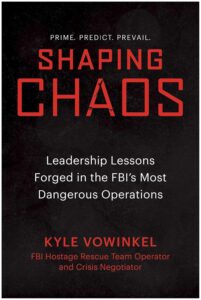
Kyle Vowinkel is a former FBI hostage negotiator, Hostage Rescue Team operator, and author of Shaping Chaos: Leadership Lessons Forged in the FBI’s Most Dangerous Operations. He has talked a terrorist out of a bullet-riddled boat and helped free a five-year-old from an underground bunker. Here, Kyle explains how he coaxed the surviving Boston Marathon bomber into surrendering with research, empathy, and a wrestling metaphor, why a five-second pause can rescue your rationality, and how his ego got him passed over at his first HRT tryout. He also shares what leaders get wrong about credit and blame, and why the hardest calls should be made before the pressure hits. Whether you lead a team, negotiate for a living, or just want to keep your head in a heated conversation, this one’s for you. Listen, learn, and enjoy!
Please Scroll Down for Featured Resources and Transcript!
Please note that some links on this page (books, movies, music, etc.) lead to affiliate programs for which The Jordan Harbinger Show receives compensation. It’s just one of the ways we keep the lights on around here. We appreciate your support!
- Sign up for Six-Minute Networking — our free networking and relationship development mini-course — at jordanharbinger.com/course!
- Subscribe to our once-a-week Wee Bit Wiser newsletter today and start filling your Wednesdays with wisdom!
- Do you even Reddit, bro? Join us at r/JordanHarbinger!
This Episode Is Sponsored By:
- Orion: 15% off: orionsleep.com/jordan
- SimpliSafe Home Security: 60% off: simplisafe.com/jordan
- Whatnot: Start selling today: whatnot.com/sell
- Xero: Find out more: xero.com
Thanks, Kyle Vowinkel!
Click here to let Jordan know about your number one takeaway from this episode!
And if you want us to answer your questions on one of our upcoming weekly Feedback Friday episodes, drop us a line at friday@jordanharbinger.com.
Resources from This Episode:
- Shaping Chaos: Leadership Lessons Forged in the FBI’s Most Dangerous Operations by Kyle Vowinkel | Amazon
- Kyle Vowinkel | Official Website
- Patriots Day | Prime Video
- ‘We Got Him!’: Boston Bombing Suspect Captured Alive | NBC News
- How Do Flashbangs Work? | CEENTA
- M-80 (Explosive) | Wikipedia
- The Use-of-Force Continuum | National Institute of Justice
- Chris Voss | Negotiate as If Your Life Depended on It | The Jordan Harbinger Show
- Chris Voss | Hostage Negotiation Tactics for Everyday Life | The Jordan Harbinger Show
- Brief Structured Respiration Practices Enhance Mood and Reduce Physiological Arousal | Cell Reports Medicine/PMC
- How Infrared Cameras Helped End Boston Manhunt | CBC News
- Cambridge Wrestling Coach Recalls Dzhokhar Tsarnaev as ‘Dedicated Kid’ | Boston.com
- Private Funerals Held for 8-Year-Old Boston Bombing Victim and Slain MIT Police Officer | Fox News
- Putting Feelings into Words: Affect Labeling Disrupts Amygdala Activity in Response to Affective Stimuli | Psychological Science/PubMed
- Stress Signalling Pathways That Impair Prefrontal Cortex Structure and Function | Nature Reviews Neuroscience/PMC
- Cadet Summer Training: Training Future Leaders | West Point
- John Tierney | Harnessing the Power of Bad | The Jordan Harbinger Show
- The Hostage Rescue Team Part One: 30 Years of Service | FBI
- The Hostage Rescue Team Part Two: The Crucible of Selection | FBI
- United States Practical Shooting Association | Wikipedia
- Robin Dreeke | Sizing People Up | The Jordan Harbinger Show
- Sizing People Up: A Veteran FBI Agent’s User Manual for Behavior Prediction by Robin Dreeke and Cameron Stauth | Amazon
- The Code of Trust: An American Counterintelligence Expert’s Five Rules to Lead and Succeed by Robin Dreeke and Cameron Stauth | Amazon
- A Reasonable Officer: Examining the Relationships Among Stress, Training, and Performance in a Highly Realistic Lethal Force Scenario | Frontiers in Psychology
- Self-Efficacy: Toward a Unifying Theory of Behavior Change | Stanford Center on Longevity
- Stuart Smalley | Wikipedia
- Michael Scott Moore | What It’s Really Like to Be a Pirate Hostage | The Jordan Harbinger Show
- The Desert and the Sea: 977 Days Captive on the Somali Pirate Coast by Michael Scott Moore | Amazon
- Navy SEALs Rescue 2 Aid Workers from Somali Pirates | KPBS
- Journalist Held Captive by Pirates Says Focus and Forgiveness Were Crucial | NPR
- Hostage Recovery Fusion Cell Marks Fifth Anniversary | FBI
- Two Somali Pirates Sentenced to 30 Years Each in Prison for Armed Hostage Taking of American Journalist | U.S. Department of Justice
- The Theory | Center for Self-Determination Theory
- Bomb Suspect’s Cause of Death Found, Not Released | CBS Boston
- A Review of the September 2005 Shooting Incident Involving the Federal Bureau of Investigation and Filiberto Ojeda Ríos | U.S. Department of Justice Office of the Inspector General
- Christopher Whitcomb | A Life Among Spies Part One | The Jordan Harbinger Show
- Christopher Whitcomb | A Life Among Spies Part Two | The Jordan Harbinger Show
- Cold Zero: Inside the FBI Hostage Rescue Team by Christopher Whitcomb | Amazon
- No Heroes: Inside the FBI’s Secret Counter-Terror Force by Danny O. Coulson and Elaine Shannon | Amazon
- 2013 Alabama Bunker Hostage Crisis | Wikipedia
- More Details on Alabama Bus Driver’s Heroic Response | School Bus Fleet
- Saving Ethan: The FBI’s Race Against the Clock to Rescue Kidnapped Alabama Boy | CBS News
- Former FBI Agent Teaches Cadets Hostage Negotiation Using “Boy in the Bunker” Case | U.S. Army
- Ethan Turner, Once Known as “Boy in the Bunker,” Graduates, Looks Ahead | WBRC
1397: Kyle Vowinkel
This transcript is yet untouched by human hands. Please proceed with caution as we sort through what the robots have given us. We appreciate your patience!
Jordan Harbinger: Welcome to the show. I'm Jordan Harbinger. On The Jordan Harbinger Show, we decode the stories, secrets, and skills of the world's most fascinating people.
Our mission is to help you become a better informed, more critical thinker through long-form conversations with a variety of amazing folks, from spies to CEOs, athletes, authors, thinkers, and performers, even the occasional neuroscientist, Russian chess grandmaster, a real-life pirate, or a special operator. And if you're new to the show, or you're looking for a way to tell your friends about it, I suggest our episode starter packs. These are collections of some of our favorite episodes on topics like persuasion and negotiation, psychology and geopolitics, disinformation, China, North Korea, crime and cults, and more.
That'll help new listeners get a taste of everything we do here on the show. Just visit jordanharbinger.com slash start or search for us in your Spotify app to get started. Today, former FBI hostage negotiator Kyle Vowinkel takes us 10 yards from the boat where the surviving Boston Marathon bomber was hiding and explains how he got a response after gunfire and 12 flash bangs hadn't worked.
We'll explore how to keep your brain working under extreme pressure, why the ego that makes you feel like the toughest guy in the room can actually make you the last guy anyone wants on their team. Apparently, being heavily armed doesn't automatically make you a good listener. Who knew?
Here we go with Kyle Vowinkel. So this book starts off with a bang, really. Your negotiation with the surviving Boston Marathon bomber was like 90 minutes, about the length of a good podcast.
So put me 10 yards from that bullet-riddled boat in Watertown. And my knowledge of this comes from your book and then the movie, which I can't remember what the movie was called, but I guess that was accurate. He was just hiding in some guy's boat?
Kyle Vowinkel: Yes. Patriots Day. Pretty good movie.
Right. They had an actor portraying my role and they actually had the negotiator talking to the bomber, but then the movie pace, they cut it out on the editing room floor. I never got to have my moment in big screen.
Jordan Harbinger: Got it.
So they're like, hey, we should be keeping it real and have a negotiator. And they're like, no, the test audiences just wanted us to skip straight to shooting. All right.
Kyle Vowinkel: My former teammates on the hostage rescue team, the ones that came in and the team leader did a great job. He instilled order into the chaos. Because when we first got there, it was like a circus.
Imagine 400 different police officers, every different agency you can imagine. There's no real command and control. And he did a really magnificent job, just calmly, coolly collected, instilled order into that chaos.
And so they tried launching flashbangs, nonlethal concussion devices into the boat. And after all, the law enforcement attack has failed. We shot at him, commanded to come out, did the flashbangs.
None of it worked. And the FBI director said, try to negotiate.
Jordan Harbinger: These flashbangs. So these are concussion grenades. Again, my experience of these is looking at them in video games or movies.
Right. So this is super bright and super loud. But also there's a shockwave that disorients you.
Is that accurate or is there more to it?
Kyle Vowinkel: Yeah, it's about 180 decibels. So it's almost ear piercing loud. And that's like a million candle power flash.
So it's super bright, super loud. Exactly what you said. Designed to disorient, distract and kind of disrupt the nervous system without doing any permanent damage.
Jordan Harbinger: Really? You can hear a pop that loud and it doesn't cause hearing loss?
Kyle Vowinkel: No, it's temporary. Your ears are ringing. And yeah, everyone else on my former team, you experienced hundreds, if not thousands of these flashbangs going off.
Although we would wear ear protection.
Jordan Harbinger: That seems like a good idea.
Kyle Vowinkel: Yes, they were designed, though, for individual use to distract and disorient without long term damage.
Jordan Harbinger: Okay. So are these landing in the boat? Because I can see how it wouldn't be that big of a deal if it's under the boat.
He's like, well, that was loud and I guess it was bright. But if it's a foot away from you and inside a little boat, it's got to be just ear splitting. Even if you can hide your eyes like the shockwave from something.
I'm an 80s kid, right? We had these firecrackers that are obviously federally illegal now that would blow your hand clean off. If that thing is even 20 feet away from you, you can feel it through your whole body.
And I would imagine a flashbang has got to be somewhat similar to that. An M80, I think it was called.
Kyle Vowinkel: Yeah, I had M80s similarly. And I foolishly played with those as a kid as well, which we can talk about later. The flashbangs are designed, they're metal canisters, and they have dozens of holes.
So the gas escapes through the holes. So there's no fragmentation, right? So there's nothing that can harm you.
But just like you said, when one goes off, it is massively like earth shattering when one goes off next to you. And these were the actually large one, the 40 millimeter. We normally hand deploy smaller flashbangs.
These are deployed from a grenade launcher, right? Law enforcement can have grenade launchers. So they're 40 millimeter, which means the larger diameter flashbangs.
And they launched a dozen of those. 12 into this boat, the Slipaway 2, which is only about 23 feet wide, maybe an 8 foot berm. And every one of them landed, I saw, inside the boat and went off.
And these would rock your world.
Jordan Harbinger: Yeah. Why did they put a dozen in there? Isn't it diminishing returns after one of them goes off?
I don't understand why you'd use 12.
Kyle Vowinkel: Our objective was to try to get them out of the boat.
Jordan Harbinger: Okay.
Kyle Vowinkel: Because inside the boat, we thought there were more explosives, more improvised devices, more weapons.
So we wanted him out of that craft. And then he would be easier for us to arrest. It's a lower risk situation because now we can see him if he's outside the boat, right?
When he's inside the boat, we can't see what's around the boat, what he can grab, what he can detonate. That's why they kept launching him. They were hoping like, oh my god, it's so loud, it's so loud, he would get out of the boat.
Jordan Harbinger: Okay. By the way, props to whoever's shooting this with this little ARC launcher, because that's really good aim to hit the target 12 times in a row. Because I've used one of these things with tear gas in it because I worked security at kind of a rough place.
And we had this civilian version of this, right? It was like this huge thing that probably did launch real grenades if you get your hands on them. And it launched these tear gas canisters.
And I've got to tell you, nobody in our organization who ever used that got anywhere close to what they were actually aiming at. Like if you're aiming at a crowd of people, you could hit the crowd of people. But if you're aiming at an object like a car, you're not getting it on or in the car.
It's just going to go somewhere in the vicinity of the car.
Kyle Vowinkel: Terrific point. It's like an area fire weapon. Exactly.
It's not easy, as you said, to get it at pinpoint accuracy. And especially under pressure, right? There's 400 law enforcement officers, FBI headquarters is monitoring via drone and helicopter overhead.
There's tremendous pressure. That's why the consummate professionals on HRT, that guy didn't miss a single one. He boom, boom, boom.
Jordan Harbinger: This is like football kicker pressure, right? You're down by whatever three points and like you're on live TV and it's like, don't screw this up because everyone's going to hate you for the next month and a half. And you're just like, boom, right in the middle.
Kyle Vowinkel: I compare it to like the Super Bowl. Like one of these big missions when everyone's watching, that's the kind of scrutiny and pressure you're under. But it's more than a game.
It's lives on the line. So you've got to perform at your best when at peak pressure.
Jordan Harbinger: Yeah, if it goes over the back fence and it kills a dog or something, that's all you're going to hear about for the next three days is like, sadly, HRT killed the neighbor's dog and is now being sued for $2 million for emotional distress. And it's like, oh man, Brad, come on, train with that thing a little bit. How did you hit the fence?
Yeah. Okay. They're firing these things into the boat.
At what point are they like, hey, you're up because he's not coming out of the boat.
Kyle Vowinkel: There's like a pause after those 12 and it was like maybe 10 seconds. And I remember thinking to myself, what's next? Because he's been shot at, not FBI, but the first responders shot at him.
Again, they commanded him out. They tried to flip him out and they launched their flashbangs. We've gone through every element of the lethal force as a triangle lethal force.
You start out physical presence, you go commands, then you go physical, then you go lethal force. We've done it all. And he's been non-compliant, non-responsive.
What's next? And actually it came from headquarters. The FBI director said, let's try to negotiate.
And then the team leader, a guy named Big D, he goes, the radio, he said three words, I'll never forget.
Kyle, you're up.
Jordan Harbinger: Oh man. So again, Super Bowl pressure, right?
Because if you blow it, I've had Chris Voss on the show who I'm sure you know. And my experience with this is only again through movies, right? Most people have seen, I don't know, probably some Kevin Spacey movie where he's negotiating a hostage situation or I don't know, Sam Jackson.
That's pretty much it. Before you tell me what you said, what are you physically feeling? Are you nervous at all?
The guy just hit 12 out of 12 with the flashbangs and that didn't work. So are your hands shaking? Are you nervous?
Do you get any of the heart pounding tunnel vision type of stuff? What does a trained hostage negotiator actually experience in a moment like that?
Kyle Vowinkel: So I've been in a hundred combat missions overseas in Iraq, Afghanistan, been in multiple firefights. So I understand what stress does to the body and normally decently calm, cool, and collected. But here when the radio call went out, Kyle, you're up, I felt my heart rate spike because normally we operate in teams and my two partners, fellow negotiators, couldn't make it over the fence.
So I'm all alone.
Jordan Harbinger: What do you mean they couldn't make it over the fence?
Kyle Vowinkel: They're healthy individuals.
They're not maybe as agile and they couldn't hop over the fence. When we moved to that location, we had to move through several houses, backyards.
Jordan Harbinger: Wait a minute, these are not HRT guys.
Kyle Vowinkel: Fellow negotiators.
Jordan Harbinger: Okay, from the FBI?
Kyle Vowinkel: From the Crisis Negotiation Unit, yes.
Jordan Harbinger: I don't want to be a jerk, but they couldn't climb over the fence to get there?
Kyle Vowinkel: It was a six foot fence and we were under time pressure. So there literally was no time. It was like, go, go, go.
And they couldn't hop over quick enough.
Jordan Harbinger: Yeah. Okay. Look, I'm pushing 50.
Could I hop a six foot fence? I think so, but now I'm not sure. Maybe I should withhold judgment.
Kyle Vowinkel: It was not an easy one to climb and we just didn't have time. The team leader said, we've got to go. We've got to go.
So I said, we'd link up later with them on the objective. So normally, right, talking about the Super Bowl analogy, you have a team and I had my teammates there from HRT, so I wasn't worried about a safety issue. I was worried because I didn't have my kind of quarterback, my coach and the team leader of our unit.
So when that first call came out, I thought, shit, I'm all alone. My heart rate started to spike, but then I started walking to the house and I paused at the threshold and I literally took three deep breaths in and out quick. I tell myself, I've done this before.
I've negotiated with pirates, terrorists and kidnappers. Well, actually this is the first terrorist on US soil. That's a pretty rare example, but I've done it before.
I can do this. Let's go. And I walked up the stairs and then once I did that, timeout for five seconds, reset my physiological state, then I was fine.
So that's the one thing you've got to definitely do with your body is give yourself, even if it's a five second break, pause, reset, give us self-confidence talk. I've got this and then move out. And then my heart rate never raised after that.
Jordan Harbinger: So what are the catastrophic outcomes running through your mind? Because I would be worried that if he's not responding to the flashbangs, is he dead already? Or is he just bleeding out to the point where he can't even function?
Or is he holding on to another bomb? Does he have one of those switches where when he dies, it goes off? Is he waiting for people to get close and then he'll blow himself up with the boat and kill everyone?
That's what I would be worried about. And that was just what I thought of in the last 10 seconds.
Kyle Vowinkel: Absolutely right, Jordan. So we had overhead forward-looking infrared radar FLIR in the helicopter that showed a warm body.
Jordan Harbinger: So that's the heat sensor stuff you see on cops or whatever sometimes, right? Or on TV.
Kyle Vowinkel: Exactly. So it differentiates the heat of the body with the heat of the surroundings and that differential shows up as kind of a white blob. So we knew he had blood somehow flowing through his system.
But to exactly what you said, I was just within 10 yards of him at the window looking out. We were very afraid that he had more improvised explosive devices. Because remember the night before in Watertown, he had thrown more IEDs at the police.
And obviously, they used the pressure cooker bombs at the Boston Marathon finish line, and they had multiple weapons. So we were absolutely inside the blast radius, the danger close area. Me and everyone else on that inner perimeter of the hostage rescue team were danger close.
So yeah, that was a number one fear was explosives, additional weapons. And was it a trap, as you said? Is he just luring us in to get as many officers as close as possible, and then he's going to detonate something?
Jordan Harbinger: Wow. Do you just put that out of your mind because your job is to negotiate and you can't be sitting there worried about all that stuff?
Kyle Vowinkel: Absolutely.
It went through my mind quickly. And I just said, I'm going to process that later. Like I told myself, I can't deal with this right now.
It's a safety issue. But my job right now is to connect with a terrorist, right? And fortune favors the prepared, as I know you like to say.
Jordan Harbinger: That's funny. Where did you find out that I like that quote? Where is that?
Did AI surface that? I'm impressed.
Kyle Vowinkel: I've got to give credit to my friend, ChatGPT. Yeah.
Jordan Harbinger: Okay. That's pretty cool. Because I feel like that was my Facebook 20 years ago.
It was like my Facebook quote when they asked you for your favorite quote, and I haven't done anything with it since then. That's really funny. That's so funny.
Yeah. I loved that when I was like in law school. That's a throwback.
That's hilarious.
Kyle Vowinkel: It's a great quote. I believe in it to this day. And it favored me that day because I had prepared.
Even after all that violence, no one thought there would be a negotiated resolution because they fought with the police when they're confronted with them. It was going to end in a lethal shootout, everybody thought. But it was my job as a negotiator to be prepared just in case.
So that morning, Friday morning, I'd reached out to his wrestling coach, Coach Payak, because he'd been on the news the night before speaking positively about the bomber. So I called him and asked. Yes, everyone else was like his uncle, went on the media, called them losers.
The aunt went on television and thought the police were setting up the brothers. But there was one person speaking positively about him. It was the coach.
So we in the FBI, we're going to interview everyone, right? Associates, people talk poorly and positively about someone. But I prioritize talking to the coach just in case that one in a million chance I would end up negotiating with him.
So I talked to the coach that morning for like an hour. I learned his nickname. I learned details about his personal background.
So I was prepared. I was primed and ready to go when Kyle, you're up came out. So when I went to that window, I had the confidence because I was prepared.
My team and I had done our research and my first words, you want to try to lower someone's defensiveness. And I know you're big on how to influence behavior and connect with people. And this is from what I was learning in negotiation.
The first words are so important framing, right? A conversation from the other person's perspective, talking from their interest point, right? To gather their attention because we're all self-centered and we all at times really just focus on our world.
But to connect with someone, you've got to start from their world. So my first words were, my name is Kyle. I'm from the police.
I'm here to talk with you. So I very clearly said my objective to him and wanted to be in a non-threatening manner because right, he'd been shot at. His emotions are way high off the chart.
We want to lower his emotions and kind of increase his rationality.
Jordan Harbinger: Okay.
So instead of him guessing what you're going to do or what your aim is, you tell him right away so that he can relax a little bit after 12 flashbangs did the opposite.
Kyle Vowinkel: Exactly. And I just want to establish communications with him, right? Because nothing else had worked.
And so for 10 minutes, it's dead silence. It's me talking, but there's no response.
Jordan Harbinger: At this point, he's responsible for horrific violence, right? I think he killed an MIT police officer. He set off the bomb at the Boston Marathon.
How do you turn off that part of your brain being like, I'm going to shoot this guy myself if I get the chance? I mean, you have to create a genuine human connection, but I would assume you're also like he's a terrorist on American soil, right? This is not somebody who you would hang out with on the weekend normally.
So you've got to compartmentalize all of that.
Kyle Vowinkel: Absolutely. It's self-regulation is really at its core because I loathed what he did. I detested.
He killed an eight-year-old Martin Richards, an innocent eight-year-old boy at the finish line, and then murdered MIT officer Sean Collier. So to do these horrific acts, I had to absolutely compartmentalize and put that on the side because it was a palpable in the air and his thirst from law enforcement to extract vengeance, right? To kill him.
You could just sense it. People wanted that revenge. So I understood that.
However, we were worried at FBI about other terror cells, right? Were there other bombs waiting to go off in New York City? Was there another terror cell in DC or Las Vegas that are about to attack?
So our primary objective was to capture him alive as much as I wanted him to see justice. The three things you can only control in your life is your ego, your emotions, and your actions. So I had to control all three and not judge him.
When you're connecting with someone, especially a terrorist, you've got to leave that judgment aside. So you've got to demonstrate empathy. So what I said during those 10 minutes is, you're probably hurt, scared, confused, right?
I'm not judging him, but I'm not agreeing with him, and I'm not condoning his actions, because that's the second step of the path to influence, is demonstrate empathy. Putting yourself in the other person's shoes, you validate their experiences and emotions, but you're not condoning them.
Jordan Harbinger: I see. So when I read the book, I was trying to follow along here with you. You start to label his emotions, right?
So he's alone, maybe he's injured, he's definitely nervous and riled up, and he's probably really thirsty, and then I think you were onto something because he groans back and he's like, water, right? Because he's just dying of thirst at this point from being riled up and having his adrenaline pumping and probably, yeah, I don't know, maybe he didn't hydrate enough before the marathon. Sorry, I'm trying to keep it light.
When he says water, what changes in your head?
Kyle Vowinkel: So that was a magic moment because for 10 minutes he was non-communicative and I was saying like, hey, just let me know you're okay, bang the bottom of the boat, shake the tarp so I know you can hear me, and yeah, the first words were, again, almost magical because now we know that he's alive, he's communicative, and we've established now two-way communications, right? Words succeeded where weapons had failed.
Jordan Harbinger: Yeah, I think that's interesting because you said there were 400 cops. That's not an exaggeration, right? Maybe you're rounding to whatever number, but who doesn't want to be part of that if you're local?
You're not going to be sitting around writing parking tickets in suburban wherever if you think you can go help in this particular situation. So 400 armed cops show up, but you've got something that none of them have, which is the dialogue with the terrorist.
Kyle Vowinkel: Steps that I'd done, right? Finding out about him. Everyone wants to be seen, valued, and heard.
So by me talking to him like a person with respect and dignity, even though I can't stand what he did, and he's showing concern for him, that got the response that elicited that water. That's a great progress step because FBI headquarters is monitoring. Everybody's wanting progress and action, and now, hey, we've got two-way communication.
That's great. We've established it. Now it's going to step two, build rapport, and I start talking to him.
Great, I got ice-cold water for you, but it's outside the boat. So does he have to come out and get it, or is he going to be like, throw it in here? That's what I'm trying to do, right?
I'm trying to persuade him to go outside the boat, and he says, I can't move. I can't move. And I said, you've got to move.
If you stay in the boat, you're going to die in the boat. So it's very clear with outlining the consequences of his actions. But again, spoke to his coach, so it was another kind of magic moment when I said, I know who you are, Jahar.
I know who you are.
Jordan Harbinger: Is Jahar his name or his nickname?
Kyle Vowinkel: Jahar is his nickname that his friends and family call him.
So I could see, actually, his head popped up from the bottom of the boat for the first time. We saw a physical reaction from him when I invoked his nickname. And I said, I spoke with Coach Payak, his wrestling coach.
And I also was a wrestler. I know what it's like to be on that mat one-on-one. So I developed rapport because I had a personal connection, just thankfully, but really because I'd done the research and my homework being prepared for that moment.
And that was a kind of electrifying moment between us. I almost could feel the connection because he then knew that I knew who he was, and I did my background research on him. And I said, you've got to bring yourself to the edge of the boat.
So he starts crawling over like inch by inch. And he said, I can't move. I can't move.
And he moved another inch though. And I said, you've got to finish the match. Finish the match, invoking that wrestling connection.
Jordan Harbinger: Wow. So I know you're a wrestler. You read that one of the most nervous moments of your life was your first high school wrestling match at 16.
Why was that so nerve-wracking?
Kyle Vowinkel: Oh, incredibly nerve-wracking. I was kind of a rebellious kid and I liked the wrestling, right, going mano a mano, but I got beat down severely, right? I wasn't very good when anyone who starts wrestling that first year, you lose, I think, most of your matches.
When I finally earned my spot on the JV roster to wrestle in front of the home crowd, you know, in University City High School in San Diego, where I grew up. And I remember looking out before my matches up in the crowd. It's all my friends, all my family.
And my heart rate was just off the chain. Like literally, I felt like my heart was going to burst. My knees started shaking and wobbling.
I really couldn't even control myself. Like I was just so nervous. And I had a fellow wrestler teammate, Andrew Kish, came over to me.
He's all, dude, relax. Look at the other guy. He's just as nervous as you are.
So it really helped me to just kind of process. And he told me to take a few deep breaths and relax. But yeah, I still think that's one of the most nervous moments of my life.
Jordan Harbinger: Yeah, okay.
Kyle Vowinkel: But then through a series of experiences, and that's what FBI does a really good job, and the military did a really good job, is preparing you for those moments to have your system prepared to react so it doesn't take over. Because those emotions, if they get too high, they hijack your rationality.
That's the other thing I learned too as a negotiator. You really want your rationality high and your emotions low. Because it's like a teeter-totter.
When one is high, the other is low. If you let those emotions take over your cognition, then you're going to make poor decisions.
Jordan Harbinger: You've been through a lot of weird sort of high-stakes situations. I mean, even just small things, air quotes, small. West Point, this upperclassman holds a hot iron inches from your face and he says, sometimes I feel like pressing it into you.
First of all, what's that guy's problem? That's psycho. And is that acceptable behavior?
It scares me that guy could be in charge of a lot of people in the military.
Kyle Vowinkel: Not acceptable. And he got turned back a year, got a massive punishment.
Jordan Harbinger: Good.
Kyle Vowinkel: But yeah, this is during the, it's called Beast Barracks, the first six weeks of cadet basic training. And again, I was kind of a goof-off. I was a class clown, right?
I love to make people laugh and strict regimentation and the strict discipline of West Point. Not a real good fit for those two.
Jordan Harbinger: Sure.
Kyle Vowinkel: So even though I was trying to be a good cadet, I wasn't the best cadet. You've got to obviously shine your shoes and everything's got to be perfect. So I wasn't the model cadet.
And he didn't like that, right? It was his core of cadets and he wanted only the best in his mind, meet the standard, even though it's new basic training, just the start of it. And so he called me into his room and he held up his iron in his shirt and literally that iron, I could feel the steam coming off the iron.
It was so close to my cheek. And he said those words, sometimes, Vowinkel, I just want to shove this iron in your face. And I was truly freaked out, but I also thought like, and I wasn't being brave.
I just thought there's no way this guy's going to really hit me with the iron. No. Like I was logically thinking there's no way, but then I thought, what if he does?
This is going to scar me, but I can't say I was being brave because I wasn't, but I just didn't think logically he would go through with it. And actually I didn't tell anyone except my roommate. And then my roommate quit a month later and he'd had a similar hazing incident with him and he'd kept a notebook.
And my roommate turned his notebook to the officers and yeah, there was a massive investigation. And then when they interviewed me, of course, I showed the story then because it was obviously relevant to his conduct and his character.
Jordan Harbinger: So your roommate, he just left West Point, period.
Kyle Vowinkel: He quit. Yes.
Jordan Harbinger: Oh man, that's too bad because if it had to do with the hazing, that's really too bad. That seems unnecessary. Yeesh.
Okay. But the point is you describe emotional regulation as possible, even when you can't remove the threat. How do you distinguish useful stress inoculation from somebody abusing you during a hazing incident?
Kyle Vowinkel: Then I was still learning self-regulation, right? And still understanding and applying a little bit of logic because I said, like, I don't think he's really going to burn me versus later, especially being shot at the first time. I learned if you focus on the threat so much and dwell on this thing, which may kill you, it's going to occupy all of your thoughts, all your mental energy.
And it's going to just, again, hijack the cognition. So you need to accept the threat, respect the threat, but now let's come up with a plan. Let's act decisively and not let those emotions take over.
So that comes with training. It comes with evolutions when you are faced with those serious consequences. So yeah, it builds up, as your question before, I wasn't born with any of this, but it just builds up over time and you build confidence in more and more situations obviously you're in.
Jordan Harbinger: Kyle's backup negotiators couldn't get over a six foot fence. Apparently, the final boss of FBI crisis response is residential landscaping. While they look for a gate, let's hear from our sponsors.
This episode is sponsored in part by Orion Sleep. Eight hours in bed doesn't always mean eight hours of great sleep, man. Do I know that?
If you've ever woken up too hot, you know temperature makes a huge difference. That's why I'm excited about Orion, a smart sleep system that fits over your existing mattress. It adjusts your bed's temperature throughout your sleep cycles, using sensors to personalize it over time, help support deep sleep, REM sleep, fewer overnight wake ups.
I like the idea of taking the guesswork out of it instead of just kicking off the covers at 2 a.m. Let the bed adjust, check the data, see if I'm actually sleeping better. Orion starts at 60 bucks a month with no mandatory subscription. It comes with free shipping, a 30 day free trial with a full refund and a two year warranty.
Right now, Orion is offering our listeners 15% off at orionsleep.com. This episode is also sponsored by SimpliSafe.
Home security is not really about protecting a house, it's about protecting the people inside and keeping home a place where we actually feel safe. That's what I appreciate about SimpliSafe's approach. Every night before our kids fall asleep, they ask us, is the alarm on?
It's a small question, but hearing yes gives them the peace of mind to close their eyes and finally fall asleep. That little bedtime check tells me how much feeling safe actually matters to my kids. And for me, that means wanting a threat stopped outside before somebody ever gets close to their bedroom.
SimpliSafe is built to stop break-ins before they start. Its AI-powered cameras identify potential threats and alert a live U.S.-based security specialist. An agent intervenes in under 30 seconds, speaking through the camera to deter the intruder and calling for urgent 911 dispatch when needed.
That's protection that goes beyond just recording what happened.
Join more than 6 million people who entrust SimpliSafe with their home security. Right now, save 60% off with professional monitoring at simplisafe.com. That's simplisafe.com.
And please write The Jordan Harbinger Show in the checkout survey. It lets them know we sent you and really help support the show. SimpliSafe.
Ahead of crime in real time.
All right. I don't get a cut from sales, but when you use the codes, companies see that you're listening to the ads and they appreciate that and they shovel more money in my direction. So hey, if you decide to sign up or buy anything, please use our code.
It's usually Jordan, but not always. And they're always listed on the deals page at jordanharbinger.com slash deals. It's a double win.
You get a great deal and you help keep the show going strong. Thank you for your support. Now, back to Kyle Vowinkel.
This is totally a tangent, but why do you think we evolved this way? Right? Because human nature is there's a threat hyper-focus on it.
But everybody who comes on this show, yourself included right now, is saying, by the way, that's the absolute wrong thing to do. So it's like, how come over millions of years of evolution on planet Earth, this is what nature tells us to do? And every single person right now is like, by the way, you've got to train like crazy to not do that, that thing.
It must have worked most of the time for a really long time.
Kyle Vowinkel: Yeah, it's a great thought to ponder. I still think you focus on the threat, but you don't let it consume you. Because that one threat there that could be off to your right, there could be three other more higher priority threats to the left.
And if you're so myopically focused on that singular threat, you're going to miss the other one that's even closer that's going to take you out. So I think that's what comes with training and conditioning is to have not just situational awareness, but be on the lookout for other threats.
Jordan Harbinger: Usually evolution gets a lot of stuff kind of right, or maybe I just think it did because of all the failures that you don't see. Someone who does this for a living is going to write in and be like, oh, evolution's not always spot on. Maybe the best thing to do is to focus on the threat at some level.
And so nature turned that up to 11. And there's no evolutionary pressure to tune it back down somewhere, because we live in a more or less civilized world where you don't get shot at every single day.
Kyle Vowinkel: No, that's a good point, too.
Jordan Harbinger: Yeah. Anyway, so years later, after West Point, you train for a year, a long time training with two friends to make the FBI hostage rescue team, HRT. So tell us a little bit about what this is, because I think a lot of people have never heard of it and they don't realize that this isn't just cops who have SWAT gear in the closet, right?
These guys, they get selected, but you don't. What happened?
Kyle Vowinkel: Hostage rescue team is the Department of Justice's premier counterterrorism team created back in 83 to be a civilian counterpart to Delta Force and SEAL Team 6, two units that we train and work with. And literally our founding was with Delta Force operators who came up to help design our selection process, because they wanted to select individuals with obviously various skill sets, discipline, judgment, teamwork, compatibility. And it's a grueling physically as well.
And you also go through arrest scenarios and shooting. So it's a tremendously difficult process. And I'd been through ranger school in the Army, and I felt like it was a month of ranger school condensed into two weeks.
And my buddies and I trained for over a year, as you mentioned, two-a-day workouts. We're doing stairs at the UCLA track in the morning, then followed by pool workouts in the afternoon, just putting our bodies through hell to be ready for this grueling selection event.
Jordan Harbinger: How old are you at this point?
Kyle Vowinkel: 30 years old, I think.
Jordan Harbinger: Okay.
Kyle Vowinkel: So you get a mature, seasoned operator when you come up for HRT, which is nice compared to the military is a great pipeline too.
And everyone's got to have a college degree and not just that. You have to have three years as an FBI agent, and then you've got to be on the SWAT team. Normally I was in the LA SWAT team.
So it takes a while for our feeder program to even get to HRT. So you do get someone with a little bit more maturity than an 18-year-old coming into the Ranger Battalion, for example.
Jordan Harbinger: Yeah, I gave a talk at 2nd Ranger Battalion. I was really impressed by those guys, obviously. But what it does, it makes you think, wow, I'm old.
Because you go in there and you're like, oh, these are some of the best soldiers in the US military. And then you look and you go, wait a minute, but you look like a child. But you just climbed a pole in front of me like a monkey and you did like 50 pull-ups and you're shooting.
And I know you can do way more than that. You probably jump out of airplanes, but I'm looking at you and you look like a middle school student. And then you just look in the mirror and you're like, oh, right.
No, no, no. It's me. I'm old.
Yeah. Shit. Man, this selection process sounds really tough.
It's obviously really grueling, I think is a better term for it. I guess it's a relief, though, because what you have to do is rescue hostages taken by terrorists or criminals without shooting a bunch of innocent people. And that's not easy to do.
Kyle Vowinkel: You need to be able to endure some extreme physical circumstances and then perform, show judgment under pressure, just like the guy who shot the 12 flashbangs in the boat, like without missing a beat. So that's where you're looking at performance level and a trained ability because nobody goes at that level, right? You have to be trained up to the level to become an HRT operator, which takes a couple of years, really.
And when I first tried out, I did decently well physically, but I opened my mouth twice when I shouldn't have. Once was the Marine Corps obstacle course, it's the weaver. You go up and down these logs and you traverse the logs and go over this arc.
And there's one log and another foot is another log. You just go up and over the log, if that makes sense. So there's no way to miss a log, right?
Because you have to go up one and over one. After I complete the obstacle, blue six, you missed a log. Go back and do it again.
I turned my head and I thought, how do you miss a log? There's no way to miss a log because you up one over it. You'd have to have a wingspan of eight feet to skip a log.
I asked him, I said, sorry, sir, what log did I miss? How did I miss a log? This is a former Navy SEAL, BUDS instructor.
You're not supposed to question the instructor.
Jordan Harbinger: The right answer was yes, sir. The wrong answer was literally anything but that, right?
Kyle Vowinkel: Exactly. Stupid me.
Jordan Harbinger: Even I know that one.
Kyle Vowinkel: Yeah, but I was tired. I was exhausted. Again, no excuses, but I'm just saying a state of mind was not clear.
Jordan Harbinger: No, I get it. I was in the reserves in ROTC and I remember they were like, we don't like people with your kind of mindset here. Because I wanted to study Arabic and Russian.
And they were like, we don't want that. And I was like, I'm pretty sure you're wrong about that. And the guy was like, come here.
I'm not wrong about anything, especially in front of other people. Do you understand? And I was like, oh, okay.
I'm not going to fit in well here at all.
Kyle Vowinkel: At all. Excellent analogy. And same thing.
I made that mistake. And then I made another mistake. We're all self-centered at times and especially on HRT, you've got to put the team first, the mission above ego.
So the second time I opened my mouth was during a shooting competition and I shot competitively in USPSA, went to three gun nationals several years. Shooting was my forte. I was very comfortable and very confident in my shooting.
In the steel plate competition, you shoot against your fellow selectees and I get down to the finals and the guy beats me. I missed a shot on one of the plates. And again, I was just so kind of angry at myself and irritated that I choked that shot.
When we go back, we're reloading our magazines for the next firearms drill. And I thought it was just the selectees, right? Just as people trying out.
And I said to him, hey, I'll bet you a paycheck. I'll beat you next time. And around the corner was an HRT operator listening.
That went like wildfire. Hey, who the hell is this Vowinkel guy thinking that he's going to bet a guy a paycheck to beat him in a shooting contest, which is meaningless in the big picture. So those two things rightfully caused HRT to question, maybe Vowinkel is not ready for this team.
So I didn't get the call. And again, justifiably so, I needed some humility and kind of reminding back to my core, like, hey, I've got to subdue the ego because the team is more important.
Jordan Harbinger: Yeah. There was a Marine on here who is also an FBI counter-terror guy, Robin Dreek. I don't know if you know who he is.
Kyle Vowinkel: I heard of him, but I don't know him, yeah.
Jordan Harbinger: He tells a story in his first book about this essentially kind of a road rage incident. It's not as bad as it sounds.
And he's like, yeah, I just thought I was like a real tough guy, Marine, you know, I'm not going to take any crap from this other guy in this other car. And he's it was so stupid to do that. The guy had his kids in the car or whatever.
And so it feels like everybody who's in a position similar to yours has a story like this, where they just, they were doing great and they needed to just be taken down like one peg. Unfortunately, your peg was a year long grueling training process that you had to redo. So that's a thick peg.
Kyle Vowinkel: I'd prepared literally for five years, or I should say that was my goal to make HRT. And then my two buddies, well, first, the fact that the three of us finished is a feat in itself, because normally there's a lot of former military guys try out and former SWAT guys try out for HRT. So it's already the top cadre within the FBI we're trying out.
So let's say 40 try out or start, only 20 usually will finish. And then out of that 20, they'll only pick maybe 10. So you're looking at a 25% really on a good year selection rate.
So it's a very high attrition. And if they have any question about you, just like with me, let's make them come back. And that's their default, which I like it.
So this is super high standard. And if they don't like it, you don't even get an offer to return. So thankfully, I performed decent enough that I had the opportunity to come back because you have to apply and they accept you, but they can tell you no, like, no, thanks, Kyle, we've seen enough, we don't want you.
But yeah, a whole nother year, putting the family and the body through this really excessive physical toll, preparing for this event. And really, it was the soul searching, which was the most important part just to realize it's not about me. It's about the team.
Jordan Harbinger: I guess it was good for you. But going through it a second time, you know what to expect. So there's that.
And you got your buddies on the team. So you're looking forward to that. Maybe they can put in a word for you once they're already on.
I don't know how that whole thing works. But I feel for a young Kyle at this point. And you're candid that HRT, it becomes almost like a marriage level commitment.
And so these relationships are so tight, they sometimes eclipse relationships at home. That's a pretty serious cost. But I guess the sacrifice is usually justified, at least in your opinion.
Kyle Vowinkel: These men that I was fortunate to serve with, I never worked so hard to be ordinary, because they're extraordinary people. And I was just ordinary among the extraordinary. Because when I did make it, and when you're on that team, and when you routinely almost daily place your life in another man's hands, and vice versa, when you're training, or on real missions, like that bond is really unlike anything else, because I know that a mistake by my partner can cost my life, and vice versa.
If I make a mistake, I could cost his life. You travel, you live, eat, sleep with these guys a lot. So it's a commitment, which I love, but it takes a toll.
Jordan Harbinger: You talked earlier about governing your own emotional state first. And your argument starts with something surprisingly basic, which is before you leave the room, you have to be able to control your own physiology. What actually is going wrong cognitively when somebody gets flooded by stress?
Because I've had these really undesirable stress reactions too, sometimes to stupid things. I remember probably the first time it happened, I was a kid, and I lit a firework in the house, because I was dumb, and not thinking that there would be an obvious consequence to this. And I thought, oh my god, I'm going to be in so much trouble.
And I remember opening the window in the bathroom, and turning the water on in the sink, and washing it, and then throwing it away. But my hands were shaking uncontrollably, my knees were shaking like you described earlier. But what's going on there?
Because really, it wasn't a big deal. It was a tiny little firework, it went out immediately, I threw it away, the smoke went out the window, my parents weren't even home. So there really wasn't anything I should have been afraid of.
Even after I was like, oh this is fine, I was still going haywire and out of control.
Kyle Vowinkel: Because your mind perceived this massive threat of a potential fire, the potential consequences for the parents, and especially at a young age, that's where your body went into kind of hyperdrive, because you were flooded with those emotions, right? Physiologically, you weren't prepared to deal with what happened. And this is so fascinating, Jordan.
I also lit up a firework in my house when I was young. Geez, I'll never forget, I'm sitting at a table with my buddies, and my buddy's holding a bottle rocket. And I said, go ahead and light the fuse, and I'll pull out the fuse before it actually lights a bottle rocket, so it won't actually go off in the house.
Jordan Harbinger: Why were we so dumb, Kyle?
Kyle Vowinkel: Yeah, so I don't have to tell you the ending, you know how this goes. My buddy lights it, and I wait, and then I grab the fuse, I go, ow!
And it goes, goes off, and then popped in the house, and it starts a fire. A small little fire, really small. So I had just a cup of water, and I ran over and put it out, and my mom comes running in, and similarly, my emotions were overtaking the body, because I was so nervous and thankful the fire had gone out.
But that's an eerie similarity that you and I have both lighting up fireworks in the house, Jordan.
Jordan Harbinger: Where did you grow up, by the way?
Kyle Vowinkel: San Diego.
Jordan Harbinger: Okay, so you're from California.
I grew up in Michigan, and I feel like we just had this redneck-y sort of element. But apparently, this is a nationwide phenomenon, right?
Kyle Vowinkel: Because I think also growing up in the 80s with Rocky, Red Dawn, and Rambo, those are the movies, and they kind of affect us, so we all envision ourselves as those main characters in the movies.
Jordan Harbinger: Yeah, I suppose you're right. I never really aimed for any of this sort of elite-level stuff, because I didn't have a six-pack like Stallone or whatever. But yeah, I did all the dumb stuff.
We have that in common. I missed out on the whole hostage rescue team angle, and instead, it went in a slightly different direction. But man, this is funny.
So there's also a hilarious training failure in the book involving a simulated airplane hijacking and three pizzas. Tell us that story.
Kyle Vowinkel: Yeah, so this is in the crisis negotiation unit. We put on regular training for the negotiators, so they come in from all over the field and state and local negotiators. And so it's a mock scenario where an aircraft is taken over.
And so there's role players being the bad guys and hostages, and then we're off in a side room as the negotiators, and we're instructing, we're training the new negotiators. And so he's on the phone with the hijacker, and the hijacker is demanding release of 100 prisoners from U.S. custody. And all of a sudden, an intel inject is injected in the scenario that this terrorist's hometown in Syria had just been bombed, right?
So he's irate over the bombing, and the negotiator says, well, I understand you're upset, but how about we give him some food? How about we get some pizzas? And the guy said, yeah, give me two pizzas, but damn it, I'm so worried about this, or I'm so angry about the bombing, I'm going to kill these passengers.
And so the negotiator focuses on the pizzas, not the killing of the passengers. And he says, okay, so you wanted one pepperoni and a pineapple? And he starts shooting the passengers, and the negotiator says, sir, I can't hear you over the gunfire.
Did you want pepperoni?
Jordan Harbinger: And this is a training exercise, which is why we're laughing. People are not actually dying. This is a training exercise.
Kyle Vowinkel: It's all simulated, but one of the funnier moments, because obviously we pull them aside and counsel them later, like you have to stop when there's violence being threatened, or actually violence committed with shots fired, even though it's simulated shots. The pizza is not the most important thing, but this is what happens in stress. Also, you can become singularly focused on something that is not relevant or important, right?
The pizza is not relevant or important. The action is, you've got to stop the action.
Jordan Harbinger: So what did stress do or make? Because he was literally unable to notice this, right? I mean, he noticed the gunfire, but he's going, sorry, it's really loud because you're shooting hostages.
Was that pepper or pepperoni? I don't want to get your order wrong. It's like, wait a minute.
Kyle Vowinkel: I had to stifle a laugh, right? Because it was so comically funny, but it's not because this is real life FBI training.
Jordan Harbinger: Oh, gosh.
Yeah. If something like this happens in real life, it's absolutely not funny because three people died because the hostage negotiator lost his sense of focus.
Kyle Vowinkel: Well, he got the pizza order right though.
Jordan Harbinger: Right. The rest of the hostages ain't good, but the three people who bled out on the floor are highly upset. Yeah.
It's crazy that stress can do this, right? So it's like mental tunnel vision.
Kyle Vowinkel: Yes. We were talking before with our analogy, if you can become wired to focus just on that one threat or that one item, it excludes and blocks everything else when something else could be more important and a higher threat than what you're currently dealing with. That pizza example showcases that.
Jordan Harbinger: So how do you defeat that? Is there a way to mitigate that at all? You have tactical pauses and physiological size and stuff like that.
Is that where this comes in?
Kyle Vowinkel: Yeah. I think the timeout is one of the most important things. And I did that both the Boston Marathon bombing capture and the Alabama bunker incident, two very stressful incidents with lives on the line, but both times I took a timeout with my partner.
So in the middle of the highest stress situations, I knew my emotions were starting to rise and I knew I needed to take a timeout to let that rationality come back. Again, that teeter-totter and that self-regulation. So I talked to my coach and actually it was my coach's idea.
He said, Kyle, let's take a timeout. So I advanced credit. And then we just talked for a couple of minutes.
And not only is it lowering my emotions, increasing my rationality, but in Boston, we wanted the bomber's emotions to lower and his rationality to increase. So it was this twofold effect. And that's why the timeout, again, you just reset your breathing, reevaluate what's going on, reassess.
It's only going back to the pizza story. It's only when there's an imminent danger and like actions or like rounds being fired where you have to act immediately. But that's very rare.
So in almost every other instance, you can take a timeout. If you're in a boardroom meeting and you're feeling overwhelmed as a leader, or you're meeting with a subordinate and providing feedback and all of a sudden it gets superheated, take the timeout. Say, you know what, I'm sorry, I need to use the restroom.
I need to go get some air. Let's come back in five minutes. We'll start this.
So that's what I've encouraged people to do. That timeout gives yourself that time to just settle down a little bit and just kind of reset physiologically, or else you're going to continue up that path and then make some decisions or say something that you regret.
Jordan Harbinger: What makes this different from just telling somebody to calm down, which has never worked to calm anyone down in human history? By the way, if you've ever told your wife to calm down, you know that to be fact. Telling your wife calm down is the married guy equivalent of lighting a firework in the house.
That's what that is.
Kyle Vowinkel: Yeah.
Jordan Harbinger: You might as well light the bottle rocket and point it at your wife.
Kyle Vowinkel: That's right. It's like launching it just at your mom in the kitchen.
Jordan Harbinger: You might as well do that.
How is this different? Because I feel like a lot of people go, oh, okay, gosh, the whole technique is take a timeout. The stories are interesting, but the techniques are a bunch of crap.
I don't need to timeout to calm down. I think a lot of people probably think that.
Kyle Vowinkel: I don't just say that. I practice it in those high stress moments. I know how it works.
Personally, as I mentioned before going in the second floor of the house in Boston, I took a personal timeout. I took three deep breaths and actually had that second little kind of top off breath on top of that breathing. I know it's remarkably simple and everybody says breathing, but it is true.
The breathing helps reset you physiologically. You're oxygenating the brain, the muscles, and you're focusing on something else besides what the other thing was, right? You're focusing on that breathing temporarily, giving yourself a little bit of a mental break.
Then think about, there's some studies about if you recall mastery experiences, for example, everyone has overcome hurdles and obstacles and successes that you've achieved. If you're about to face another hurdle or a challenge, if you recall a previous experience where you overcame, where you persevered and say, hey, I did that then just like I kind of did in Boston. I've done this before.
I can do this. If you recall that experience, you gain some confidence, you actually perform better. That's another thing too is recall a mastery experience and say, hey, I've done this before.
I can do this. That little self-talk too is beneficial.
Jordan Harbinger: By the way, all this is in detail in the book. If people are like, wait, I need more about the breathing. It's all detailed really well in the book.
This is interesting, this self-talk anchor, because you distinguish an earned self-talk anchor from this bullshit positive affirmation. The difference is subtle, because you're recalling a mastery experience where you're saying, hey, I have survived this before. I have done this before.
It kind of gives the brain evidence that you have done this before versus I'm great and everything works out for me, which is kind of this useless.
Kyle Vowinkel: Yeah, it's like the Stuart Smalley. I'm good enough. People like me.
It's not that at all. It's kind of hooey-fooey. I suppose for some people that works, that's fine, but no, it's very specific to what you have done and it's got to be concrete.
It can't be just, oh, I almost did this. No, it's something you actually achieved, you're proud of, that took work, you earned it, and you can use that again to kind of jumpstart this next hurdle you're about to overcome.
Jordan Harbinger: What if you've never made anything of yourself in life, asking for a friend? Where do we get this evidence if maybe we're light on evidence of mastery experiences?
Kyle Vowinkel: I would start with small achievements. You need to start with something and then you just kind of build upon those. Set small goals and work your way up.
No one climbs Everest on their first attempt, right? You start with smaller peaks and work your way up.
Jordan Harbinger: That's funny. Yesterday, somebody sent me a video. You know how you get to the top of the mountain and you see these guys with oxygen tanks and they can barely breathe even with those, and the Sherpa who doesn't have a tank sits his stuff down and he lights a cigarette?
Kyle Vowinkel: Yeah, I've actually been to the top of Everest.
Jordan Harbinger: You have?
Kyle Vowinkel: In a plane.
Jordan Harbinger: Oh, okay.
Kyle Vowinkel: Yeah, I was in Nepal and took a chartered plane ride around the top, so I didn't climb. That's how I'm getting to the top of Everest.
Jordan Harbinger: Is regulating your emotions, is this sometimes just very sophisticated emotional suppression? Because you stayed composed through Boston, but then you go to this hotel room afterwards and they're celebrating and you're like, I'm tired, I can't do this. Where does all the emotion go when the mission is over?
I think that's what I'm trying to ask here.
Kyle Vowinkel: No, and that's a great point. That is probably the third point of how I dealt with it, is that I compartmentalized at the time and I told myself, I'm going to deal with this later. And so that during the moment, again, that's highly emotional, but I'm not going to process it now.
But I told my mind and I meant it, I'm going to work through this later. So yeah, after the Boston event, when I'm in my hotel room and my partner's texting me, they all want to go out and drink and celebrate because we reopened the Boston bars. It's kind of cool to think that the storied Boston bars were closed for a week and we helped reopen them and everyone is celebrating.
The city was on fire, exhilaration after a week of being cooped up, but I wasn't ready. And I'm normally the first guy to want to go out and have a beverage with friends, but I needed that just time alone to decompress, to process, think through, and just kind of be alone. And everyone's different, but telling myself, hey, this is a lot right now and I'm going to deal with it later because right now I need to focus on the job and the task at hand.
Jordan Harbinger: But the bill eventually arrives.
Kyle Vowinkel: Yes, but I can deal with it later when the pressure is not on to perform, when I'm alone and with the wife. So yeah, it's kind of those three key pieces for me is how I dealt with it.
Jordan Harbinger: Does it ever hit you by surprise? Like you finish something and then you're watching Minions with your family and you're just like, I have to go cry in the bathroom. I'll be back in half an hour.
Kyle Vowinkel: It will be triggered by some things. I haven't been triggered by Minions yet.
Jordan Harbinger: Okay.
Not yet. You should see the new one.
Kyle Vowinkel: But yeah, occasionally talking with a friend or seeing a scene on a movie or TV, which will bring me back to an incident.
But yeah, I will tear up sometimes and my wife will ask me what's wrong and I'll say nothing, just bringing back old memories. It's something that they never leave you. I think these highly emotional experiences and that's okay, right?
We process and deal with emotions later, but it was at the time to perform that you put those emotions on the side.
Jordan Harbinger: Now, this makes sense. There's a lot of nuance to the negotiations that you were once training with Scotland Yard. How do we classify that?
Is that the FBI for the UK or is that not quite what it is?
Kyle Vowinkel: Not exactly. So the Scotland Yard is part of the Metropolitan Police and they're the ones that used to wear those bobbies.
Jordan Harbinger: Okay.
Kyle Vowinkel: So they're like the local police there. The MI5, MI6 are more similar to the FBI and CIA.
Jordan Harbinger: Okay.
Kyle Vowinkel: Yeah. They handle the negotiations and we have a great partnership program with them. So again, our national asset, the Crisis Negotiation Unit, about 10 of us, every one of those 10 will cycle through that Scotland Yard.
So every year we'll get maybe one or two slots. So I got a slot as being in CNU and went over there. That was just a great experience.
Fantastic people and getting honed my skills. And it really taught me something about perspective and framing. I'll talk about one incident in there or on a loading dock, the negotiator is, and there's a subject in a car down here and he's got a knife in his hand.
You start off talking down to him, not connecting with him, like nothing's working.
Jordan Harbinger: Is this a training situation?
Kyle Vowinkel: Yeah, training.
That actually happened. Oh, okay. Okay.
So a training scenario and nothing's working for like five minutes. And I realized I'm above him. My position is too kind of high and superior.
So I literally sat down. So now I'm on the same level with him. So he had a knife in his hand.
I kept telling him, just please put the knife down on the dashboard of the car just so I can see it. Because you don't need it in your hand. It's still in your possession.
Just put it down, right? The further we can distance him from the threat, the better. So we just work in little steps.
I just, first step was getting the knife down. And when I moved, then the knife moved. So that was the great lesson that I learned.
Bring yourself down as simple as being on the same eye level as someone makes a difference when you're trying to connect with them.
Jordan Harbinger: So during training exercises, do the other people just know how they're supposed to react based on how people have reacted in reality in the past? Since it's not real, I don't know. It's hard to say.
It's not fake, but it's also not real, right?
Kyle Vowinkel: Yeah. Great point. They hire actors or in this case, they're former negotiators or retired negotiators.
And the more of these scenarios you do, and we also will, you know, volunteer some negotiators to go on like suicide hotlines and help others in need. So you understand empathy and you understand how people act. And also the longer you're in the unit, you'll deploy to these real situations.
You'll see how people act. So the actors, these former negotiators portraying those people, they do a really good job. So it feels real to you, even though you know there's no threat.
He's really not going to kill himself. It's like a movie. You know it's fake, but you feel like you're in the movie and it's real.
The FBI in Scotland Yard does a great job of making it feel like a real life situation.
Jordan Harbinger: During a simulated hijacking, a negotiator got so focused on ordering pizza that he talked over the gunfire. The dead hostages were fictional. The commitment to getting the toppings right, however, was terrifyingly real.
Speaking of questionable timing, how about some ads? We'll be right back. This episode is sponsored in part by Whatnot.
All the first graders at my son's school are obsessed with Pokemon cards right now, so naturally I got involved to support Jaden. We bought a bunch of shiny cards on Whatnot. For him, you know, they're not for me, of course.
Definitely not for the grown men going, wait, let me see that one again. I want to put that one in my binder. And that's what makes Whatnot so much fun.
You're shopping live with a real seller. You can ask questions, get a closer look and hear why a particular card is interesting. The chat gets into it.
The seller gets excited. Suddenly I'm getting excited about something I was supposedly buying for my seven-year-old son. And it's engaging because there's an actual conversation happening.
As a seller, you go live, you show your products, answer questions, let your personality come through. People get to know you. Those connections give them a reason to come back.
You're connecting with people who share your interests and finding great products without paying full retail. I'd recommend checking it out. And if you run a business, think about what that experience means for you.
Whatnot is the largest live shopping marketplace in the country with everything from collectibles and electronics to beauty, luxury fashion, even cookies. Whatnot buyers spend more than an hour a day in the app. Whether your business is established or still just an idea, showing up consistently can help you build a community and turn what you love into real income.
Search Whatnot, W-H-A-T-N-O-T in the App Store. Download and you can start selling right away.
This episode is brought to you by Xero. That's Xero with an X. Running a small business means there's always something competing for your attention.
Managing your finances shouldn't make your day more complicated. Xero brings accounting, payments, payroll, and analytics together in one connected platform. So you spend less time piecing together the numbers and more time actually building your business.
We've been using Xero for nearly a decade now, and honestly, we don't know what we'd do without it at this point. That's meant clear reports, dashboards we can actually read, forecasts and AI-powered insights that help us understand our own cash flow and see how the business is really doing. It was simple and easy to use from day one, and it still is.
In fact, 91% of customers surveyed agree that Xero is easy to use, and when you choose Xero, you're joining 5 million customers worldwide, including us. That's Xero with an X at Xero.com. The 91% claim is based on a 2024 Xero survey conducted in the US, UK and Australia.
If you liked this episode of the show, I invite you to do what other smart and considerate listeners do. Take a moment to support the sponsors. They make the show possible.
They're all searchable and clickable on the deals page at jordanharbinger.com slash deals. And if you can't remember the name of a sponsor or you can't find a code, email me, jordan at jordanharbinger.com. We're happy to surface codes for you.
It is that important that you support those who support the show. Now, back to Kyle Vowinkel. I'd love to talk about Michael Scott Moore.
So this guy we mentioned before we did the show, you were telling me about this guy. I was like, oh yeah, I know that guy. He's episode 115 of The Jordan Harbinger Show.
So the Boston situation compressed all this into like 90 minutes, but Michael Scott Moore, he was kidnapped for like two and a half years. It was like 29 months or something crazy. So he was a journalist, correct?
And how did he end up getting chained up by Somali pirates? It's been a while since my conversation. It was more than a thousand episodes ago, so I might need a little refresher.
Kyle Vowinkel: Well, I love that you spoke with Michael Scott Moore and you heard his firsthand perspective. Yeah, he was a German U.S. citizen, traveled to Somalia to write a book on piracy. He got kidnapped and he's a great guy, but he was in Somalia and one of his guards kind of turned on him.
He got abducted from his car, beat savagely, broke his glasses and they broke his arm and they tore him from his vehicle and then took him on board a ship, the Naham 3. So he was physically abducted against his will in Somalia.
Jordan Harbinger: He told me that he tried to escape a few times and also he had talked to somebody in the FBI. Maybe it was you, I don't know. But they had said, oh yeah, we knew where you were the whole time.
We couldn't do anything about it. That made him really angry because he was like, oh, no one knows where I am. He's like, if I had known they knew where I was, I don't know, I might have tried different things or whatever.
He's also like, and also you didn't even try to come and get me. Like, that's kind of makes me feel not so special.
Kyle Vowinkel: I can tell the other side of the story now without revealing too much sense of detail. Because I was on the team of the U.S. government side, obviously the FBI side, supporting Michael's mother, Marlies, who's a remarkable woman. She was in Los Angeles.
And talk about the incredible team. We had an agent out there, Steve and Laura were the two agents in LA assigned to kind of support her and help her through this negotiation. Then I was out of Quantico, right?
Our program managed it myself in advance. So we flew out to LA several times, met with her. Because in a kidnapping like this, a private citizen's kidnapped, the family does make all the decisions.
We are there to advise, provide strategy, talking points and suggestions to Marlies. But it is 100% her decision as far as engaging in negotiations and ransom payments. What unfortunately happened to Michael is like two days after he's kidnapped, Jessica Buchanan was rescued by SEAL Team 6.
Jordan Harbinger: Was that the guy on the boat?
Kyle Vowinkel: No, Jessica Buchanan. She was sick.
She was in the desert in Somalia, captured also by Somali pirates and SEAL Team 6 went to rescue her because they were worried about her dying in captivity and they had her location. So suddenly the cost of doing business, of holding an American skyrocketed. So that's why his ransom was initially $20 million to Marlies, which like no private family has $20 million.
Jordan Harbinger: No.
Kyle Vowinkel: And to Michael's point, it's horrible being abducted. I've never been kidnapped.
I know you've had a couple close calls.
Jordan Harbinger: Nothing like this. This is like, oh, a taxi's not going to drive me to my destination or these cops are holding me. This is being held captive for 29 months on a boat without your glasses and a broken arm.
It's not even close. His ordeal is horrible. I have nightmares about it and I wasn't even there.
Kyle Vowinkel: He talks about it in his great book. They had miserable conditions on the ship. They had the corpse of the Taiwanese captain, this fishing vessel they killed was in the freezer there on the boat and, you know, rat infested food they're eating.
And he used to fish every day because we had signal intelligence assets overhead and we saw him on the side of the boat, the Naham 3, fishing every day. Michael didn't see this, but it's probably literally, I'm going to say a thousand people, not full time, but collectively working on Michael Scott Moore, right? Getting intelligence.
We're going to National Security Council. When an American is kidnapped overseas, the US government really goes Herculean efforts to try to recover them.
Jordan Harbinger: That's good news because after he told me that nobody went for, I was just like, wow, that's really sad.
Kyle Vowinkel: Yeah, he was in captivity. He didn't know anything behind the scenes what we were doing. We were close to possibly getting him because we saw him right on that edge of that fishing boat where they had the other kidnapped hostages, the Naham 3.
Every day around three o'clock, I think he was like fishing on the starboard side. And actually it was partners in the DOD who said we were in a meeting with him talking about options and they came up with the idea, hey, what if he jumped off the boat and then we rescued him in the water? Would he be comfortable in the water?
And I said, yeah, he was a California surfer. I think he'd be totally comfortable in the water. But we also, right, we go to the family, we discuss this with Marlies and she says, yeah, I'm okay with it.
And then we are trying to figure out a way to send him a message about the plan, right? When you see this, we want you to jump. And so we're leading the process.
This is maybe a week or so after, and we're briefing this up to the highest levels because everyone's super excited because we think it's a good plan that exposes our personnel to lower risk and has a good chance of succeeding. Well, he jumped off the side of the boat himself.
Jordan Harbinger: Just without any prompting. He just came up with the idea to jump off the boat. What was his plan?
Was that like a suicide move at that point? I don't even know.
Kyle Vowinkel: The conditions were so miserable, he thought he would swim miles to shore. And he's in the Indian Ocean off the coast of Somalia. He talks about he jumps, he swims around for like an hour or two and then is exhausted and then goes back to the boat.
I love Michael. God bless him. But he literally ruined our chance because now they didn't let him fish anymore the side.
He's shackled in his room. Again, I thought it was a great plan, would have been phenomenal. He would have done a movie about it.
But we couldn't execute it because the conditions changed after he jumped.
Jordan Harbinger: Not that I ever plan to be in this situation, but go out where you're captive, out in the open at the same time every day if you can, over and over and over again so you have a predictable schedule. Don't do anything crazy like try to escape by swimming or doing something wild. Let you guys see what my routine is and then be as predictable as possible.
Are those the tips that we're to take away from this story?
Kyle Vowinkel: Try to establish a routine if possible and know as alone as you feel. And I get it, you'd be lonely as hell talking to no other Americans, but just know the U.S. government and now there's a hostage recovery fusion cell at FBI headquarters which brings together all government entities. We kind of ad hoc were doing it back then, but now it's much more structured and formalized.
Yeah, but just know the government is working behind the scenes truly hours and hours every day trying to get you back.
Jordan Harbinger: Wow. Yeah. Okay.
That would have probably given him some comfort considering his main thing was how alone he felt and he's like, no one knows I'm here. Everyone thinks I'm probably dead or whatever. It's just terrible.
Man. The negotiation part's interesting because of course he didn't talk much about that because he wasn't there. He was held captive, but his mother unexpectedly switches to German with him during a proof of life call.
This seems like the pirates should have not allowed that, but I guess that's smart, right? Because they couldn't understand German.
Kyle Vowinkel: 100%. So first it was really difficult to establish who is in control of releasing him. We call it proof of authority when we had several intermediaries call Marlies and offer, oh, I can help get your son.
I can help negotiate his release. And it's okay. And we're going to have multiple people at the same time.
All right. You need to establish that you have access to Michael, show us and get us a proof of life, right? It means get him on the phone.
And then also you've got to prove to us that you have authority to release him. So it was during one of those proof of life calls where Marlies on her own, because she's spoke German and Michael spoke German, she slipped in there. I don't even think intentionally.
I think it just like a natural switch from a fluent native German speaker. Yeah. It was like a light bulb moment for me and my partner.
Like, oh my God, that's brilliant. Marlies, we're going to have you start sending subtle messages to Michael via the German. And yeah, the pirates absolutely, you would have thought a smart captor would have not let them do that, but thank God they weren't the brightest captors.
Jordan Harbinger: Maybe they also don't know the difference between English that they didn't quite understand and German, because it is close. If you're not a fluent speaker, right? And you might confuse the two.
It's not Chinese or something, right? So you might just go like, I didn't understand that part, but it wasn't important because his demeanor didn't really change. But what was she saying?
Like, where are you? What color is the sand behind? I mean, what kind of information?
Kyle Vowinkel: Yeah. Can you hear any noises? Do you have any idea where you're at?
How long have you been there? Just like real quick questions to help us narrow it down his location. So it was like a kind of a mosaic I talk about.
We're trying to paint this Intel picture with the signal intelligence, with every form of intelligence the US government has, human sources, and then those conversations as well to identify like who is really in charge of holding them, because they also would transfer prisoners. The pirates would sell one prisoner to another clan. So there's a lot of clan dynamics.
It was a very fractious relationship. The pirates don't have a good structural hierarchy. You know, it's no org chart that you can go look at for the pirate CEO.
Jordan Harbinger: Yeah, that whole thing was a mess. Like you said, they executed the captain, this Taiwanese guy, and they threw his body in the freezer. But I think the boat had run out of maybe electricity or food.
It was just like, you're living in this decrepit crap hole that could sink, and there's no way off. The whole thing is a nightmare, really. I remember they broke his glasses, and he told me he really couldn't see without them.
I remember somebody had wrote in a week later, and they're like, I went and got LASIK after hearing this story. If I ever get kidnapped, I would have 20-20 vision.
Kyle Vowinkel: Yeah, your show is changing lives.
Jordan Harbinger: That's right. If that guy ever gets kidnapped by Somali pirates, he's going to be like, aha, I don't need glasses. They're just a fashion statement now.
So back to the Boston bomber, right? You give this guy a choice, and it's pretty stark. You said stay in the boat or die there, or come out and get water and medical treatment.
In the book, you call that preserving agency. But is, hey, choose this or, you know, B, you die. Is that really a choice?
I mean, I guess from their perspective, it feels like one, even though it's not really.
Kyle Vowinkel: Yeah, well, I'm trying to illustrate the principle, you know, translate it to practical influence, because very few people are negotiating with terrorists on life and death issues. But it is still a choice. And I talk about the self-determination principle.
No one likes to be told what to do. Do you like to be told what to do, Jordan?
Jordan Harbinger: Yeah, not so much.
Kyle Vowinkel: I don't like to be told what to do. So if you give people a choice, even though it's not much of a choice, right? It's die on the boat or come off.
That's still a choice. And I'm trying to encourage him, and I outlined all the negatives to stay in the boat. He's alone.
He doesn't have any food or water, no medical care. But you come off the boat, you get all these positives. You're going to see people that love you.
Coach Payak wants to see you, your family, and you're going to get food, water, medical care. But you've got to come off the boat. So that way, he felt a little bit, like this is all negotiations too.
People want to feel like they have a say in the outcome. Even if it's a tiny little say, but they're more likely to act if they follow through on it, if they feel like they have agency in it. So that's why that influence, I think, is such an important component of it.
Jordan Harbinger: So he finally gets up on the side of the boat. He's surrounded, I mean, again, 400 armed cops. Instead of saying, hey, we got our eyes on you, you just tell him, look at the red dots on your body.
So what are you trying to accomplish physiologically there? That's a pretty interesting and clever way for him to viscerally feel what's going on around him.
Kyle Vowinkel: That was the point at which we were going to send the tactical guys forward because he couldn't lift his right leg over the edge of the boat gunwale. We were worried about he was going to pass out because he was literally falling forward. And he's at the point of sheer exhaustion.
So we're worried that if he falls back in the boat, that we've lost all the negotiated gains. So now he's a compliant subject, right? He's following my instructions.
We have good two-way communications. But we're going to send officers forward to cuff him. And I want to minimize the risk to those officers and make sure he understands that there's consequences, negative consequences, if he doesn't follow.
I said, if you want to live, listen to my words. And you see the red dots, if you make a furtive movement, or you don't follow what I say, we're going to shoot you. Because I didn't want him to detonate a device or reach for another weapon as those officers were approaching.
So that was why I gave that hard thing to protect my fellow officers.
Jordan Harbinger: So why have him lift his shirt? Just to make sure he doesn't have bombs strapped to him?
Kyle Vowinkel: Yeah, absolutely. I'd been in Iraq and Afghanistan, seen suicide vests on individuals before. And so that was 100% reason why I had him lift up his shirt to make sure he had no explosives strapped to his chest.
Jordan Harbinger: And how close was this kid to getting shot at this point? It seems like he was just one wrong move.
Kyle Vowinkel: I'd say almost every finger was on the trigger as he emerged from that boat and he's on that side. Everyone was ready to end it.
Jordan Harbinger: So then you ride to the hospital with this guy and he barely manages to ask you, how's my brother? And now at this point, you know his brother is dead. And as in the movie, he actually ran his brother over with a car during the escape, which I guess in the movie, I assumed he knew that, but I guess he didn't actually know that.
Kyle Vowinkel: I knew that his brother was dead, but it was unknown to me what he knew, right? He drove the car in Watertown, escaped him from the police. And I think he knew he hit his brother.
I don't think he knew the extent. Obviously they killed his brother, but I'm not sure, right? In that moment, he grabs my hand because he heard my voice and he asked, how's my brother?
He can barely eke it out. He's shot badly. He's bleeding all over and the paramedics attending to him.
And so I held his hand, which is a truly odd moment as well. This terrorist, right, who killed innocent Americans is now holding my hand because I was the only human kind of connection to him. I kept holding his hand, but I thought, okay, do I tell him you killed him?
And I thought, well, what's the benefit to that? As I knew there were FBI agents waiting in surgical gowns at the hospital, he's going to go immediately to surgery. And then they were going to immediately interrogate him, right?
To find out there's more bombs or cells out there. So I didn't want to kind of disrupt my future interrogators or say something that could be not true, right? I don't want to say he's alive.
It really took me a second to kind of process and think what's the best answer. And I just said, I'll check on your brother for you. I'll check on him.
Jordan Harbinger: How do hostage negotiators think about honesty when complete transparency might not be a good idea? It might get somebody killed or might compromise something. So how do you make these decisions in the moment?
Is there like a handy little pyramid or something, or is it just experience?
Kyle Vowinkel: It's experience, but we have a foundational rule. We don't want to lie and destroy rapport, right? The steps on the path to influence, you want to build rapport and it's got to be genuine, can't be fake.
If there's a lie in there, if you're caught in a lie, you're going to lose all rapport. We're taught not to lie, but we're also, we don't tell everything, right? We don't tell the whole truth to the individual.
So there's definitely withholding of information, which is not going to be advantageous to them. So we're not fully transparent by any means. So it's just that fine line between the two, like you're not going to tell them everything, but you're not going to lie to them either.
And I think that response kind of illustrated that, like I'll check on him for you. So I didn't lie to them, but I certainly didn't tell them the whole truth.
Jordan Harbinger: Yeah. It would be complicated. Because for me, I'm just like, oh, who cares? Lie.
But you're right. If you blow it and he catches you in something, he's never going to trust you again. Potentially that's even worse than just having to be transparent in the first place.
Tell me about mission over me. I like these principles, mission over me. Truth moves upward quickly, even if it's uncomfortable, credit moves outward.
So you don't end up just basking in your own glory and pressure should be absorbed by leaders instead of being dumped downward. And the book gets into way more detail on this, but I'm wondering which one leaders screw up the most.
Kyle Vowinkel: I think ego gets in the way. And again, I've personally made mistakes with ego because that ego to take credit, right? The ego to be seen as like the boss, to be large and in charge can be really disruptive to team dynamics because everybody wants to feel seen, valued and heard and part of the team.
If the leader is taking all the credit, like that's the antithesis of really that team formation. And especially the higher up I was fortunate enough to go, the more I realized it's less about me and it's more about the team. So I actually, I've relished opportunities when like the team did a good job, even if I directed it or helped lead it, I would try to give credit to absolutely the lowest level of people that did the work and let them receive the attention that they rightfully deserved.
Especially at a certain point, it's not about your ego, it's about how well your team does. So I took pride in the team's accomplishments. I didn't need personal recognition for that.
And you'll see that the teams that perform the highest are the ones that have that faith in their leadership that's going to protect them also, right? And absorb that blame. That was my other job.
I kind of viewed myself as an umbrella. When it's sunny out and there's credit coming, the umbrella's closed, let the sun go on my team and then receive the credit. But when it's raining, when the shit's coming down from a higher up, open that umbrella.
It's my job to absorb all that and not to funnel that downward.
Jordan Harbinger: You have these three very clean diagnostic questions, which I like. Does this person help truth move or slow it down? Do they widen ownership or do they centralize credit?
And do they absorb pressure or do they transmit it? I think this is clever. And again, there's more detail in the book.
I'm not a corporate guy, as you can guess from me doing a podcast from my home here most of the time or from studios, but you recommend that the leaders speak last. I thought this was clever, right? Because you get the facts first, you get dissent or other options or other ideas from everybody, and then the leader speaks last so that their authority doesn't contaminate all the incoming data.
Because if your boss says, here's what I think we should do, it's way harder for someone to go, here's a totally different idea because your idea has all these different holes in it, right? They have to really put themselves on the line to do that. But if they can do that first and then the boss says, originally I thought this, but Tom's idea made me realize that my idea was pretty crap, so maybe we're going to go with that instead.
Thank you for that. You just end up with way better data and it's way cleaner and people aren't trying to filter something through trying to protect your ego or your image or something like that.
Kyle Vowinkel: No, you're absolutely true because I saw that in meetings, especially like FBI headquarters, like when the bosses start speaking and say, I really think we should go plan A, and then even if the rest of the room thought plan B was better, people were less likely to speak, their ideas less likely to support the alternative idea, even though it was a better idea, because they're worried what the boss would think. So it was really through personal experience and I realized and matured as a leader like, I'm the last guy, if I'm the leader in the room, I should be the last one to speak.
The other thing too is leaders can become too confident in their own ideas. I loved it when I was sitting down in a room and I realized, I'm the least intelligent person in this room and I love it. It's a fun feeling.
Jordan Harbinger: Yeah.
Depending on how far below everyone else you are, I guess. Hopefully just at the bottom, not like well below everyone else.
Kyle Vowinkel: Yeah, not too massive of a gap, but I sincerely like that. And then you're hearing from smarter people than you. I hear all their ideas and then we kind of collectively think, okay, I think this is the best plan of action combining a little bit A and B, or we're going to go with B, whatever the case may be.
But yeah, encouraging that input from the team and dilute the pool with your idea or filter it with your idea from the get-go, as you said, it's just going to taint people's input.
Jordan Harbinger: I'd love to talk about this debacle of sorts in Puerto Rico. So you went to arrest or attempted to arrest Filiberto Ojeda Ríos. Who is that?
I don't even remember hearing about this and I was 25. I'm surprised that I didn't know who this was instantly.
Kyle Vowinkel: Yeah, it didn't get much national news. Like a Puerto Rican militant, separatist, anti-government and robbed a bank. Actually, he and his crew got away with, I want to say like $7 million.
He previously shot it out with the FBI during arrest. And then he was given like ankle monitoring. He breaks off the ankle monitoring.
So now he's on the run, on the flee, but he's got lots of local support in Puerto Rico because he's like this almost folk hero, anti-government person living deep in the woods. And so we got some intel where he was at. And so we go down with HRT and I was a sniper at the time, but the first element goes out and the sniper set up on him.
And I think day two, and this is like rugged terrain, steep mountains, like in the middle of nowhere in Puerto Rico. And he is walking around his own perimeter. And one of the snipers thinks that he sees one of their infiltration routes, like a trail of walking.
And so he says, hey, potential compromise. And so they launch a daytime, then emergency assault on him to go arrest him. And then a firefight ensues.
He's in his house, his cabin in the woods. He shoots out at us, HRTs shoot guys, assault team goes up, storms the front. And one of our guys gets hit badly right underneath the vest in his belly, gets two rounds on the porch.
And just some incredible heroics by my teammates. Whit stands in the window frame, engages the subject, while two other HRT guys come up to take the wounded operator off the porch, get him out of harm's way. And so that firefight goes on for 15 so minutes, I think.
And then he pushes his wife out the door.
Jordan Harbinger: What?
Kyle Vowinkel: Gets his wife out of the residence.
Jordan Harbinger: I don't remember realizing she was inside it.
He pushes his wife out the door. Did he tell you, hey, I'm getting my wife out of here so she doesn't get shot? Or was he just like, sorry, honey, better you than me?
Kyle Vowinkel: Yeah, I think he was trying to protect her. So it was during a brief lull in the firefight. He was behind the door.
We couldn't see him. He just opened it a little bit. She kind of squeezed out.
And we obviously didn't shoot her. And then she came out. So then it was just him in there.
And then I was on the relief force. Our sniper team came in. And this is brutally hot, Puerto Rico, you know, like sweltering heat.
And I remember looking through the sniper glass and like sweat is just pouring down my face and eyes. And I'm seeing shadows inside the cabin. And I'm thinking, man, is that a target?
Or is that just my eyes? Because after several hours on glass, when you're a sniper, even though you rotate with your observer partner, it's tough to be constantly observant and ready to shoot. That made me realize I'm not cut out to be a sniper.
Jordan Harbinger: How long do you lay there or sit there with your eye on a rifle scope? Because I feel like I'm good for, I don't know, a few minutes, maybe at most.
Kyle Vowinkel: You'll probably rotate 15, 20 minutes with your partner. But even 15, 20 minutes is a long time. And then he'll do it and then you're back on it.
Jordan Harbinger: That's 10 times longer each time than I think I would be good for. Because people realize it's very difficult to do that. I tried to learn how to shoot things.
I'm trying to hit this little target the size of a pig at 800 yards. And this Marine Corps former sniper was teaching us how to do this. And I remember looking through that scope and it magnifies so hard that if you move like a millimeter, you're completely off and you can't see through it.
And I was like, it's just black. And he's like, no, you're not centered. You're not centered.
You're not centered. And I finally was like, no, something's wrong with your scope. He's like, nothing is wrong with my scope.
You're just not centered. And then finally, if you move, you have to move to the precise right place and stay there. It's so hard.
And then you can see the target. And I'm like, wait a minute. I have to work within this one centimeter of movement.
That's all I can do. And he's like, yeah, you just lay there until you're completely calm. Slightly.
You move this thing just very slightly until it's exactly where you need it to be. And any little thing that you do moves it so wildly that it's almost impossible. And it took me a really long time and many tries before I hit the pig.
And then I went home because I was like, I'm not going to be able to do that again.
Kyle Vowinkel: You described it perfectly because it was so irritating and annoying, like when you're on target and then you would move on those far shots. And then you're like, oh, my God, I can't see anything. And then reacquiring that target for 800 yard shot at steel.
Jordan Harbinger: Yeah. And your guy's walking around in there. My pig was metal and flat and didn't move the whole time.
It still took me 45 minutes to do it.
Kyle Vowinkel: Right.
Jordan Harbinger: So I don't know.
It's superhuman. So doing that. Yeah.
It's just mentally so taxing that just staying on there for hours would be brutal. By the way, you said Whit was in the window. Is that Chris Whitcomb, by any chance?
He was on our show.
Kyle Vowinkel: No, it's a different Whit. Chris is a buddy of mine. He actually encouraged me to write the book.
And I read his book, Cold Zero and Danny Coulson's. That's some of the reasons why I wanted to join HRT. And one of the reasons I wrote the book, too, to share these stories about extraordinary people.
But Whit Darnell, it's a different Whit. There's two Whits. But Whit Darnell was a team leader.
He was a guy I was with in Ramadi. And he was there in Alabama as well. Just a fantastic leader.
Just like Captain America. Just built like a stone fortress and no ego. Just an awesome leader.
But yeah, he literally put himself in harm's way of the window to protect the operator being moved off the porch by two other operators.
Jordan Harbinger: What happened at the end of this mission? Were you able to arrest this guy or did you end up having to kill him?
Kyle Vowinkel: So we ended up, after several hours later, they got a robot on scene. Now we'd seen no movement for a while, even though I saw the shadows. But it was never a confirmed target, right?
Even though I put the finger on the trigger a couple of times. We are responsible for each and every shot that we fire. And I never was 100% sure of a target.
So the robot goes in and you'll enjoy this. He actually is on the floor. So the robot grabs his belt on his waist and turns him over.
And his hand is rigor mortis. So his hand goes up like this. And when the HRT guy says, oh, it looks like he has a question.
Jordan Harbinger: But he's been dead for 45 minutes already.
Kyle Vowinkel: Yes. Yeah.
Jordan Harbinger: Yeah. Oh God, that's dark. Why do I laugh so hard?
I don't have the health. Yeah. Question.
How much longer is this going to be? The morbid humor of HRT operators. I guess.
Yeah. So when he pushed his wife out, maybe he was already bleeding at that point or something.
Kyle Vowinkel: We reconstructed it later. It was another operator on the other side of the door of Whit. This was later on.
He went to the refrigerator to get some water. Our open refrigerator. I think it was water.
Then this was backlit by the refrigerator light temporarily. And so an operator took a shot. And so that's when we later found out that was the kill shot, so to speak.
Jordan Harbinger: Wow. Okay. Oh, because it was dark and you couldn't see, but the refrigerator.
Imagine this, right? You're hundreds of yards away, potentially. It's dark.
You think, you know, maybe where he kind of is. And then a refrigerator light, which is, by the way, for folks who don't have refrigerators at home, not a very bright light is enough for this guy to say, okay, that's the outline. That's probably him.
Is this height this way? This is kind of what we're looking for. I'm going to take that shot.
And he did that all in the time it takes for the guy to open it up, grab a water and close the fridge. The quickness of thinking and reaction time is pretty impressive. Wow.
Telling your wife to calm down is the married guy equivalent of lighting a firework in the house. You've created a much bigger problem. And now you're wondering why everyone's yelling.
Let's take a tactical pause for our sponsors. We'll be right back. Once again, all our deals are searchable and clickable on the deals page, jordanharbinger.com slash deals. Thanks for supporting our sponsors. It helps keep the show alive. Now back to Kyle Vowinkel.
I want to talk about the boy in the bunker because I'd never heard this story for some reason, but take us to rural Alabama, January 2013. Not that long ago, Charles Poland and this five-year-old boy named Ethan. What happens?
This armed man walks onto their school bus. Again, I had to look this up because I was like, where was I? Why didn't I hear about this?
Kyle Vowinkel: I'm not sure why it didn't get much bigger news. And it's one of the most incredible and challenging FBI kidnappings in our history. And yeah, this deranged diabolical individual cultivates a relationship with a bus driver because he went down this dirt road by his house.
So one morning he brought out, you know, a bag of carrots and broccoli offered. Hey, you like carrots and broccoli? I was like, yeah, I do.
And Mr. Poland opened the window and talked to the individual. And actually the bad guy cleared some laurel brush to make the turnaround easier for the bus driver. So think about he was intentionally cultivating a relationship to influence the bus driver because then he knows the next week he's going to want him to open the door.
That's what Mr. Poland, unfortunately, as heroic as he was, he opens that school bus door for the very last time. The bad guy comes on, he has a pistol and a note demanding two children be handed over to him. And Mr. Poland is faced with a pistol and he defiantly says, no, I'm not giving you kids off my school bus. Just think about that, facing a gun, the guy's threatening to kill you and he won't comply because it's his job to protect those kids on the bus. So I just always want to spotlight Mr. Poland's heroics. The bad guy, unfortunately, shoots him.
Jordan Harbinger: This story, it just riles me up, right? Because I think Mr. Poland said, you have to shoot me. These kids are my responsibility.
Kyle Vowinkel: Yes, those are exact words. You have to shoot me because they're my responsibility. So think of that sense of duty and willingness to sacrifice your life for others, knowing you're going to die.
That's remarkable. I had carried a gun for 25 years and it's much easier to be brave and go into harm's way when you have weapons at your side or you know you've got a team of badasses with you. This guy had nobody.
He's alone on the bus, the only adult, and says, you're not taking my kids. Remarkable, man.
Jordan Harbinger: Get choked up thinking about that because he basically just decided, I'm going to die versus letting you take two children. I would rather be dead than know that I handed two kids over to you, this psychopath.
Kyle Vowinkel: Exactly. Rightfully is a hero among heroes in my mind. Charles Poland, rest in peace.
Jordan Harbinger: So now you've got a murderer and he had some kind of underground bunker that he had made. How did this exactly work? Because he did take a five-year-old child, Ethan, and he brings him to this bunker situation.
Kyle Vowinkel: Do you not have your own underground bunker, Jordan?
Jordan Harbinger: You know what? That's classified information, but as far as you know, I don't. Look, not everyone has a bunker.
There might be somebody in my audience that doesn't have a bunker and needs this to be explained.
Kyle Vowinkel: So he, for over a year, was planning for this confrontation with law enforcement. So he hand dug. He actually hired some neighbors to help him as well a couple times to dig out this massive hole to create this underground lair, this bunker, basically six by eight foot, about 12 feet down, and then covered it in wood and piled dirt, tons of dirt on top of it for this confrontation with us.
So he's very methodical and detailed in his preparation.
Jordan Harbinger: Imagine helping your neighbor and you go, Oh, my silly doomsday prepper neighbor gave me 500 bucks to help him dig a hole. And then a year later, he's kidnapping five-year-olds down there. And you're like, I helped him dig the hole.
Kyle Vowinkel: Even one neighbor listened to this. He asked one neighbor to stay outside and he was going to go down inside the bunker and scream outside the bunker. He wanted to know if the neighbor could hear him scream.
Jordan Harbinger: Okay. At that point, I'm calling the police.
Kyle Vowinkel: The neighbor, in hindsight, said, Yeah, I guess I should have told somebody.
The bad guy had said, Oh, it's a hurricane shelter. I want to see if people can hear me. That was an excuse.
But yeah, tip to the audience. If your friend asked you to hear him scream, I would alert the police.
Jordan Harbinger: Yeah. Hey, if I put you in the trunk of my car, can you hear me screaming? Just because I want to make sure that people can hear me screaming in case I lock myself in here.
And why do you have all the soundproofing tape? Anyway, get in the trunk, Tom.
Kyle Vowinkel: Yeah.
Stop asking questions, Jordan.
Jordan Harbinger: Exactly. It's like, do you want the money or not?
God, that guy's brain dead. I guess I should have said something. You think so, buddy?
God. Okay. So what does the FBI know about the bunker?
Nothing. Or do you interview the neighbor? And he's like, yeah, okay.
It's like 10 feet by 8 feet. What's 10 feet underground? Like, how do you even find out information about something like this?
I assume he didn't file a permit with the county.
Kyle Vowinkel: No, unfortunately, there's no permits on file with the county for underground bunkers. Maybe that should be an Alabama ordinance. So yeah, we basically fly out the morning of day two and we're scouring everything we can.
But there's very little information available. We have that one neighbor that had been down there. He had the most information.
And then some other neighbors had driven by it and seen it. And he had talked to a couple of people. So again, that's what the FBI does.
We're pouring resources investigatively to determine as much as we can about this bunker to help HRT prepare for possible tactical entry. But fortune favors the prepared. A former Navy SEAL who was on HRT called the Navy Seabees down in Gulfport, Mississippi.
The Seabees are the Navy's construction battalion. They make things. And he asked them to come up to Midland City where we're at.
And in Midland City, they created a mock-up of the bunker based off all the intel we were gathering. And we also, in negotiations while we're talking to the bad guy in the bunker, we're asking him details, like prompting him. Oh, it seems like you're pretty proud of this bunker, right?
Just prompt him a little bit. And then he would talk about it. Yeah, I put up two by fours here and it's pretty strong.
So we'd get information from him as well about the construction of the bunker for that mock-up.
Jordan Harbinger: God, this is so intense. And I assume people are like, why don't you just go in there and shoot him and get the kid, right? Because he's still in there with this five-year-old kid.
And is it dark in there? I guess he probably put a light in there, but...
Kyle Vowinkel: Yeah, he had power running to it.
Jordan Harbinger: Really?
Kyle Vowinkel: And Ethan, he had Asperger's syndrome and he required medication three times a day.
So Dykes had set up this elaborate communication speaking tube, 170 feet away. He buried this tube in the ground. He didn't want law enforcement coming up to this bunker.
But because Ethan needed medication, the negotiators talked him into accepting medication. And so that's where my involvement began. I said, hey, HRT is going in the hole, delivering the meds with the local sheriff's deputies.
There's communication with the bunker. I should be there as a negotiator. So then I started going up and back to that bunker lid, being that kind of forward negotiator.
Jordan Harbinger: God, this is so crazy. So you also, by the way, made a mistake here, right? You think the captor is asking for medication for himself and people start exploring whether there's an opportunity there.
And then you later found out the medication was actually for Ethan, like you said. And so you went back to the audio and you figure, oh, shoot. All right.
This is an interesting error, right? Because it shows you that even experts fail under load sometimes.
Kyle Vowinkel: We had 25 negotiators on our team and Vance was the lead in it. I was his deputy and we're broken up in an eight hour shift. So not everyone's on the same shift.
And I remember hearing in the morning brief, hey, he's a little bit under the weather. He wants medication. And everybody got super excited.
We called the FBI medical doctor. We start talking to pharmaceutical companies about making a special packaging pill. That's a length.
We are spinning.
Jordan Harbinger: Oh, so he thinks he's taking Tylenol, but it's something that knocks him out and you go in and get him.
Kyle Vowinkel: That's what our thought was. Yeah.
Jordan Harbinger: Yeah.
Kyle Vowinkel: We're going to prepare a special bottle of Tylenol for him that puts him out. So we're investing dozens of hours collectively with different man hours and man and woman hours into this. And then at the end of the day, again, I should have gone back and listened to the tape, right?
This is my responsibility. And I didn't. We didn't know exactly.
Does he want Tylenol? Does he want Motrin? You know, aspirin?
What exactly does he want? We need it made to what he wants. We can't just say this is the only thing we can get.
And we go back to him and say, what do you want? He says, oh, it's not for me. It's for Ethan.
Boy, we had spun our wheels so much. And yeah, talk about verifying failure on me to verify the inputs that cost us like almost a whole day of kind of negotiation, effort, investigative effort.
Jordan Harbinger: Jeez. So day five, and this kid's been in there the whole time. After days of rapport building, the captor, he unexpectedly offers to help you lift the bunker hatch for a moment.
You think he's handing you the golden opportunity that you've been waiting for. Tell me what happens next.
Kyle Vowinkel: Yeah. So think about this for five days. This guy's underground, but he's talking to negotiators.
We're treating him with respect. And this is why that building rapport is so critical is that he offers to help law enforcement. Again, this doesn't happen too often because the hatch lid, imagine it's overhead.
It's like a 200 pound four by four block of wood or two by four is put together. And it had two garage door springs on top of it to help lift up the hatch lid. It was so heavy.
He put those two garage door springs on it. And one of the springs would come off in a storm the night before. And he on his own says, hey, I know a spring is off because he could feel it when he lifted up before and I'll come help you lift it up so that you can attach that second spring.
We have 150 law enforcement officers outside. We could get a crane, a helicopter. I could probably get the space shuttle to fly overhead.
We had every asset US government at our disposal. We didn't need his help at all. But the fact that we had built rapport with him, treated him with respect, even though he's holding a kidnapped kid hostage, right?
You put that judgment aside when you're negotiating. And now he's willing to help us. So I ran to HRT commander when I heard that on the phone call.
And I said, hey, boss, we may have an opportunity. If Ethan is not right in front of him, an operator can confirm a clean shot. We may be able to end this crisis.
So we talk amongst the team. Everybody likes the plan. We're going to go up there just like usual, deliver the medication because he had to open up that hatch lid also had winch cables, which went down inside like steel bicycle lock cables attached underneath.
So not only is it super heavy, it's like winched down. And so we deliver the medication, Ethan, which is like one pill in one envelope. And then he comes up to lift up the hatch lid.
And I'm right there. And I'm like three feet away. I can see his white hair.
And I thought, oh, thank God it's going to be over, right? We're going to get Ethan out of there alive. And the operator is right here, like facing into the bunker lid.
It's a no fail shot, right? He cannot take that shot unless he confirms that Ethan is not there. And he just sees the forehead.
I can see his finger on the trigger, taking up the slack. But then Dykes, and this happens in like a fraction of a second. Dykes sees sunlight glint off the edge of the barrel, right?
And he knows that our operator there with a long gun drops the hatch lid. You motherfuckers just tried to kill me.
Jordan Harbinger: Oh, man.
Kyle Vowinkel: All that trust is gone. I was trying to help you and you just tried to kill me. So five days of rapport building out the window.
Jordan Harbinger: Dang, you come up with another plan involving his estranged daughter, Cindy, and Ethan's toys and a laptop. It sounds insane until all the pieces come together.
Kyle Vowinkel: Kind of the key point of the whole book is establishing triggers in advance to make the hard decisions in advance. Because we needed to go in there. Basically, he puts a deadline on us.
We've got to go in and save Ethan. And I thought, how can I lower the risks and establish some triggers for HRT to go in? And I'd previously noticed in toy deliveries that Ethan would take the toys over the far side of the bed, which is the furthest from the hatch that you could possibly get in that six by eight foot room.
And I thought we'd deliver toys to Ethan. And if he takes them to the bed, behaviorally, he's done that twice already, hopefully do a third. And if we can somehow get Dykes up the ladder, then I've made maximum space and distance between the hostage taker and the hostage in the space.
And he'll be the most vulnerable. And we'll have the tactical advantage. HRT will have a tactical advantage.
So I thought to lure him up the ladder, we'll put his daughter on a laptop and have a Skype session. And I'll just lower that laptop about a foot and have him talk to her. So that's the plan.
We brief, HRT loves the plan, brief the sheriff, director, everyone likes the plan. And we set it with those two triggers. Hey, if Ethan's over there, it's trigger one and trigger two.
If he is up the ladder, then we'll execute the assault. And that's what shaping chaos is all about, right? Shaping conditions as volatile, as insane as this is, shaping them to our advantage.
And so thankfully he takes the bait. He goes up the ladder well, and the ground force commander gives the command, execute, execute, execute.
Jordan Harbinger: Was Cindy essentially kind of bait? Because you didn't tell her like, hey, we're using you to set up your dad.
Kyle Vowinkel: She was 100% bait. And I met with her, I talked with her, never told her. Again, an example of not being totally transparent with individuals, which I try to be transparent as I can in my personal life, but sometimes the FBI, you can't.
And we did in that case because we didn't want her to realize or say something wrong if she knew that she was the carrot to lure him up.
Jordan Harbinger: Exactly. So tell me about the final assault. Take us through the final rescue from the moment Cindy says, hey, dad, it's me.
Kyle Vowinkel: So he says, execute. And the charges go off, explosive charges on those eye bolts, takes out the eye bolts. The breachers lift up the hatch lid.
And the number one man goes down the hole, but then he's stuck. So imagine this at the top of the bunker lid, his chest and upper body, just like me behind this table, they're up above that hatch lid. And it doesn't make any sense.
Why is he not descending down this hole? We've looked down that hole like a dozen times. I'd looked down and we all had, there's no obstructions.
But now he's dangling almost there. And he starts getting shot at. So now we're hoping Dykes had been disoriented, distracted, or ideally taken out by those small charges.
But they couldn't be too big of charges because he's got a five-year-old in there. He's got a five-year-old. We don't want to collapse the whole bunker.
So there were small shaped charges anyway. They pull him out. The team leader Whit, same Whit, does a fantastic job leading the team.
Insert a canine. The canine Ella can't get down either. And now the team, for the first time ever, I just felt like I could pause like, holy crap.
Normally HRT's speed, surprise, violence of action. But now the bad guy has the advantage. He knows we're coming down here.
There's no other way through this fatal funnel. And Whit said some magic words like, Guys, this is what we do. Get in the hole.
Just some words of inspiration, motivation. The breachers reached in. In the face of oncoming fire, they're being shot at.
They reached down and feel another set of cables. He installed a secondary set of cables. And they cleared those.
And the number one guy, he could have easily stayed out of the line of march, right? He's already been in that hole and shot at. He steps back in the line, jumps back down that hole.
And during rehearsals with the Seabees' mock-up, he knew he was going to encounter either the bad guy in a fight to the death, or he's going to encounter Ethan, a terrified five-year-old. But he wouldn't know which one. So he jumps down, right?
Think about this. Charles Poland was a hero. But think of the heroism of this man.
He's going down where an armed adversary actively trying to kill him. And he knows that. And he lunges forward and encounters Ethan.
He cradles him in his arm, turns his back to the subject, and says, you're going to be okay, Ethan. You're going to be okay. Because he knows that number two and three and four man are right behind him.
And it's the caliber of individuals selected or on the hostage rescue team. They follow them immediately down the hole. Number two engages.
Number three engages. They eliminate the threat. And Ethan is saved.
Jordan Harbinger: My gosh. That is so intense. It's amazing.
They can identify the target. They don't shoot each other. They don't shoot Ethan.
They protect Ethan.
Kyle Vowinkel: This is dusty, smoky environment. It's dark. The lights are out now.
You're underground.
Jordan Harbinger: Yeah, you're getting shot at. And so the other guy was what?
Stuck in like metal mesh? Some kind of cabling?
Kyle Vowinkel: Yeah, he'd set a secondary set of cables. Like imagine three more horizontal cables. And so it was like a spider net almost.
Dykes must have thought we were potentially going to go in and he put those up. I should have checked one last time and we didn't. We didn't verify the inputs.
Jordan Harbinger: Yeah, you didn't verify the inputs. Man, this must have been super emotional. I think after that I'm like, guys, I've got to go.
I left my front door open. I would just go into my car and cry after that, I suppose. Because that's such a harrowing situation.
You must have been so relieved to rescue that boy.
Kyle Vowinkel: Oh, I've never been more relieved. And again, I've been in 100 combat missions in Iraq and Afghanistan with JSOC forces been shot at numerous times. That was the most stressful moment of my life.
Because Ethan, thankfully, was whisked away to the hospital. I just walked over kind of a hilltop alone. Tears just gushed out of me.
I wasn't even consciously controlling it. It just flooded out of me. My partner even came over a few minutes later and says, are you okay?
I said, yeah, I can't even control it. I'm okay. I'm just so happy and relieved.
And I've never had that just outpouring of emotion, like uncontrollable emotion before. Because it was seven days of bottled up control. We're going to perform.
We got this plan. And then it worked. It was really unbelievable.
And these men, those five guys that went in the hole, just the most heroic thing I've ever seen.
Jordan Harbinger: Yeah. Gosh. Five star review from Ethan.
He said, man, those guys shoot a lot.
Kyle Vowinkel: He did tell the doctor that. Because we deployed flashbangs also, those non-lethal concussion devices inside the hole while we're in between the K-9. And before the guys went down again, we threw flashbangs.
So he confused that with shots.
Jordan Harbinger: Yeah.
Kyle Vowinkel: And tells the doctors, man, those guys shoot a lot.
Jordan Harbinger: Yeah. 13 years after you watched five-year-old Ethan come out of that bunker, you put on his Mickey Mouse sunglasses because it was bright outside. He'd been underground for a week.
He just graduated high school. So he's 18 now. When you see that, what does that mean to you?
It must mean something knowing that, okay, I saved that kid. And now he's going to college.
Kyle Vowinkel: That's why we do what we do. Seeing his high school photo literally moved me emotionally. And I sent it to some teammates and it was going back and forth in our small HRT community because it is so meaningful.
And we did sacrifice a lot, risk so much, especially those guys that went in the hole to save one person's life. Think of the Herculean efforts that the FBI, U.S. government went to. And that's what we should do, though.
So I'm immensely proud of what the team did. It's really one of the most incredible kidnappings in FBI history.
Jordan Harbinger: You spent one part of your career learning to solve problems with overwhelming force, usually guns or something of that nature, and another part of your career learning to solve problems with words. So after all of that, which method do you trust more?
Kyle Vowinkel: What I learned is the best is not deciding which tool to use, but waiting to evaluate because maybe it's a combination of the two. Because there's certain situations where you have to use force. There's certain situations where words are better.
And the Alabama situation, I think, perfectly illustrates if you combine the two, it's not one plus one. It's like an exponential increase. If you combine the power of words and negotiating and influencing with that potential lethal force, you can do some incredible things.
So you can train so much, and this happens to people, right? You've trained so much on HRT, and you love HRT, and it's in your blood. So you want to use the HRT tool.
But like anything, if you are trained on a tool, you want to use that, that doesn't necessarily mean it's the best tool to use.
Jordan Harbinger: Yeah, geez. How do you even know what plan to create? Look, underground bunker kidnapping case, that happens in a couple of hours, and you have to then go, oh, let me look through my training manual for an underground bunker kidnap.
There's no, if it's a bank robbery, it's like, okay, surround the bank, make sure the streets are closed, put cops in all entrances, make sure the exits are blocked, make sure we got control of the power and the water or whatever. But like underground bunker, there's no kind of like, all right, step one, right? You're just like, I guess, find his daughter and then see if he'll talk to her and then put a laptop in there.
And then we can see on the camera. You've got to be just feeling your way in the dark through most of these.
Kyle Vowinkel: Absolutely, because there's no playbook, as you said, for underground bunker situation. But it's the creativity and that problem solving, which I love on HRT. And I was, again, ordinary among extraordinary there, because everyone there is iteratively, like every day, every hour, trying to improve the solution.
So like the first assault plan we had was horrible. It was just the guys going down in the bunker. Then each and every day, we're improving that, adding conditions and really establishing those triggers.
And ideally, it's trying to make the hard decisions in advance, right? When your emotions are down and rationality is high. So we established those triggers in advance for the director.
These two conditions are met, then we're going in the hole. So that hard decision was made and approved in advance. So when the conditions were met, we acted decisively and didn't rely on an emotion in the heat of the moment.
So that's the hardest part, really establishing what are those criteria which are going to make us act? Because don't let the pressure force you to act. The conditions should line up with what you want, then make you act.
Jordan Harbinger: Kyle Vowinkel, thank you very much. Super interesting stories and good lessons that come with them.
Kyle Vowinkel: Thanks very much, Jordan. Pleasure.
Jordan Harbinger: If you're looking for another episode of The Jordan Harbinger Show to sink your teeth into, here's a trailer for another episode that I think you might enjoy.
You're in Somalia trying to track down pirate gangs. And I'd love to kind of hear what this felt like.
Michael Scott Moore: We went with a big security team and we paid the security team a lot of money. And it was this one portion of a clan in central Somalia that was supposed to protect us.
Jordan Harbinger: So how did they get you?
Michael Scott Moore: My partner, Ashwin, flew off to Mogadishu. I drove him to the airport and then we saw him off. He got on the plane safely.
And then on the way back from the airport, back into town towards our hotel, there was actually a truck waiting for us. It was a truck with a cannon welded in the back. These are very common trucks.
They're called technicals. At first, we thought it was there to watch over us or protect us or something. But actually, it stopped our car and 12 gunmen from the flatbed came over to my side of the car.
And they actually fired in the air and then opened the door and tore me out of the car. They were waiting for me. And they were probably waiting or hoping for both of us.
I think they were a little bit disappointed that there was only one journalist. They beat me. They broke my glasses.
I was wearing glasses at the time. And they had another car waiting and they bundled me into it. And off we drove into the bush for about three hours.
Something like that. Hard to keep track of time. But at some point, we stopped.
They blindfolded me and they took me a few steps over to a mattress. So there was a mattress waiting for me in the middle of nowhere. There were other people there, other guards and other hostages.
And I sat down for the next two years and eight months. I was a hostage.
Jordan Harbinger: For more on life in captivity under the thumb of Somali pirates and how he made it out, check out episode 115 with Michael Scott Moore here on The Jordan Harbinger Show. My biggest takeaway, influencing someone else starts with managing yourself. Kyle had to put his own anger aside long enough to understand someone he despised and get him to cooperate.
Understanding that person didn't mean excusing what he'd done. It meant keeping the objective bigger than the urge to lash out. Before your next difficult conversation, ask yourself, am I trying to get somewhere or just make sure this a-hole knows I'm right?
Those can lead to very different conversations. All Things Kyle Vowinkel will be on the website, advertisers, deals, discounts, and ways to support the show, all at jordanharbinger.com slash deals. Please consider supporting those who support the show.
Don't forget about Six Minute Networking, still free over at sixminutenetworking.com. I'm at jordanharbinger on Twitter and Instagram. You can also connect with me on LinkedIn.
And the show is created in association with PodcastOne. My team is Jen Harbinger, Jase Sanderson, Robert Fogarty, Tadas Sidlauskas, Ian Baird, and Gabriel Mizrahi. Remember, we rise by lifting others.
The fee for the show is you share it with friends when you find something useful or interesting. In fact, the greatest compliment you can give us is to share the show with those you care about. If you know somebody who's interested in persuasion, negotiation, or just crime stories like this, definitely share this episode with them.
In the meantime, I hope you apply what you hear on the show so you can live what you learn. And we'll see you next time.
Sign up to receive email updates
Enter your name and email address below and I'll send you periodic updates about the podcast.


 Tiktok
 Spotify
 Apple Podcasts
 Overcast