




How did Russia’s mafia become its government? Jamison Firestone, a Moscow lawyer who dealt with both, explains how Putin turned the courts into a racket.
What We Discuss with Jamison Firestone:
- How Russia’s justice system became a pay-to-play storefront where a rival could buy the whole package — investigation, arrest, jail, and conviction — with one respected opposition paper later pricing Sergei Magnitsky’s arrest at $6 million.
- Why Putin’s 2004 takedown of oligarch Mikhail Khodorkovsky was the turning point. Once investigators, prosecutors, and judges learned to railroad someone for the state, they realized they could sell the same service to anyone.
- What growing up around his father’s crack habit, contract killers, and Manhattan’s priciest brothel taught Jamison about handling mobsters, and how respect, humor, and non-yes-or-no answers helped him fire a Russian protection racket.
- How Magnitsky exposed a $230 million tax fraud, died in custody after being denied medical care, and was then blamed for the very crime he reported, and how the fight for accountability produced the Magnitsky Act’s targeted sanctions.
- What Jamison learned from backing Yeltsin’s 1993 assault on his own Congress — a crisis that cost him his best friend — and why guarding democratic institutions over any policy of the moment protects all of us, whichever side we’re on.
- And much more…
Like this show? Please leave us a review here — even one sentence helps! Consider including your Twitter handle so we can thank you personally!
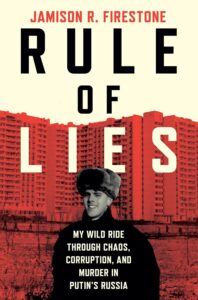
If you reported a quarter-billion-dollar theft from your country’s treasury, you’d expect a medal, or at least a thank-you note. In Russia, you’re more likely to get a cell, a made-up criminal case, and a starring role as the villain in your own whistleblowing story. We tend to think of corruption as a system that’s broken, but the stranger truth is that a justice system can work perfectly well — just for whoever is paying. When the police, prosecutors, and judges all answer to the same buyer, the mafia doesn’t disappear. It just gets a government job. The most unsettling part isn’t that this happens somewhere far away. It’s how easily ordinary people go along with it for as long as life stays comfortable.
Jamison Firestone, author of Rule of Lies: My Wild Ride Through Chaos, Corruption, and Murder in Putin’s Russia, is an American lawyer who co-founded a Moscow law firm in 1993 and spent years representing Western companies trying to play by the rules in post-Soviet Russia. He was also the boss of Sergei Magnitsky, the tax lawyer who exposed a $230 million fraud against the Russian treasury and died in detention after being denied medical care. Jamison takes us from a childhood of crack, contract killers, and his father’s Manhattan brothel, which taught him how to make mobsters laugh and lose interest, to 1990s Moscow. There he fired a protection racket by teaching it about conflict of interest and hired a private SWAT team of Afghan war veterans to raid his own office. He explains how Putin’s 2004 takedown of oligarch Mikhail Khodorkovsky showed Russian officials that the justice system itself could be sold, and why one of his lawyers had to escape over the Ukrainian border on an overnight train. He also describes how YouTube exposés, spread by a then little-known blogger named Alexei Navalny, helped lead to the Magnitsky Act’s targeted sanctions. Jamison also looks back on why he supported Yeltsin’s 1993 attack on parliament, during a crisis that killed his best friend and law partner, Terry. Whether you’re a history buff, a business owner eyeing markets abroad, or a citizen wondering how democracies quietly wear away, Jamison’s hard-won advice to protect the system before chasing the policy of the moment is worth hearing. Listen, learn, and enjoy!
Please Scroll Down for Featured Resources and Transcript!
Please note that some links on this page (books, movies, music, etc.) lead to affiliate programs for which The Jordan Harbinger Show receives compensation. It’s just one of the ways we keep the lights on around here. We appreciate your support!
- Sign up for Six-Minute Networking — our free networking and relationship development mini-course — at jordanharbinger.com/course!
- Subscribe to our once-a-week Wee Bit Wiser newsletter today and start filling your Wednesdays with wisdom!
- Do you even Reddit, bro? Join us at r/JordanHarbinger!
This Episode Is Sponsored By:
- Xero: Learn more: xero.com
- Wayfair: Start renovating: wayfair.com
- Boll & Branch: 15% off first set of sheets: bollandbranch.com, code JORDAN
- FlyKitt: 15% off: flykitt.com, code JORDAN
Thanks, Jamison Firestone!
Click here to let Jordan know about your number one takeaway from this episode!
And if you want us to answer your questions on one of our upcoming weekly Feedback Friday episodes, drop us a line at friday@jordanharbinger.com.
Resources from This Episode:
- Rule of Lies: My Wild Ride Through Chaos, Corruption, and Murder in Putin’s Russia by Jamison Firestone | Amazon
- Jamison Firestone | PEW Literary
- The Corrupt Officers Attempt to Arrest 8 Lawyers | Stop the Untouchables
- Corporate Raiding in Russia: Tackling the Legal, Semi-Legal and Illegal Practices That Constitute Reiderstvo Tactics | RUSI
- Guilty-Oriented Justice: The Chances of Being Declared Not Guilty by a Russian Court Are as Low as 0.15% | Novaya Gazeta Europe
- Khodorkovsky Marks the Spot: Russia’s Turning Point From Economic Freedom to State Control | Russia Matters
- My Goal Is to Crash Russia’s Economy — Because I Am a Russian Patriot | Ctech
- Krysha and the Meaning of Muscle in Moscow | Foreign Policy
- Protection in Russia: Different Providers, but Same Racket | The Jamestown Foundation
- Donald Barr | Wikipedia
- Tatum Shot Dead by 11 Bullets | The Moscow Times
- Questions About the Failed 1991 Soviet Coup That You’re Too Embarrassed to Ask | Meduza
- How Did Russia’s Oligarchs Get Rich From the Fall of the Soviet Union? | History Hit
- Yeltsin Immunity Suggests a Deal Done With Putin | The Irish Times
- Alastair Smith | The Dictator’s Handbook Part One | The Jordan Harbinger Show
- Alastair Smith | The Dictator’s Handbook Part Two | The Jordan Harbinger Show
- What We Know About the Aftermath of Ukraine’s Wildberries Drone Strikes | The Moscow Times
- EU’s Reparations Loan Plan Takes Nothing From Euroclear or Russia, Lawyer Says | Kyiv Post
- Ukraine President’s Estate Included Exotic Zoo | NPR
- UN Report Details Summary Executions of Civilians by Russian Troops in Northern Ukraine | OHCHR
- Caught in the Crosshairs of History | The Washington Post
- Who Was Who? The Key Players in Russia’s Dramatic October 1993 Showdown | RFE/RL
- Hunting Down the Man Who Shot Me | Men’s Journal
- Report: Lawyer Beaten to Death | The Moscow Times
- Death and Tax Evasion: The Strange Case of Sergei Magnitsky | NPR
- New Video of Tax Official’s $40M Fortune | The Moscow Times
- Alexei Navalny vs. Vladlen Stepanov | The Moscow Times
- Bill Browder | Hunted by Putin | The Jordan Harbinger Show
- Bill Browder | Surviving Vladimir Putin’s Wrath | The Jordan Harbinger Show
- Red Notice: A True Story of High Finance, Murder, and One Man’s Fight for Justice by Bill Browder | Amazon
- Freezing Order: A True Story of Money Laundering, Murder, and Surviving Vladimir Putin’s Wrath by Bill Browder | Amazon
- Body of Russian Who Died in UK Contained Poison | Al Jazeera
- Vladimir Putin Probably Approved London Murder of Alexander Litvinenko, U.K. Inquiry Concludes | CBC News
- Putin Bears Moral Responsibility for Novichok Death of UK Woman, Inquiry Finds | The Irish Times
- Sean Wiswesser | Inside Putin’s Russian Intelligence Machine | The Jordan Harbinger Show
- H.R.6156: Russia and Moldova Jackson-Vanik Repeal and Sergei Magnitsky Rule of Law Accountability Act of 2012 | Congress.gov
- Anne Applebaum | Inside the Fortune 500 of Modern Dictatorships | The Jordan Harbinger Show
- Putin Signs Antiadoption Law, Throwing Pending Adoptions Into Confusion | The Christian Science Monitor
- Russia’s International Memorial Society Liquidated After Supreme Court Ruling | The Washington Post
- Russians Feel Strain of Putin’s War With Mobile Internet Shutdowns | NBC News
- The Iran War Has Been an Economic Gift for Putin | Chatham House
- Konstantin Samoilov | Putin’s Russia: An Insider’s Perspective | The Jordan Harbinger Show
- When Russian Democracy Died | Hudson Institute
1389: Jamison Firestone | A Wild Ride Through Putin's Corrupt Russia
This transcript is yet untouched by human hands. Please proceed with caution as we sort through what the robots have given us. We appreciate your patience!
Jordan Harbinger: This episode is brought to you by Xero. That's Xero with an X. Running a small business and managing your finances shouldn't make your day more complicated.
Learn more at Xero.com. Welcome to the show. I'm Jordan Harbinger.
On The Jordan Harbinger Show, we decode the stories, secrets, and skills of the world's most fascinating people. Our mission is to help you become a better informed, more critical thinker. Through long-form conversations with a variety of amazing folks, from spies to CEOs, athletes, authors, thinkers, and performers, even the occasional rocket scientist, hacker, cold case homicide investigator, or tech luminary.
If you're new to the show or you want to tell your friends about the show, I suggest our episode starter packs. These are collections of some of our favorite episodes on topics like persuasion and negotiation, psychology and geopolitics, disinformation, China, North Korea, crime and cults, and more. That'll help new listeners get a taste of everything we do here on the show.
Just visit jordanharbinger.com slash start or search for us in your Spotify app to get started. Today on the show, Russian corruption stops being an abstraction and becomes a pricelist. Jamison Firestone ran a law firm in post-Soviet Moscow, where you could apparently buy the full legal package.
Investigation, arrest, prison, and conviction for one convenient fee. When fellow attorney Sergei Magnitsky exposed a $230 million tax fraud against the Russian government, Firestone's lawyers were hunted, one fled Russia by overnight train, and justice showed up dressed like organized crime because it was. Also, his childhood involved crack, contract killers, Manhattan's most expensive brothel, and a prostitute arriving at a boarding school in a limo.
Somehow Russia was not Jamison's weirdest chapter. Here we go with Jamison Firestone. Jamison, thanks for joining me.
There's a lot of stories in this book that I want to crack open because Russia is crazy and I think people know Russia's crazy, but 90s Russia and early aughts Russia is extra crazy.
Jamison Firestone: Yeah, it was really something else and something I wasn't quite expecting either.
Jordan Harbinger: Yeah, I can imagine. It's Thanksgiving Day, 2008. I'm probably eating something that I microwaved and you're sitting in a hotel.
Sergei Magnitsky, who we'll get into later, I've talked about on the show, he's locked in a Moscow jail. Several members of your legal team are running for their lives, even though they're lawyers and haven't done anything wrong. And the American embassy is telling you to essentially get out of there as fast as you can, I would imagine.
So take me inside the 72 hours in which you realize the Russian justice system is not failing. It's actually just being weaponized and now you're the target.
Jamison Firestone: Yeah. Essentially, my partner in my law firm, Sergei Magnitsky, an employee of mine, had discovered this massive fraud against the Russian government and he had turned in the people who had done it. And normally, if you reported a crime and you said these people stole a quarter of a billion dollars from the IRS, right, you'd be a famous whistleblower.
I've got to get a presidential medal of freedom or something like that.
Jordan Harbinger: Maybe not quite that heavy duty.
Jamison Firestone: The whole apparatus of government would first of all be looking at the accused here and then you would become a hero if what you said was true. But what happened in Russia was the opposite. Sergei blew the whistle on a scam like this.
And then all of a sudden we found that he was arrested. And me being a lawyer, I thought, OK, this is obviously garbage and we'll be able to overturn this. And so I did not get on a plane and run away.
I stayed. And then the next morning, the police started sending these search and arrest teams to the homes of three other of my lawyers. And I realized, oh, my God, right.
Two of them weren't in the homes that the police went to. And one of my lawyers was actually home when the police came and she called me and she said, the police are at my front door. I know it's an arrest team because they arrested Sergei yesterday. What do I do? And I said, pretend like you're not home. Don't make any noise.
Avoid the windows. Turn your phone down to silent now. And what you've got to do is wait, because either they're going to bust the door down and find you there or they're going to go away. And I don't know which they're going to do. But in the meantime, get whatever you can carry and no more than what you can carry in a bag and be ready to get out of there. And so the police left. We sent somebody over to kind of watch the flat from the outside who called us. The police have left. And so we've got this one attorney. His name was Lilia. And we're sitting in Moscow and we get some big criminal attorneys because I wasn't a criminal attorney. I was a business attorney.
And we said, look, what do we do? And they said, look, nobody can protect you from what's going on right now. Obviously, there are some powerful people who don't want Sergei to say what he's been saying. And that's why he's arrested. And what's going on is illegal. And we've never helped anybody run before. But you should run.
Jordan Harbinger: These are defense lawyers who typically don't help people flee justice wherever they happen to be. But they saw the writing on the wall. I wonder.
So what did they know? Because in the United States, I'm also not a criminal defense attorney. But if my client was like, they're going to arrest me and I didn't do anything, I wouldn't be like, oh, my God, you better book a flight to Barbados right now. I'd be like, look, this happens. You're going to go to jail. They'll get you out. Then we have evidence that says you had nothing to do with it. It's going to be a rough ride. You're going to be fine. Not, oh, my God, they're probably going to murder you in prison. That's just not how we operate.
Jamison Firestone: Now, I think what the police were saying is they're going to arrest you and you're going to be in jail for God knows how long. But the difference between America and Russia is that by this time, the justice system had already been weaponized and we had seen that happen. So what would happen is, let's say somebody wants your business, right? They would pay law enforcement for the entire procedure from opening a case against you, investigating the case, arresting you, holding you in jail and convicting you. And so we had seen this happening.
Jordan Harbinger: How expensive was this? This is a ridiculous question. You probably don't even know. But what if I want your ten million dollar business? Do I pay them a hundred grand with the promise of nine hundred more on the back end when I liquidate some of the product? How does that work?
And I assume it's not. Go to this website, StealMyBusiness.RU. Right. So you just what, you know, the police chief and you say, look, I know a guy, I need the rest of you to be on board. We're going to steal this guy's business. He's German. You know, we'll just take it. We'll split the profit. Like, how does that work?
Jamison Firestone: So how it works is there are a bunch of people who have connections with different branches of law enforcement or the FSB, which is like our version of the FBI. So people have connections with these people and they're like fixers, right? You go to them and they use whichever branch they have power with. So you ask the question, how much does it cost? Years after Sergei was arrested, a story ran in one of Moscow's most respected opposition papers. They're investigative journalists. They're very serious. And they said the price for Sergei's arrest was six million dollars. So we have an idea of how expensive it was to have him arrested and to have this case brought against him. So going back to what happened, so there Lidia and I are sitting in front of the defense lawyers in Moscow thinking, you know, the police have just been to her house. They ostensibly were there for a search, but the night before they had arrested Sergei Magnitsky. So we knew they weren't just going to search. We knew they were trying to shut her down. And so they said, look, we can't protect you from this. You've got to go. And so we thought, all right, the safest way to go, maybe they're watching the airports or something. We're going to go over the Russia-Ukrainian border at two o'clock in the morning by train. Easier than it was now, probably. Yeah. Much easier. So we took this terrifying train ride where we had no idea what was going to happen on the border, whether she would be pulled from the train when we went through passport control. Now, luckily, she was not pulled from the train. I can't believe that they didn't find her.
Jordan Harbinger: That has to just be, we don't have a computer system that can get the information to the people at the right time all over nationwide, right? This is just like some weird... What year is this? 2008? 2008.
Jamison Firestone: You're right. And we thought the same thing you did. The reason we took the train was in the hopes that they don't have this unified system. It turned out later, we found out they have the unified system. They just hadn't entered her in. They didn't expect her to flee, right? So we were just very lucky that they were very sloppy.
Jordan Harbinger: The guy who thought she was going to flee was like, yeah, but I really need a nap. I'll do it tomorrow and just forgot. Yeah. That's just shocking, right? Oh, she's not home. Where could she be? She definitely wouldn't leave the country even though she knows we're coming to arrest her. So let's do absolutely nothing to prevent her from doing that.
Jamison Firestone: I don't know. That's just... So all through this thing we were in, one of the things that aided us was that kind of sloppiness because we were dealing with corrupt police who get rich by taking your money and then either arresting innocent people or freeing guilty people, right? So they're not necessarily the brightest people in the world. It's got to be that.
Jordan Harbinger: Yeah.
Jamison Firestone: They're just thugs with money. So we went over the Ukrainian border and it was a crazy situation. We were terrified. We got there early in the morning. The next flight out was like six hours away and Pritish hadn't slept all night. I walk into the first hotel possible. I want a shower and breakfast. I'm like, I walk in with her. I'm like, I need a room for three hours and they look at me, they're like, we're not that kind of hotel, sir. But we freshened up. We flew out of the country and then we just realized here I was Thanksgiving day and Sergei Magnitsky who I've worked with this whistleblower is in prison, is being held in detention and isn't going to get out and that they're treating it seriously enough to try and arrest three more of my people all because we're in possession of information that they don't want out there. And so we really realized that at that point the Russian justice system was not going to defend us unless we could do something where we got the public involved.
Jordan Harbinger: Yeah. Even then, gosh, I don't know. They must have wanted something from Sergei badly enough to dismantle your entire team. It's still shocking to me that the defense lawyers helped you guys with this. I feel like in 2026, maybe that wouldn't happen. Like maybe any defense lawyers left are kind of like my job is to do the will of the state. And even though I'm a defense attorney, I basically am just going through the motions of a free and fair justice system because I'm trying to get into the mind of an attorney and I know you're also an attorney going to law school. It's like your client deserves a zealous defense. The state, you've got to run them through the ringer. Even if you know your client is guilty as hell, you want them to rise to the occasion where they bring every bit of evidence and proof. You can't let them lollygag their way through a prosecution. But in Russia, it seems like, hey, we've decided your client is guilty of whatever something we want his chain of dry cleaners. Your job is to stand there and pretend like you actually are going to do something about it. You're going to get steamrolled. We're going to give you no resources. If you do find something that would absolve him of guilt because there is no guilt, obviously you can't bring that up in court or put that on the record. So just stand there, look pretty, look serious, whatever, and then go home. And that's what I feel like their job is now. Am I overstating that? Am I wrong about this?
Jamison Firestone: So you have it almost right. If you're a defense attorney, there are two kinds of cases, the case that's been bought or controlled by the government and the case that's free. But the function of an attorney changes. So if you think about this, normally what an attorney does is try and develop the winning argument. Right. And then you use that argument in court. And if it's the winning argument, your client gets off. In Russia, it's a two-step process. If the case is political or if it's been paid for, you have to develop the winning argument, which will not win unless your client can make a deal with whoever brought the case. If your client makes a deal like, hey, you can have my factory, right, then I make that argument and my client doesn't go to jail. But if my client doesn't make an agreement with whoever brought this thing, I make the exact same argument and he goes to jail. So in a way, an honest defense attorney will tell his client this is completely bought and paid for. And unless you can come to an agreement with these people, I'm not going to be able to win this for you. I see.
Jordan Harbinger: So they're at least still being honest with their client in those particular cases. They're saying it's like when you tell a client to plead guilty, you're not really supposed to do this, but you tell your client to plead guilty even though they are not guilty at all because you go, look, they have a video of a guy who looks exactly like you. You must have a long lost twin robbing this liquor store. You're totally screwed. I believe it's not you and we have an alibi that says it's not you, but that's not going to work and you're going to go to jail. That seems similar. So it's not that the attorneys are all completely and totally corrupt and bought and paid for. It's just that they're outgunned to the point where there's only so much they can do.
Jamison Firestone: So in this case, they're not saying plead guilty. They're saying we know the case is bought and paid for. And so if you make the decision not to run, we will fight our best for you. But we really don't think we can help you. And you know, there's a train leaving in 10 minutes.
Jordan Harbinger: When I was doing legal clinic work, it was like, hey man, that's not me on the camera. I don't understand how the justice system works. It feels like a bunch of white people throwing people that look like me in jail. And I'm like, my job is to help you navigate the justice system because I'm a professional, a second year law student, but whatever. I'm a professional in training. I'm going to help you navigate this. And in Russia, it's instead of help you navigate the justice system, it's we're going to help you navigate this corrupt nonsense system as best we can. But again, it's a corrupt nonsense system. So it's like a dice roll unless you can make a deal. It's not even a dice roll. It's a weighted dice roll against you.
Jamison Firestone: Exactly. So if it's a true misunderstanding, right, or if it's a regular court case and nobody's bribing, then your lawyers are like, yeah, we'll defend you. Let's do this. Right. But if they know the case is bought lock, stock and barrel, the best thing they can do is tell you we can't win this unless you can fix the real problem.
Jordan Harbinger: Basically, they navigate a settlement with whatever corrupt group decides that they want your chain of dry cleaners or burger restaurants or whatever it is.
Jamison Firestone: Absolutely. And a settlement is not always on the table. Sometimes it's not offered.
Jordan Harbinger: I see. So the settlement is you're going to prison and we're taking your business and you're probably going to die in there. And it's like, oh, crap.
Jamison Firestone: That is often the choice on the table, which is why people run.
Jordan Harbinger: Yeah, that makes sense. OK, so again, it's 2008. You don't have the benefit of 20 extra years of hindsight or whatever, 18 years of extra hindsight at this point in the story. Do you think it's a corrupt group operating inside the government or are you like, OK, the whole government is protecting this group?
Jamison Firestone: So Sergei had discovered this fraud where a group of criminals and Russian officials had stolen a quarter billion dollars from the Russian government. And they, of course, wanted him to shut up, which is why he got arrested. So initially we thought this was just a criminal cell right within the government that we didn't think that Putin was in on it or President Medvedev at that time was in on it. And one thing we certainly thought, even if the higher ups knew about it, right, if we made it public, if we could get Sergei's story out there that officials had stolen from their own government and they had put the brave whistleblower in jail, there would be this public pressure on the police. It's one thing for Putin and Medvedev to know that people are crooks. It's another thing for Putin and Medvedev to know that the whole country knows that these people have stolen public money and you as president aren't doing something about it. So we were trying to create that situation where they were like, OK, we're going to look really bad if we don't act. So we need to act. And so that became our plan after Sergei got arrested when I was in London. How do we create public pressure on this seeming group of bad apples within the Russian government?
Jordan Harbinger: Yeah, interesting. OK, so looking back, had the warning signs been somewhat obvious for years and were you just making a ton of money and you're like, whatever, this isn't going to happen to me? Was there a little bit of that or not really?
Jamison Firestone: Actually, I mean, I had more awareness of what was going on than most people because I ran a law firm. But my practice was a very special practice. It was a practice representing Westerners, many of them Americans, coming from a country where if we bribe, we go to jail in America. So I was representing companies and people who played honestly within the system. And for a long time, they were able to do very well. If the tax department tried to shake them down, they could say, we're not going to pay you a bribe, we'll go to court and we would win. And Sergei Magnitsky, the guy who got arrested, would fight those courses and win cases and win. And the reason they would win is because they were actually heard honestly, because nobody was paying the judges or pressuring the judges to do anything. But I did recognize that if I was in a pond of honesty, that pond was drying up and getting smaller and smaller. When they arrested Sergei, we realized at that point we were in one of these situations where justice wasn't going to work.
Jordan Harbinger: Because he wins a tax case, let's say in 2005, and the tax guy who brought it goes, they didn't give me a bribe because the judge found out and he said, you can't do that. So the next step for me is to go and play golf or whatever with that judge and have a couple drinks and tell him that, hey, next time I bring a case, it's for $10 million. If you want two of those millions, you're going to change your decision. And then that just proliferates throughout the whole system, right? Like, hey, the prosecutor won't help me out. Let me go have dinner with that guy and tell him my business plan for shaking down these foreign corporations. Right. So is that kind of how this happens? Because it seemed like early on it was like, no, you can't ask for bribes anymore. And then suddenly it was like, wait a minute, this is really profitable. Maybe we should reconsider.
Jamison Firestone: I think the way it happened was in the initial years when Putin came in, he did actually set up courts that knew what they were doing. And a lot of people were happy to see that. And we had experienced judges and don't get me wrong, they were still open to bribery. There was an old Russian joke, which is the judge comes out and says, since both sides have paid me equal bribes, I'm going to decide this one on the law. Oh, gosh. But Putin did something really earth shattering in 2004. And that is when the country's richest oligarch Mikhail Khodorkovsky embarrassed Putin on national television, Putin decided to take him out. He weaponized the justice system. And that's what started all of this seriously, because once the government does it, right, once you see the government weaponized the justice system, and once all those people have to work for free over time, hundreds of investigators and hundreds of prosecutors and judges all working overtime to do something illegal to railroad somebody, right? Then they go, wait a minute, we could sell this. And that became the turning point when it all goes very bad.
Jordan Harbinger: Yeah, this is quite interesting. OK, I want to back up a little bit as well. Before you ever encountered Russian gangsters or corrupt police, your father also and I feel bad doing this because you're not your father. But you told me this on the pre-interview and I'm like, OK, I've got to get this. Your father ran some sort of weird fraud, owned part of a brothel, maybe smoked a little crack here and there, surrounded himself with mobsters. He was a character, I guess we would say in modern parlance. So Putin's Russia maybe feels strangely familiar a little bit. I don't know. What do you think?
Jamison Firestone: Yeah, OK, so you're correct. My dad essentially defrauded hundreds of investors in the IRS out of tens of millions of dollars. And while awaiting trial, when I was a teenager, people get nervous and go crazy. And so my dad started doing a lot of crack, crack every day. And he bought Manhattan's most expensive brothel. And he filled our sixth floor brownstone with all the working girls. So I basically grew up in risky business. Wow. And at the same time, he started hanging out with mobsters, contract killers and lunge sharks. And so I grew up understanding these people. I could make them laugh. You have to show them respect at all times. And if you can make them laugh and make them think you're useless, right, they stop pushing you to do business with them. I learned how to get out of doing business with them. And when I went to Russia, I wasn't expecting a really mafia country. But Russia in the 90s became completely mafia, like Chicago in the 20s, with all these mafia groups running around. And all of a sudden you had protection groups extorting money from everybody. And I knew how to talk to them. I've even fired Russian protection groups. Oh, yeah. So I unexpectedly my background came in useful.
Jordan Harbinger: The Russian justice system came as an all inclusive package investigation, arrest, prison conviction. Our sponsors are also bundled, but with fewer kidnappings and, depending on the sponsor, substantially better customer support. We'll be right back.
This episode is sponsored in part by Wayfair. We try to keep things minimal at home, but with kids, the stuff just adds up. So we got an outdoor storage shed from Wayfair to give everything a place and make a little more room in the garage. That's what Wayfair helps you do. Create a home that stands up to real life with quality products, great value and trusted reviews. Wayfair verified products are hand vetted by product specialists using a 10 point quality inspection, giving you added confidence in what you're bringing home. And there are thousands of products across every style and budget, whether you're refreshing your space for fall, transforming it for Halloween, or finally tackling that storage situation. You can use filters, customer photos and reviews to find the right fit for your home. With more than 20 million verified five star reviews, you don't have to figure it all out on your own. Plus Wayfair rewards members get 5% back on every purchase. For us, it started with getting organized. If you're furnishing or refreshing your own space, I'd recommend taking a look.
Speaker 4: Transform your space with pieces that hold up to real life. Join Wayfair rewards today and get 5% back on every purchase. Head to Wayfair.com or shop the Wayfair app for all things home. That's W-A-Y-F-A-I-R.com.
Speaker 3: Wayfair, every style, every home.
Jordan Harbinger: This episode is sponsored in part by Boll & Branch. A good night's sleep affects pretty much every part of your life, your energy, your mood, even your long term health. So it makes sense to do what we can to improve it. But there's something surprisingly easy to overlook. The sheets. They're touching our bodies all night, every night. We spend a huge part of our lives wrapped in them. Shouldn't we put some thought into how they feel? That's what I love about Boll & Branch. They make the entire bed from their signature organic cotton sheets to plush pillows, breathable blankets and temperature regulating comforters. Everything is designed to make your bed feel softer, more comfortable, more inviting. We have Boll & Branch sheets on every bed in our house. In the winter, we love their buttery soft signature sheets. And in the summer, we switch to their cool, crisp percale sheets. Sliding into bed, pulling up the covers, getting comfortable. Ten out of ten. Their cotton is woven specifically for airflow so you can feel cozy without overheating. And 94% of Boll & Branch customers say their sheets get softer with every wash.
Speaker 4: Upgrade your sleep with Boll & Branch. Get 15% off your first order plus reshipping at bollandbranch.com sash jordan with code JORDAN. That's Boll & Branch, B-O-L-L-A-N-D branch.com sash JORDAN. Code JORDAN to unlock 15% off. Exclusions apply.
Jordan Harbinger: There's a little inside baseball many of you may not be aware of. When you use our promo code, it does help support the show. I don't get a cut of the thing that you buy. A lot of people think that. But when sponsors see that the codes are getting used, they're more likely to re-up their campaigns with us. So if you're signing up for stuff, please use our code. Sometimes it's JORDAN, but not always. You can find out to the minute codes, hopefully, on the deals page at jordanharbinger.com slash deals. It's a win-win. You get the discount and you help keep the show going strong. Thank you for supporting those who support the show. Now back to Jamison Firestone.
Jordan Harbinger: I think I told this story on the show, so I'll keep it brief, but my wife's Taiwanese and they have Taiwanese relatives. And I don't know how this story got back around, but somebody they know owns a business. They have a Taiwan-Russia business. And the guy called from Russia and said, the Taiwanese guy, and he goes, these guys keep coming over and they keep saying, you've got to pay us. And these people in Taiwan are like, that sounds illegal. Don't do it. So the next time they came back, he was like, hey, my boss said not to pay you. And they were like, oh, what's your boss's phone number? And he gave them the phone number and they're like, okay, let's go on the roof and call him. And they threw him off the roof and took a photo or a video of it and sent it to them. And they were like, oh my God. And then they're like, yeah, tell the next guy to pay us. So these are scary people. They're not just coming in and, I don't know, breaking a vase and saying, pay us extortion, like they'll kill you.
Jamison Firestone: There is kind of a strange code of honor or a myth that people buy into, right? So they're selling protection. Now, we all understand that what they're really selling is protection from themselves, right? But they're also in a way selling you protection from other groups. So what's supposed to happen is once you're owned by one of these groups, if anybody else comes and tries to hit you up for protection, you just say, no, I've already got a roof. Call them. Here's the phone number. And everybody else is supposed to go away. And they tell you that they help you solve problems, which is a bunch of BS most of the time. So in this case, my client was selling timeshare to the Russians. By a week in the sun on the Canary Islands once a year, right? And he was paying them $100,000 a month for protection. Holy moly, that's a lot of money. So you've got to be super profitable to even afford this. Absolutely. It was a great operation. And one day, a group of their employees stole their database, which is all their clients and all their potential clients, and set up across the street. And so my client goes over across the street to talk to them. And who does he find protecting them? But members of his own protection group, you know, he can't do anything about it. So he calls me and he's like, Jamie, will you help me talk to these people? And I'm like, okay Simon, let's go. So we go to their mafia headquarters, which was a whole floor in an old Soviet hotel. In one of the rooms, you've got the big guy and he's sitting behind his desk smoking for sure. He's got, they all smoke and he's got an L-shaped couch and he's got three heavies on the couch. And I walk in. So the guy's name is Pyotr. I'm like, Pyotr, first of all, I want to say that Simon has been very happy with your relations so far. And you guys on the couch, you guys are the best, but we're just kind of confused about something. Simon gets ripped off by his own employees and he goes across the street to see what happens and he finds your guys protecting them. Now I'm a lawyer licensed by the state of New York. And in America, we have this thing called conflict of interest. A lawyer can't represent both sides. I lose my law license if I represent both sides. And this big guy, he looks at me, he goes, Jamison, this is the difference between guys like you and guys like us. Guys like you, lawyers, always fighting. Guys like us, we keep the peace. No fighting. We keep both sides from fighting. So I said, Pyotr, we owe you an apology. We owe you an apology. We're foreigners. We don't know how Russia works. Simon's from the UK. I'm from America. And we really have to apologize. It's OK. It's fine. Because you've really been great and you guys are really great. It's fine. And I'm like, OK, I'm glad we got that out of the way. Now, we messed up and didn't understand your service. Now that we understand it, it's not the service that we thought we needed. So thank you. We don't need you anymore. But thank you. And you guys are great. And he's like, what? No, no, you don't understand. And now they're trapped by their own logic because they're supposed to be selling you stuff, right? So no, no, no. The next time you need help, it'll cost twice as much. We're like a train moving. You've got to jump on. I'm like, no, no, no. Listen, we understood. We totally apologize. But and if we have a problem in the future, you'll be the first guys we call. But we've got to go. Thanks. Bye. And I walk out. I mean, Simon is like, would you like a yes, a beer now, a drink now. So we went to the bar, had some drinks, 730 in the morning. And then three days later, Simon calls me and he said three of Pyotr's heavies just came into the office. And I'm like, oh, how bad is it? He goes, no, it's great. They've shut down the competing operation. They're returning our computer and database and they're going to do it for half price now. Oh, my gosh. Customer service. Exactly. My client's happy. And I've taught conflict of interest to a Russian mafia group. It's now available for commercially acceptable rates.
Jordan Harbinger: So here's my question. What happened with that? Because why didn't he just say, all right, keep extorting the new guy who stole the computer and then go and beat up Simon from the UK? I imagine he must have gone to the new guy and been like, hey, you're late. And the guy says, oh, I need a couple of weeks to set up my new business. And they were like, screw it. The other guys were paying us on time. Give me the damn computer. Go back, give it to you and go. We need the guy who's actually making money to be our client, not the new guy who's got his head up his ass. Why are you still alive? Is my question, I think.
Jamison Firestone: First of all, it's being out of the box. Mafiosi are pre-programmed. A lot like US police officers, right? The answer is always, yes, sir. You don't argue with the police. You don't argue with the mafia. You show them respect. And they have pre-programmed responses for yes and no. So what you have to do is give them an answer that's not yes, that's not no, and that's very respectful. It's like an improv class. Yes and. You know, it's a head scratcher. And so they resolved this. I mean, sure. I mean, I guess they could have come back and said, you're going to pay us anyway and beat everybody up. But they resolved this is what you said. Wait a minute. We've got a client who is already making money there and we did something kind of stupid, right? We look bad and we did give our word. We look stupid. And so they came back and they resolved it that way.
Jordan Harbinger: Also they had to think, oh, this business that was reliable is destroyed because the guy stole the database and is now competing. So that guy is eventually going to go under. And then we've got to what? Hope the new guy we also don't care about. We just've got to hope he succeeds where the other people had proven that they already could. I mean, once you sleep on it, it's pretty clear, right? So it's just a question of getting somebody to think without getting killed. Gosh, that's crazy. So respectful, funny, and then you've got to be useless enough that they leave you alone or give you the deal that you can afford. You've got to be real careful, I suppose, because you've got to distinguish the situation in which humor creates an exit from which humor gets you thrown off a roof. Yikes. OK. The message is we're not worth the effort or the trouble or the cleanup on aisle three.
Jamison Firestone: That's one message. Or this other message was, look, you just explained to us what you were selling, right? And why this situation is happening, which the guy knows is wrong. But you can't say you're doing the wrong thing. Then you get killed. Right. So you just go along with his logic and say, OK, now I totally see it. It's not the service we wanted because they're still pretending they're protecting you. Right. Now, this is a head scratcher. You've got to go think about it. How do we resolve this in a pretty way?
Jordan Harbinger: This is a little out of your wheelhouse, maybe. But were the mafias in 2008 the same mafias that were around in the 80s or did stuff shift as soon as everything crumbled in the 90s?
Jamison Firestone: So what actually happened was the mafias disappeared when Putin came to power. It's a coincidence. It's not anything great Putin did. The price of energy went through the roof. And when the price of energy went to the roof, because Russia is such a huge energy supplier, all of a sudden this country that had gone completely bankrupt and defaulted on its debt, where every bank in the country had gone bankrupt two years before, all of a sudden hundreds of billions of dollars were falling on the country. And the mafia kind of just assimilated. It all went into business or into government. Putin never made a war on them and they just disappeared. And then when Putin weaponized the justice system, the government became the mafia. The mafia. Right. And they hate competition. Where do you run when the people who are supposed to be protecting you, when that system doesn't work anymore?
Jordan Harbinger: Somebody told me a long time ago, somebody who was like a Central Asia expert. They said in the US or the West, you need the government to protect you from criminals. But in Central Asia, I forget exactly where, it's like Dagestan or something, you know, one of those places. He's like, you need the criminals to protect you from the government. And I thought that was kind of interesting. And I said, that can't really be it. And he's like, no, no, no, no. Like the bureaucracy is so stifling and everything is so broken. You actually do need a mafia connection to even just run a restaurant, because otherwise you're going to get shut down. You're going to get people coming in. The cops are going to get bribes. The health people are going to get bribes. The suppliers are all going to screw you. But if you have a mobster show up with his three giant dudes on the couch, your meat arrives on time and it's the price you actually agreed. And the cops stopped robbing the cash register because the mafia has already done that. Right. They're actually offering protection. I thought that was a crazy place to do business. I wish I did my legal internship and first years of law at your law firm, because it was 2006, 2007, 2008 is when I left and I was doing mortgage backed securities. And what you were doing sounds way more interesting. Too bad. Although maybe I might have gotten in some trouble over there in Russia in my 20s.
Jamison Firestone: Yeah. You never had to raid your own offices with a private SWAT team. So that's true.
Jordan Harbinger: I never had to shred paper and light the shreds on fire or whatever happened in your office. I don't know. Let's go back a little bit again to your childhood. Your dad sends a prostitute in a stretch limousine to pick you up from school and the limo has a stocked bar and the principal is not amused.
Jamison Firestone: First of all, this is a very rich, conservative boarding school, high on a hilltop. All the buildings are built of granite. It's got a chapel with stained glass windows. Right. So this is not kind of a thing that happens. And all of a sudden there are kids running through the halls going, Jamie, Jamie, there's a prostitute in the hall. And I'm like, oh, dad, my dad had her dressed to prostitute to the max. Oh no. His sense of humor. Right. So I get her and I'm like, look, wait in the car. I'll get my stuff. How old were you at this point? So I was probably 15 or 16. Oh man. Wow. The really funny thing about this was, okay, so all my friends know that my dad owns a brothel and that my house is filled with hookers, which made my friends, not the whole school, school found out right then and there, right. But it made me a popular kid. And the great irony of all of this is it's the gay kid who ends up with the brothel. My father having a brothel was the best cover for a gay kid who didn't want to come out of the closet. Nobody in my high school ever asked, why aren't you dating any girls? Right. Don't bring sandwich to a restaurant. Yeah. Oh my God. So this car shows up and I've got the woman in the car waiting and I got my stuff together and I go over the car. I opened the door to the car and just at this moment, the headmaster walks out. And this guy is a hefty guy and he's a nationally well-known educator and generally terrifies the student body, including me. As a matter of fact, he was attorney Bill Barr's father. Oh, wow. Okay. And I'm getting into the car and he just walks up and says, Firestone, isn't it? And I'm like, yes. And he looks into the car and there's the bar and the girl and he said, do you know the rules about having alcohol on campus? And it was instant expulsion. Yeah. And need I even mention rules against, shall I say, women of questionable virtue? Oh, geez. Well, get out of the car. And I had one foot in the car, right? I was just getting in the car and I was just whimpering. I was terrified. I'm like, first of all, dad, you've gotten me expelled. And I'm like, it's just the bar in my car. And he turns to me and he said, Mr. Firestone, and he puts a foot in my car and he goes, the rules are the headmaster gets unlimited use of the bar and first dibs on the woman. And then I'm like, and then he turns to me and I'm in shock. Right. And then he turns to me and he calmly got out, he put his foot out of the car and said, see me on Monday. Yeah. This was a Friday. And he walked away. And I went home, told my dad, what the hell did you just do? And spent the whole weekend worrying that I was going to be expelled, except the headmaster's humor gave me a little hope that maybe I wouldn't be.
Jordan Harbinger: Yeah. You didn't expect him to make a joke out of it, right? This is like some Ferris Bueller principle level angst.
Jamison Firestone: Exactly. So I went back on Monday and he just said, what the hell was that? I guess the whole story of my dad awaiting trial for a crime and his drug habit and the prostitutes, it all just poured out of me. And he was incredibly sympathetic. He just said, look, I will do everything I can do to shield you from the craziness and help you graduate. And he really became my protector and he's got me into Tulane University and changed my whole life. Wow.
Jordan Harbinger: I wonder if there's a straight line from Attorney General Bill Barr's dad protecting you to you later insisting that you had to protect your employees when the Russian state was threatening to arrest and maybe kill them.
Jamison Firestone: When Sergei was arrested, I liked him, I respected him and I was responsible for him. I was his boss. The matter that he was working on was a matter that our company was being paid for. And so there's never any question that I would walk away. And interestingly enough, it was the same for our client who was paying us. Somebody once asked me, so my client, his name is Bill Browder and Bill Browder ran this big hedge fund. And the scam that Sergei discovered essentially involved taking control of some of Mr. Browder's companies and arranging a refund of the taxes that Bill had paid into the pockets of the criminals. Somebody once said, well, you know, what was your decision process like that you were going to go after these people? And we both answered Bill and I simultaneously. We never had a conversation about it. There was never a decision process. It was like breathing. It was I was responsible for Sergei. He was working on Bill's matters. Bill was responsible. We just did it. We didn't spend 30 seconds. We immediately went into from me being in London to how do we get Sergei out? How do we fight these people? Your first Russian bribe is interesting. Tell me about this because I was like, wait, I had to reread this. So actually I was cutting classes because of my whole life was so screwed up with what my dad was doing. I was going to fail Russian. Being cheeky, I asked my teacher after school, I said, do you offer private lessons? And after and he said, yes. And I said, how much they cost? He said, twenty five dollars an hour. And I said, well, how many lessons do I need to pass your course at twenty five dollars an hour? He said ten. So I got the two hundred fifty dollars from my father's wife at that point, who was making porn and stealing radios out of BMWs. As one does. My God. Right. She gave me the two hundred fifty and I came back to school. And I said, here's the two hundred fifty for the ten lessons. And I was standing there because I thought he would then discuss when we're going to have these lessons. He counted the money, put it in his pocket, went back to reading a book, and then he looked up at me after like 30 seconds and said, why are you still here? And then I realized there are going to be any lessons.
Speaker 3: Right. Right. Right.
Jamison Firestone: Oh, my gosh. That was it. So I passed Russian. I'm sure I failed the exam, but I passed the exam. That's how it happened.
Jordan Harbinger: So before you ever moved to Russia, you essentially figured out, oh, OK, this is how things work with this particular guy. But did that register as corruption at the time or was like was this just solving a problem? By the way, was the teacher himself Russian or just somebody who knew Russian?
Jamison Firestone: Yeah, the teacher was Russian. Of course, what I thought it would be a combination of him really teaching me as best as he could and the incentive of two hundred and fifty dollars to pass me with whatever my improved performance was. Right. But he just got to the chase. It's like, I've got the money, no lessons. You'll pass. Get out of my classroom.
Jordan Harbinger: Yeah. She's not doing the stereotype. Any favors that guy just I'm going to turn this into a bribe and not actually provide tutoring. I mean, you would have taken the tutoring. Right. And then just learn.
Jamison Firestone: Absolutely. I was expecting the tutoring.
Jordan Harbinger: Jeez. My gosh. Your childhood certainly taught you to function inside chaos. And I wonder, did it teach you to rationalize behavior that should have made you walk away at certain points or did it arm you for business in Russia?
Jamison Firestone: Both. I mean, one thing it did was arm me so that when I got into a big fight with my partners who were ripping me off and wouldn't leave, I was willing to do things that were crazy like hire the SWAT team. And it also made me intensely loyal. And so like with Sergei. So yeah. So that story, by the way, it was just in the 90s. At that point, we were a law firm, we were a partnership of four people and two of them were accountants. I went to St. Petersburg, Russia from Moscow to open another office. I left two accountants in control of my office. And when I came back to Moscow, I found out that the way they were going to raise our profits was essentially committing tax crimes. And I couldn't get them to stop. And I went to the embassy and the embassy sent me to the police and the police said, let them steal some money first and then we'll help you. But the police obviously couldn't understand the crime. And so I thought, I'll compromise, right? I'll do what the police said, which is I'm going to let them steal some money so that they've actually committed the crime that they're planning. But then I'm going to take matters into my own hand, hire my own private police and raid my office with a bunch of Afghan war veterans and settle this matter. So that's what I did.
Jordan Harbinger: Wow. And did your partner say, oh, wow, this is a really bad idea. People kicked our door down and had machine guns or how did that shake out?
Jamison Firestone: It was actually really funny because he had just attempted to steal another five hundred thousand dollars. He had given the wire order and the wire order was my cue that I secretly stopped the wire. But it set a clock running. It was like in two days he's going to know this money is not coming. So I've got two days to do this. So I got my SWAT team. I raided the offices. We come bursting in the office with this big Afghan war commander behind me. And the first thing he does is calmly look up at me and goes, that money I sent isn't coming, is it? I'm like, no, Konstantin, that money is not coming.
Jordan Harbinger: Hold on. I've got to make a call. I owe somebody four hundred and ninety eight thousand dollars yet. How do you find an Afghan commando SWAT team on short notice? We knew this was coming.
Jamison Firestone: And so it wasn't really on short notice. Any notice at all. How do you find an Afghan commando SWAT team? They were all over Russia in the 90s. They would call themselves like alpha anti-criminal. Right. It was wild. So you could hire these private SWAT teams. Now, interestingly enough, they would often check your legals first. So like, OK, you want to raid this office? Prove to me it's your office first. Yeah. Good idea. You would be talking to these guys, you know, arguing legals with the head of the SWAT team. Right. So you could get the SWAT team to go to the raid.
Jordan Harbinger: Oh, my gosh. This is so insane. It's surprising to me and probably shouldn't be that those businesses had enough clients to stay in business. How many people are like, oh, God, I wish I could pay a SWAT team to raid my own office right now. Apparently, you aren't the only one because there were companies that did this and that's all they did. That's crazy to me.
Jamison Firestone: In Russia, there was always a need for protection, whether it was the protection group that was shaking you down or somebody you wanted to help you out with a problem like this. But there was an infinite need.
Jordan Harbinger: My God, it's amazing to me that with all these armed groups around, there weren't actually shootouts constantly or were there. And I just don't know about it.
Jamison Firestone: So there were quite a lot of deaths. Usually it came when mafia groups were fighting over something. For instance, if you were a television official and you control all the advertising on a station, so there's tens of millions of dollars of advertising, right? If you're not doing what a mafia group wants, your car blows up with you in it. That was happening. So there were a lot of, in the 90s, a lot of people were getting shot. There was an American guy running a hotel business center. He was in an argument with his partners and he ended up getting riddled with seven bullets in an underpass in downtown Moscow.
Jordan Harbinger: Jamison talked a Russian mafia crew into cutting its own extortion fee in half. If he'd had a promo code, he probably could have gotten free shipping. Speaking of discounts, we'll be right back.
This episode is also sponsored by FlyKitt. We're getting ready for a trip to Taiwan with both kids. I'm excited, but also bracing myself because we're tired on a normal day, adding a 13-hour flight, a 13-hour time change, and two kids who don't care what time zone we're in. And jet lag is not just annoying, it's an emergency. That's why we're packing FlyKitt. It's a kit plus an app that creates a personalized jet lag schedule for your trip. When to take the supplements, when to wear blue light blockers, when to get light, when to caffeinate, when to nap, all to give you the best shot at beating jet lag. I was very skeptical to say the least when I first heard about this years ago, but after dozens of international trips, I don't travel without it ever. You enter your travel details, FlyKitt maps out exactly what to do and when, it's based on research with, of course, Navy SEALs, fighter pilots, and athletes, but hey, also with podcasters that are old and get tired when they travel. Anyway, it helps a lot with jet lag and the inflammation that flying can cause. I've used it on brutal time zone trips, and it works every time. Go to FlyKitt with two Ts dot com. Use code JORDAN for 15% off, and let me know how it works for you.
If you liked this episode of the show, I invite you to do what smart and considerate listeners do. That is take a moment, support our sponsors, they make the show possible. You can find them all searchable and clickable on the deals page, jordanharbinger.com slash deals. And hey, if there's a problem with any code, any sponsor, any issue at all, email us jordan at jordanharbinger.com. We're happy to surface codes for you. It's that important that you support those who support the show. Now, back to Jamison Firestone.
Jordan Harbinger: All right, so you arrived, what, in 91, and you're looking for business opportunities, and 11 days later, Swan Lake is on every channel. There's tanks in the streets that are not on any channel. So what does this failed coup, spoiler alert, the coup failed, right? Teach you about how much political power ordinary people actually possessed in Russia at the time.
Jamison Firestone: So interestingly enough, at that particular time, in 1991, when the Soviet Union had worn out all its legitimacy and nobody really bought into it, right, people had a lot of power because essentially Gorbachev was pushing reforming the system. And these hardline KGB guys said no, right, so they kidnap Gorbachev and they rolled the tanks in. They said there are no more reforms, over. And when these people came into the streets, surrounded the tanks, there's people arguing with them. They were just like grandmothers were saying to these 19 year old kids commanding the tanks, we're your grandmothers, we're your mothers, you're not going to kill us, are you? And these kids look miserable. And their answer was no, we don't want to run over our own grandmothers. And so the coup plotters chickened out and Gorbachev was returned. But people still held a bit of power. It was a unique moment in time, but all through the 90s, people actually mattered. Elections mattered. And even though Yeltsin wasn't really a Democrat, he shelled his own Congress because they couldn't agree. But the new Congress didn't agree with him either. When you say shell, did the tanks fire at the building? Yes. They fired at the building. Oh my God. I don't think I knew that. So people had power throughout the 90s. Now, what Putin did was make this grand bargain with the Russian people, which is essentially I'm going to make everything comfortable for you, right? But stay out of my hair. So that was the first thing he told the oligarchs. He said, you can keep your money and your businesses if you don't get involved in politics. Right. And if you don't use your TV and media companies to oppose me. So think about that. In America, we can say that companies may be too involved in politics, but nobody would want to strip all of the richest people in America and all of the American corporations from having a voice. That's not the way a democracy works. You want to make a balance. But Putin said, get out. So Russian citizens have not had much of a voice in the 2000s. And they started to regain that voice in 2010 when Medvedev was president. And there were these huge rallies under Navalny and other activists. But that was pretty much taken away from them after that.
Jordan Harbinger: So Russia, you describe it as a bit of a time machine. You already know what products and what businesses would work there, essentially, because you saw the future in America. So was this genuine entrepreneurial insight or were Westerners kind of arbitraging a collapsed society?
Jamison Firestone: No, some of them were doing that, but not really. What most of us were doing was saying, hey, I didn't know how to do anything. I was a kid out of law school, right? But there were people who had run real estate brokerage firms before, right, or people who had run restaurants. And they were going into, like, Moscow, a city of 10 million people that really didn't have anything and saying, hey, I know how to set up a restaurant or a dry cleaning operation or sell timeshare. And those were very honest businesses. Except for the timeshare. Those are always a f***ing scam. Yeah, I agree. I don't think timeshare is a good investment. And there were people who knew how to work the system and make money off of it, sure. They sold the whole country for what they called vouchers, because everything in the country was owned by the government. Everything from the biggest oil company to your corner shop. And so all of this was privatized for about 130 million pieces of paper. So if you think about that, a Russian company could be worth billions. But 130 million pieces of paper could buy everything. So the people who understood that and understood how to use those papers to buy stuff got very rich. And we call many of them oligarchs today. The rest of us, including me, I didn't have enough business knowledge at the time to know how everything worked. We were just going about our businesses and there were a bunch of poor Russians around. And then like the next month, you've got these absurdly wealthy small group of people.
Jordan Harbinger: I think it was Bill Browder, possibly, who told me they would have these auctions for a big company like the factory that makes tractors. And every employee would go and get their share of the factory. But there would be guys outside that were like, I'll give you a hundred bucks for your share of the factory and a bottle of vodka as a bonus. And people were just like, sure, I don't know what this is. It's probably not worth anything. I don't understand it. So I'll take the hundred bucks and I'll take the vodka. And maybe some people kept it or were persuaded to not keep it for whatever the strong, scary looking guys were that were at the next station outside for that, you know, or maybe they gave him two bottles of vodka. Is that kind of how it worked? That's what it seems like, right? Somebody who just had cash on hand just took all of it.
Jamison Firestone: Yeah, absolutely. So it was one step removed and that one step was important because it's what made it confusing. So if you worked for a company all your life and somebody gave you a piece of it, you might have an idea of how much that piece is worth. But the Russian government didn't do that. What the Russian government did was give everybody one piece of paper and say, you can use this piece of paper in an auction to bid on everything, but you only get one piece of paper. So you've got to go to an auction, understand how the auction works, right? And say, I'm going to use this piece of paper to try and buy some shares of this company. And that was too complicated for people. Oh, so it was like a stock option, essentially, which is already confusing. It was like a stock option on the whole country. So people didn't know what they were worth and people went, I don't know how to use this piece of paper. A bottle of vodka sounds good to me. And it wasn't always strong arm physical tactics. Sometimes what a big factory director would do if it was like a factory town with 300,000 workers, right? It's like a huge town. It's like a mini city. The factory director would just stop paying everybody for two months until 300,000 people were starving and all the families depending on them. And then he would offer cash for their vouchers. Then when they sold the vouchers, he'd start paying everybody again.
Jordan Harbinger: And then that guy was a billionaire immediately because he owned the Volga plant or whatever. OK, geez, that's crazy to me. I can't relate to this level of graft, really. And also heartlessness. Yes, exactly.
Jamison Firestone: You have 300,000 people dependent on you and what you do is starve them and their families out so that you can defraud them.
Jordan Harbinger: Exactly. I can't get there mentally. Do you think the disastrous economic transition made Putin possible or do you think that kind of lets Putin off too easily?
Jamison Firestone: It completely made Putin possible because essentially what happened was Russia devised this plan, as we said, to sell the whole country for 115 million vouchers, which nobody understood. And so some people got very rich. Most people, almost all people, remained pretty poor. And there was this constant economic insecurity with these mafia groups running around and the government was broke. Government had no money. So the government couldn't protect anybody. And then the graft Yeltsin and his family were not completely honest. His family was completely corrupt. And so at the end of 1999, this old alcoholic president who's just had triple or quadruple bypass surgery, he knows he's not going to be elected again. And he knows that he and his whole family are going to prison. And so he literally just made a deal. He went on TV on New Year's Eve of 1999 and wished all of Russia a happy new year and a nice life. And he resigned on national television and made Vladimir Putin president in exchange for pardoning him and his family. And so Putin wasn't inevitable. And then the next thing that led us to where we are today, Putin is perceived as bringing order. There's no war on the mafia. He didn't bring order to Russia. Russia got rich because of the price of oil. And so once Russia got rich, it had money to do stuff. But the way Russian people see it is Putin brought order to Russia and that if it wasn't for Putin, we'd have all these mafia groups running around. And so as long as it's comfortable, as long as they're making money, Putin can take away as much of their rights as he wants. And so that's what he's had until now.
Jordan Harbinger: That's always the deal with authoritarian rulers, right? As long as my cronies or the stakeholders, whatever you want to call them, are doing well, then I'm fine. And you can see that crumbling, like with the Syrian civil war, like that stops happening slowly over time and then quickly all at once. And it seems like that's the story in Russia, too, right? These elites that essentially don't have enough power, of course, but also they're doing either really well or well enough where it's like, you know what? This is fine. It's not worth going outside and getting shot by the military. That's for sure.
Jamison Firestone: Also, the elites have been great. But what Putin essentially did was promise the population at large a good and comfortable life in exchange for giving up their freedoms. And because so much money was falling on Russia, that promise was delivered year after year in the 2000s. And normal people got rich and did well. And Moscow has a real middle class. And so as long as everything's ticking along nicely, who cares what happens to the gays or immigrants? Or as long as normal Russians can do their thing, everybody's fine. And who cares about those troublesome democracy activists? It doesn't matter. I have money. I have a nice car. I can vacation in Thailand. And so Russians let Putin do that to them. Now the question is, he's dragged them into a war with over a million casualties, right? And if he has to draft Russians, I don't know how happy Russians are going to be about dying on the Ukrainian front for this. That wasn't part of the deal.
Jordan Harbinger: Yeah, I wonder about that myself, because your middle class lifestyle doesn't matter if your kids are dead, right, or getting blown up by drones. You'll definitely start paying attention then. Look at what happened with these wild berries, which are essentially Amazon warehouses. There's literally people crying on social media. And I shouldn't ridicule them because in many cases lost their life savings, right? They had a business selling, I don't know, iPhone cases or something like that from China or India. And now they're on fire. But the irony is, oh, now you care about the war. Before you didn't care when it was a hospital full of kids. They were all the way over there. Now your iPhone case crates are on fire and you're crying on TikTok. I don't have a lot of sympathy for you.
Jamison Firestone: Yeah, absolutely. So, I mean, my job today, what I do is out of choice, nobody pays me for it, is to make Russians feel the war, to develop measures through sanctions to make Russians feel this, because you're absolutely right. Russians drop bombs on hospitals in Kiev. They drop bombs on schools in Kiev and they go live their lives all nice. And then when something blows up in Moscow, and here's the terrible thing. This happens with people who I genuinely love. Some of my closest friends in Russia, I will say to them, they know what I do. They know that I'm trying to use sanctions to economically squeeze Russia. And they know that I'm trying to take vast amounts of frozen Russian government money and give it to the Ukrainians so they can stay in the war. And they're like, what you're doing is only going to cause more people to die. If you would just stop doing that, the war would end. And I'm like, OK, so think about that, right? If America were being invaded, right, the easiest way to stop Americans from dying is just give the country to the invader. Is to surrender, right? Yeah, exactly. Right. No, the easiest way to stop the war is you, Mr. Attacker, stop.
Jordan Harbinger: Get your government to stop. Right. Well, the problem they're really having right now with that whole thing is Ukrainians already have plenty of experience living under the thumb of Russia, and it was not a good deal for them. Right. You look at the tens of millions of them who died because of Russia starving them or mismanaging their economy or just oppressing the crap out of them for decades at a time. They already know what to expect from something like that. I'm not saying America could be convinced to surrender either. But if a country invaded Burma, right, Myanmar, you could say, look, we're getting rid of your super corrupt government. Or when the Vietnamese invaded Cambodia and they had Pol Pot and the Khmer Rouge. You could say, we're getting rid of this government that's killing you by the millions. Plenty of people are going to go, well, it really can't get any worse. Right. Ukrainians are like, hey, we were leaning towards Europe. We have a pretty decently functioning society compared to how it was 20 years ago. This is going to get much worse. They look at Bukha and these villages that were everybody was murdered, and they're looking at their sons and kids getting droned by Russia and blown up. And they're like, no, this is the beginning. This is all they can do to us right now because we're fighting back. Imagine when we can't, when we've stopped. So they know what they're up against.
Jamison Firestone: Yeah, absolutely. I mean, in 2014, when all this started, there was a pro-Russian president of Ukraine and the country wanted to get closer to the EU. And Putin put a stop to that, which caused riots. And Putin's advice was kill everybody in the streets. And they started killing people in the streets and people rebelled and this guy fled. And then they, it's like out of a movie, they storm his presidential complex outside of Kiev. And there's this fantasy land. The guy had giraffes, right? And the guy had 40 cars or something. And so they don't want the corruption, but they're facing corruption now. They know that they have corruption in their country. But like Americans, they don't want somebody else running their country. They don't want to be Venezuela with America running the country, right? They want to be Ukraine, and we're running the country, not taking the orders from Moscow. And you're completely correct. So they made this decision to fight. And then after what Russia did after the invasion with Bucha and Irpin, and they've seen Russian slaughtered innocent people, tied them up and shot them in the back of the head. There's no going back. Nobody's going to put up with this. They'll fight to the last man.
Jordan Harbinger: Yeah, it's really, it's super sad. My Ukrainian friends have these really morbid senses of humor, and one of them said something along the lines of, hey, if someone's going to run this place into the ground, it's going to be us. We don't want them controlling everything. If we're going to set this place on fire, I'm going to be the one who's going to light the match. Not some guy from St. Petersburg. It's so dark. All right. Before we talk about what happened to your friend, Terry, who was he when there wasn't a revolution happening outside?
Jamison Firestone: Okay, so we're going back to 1993. So I arrived in Russia in 1991. In 1993, I finally found what I would be good at, which was using my knowledge of how to do business in Russia and my legal knowledge to run a law firm. So I called my best friend in the United States who was graduating law school, GW Law, and I said, Terry, how would you like to come over to Russia and start a law firm with me? And he said, well, you know, I don't know anything about Russian law. I said, well, nobody else knows anything about Russian law either. It's all new. They're writing everything from scratch because all the Soviet stuff doesn't work anymore. And so he came over and we founded this two-man law firm to help foreigners do business in Russia, set up their companies and get going. It just so happened that while we were doing it, it was at this time of instability that we talked about where the government was pushing ahead with these reforms to privatize everything in a way that most people couldn't understand or follow. So some people were getting rich, most people were getting poor. And there was this huge schism developing between the Yeltsin government that wanted to push these reforms forward and his Congress, which was mostly communist, that wanted to slow down or stop the reforms. And so Terry was my dear friend. He was my law partner. And we were working in this environment while there was becoming this standoff between the presidents of the country and his Congress over the reforms.
Jordan Harbinger: So during the constitutional crisis, you and Terry become separated outside the Russian White House. You go home. He used to be an EMT, right? So he climbs into a truck heading towards the TV station. Was he trying to help people? What was the story there and what happened after that?
Jamison Firestone: So there was a standoff and the Congress actually lawfully impeached the president and the president wouldn't leave office and he illegally dissolved Congress, who also wouldn't leave. So what ended up happening was Congress said, if you support the Congress, come to Congress, come support us. And there were tens of thousands of people surrounding the building that Congress was in. And Terry and I had gone down there to kind of check this situation out. And the vice president, who supported Congress, got up on a balcony and he said, I am the legal president of Russia. Yeltsin has been impeached. Go to the TV station. Take the TV station. Tell the nation that Yeltsin is out and I am the legal president. And that's when the trucks pulled up and everybody started getting into these trucks. Now, I had gotten separated from Terry because there were just so many people. And the decision that I made was right or wrong, if the Yeltsin government doesn't kill those people who went out in those trucks, there's not going to be a Yeltsin government tomorrow. Terry made a different decision, which was just to get on one of the trucks. Now, I don't know what was motivating him when he made the decision because I wasn't with him. But when he got to the television station, Yeltsin snipers started shooting at the people on the trucks and not just at the people in the trucks, but also at all the journalists who were covering what was going on at the bystanders, just people on the streets. And it became a shooting gallery and there were a lot of wounded. And that's when Terry put his EMT skills to work, his paramedic skills. And he was rushing out, out into the field of fire, grabbing the wounded and bringing them back to ambulances. So he got 12 people out, wounded people out. And he went back for a 13th guy. He was a 24 year old American photojournalist who had been shot twice. And while Terry was in the process of trying to help him, Terry was killed, but the photojournalist lived. God, it's so tragic.
Jordan Harbinger: I just, I can't get there with some of these people. Just, hey, shoot everybody who's in front of the building. There's EMTs trying to save people. There's press trying to cover it. Yeah, I don't care. Just shoot everyone and then the rest will go away. You really have to be at your core, a heartless authoritarian bastard to do stuff like this. Like you just have to not value anyone's life other than your own.
Jamison Firestone: And not just the government who ordered it, but the snipers. As a matter of fact, the 24 year old photojournalist, when he recovered, went back and tracked down the sniper who shot him and killed Terry. And the guy was just nonchalant about it. He goes, oh, are you talking about the guy wearing that baseball cap that I killed? Just very nonchalant. Yeah, doesn't care.
Jordan Harbinger: Just, I've got to think you just have to screen for complete psychopaths for whatever police force does that. And it's like, oh, do you enjoy killing people who haven't done anything wrong? Oh yeah, that's me. All right. We've got a job for you. Like, how do you even screen for those people who don't hesitate to kill a random unarmed person who's definitely in your country, not invading, especially somebody who's carrying wounded people. You'd think like, okay, I have a thousand targets here. You really have to be not just heartless. You have to actually be an evil person to do that.
Jamison Firestone: America, for all of its problems with police brutality and ICE, America does in normal times devote an awful lot of time to training police officers how to deal with situations And also we have rules of war. And in Iraq, when our soldiers committed some war crimes, we prosecuted them. It's not that bad things don't happen, but at least America makes an effort to train people not to be this way. Russia doesn't make that effort.
Jordan Harbinger: Clearly not. Oh man. The firm was still at that time called Firestone Duncan, right? You didn't remove his name from it, but you had to finish your client's work. I'm surprised that you returned to Moscow to finish your client's work and then close the firm. I can understand. But why did you accept any more assignments after that? You must have just been like, you know what? I'm not going to quit because that's what they want us to do.
Jamison Firestone: Actually, I was going to quit. Yeah, that's what a smart person would do, Jamison. So I had taken clients' money and I had spent it doing their work, but I wasn't finished with the work. And I had also borrowed some money from friends to fly to the funeral, which was back in Atlanta, Georgia. And so my plan was to go back to Russia, finish the client work that I had accepted, pay my friend back, and then go return to America. But a funny thing happened, which was I didn't have anywhere to return to. My dad was now an ex-con. My relations with him were terrible. I didn't know how to do anything in the States. I did have a law degree, but I had a business that was functioning in Russia. And so somebody called me, a new client, and asked me to do something. And I realized while I was talking to that guy, if I take this, it means I'm staying. And if I don't take it, where am I going to go and what am I going to do? And so I just took it.
Jordan Harbinger: I guess that was the only option. Although I was 20-something once, right? I might have done the same thing. But it's got to be one of those things that you just do when you have no kids. And again, there's nobody waiting for you somewhere else, because otherwise it's a crazy choice on the face of it.
Jamison Firestone: But also you have to realize that what had happened in those few days was an anomaly. It was like January 6th, right? We don't have January 6th every day in America. There was a constitutional crisis and there was fighting involved in that. When the crisis is over, that risk is gone.
Jordan Harbinger: Nothing cleanses the palate after corrupt cops contract killers in a brothel on a brownstone like hearing from a company legally required to actually deliver the product it sold you. We'll be right back. Don't forget about our newsletter, Wee Bit Wiser. It is practical, actionable, on many a Wednesday, and it's an under two-minute read. JordanHarbinger.com slash news is where you can find it. Now for the rest of my conversation with Jamison Firestone.
Jordan Harbinger: I'm trying to put myself in your shoes, and I'm just like, what would I do? You know, my parents would be losing their minds, and I don't know if I could do that to them. But again, if your dad is in jail or something like that, and you're like, what else am I doing? I guess the choice makes sense in that context. I want to distinguish the 90s mafia era from Putin's system, because in the 90s, right, criminals, they might threaten or shoot someone or whatever. Under Putin, though, the state's machinery is that's performing the theft. The police, like you said, sees the documents. The investigators fabricate the cases, the prosecutors approve the cases, judges produce whatever required decision, and then corporate assets change hands under like a formal legal cover. But why bother with this expensive farce if you're Putin? Who cares? Everyone knows you're corrupt. Why are you sharing even the money with the police and the investigators? Why don't you just have your own people just do this? Or is that effectively what it is? Because it just seems like a lot of work to cover up an obvious crime.
Jamison Firestone: Yeah. So it works like this. Everybody in the government has a scam. So if you're a police officer, you make money by being paid to arrest the innocent and being paid to let the guilty go. If you're a tax collecting officer, you figure out a tax scam. So first of all, everybody's got their own scams going on in the government. Right. And it's not like Putin necessarily knows what's going on or gets a piece of everyone. And of course, Putin's got his own scams going on. Right. Russia has been very formalistic since anybody can remember. Everybody who got shot under Stalin had a trial first. Right. Why do that? Sure. It's just the way they operate. So Russia's always been very formalistic. They have to have some fake legal mechanism to take. But as you mentioned, so in the 90s, it was a guy with a gun. They made you an offer you couldn't refuse. Now it's a criminal case where they come to you and they say in a way that you will understand that this is bought and paid for or this is being brought by the powers that be. If you give us what you want, this goes away. And that's how they steal.
Jordan Harbinger: So Sergei Magnitsky, back to him for a bit here. He's arrested. He's pressured to implicate you and Bill Browder. And he starts documenting his treatment in prison. He's deteriorating health. I think he had a kidney issue, was it? Or something like that. He had an illness that he wasn't allowed to get treated for.
Jamison Firestone: Exactly. I mean, essentially, it's like taking you. I assume you're reasonably healthy now, but they take you and they put you in a cell that's squalid. That's either five degrees below zero or 98 or 102 degrees hot. And you live in this dirty, squalid condition until you get sick. And then as a punishment, when you need the doctor, you don't get the doctor unless you do what they say. So that's essentially what they did to Sergei. So he developed pancreatitis and gallstones and he got to the point where he just he needed an operation. Now, it's like, look, it's like an appendicitis is a really simple thing. It's an easy operation. But if your appendix bursts, you're going to die if you don't get immediate medical care. So it was one of those.
Jordan Harbinger: Yeah. So dies in custody November 16th. This is 2009. And then there's this effort to basically rewrite his role in the fraud. Right. This is him. And that's why he went to prison. And then he died. This is like the Navalny thing, but even more sort of sinister in that they're saying, oh, this is all him. Right. He did it. Was that not the story?
Jamison Firestone: Yeah, absolutely. So if you think about this, these criminals that included Russian government officials stole hundreds of millions of dollars from their own treasury and Sergei exposed that fraud. There's no question that the fraud happened. So the only way for them to protect themselves is say it wasn't us. So they wanted Sergei to say it was Bill and he wouldn't do that. And so they basically killed him. They kept trying, pushing and pushing until he broke. But they're still stuck with the problem that the money has been stolen. So they have to create this alternate narrative. Right. So the alternate narrative is that Sergei, Bill and I stole it. The people who purported it are the people who stole it. And that became the narrative of this group of people. But you asked a really good question before, which was, do you think it was just a group of people or do you think it was the Russian state? I'll tell you when it became the Russian state, when there's no question that it was the Russian state. So they've created this narrative. And initially it is this group of people, but we tried to bring public pressure on them because, as I said before, we understood the legal process wasn't going to work unless we could bring public pressure. So the way we did that was we started to make these YouTube videos showing what the various corrupt officials stole and how they use their power to arrest and kill Sergei, the whistleblower. And so we had these amazing videos where people who are making fifteen thousand dollars a year have three million dollars worth of stuff and a fleet of cars and they're in all these cool restaurants. And the tax inspectors who look like three grandmothers who signed off on this return ended up with like forty something million dollars and houses in Dubai. And we're showing these videos at the same time as we're making all our police complaints. And the whole country is going, wow. And the guy I found to distribute these videos was this popular blogger. He wasn't like a nationally known figure, but he was popular. That was Alexei Navalny. So I showed him the videos that I was making. He went, wow, this is so cool. I've never seen anybody go after these bastards. It's like I'm going to get so sued by distributing these, but I want to do it. So he distributed the videos for us. And eventually he started making his own videos, which were bigger and got more views. But still, with the videos and with people watching and getting a few million views, the government was still exonerating these people. And so that's when Bill Browder, my client, he's like a Bruce Wayne like figure. Picture this really wealthy guy who hangs up his business and becomes a justice crusader. And that's what he did. So Bill gets this idea, if we can't touch them in Russia, why don't we create sanctions that touch them abroad that make it so they can't travel and freeze their stuff?
Jordan Harbinger: It's going to be embarrassing if you've got a villa in Lucerne or Switzerland, right, or something like this. And you go, hey, you know, that guy that owns that villa, he makes twelve thousand dollars a year. His Rolls Royce is parked in the driveway. So do you think that he spent his life savings on that? Oh, no, his daughter owns it. Oh, that's interesting. She's 17. What do you think she does for a living? Like it just starts to be like, oh, we look really bad right now for not doing a quick Google search.
Jamison Firestone: You've captured the moment. But so we wanted to have a sanctions regime where we could freeze their money, freeze their houses and say, hey, you can't visit your stuff anymore and you can't sell it. That was when it was like the eye of Sauron on Mount Doom turned to us, right? We caught Putin's attention and all of a sudden Putin was like, listen, whatever funny business is going down there with people having stolen some money and people having killed somebody and videos, I don't care. But if you're going to make it so that I can't touch my money, I care about that a lot. And so the Russian government took this narrative devised by the criminals blaming the crime on us and made it their story and used the whole apparatus of the Russian government to try and get us.
Jordan Harbinger: That's got to be a scary moment when you realize, OK, now Vladimir Putin wants me dead. Don't you think about this? Because he goes after people in London who are sitting around on a park bench with their daughter. Right. And he has guys fly in from St. Petersburg or whatever and put some kind of custom poison on them and kill them. That's really scary. He poisons former KGB or FSB officers with polonium 212 or something like that so that you know it can only be him. And they die this crazy, painful death for saying something. I mean, you just went and got yourself a tea. You've got to think about that every single time. I was joking with Bill Browder. I was like, hey, man, when you drink tea and you've just, I don't know, talked to a Russian person or flown through Europe, he kind of made a joke like I always bring my own tea or something like that. That's kind of not that funny if you think about why. Right. It's terrifying to think that you're one sip away from a horrific death.
Jamison Firestone: You're correct. And so one of my movies had been based on information given to me by a Russian who fled Russia and began living in the UK. And this guy was found dead here in the UK at 43 years old. And when they did an autopsy on him, they find this extract of a plant that only grows on the foothills of the Himalayas called heartbreak grass that kills you. Right. And so this happened in London to the guy who gave me the documents for proving what the tax inspectors stole. So it's very personal and it's very scary.
Jordan Harbinger: The fact that they had somebody go there to do it, think about how they did this. They had an intelligence agent or whatever operative go to that area and collect that or they bought it somehow, but they wouldn't want to do that because it would be somebody would say, hey, someone's trying to buy poison grass. You send somebody to go collect that, you send it to a lab, someone turns it into a poison. That person then what, flies to the UK to figure out how to get that guy to ingest it? That's just like Bond villain level.
Jamison Firestone: Yeah, apparently that's what they do. And with the scripples, right, they sent two agents who had a fake perfume bottle, but it was filled with a nerve agent and they sprayed it on the guy's doorknob and then they took the bottle and just tossed it in the trash. And so the guy who touches his doorknob, he goes into a coma. His daughter goes into a coma. The police officer who shows up at his home to investigate goes into a coma and they live. But some guy weeks later finds that bottle of perfume and gives it to his girlfriend as a gift, sprays it on herself and dies.
Jordan Harbinger: He was homeless, as I recall. And he gave it to, he found a full bottle of perfume, which is an epic find. Yeah, gave it to his girlfriend and she sprayed it on herself and died. They don't care about anybody at all. So again, you have to scream for the absolute most psychopathic people that you can find. I'm going to go to another place and kill this guy, maybe his daughter by accident. Why? Oh, he offended my boss's boss. Once in a way, that was pretty bad.
Jamison Firestone: That's basically a Putin considers him a traitor.
Jordan Harbinger: They kill him. Just nuts. So the Magnitsky Act, maybe you can briefly explain what that is. This is an unusual response. Right. So instead of sanctioning an entire country, it targets these individuals, as you were saying earlier, with visa bans, asset freezes. Why is that more threatening to Putin's system rather than diplomatic condemnation or something broader?
Jamison Firestone: You can laugh off a diplomatic condemnation, but when your money sitting in a foreign bank account gets frozen, when you can't use your house and your yachts, that's a whole different thing. I think that Putin never in a million years thought that we could do anything against corrupt Russian actors. Right. But their vulnerability is that they keep their money here and they like to come here and they sent their kids here. And so taking that away from them is very powerful.
Jordan Harbinger: Yeah. You know, it's funny to me is people right now, some people might be asking at first, why do they keep their money in the West? You know why? It's not safe to keep your money in Russia because somebody will steal it from you. That's how they got rich in the first place. Right. They stole someone else's crap, probably. And they're like, oh, OK, first thing I'm going to do is make sure I don't keep this money here. Sort of reminds me of wealthy people in China. And they're like, I've got to buy real estate in Vancouver. Why? I got this from basically means that might not be available to everyone. And I want to make sure that I keep some of it. And the safest place to do that is in the West. That place we complain about constantly and say is terrible. That's the safest place to invest and keep our money. It's just so ironic. But you see these people robbing their own state. It's so cynical, right? I'm going to rob my own state, but I don't want to keep the money here because this is a sinking ship and they're the rats that are on it. So I get these emails when I have Bill Browder on or I'll get him after this episode too. Oh, these are foreigners that took advantage of Russian instability. They deserve to have their stuff nationalized. Oh, wait, let me stop you right there. It wasn't nationalized. It wasn't given to the Russian people. The two hundred thirty million dollar tax fraud wasn't reinvested in the Russian economy. It was supposed to go to the Russian economy. It was taxes. And then it went to, I don't know, some guy's bank account in the Caribbean through a shell company. They're robbing Russians. They're not robbing foreigners to give to Russia, which is the narrative they like to pull when stuff like this comes out.
Jamison Firestone: Yeah, you're completely right. First of all, they keep their money abroad safe from the system that they built. And the second thing is, yeah, Bill Browder's companies paid half a billion dollars in taxes. And this corrupt group stole back half of it, stole it out of the Treasury, stole it out of the pockets of retirees and schoolchildren and hospitals. That's what they stole. Bill did the right thing, right? Bill paid half a billion. You've got to admire somebody who pays half a billion dollars in tax.
Jordan Harbinger: Yeah, that's a hefty sum. And just the retaliation against the Magnitsky Act, Russia blocks American adoptions, including cases that are already underway. So basically he says, hey, there's orphans that are going to grow up in a really terrible, underfunded orphan system here in Russia and nobody wants to adopt them. And they're going to be adopted by wealthy upper middle class or whatever middle class American and foreign families. And they're going to have a great life. And Putin says, you know what? No more of that. And that really says it all, right? This just reveals authoritarian systems choose hostages based on just pure utility. It doesn't matter if it's a seven month old baby who's going to probably live a painful life, short life, miserable life, potentially in an orphanage and die young. It's like we could fix that. No, I'd rather just thumb my nose at the West. I don't care if hundreds or thousands of babies die as a result. Doesn't matter. Totally an afterthought. The consequences. You arrived in a Russia that briefly seemed freer and more hopeful than probably almost anywhere on earth at the time. Right. I mean, it was just the hockey stick upswing of this place was just going to be envied by everybody. What would have to happen for the Russia that you, Terry, Sergei and millions of Russians imagine? What would it take for that to become possible again?
Jamison Firestone: It takes a real loss of belief in Vladimir Putin. Right now, as I said, people see him as he is the man who brought stability, who saved us from the terrible 90s. Right. If that stability is destroyed, such as if the Russo-Ukrainian war starts to really make people uncomfortable in Russia, people are going to scratch their heads and say, why are we in this position and shouldn't we have a voice? Why don't we have a voice? Nobody's arguing about not having a voice while everything's good and they can buy their cars and travel. But as soon as things aren't so good, people are going to want to exercise a voice. And when they don't have it, I think that's when things start to change. And it's going to be slow because you have to remember that Putin's been president for 25 years now. And so this system of corruption and thuggery is embedded. There are people who remember that amazing moment of freedom when the Soviet Union fell because they stood in front of tanks. There are people who remember marching in the streets with Alexei Navalny, but there are a lot of people who didn't have that experience. And so even if we get rid of this government, which I hope we will, it's going to be quite a while before you have a lot of people thinking in a normal manner again.
Jordan Harbinger: That makes sense. There was a person that I saw online. They were talking about Belarus, so it's a little different. But he said something like, when I was born, Alexander Lukashenko was president. When I went to high school, Alexander Lukashenko was president. When I graduated from college, Alexander Lukashenko was president. When I got married, Alexander Lukashenko was president. When I had my son, Alexander Lukashenko was president. I just had my daughter, Alexander Lukashenko is president. And it was like, oh, yeah. His point was, how can I imagine that anything would be different for my kids than it was for me, essentially?
Jamison Firestone: He's been president for 25 years. And the fact of the matter is democracies don't have presidents for 25 years.
Jordan Harbinger: If Putin vanished tomorrow, what is the first lie that Russia would have to confront before it could begin to heal?
Jamison Firestone: Russia has a lot of lies that it has to confront. But I think the most immediate lie is that this war on Ukraine was a complete war of aggression, that nothing justified it, and that Russia has committed terrible atrocities, which they don't admit to. Normal Russians think that all the bodies in Irpin were faked in Bucha. They're told that Ukrainians destroy their own cities. So there was a time when the Russians under Yeltsin were beginning to come to terms with their past, this horrible gulag concentration camp system they had and the tens of millions of their own people that they killed. And Putin told them, stop worrying about that stuff. The only thing that matters is being strong, being respected. And so they've got to come to terms with the mistakes and the atrocities. And certainly what they've done in Ukraine is the most immediate one.
Jordan Harbinger: What do you think is the first sort of pressure point inside Putin's system that's most likely to crack? And when will we see that process has begun? What's going to be the sort of first thing to show?
Jamison Firestone: It could be resistance to a draft. For the first time, you're seeing criticism. It's kind of polite criticism, but you're seeing social media influencers saying things, always being respectful to Putin, but maybe you don't understand that people are feeling this way. And that's the first grumble, right? You even got a few people who've openly said this is bad and you need to stop this and they go to prison. So a draft could bring that out. And the other thing is just financial stuff. You mentioned before that people are seeing stuff getting blown up in Moscow. And so Wildberries, like their Amazon, gets hit. And not only do people not get their deliveries, but all those small sellers who have their businesses in Wildberries, they're out of business, right? There's no mobile Internet on the streets most of the time now.
Jordan Harbinger: Is that still off? They've just turned off mobile data because it's been, what, like a year of that almost?
Jamison Firestone: It goes on and off, so they can't use the equivalent of Google Maps or Uber or even send their friends cute cat videos as they walk down the street, right? That's because those signals can be used by the drones. And so they shut them down. And in addition to that, you have other things. The airport shut down. So you've planned your yearly holiday, but you can't fly because the airport shut down because there are drones in the air. All these inconveniences are making people very frustrated. And so if we're successful with the sanctions, and I think we will be, it took Russia five years to do it, but they've burned through their money. They've burned through all their surplus money. The thing that's keeping them alive right now is high prices created by the war in Iran. But if that economic hardship comes back because of sanctions, we're also going to see something. So that's where we are.
Jordan Harbinger: You watched a hopeful society lose its rule of law gradually while most people continued living somewhat normal lives. What do you think Americans should be looking for here that you wish you'd recognized earlier in Russia?
Jamison Firestone: All right. It's a great question. In 1993, Yeltsin wanted to continue his reforms. His Congress opposed him. And he ended that by shelling his Congress and forming a new Congress. I supported that action, even though my best friend got killed in the firefight. America supported that action. We all supported that action because we thought reforms were important in the way to go, but it was an undemocratic action. It was overriding the democratic system. And what I've learned is if you override the democratic system, if you weaponize the justice system to get what you want, whatever it is, for gay rights, against gay rights, for guns, against guns, if you override the justice system because you want to push your policy of the moment, right, you may get your policy of the moment, but you destroy all the institutions that protect all of us. So I stupidly supported Yeltsin shelling, even though it cost me my best friend. But then the casualty of this wasn't just my best friend. Reforms continued, but we lost democracy. And so that's what I would tell my fellow Americans. Put protecting the system over policy.
Jordan Harbinger: Yeah, it's scary. I like this message, put the system before the policy, because people who root for authoritarians, it's always because you're rooting for authoritarians or fascists because you think I'm in the group that's not going to get affected by this. But everybody thinks that until they're like, wait a minute, why are you arresting me? I'm a business owner. I'm exactly the type of person because the state needs enemies and you're next on the list, pal. That's how this works.
Jamison Firestone: That's how that works. You destroy that system. And sooner or later, you or your children are going to be eaten and there's not going to be anybody to cry to help for.
Jordan Harbinger: Jamison Firestone, thank you so much. Really interesting episode and conversation. You've got some stories, man. Again, I wish I'd done my legal internship at your office. That would have been a hell of a ride.
Jamison Firestone: Thank you very much for having me on the show.
Jordan Harbinger: You're about to hear a trailer for our interview with Bill Browder. He was one of the first investors in Russia after the fall of the Iron Curtain and became a thorn in the side of Vladimir Putin, who to this day has him looking over his shoulder after he uncovered a massive fraud inside the Russian government.
Bill Browder: Making 10 times your money is the financial equivalent of smoking crack cocaine. And once you do it once, you just want to repeat it over and over and over and over again. It was completely, absolutely ridiculous. Wild West, chaos, gold rush type of situation. The companies were run by these oligarchs and these oligarchs said, well, we might as well just cheat everybody on everything. And so while I was sitting there down 90 percent, they were going to steal my last 10 cents on the dollar. I took a decision which nobody had ever taken before, which was to take on one of the oligarchs. I did. I fought back big time and I ended up with 15 bodyguards. There was a lead car, a lag car, a sidecar, three armed guys in my car. When we got close to the home, they would go and scout the rooftops for snipers. They look for bombs under the cars and secure the stairwells and then escort me into the apartment. And then I had two guys with automatic weapons sitting in my living room. It was very, very intense, very scary. And after that, I hired a young lawyer named Sergei Magnitsky to help me investigate it. Sergei and I exposed the crime. The same people who Sergei testified against arrested him and then tortured him to try to get him to withdraw his testimony. And they thought, here's a guy, he buys a Starbucks in the morning, he wears a blue suit and a white shirt and a red tie, and he works in the tax practice of an American law firm. He'll buckle in a week. And it turns out that they got him wrong completely. He's the most principled guy in the world. He was really a man of steel. On the morning of November 17th at 745 a.m., I got the call from Sergei's lawyer and it was the most horrifying, life changing, soul destroying news that I could have ever gotten.
Jordan Harbinger: And if you want to hear more about how Bill Browder took on one of the most powerful men in the world, Vladimir Putin, and continues to fight for change, check out episode three of The Jordan Harbinger Show. Thanks again to Jamie Firestone. Nothing says career development like surviving a brothel owning father, Russian mob protection, and a private SWAT raid on your own office. And then, of course, helping turn Sergei Magnitsky's death into sanctions that freeze oligarchiots. My childhood suddenly feels aggressively underachieving. All things Jamison Firestone and the show notes on the website, advertisers, deals, discount codes, ways to support the show, all at jordanharbinger.com slash deals. Please consider supporting those who support the show. Don't forget about Six Minute Networking as well over at sixminutenetworking.com. I'm at Jordan Harbinger on Twitter and Instagram. You can also connect with me on LinkedIn. And this show is created in association with PodcastOne. My team is Jen Harbinger, Jase Sanderson, Robert Fogarty, Tadas Sidlauskas, Ian Baird, and Gabriel Mizrahi. Remember, we rise by lifting others. The fee for the show is you share it with friends when you find something useful or interesting. In fact, the greatest compliment you can give us is to share the show with those you care about. If you know somebody interested in Russia, Putin, oligarchs, sanctions, or just loves a wild story, definitely share this episode with them. In the meantime, I hope you apply what you hear on the show so you can live what you learn. And we'll see you next time.