





We’re apes stuck in a zoo of our own design. Christopher Ryan, author of Civilized to Death, reveals what modern life is really doing to us.
What We Discuss with Chris Ryan:
- Civilization loves writing its own Yelp reviews — the story that it saved us from lives that were nasty, brutish, and short is propaganda. We never doubled the human lifespan either; a wave of child deaths dragged the average down, while hunter-gatherer adults routinely reached their seventies.
- Many of the problems civilization brags about solving, it created. Contaminated water, crushed teeth, and the plagues bred by crowding and livestock all arrived with us. It’s like lighting your house on fire, then showing up with a bucket and expecting thanks.
- Pick the yardstick and you win the argument — so we count GDP, tennis rackets, and mango slicers instead of loneliness, chronic pain, and despair. By honest measures, record anxiety and suicide among the young point to a culture built for commercial interests, not human ones.
- Agriculture wasn’t a triumphant invention — it was an emergency irrigation fix during drought that ratcheted into a trap. Surplus grain needed storing, storing needed guarding, guards needed bosses, and the cascade rolled on to taxation, hierarchy, patriarchy, and slavery.
- The good thing is that none of this is destiny, and, for the first time in human history, we can choose how we live. This week, shrink your world to human scale: learn your neighbors’ names, get into nature, share the caregiving, and find work that feels more like play. Helping others is the oldest cure.
- And much more…
Like this show? Please leave us a review here — even one sentence helps! Consider including your Twitter handle so we can thank you personally!
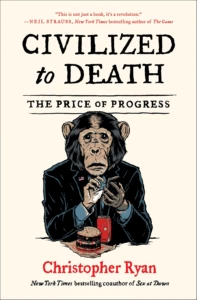 Most of us grew up believing a tidy story: before civilization, human life was solitary, poor, nasty, brutish, and short, and then progress rescued us and never looked back. But what if that story is the most successful marketing campaign in history? Look closely and a strange pattern emerges. Many of the ailments civilization congratulates itself for curing, from contaminated water to rotting teeth to the crowd-borne plagues that leapt from our own livestock, barely existed before we built the conditions that produced them. We keep score with GDP and shelves full of mango slicers, then quietly step around the loneliness, chronic disease, and record anxiety stacking up underneath. Which raises an uncomfortable question: what if your private struggles aren’t a personal failing, but a healthy animal’s response to a world in which it was never designed to live?
On this episode, we’re joined by Christopher Ryan, the author behind Civilized to Death: The Price of Progress and the earlier (with Cacilda Jethá) Sex at Dawn, and a working podcaster for over a decade, who has spent years assembling civilization’s most honest balance sheet. Chris walks us through the foundational lie he calls the neo-Hobbesian narrative, beginning with the myth that we doubled the human lifespan; in reality, a heartbreaking rate of child mortality dragged the average down while hunter-gatherer adults routinely reached their seventies. From there he traces how agriculture began not as a triumphant invention but as an emergency irrigation fix during drought, one that ratcheted into surplus, storage, armed guards, bosses, taxation, patriarchy, and eventually slavery.
Chris explains why people so often turn kinder during catastrophes, drawing on the discipline of disaster sociology and Rebecca Solnit’s A Paradise Built in Hell, and why convenience can quietly become another word for isolation. He reframes the modern epidemic of childhood distress, suggesting a restless five-year-old might be a perfectly healthy young primate reacting to an insane environment, and argues that asking two exhausted parents to shoulder the work of an entire village was never going to end well. The point isn’t to torch our antibiotics and crawl into a cave. It’s that none of these arrangements are destiny — a society gets more of whatever it rewards, and for the first time in history we can choose to reward something better. For burned-out parents, anxious young people, and anyone who has ever felt like a failure inside a “successful” society, Chris offers a strangely liberating diagnosis and a refreshingly simple prescription: know your neighbors, get into nature, and share the work of caring for the people around you. Listen, learn, and enjoy!
Please Scroll Down for Featured Resources and Transcript!
Please note that some links on this page (books, movies, music, etc.) lead to affiliate programs for which The Jordan Harbinger Show receives compensation. It’s just one of the ways we keep the lights on around here. We appreciate your support!
- Sign up for Six-Minute Networking — our free networking and relationship development mini-course — at jordanharbinger.com/course!
- Subscribe to our once-a-week Wee Bit Wiser newsletter today and start filling your Wednesdays with wisdom!
- Do you even Reddit, bro? Join us at r/JordanHarbinger!
This Episode Is Sponsored By:
- Wayfair: Start renovating: wayfair.com
- BetterHelp: 10% off first month: betterhelp.com/jordan
- SimpliSafe: 50% off + 1st month free: simplisafe.com/jordan
- Whatnot: Start selling today: whatnot.com/sell
Thanks, Christopher Ryan!
Click here to let Jordan know about your number one takeaway from this episode!
And if you want us to answer your questions on one of our upcoming weekly Feedback Friday episodes, drop us a line at friday@jordanharbinger.com.
Resources from This Episode:
- Civilized to Death: The Price of Progress by Christopher Ryan | Amazon
- Sex at Dawn: How We Mate, Why We Stray, and What It Means for Modern Relationships by Christopher Ryan and Cacilda Jethá | Amazon
- Tangentially Speaking with Christopher Ryan (Podcast) | Apple Podcasts
- Tangentially Speaking with Christopher Ryan (Newsletter) | Substack
- Christopher Ryan | Official Website
- State of Nature | Encyclopaedia Britannica
- Hunter-Gatherers Live Nearly as Long as We Do but with Limited Access to Healthcare | The Conversation
- Disease Threats: The Animal Origins of Human Infectious Disease | National Academies of Sciences, Engineering, and Medicine
- The Worst Mistake in the History of the Human Race | Discover Magazine
- The Rational Optimist: How Prosperity Evolves by Matt Ridley | Amazon
- Marshall Sahlins’s Original Affluent Society 50 Years Later | Public Books
- No-Vacation Nation: Comparing the U.S. to Other Wealthy Nations | Center for Economic and Policy Research
- New Research Is Changing Our Understanding of Global Poverty | London School of Economics
- A Paradise Built in Hell: The Extraordinary Communities That Arise in Disaster by Rebecca Solnit | Amazon
- Jemmy Button | Wikipedia
- Aguirre, the Wrath of God | Prime Video
- Daniel Lieberman on Health, Human Evolution, and Mismatch Diseases | Harvard Magazine
- Our Epidemic of Loneliness and Isolation | Office of the U.S. Surgeon General
- Exodus 20:17 (The Tenth Commandment) | Bible Hub
- Cannibals and Kings: The Origins of Cultures by Marvin Harris | Amazon
- The Better Angels of Our Nature: Why Violence Has Declined by Steven Pinker | Amazon
- Steven Pinker | Why Rationality Seems Scarce | The Jordan Harbinger Show
- The Decline of Play and Rise in Children’s Mental Disorders | Psychology Today
- Evolutionary History of Partible Paternity in Lowland South America | Proceedings of the National Academy of Sciences
- Hierarchy in the Forest: The Evolution of Egalitarian Behavior by Christopher Boehm | Amazon
- Battle of the Keys: Why Do We Have QWERTY? (Path Dependence) | Jane Takes On History
- Dunbar’s Number: Why My Theory That Humans Can Only Maintain 150 Friendships Has Withstood 30 Years of Scrutiny | The Conversation
- A Short History of Progress by Ronald Wright | Amazon
- The End of the World Is Just the Beginning: Mapping the Collapse of Globalization by Peter Zeihan | Amazon
- Peter Zeihan | Mapping the Collapse of Globalization | The Jordan Harbinger Show
- The Hero with a Thousand Faces by Joseph Campbell | Amazon
- Christopher Nolan’s The Odyssey (2026) | Encyclopaedia Britannica
- Growth for the Sake of Growth Is the Ideology of the Cancer Cell (Edward Abbey) | Quote Investigator
1383: Christopher Ryan | The Dark Side of Civilization and Progress
This transcript is yet untouched by human hands. Please proceed with caution as we sort through what the robots have given us. We appreciate your patience!
Jordan Harbinger: Coming up next on The Jordan Harbinger Show.
Chris Ryan: The best antidote to depression is to go help someone else. It's not to help yourself, it's to go to a soup kitchen, you'll feel better after helping other people.
That ties into instinctive appetites that we have, because that's how we survive as a species, by taking care of each other. Convenience is the absence of sensation, it's the absence of having to deal with other people. That connects to our innate hunger for being valuable to our group.
But we're seeing a lot of evidence of damage to the spirit in modernity. Anxiety, self-harm, suicide, depression, these things are all very high among young people, higher than they've ever been. It's a direct result of the conditions in which young people find themselves living.
Especially in the U.S., we live in a culture that's designed to satisfy commercial interests, not human interests.
Jordan Harbinger: Welcome to the show. I'm Jordan Harbinger. On The Jordan Harbinger Show, we decode the stories, secrets, and skills of the world's most fascinating people.
Our mission is to help you become a better informed, more critical thinker through long-form conversations with a variety of amazing folks, from spies to CEOs, athletes, authors, thinkers, and performers, even the occasional journalist-turned-poker champion, Hollywood filmmaker, or Russian spy. And if you're new to the show, or you want to tell your friends about the show, I suggest our episode starter packs. These are collections of some of our favorite episodes on topics like persuasion and negotiation, psychology, geopolitics, disinformation, China, North Korea, crime and cults, and more.
That'll help new listeners get a taste of everything we do here on the show. Just visit jordanharbinger.com slash start, or search for us in your Spotify app to get started. Today on the show, what if civilization is the arsonist selling us the fire extinguisher?
Most of us were taught that civilization rescued humanity from a life that was solitary, poor, nasty, brutish, and short. Today's guest, Chris Ryan, has reviewed the evidence and would like civilization to stop writing its own Yelp reviews. We'll examine how an emergency irrigation project became agriculture, surplus grain, private property, armed guards, taxation, patriarchy, slavery, and eventually middle management.
We'll also hear why people often become kinder during disasters, why convenience can be another word for isolation, and why modern parenting asks two exhausted adults, sometimes one, to do the work of an entire village. We'll also explore whether ADHD is sometimes a perfectly healthy young primate reacting to an insane environment, why hunter-gatherer societies would treat our loudest aspiring leaders as dangerous weirdos, and how progress can give us antibiotics, Beethoven, podcasting great, polluted water, diabetes, and mango slicers, all while insisting the balance sheet just looks fantastic. The point isn't to abandon medicine, put on a loincloth, and wait for a salmon run.
It's to ask whether we can keep civilization's best inventions while redesigning this human zoo around the animal actually living inside it. Here we go with Chris Ryan. Most of us were taught that civilization rescued human beings from lives that were solitary, poor, it was a nasty, brutish, and short.
And your book argues that this may be the foundational lie of modern life, right? Because the system that became richer and more powerful while the humans inside it were sicker, lonelier, more anxious, less free in many ways. So what if progress isn't the cure, and what if progress is the disease?
Chris Ryan: Yeah. I think what happens is these sorts of conversations about the value of a given culture that happen within the culture tend to veer very far from any kind of objective, rational analysis, right? It's very self-congratulatory, right?
USA, we're number one. And over in France, they're saying, everyone who's not French is an idiot. And in Italy, they're saying, non-Italians don't know how to live.
Every culture is patting itself on the back, including ours, and not only patting ourselves on the back, but demonizing alternatives and demonizing the past. So I call it the neo-Hobbesian narrative, as you refer to Hobbes's line from Leviathan, before the advent of the state, human life was solitary, poor, nasty, brutish, and short. It turns out it wasn't any of those things.
And one of the most prominent bits of misunderstanding, but I would say it's also propaganda, it's because it serves the dominant narrative, is that we've doubled the human lifespan. I can't believe how many people believe that.
Jordan Harbinger: Doubling the lifespan, that is something that I guess up until I read your book, I also believe because it totally makes sense that people would have died at 35 or something if they didn't have dentists or antibiotics or Band-Aids or clean water. I guess it just seems like kind of logical somehow.
Chris Ryan: It seems logical as long as you don't really look into the actual data, right? Like clean water is a good one. What was the water contaminated by 20,000 years ago?
There were no factories, there was no sewage pumping into the rivers and the oceans. So many of the problems that civilization claims to have solved are actually caused by civilization itself. So take another one, you mentioned dentistry, right?
Okay, yeah, dentistry, thank God we have dentists in Novocaine. 20, 50,000 years ago, people weren't suffering from the dental problems that we have now. There wasn't sugar in their diet, their jawbones were much larger, so their teeth weren't crushed together.
Antibiotics, you mentioned, what do antibiotics help with? Infectious disease. When people are spread out as hunter-gatherers were until the advent of agriculture, spread out and nomadic, they're not transmitting infectious diseases because population density is very low.
Furthermore, most of the infectious diseases that humans have died from, tuberculosis to chickenpox to smallpox, all the big ones, are a result of either humans living in high population density and eating where they shit, basically, or close proximity with domesticated animals. So tuberculosis is a virus that came over from cattle to humans, smallpox and chickenpox, all the poxes came over from birds, ducks, chickens, whatever. So most of the most damaging diseases humans have ever died from are a direct result of civilization.
So it's like you light my house on fire and half an hour later, when it's burning out of control, you run over with a bucket of water and expect me to thank you. That's our relationship with civilization. And the thing about dying at 35, everyone's, oh, we've doubled the human lifespan.
Everyone was old at 35. That's complete nonsense. No human has ever been old at the age of 35.
Hunter-gatherers, as I discussed in the book, live well into their seventies all over the world. Chimpanzees in the wild live into their fifties. This whole sort of like life was hell, everyone was on the brink of starvation all the time and rampant warfare between groups.
This is all just propaganda. This is all nonsense.
Jordan Harbinger: So before we let you burn civilization to the ground, give me the strongest case against parts of your own book. What has civilization made undeniably better? Why don't we start with that?
Chris Ryan: Convenience I would say. And even more importantly than convenience, I would say the weakest link or the most vulnerable part of the argument that prehistory may have been better than modernity is that a great number of children died before adolescence. And just to continue with that whole human lifespan thing, the reason the average lifespan at birth is calculated at 30 or 35 years is that a lot of kids died very young.
So when you take some hunter-gatherers, it's 40 to even 50% of kids die before the age of eight. So that's a lot of dead kids, a lot of pain, a lot of suffering, a lot of grief. And that shouldn't be denied.
I'm not here to romanticize prehistory. That's a serious thing. And what it does is it skews the mathematics.
So when you're looking at average lifespan at birth, and 40% of people die before the age of 10 or 8, that skews the average way down, even though adults live into their 70s typically, right? So that's where that number comes from, that 30, 35. And the other thing is that the way archaeologists measure age in a skeleton is through something called dental eruption.
So it's how far the wisdom teeth have emerged from the jawbone. And so by 30, they're fully emerged, right? But when someone dies at 10 or 12 or 15 or 18, you can estimate more or less within a five-year span how old they were when they died by how far the wisdom teeth have emerged.
But then 30 plus, you don't know because it's fully emerged. That's it. So archaeologists, when they're noting the age at death of a skeleton that they dug up, they have five-year increments.
But it tops out at 30 or 35, 35 plus is what they write in their report. But journalists don't understand this. So a journalist looks at that archaeological report and says, oh wow, nobody was over 35.
But that's not what he's saying. He's saying we can't tell how old they are after 35. So those two misunderstandings have led to this mistaken belief that people only lived into their 30s.
So yeah, and the weakest point, to get back to your question, the sort of most vulnerable aspect of prehistory and this whole argument is that, yeah, a lot of kids die before reaching adulthood or even adolescence.
Jordan Harbinger: So are we arguing that modern civilization is a net loss or that nobody's really ever produced an honest balance sheet?
Chris Ryan: The second part is clear. The first part, whether it's a net loss or not, that's up to everyone to decide. But what I was trying to do in the book was just say, look, you know, I quoted from a book called The Rational Optimist by Matt Ridley, who's a very well-known writer.
And he begins that book arguing against the position that I argued, that he's basically saying, look, modernity is indisputably better. I don't know how anyone romanticizes the past. It's ridiculous.
This is quoting from his book. He says, we have more tennis rackets, more mango slicers, more intercontinental ballistic missiles. And he just goes down this list, right?
And it's like, okay, sure. How is tennis rackets and mango slicers a rational, objective measure of the quality of a society? And so that was the point I was trying to make in the book that like, look, if we're going to talk about whether the past was better or worse or whatever, how it compares to the present, the first step in any sort of rational analysis is to choose measures that actually reflect the quality of life of the people in those societies.
So tennis rackets and mango slicers do not qualify, in my opinion. But a sense of community, a sense of being embedded in something larger than yourself, the humiliation of being forced to do something you don't want to do. In other words, work, what we call work.
Most hunter-gatherer languages don't have a word for work. It doesn't make sense to them. Like why would you not want to hunt or gather fruit?
That's what we do, right? Why would you like caring for children? Of course we care for the children.
We love the children. That's what we do. So in a hunter-gatherer society, the activities that from an outward analysis, we would call work, the things that are necessary to survival, from their perspective are pleasurable.
And you can see that in the modern world where maybe you and your buddies go off on a fishing trip for the weekend. That's not work, that's pleasure. That's what you want to do.
That's what they do every weekend, right? That's life. So I think the first step is to say, okay, what reflects quality of life?
Chronic disease, how much of your life is spent in pain? How much of your life is spent in involuntary solitude, right? How many friends do you have?
Do you feel connected to any kind of spiritual realm? How afraid of dying are you? How likely are you to die by violence or cancer?
How likely are you to commit suicide? How much mental illness does a society have? So when you start looking at these things, which I think are arguably objective indicators of quality of life, you find some very interesting things that don't align with the propaganda.
Jordan Harbinger: You say that human beings are the only animals who live in zoos of their own design. So I'm wondering what are the bars of our zoo that have become so normalized that we no longer see them? You mentioned, I think, work.
I don't know if that's one of them, but it sure seems like it might be.
Chris Ryan: Yeah, that's a really good question. I think work is a big one. I think that the idea that your life has no dignity if you're not constantly producing, that's very baked into at least American mores.
I lived in Spain for a long time, so I have a different perspective on things. In Spain, who you are is not what you do, right? I lived in Spain 20 years.
Nobody ever asked me what I did for a living at a party.
Jordan Harbinger: Wow. I think I heard you tell me this before, or maybe you wrote it somewhere, because I swear I've read this from you before. Nobody ever asked you that at a party, or maybe other people have had the same experience in Europe.
It's funny because right before this, my friend Johan from Sweden was texting me and he's like, how's your summer? I'm like, I just got back from China. I'm catching up on everything.
And he's like, I'm on week number seven at my summer home. And I was like, oh, I remember asking him before, do you work remotely from there? Because he works for Apple, right, a company that's kind of not super hands off.
They don't seem like a two months off per year. He's like, I work remotely, but nobody's doing anything. So I just kind of check in on the VPN from 8 to 8.14. And then, I don't know, you know, go outside and grill up some sausage. And he's just like, how many weeks off a year do you get? He's like, this year is kind of weird because I only get eight. And I'm just thinking like, wow, that's most people's vacation over five years or four.
So yeah. And that doesn't even count. I don't think that counts holidays.
I think that's just the summer vacation that he's allowed to take without checking his email basically six to eight weeks. Crazy. Steve Jobs is rolling over in his grave.
Yeah. He's so sad that he has to pay these people to work a normal amount of hours. But yeah, this is quite normal.
And I've lived in Germany. I was an exchange student. And I remember being like, nothing's open today again?
Tomorrow? Wait, there's another school break? When do you guys do anything?
And they're like, but it's funny because they still are better educated than us somehow because I don't know. It's hard to explain, even though I've experienced both the U.S. education system and the German one. It's completely different, but way more efficient.
All that stuff is. And they're happier. The data shows that too, right?
That they're way more happy about having eight weeks off a year? I would be too.
Chris Ryan: And not only that, but the absence of chronic stress that we have in the U.S. Nobody in Germany or Spain is losing their house because they get sick in a car accident. It doesn't happen. You asked about the bars of the cage.
I think it depends what specific culture we're talking about, right? And I think the United States, it's useful to be writing for an American audience because the United States is the epitome of a lot of these negative value structures that I talk about, right? The overworking and the solitude.
People think it's normal, that sort of rugged individualism of American culture, right? I don't need anybody and I'm going to do it my own. Or conversely, I pay my own way.
I'm always struck by the commercial for State Farm Insurance where it says, like a good neighbor, State Farm is there. So you've monetized good neighbors now. We've removed the actual neighbor.
We don't talk to our neighbors. We pay State Farm to stand in for the neighbor, which is a robot or something. And like, we're just replacing all these real relationships and real humans in our lives with some sort of product and source of revenue for somebody.
Sure.
Jordan Harbinger: They're like a good neighbor that you pay an exorbitant amount of money to that might be there if they decide that they have no way to get out of being there. Yeah. You might have to sue them.
Yes. To be neighborly. Yes, exactly.
Oh, gosh. You contrast this bleak Indonesian zoo where orangutans are psychologically destroyed, I guess, is a way to put it. And then the San Diego Zoo, people have been there.
It's pretty amazing. I mean, as far as zoos go, it's like, wow, if I were a monkey, I'd want to be in this enclosure if I had to be in one. And so the larger question is not maybe whether humans can escape civilization.
I'm sure some people like to, I mean, the Unabomber, for example. But whether we can redesign our artificial habitat that we are in, admittedly or not, around the kind of animal that we actually are. So I think people are like, oh, so what, this guy wants us to just go back to living in caves and being around the campfire with our kin group?
And that's not really what you're arguing, right?
Chris Ryan: Yeah. We have to start from where we are. And yeah, it's totally unrealistic in any scenario to think that we're going to go back to a hunter-gatherer existence.
There's just too many people and nature is too destroyed. And the only way that would happen would be as a result of absolute catastrophe. And it's unnecessary.
It's strange because we give ourselves so much credit for our amazing ability to work together and accumulate knowledge and build supersonic airplanes and aircraft carriers and all the rest of it. But somehow we haven't been able to take control of the whole scenario in such a way that we maximize human contentment and the quality of life, right? We're living in a world designed for something else, not us, at least in the United States.
So you see this even in diet. We're talking, contrasting Europe and the US. And in Spain, you go out to a tapas bar and you get a very small plate of very good quality food.
In the US, you get a huge plate of bad quality food. Yeah, that tracks. Like why is that?
Is that because people are just hungrier in the US? No, it's because it works to sell a large jumbo bag of chips results in a higher profit margin for the manufacturer and the distributor than lots of smaller bags of chips. And we live in, especially in the US, we live in a culture that's designed to satisfy the commercial interests, not human interests.
And so it always strikes me as strange when we were congratulating ourselves on designing all these complex systems. And now AI is maybe the end all and be all, but we still haven't designed a system that results in everyone being taken care of, you know, minimum level of human dignity and decency. We can't even take care of veterans who we've explicitly promised to take care of, 50,000 sitting on the street right now.
The suicide rates, anxiety, depression are the highest they've ever been among young people. Sense of social isolation. It's as if we're getting worse and worse at designing the most important thing that we have a hand in designing, which is the world in which we live.
Jordan Harbinger: That distinction sort of seems central, right? Survival is not the same thing as flourishing. And we point to survival statistics and then pretend that we've proven flourishing, right?
Like, oh, look, we have a higher population. That's one that comes to mind, right? There's more people.
Our net income has gone up. I don't know. What are you seeing out there where we go like, look, we've lived this far and it's like we're pretending that's some kind of accomplishment.
Chris Ryan: That's like what we were talking about earlier with the mango slicers and the tennis rackets, Yeah, that's a good point.
Jordan Harbinger: Yeah.
Chris Ryan: Was it Machiavelli or Lao Tzu or somebody who said, if you choose the field of battle, you've already won. So if you choose what you're going to measure, then fine, you're going to win the argument. So that's why I said it.
The first step in writing Civilized to Death was to say, what are we going to measure? What's a fair sort of analysis or what are fair measures to look at? So GDP, for example, everyone's talking about that, right?
The U.S. has this massive GDP. Okay. Let's say we're on a bus.
There are a bunch of us on a bus and our average income of all the people on the bus is a hundred grand a year. Okay. That's more or less somewhere around average.
And then Elon Musk gets on the bus. Now suddenly the average income on the bus is $700 billion each. That doesn't make any of us richer. None of us got richer.
And so that's what's happening in the United States. Yeah.
You have a lot of economic activity, but the distribution of that wealth is very skewed. So people look at the United States and say, it's the richest country that's ever existed. And they think therefore the quality of life of the average person must be the best of any society that's ever existed.
That's just not true. Another one that comes up a lot is, you'll see these statistics of 200 million people have been pulled out of poverty in the last 20 years or whatever. I'm making up the numbers.
I don't know what exactly what the numbers are, but that's touted a lot. But what that doesn't say is that when you've got, my ex-wife is from Mozambique, for example. So I'm quite familiar with the situation there.
It's one of the poorest countries in the world. And often that's touted as an example of economic development and how, you know, it's something that modernity should be congratulated for. But what she explained to me is, you've got villages in Mozambique 20 years ago that were totally self-sufficient.
They had chickens, they had pigs, they gathered, they grew food and they gathered food from the forest. There was no money. They weren't on a money economy.
Then some company comes in, sets up a big fishery on the coast there. The fish get wiped out so the people can't fish anymore. The people get kicked off the land because this big company says, now we own the land.
And this happens all over the world, Guatemala, Honduras, all over the place. And so now those people say, well, you're kicked off your land. You can't fish anymore.
So you don't have land to grow food. You can't eat fish, but you can come work in the factory for a dollar a day. Now according to the World Bank and economic analysis, those people are being drawn out of poverty because they've gone from having no money to having seven bucks a week.
That's an improvement. But if you look at their lives, that's not an improvement. They went from being independent, having a fantastic diet, pretty good life, except for dying children, which skirt around that.
It's not nothing. And now they're slaves, essentially. And that's framed as economic development.
So those are two examples.
Jordan Harbinger: Yeah, that's interesting, man. There's this narrative of perpetual progress that you discuss. And I wonder, what is believing that our ancestors were these sort of violent, desperate idiots?
That's a common sort of narrative that we see. How does that affect how we build workplaces, schools, prisons, governments, even maybe families now? That's interesting to think about.
Chris Ryan: The narrative of perpetual progress, or the neo-Hobbesian narrative, underlies so much of how we design social institutions and how we behave with each other. And it's really misleading. It's unfortunate.
For example, as you phrased it, thinking our ancestors were brutish. Then the assumption is that without the protections of the state, we would be tearing each other apart. Right?
So that's the underlying assumption. We need the state to protect us from each other, because you can't trust your neighbors, you can't trust strangers, you can't trust anyone. The world's full of psychopaths.
Where the reality is, if you get out into the world, you find that the vast majority of people are wonderful. They're not psychopaths. When you write a book, and I've written two, and in the course of the research, you come to things and you're like, holy shit, I had no idea about this.
Right? You have a general sense of what you're doing at the beginning, but then you stumble over things that are amazing. And in this book, one of the things I stumbled over was an academic discipline that I hadn't known existed called disaster sociology.
So these are people who study human behavior in disasters. Right? And so the neo Hobbesian or the nasty brutish and short narrative of human history would have us believe that in a disaster, which is precisely when the sort of overarching control of the state falls away.
So in an earthquake or a hurricane or a flood or a war or whatever, when shit falls apart, that's when people are going to be at their most rapacious and exploitative and they're going to destroy each other. And what the scientists have actually found in decades of studying human behavior in disaster is that's precisely when people are the most generous and the most compassionate and the most kind to strangers to the point where there's a fantastic book written by Rebecca Solnit about this called A Paradise Built in Hell. It's about disaster sociology.
And I remember there's a section where she interviews the man who basically started the discipline. And I think if I remember correctly, it started because in World War II, he was studying the behavior of the Germans under bombardment because the military wanted to understand what's the best way to break their spirit. The bombing of Dresden is a famous example of that campaign.
And he was studying their behavior and what he found was that bombardment has the opposite of the effect that you would expect. People come together more, they care for each other more, they get more defiant in the face of the aggression that's coming at them. So it's an unanticipated response to this thing.
Jordan Harbinger: Now back to Chris Ryan. I was talking to somebody recently. They said they were doing business in Russia and they had, I think they were trying to evict an older woman from her property. And so they sent these thugs in and she said, I was here when the Nazis came and I was a little girl.
Just kill me. If you're not going to kill me, get the fuck out of my apartment. And they were like, we're not killing this old lady.
I don't think we're getting this property boss. And the guy was just like, all right, whatever. Like, I think they just had to wait until she passed away.
And it was just like, okay. She was still defiant and it's been, I don't know, 80 something, has it been 80 years? Yeah.
She was not having it. And she was probably in her nineties. Babushka.
Yeah. Those are the ones that were also in the square in Moscow when the tanks were there and the soldiers and they said things like, I'm your grandma, I'm your mother. Are you going to kill me?
If you're going to kill me, then go ahead and do it. And these young soldiers are like, I'm not messing with these old ladies. Are you crazy?
19 years old.
Chris Ryan: The end of that story is that she interviews this guy who's been doing this his whole career and he says, in all this research I've done, what I found is that people who survive these disasters look back on that as the best time of their lives. Those were the best times. And he even says, after all this research, I've come to the conclusion that the real disaster is normal daily life.
Jordan Harbinger: When I lived in Serbia, this is a long time ago, 20 years. It was a few years after NATO had been bombing them, not even a decade, right? So everybody who was my age, 20, whatever, remembered the NATO bombing days.
No school, no work, maybe no electricity. And every single one of my friends was like, that was the best time. Because you'd be home with your parents, your neighbors would come over because you're the one who had candles that day or whatever.
People just happened to go there. And you'd bust out all the stuff you'd been smoking in your shed. And other people would bring all the fish that they had been taking off the bones for the last five hours in the dark or whatever.
And then you just have these parties and you play cards for like nine hours until everybody passed out from either the drinking or just being awake for that long. And then you'd hear the air raid siren go off and roll over because it wasn't going to be your house. I mean, it was going to be some building downtown.
And you realize, I don't have work tomorrow either. Who's got the sauce? Let's wake up and do it again.
And I thought, OK, young people are always going to be nostalgic. So I started asking older people and they were like, well, we had a civil war. So it was kind of nice to get a break and nobody was really doing anything because NATO was bombing us.
Don't get me wrong. I still hate America. But yeah, it was kind of nice to get a little vacation from the factory that was making guns or bullets or cars or whatever, because it was just, what are you going to do?
There's cruise missiles coming in, you know, get out the cards. You might die tomorrow. Have your friends over.
It's really interesting to hear.
Chris Ryan: I mean, you asked earlier, what does modernity do better? And there are many legit answers to that. And I said convenience, right, I think.
But what is convenience? Convenience is the absence of sensation. It's the absence of having to deal with other people.
I wrote about this in the book. I went to India in my 20s and it was the first time in my life I ever felt wealthy, like wildly wealthy, because I wasn't. I was a backpacker with $8,000 to my name.
I was eating in a restaurant and the kids with their faces pressed against the window were orphans living in the street, right? So I had to face this reality of wanting to help people, but the scale of the problem being so far beyond even my resources, even as a quote unquote rich guy in the context, it gave me a lot of compassion for wealthy people who are like, I've got $100 million, but the problem is way beyond my resources. So what do I do?
How do I most effectively help people? I want to help people, but I don't know how. And so they face the same sort of psychological challenge that I was facing on a much smaller scale where you have to build scar tissue over your heart and you separate yourself from other people because it's innately painful to a highly social species like ours to be in proximity to the suffering of someone that you can't help.
So inversely, your experience in Serbia, why does it feel so good to help people? Why does it feel so good to show up at the bunker and like, Hey, I've got some beer.
Jordan Harbinger: I found some beer. You're a hero, you know? Yeah.
Extending ovation because you found a bottle of some bathtub rakija somewhere in the garage that you forgot about. Yeah.
Chris Ryan: That connects to our innate hunger for being valuable to our group. That's why the best antidote to depression is to go help someone else. It's not to help yourself.
It's to go to a soup kitchen. You'll feel better after helping other people. That ties into instinctive appetites that we have because that's how we survive as a species by taking care of each other.
So the trajectory of modernity toward comfort and convenience and all that, we go from, in the book, the way I tried to illustrate it was I went from a backpacker in a dorm room in a youth hostel in Rajasthan in my 20s to now that I've got some cash, an air-conditioned room in the Marriott with tinted windows and I'm alone watching CNN. That's the trajectory. That's what money and convenience and wealth does.
It pulls us away from people. That integration that is so nourishing to the soul.
Jordan Harbinger: Tell me about Jemmy Button. This guy sort of rejects England in modern society. It's a good example from the book.
Chris Ryan: Yeah. That's interesting. That's another one of those things I had no idea about.
Jordan Harbinger: I'd never heard of this guy. Yeah. I'd read a bunch about Darwin, but I didn't really know much about what was going on on the Beagle.
Chris Ryan: Yeah. So the story there is that Jemmy Button and a woman, I forget her name, and there was, and of course these are names the English gave them, so we don't know their name in their own language, but they were picked up in Tierra del Fuego by Captain Fitzroy on an earlier mapping mission down there and brought back to England. And the idea was that they were going to show them the splendors of England.
And they did. They showed them around. I think they met the king and the queen, and they saw the best of English-British life.
They weren't in the street cleaning the gutters and stuff with most of the people. They saw England and how wonderful England was, and then on the journey where Darwin accompanied Fitzroy on the Beagle, five, ten years later, they brought them back to Tierra del Fuego. And the idea was that they would go back to their tribes and tell them how wonderful England was, and then everyone would want to go live in England, and so they would all settle down and put on clothes and build gardens and help the English.
That was the idea. They brought them back, and they dropped them off, and then they went, I think, for a month or so on this mapping mission up the coast. When they dropped them off, they built them a little house and tilled a garden and planted some vegetables and all this.
And when they came back, they were gone. And of course, at first, they thought, oh my God, they've been killed, and what's happened? So they went and started exploring, and they found Jemmy Button living with his tribe that he'd grown up with, and they brought him to dinner on the Beagle.
So he sat in the officer's mess with the captain Fitzroy and with Darwin and Jemmy, and Darwin wrote about it in his journal, which is the only reason we know any of this. And they said to him, what happened? Why did you abandon the house we built you and the garden and all this?
And he said, I don't understand why you want me to farm. There are plenty birdies and plenty fishies. What is it with you people in work?
And you find this all over the world. When the British or the colonizers happen to be from whatever, whether Spanish or British or French or whatever, they try to teach the wonders of agriculture and proper, decent, civilized life to the native people. And invariably, the native people are just like, what are you talking about?
The world is full of food. Why on earth would I do this for food? The world is full of food.
It's like the world is a supermarket, and I've got a black Amex card.
Jordan Harbinger: I just show up, and there's a fish in the pond. I'll get one of them, right? I don't have to breed them in the backyard and make sure they don't die.
Yeah. Of course, there's a selection bias here, right? We don't hear from the, like you said before, the mother who lost a child or someone who died of sepsis or the person who would have loved some antibiotics and indoor plumbing for a specific reason.
But on the whole, we're seeing kind of a trend here. So of loneliness and sedentary living, artificial light, what is it? Too much sitting, meaningless work, rigid hierarchy, status comparison.
Which mismatch in modern society do you think is doing the most damage?
Chris Ryan: Look, I'm a well-fed, privileged, early 21st century white dude. My concerns skew in certain directions. So I guess I have the privilege to say that I think damage to the spirit is probably in the top three.
In objective terms, someone serving life in prison is probably relatively well-fed. If they're not dying of starvation, they're well-fed. They're not being attacked by predators.
They get medical care, more or less. But I think we're seeing a lot of evidence of damage to the spirit in modernity. As I mentioned earlier, anxiety, self-harm, suicide, depression, these things are all very high among young people, higher than they've ever been.
And I think that's a direct result. I don't know what else it could be. It's a direct result of the conditions in which young people find themselves living.
There's this cliche of the angry teenager. I was an angry teenager. I don't know how you dealt with it.
But I think there's a transition that we go through from a childhood where the world feels wondrous and magical and like just this incredible adventure. And we're safe. If we're lucky enough to have a stable family and loving parents, we feel safe.
And then there's this transition where you start to get a sense of what the world's really in the injustice. And that's why you get all these screaming, kind of maniacal college students, of which I didn't scream, but I was pretty maniacal. Because they get a sense of what the world really is and how unjust it is.
You don't get that in hunter-gatherer societies. You don't have the rebellious teenager. Your life is your father's life and your grandfather's life.
And I think that's another reason ancestor worship makes sense in those societies. We have this distorted view. When we go in, we being Europeans, go into those worlds and we're so out of context, we don't understand how things work.
I don't know if you've ever seen Werner Herzog's film, Aguirre, The Wrath of God. It's an amazing film. Klaus Kinski.
It's one of Herzog's weirdest movies. It's about the conquistadors going up the Amazon for the first time. And these guys are wearing armor.
They're in the Amazon jungle. And they've got their steel armor like they're going to go fight the knights in Alsace or something. We bring our world with us on our backs.
We carry the assumptions and the ignorances of our world. And so we don't adapt to the world that we're moving into. Physically, our bodies suffer.
What is it? 60, 70% of Americans are obese or overweight right now. Diabetes rates are off the charts.
I think one of the insights I was trying to convey in Civilized to Death is that you can look at our bodies and our bodies are very clearly telling us about the mismatches. We get the back pain. We get the diabetes.
We get the gout. All of these are directly related to our bodies not living in the way they were designed to live, right? But what I was trying to say in the book is our minds, our spirits, our sexuality are so many less visible parts of us are also suffering from the same disconnect of not living in the world as we were designed by evolution to live in.
And that's why I went with the spirit because I feel like that's maybe the least visible. When you're living alone, I have a friend who's a fireman. He was a fireman up in Portland.
I remember this conversation I had with him. We were talking about getting old and some of the calls that he goes on and he said, man, the most difficult ones are it's just an old person who hasn't spoken to anybody in weeks and they call 911, but all they really want is to talk to someone. Oh, man.
And he's like, those are the hardest because you show up, there's no heart attack. There's nothing to fix. There's nothing.
They just want you there and you've got to leave after five minutes and you can just see the pain in their eyes. They're just dying for someone to talk to.
Jordan Harbinger: That's really depressing. That's really sad. Jeez.
I want to switch gears a little bit because you write about how agriculture essentially was a response to ecological pressure rather than a voluntary lifestyle upgrade. I guess I never thought about who invented agriculture.
Chris Ryan: Yeah. And we frame it as an invention, right? Oh, look what I figured out, which, you know, it was, but it was under duress.
And I didn't know about this until I researched the book is that agriculture has arisen around the world at different times. We always talk about the fertile crescent, right? As if it's an innovation that originated in modern day, Syria, Turkey, and then spread out from there.
But that's not actually how it happened. It did originate in Syria, Turkey, but it also originated in modern day Cambodia, where it was based on rice cultivation, totally unconnected, no trade. It wasn't a information that spread from the fertile crescent to Cambodia, right?
And certainly not to Peru, where it also originated there based on the cultivation of quinoa and potatoes, I believe. It arose in, I think, five different parts of the world at different times. And for the purposes of the argument that you're referring to there, from studying pollen counts and mud cores and different techniques, we can see that climactic conditions in each of those places followed the same sequence leading up to what we now call agriculture, which was years of unusually high rainfall resulting in plentiful food, wild food, right?
So the environment is flourishing. There's lots of life, lots of water, lots of food, fish, fruit, whatever, followed by a sudden reduction in rainfall, which normally when you have these patterns in nature, when there's a lot of food, you have a lot of rabbits, and then you have a lot of coyotes, because there are a lot of rabbits, and then the rainfall drops, fewer rabbits, fewer coyotes, because starvation, right? And the humans were part of that system until the advent of agriculture.
So in each of these cases, somebody was like, we're all going to die, or most of us are going to die, but I figured something out. And the evidence is not that they so much figured out planting and growing, they figured out irrigation. So they figured out like, hey, here's this grove of pistachio trees that we were coming to every year, and this year they're dying because it hasn't rained.
So somebody figured out, but that stream is running over there, and if we dig a dish, we bring the water to the pistachio grove, and next thing you know, the pistachio trees are flourishing again, and that's the trigger, that's the key. Like, we can bring the water to the plants. And then, of course, it's just one step to say, wait, we can also bring plants to this, start irrigation, and you're off to the races.
Okay.
Jordan Harbinger: So this is like an emergency measure that became a ratchet, and once it produced more calories and more babies, you can't really return to foraging because you need the elevated amount of calories to survive. So how did we go from, okay, surplus food or enough food, how did we get from there to property, and then somebody's got to guard the property, and then somebody's got to control the guards and the people who own the property, and then, I don't know, we need a taxation to run this place, and, I don't know, slavery and warfare. There's probably a few ellipses in between each of these things, but yeah, how did we get there?
Yeah.
Chris Ryan: As you said, it's a ratcheting system. So once you get surplus food, because we figured out how to grow more than we need, then, okay, we need to store it, which is why grain is so popular, because grain can be stored, right? You can't store plums for next year, right?
You get this system where, okay, you have storage. Once you have storage, then you need to protect that storage, because maybe the people in the next valley over didn't have such a good year, so now they're going to come and try to raid us and steal our stores. So now you need a system of protection.
Who's going to pay for that protection? How do we pay for the protection? We give them some of the food that we've been storing.
Well, who makes those decisions? Okay, someone has to be a boss, and they have to have the power to make decisions that are enforceable. How are they enforceable?
Well, they've got henchmen, right? They've got people who enforce their decisions. Also, a lot of the agricultural projects, you need people to plant, right?
You need a lot of people, especially rice. You need a lot of people to go out in a very limited amount of time and plant the rice as the water's flooding, or in the case of grains, you need to go out and sow the fields. You need to protect it from birds and other things that are going to come and steal the crop.
So yeah, it gives rise to a hierarchical political organization. That kind of situation immediately diminishes the autonomy and leverage of women. Because in hunter-gatherer societies, women actually, even though the men were the hunters generally, so they brought back the meat, which has high status.
Everybody gets excited about a barbecue. But most of the calories that kept people alive were the result of the work of women, the gatherers, the roots and the rodents that they would trap and the birds they catch and the fruit they found and nuts and that kind of stuff. So women had very high status.
And also no one could be coerced because if everybody knows how to hunt, they know how to gather, they know how to build shelters, they know what plants have medicinal uses, as hunter-gatherers all have that knowledge. How are you going to force anybody to do anything? You don't have any leverage over them.
So if a woman doesn't want to be with a man anymore, she just leaves. What's he going to do? There's no enforcement mechanism.
And since the children are raised collectively by the hunter-gatherer band, there's no disputes over who's going to be the father and the mother and there's not a custody battles. So you end up with extreme egalitarianism among hunter-gatherers and women have very high status. But once you get into agricultural societies, women's status plummets.
They become just another possession of the men along with the land and the domesticated animals and so on. So you get the rise of paternalism and the patriarchy and all that is closely tied to agriculture. One of my favorite lines from the Old Testament is where you say, Thou shalt not covet thy neighbor's wife, which I always took to be respect your neighbor's marriage.
But if you read it in context, it says, Thou shalt not covet thy neighbor's wife, nor his house, nor his slave, nor his ox, nor his ass, nor his manservant. It's like, don't covet your neighbor's stuff.
Jordan Harbinger: So basically, it's a status comparison thing, not a respect your neighbor's marriage thing. That's interesting. Hey man, don't worry about what your neighbor's driving, what he's riding, who's riding him.
All that stuff is irrelevant. Worry about yourself. Yeah, but it has nothing to do with the sanctity of this.
Yeah, that's funny. With the context removed, it is completely different. Apparently, humans become kinder during disasters.
Jordan Harbinger: If you like this episode of the show, I invite you to do what other smart and considerate listeners do. Take a moment, support our amazing sponsors. They make the show possible.
They're all searchable and clickable on the website at JordanHarbinger.com slash deals. If you can't remember the name of a sponsor or can't find a code, email me, Jordan at JordanHarbinger.com. We're happy to surface codes for you.
It's that important that you support those who support the show. Now, back to Chris Ryan. I want to be sort of clear here, or fair, I should say, because agriculture also allowed writing and math and learning, building cities, whether you like those or not, medicine.
I don't know, libraries, Beethoven. Beethoven's a big one. Yeah.
Podcasting. God, where would we be? Where would we be without podcasting?
It seems like we have to sort of be careful not to assign every downside to the invention of agriculture while treating every upside as well. That would have happened on its own. Well, fine. Okay, fine. We have medicine, but man, people have bad backs. I just want to be fair here because otherwise it could be a little ridiculous, I think.
Chris Ryan: Yeah. No, for sure. I love podcasting.
I've been making my living podcasting for 12 years or something now.
Jordan Harbinger: Nerd alert. Yeah, I can relate.
Chris Ryan: OG, OG.
Jordan Harbinger: Is hierarchy really the inevitable result of farming or is it just kind of one path that farming societies just kept taking? Is there any other way it could have ended up, you think?
Chris Ryan: I think that it is inevitable. It didn't happen immediately. There are hundreds of years sometimes of egalitarian horticultural societies, which are societies that are defined as partly farming and partly hunting gathering.
The Mozambican villages I described earlier. But yeah, it is an inevitable result. I'm an adherent of what's called cultural materialism in anthropology.
It's a school of anthropology started by a guy named Marvin Harris, who was the head of the anthropology department at Columbia. Really interesting guy. Anyone who wants to read about this, I'd highly recommend his popular books, Cannibals and Kings is a great place to start.
But his argument is that societies grow out of a particular material context. So just as plants do. So in other words, you're not going to find orchids growing in the desert, just as you're not going to find cacti growing in the Arctic.
So different life forms come out of different physical conditions. And he expanded that to include culture. And so there are cultures that are typical of deserts, cultures typical of jungles, cultures typical of the Arctic, the steppes, and so on.
So following that line of thinking, there are cultures that emerge from surplus of food. And a test case of that would be, well, OK, are there societies that have a surplus of food that are not agricultural, and how do those societies look? And so the examples are the Pacific Northwest salmon cultures.
So they're not agricultural, but what happens is they have these massive salmon runs on the rivers and streams of the Pacific Northwest, and the people learn to harvest way more salmon than they could possibly eat. So they smoked it and dried it on racks and then would save it for the winter and survive the winter eating this food that they harvested in the fall. So that's very much like agriculture.
It's surplus resources, accumulated resources. And so once you have accumulated resources, the status of women plummets, you get slavery, you get warfare, you get fighting over land, you get all these things without the agriculture. It's really about the surplus resources that triggers this cascade of events.
Jordan Harbinger: That makes sense. Well, I don't know. I mean, it seems like, of course, violence has declined in many ways.
Steven Pinker's book, right, if you compare us to how things were a few hundred years ago, you don't have raiding parties or whatever, but it seems like probably when you had hunter gatherers, you didn't even need any of that because you could just, oh, no, there's another tribe here eating these berries. OK, well, let's go to another patch of berries that's a mile away. We don't have to kill these people.
Also, they're going to kill a bunch of us. And then what? We got raspberries.
There's raspberries down there, too, or blueberries. Who cares? So it just seems like the surplus that you just mentioned, if you really need a surplus of dried salmon because your protein is short, you're not just going to go catch a bunch of fish in the middle of winter.
You just got to go kill the people who have the salmon. So all this seems like maybe violence is down in some ways, but you have industrial size warfare where we need to get oil. So now we're blowing people up in the Middle East.
It certainly has happened in the past where we've had to secure our oil supply from whatever Saddam Hussein. And so suddenly we're moving aircraft carriers over there. That just seems like we've shifted the violence to different places for different reasons, but with machines instead of worrying about getting shot when you walk outside your house.
Chris Ryan: Yeah, you probably noticed this. I don't have a lot of respect for Steven Pinker's scholarship.
Jordan Harbinger: I noticed that, yeah.
Chris Ryan: He plays some weird games. It talked about this in my previous book, Sex at Dawn, as well. One that I think I talked about in Civilized to Death was he mentions the !Kung San people of Botswana, of the Kalahari.
Jordan Harbinger: Is that the one where you have to click into your tongue before you say Kung? Yeah, I didn't want to be that pedantic about it, but yeah. I think it's cool.
I remember learning about that in middle school. And of course, we all went for the rest of the week. !Kung San.
Yeah. Yeah.
Chris Ryan: So he says something about how the murder rate among the !Kung San is equivalent to modern day Baltimore or something. But what he doesn't say is they're like, I don't know how many millions of people live in Baltimore, whatever it is, say 5 million people or something. So every day there are murders happening in Baltimore, right?
And so everybody's conscious of murder, all this stuff. Anyone who's watched The Wire knows what Baltimore is like. But there are like 500 !Kung San people.
And so to have a similar murder rate per capita among the !Kung San, one guy killed another guy 30 years ago. And statistically, that's the same murder rate as 12 murders a day in Baltimore. How many !Kung San are walking around worried about getting killed versus the sort of psychological context of living in Baltimore?
It's a totally different thing. But he presents that as data. And it's like, dude, I don't know. I got a thing for Steven Pinker.
Jordan Harbinger: You got your work cut out for you in some ways, right? Because, OK, a lot of modern civilization is unhealthy, but it also lets me keep my kids alive and survive appendicitis. And I need anesthesia if I'm going to have a root canal.
I guess you maybe wouldn't need a root canal if your diet was different. Maybe that's a bad example. But if I break my ankle or a bone, I would like some anesthesia, probably.
Anyway, I can avoid dying from an infected cut that I got sliding out of a river. And then you've got to balance like, OK, how much loneliness or loss of personal autonomy outweighs those things? And I don't know how you could possibly make that compare.
There's no way to measure those things, right? That's it.
Chris Ryan: That's why I said at the beginning of this conversation, part of your argument is like, how do we compare these things? And then part of the argument is, which is better? All I can really do is say, look, the analyses have not been objective up till now.
So let's attempt to do an objective, fair-minded analysis where I just present this data. And then you decide. You and I are among the lucky ones.
This is another thing that drives me crazy, where I was talking to this Harvard professor, famous author, I don't want to name him, but well-known guy. And we were going through this, and he was friendly. He was letting me present my arguments and all that.
And his final word was like, well, look, I'm just an average guy, and I would much rather live today with my health care and my this and my that. And I'm like, dude, you're a Harvard professor.
Jordan Harbinger: You make $600,000 a year.
Chris Ryan: Best-selling books. So $600,000 plus your books.
Jordan Harbinger: Plus a million-dollar advance on every book. Yeah, exactly.
Chris Ryan: And you think you're an average guy. Give me a break, dude. You're not even an average guy in New England, much less an average guy in North America, much less an average guy on planet Earth in the year 2025 or whatever it was.
That's another one of those three-card Monty ways of framing this argument, where you're like, I hate getting into these conversations at cocktail parties because it's always the same bullshit. But somebody said to me, oh, I wouldn't want to live in prehistory. I don't even know how to start a fire.
And it's like, that's like saying, I wouldn't want to be French. I don't speak French. Yeah, yeah.
Jordan Harbinger: You would if you were. It reminds me of a joke my friend told me. He's a lame-o comedian.
He's like, you think one of the first thoughts Chinese babies have is, oh, shit, man, I got to learn Chinese. Exactly.
Chris Ryan: This is hard. Yeah, it's going to be so hard. And chopsticks.
Jordan Harbinger: What do I, how do I do that? These are going to be so tricky. What a short stride, John.
That's kind of an American thing, though. The Harvard guy saying I'm just an average guy. I remember one of our professors said something, this is a long time ago now, quarter century plus.
He had done surveys on a bunch of the students. And it was like, what socioeconomic class are you in? Are you working class?
Are you middle class, upper middle class or wealthy? No matter what, everyone put either middle class and then some people put working class. And it didn't matter if their family's income was my parents have never held a job and I'm a foster kid or my dad might own the Coors Brewing Company, but we're middle class.
Maybe we're upper middle class. Nobody said we're wealthy. That's a thing.
Americans don't do that. They don't really say, at least back then, yeah, well, I'm in top 0.1% for XYZ unless they're, I don't know, maybe writing a marketing page for themselves or their company. We don't like to think of ourselves that way.
You could have $10 million in a bank and be at an investment board meeting and you can step out on the street and somebody can say, are you wealthy? And you tuck your hand with your Patek Philippe watch in your pocket and you put your iPhone 17 Pro Max, whatever the heck it is in your other pocket. And you go, I'm just a regular guy.
As you try to shrug in your $8,000 suit and walk back to your jet. So you can go home. I'm just a regular guy like everybody else.
Like Jerry Seinfeld probably thinks he's a regular guy like everybody else to some extent. I think you're right. That's funny.
It's clear that society can be progressing technologically, medically, while regressing socially and ecologically. And that's, I think also makes your job a little bit harder, right? Because people are like, but progress.
And it's like, we're going this way in one hand, and you're definitely going that way in the other hand. Like you said, you didn't need to worry about the cleanliness of the water before agriculture because there wasn't a factory or even a farm dumping fecal matter or chemicals into the water. If you had polluted water, that was like, where did you find this water?
How did you even find polluted water before this?
Chris Ryan: You have to pollute it yourself.
Jordan Harbinger: You have to pollute it yourself. Or it would have to be like some weird event happened. And the water got polluted with a bunch of dead animals that died from some weird natural disaster, which just wouldn't even make sense.
Chris Ryan: It's possible for societies to be progressing dramatically on some matrices and declining in others. And you're right that, yeah, the book came out, I don't remember, five years ago, at least. But I think that in the years since Civilized to Death came out, that contradiction has become more conventionally understood because what's happening in the United States right now?
The economy, oh, the stock market's doing great, but I can't afford bacon. So people are seeing this disconnect between ways of measuring something that seem to indicate something that is in conflict with their perceived reality. OK, the country's getting richer.
I'm getting poorer. You're saying things are better? How come my kids are depressed and sitting in their room staring at a screen all the time?
I think people are seeing that because we're advancing ever further into the end of empire morass.
Jordan Harbinger: You have also made a really good point that I thought was quite interesting in the book. You said that we kind of pat ourselves on the back for solving harms that we actually created, right? Which is pretty fair.
It's kind of hard to argue that, like you said, our diets are terrible and, oh, look, we've got drugs that can make you lose weight. OK, I'm not seeing a whole lot of people that are obese and diabetic in the hunter-gatherer societies that are still living in the Amazon. But I do wonder if that adequately accounts for, again, it's hard to balance this stuff, gay marriage and women's legal rights and disability rights and due process and protection from arbitrary violence, whether it's from the state or from your neighbor.
And I don't know, even when civilization created the cage that we're in, going back to the jail analogy, isn't removing one of the bars still progress?
Chris Ryan: Yeah, but it's progress from where? See, this is another frustrating thing about this kind of conversation, because people will say, well, in the past, gay people had no rights. And I'm like, which past are we talking about here?
Are we talking about Victorian England? Are we talking about medieval Europe? Are we talking about Rome?
Are we talking about ancient Greece? Are we talking about 20,000 years ago hunter-gatherers?
Jordan Harbinger: At some point, I'm just giving you a hard time about this, I think. But yeah.
Chris Ryan: No, but you're replicating the common responses that I get, which, you know, is your job as a podcaster there, Jordan. I remember talking to this guy, I lived in Manhattan for a while in the 80s, and I remember talking with this homeless dude, and I said to him, like, hey, why don't you like go down around Wall Street, where all these super rich guys are? Like the stock market was super booming in the mid 80s.
And he said, nah, man, nobody gives you anything down there. He said, the richer they are, the less likely they are to give you anything. Wow.
It's like the people who give you money are the people who are one event away from homeless. I experienced that myself in the early 80s. I hitchhiked up to Alaska a couple times.
And yeah, the guy in the Mercedes is not stopping. It's the guy in the old beat up Volkswagen van who might stop. So there is this proximity to tragedy, I think, that brings out that element of people.
Jordan Harbinger: I'd love to talk a little bit about the what is called alloparenting, partable paternity. You kind of mentioned that mothers and children historically existed within broader caregiving networks instead of the nuclear families that we have now. There's maybe even different socially recognized fathers because they didn't do DNA testing or anything like that.
And since there was no nuclear family, it's like, oh, well, the dads are like these men, probably. And everyone was just OK with that. That whole idea of partable paternity is so alien to us here.
Chris Ryan: Yeah, it is. So you have to preface it by saying that there are many societies around the world that don't understand that sex causes pregnancy.
Jordan Harbinger: Bad at noticing patterns, are they? I mean, cause and effect, not super hard to figure out in some cases. Think about it, right?
Chris Ryan: Like everybody's having sex. At least the women are having sex and the women are getting pregnant. So they're also eating monkey.
They're also stepping over smoky fires. They're also swimming in the river. If sex isn't this sort of special, set aside, shamed, strange behavior, you're not going to notice it as much because it's just happening anyway.
It's just a natural part of life. So, yeah, there are societies that think that a woman gets pregnant by stepping over a smoky fire and the smoke enters her and whatever. But among the societies that do have an inkling that there's a connection between intercourse and pregnancy, there are a bunch of them in the Amazon basin who are, as far as anyone can tell, there has been no contact between them.
So there's no common language, no obvious trade relationship or whatever. And this also has appeared in Papua New Guinea and I believe among some Inuit people. So the assumption among the anthropologists who study this is that this was probably a very widespread belief.
But among people who understand that intercourse is related to pregnancy, and remember, these are societies that don't have a sense of shame around sex. So it's very hard for us to imagine that, but it's a good intellectual exercise. A woman who wants to have, as most women do, wants to have a child who's smart and funny and athletic and a good hunter, assuming she's going to have a boy, will have sex with the smart guy and the funny guy and the guy who's a good hunter so that she gets the essence of each of those guys into her baby.
Because the belief is that a fetus is literally made of accumulated semen. So when she accumulates a sort of critical mass of semen, then it starts turning into a baby and growing. And then when the baby's born, each of those men will acknowledge their paternity.
So it's a group. So fatherhood is a group endeavor in those societies.
Jordan Harbinger: That seems, yeah, again, quite alien. You really have to have a totally differently constructed society for that to happen. Instead of having people be jealous and upset or withhold resources or all this stuff.
Chris Ryan: That's the thing, right? There's no private property. So this is another conflict with the conventional view of human sexual evolution, which is based around this idea of paternity certainty.
The idea is that since time, since the beginning of time, men have been very concerned with who is the father because they don't want to invest their resources in the child with another man's DNA, right? But when you actually look at these societies and you look at the anthropological literature, you see there is no private property. So this whole architecture of concern doesn't pertain. It doesn't matter. Property is shared.
Jordan Harbinger: So who cares? So it's good news, I guess, for modern parents, right? Maybe we're not failing. Maybe we just built a family structure that asks two exhausted people to perform the work of an entire community.
Chris Ryan: Dude, that would have been a good answer to your question earlier about the most pernicious mismatch. You said two, right? That's in the best condition.
Jordan Harbinger: Oh, yeah. And that's the ideal scenario these days. Sometimes it's just one. Oh, and by the way, you need a full-time job or two because kids are expensive. And school.
Chris Ryan: And yeah, it's insane. Both of the books that I've written were motivated by the same thing, which is that I get outraged at people suffering unnecessarily because of lies that they've been told about human nature, about the nature of our species, about the quality of our society. You live in the best, richest country that's ever existed.
How can you complain? What's wrong with you, man? It's your fault.
No, it's not. It's not your fault. It's that you live in a sick society and being, quote, successful in an unhealthy pathogenic society is no sign of health.
Jordan Harbinger: Now for the rest of my conversation with Chris Ryan. I would love to talk about ADHD because this is something that, first of all, it's all on the rise. Maybe I have it or maybe I just got diagnosed poorly, but I do see a lot of distress in kids.
Every parent does. I guess I'm wondering how much of that children's distress comes from their brains and their wiring and how much comes from requiring a five-year-old boy to sit still for a long time, obey a clock, compete continuously in sort of weird, artificially constructed environments and then spend most of their day indoors, among other things. I mean, I had to sit at a desk and read things and listen to teachers talk, and I wasn't good at that.
If you had asked any teacher that I'd had all the way up probably until high school, they'd be like, oh, this guy going absolutely nowhere. I remember when we graduated from middle school, you were walking out and all the teachers would shake your hand. And I remember many of the male teachers were like, Jordan, take care of yourself, man. They gave me that look like, we'll see that kid on the news. You know what I mean? Like that.
And I remember it now because I was like, what's Mr. Wilson and Mr. Sheets? What are they so worried about? I'm fine.
And it's like, oh, not according to them. I was going absolutely nowhere, maybe straight to jail. Yeah.
Chris Ryan: Just ask yourself one question. See, the sort of central lie underlying my first book, Sex at Dawn, is that we are not primates. We're not animals.
We're special. We're something else. Humans.
That's a lie, right? Like people often say, they'll argue about whether or not we're evolved from apes. We are apes.
We're not evolved from apes. We are apes. We are a species of ape, which is a tailless primate, right?
So there are these huge misconceptions or lies or whatever we're going to call them, underlying things. The lie underlying Civilized to Death is everything's better. So whatever problems you're having are your fault, a sign of your inadequacy because God knows it isn't society's fault because society's been progressing for 10,000 years.
But the question to ask about ADHD is what do young primates do? Do they hang out and think or listen to old primates? They wrestle.
They climb. They fall. They roll. They scream.
They jump. They're moving and they're hyper-social. They're with each other.
They're puppies rolling around, right? Any young animal is practicing getting into its body, learning how its body works, learning how competition works, learning who's stronger, who's weaker, how to deal with strength and weakness, how to maneuver. You learn how to be a human by playing and to have a society that's structured around telling kids, don't play. No, don't talk.
Don't interact. Oh, and by the way, eat at six o'clock. Oh, you're not hungry? I don't care. Eat anyway.
Wake up now, but I'm sleepy. It doesn't matter. Wake up.
So, what are we doing? We're teaching kids to ignore the communication from their own bodies about what they need. Eat this. I don't want that.
Eat it anyway. And with great compassion for parents, I'm not blaming parents because the parent's role is to take this animal and adapt it to this world. And if this world is fucked up, you kind of have to fuck up your kid in some ways.
You have to teach a kid to thrive in a distorted, distorting reality. I think that results in the angry teenage syndrome we were talking about earlier because it's not what we were designed for. But you were a lawyer for a while, right? You don't get to be a lawyer by rolling around on the jungle gym outside.
You've got to sit there and listen to old people and blah, blah, blah.
Jordan Harbinger: You've got to suck it up. That's true. It's a lot of lectures and reading.
That's the epitome of modern convenience job, right? A lot of sitting, a lot of reading, a lot of artificial light. But you quit.
But I quit. Why did you quit? I quit because I found this and it didn't feel like work.
And I also was doing other things that didn't feel like work. But yeah, the media, the podcasting thing, I was like, this is where I belong. I remember saying, I'd rather make one third of what I make as a lawyer.
If I could just do this podcast thing full time, that would be amazing. I basically just read books and talk to smart people. And now I probably make as much as a partner at that law firm, I would assume.
Well, they went out of business actually. But another law firm that didn't go out of business in 2009. I think I probably do all right.
And even if I didn't, even if I made way less, I just wouldn't even care. Because I'm sitting around reading books. I walk outside listening to audio books.
I take notes and then I come and talk to you. And I record it and send it to a group of people that like to edit videos while they travel around the world or edit audio while they travel around the world. I mean, most of my team, I don't think they feel like this is a tough gig.
This is pretty much them getting to do their hobbies, except they get paid for it. And that's a pretty good racket. It's awesome.
Chris Ryan: That's hunter gatherers. It's like, oh, you're good at hunting. Okay.
You're the hunter. We all love you. You bring us food and you enjoy it.
And you know, you're good at it. Great. I'm good at building huts.
I'll build the hut. You go hunting. Yeah.
Doing what you're good at feels good, especially if you're sharing that wealth with people you love.
Jordan Harbinger: Yes, exactly. You said in the book, we can't go backward. So what does forward look like?
That's going to be tough, right? I mean, how do we build a modern society designed around human nature without sacrificing medical breakthroughs and science and rule of law and rights and things like that? I mean, I'm not asking you to answer this.
I'm just saying that's what we would have to do, which it's a tall order.
Chris Ryan: Yeah, but is it? I don't know how tall it is because I think the first step, the necessary step is seeing past the lie that the only way to have these benefits of society is for society to be exactly as it is. So we see this argument being made around extreme wealth, right?
I got into an online debate with Paul Graham, I think. Oh, yeah. Founder.
I've seen him on Twitter and- He's a great essayist. He's a very smart. I think he founded Y Combinator.
Oh, yeah, because I knew he was an investor. I just couldn't remember where. Yeah, he's a Silicon Valley OG and he's super smart.
I respect him immensely, unlike Steven Pinker, but he was arguing against taxing billionaires, right? You can't tax billionaires because then they won't be motivated to innovate and blah, blah, blah. And I was like, do you really believe someone who is still working hard after they have $500 million is motivated by money?
That's a good point. Dude, at that point it's ego or it's just love of the work or whatever it is, but it's not money. And that ego gratification can be leveraged in many different ways.
A social organization that has worked in many parts of the world is called the big man theory of social organization, which is that status accrues to the person who gives away the most. This led to a lot of confusion when colonialists would show up first contact and they'd come to a village and be like, okay, where's the chief? He must have the biggest house and the biggest this and the most that.
And no, actually it's the opposite. He's living in the smallest hut and the humblest and he's wearing the shittiest clothes and all that because he gives away more than anyone else. That's why we all respect him so much because he's so generous.
I guess what I'm trying to say is that the germ of understanding anthropology is understanding that societies organize themselves to value qualities that are good for that society. In that case, you value politically in hunter-gatherer societies. Who's the leader?
It's not the guy who says, I'm the leader. I'm the best. I'm the smartest.
I'm... No, that guy's considered ridiculous. That's pathetic.
That kind of behavior is seen as antisocial and dangerous. And I talked about examples of that in Civilized to Death where anyone who shows any aspiration to wield power over others is seen as a danger to that society. So he's immediately eliminated from any consideration of leadership.
The leader is the person who has a history of kindness, wisdom, compassion, making good decisions, calming people down in times of conflict or whatever. So a leader is chosen in exactly the opposite way that we choose our leaders. Yeah.
Wow. Jeez. I see.
And so my point is these things are not immutable. They emerge out of the value structure of a society. And what we've allowed to happen in the United States is we've allowed our society, our social system to emerge out of commercial values, not human values.
Getting back to State Farm Like a Good Neighbor, it's good for the company. It's not good for us. And so once we understand that, that's the first step.
Oh, this is not destined to be this way. We can manipulate this. We can change this.
The debate over universal health care. On the one side, you have people saying, oh, no, we can't possibly cut the insurance companies out. That would be disruptive to blah, blah, blah.
On the other side, you say, okay, every other developed country in the world has done this. It's like the QWERTY keyboard that I'm looking at on my laptop right now, right? You know why the letters are arranged this way.
It's because old mechanical keyboards, the keys that swung up, you wouldn't want two of them to swing up together because they jam. So they organized the keyboard so that the most used letters were all spread out, which is the worst way to type. You'd want the most used letters to be like your index fingers, like right up here.
And then occasionally you hit the Y down in the corner or whatever. But we're stuck with this keyboard just because it's got its own momentum. It's always been there and it's too much trouble to change it.
Jordan Harbinger: Might as well for the digital era. Yeah. But good luck.
Then you can't use anybody else's keyboard for the rest of your life.
Chris Ryan: You know, I lived in Spain for 20 years, as I told you. So I got used to the metric system. And now I'm in Colorado and I'm working with this carpenter and he looks up at me and he says, what's 16 and five eighths minus?
And I'm like, are you kidding me?
Jordan Harbinger: Could we just go metric? This is ridiculous. You need a fraction calculator or you just use centimeters, whatever.
That's too easy. Let's do it the hard way. Gosh, don't even get me started on that.
What have you personally stopped doing because writing this book convinced you it was just insanity? And what have you started doing instead? Living in Los Angeles.
Chris Ryan: Yeah. Okay. That's a good one.
Yeah. I moved to a tiny little town in Colorado where everyone knows each other because a lot of these problems that we've been talking about today are problems of scale. Who was it?
Stalin who said one death is a tragedy. A million is a statistic, something like that. Right.
And so what happens, you know, about Dunbar's number?
Jordan Harbinger: Yeah. That's the number of people you can keep in your head and have a relationship with it, right?
Chris Ryan: Something like that. Okay. Before they become abstractions.
So the human brain is evolved with a capacity for about 150 individuals that you actually know. You remember who they are. You remember who they're related to.
You remember what they look like. You remember how much you like them or dislike them, all that shit, right? And beyond that, it becomes abstraction.
And so that's one of the reasons that you can have a senator or a CEO or whomever, someone in a position of power who's able to do something to the public that they would never do to their friends or their family. You read about some Ponzi scheme guy or whatever, and his nephew saying, he's a great guy. He paid my way through college.
Like, okay, he's a great guy to you, but he rips off strangers. We're able to do that because they're not real. So I moved to this little town because I wanted to get down into Dunbar's number territory and experience what it's like to have some responsibility to my real neighbor, lend her a ladder and go over and help her.
I just helped my neighbor build a greenhouse the other day. I wanted that kind of tangible social world and also to be very much immersed in nature. There are mountain lions walking through my backyard and bears, and it's an extraordinary place. It's an hour from the nearest red light.
But it's a community. There are 3,000 people that live in that area. Then I bought a sprinter van and my wife and I spent a few months every year driving around in the sprinter van, camping out, sit by a fire, looking at the stars.
Yeah, what I've done is I've tried to integrate as much as I can from what I've learned in these books by being as close to nature as possible. We have a garden and we buy our eggs from our friends with chickens and we get milk from our friends with cows and it's all local. You're going to survive the apocalypse, maybe, probably, possibly.
Jordan Harbinger: That's the idea. It feels like it's right around the corner. Well, maybe, actually.
What is the first sort of unmistakable sign that tells us a civilization is past the point of no return? Is there one?
Chris Ryan: I don't know the point of no return, but you can definitely tell when civilizations are on the downslope. There's a fantastic book called A Brief History of Progress by Canadian writer Ronald Wright. I think his name is W-R-I-G-H-T.
He looks at every civilization that's ever existed and shows very clearly that every one of them has collapsed. They all go through the same life cycle. And every single one has collapsed either from a sort of natural decay and corruption.
You get the decadence of the late Roman Empire with Caligula and marrying his horse and whatever, all the crazy shit that went on there. Or invasion from a neighboring empire that grew faster and took it over. Or ecological trigger like the Mayan Collapse.
So yeah, every single civilization has come to an end. And his point is that each time it happens, the repercussions are worse. And partly because this one is going to be the worst because they were all localized in the past.
When the Mayan civilization collapsed, you could go somewhere. There was somewhere to go. Now there won't be. This will be global.
And so we see it happening already. I don't know if you follow Peter Zeihan.
Jordan Harbinger: Yeah, yeah. It's funny.
Chris Ryan: He's coming on like in a few days, actually.
Oh, really? Give him my love. I think he's fantastic.
His book, The End Is Just the Beginning, you know, he's been predicting the collapse of globalization for quite a while. And we see it happening before our eyes right now. The Straits of Hormuz shutting down.
The Suez Canal looks like that's going to be shutting down. It just takes a few well-placed missiles to make a real mess.
Jordan Harbinger: Amazon, it's going to be tricky for you to get your silicone ring or whatever the heck it is in two days.
Chris Ryan: Yeah, exactly. I need it today.
Jordan Harbinger: Yeah, I planned on using that this weekend.
Chris Ryan: Nope. No, sir. Zeihan is correct that we're looking at a restructuring of global trade where it's going to be regional.
And I would say beyond that, quite localized, which is one of the reasons you were joking about the apocalypse. But one of the reasons we live where we do is, well, in the summer, 90% of our food is local. Local gardens, local beef.
There's a yak ranch right outside of town. Okay. What do they do?
They give meat or milk or what do you make cheese? Both. Okay.
Jordan Harbinger: Everything. They're like Tibetan cattle. They're just big, shaggy cattle.
I can picture that. Yeah. So you can make your yak cheese and yak milk.
Wow. Yeah, we're at high altitude. So yaks make sense.
I see. Yeah. The cows all have altitude sickness.
Chris Ryan: I see. Yeah. Yeah, exactly.
Jordan Harbinger: So if we get this right, not by returning to the past, but by designing modern life around the animal that we actually are, what does an ordinary Tuesday look like for a kid born 50 years from now?
Chris Ryan: First of all, the kid is probably living in a social group, whether we define that as a family or a village or whatever, where there are lots of other kids of various ages running around learning from one another. You think about who does an eight-year-old kid respect the most? A 10-year-old kid?
An 11-year-old kid? Yeah. Right.
Not an adult. An adult's another species. I remember I was teaching English in Spain for a while and I had this class of kids.
They were, I don't know, 10 or something. And I asked them to guess how old I was and write it on a piece of paper. And at the time I was probably 30 or something.
And the guesses ranged from 15 to 80.
Jordan Harbinger: Wow.
Chris Ryan: They had no idea. It's just grown up. It's this amorphous realm.
So yeah, kids hanging out with other kids, not segregated by age or sex or whatever. Just chaotic kid life, I think is really important. They're in nature.
They know where their food comes from. They're interested in where their food comes from. They participate in gardening and caring for the animals and all that.
They are not being trained to be useful to a sick society that values productivity over happiness, over health, over everything. That's what I foresee. If we can get through this multi-pronged crisis that we're slipping into right now in 50 years, if we come out on the other side of this with some wisdom and compassion, that's what I see.
Kids are growing organically and being prepared to live in a world that is satisfying and meaningful and health-inducing. A lot of our conversation has been kind of a downer because we're talking about all these things that people think are good. And I'm like, no, it's not really good.
You've been lied to. But at the end of the book, I did try to land the plane on a hopeful note because I referred to Joseph Campbell in The Hero with a Thousand Faces. And he is the mythologist to show that almost all societies around the world have the same central myth.
As we're talking, The Odyssey is a huge film, right? Oh, yeah. That's the oldest story in the Western world, but it turns out it's the same story in many other worlds.
It's about the young person who goes out and has adventures, searching for something, searching for wisdom, for whatever. And then they go home with what they've gained in their journey. So it's always an itinerant story.
It's about going out and finding things and bringing it home. And I look at human history and I see us as a species that's gone out, had all sorts of adventures, gone down all sorts of blind alleys and made lots of mistakes and lots of brutality and all sorts of things. But we've learned some really interesting things.
We've learned birth control. So we could control without hurting anyone, without taking away anyone's rights or doing anything coercive. We could choose how many people live on this planet.
And we can look at the ecosystem and say, well, 200 million people could live really well on Earth without disrupting the natural systems. There'd be plenty of fish in the oceans. Air would be clean.
There'd be plenty of oxygen. We don't need to burn down the Amazon. This idea that growth, we have to have growth, that's the ideology of the cancer cell.
That's not wise and it's not unnecessary. We've also learned how to create electricity without destroying the planet. We don't need to burn things, right?
So we can have solar farms. We can have wind. We can have wave and tidal energy.
So we can live on the planet way more lightly and respectfully than we do. We know how to do it. Whether we do or not, we'll see.
But for the first time in the history of our species, we can choose how we live. We can choose how we interact with the natural world. Whereas up until now, we've just been swept along by technological progress, in air quotes.
Chris Ryan, thank you so much. This is great. Thank you, man.
Jordan Harbinger: What if everything modern society teaches us about trust, status, and connection is backward? Psychologist Guillaume Delude ventured into some of the world's most remote communities with no shared language, no GPS, and no guarantee he'd be welcomed or even make it home.
Guillaume Delude: I've always been attracted by nature, animals, expeditions, tribes. I'm going to try to go around the world with no money. Just rely on communication to survive.
Talk to people, get accepted by people, go live with them. And see if I can survive like this. So that's how it started.
Safety-wise, you need to know when people have problems with you and you need to keep your distance and you need to show them that they will lead. If you're trying to do too much, even with good intention, you don't have no idea what they can do. There are no rules here.
We're absolutely alone. There is nobody that knows exactly where we are. So you need to always show that you understand their rules and you play by their rules and you're always listening to them.
If they feel that you're always listening and responding in a way that they want, the anxiety will lower, vulnerability in a relationship will increase. I do as much research as possible. I'm addicted to discovery, I think.
I'm addicted to new cultures, new experience, and the whole psychology around a culture. I want reality. I want proof.
I want to know how do you live traditionally, where we come from as human beings. And I think that's always been my quest. Who are we?
Who am I? Where do we come from? What's the future?
If we know where we come from, can we make a better future? I was hooked. So the rest, it's history.
Jordan Harbinger: Discover what uncontacted tribes revealed about earning trust, creating belonging, and reclaiming the human connection we may have lost on episode 1318 of The Jordan Harbinger Show. The disturbing idea running through this conversation is that many of our private failures may actually be normal reactions to an abnormal environment. Maybe you're not defective because meaningless work makes you miserable.
Maybe two people were never supposed to raise children without a larger caregiving network. Maybe a five-year-old boy who wants to climb, wrestle, shout, and investigate things isn't malfunctioning simply because he refuses to spend the day impersonating some sedated accountant. Chris isn't arguing that we throw away antibiotics, anesthesia, civil rights, or Beethoven and crawl back into a cave.
The challenge is to stop pretending those achievements require every other feature of modern life. Chronic loneliness, endless growth, rigid hierarchy, sick bodies, anxious kids, and wealthy people wearing Patek Philippe watches while explaining that they're basically middle class. The practical takeaway is smart and more immediate.
Know your neighbors. Spend time in nature. Share the work of caring for people.
Find something useful that feels more like play than punishment, and remember that a society gets more of whatever it rewards. If status belongs to the loudest narcissist with the largest pile of stuff, don't act surprised when that's who ends up running the place. Chris Ryan is the author of Civilized to Death and Sex at Dawn, and if civilization does collapse, apparently he's got a garden, a sprinter van, friends with livestock, and a yak ranch nearby, so be nice to the guy.
All things Chris Ryan will be in the show notes at JordanHarbinger.com, advertisers, deals, discounts, and ways to support the show. All at JordanHarbinger.com slash deals. Please consider supporting those who support the show.
Six Minute Networking is at SixMinuteNetworking.com. The newsletter's over at JordanHarbinger.com slash news. Can you remember all that, folks?
I'm also at JordanHarbinger on Twitter and Instagram. You can also connect with me on LinkedIn, and the show was created in association with PodcastOne. My team is Jen Harbinger, Jace Sanderson, Robert Fogarty, Tadas Sidlauskas, Ian Baird, and Gabriel Mizrahi.
Remember, we rise by lifting others. The fee for the show is you share it with friends when you find something useful or interesting. In fact, the greatest compliment you can give us is to share the show with those you care about.
If you know somebody who's interested in evolutionary psychology or just thinks maybe we need to chill a little bit and go back to nature, but not all the way back to nature, definitely share this episode with them. In the meantime, I hope you apply what you hear on the show so you can live what you learn. And we'll see you next time.