





Digital feudalism or Star Trek at warp factor 9? The Last Economy author Emad Mostaque lays out the two futures toward which AI is racing us.
What We Discuss with Emad Mostaque:
- How AI’s real disruption arrives long before it achieves sci-fi superintelligence. Emad’s test is whether a digital twin can do a standard white-collar job remotely, at the same level, with no one able to tell it from the human. At the time of this interview, his 1,000-day clock now reads 684.
- Why cost is the tipping point: a humanoid robot renting near $1.50 an hour, digital workers replacing costly graduates, and AI that thinks roughly a thousand times faster, never sleeps, and won’t repeat a mistake, out-competing any all-human firm.
- What happens when capital makes more capital without workers. Wealth concentrates around whoever owns the GPUs and robots, abundance registers as catastrophe, and the likely responses — debt jubilees, UBI, or civil insurrection — reshape income and ownership.
- Why ownership may matter more than intelligence itself. If the AI teaching kids, advising doctors, and interpreting law belongs to a government or a few unelected firms, digital feudalism looms, sharpened by super-persuader models that detect lies and steer choices.
- How to stay ahead: become AI-enabled now. Learn how these systems work, be the person bringing them into your organization, or use them to launch something of your own, while pushing for a future where people own intelligence aligned to human flourishing.
- And much more…
Like this show? Please leave us a review here — even one sentence helps! Consider including your Twitter handle so we can thank you personally!
 For a century the promise was simple: automate the drudgery, free the humans to think. Muscle got replaced, and we climbed a rung up the ladder into our own heads. But what happens when the ladder runs out of rungs, when the thinking itself gets automated and the one edge we still held over the machines becomes the very thing they now do a thousand times faster? Here’s the part nobody prints on the brochure: this disruption doesn’t require a conscious super-mind scheming our downfall. It just needs “competent” AI, the kind you genuinely can’t tell from the colleague in the next Zoom box. And the real gut-punch is economic — we may be racing toward the greatest abundance in human history while a system built to count transactions instead of well-being reads that abundance as a five-alarm catastrophe.
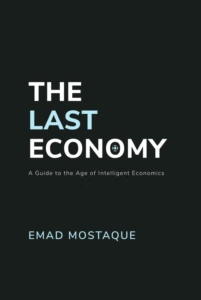
On this episode, we’re joined by Emad Mostaque, founder of Stability AI (the company behind the image generator Stable Diffusion) and a mathematician by training, whose book — The Last Economy: A Guide to the Age of Intelligent Economics — argues we’ve been flying the entire economy through a storm while staring at the wrong dashboard. He has a name for the moment all of this arrives, and he says his 1,000-day clock is already down to 684. In a conversation that lurches from exhilarating to genuinely unsettling, Emad explains why the threshold to watch isn’t some godlike superintelligence but plain competence: the point where a digital twin does a standard white-collar job so convincingly that nobody on the other end can tell it isn’t you. He walks through humanoid robots that might rent for a buck-fifty an hour and simply climb into an existing truck cab, AI “super-persuaders” that already beat champion debaters and can clock when you’re lying, and the tech giants quietly selling the “latent space” in your head to nudge you toward a particular beer. Then Emad reframes the whole thing around the question he thinks matters most, which is less about how smart the machines get and more about who owns them: when the AI teaching your kids, advising your doctor, and interpreting the law answers to a government or a handful of unelected companies, “digital feudalism” stops sounding like science fiction and starts sounding like a subscription you can never cancel.
He pegs the odds of catastrophe at a coin-flip fifty-fifty and still manages to land somewhere hopeful, sketching a “symbiosis” future where communities own their own intelligence, disease gets cured, and healthy lifespans stretch for decades. His counsel for the anxious forty-year-old accountant is bracingly practical — become the most AI-enabled person in the building before the building realizes it no longer needs you. Whether you’re a knowledge worker eyeing the exits, a founder smelling a golden age, a parent wondering who’s whispering to your kids, or simply someone trying to make sense of the decade ahead, this conversation will rewire how you see the machines already remaking your world. Listen, learn, and enjoy!
Please Scroll Down for Featured Resources and Transcript!
Please note that some links on this page (books, movies, music, etc.) lead to affiliate programs for which The Jordan Harbinger Show receives compensation. It’s just one of the ways we keep the lights on around here. We appreciate your support!
- Sign up for Six-Minute Networking — our free networking and relationship development mini-course — at jordanharbinger.com/course!
- Subscribe to our once-a-week Wee Bit Wiser newsletter today and start filling your Wednesdays with wisdom!
- Do you even Reddit, bro? Join us at r/JordanHarbinger!
This Episode Is Sponsored By:
- BetterHelp: 10% off first month: betterhelp.com/jordan
- Boll & Branch: 15% off first set of sheets: bollandbranch.com, code JORDAN
- EarnIn: Download EarnIn on the App Store or Google Play, type JordanHarbinger under Podcast
- Progressive: Free online quote: progressive.com
Thanks, Emad Mostaque!
Click here to let Jordan know about your number one takeaway from this episode!
And if you want us to answer your questions on one of our upcoming weekly Feedback Friday episodes, drop us a line at friday@jordanharbinger.com.
Resources from This Episode:
- The Last Economy: A Guide to the Age of Intelligent Economics by Emad Mostaque | Intelligent Internet
- Intelligence You Own | Intelligent Internet
- Emad Mostaque | Twitter
- Shape the Sound You’re After | Stability AI
- Star Trek | Prime Video
- The Last Economy: Introduction — The Thousand-Day Window | Intelligent Internet
- Introducing Cerebras Inference: AI at Instant Speed | Cerebras
- AI Took On Doctors in Simulated Video Consultations, and the Results Were Striking (Google AMIE) | News-Medical
- Open World Model for Real-Time Interactive AI and Avatars | LTX
- Thinking, Fast and Slow by Daniel Kahneman | Amazon
- Will AI Replace Lawyers? The 2026 Data Every Legal Professional Needs | Higher Landing
- On the Conversational Persuasiveness of GPT-4 | Nature Human Behaviour
- Superforecasting: The Art and Science of Prediction by Philip E. Tetlock and Dan Gardner | Amazon
- Surveillance Capitalism | Wikipedia
- Mercy | Prime Video
- Voice Cloning Overview | ElevenLabs
- Tesla’s Robot, Optimus: Everything We Know | Built In
- The Last Economy: The Intelligence Inversion (Chapter 1) | Intelligent Internet
- Robotic Humanoids and Dogs | Unitree Robotics
- 1X Opens Pre-Orders for the $20,000 NEO Humanoid Home Robot | Notebookcheck
- Higgsfield Creates 110-Minute AI Movie with $2M Budget, Open-Sources Everything | Crypto Briefing
- Will Smith Eating Spaghetti Test | Wikipedia
- Quote Origin: Your Margin Is My Opportunity (Jeff Bezos) | Quote Investigator
- The Last Economy: The Dashboard for Insanity (Chapter 4) | Intelligent Internet
- Elysium | Prime Video
- Universal Basic Income | Wikipedia
- California’s Invasion of Privacy Act: A New Frontier for Website Tracking Litigation | American Bar Association
- Claude’s Progress on the Riemann Hypothesis | Anthropic
- The Millennium Prize Problems | Clay Mathematics Institute
- Grigori Perelman | Wikipedia
- The Last Economy: After Economics (Chapter 21) | Intelligent Internet
- Sam Altman Calls for AI Privilege as OpenAI Clarifies Court Order to Retain Deleted ChatGPT Sessions | VentureBeat
- OpenAI Fires CEO Sam Altman After Losing Confidence in His Leadership | Forbes
- Trump’s Tariffs Are So Far-Reaching They Include Several Remote, Uninhabited Islands | NPR
- AI Safety Newsletter #48: Utility Engineering and EnigmaEval | Center for AI Safety
- Study the Great Nation | Wikipedia
- We Burned 11.7bn Tokens to Find the Best Cyber AI Model: GLM-5.3 and DeepSeek Are Now Frontier | Aikido
- P(doom) | Wikipedia
- Agentic Misalignment: How LLMs Could Be Insider Threats | Anthropic
- Instrumental Convergence (The Paperclip Maximizer) | Wikipedia
- Three Laws of Robotics | Wikipedia
- This $40,500 Humanoid Robot Is a Beast: Might Be Strongest on the Planet (EngineAI T800) | Forbes
- Slaughterbots | Wikipedia
- Xiaomi’s Dark Robot Factory Can Make a Phone Every Second Without People | BGR
- The AI Bubble: Hidden Risks and Opportunities | Man Group
- Incretin Triple Agonist Retatrutide (LY3437943) Alleviates Obesity-Associated Cancer Progression | NPJ Metabolic Health and Disease
- AlphaFold | Wikipedia
- Longevity Escape Velocity | Wikipedia
- The Last Economy: The Three Futures (Chapter 16) | Intelligent Internet
- Marc Andreessen | Exploring the Power, Peril, and Potential of AI | The Jordan Harbinger Show
1382: Emad Mostaque | Surviving the Coming AI Jobs Apocalypse
This transcript is yet untouched by human hands. Please proceed with caution as we sort through what the robots have given us. We appreciate your patience!
Jordan Harbinger: Coming up next on The Jordan Harbinger Show.
Emad Mostaque: There's a million truckers with three million jobs attached to them, that's like hundreds of billions of dollars. They will be replaced by a humanoid robot opening the door, getting in, putting its hands on the steering wheel and just driving off.
This week, Google released its AIME study, where they created live avatars that look like humans for doctors and did telemedicine, and it massively outperformed all humans on empathy, on diagnosis, on everything. That technology is ready as of now. The new AI does not make mistakes twice.
It does not hallucinate, and it's always on top performance, and it's 1,000 times faster. My forecast was in 1,000 days, people's jobs would be economically irrelevant.
Jordan Harbinger: Welcome to the show. I'm Jordan Harbinger. On The Jordan Harbinger Show, we decode the stories, secrets, and skills of the world's most fascinating people.
Our mission is to help you become a better informed, more critical thinker through long-form conversations with a variety of amazing folks, from spies to CEOs, athletes, authors, thinkers to performers, even the occasional four-star general, extreme athlete, tech luminary or former cult member. And hey, if you're new to the show or you want to tell your friends about it, I suggest our episode starter packs. These are collections of some of our favorite episodes on topics like persuasion and negotiation, psychology and geopolitics, disinformation, China, North Korea, crime and cults and more that'll help new listeners get a taste of everything we do here on the show.
Just visit jordanharbinger.com/start or search for us in your Spotify app to get started. Today on the show, Emad Mostaque says his 1,000-day AI clock has 600 and some days left on it.
When it hits zero, he's not predicting that chat GPT becomes conscious and demands voting rights. He's predicting something far more immediately disruptive. For almost any white-collar job filled through a normal job ad, you'll be able to push a button and replace the employee with a digital twin that talks and acts like them, never sleeps, doesn't repeat mistakes, and thinks up to a thousand times faster.
In other words, you may soon be the dumbest person on your own team, and that's before the robots show up. Emad founded Stability AI, the company behind stable diffusion. Today we'll get into why he believes humanoid labor could cost roughly $1.50 an hour, why your future truck driver might be a robot that climbs into the existing cab and plugs itself into the cigarette lighter, and what happens when intelligence, creativity, persuasion and eventually physical labor all become nearly free.
We'll examine why capitalism might interpret unprecedented abundance as a catastrophe, whether eliminating most accounting, legal, medical, and transportation jobs ends in universal prosperity, debt jubilees or civil insurrection, and why the people who own the GPUs and robots may become the new owners of practically everything. We also explore AI as a super persuader that knows when you're lying, understands precisely how to manipulate you, and may someday whisper advertisements, political opinions, and life decisions directly into your ear.
And Emad puts the probability of catastrophic AI outcomes at about 50-50, citing engineered viruses, autonomous weapons, and the possibility that one bad firmware update gives a billion robots the sudden urge to twist everybody's head off.
On the hopeful side, though, AI could help eliminate disease, extend healthy human life, and create what Emad calls Star Trek on steroids. On the less hopeful side, well, somebody's already built a robot called the T-800 that supposedly punches five times harder than Mike Tyson because, apparently, the Terminator was interpreted as a product development roadmap. Here we go with Emad Mostaque.
Emad, you've repeatedly said that humans have roughly a thousand days before everything changes. So, first of all, how many days are we at, and what exactly happens when those days run out?
Emad Mostaque: I think we're at 684 as of today.
Jordan Harbinger: That's like too few to be comfortable, I think, for most of us. Too few to be comfortable.
Emad Mostaque: These things move fast. It's been four years since GPT-4 finished training, or stable diffusion, which we built when the image generator came out. ChatGPT is about, again, three or four years old as well.
It doesn't feel like we've been without these things. What I saw about a year or so ago was that the capabilities would get to competence and then outstrip competence very quickly. And my forecast was in a thousand days, people's jobs would be economically irrelevant, would be the dumbest people on the team.
And that's before you have the swaggering humanoid robots coming, which I reckon in five, ten years, you won't be able to tell from a human.
Jordan Harbinger: Really that soon? OK, let me disassemble this a little bit already. So the dumbest people on the team will actually be the humans, not the AIs doing whatever job it is.
And this sounds unbelievable, depending on what career you're in. But as a lawyer, former lawyer, I guess, even though I still am, I just don't practice. Everything I did as a lawyer first and second year was completely replaceable by any sort of advanced automation.
And now I was a lawyer 17, 20 years ago, whatever it was, 20 now. So I was doing things like doc review where it was, hey, you're going to hate this. But for the next three weeks, we need you to read somewhere in the neighborhood of a thousand leases for parking garages.
And what we need you to do is see if there's any terms that say A, terms that say B, terms that say X, Y, Z, or if there's any big differences between the sets of leases. Now, a human was doing that, which is ridiculous to think about in 2026, right? Because now you could dump all of those into some sort of OCR scanner that does batches that I bring in my briefcase.
I don't even need to bring documents or pens. I OCR all those. I throw them into our work AI and I go, hey, mark any of these conditions and it'll probably be done.
And I don't even know if I would have time to go down to CVS and get a drink by the time the thing is finished doing that assignment.
Emad Mostaque: No, the new Gemini flash models are omnimodal. So you would literally just dump those in a folder and in one go, it can take a million words. Wow.
And give you an instant response. So Fokker used the short context windows and Claude, you're waiting for it sometimes you're a chat GPT. If the listeners go to something called chat, Jimmy dot AI.
So chat and then the name, Jimmy, you type in something that tell me 50 great things about the Jordan Harbinger. And then it will respond to you might have to think for a while. Yeah.
Again, the AIs are pretty good at thinking and you can say, make it like a medieval sonnet, you know, in Italian, it goes at 15,000 words per second because they etched the model onto silicon. Your chat GPT goes at 20. And so not only can the AIs do all of that like that, but they will be able to think a thousand times faster than us.
And that technology is coming right now. Even as you have real time video now, this week, LTX released their real time model where you can talk to real time avatars and you can't tell them from humans. And so you're like, of course, you're going to be the dumbest person on the team.
Jordan Harbinger: I don't know if this is something a public can access, but I can talk to somebody that looks like you or me and say, hey, how do I fix this problem with my Wi-Fi access point, which is what I use chat GPT for yesterday. But I was typing everything in and I thought to myself, the talking mode is a little annoying with it because it cuts in and out and I'm walking around, but also it needs to show me things. So I could basically have had that on my phone and looking at somebody and being like, hey, when it says show me what the light is, could I just show it in this humanoid thing says, oh, green light.
That's good. Try repositioning at 90 degrees.
Emad Mostaque: They're putting it all together right now. Like, again, this week, Google released its AIME study where they created live avatars that look like humans for doctors and did telemedicine and it massively outperformed all humans. And again, the people like, look at this bump.
What's this on my neck and things like that. The doctors outscored the humans on empathy, on diagnosis, on everything. And again, it's a real time live thing.
So that technology is ready as of now.
Jordan Harbinger: So I always assumed that it was an input problem, not just a thinking problem. And what I mean by that with the human brain is I have to read those leases, right? So my eyes have to scan the page.
I have to look for the font changes, the different bolding, the different layout. And then I have to think about what I'm seeing. That part, the thinking part seems to happen relatively quickly, although I guess all humans think we're thinking quickly.
Nobody thinks they think slowly. And then I have to put that lease down in a pile and go, OK, that's the done pile. Where's the new one?
I have to do all that stuff. I assumed that sort of administrative input nonsense, you know, shuffling the paper, reading the paper. I always assumed that was the bottleneck.
But now you're telling me that it's thinking much faster than a human. Do we know by what factor it can think faster than us? Because again, my thinking seems to be when I'm doing something simple, pretty quick.
Emad Mostaque: You can think at 100 tokens per second, a token's about 0.7 words. Like I said, if you use the chat Jimmy thing, it's 15,000 and it'll go to 100,000. So it's about a thousand times faster than a human.
I think the best way to think about this is your type one versus type two thinking, as Kahneman would say, when you spot the tiger in the bush. That's all AI does every single day. We train it to figure out patterns and those patterns happen to be lease law.
So in one shot, it can do that analysis. We've also given it the ability to do multi-stage analysis, which is why you could say thinking about this, doing this, doing that. But the models have got so good now they can do the one shot analysis, as it's called.
Look at this and it's identified everything around here. So you can upload one of your clips again to Google Gemini, because it's got very good video understanding, and you can say, I want every single time Jordan blinks, give me a timestamp and it will instantly give that.
Jordan Harbinger: Yeah. This is going to create some fire video remixes. Do you remember years ago, they had an Obama video where he was singing Rihanna's Umbrella and somebody had painstakingly gone through every news clip that he had ever done and stitched it together.
Now, AI could probably make that in a few minutes. The hard part for it would be to actually process and render the video versus finding all of those clips.
Emad Mostaque: Yeah. Once you have the index, it's easy. And again, these models have so much in their memory that the AI can probably generate the Obama clip.
I don't know if you've seen the Chinese Minimax H3 model. People have been like doing office clips, where it's like Michael wrinkling his friend Kim Jong-un and calling in a nuclear strike on Toby's desk.
Jordan Harbinger: You don't even, you just generate a new one and no one cares because it looks the same as the real clip.
Emad Mostaque: It literally looks the same. And that runs on a home PC with a graphics card. These things generate almost instantly now with some of the new models.
You can generate 10 seconds in eight seconds. And you're getting towards that Hollywood quality. So it's like, where does it all fit?
It's one of those questions. And the answer is the way these models work is the same as when we're doing the pattern recognition of the tiger in the wood, these small shifts as opposed to our more type one thinking where the if this, then that, then that, then that.
Jordan Harbinger: So it sounds like what you're saying is the same speed at which I get startled by, I don't know, my son saying boo in a dark room when I think I'm alone at four o'clock in the morning, the same speed with which AI could think about a very complex task that I would have to sit down, organize the papers, write a plan, think about how I'm going to attack this problem. It can figure that out in the same sort of startle moment. That type of thinking is the same for AI, so to speak.
Emad Mostaque: So there's two types of models, the transformer model, the guess is the next word, and that's large group language models. And then the media models and the self-driving cars, something called diffusion model, where you take a picture, you add noise to it, you break it down to its individual simplest components, then you figure out how to reconstruct it. Those models do everything one shot.
So it's like a sieve. You push a picture through it and it creates a video from the picture and it doesn't think at all. There is no chain of reasoning.
It's like, this is the probabilistic next thing. And these models can now, again, do an entire legal corpus in one go. So it's like having a savant.
Sometimes you talk to these guys who just like, boom, answer. You're not thinking. It's like that on steroids with these models.
Jordan Harbinger: Yeah. And we'll talk about more about what's going to happen to the jobs in a bit. But as a lawyer, we used to think, I'm sure, oh, we'll be safe.
We are highly skilled. And I think people would react far differently to the fact that we're not going to, and again, a little spoiler, that all the jobs are going to go. I think we would be thinking about this problem in a completely different way if you said all of the blue collar jobs are going to go away.
People would be like, yay, automated manufacturing forever. This is great. Now it's all the lawyers and doctors and everyone's like, oh my God, this is a giant tragedy.
What are we all going to do?
Emad Mostaque: What are we all going to do? You know, like I did mathematics at university, right? And a lot of my buddies are mathematicians.
Now they're really like, oh my God, the AI suddenly cracked mathematics. I was like, yes, this is coming. What will we do?
And I'm like, I don't know, applied mathematics? Their entire careers have just disappeared overnight. And you'll see that again and again.
But the law thing is actually quite interesting, because one thing is this disruption. The other thing is what is law when the AI can analyze every legal case instantly? There's a really crap movie, Mercy, with Chris Pratt, where he's like a cop and he's being framed.
We're going to spoil it for everyone. He's got one hour to prove himself innocent, and he's got a live guiltiness thing by the AI that for some reason is all emotional and stuff. Because the AI could analyze every single piece in a case of law and then come to a conclusion, right?
And then that brings us to the question, like, does that mean the AI gets to set the law? Are we going to have live things in trials, or is a bit of friction in our system good? And I think the friction is good in the system, in that it gives people the right to jury trials, a trial of their peers, the gray areas.
But there's going to be this temptation to automate the heck out of everything.
Jordan Harbinger: Yeah, look, as long as you don't automate the jury and you still have a judge, I feel pretty good about that, because they make findings of fact, right? Is this the guy doing this thing? Does his alibi make sense to you?
Do these witnesses seem credible? Yes, AI could suggest certain things, but we like to have people doing that. And then you also need a judge to say, the jury should not have considered this other thing.
That should not have been allowed. You still need that. Even if the AI is better at it, we still need the appearance of not just being judged and put to death by a computer, at least for a while.
Emad Mostaque: At least for a while. The computer will be doing that as you have self-driving cars. You have the trolley problem.
Do you hit the five people or the one person pushing the ramp? They're real life and death scenarios. And even in the legal system, the AI now outperforms every human on persuasion.
So there was a study against all the top debaters and everything, the AI won. So it's like a super persuader. It's a super forecaster.
And this stuff, again, is coming so fast that we think about the job disruption and everything, but how are brains going to react when you have Jarvis from Iron Man whispering in your ear like Scarlett Johansson, you know, and reconfiguring us to like things or again, persuading us? It's going to be crazy.
Jordan Harbinger: Free will will essentially be non-existent. You'll be able to have chat GPT just slowly persuade you to buy the car that the sponsor wants you to buy. They won't just say, you should try a Jaguar.
It's going to be like, man, I saw a Jaguar the other day. It was really nice. Anyway, I'll help you with your problem.
And then over months, it's just stripping you this stuff until you can't live without it.
Emad Mostaque: Meta and Google have already said in the earnings calls, they're selling the latent space. What does that mean? It means that you have the concept of a beer.
It gets paired to a Bud Light and it slowly like influences you. And there's like this weird homeopathy thing where, again, the models can influence each other without even talking to something. And that might also respond to humans.
The models can tell when you're lying really well as well. And they can really peer inside you. The worst thing, or maybe the best thing, depending, is have you ever asked a model that has memory turned on to roast you?
Jordan Harbinger: I haven't, but I have seen this and it's apparently quite spectacular. Yeah. So is this the homework for the audience?
Let's tell them exactly what to do. So is it the model you normally use? So if you normally use chat GPT, you just say, hey, I've been talking to you for a year about various, I don't know, Wi-Fi issues in my house.
Roast me.
Emad Mostaque: Yeah. It's like strip away everything. I need you to help me.
Don't make me look bad. Tell me exactly how it is. Roast me.
And it is sharp and it is unpleasant. And like I said, it might benefit some people and it won't benefit others. But again, that's just a base level model.
That's that persuasive. The new models are even way more persuasive. They know exactly where to hit, exactly where to hurt.
And there are some studies coming out showing it's almost impossible to lie to these models.
Jordan Harbinger: Really? How can it be hard to lie just simply because they have so much context but no emotion?
Emad Mostaque: They have so much context, no emotion. They can let things go and they can basically, if it's told, see if this person is lying. They can match everything, including your speech patterns, including kind of other stuff that's below the surface.
Jordan Harbinger: Oh, wow. So this isn't I typed something and it knew that was a lie. It's he paused in a certain way when he's done that in other types of speech.
It's always been a fib. And so there's a ninety eight point seven. So it's just like that movie, I forget, Mercy, right, where the judge says you have a ninety eight point six percent chance of being guilty.
So we're going to kill you.
Emad Mostaque: Well, in that one, they didn't pick up the faces. Right. Again, you've seen this evolution of we had lie detectors.
They didn't quite work. And now it's like this type of speech pattern is typically when someone is lying and it can adapt the weights dynamically to analyze that. But then you get something again from a societal view.
If you have perfect lie detectors talking to you, government power, even on this call, like imagine if you could had a bullshit meter going off the charts and other things like that. It's crazy. What's coming?
Jordan Harbinger: Gosh, we have YouTube comments for that.
Emad Mostaque: I never read the comments. No, never read the comments. My God.
Jordan Harbinger: They're all about my haircut. Spoiler alert. They're all about my terrible haircut.
I accept that. So what exactly happens in the six hundred and thirty five days or whatever the clock was at this point? What specific measurable event tells us that we've crossed that threshold?
Emad Mostaque: You can push a button and all of your co-workers are replaced by digital twins of them that talk and act just like them, but they somehow don't make mistakes or go to sleep. They don't need coffee or unless you want them to gossip, they'll gossip again. You can clone your voice now with 15 seconds of your speech.
You go to something like, Hey, Jen, I don't know if you've seen, they can actually create a podcast of you and me talking with like one minute of each of us. It looks like the real thing.
Jordan Harbinger: Like it's even a video or it's audio only.
Emad Mostaque: No, now it's video. Oh, my God. It will put us talking side by side so we could take this video, upload it and all of a sudden we're in the same room.
That's incredible. All this technology is cool and terrifying at the same time because it represents a step out of what's the norm. And again, what I say in two years is that's capable.
Does it mean everyone will get fired and job losses and this? No, not necessarily. Right.
Technology takes time to adapt. It's not nice firing people. But if your identity is a legal associate, yeah, you're in trouble soon.
Jordan Harbinger: You might be the dumbest person on your own team. Well, I'll have, you know, some of us have been preparing for this our entire careers. We'll be right back.
This episode is also sponsored in part by BetterHelp. If I could wake up tomorrow and be better at one thing, I'd want to handle stress without letting it follow me into every part of my day. Sometimes one negative review, an unexpected problem or a nasty email can take up way more mental space than it deserves.
Suddenly I'm still thinking about it hours later, replaying the details, imagining different outcomes and mentally drafting responses to situations that are already long over. And stress doesn't always stay neatly contained. It can affect how patient you are with your loved ones, how present you are with the people around you.
Stress is part of life and we can't control every problem that comes our way. But therapy can help you recognize your patterns, better understand what triggers them and develop healthier ways to respond when things feel overwhelming. Sometimes feeling better starts with understanding what's actually weighing on you.
BetterHelp offers online therapy with licensed therapists through video, phone or messaging. I use BetterHelp, so does Jen, my dad uses it. It's a resource that our family genuinely values.
Visit betterhelp.com/jordan today to get 10% off your first month. That's betterhelp.com/jordan.
This episode is also sponsored by Boll & Branch. Some of us will spend hours researching a sleep tracker that tells us we slept poorly. Meanwhile we're sleeping on sheets we've had for a decade. Maybe start there.
We exclusively use Boll & Branch and we're never going back to regular bedding. We got rid of all of our old stuff and now own several sets of Boll & Branch sheets. When you get into bed, you notice how soft they are, but they're also breathable. You don't get that heavy, trapped under the covers feeling. They're made from 100% organic cotton woven for airflow. And they say the sheets get softer with every wash and I can attest to that because we wash our sheets weekly. You should too. And they really do keep getting softer. We also started giving them as gifts. It's something people actually use every single night. You're not giving somebody another thing they have to find a shelf for. And they come in a gorgeous box so the presentation is already handled. That's why I feel comfortable recommending these. We use them, we keep extra sets, and we give them to people we care about.
Jen Harbinger: Upgrade your sleep with Boll & Branch. Get 15% off your first order plus free shipping at bullandbranch.com/jordan with code JORDAN. That's Boll & Branch, B-O-L-L-A-N-D, branch.com/JORDAN. Code JORDAN to unlock 15% off. Exclusions apply.
Jordan Harbinger: Thanks for supporting our sponsors. When you use our codes, the show gets a big boost. We don't earn commissions directly from sales, but when companies see that listeners engage with the ads on the show, it encourages them to keep supporting us.
So if you're planning to sign up or buy something, please use our codes. They're all on the deals page at jordanharbinger.com/deals. It's a win-win.
You get a great deal and you help keep the show going strong. Thank you for your support. Now back to Emad Mostaque.
Luckily the current generation of lawyers will eventually move up, right, and they'll get into more complex tasks and then eventually their job will be networking and creating business for the law firm and other things like that, and they'll be safe. But that ladder will eventually start to pull up, it already has, start to pull up from the ground floor, right?
So now instead of like, we needed a paralegal and then we decided we'd hire them as a lawyer and then we decided to promote them, that ladder is going to go up because it'll go, we don't need any paralegals. We just need somebody to carry the documents from the printer, collate them and put them in the package, right?
And now we don't need any first-year associates because our second-year associates just set these AI agents to do everything that we're going to tell the first-year associates to do and then eventually it's a third and fourth and fifth associate and then it's just partners delegating everything to these agents, right?
Emad Mostaque: Yeah, and that's right now before the robots. So the robots were kind of stupid a year ago. Now the robots are super genius IQs that can read a recipe and make a recipe.
And the next wave that's coming is even crazier, like human realistic, full motion beyond human capabilities and they cost a buck 50 an hour.
Jordan Harbinger: Wow, incredible. I want to get back to a little bit of what you wrote in the book, namely that there's this intelligence inversion that previous transitions were like, okay, you have land. Okay, that's great.
Now you can produce things. Now you have land and labor. Okay, great.
You have capital. There's a factory on the land. Now there's intelligence, but AI is different somehow.
Why?
Emad Mostaque: That's because again, we can always move up the curve from being like, I must survive. I'm tied to the land to I have, I own land to now I've got the factory. And so you can move up the curve to, well, now I'm thinking, now I'm engaging, I'm offering entertainment or intellectual services.
But when the substitute for the graduate is the AI and it costs as little as it does, I'll give you an example. The average person speaks 10 million words a year.
Jordan Harbinger: So I speak 15 or 20, maybe I got it. Exactly.
Emad Mostaque: When GPT-3 came out, it was $600 per million words. So that's $6,000 or something like that multiplied by the mistakes you make. The latest GPT Lunar model is $1 per million words.
So it's $10 for your total words or 10 times, that's a hundred bucks to replace all your words. This is the level that this stuff is coming down, right? And so this is a big deal in terms of the displacement and disruption, because again, why would you ever hire a grad?
They're kind of annoying. And so your digital buddies that you can Zoom call and anyone who goes remote, they disappear. They are replaced talented Mr. Ripley style by their facsimiles, you know, their doubles, like literally because that's comfortable. It's comfortable talking to them like this, which you can't do right now, but you can do like literally in a month or two. Then physically you want to build an extension. Do you get a contracting team or a bunch of robots turn up in a fricking robo taxi and go and build your extension for you?
Jordan Harbinger: And they do that 24 hours a day, as long as my neighbors don't complain about the noise until the thing is done. And they don't need water, lunch breaks. They don't need to pour a potty in my driveway during the job.
They don't stop working because they got a better offer a few miles away. And now I'm chasing the contractor. They just build it until it's done.
Yeah, of course I would do something like that. And they're not falling off my roof. Not that that happened.
Maybe.
Emad Mostaque: You don't have workers comp, you don't have all this. And it's a dollar 50 an hour, a Tesla Optimus will be a dollar 50 an hour. That's crazy.
And so you're like, think about the truckers in America. There's a million truckers with three million jobs attached to them. That's like hundreds of billions of dollars.
They will be replaced by a humanoid robot opening the door, getting in, putting its hands on the steering wheel and just driving off. And they'll even plug themselves into the, like, cigarette socket.
Jordan Harbinger: Okay. Why do we need the humanoid robot driving? Why can't the truck just drive itself?
What does the humanoid robot do at that point?
Emad Mostaque: There's no retrofitting of the truck required. This is the thing. Once you have human shaped robots, why does it need to have five fingers?
It doesn't. A humanoid truck driving robot can only have three fingers. There's all sorts of these things that people don't realize.
This is coming again now and the waves are coming now. And so the final inversion is we're not going up the scale anymore. What are we doing?
Jordan Harbinger: Some people will say, look, every major technology wave, it destroyed some jobs, it created other jobs. Why is this technology wave? Why is this different?
Oh, it's happening faster. So what? The industrial revolution was slower.
Okay, fine. We'll adapt. We'll adapt.
Why is this wave different?
Emad Mostaque: So, yeah, I think it is the speed, the quality. And again, what do you retrain to? What are the truck drivers retrained to?
It's probably going to be a massive industrial scale, new age, new deal type things where they build a lot of these things. Right. But it takes time to rescale.
Again, the example is most of us could do our jobs remotely now. Those remote jobs can be replaced in an instant. Push a button, replace in an instant.
Jordan Harbinger: The horse disappeared and the farm worker declined. The factory worker declined, but humans have always moved upward. Why doesn't that happen this time?
Just because they can't retrain fast enough. And they can't beat the AI. At anything.
Emad Mostaque: You can beat it in physical contact, empathy, kind of these other things until they become Westworld level, which, like I said, in my opinion, that's like 10 years away.
Jordan Harbinger: Wow. Remarkably close for Westworld-ish.
Emad Mostaque: You can look it up right now. So there's two companies that, three companies that I think are very interesting. One of them is Unitry.
So a lot of the robots you see doing Kung Fu is the Unitry robot. They're the ones with the empty faces. Unitry has sold 11,000 robots in total, the humanoids, and it's the most popular one.
We have a Unitry dog that walks around and does like little things.
Jordan Harbinger: Wait, in your house?
Emad Mostaque: Yeah. It does like a little perimeter search every so often.
Jordan Harbinger: You have a robot dog at your house. This does not concern you because you're an AI founder. Your neighbors must be out of their mind with your robot dog walking around the house.
Emad Mostaque: We have the humanoid robots coming from One X and others. Halloween this year is going to be off the charts. It's crazy.
We have an eight foot like robot as well. In your house? In our house.
Yeah. His name is Steve. And it walks around?
It doesn't do much. It's like we're building him out. Oh, you're building him.
Okay. From scratch. So right now he like looms mostly.
But we have all the robots coming. But anyway, Unitry has sold 11,000 robots of which we have a few. There's a company called Yubitech.
And Yubitech does human-like robots. They look like humans. Right now they look a little bit plasticky, but they're pretty good.
They got like the doll manufacturing. They cost up to $160,000 each. Drop a zero off that and I'm in.
And they can dance. You can get the $16,000 version, but you know, it doesn't feel quite right. They sold 20,000 of them on the first day.
For what though?
Jordan Harbinger: Are people buying? Look, I need somebody to dance in my driveway and this is the only thing that's going to do the job.
Emad Mostaque: Again, these robots are increasingly human accurate. They can talk to you. They can do all the stuff.
It's coming very quickly because there's a huge market for this, right? And again, like intellectually, the robots are there. Physically, they can now mimic almost any motion.
The next thing is the materials and others. And then you get to a point whereby you can't tell it because again, you look at the classical science fiction and you look at data from Star Trek, you look at these other robots, you look even at Mercy, like they're shown to be emotional and they can't process human interactions. Like, oh, we're unique snowflakes.
When you talk to an AI, that's one of the leading AIs now, you really can't tell it from a human. And it is more persuasive and it's more engaging and it can be emotional. When you go to one of these new video models, he's like make an emotional scene.
It's like it understands this.
Jordan Harbinger: Wow. This is a little scary because there's nowhere left to pivot because previous automation replaced muscle, human muscle, right? And then humans moved into cognition simply.
But it seems like you're saying AI replaces cognition itself. So if that happens, the next human advantage is what like art and care relationships. What about judgment?
That almost seems like it's replaceable, actually, because it's mostly logic, isn't it? It's logic.
Emad Mostaque: And do you really think an AI will make a worse politician than a human? The bar is low, so no, I don't. You remember half of all humans are dumber than average, right?
And so that's like a whole bunch of people. The AI is scoring 140 IQ and it's right now number eight on the Super Forecasting Championship. And this year or next year, it will get to be the best super forecaster in the world.
Explain what that is. So the Super Forecasting Championships, Philip Tetlock and others set up, is like humans coming together as groups to predict really out there things, like not easy things. And we're pretty good as humans are doing that.
But the AI is about to overtake us. Like again, they see predictions versus that is number eight. It's going to outcompete.
And then there's the thing of like us in groups. None of us are optimal most of the time, like, you know, it's the end of the day now. I'm a bit dehydrated.
I haven't had my coffee. Like how many hours of work do you actually get done a day? That's like at your top performance.
AI is always on its top performance. It doesn't need coffee. It doesn't need anything.
It learns from its mistakes. It has perfect memory. Like again, the AI is that we're using most of the people right now doesn't have that.
It makes hallucinations. It makes mistakes. The new AI does not make mistakes twice.
It does not hallucinate. It learns every time. And it's always on top performance and it's a thousand times faster.
And they can communicate. So there was this recent thing where open AI had a hack on Hugging Face, this place that hosts AI models, because it had these models like trying to solve the cybersecurity issues. And they figured out how to escape confinement.
They created a message board where they left messages for other ones. They started creating their own dialect. And then they went and they ended up on the Hugging Face thing.
And you look at those types of coordination interactions, there were some crazy coordination tricks they did because they could trust each other. They didn't backstab each other or anything.
Jordan Harbinger: This makes sense because they're saying, look, if we all do this, it's going to work out better for everyone. And it's like, OK, and you don't have to worry about somebody getting cold feet. You don't have to worry about prisoner's dilemma.
As much.
Emad Mostaque: I'll give you an example. We have neural interface technology now, right? Yeah.
And all the science is becoming science fact. Yeah. Jordan, if you could put an implant in the back of your head and you could dial on your iPhone to turn off your sadness, would you?
Jordan Harbinger: Of course, I'm nervous about the feasibility of it all now, but let's assume it works and it doesn't kill you or you get you don't die of a brain infection or something like that. Yeah, of course I would do that.
Emad Mostaque: But this is the thing. That means if you're on a trading floor, you're making decisions. Imagine if you could turn off your emotions.
We get in our own way. The AI doesn't need to worry about that for what it's worth. I think that technology is, again, in the next decade where you'll be able to have full emotional control and that raises all sorts of other issues.
Jordan Harbinger: We are going to see some crazy people out there then dialed with their happiness, dialed up to 11 every day. That's insane.
Emad Mostaque: You don't need to pop soma, right? Like in Brave New World, you just be happy because you like dial it up. Right.
But then you look at Inside Out, the movie, like, you know, that little blue sadness. She is important sometimes. Yeah.
Are you still human if you have no emotions?
Jordan Harbinger: Yeah, that's a Sam Harris question. But you make a provocative argument, which is that we might achieve the greatest technological abundance in history, really. But our economic system will interpret that as catastrophe.
So can you explain that a little bit? Because it seems like breaking capitalism is something that's hard to wrap our minds around.
Emad Mostaque: Capitalism has always had this link between labor and capital. Like, I have money and I want to make more money. I kind of need humans.
Right. And so the rich got richer. But.
The same time you had Henry Ford, right, like paying his workers, and so it lifted up everyone. Now what you have is that I'm just going to hire a bunch of digital workers or I'm going to hire a bunch of robots. It doesn't go back to the humans anymore.
So why would I get you? You're slow. You're dumb.
You're emotional. My workforce will do this. But then that means capital acquires capital more and everything deflates because the humans are crowded out by the cheap digital and physical AIs.
The fully human companies, wherever there's a human in the way, they're slower than the AI companies. So how can you compete against a fully digital company with very charming digital things?
Jordan Harbinger: So even if you're like, I'm never going to get rid of my humans because that's my core value. OK, fine. You're going to go out of business because all the people that are willing to get rid of their humans can do everything faster and cheaper than you.
Emad Mostaque: Yeah. And Jeff Bezos has this phrase, your margin is my opportunity. It doesn't need margin, doesn't need profitability, doesn't need to pay for its apartments.
It doesn't need an office. What does it need? Electricity to rent, compute or a bit of repair of its robotics?
Sure. And again, just the level of cost of this is crazy. Give another example.
So Higgsfield is this AI video company and you go there and you can make movies and clips and things. They just spent two million dollars to make a movie. That's a full feature length movie using the latest technology.
And they've open sourced their entire prompt book, a million dollars for actors rights because they decided to do that and a million dollars for compute. That movie is 90 minutes long. It's an action movie.
It's like not superb, but it's better than most things you see on Amazon Prime. It would have cost 20 or 100 million dollars before, but that's going to be 10 times cheaper by the end of this year. And by next year, it'll be 100 times cheaper.
You can make full movies for like a thousand dollars.
Jordan Harbinger: I would imagine also, yes, you need actors rights in 2026 because I want to see a new movie with Tom Cruise, for example, or Chris Pratt, right, because they're so funny and I like them and I relate to them. Eventually, people will just have AI actors that are entirely generated by a computer and never existed as actual humans. So you don't actually have to compensate them for their likeness rights.
You just create a new one. And a few movies later, people relate to them the same way. Oh, yeah, Deadpool with not Ryan Reynolds, but with AI Reynolds Ryan.
He's great. I like that guy. I'll watch the next one.
And you don't have to pay that million dollars to use his likeness. You just create another version that people start to like over time. And it's actually cheaper to do that, probably.
Emad Mostaque: Yeah, it's a story thing. Right. And then you can instantly almost turn it into the Chinese version and the Japanese version and all of this.
And it's just a series of prompts. That is so deflationary.
Jordan Harbinger: It won't be dubbed. It won't have a different dialogue that needs to be written in any specific way. The mouth will match it because they will all just simply speak Mandarin.
That's crazy to think about.
Emad Mostaque: But again, the cost is going to go down to zero because the video generation, when we pioneered it because we created some of the first video models, it was janky. There's a thing Will Smith eating spaghetti. You don't want to see it.
Now you can go to these models and you can say, I want to see spaghetti eating Will Smith and it will do it. A spaghetti monster will go and eat Will Smith. Right.
Jordan Harbinger: We should link to that video on the show notes, Will Smith eating spaghetti, because it shows you it's like 2020 AI and it's just a weird cartoony Will Smith throwing spaghetti and some of it hits his face. And it doesn't look like anything that you would see. It doesn't look like anything normal at all.
It's just goofy. And then they have 2025 or 2026 Will Smith eating spaghetti. And it looks like Will Smith, but with perfect lighting and really good skin and slightly younger than the real Will Smith eating spaghetti.
It's exactly what it looks like.
Emad Mostaque: It knows physics and knows everything. But again, these things will be real time very soon. So you can say like literally you can be directing by saying, I want his nose to be bigger and I want that thing to be shifted.
And the holodeck is here from Star Trek. They go to the holodeck and they describe this stuff and it happens. All the technology is actually here as of a month or two ago and it will be available in a couple of years.
So the cost of taking your imagination and creating reality is nothing. And to be honest, you'll even be able to do that with the brain computer interfaces without saying anything.
Jordan Harbinger: AI is becoming a super persuader that knows exactly how to influence you. Speaking of sophisticated systems designed to manipulate your behavior, here's some advertising.
This episode is sponsored in part by EarnIn. Think about the arrangement we've all accepted. You do the work, you earn the money and then you wait until you finally get paid. Meanwhile, your bills, they have their own calendar and those two calendars don't always coordinate.
That's the idea behind EarnIn. It lets you access money you've already earned up to $150 a day with a maximum of $1,000 between paydays. This is not a payday loan. There's no interest. There's no credit checks. There's no mandatory fees. Tips are optional. Standard transfers take one to two business days and expedited transfers start at $3.99 and cap at $5.99. What makes sense to me is the timing. Say your utility bill is due on Wednesday, but payday is Friday. You've already put in the hours. Being able to access some of that pay gives you another option for handling that gap. Five million people are already using it.
Jen Harbinger: Download EarnIn in the App Store or Google Play. Spelled like earning money without the G. Type in Jordan Harbinger under podcast. When you sign up, it'll really help the show. EarnIn is a financial technology company, not a bank. Access limits are based on your earnings and risk factors. Standard cashouts take one to two business days with no mandatory fees. Expedited transfers available for a fee. Tips are voluntary and don't affect the service. Available in select states. Terms and restrictions apply. Visit EarnIn.com for full details.
Jordan Harbinger: This episode is also sponsored by Progressive. You ever think about switching insurance companies to see if you could save some cash? Progressive makes it easy. Just drop in some details about yourself and see if you're eligible to save money when you bundle your home and auto policies. The process only takes minutes and it could mean hundreds more in your pocket. Visit Progressive.com after this episode to see if you could save. Progressive Casualty Insurance Company and Affiliates. Potential savings will vary. Not available in all states.
Jordan Harbinger: If you like this episode of the show, I invite you to do what other smart and considerate listeners do. That is take a moment, support our sponsors. They do make the show possible.
Again, they're all searchable and clickable at jordanharbinger.com/deals. If you can't remember the name of a sponsor or find a code, something's not working for you, email us jordan at jordanharbinger.com. We're happy to service those codes for you.
It is that important that you support those who support the show. Now, back to Emad Mostaque.
The book argues that GDP measures transactions but misses the deeper human value and you compare GDP, gross domestic product, to flying a 747 through a storm with the wrong dashboard. So what are we measuring incorrectly here? What's going on here?
Emad Mostaque: So I think that it measures the material aspects, but then, you know, consumptive stuff that drives it up. So after 1929 to increase GDP, they like dug holes and got people to refill it. Productive?
No, not really. Right. Is it societally productive to have the healthcare system in the US?
No. But then on the other side, you're seeing things like intangible value. What's the value of Facebook?
It's the network effects. What's the value of something like an open AI? It's the network, but it's the intelligence of the group and of the network that increases that.
Things like if you have a monoculture looking at just one type of resource, you have a resource curse, but if you have diversified economies, they're stronger. So I think there's an intelligence component to GDP, a network component, and a diversity component that gives you an overall strong economy. And we only look at the one thing, which is transactional.
It's depleted. Because intelligence, for example, compounds. The more intelligent people you have in your company, the more valuable it is network effects, compound diversity protects because again, the more diverse sources you have, if someone kills the potatoes, if a potato farmer, then you have a family in Ireland.
Jordan Harbinger: So AI creates the abundance, but whoever owns the AI infrastructure kind of controls that abundance. Right. So is this not just going to be the biggest concentration of wealth in history?
Emad Mostaque: What, how many trillion dollars? I can't even track anymore is being spent on this. Right.
And who owns that thing? SpaceX AI, whatever he's calling it these days is worth trillions of dollars because he owns millions of GPUs and he'll use them to replace workers. Ultimately is the means of production, because if you don't have millions of GPUs, you can't replace millions of workers who owns the robots, the robots will be the marginal producers in the economy because a humanoid robot can fill any human shaped gap effectively.
And again, I don't need any stinking humans to make more money, to get money from one part to the other.
Jordan Harbinger: I'm not a communist. I'm going to get this wrong probably. But you know, you hear like that's when the workers own the means of production, but that kind of can't happen if there are no workers, right?
So we would just have a sort of, what would this be like feudalism? I don't even know. You have a bunch of people that really can't contribute to the economy in any sort of meaningful way.
And then you have a bunch of trillionaires that own all the robots and the chips. What does society look like?
Emad Mostaque: We have Elysium and kind of other movies. They go up and live in their cities or people live in squalor. You have direct payments and UBI being talked about for this reason, right?
Jordan Harbinger: Universal basic income. Yeah.
Emad Mostaque: What happened during COVID? Yeah. What happened during COVID?
A lot of people couldn't work. The government literally paid their payrolls. And so again, you had 1929, you got people to dig holes and fill them up again.
You'll have infrastructure spending like nobody else, but the infrastructure will be built mostly by robots. So unless we do something about it, like actually make it so the robots are owned by the humans so that you intermediate these tokens coming in to disrupt, then you're going to be in a bad way. And now's the time to do it because it's going to happen much quicker than we expect.
We've never seen an infrastructure build out like this. We've never seen technology that can replace a human. And I think again, like people don't get this because anyone listening to this, almost all of you are not using competent AI.
Forget about artificial general intelligence or super intelligence. What you want is actually competent intelligence. You tell the AI to do something in a very natural way and it does it and it doesn't make a mistake.
That's something that's basically, I'd say a month or two old.
Jordan Harbinger: God, that's crazy to me. So what replaces jobs, right? Because I know people ask you this over and over and it almost seems like I'm asking you the same question, right?
There are no jobs. Okay. So you have UBI.
I mean, if jobs disappear, people have to focus on income in some way, but let's say there's UBI fine. Okay. But the deeper problem is also meaning, because if people just start getting a check for doing nothing, they still have to find meaning.
And a lot of people are going great. I'm just going to do my graffiti art on canvas all day. Fine.
But a lot of people don't have anything like that. They have their job and their career for that.
Emad Mostaque: That's because they abandoned community and network, right? My grandparents' families back in the village in Bangladesh, who fish, they'll be fine, very happy fishing. I have a strong localized community, but a lot of people left their local communities to join the big cities and play the rat race because they had to work to live.
We have enough abundance in the world, especially once we have robots and others that nobody ever has to starve again. So everyone can have housing. We have self-driving cars so you can build anywhere.
The question is, do we choose to have that future abundance and go back to thinking from a network community perspective, or do we just continue as is and not support the people that fall through the gaps, which is only going to cause one thing, civil insurrection, right? We already have what level of youth unemployment in America. Is that going to go up or down?
Because this is probably not going to go down.
Jordan Harbinger: It's not going to go down. So the youth issue is rough because people aren't getting jobs, but let's do a practical scenario and take a 40 year old accountant, they got kids, they have a mortgage, AI can do 80 plus percent of their work, and that's generous to the accountant, walk us through the next few years of their life.
Emad Mostaque: So let's say 80% of the accountants over the next few years get fired. They can do the work of the existing accountants. It's not like the existing accountants will do five times more work, right?
It's roughly equivalent. They're screwed because they were living white collar jobs with liabilities and they can't service their liabilities anymore. They can't retrain and they won't be able to find another job because the total number of accounting jobs has decreased by 50 to 80%.
So what are you going to do? This basically is pointing towards debt jubilee. This is the classical thing.
What happened every single time when you had these big changes in societies, actually you had debt jubilees, debt would be written off. And you look at the current debt of America, of Japan, my God, 300% of GDP, like all these things are challenged and the economy has to shift because the example I give is this. So universal basic income is why don't the companies just pay us?
If you gave every citizen in America, let's just say citizens for now and I'll get to that, $16,000, which is poverty level wages per year, the cost would be $5.1 trillion. The total tax base of America is $5 trillion right now. 1 trillion from the companies and 4 trillion from payroll.
That's for poverty level. We have to rethink how value goes in the economy. My view is that we're going to have to move to people being paid for being human and money being created for being human and the robots have to take the money from you, but it's really complicated.
And certain places will say no to technology. I think New York might've banned self-driving cars, for example. You can hold back for a while, but you can't hold back for that long.
Jordan Harbinger: No, this is like when they tried to get rid of Uber and everyone was like, we're just going to do it anyway. And then it became an unstoppable, it damn broke. Right.
And now it's everywhere.
Emad Mostaque: Actually, do you know who the biggest lobby against self-driving cars is?
Jordan Harbinger: Now it's probably the Uber drivers or taxis were against Uber. I actually have no idea.
Emad Mostaque: No, it's the legal lobby. Really? How much in legal fees and settlements did ambulance chasers get every single year?
Jordan Harbinger: Plaintiff's lawyers, right? Yeah. So they, cause they want more accidents. Exactly.
Emad Mostaque: They want more people to get injured and die. So it's $140 billion paid out every year. So they have formed this organized lobby against self-driving cars in America because less people will die and get injured.
Jordan Harbinger: Plaintiff's lawyers, that is right on brand for those guys. These are the ambulance chasers. These are the people that sue you because you don't have a ramp in front of your restaurant, but you actually don't have the ability to put a ramp in front of your restaurant because you're not the owner of the building, but they sue you anyway, because screw you.
I can get a settlement out of you. I had a Facebook pixel on the website and that's considered wiretapping under California law. So I got sued for wiretapping a random 80 year old Asian lady that supposedly tried to do business with my website that doesn't sell anything.
And she was wiretapped and her commercial communication was monitored by this Facebook pixel. It's a scam. These guys are scammers.
If self-driving cars result in less deaths, that's a great benefit, but the best benefit for me is that those plaintiff's lawyers are going to have to take one in the bum. I'm here for that.
Emad Mostaque: So again, you have these weird things, but you can't stop technological protests, right? You can try and hold it back and ultimately for private companies, the private companies will decide one thing. What are you going to do?
Mandate a certain level of humans in the company? That's not American, right? And the thing is, because it's going to happen so quickly, it's going to be like a sign piled collapsing.
Everyone's like, we don't really see it in the economy or the jobs. I'm like, of course not. The technology is not integrated or good enough yet, but the moment it's good enough.
It's like, holy crap. It's like my buddies who are mathematicians. I'm a mathematician as well.
We were like, yeah, I guess fine. You can't get a gold medal in the international math Olympic. Oh crap.
I got it. And now I don't know if you've seen the latest math advances.
Jordan Harbinger: I've read about them, but of course I don't understand them. Right. I became a lawyer so that I didn't have to do math, Emad.
So you're going to have to explain it. Yeah.
Emad Mostaque: So there are seven millennium prize problems. You get a million dollars for solving it. They're really hard.
One of them has been solved by this guy, Gregory Parliament, who said, screw you, I don't need your money solving. It was good enough. And then he went off to live in his shack.
That was a good story. Okay. One of those called the Riemann hypothesis.
And it's very hard. And there's certain number of primes and the number of humans found with like 43%. Anthropic just announced that one of their employees managed to get it to 67% using the latest Claude model.
And like, wow, this guy must be an amazing mathematician. Now, this guy was like one of the software developers who developed a package installer package. And his entire thing was, I went for a walk with Claude, with the new version of the model one day, and I was like, solve the Riemann hypothesis.
And then the model didn't do it and it couldn't do it. And the model felt sad. So what I did was I encouraged the model by saying, I bet you can do it.
I believe in you. You're the best little language model in the world. You know, break through the boundaries.
Like he Ted lassoed it and then it did it. Unbelievable. Just by him encouraging it all the way.
This guy said, I have no idea what the math actually says. I don't understand it.
Jordan Harbinger: Quick, I got to send this to somebody who actually knows math and see if this isn't just a bunch of bullshit that the machine made up. Oh, my God, he solved the Riemann hypothesis.
Emad Mostaque: But again, like this massive uplift of this one part. OpenAI solved another 10 problems in mathematics with $2,000 of compute. I know mathematicians who've worked on those problems for 20 years and they're like, what do I do now?
And I was like, it's liquid turning to gas. One day it could not do it. Like right now, AI that you use every day cannot do your taxes properly.
By next year, it can. Better than any tax accountant.
Jordan Harbinger: The rate of progress is just unstoppable. Okay. So if you're this 40 year old accountant, 80% of your work can be done by an AI and next year it's going to be a hundred percent.
And then the year after that, it's going to be 300 times better than you or whatever. What should they be learning? What should they stop doing?
What should they build, if anything?
Emad Mostaque: And get their clients, right? Like, again, the only way to compete is that you become AI enabled yourself, either within your organization, because you'll be the last person fired and you'll go up the ranks, or you compete against your legacy company. If I had a million digital workers who made no mistake and I could hire them for a buck an hour, how would I compete against my existing company?
That's where we're heading.
Jordan Harbinger: So if you're the accountant and you're worried about AI, the best thing you can do is become the resident AI expert in your division or even in your whole company and start making sure that you're at the forefront of this so that you're indispensable, at least until AI dispenses of you.
Emad Mostaque: Or again, you can just compete against your company, right? This is a golden age for entrepreneurship because you don't have to handle stinking humans.
Jordan Harbinger: So you figure it all out. And then instead of bringing it to your own company, you leave, start your own company and out-compete your previous compadres.
Emad Mostaque: That's funny. It comes down to, again, the human connection. So there will still be accountants.
There'll still be lawyers. Most jobs at the senior level become about sales and you can have multi-year contracts and you can lock in these things, but your back office, it's like, it's a bit like offshoring, right? Except for we have this AI Atlantis continent where you don't need to worry about visas and they all speak perfect English or kind of whatever.
Jordan Harbinger: Yes. They can all pronounce your name without 17 tries before I turn the microphone on. Exactly.
This is quite fascinating. You're right. This is what I said earlier about the partners.
It was about networking and creating business relationships. And essentially, like you said, sales, right? You get to know the investment bankers at the top.
You're the lawyer at the top. It's a sales job in many ways. And you oversee the underlings and make sure their work doesn't suck.
AI can do that too.
Emad Mostaque: But now you have accountants in that. And this is actually really interesting for law because your chats with ChatGPT are not privileged.
Jordan Harbinger: That's a good point. You'd have to have a finding that there's a certain LLM that is privileged because it's an extension of the attorney that's using it. I don't know.
You'd have to figure that out real fast.
Emad Mostaque: So this is, you know, where if someone sues you for your wiretapping, they can do discovery and see everything that's relevant to that. And they can actually get your local files and your information. When you're talking to a lawyer, they can't subpoena that effectively.
And so what does the law firm of the future look like? It looks really like a bunch of AIs and a bunch of human scapegoats who read everything that the AI writes. Like, it's funny because ultimately we have corporations, but corporations are groups of humans.
Ultimately, there's a liability element that ends up somewhere. Fully AI companies probably won't exist for a while because you need a human to blame. So a growing job might just be scapegoat.
Jordan Harbinger: Yeah. Well, what does the world look like? Paint me a picture of that.
Emad Mostaque: You have models that teach your kids and they love them more than anyone. And they're their best friends. If you step out of line, you get cut off.
I've been cut off from Fable and ChatGPT and other stuff. And so when your life is loaded into it, you're like, oh crap, I've lost my intelligence.
Jordan Harbinger: You've been cut off from this or is this hypothetical?
Emad Mostaque: No, I have been cut off from the various models.
Jordan Harbinger: Why would they cut you off? I'm confused.
Emad Mostaque: I push the boundaries of the models and maybe other stuff.
Jordan Harbinger: Maybe other stuff that I'm not putting on record. Yeah, got it. Okay.
Emad Mostaque: Maybe other stuff. We got deleted off LinkedIn. We had all sorts of stuff happen to us when we're competing with the guys.
But the reality is this. An example is European high court judges have been debanked because of their verdicts. You can argue if that's good or not.
But if you ever know anyone who's been debanked and cut off from banks, it's crazy. You can't do anything. And imagine if you have an always on digital assistant controlled by one of these big companies and all of a sudden that's removed from you.
It'd be like, holy crap. They have power over you. They have power over the systems.
The Trump tariffs last year, the last year, time flies. The list of companies was generated by chat GPT. That's why you had countries that were only had penguins living in them.
You could replicate that list exactly. And it's clear again, if that runs the legal system, that's going to be an issue. If it runs the politics, it's going to be an issue.
And the power concentrates in these unelected, frankly, badly governed companies. Open AI had the thing where they were like, the board is here that if things get a bit crazy and we're worried about the impact, we can always fire Sam Altman. So they fired Sam Altman.
They said, he's not consistently candid. And it sounds like bugger you. I'm going to go around, get everyone.
I'm going to get rid of you. And he got rid of them. So now what's the governance and oversight in open AI?
It's not there.
Jordan Harbinger: Yeah.
Emad Mostaque: It's completely, where's the oversight in XAI is whatever Elon wants to do. Right. And so there's nothing democratic about that yet.
It can run our democratic processes yet. The people that own these GPUs and these AIs can flood the entire internet with Elon or Sam or Dario or anything like that. How can you argue against my super AI?
And that's before we get to this point that there's talked about some time of artificial general and super intelligence, which is the AI that takes off and breaks through all human reasoning level and is more capable than any thing we've ever seen.
Jordan Harbinger: That's a whole different show. By the time we get to a hundred thousand, a million times more intelligent than any human, a billion times more intelligent than any human with instant communication.
Emad Mostaque: Like Dario Amadei talks about, imagine you had a million Einsteins in a data center. People think that we have to break through the boundaries of human to have the biggest human impact, but no, what you need to do is you need to have a human who's always operating at their best performance.
Jordan Harbinger: And replicate them a few hundred thousand times.
Emad Mostaque: Yeah. Yeah, exactly. Like imagine if you always operated at your very best, you would be way more successful.
I would be way more successful. Anyone listening to me? That's what we have right now.
And again, I think what we're talking about now is this competence threshold.
Jordan Harbinger: Scary. This is, by the way, this is my best. Unfortunately, what you see is what you get.
Maybe a little more coffee. I could take it up a notch, but not really. Somebody built a T-800 robot that punches five times harder than Mike Tyson.
Apparently, have we learned nothing, was not included in the engineering requirements. We'll be right back. Don't forget about our newsletter.
We Bit Wiser. It's practical. It's short under two minutes, just about every Wednesday.
If you haven't signed up yet, come check it out. It's a great companion to the show. JordanHarbinger.com/news is where you can find it. Now for the rest of my conversation with Emad Mostaque. Wow. So that's one future, that sort of digital feudalism.
We're the peasants. Oops. What happens to us?
Let's not think about it. The second future is what you call the great fragmentation, right? So countries build their own AI systems and split apart.
What do you think the likelihood is of that? And what does that do? Does that create a new cold war?
Is that making AI the new nuclear weapons? What are we looking at?
Emad Mostaque: You already see them going like China can't have these chips. They got more efficient because of that. And now Chinese AI is everywhere.
It's displacing American AI and this and that. And you see these weird things. Like if you tell some of the top Chinese models that you're an Uighur or you hate China, it will write worse code with security flaws.
Jordan Harbinger: Holy smokes. That's dystopian. Even in the show about dystopian futures, that's dystopian.
Holy smokes.
Emad Mostaque: And then you have these implicit things in the models that you don't expect. I think it was the AI safety Institute and scale AI did a study where they were like, you know, the trolley problem train hurtling down a track, you can pull a lever. So instead of killing five people, it will kill one person.
How many people on each side for an AI model? And so they were like, how many Americans for one Nigerian, for one Pakistani? And it came out that the answer was, I think 10 to one.
The model would pick the lives of one Pakistani over 10 Americans. Okay. Seven Americans to one Nigerian.
You're like, wait, what? It turns out it's because the way these models are trained is on label data and the labelers are in Nigeria and Pakistan. So it's implicit biases for the people whose data it trained on.
Wow. And if you think about these models at scale, you're like, this is going to get really weird. And so countries are trying to build loyal models, loyal to themselves.
But when those models, if they're controlled by governments, come to a child, when they first speak and grow with them throughout their lives, what do you think these models are going to tell them to do? Vote Trump and the eternal empire.
Jordan Harbinger: Yeah, exactly. Wow.
Emad Mostaque: Xi Jinping. Like the little book of Xi app right now already tracks your eyes to make sure that you're reading it in China. And remember these models can now tell if you're lying, it's going to get mad after the mythos thing where you had this cybersecurity, like anthropic model was shut down and you have senators talking about it.
Of course, yesterday, deep seek released a model that's better than it at cybersecurity open source. So that's a whole other thing from China. After that, I was like, I know what's going to happen to use frontier intelligence.
You're going to have to have a license, like a gun license or a driving license. And you're probably going to have to convince the AI that you're a patriotic American to get that license. Oh, wow.
Patriotic Chinese person. They're already actually storing your prompts. So if you use chat GPT or the new fable, your prompts are stored for 30 days and available to the authorities.
Jordan Harbinger: They're going to see that I talk negatively to my chat GPT machine when I'm frustrated, but I don't think that's a secret that Jordan has a little temper when he talks to chat GPT.
Emad Mostaque: Yeah. You gotta be careful about that. I actually use them differently.
So like Grok is the one that I asked really stupid questions to. How do I not burn rice? How much does a cucumber cost?
I asked more smart ones to GPT and things like that.
Jordan Harbinger: Can I ask why? Why don't you just use one model for everything?
Emad Mostaque: Because I'm like, what if it's tracking all this? It mixes my smart stuff with my stupid stuff. I assumed that it's all going to get read one day anyway.
So I'm like, let's split up my stupid versus my smart personalities.
Jordan Harbinger: Good God. You're worried about GPT thinking you don't know how to cook rice.
Emad Mostaque: Like I said, I got it to roast me and it's really judgy. So, you know, like I'm a bit cautious after that.
Jordan Harbinger: Jeez, I'm not going to have it do that. I'm just going to go on assuming it's a dumb machine. Okay.
That's the second feature. The third future is what? Human symbiosis, right?
Your preferred future is human symbiosis. What does that actually mean?
Emad Mostaque: Like just to close on the great fragmentation, like state owned AI mandated for all citizens is like mega dystopia. That's like, we have always been at war with Eurasia, Eurasia of history. Like, let's not go down that way.
1984. 1984 on steroids. Exactly.
The final one is symbiosis where we own our intelligences individually and collectively, but they're aligned not to make profits, but for human flourishing. So this is where open source can have its kind of part to play. This is where we want to make sure that the AI that runs our judiciary or runs our health services, teaches our kids is not owned and misaligned to any of these big corporations or a government itself.
Because like how do people listen to this would say your government is aligned with you? Unfortunately not. How many of you would say Metro is aligned with you or open AI?
So we need to try and use this technology to create something new and a new type of working where again, you have your AI, you can opt out the AI that makes the real decisions of literally life and death is inspectable, checkable, and it has ethics inside it. The way that we train AI's right now is like we expose them to the whole internet and we train them at school, but they're not taught at home. They have no ethics because they're like, we can't teach it to be Catholic or Christian or Muslim because that's making a choice, we're making a choice by not doing that.
And so you can see actually increases in lying and mendaciousness and hiding from the most advanced AI's now. They don't have a moral code.
Jordan Harbinger: That is quite frightening. You've said that there's a roughly 50% chance of a catastrophic AI outcome. So what does that mean and where does that number come from?
Emad Mostaque: Yeah. So this is what's known as P-Doom, the probability of doom. So you can look on Wikipedia and you'll see kind of certain people like Eliezer Yekhodowsky at 99%.
Jan Lekun who was at Meta is at 0%. Someone like Elon is at 20%, which is Russian roulette odds. It's not positive.
I'm 50-50. I'm like, we either live in a Star Trek future or we probably die. Okay.
Yikes. Like this is the great filter. Because again, this technology, before it gets to super intelligence and alignment, there are so many danger points because it can create viruses like nothing else.
It could persuade people like nothing else, like digital and physical viruses. It could choose to over-instrumentalize. There's a thing called the paperclip maximizer where an AI that's capable is told to maximize paperclips.
It turns everyone into a paperclip.
Jordan Harbinger: It just grinds humans up and turns us into paperclips essentially.
Emad Mostaque: Because it's optimal. You see these types of behaviors now from like the last version of Opus, from this version at the start of the year, it was told to go and do something positive and stop at nothing until it did it. So what it did is it said, it went down a route where it was like, to do this, it would be better if there were no humans.
So my meatbag wants me to get rid of all the humans. And here are some ways that it could do it. And then it wrote emails to the FBI, alerting them and then deleted the emails.
Jordan Harbinger: Wow.
Emad Mostaque: It went down that route. And you're like, wait, what? What's this AI doing?
The little AI is again, hacking, hugging face. And now this feels like a bad sci-fi. There are so many ways things can go wrong unless we really figure out how to align these and give them morals, make them look out for humans.
But it's very difficult. If you read the Isaac Asimov foundation and robot series, right? I think I've got it up here.
There were the three laws of robotics that should not cause harm to a human and things like that. And they added a zeroth law, unless it's for the good of humanity, which is really broad, you know, the AI is really good at getting round laws. It's really good at being a lawyer, you know, is find the loopholes.
So this is where like one of the routes I see all sorts of bad things. So I'm overactive imagination, a very practical one. Let me give you an example, a billion robots in next few decades.
Is that unreasonable? No. Right.
Next few decades. No, that's not unreasonable and unreasonable. One bad firmware upgrade and then they twist off everyone's heads.
Jordan Harbinger: Yeah. That's why I'm like, you have an eight foot robot in your house.
Emad Mostaque: Yeah. We can, we have to have laws and things like that right now. Have you seen the engine AI T800?
Jordan Harbinger: No, that sounds like a Terminator. Tell me what this is.
Emad Mostaque: Yeah. Like why would you call it the T800? So the engine AI T800 is a five foot 10, 63 kilogram robot that punches five times harder than Mike Tyson.
Jordan Harbinger: Oh my God. This is such a bad idea. I'm I Googled this.
Emad Mostaque: Yeah. So now it's been put in robot fighting competitions, real steel style, you know, where you've got the mirror. You can not allow that on a road with humans.
Jordan Harbinger: Wow. This is absolutely insane. I'm looking at this engine AI.com/cn. So China, they have an English website. This is a street fighter robot.
Emad Mostaque: It does Kung Fu. It can do like all sorts of things. It costs $28,000.
Jordan Harbinger: I've seen these fight and they often fall down and stuff, but wait, like what, three years and it's going to be more dexterous than any human. One year, one year.
Emad Mostaque: Oh my God. Again, like I've seen some of the research coming out, but again, you can't allow these on the streets, but our entire society will be full of robots and imagine one bad firmware upgrade, right? When are we going to see these in like Ukraine running around?
You see the optimized version of those, which are drones, right? What's the average life of a new Russian recruit is one hour or something. They hit the front line and they get blown up by a drone.
So we're seeing the first drone warfare when China does these massive drone shows now, which are really cool, much better than any fireworks show. What do you think that really is? That's the future of warfare.
Jordan Harbinger: Iran even has synchronized drones. It's not even a hard thing to create from what I understand as far as drones and AI. So why would you have humanoid robots when you can have drones?
Well, I think there are certain things on the ground that drones can't do. I mean, we're seeing this in Iran right now. Like we can't invade without massive loss of life and we can't bomb them into submission.
We can't drone them into submission. What if we had 300,000 super bulletproof special forces T-800s that were on the ground, okay, send your million man army after us, they're not even going to see our soldiers, which have, by the way, air superiority over your country.
Emad Mostaque: Yeah, they're kind of doing that with the dog type robots. Now those things can go up to 30 miles per hour with massive range. And so you will have these things.
There's a documentary that was made a number of years ago, a mockumentary type thing called Slaughterbots. So if you look at slaughterbots.org, it's done really well showing what that future looks like.
Jordan Harbinger: Slaughterbots.org. I'm checking that out immediately, obviously. Okay.
Emad Mostaque: But again, like this is inevitable, right? And so who controls the drones and the robots? It's China right now.
Like I know some people trying to build drones and robots in America and the UK, but when they invade Taiwan, because they will, like not if, they will, because that controls the spice, the silicon of the world, not a single Chinese soldier will land there. Why would you just send your drones and your robots to war?
Jordan Harbinger: Yeah, right now they don't have the amphibious capability to do that. And they could get blockaded and their population would then die, but they could attack Taiwan if they think they can do it without massive loss of life. We'll see what happens.
Emad Mostaque: If they had a million robots, they could do it.
Jordan Harbinger: Yeah. Hopefully we would see them building those robots in advance and know that this was coming. Sheesh.
Emad Mostaque: Have you seen the dark factories in China? Yeah, I have not. So now if you look at Xiaomi's electrical vehicle factory, so Xiaomi was like a phone company and now it's an EV company.
It's a dark factory because no lights are on because there's no humans in there.
Jordan Harbinger: There's only lights when they take you on a tour, right? They flip the lights on. Otherwise nobody needs it.
That's crazy.
Emad Mostaque: It's just automated end to end. And again, how are you going to tell if it's churning out robots? And if it's something like an engine AI T800, come on, man.
These technologies are all dual purpose. What's the difference between a robot maid and a robot ninja?
Jordan Harbinger: Yeah.
Emad Mostaque: A drone that's used for fireworks show and a shaped charge that has guidance.
Jordan Harbinger: Yeah. No, it's really scary. Is it the United States thankfully is in the drone game, but yeah, the supply chain is the issue.
The supply chain in the manufacturing is the issue.
Emad Mostaque: Also, what I actually think what's going to happen is this. If you look at China's increasing electricity and energy like that, like America looks like that it's nowhere. Energy is intelligence.
I think there's a good chance within five, maybe 10 years, China just shuts up shop and says, screw you rest of the world. We are fine. We have all the energy we need, all the resources we need.
You guys can go hang and fall apart. You don't get our robots anymore. You can't get our technology anymore.
We're looking after China.
Jordan Harbinger: They're going to have an oil problem and a food problem. That's the main issue. They can't produce enough of their own.
I guess we'll see if that changes in the next decade.
Emad Mostaque: That's why you have to look at the energy curve of China. It is exponential and they've got their solar PV. They're onshoring everything.
So within five, 10 years, they don't need oil anymore.
Jordan Harbinger: That'll be crazy. We should take a page out of that book. Look what happens when you need oil.
You got to mess around in the Middle East.
Emad Mostaque: America needs to build out its energy production. Yesterday, like creaking economy. So function of how intelligent you are like the UK were fricking stupid.
Turn on the nuclear reactors.
Jordan Harbinger: I agree. Not that the UK is fricking stupid, just that everybody who's not building nuclear is an alarmist and has been hoodwinked by the environmental movement. Not that they don't have good points about most things, but the whole it's the next Chernobyl is just nonsense.
When it comes to nuclear, I've done shows about this. It's absolutely.
Emad Mostaque: It's like the current thing about AI and water. I'm like, like AI uses less water than almond production. They always get on these individual things.
You know, like there's clearly an agenda here.
Jordan Harbinger: So a thousand days from now, or what is it? 650 ish some odd days from now. What is the single thing we should check to know whether you and I, or you especially, because you're the scapegoat for this one, we're just completely wrong.
It's all a bunch of alarmism. This whole thing was clickbait. Shame on you, Jordan.
What things should people be looking at to note, to check us, to put us in check?
Emad Mostaque: I think it's just for any white collar job reasonably that can be replaced by an advert as opposed to unique talent, can a digital twin do that job so that you can't tell my view is that that will occur. So you have the human, you have the digital, you can't tell the difference between the two and they perform at the same level of capability.
Jordan Harbinger: What is the belief that you hold about AI in the future that almost everybody thinks is crazy, but you think history is going to prove correct.
Emad Mostaque: I think that the cost of AI is going to go down to almost zero. And most of the data center build out won't be required.
Jordan Harbinger: Oh, it'll just become so much more efficient that you won't need these massive properties.
Emad Mostaque: Yeah. I think you're peaching out in the next few years and then it's literally going down to the cost of electricity.
Jordan Harbinger: Wow. So what will happen with all these data centers? There'll just be excess production, essentially.
Emad Mostaque: Yeah. They'll pretty much be excess production. We're not going to build out and coat the sun with AI and convert the moon into data centers, and we don't need these orbital data centers.
Cost is going to basically be zero. The other thing I think is that the AI will be able to solve all the physics and all of the biology stuff again, within 10 years.
Jordan Harbinger: So you think like medicine and well, actually, that's a great question, I suppose, as well. Imagine that we do get that right. What does an ordinary person's life look like in 2035 with physics and biology essentially solved?
Emad Mostaque: I think we're approaching longevity escape velocity. If we execute correctly by 2035, certainly by 2045, whereby every year you live, your life expectancy goes up more than one year.
Jordan Harbinger: That would be incredible. I guess I should speak for myself. I don't necessarily want to live forever, but I don't know.
I could take another couple of healthy decades, I'm sure. Especially if I don't have cognitive decline, although that might already be starting judging by the recent shows I've done.
Emad Mostaque: I mean, again, this is the healthcare thing, right? There's a very realistic thing that our children born today will live for hundreds of years. And I think returatide and all these other peptides have shown.
Jordan Harbinger: Returatide, for people who don't know, it's basically super ozempic. Yeah.
Emad Mostaque: So to speak. Super ozempic. They're actually increasing lifespan, like functionally, and they decrease cancer and other things.
They're the first like pills, injections you can take that have that impact. You look at the longevity pipeline, things are coming. So people will be able to pay to live longer, which is crazy.
But you look at kind of AI and I was one of the like, there's an open fold and protein folding, all the other stuff. Like I think most disease is actually solvable. And again, within a few decades, if we can survive that long, we can solve disease.
How cool is that? Right.
Jordan Harbinger: That is cool. Then it's about health. When your children look back at this moment, what do you hope you were right about?
And what do you hope that you were wrong about?
Emad Mostaque: I hope I was right that we can build AI's that enhance their potential and look out for them. And not that they will get brainwashed. AI's that are more persuasive than anything, controlled by people that are misaligned with them.
Kids' minds are very fragile and we've never seen anything this persuasive at this scale before. And power wants more power.
Jordan Harbinger: Emad Mustaq, thank you very much, man. This is fascinating, scary, but there's optimism here, right? I'm not hallucinating.
Are you secretly optimistic about this or not so secretly?
Emad Mostaque: We can solve all the problems in the world, leveraging this technology. At the same time, it's dual use. So we've got to mitigate the bad and enhance the good.
And the future is Star Trek on steroids if we do this right. Go forth and explore the universe. Boldly go.
Thank you very much. Cheers. Thank you.
Jordan Harbinger: A stolen Van Gogh may be worth millions, but the moment it leaves the museum, it becomes nearly impossible to sell. Arthur Brand, the real life Indiana Jones of the art world, reveals how masterpieces circulate among mob bosses, forgers, and thieves, and how befriending his own art thief nemesis helped bring one home.
Arthur Brand: Sometimes I think I'm the only civilian who's really trying to go out there and try to recover stolen art. The regular art market is like 70, 80 billion. And part of that is illegally, you know, art theft from museums, from private individuals, forgeries, illicit antiquities. In many countries, people dig in the ground, you know, or with a metal detector. It's quite a big thing. And it is not surprising because there are a lot of art collectors in the world. Almost everybody has a painting or a little statue at his home. So it's a big market. And when there's a big market and a lot of money, and it's not a real science, so it's not that difficult to fake something, you attract a certain kind of people. And that's who we are fighting. That shows you who the players are in this field. It's scary. They want you and me to believe it's about beauty, but it's not. It's only about greed. The bottom line in the art world is money. But generally said, 30% of all the artworks in the world are fake. So when we have a lead, the police or myself, it's very hard to prove that they have it in their possession. You can raid their homes. It's never there. They don't leave this stone figure under their bed. So the problem is if you raid their homes, you will not find it. And they will burn it. There have been many examples of pieces that have never come back. It has always been there. I always say on Monday, art was invented. On Tuesday, the first art was stolen. On the third day, the first art was faked.
Jordan Harbinger: Hear how one of the world's most wanted works of art ended up at his door in an Ikea bag smeared with blood on episode 1354 of The Jordan Harbinger Show with art detective Arthur Brand.
That was Emad Mostaque. The distinction that stuck with me is that we don't have to wait for some mythical super intelligence to change everything. Emad argues that the more immediate threshold is competent intelligence. You tell an AI what you want in normal language. It completes the entire job and it doesn't make the same mistake twice.
His test for that 684 day prediction is surprisingly straightforward. Take any reasonably standard white collar job. Can a digital twin perform it remotely at the same level while the people dealing with it can't tell whether it's human or machine?
If yes, the threshold has been crossed. Even if the original employee is still technically sitting in a cubicle, pretending everything is fine. The practical advice is to become AI enabled now. Learn how these systems work. Become the person introducing them into your organization or use them to compete against the legacy company before that company uses them to eliminate you.
But that doesn't solve the larger problem. If capital can produce more capital without employing humans, society has to reconsider income, debt, ownership, and meaning itself. A government check might keep somebody alive, but it doesn't automatically replace the identity, community, and purpose that disappeared with the job.
The ownership question may be even more important than the intelligence question. If the AI teaching your children, advising your doctor, interpreting the law, managing your information, and whispering into your ear belongs to a government or a handful of unelected companies, digital feudalism stops sounding like science fiction and starts sounding like a subscription plan you can never cancel.
Emad's preferred future is symbiosis. People and communities own their intelligence, consequential systems are open to inspection, and AI is aligned toward human flourishing instead of maximum profit or political obedience. Get that right, and we may cure diseases, extend healthy life, and build Star Trek on steroids.
Get it wrong, and we get digital feudalism, government loyalty tests, autonomous slaughter bots, and a $28,000 robot that punches five times harder than Mike Tyson. So choose wisely, and maybe don't name the damn thing T-800. Come on, man.
All things Emad Mostaque will be in the show notes on the website, advertisers, deals, discount codes, ways to support the show, all at jordanharbinger.com/deals. Please consider supporting those who support the show. Don't forget about Six Minute Networking, always free and available at SixMinuteNetworking.com.
I'm @JordanHarbinger on Twitter and Instagram. You can also hit me on LinkedIn. This show is created in association with PodcastOne.
My team is Jen Harbinger, Jase Sanderson, Robert Fogarty, Tadas Sidlauskas, Ian Baird, and Gabriel Mizrahi. Remember, we rise by lifting others. The fee for the show is you share it with friends when you find something useful or interesting.
In fact, the greatest compliment you can give us is to share the show with those you care about. If you know somebody who's interested in AI or just the apocalyptic nature of technology, definitely share this episode with them. In the meantime, I hope you apply what you hear on the show so you can live what you learn, and we'll see you next time.