




Convinced you missed your shot at getting rich? Historian and former broke professor Joseph Moore is here to explain why it’s never been easier.
What We Discuss with Joseph Moore:
- The “American Dream is dead” cry is 300 years old. Colonists burned their own capital over it in 1676, long before the phrase existed. A despair industrial complex profits by telling you the game is rigged, because doom earns the clicks, votes, and tenure that good news won’t.
- Getting ahead has never been easier — not easy, not fair, just easier. Six in 10 born in the bottom fifth climb out, one in 10 reach the top, and both wages and purchasing power beat what they were at your birth. Your ancestors would have prayed for these odds.
- Real wealth is built in slow time. Movies and headlines sell the dramatic version, so we chase crypto and sports betting for a fast-time win. That’s not how fortunes are made.
- Budgeting, index funds, and skipping avocado toast protect wealth but rarely build it — that’s just solving your own problems. You get wealthy solving other people’s, taking risks others avoid, and moving toward opportunity. And no “timeless” money advice is timeless; it keeps changing.
- The best slow-time move you can make this week is to invest in yourself. A course, certificate, or skill that lifts your earning power can double or triple your income, outpacing any index fund. Believe you can, then take the risk. It’s always been possible.
- And much more…
Like this show? Please leave us a review here — even one sentence helps! Consider including your Twitter handle so we can thank you personally!
 Ask a room full of people whether the American Dream is still alive and you’ll get a chorus of grim head-shakes: the ladder’s been pulled up, the boomers took the houses, and anyone born after roughly 1985 is just rearranging deck chairs on a foreclosed Titanic. Here’s the thing nobody mentions at that particular pity party, though. People have been pronouncing the Dream dead for about three centuries, which is a neat trick considering the phrase itself wasn’t coined until the 1930s. Angry colonists literally torched their own capital in 1676 over the conviction that nobody could get ahead anymore. A 1984 bestseller warned the boomers they’d never afford to retire. Every generation, it turns out, is handed the same eulogy for the same corpse, and the corpse keeps getting up and going to work. So what if the real product being sold here isn’t opportunity at all, but despair itself — and business has never been better?
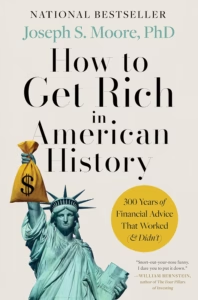
On this episode, we’re joined by Joseph Moore, a historian, investor, and self-described “former broke-ass college professor” whose book How to Get Rich in American History: 300 Years of Financial Advice That Worked (& Didn’t) began as a ten-year mission to document rich people robbing poor people, only to be sabotaged by the deeply inconvenient experience of getting rich himself and changing his mind. Joseph calls the machine behind our collective gloom the “despair industrial complex,” a racket in which journalists, politicians, and yes, tenured academics all get paid to tell you the game is rigged, because optimism wins no clicks, votes, or Guggenheims. But he backs the sunnier view with receipts: six in ten Americans born in the bottom fifth climb out, wages and purchasing power both beat what they were at his birth, and upward mobility here still laps every large nation on earth. Along the way Joseph unpacks the difference between slow time and fast time (most wealth is built quietly over decades, then revealed all at once, which is why chasing crypto and sports betting is such a sucker’s bet), why budgeting and index funds merely protect wealth while solving other people’s problems actually creates it, and why not one piece of “timeless” financial advice is timeless at all — grandparents once begged kids to never save a dime. If you’re a jaded Gen Z-er convinced you missed the boat, a personal-finance nerd who worships compound interest, or just someone tired of being told the future is cancelled, Joseph’s core prescription lands with unusual force: build a little runway, invest in your own earning power, take risks you can survive, and don’t let Big Woe talk you into quitting before your fast time even arrives. Listen, learn, and enjoy!
Please Scroll Down for Featured Resources and Transcript!
Please note that some links on this page (books, movies, music, etc.) lead to affiliate programs for which The Jordan Harbinger Show receives compensation. It’s just one of the ways we keep the lights on around here. We appreciate your support!
- Sign up for Six-Minute Networking — our free networking and relationship development mini-course — at jordanharbinger.com/course!
- Subscribe to our once-a-week Wee Bit Wiser newsletter today and start filling your Wednesdays with wisdom!
- Do you even Reddit, bro? Join us at r/JordanHarbinger!
This Episode Is Sponsored By:
- Arca Wealth Management: Book a free 30-minute call: arcawealth.com/jordan
- BetterHelp: 10% off first month: betterhelp.com/jordan
- Gusto: Three months of free payroll: gusto.com/jordan
- Progressive: Free online quote: progressive.com
Thanks, Joseph Moore!
Click here to let Jordan know about your number one takeaway from this episode!
And if you want us to answer your questions on one of our upcoming weekly Feedback Friday episodes, drop us a line at friday@jordanharbinger.com.
Resources from This Episode:
- How to Get Rich in American History: 300 Years of Financial Advice That Worked (& Didn’t) by Joseph S. Moore | Amazon
- Joseph S. Moore | Official Website
- Why America’s First Colonial Rebels Burned Jamestown to the Ground | History
- The Better Angels of Our Nature: Why Violence Has Declined by Steven Pinker | Amazon
- Steven Pinker | Why Rationality Seems Scarce | The Jordan Harbinger Show
- Shotgun House: History, Name, Layout, Floor Plan, Design, and Preservation | Britannica
- Financial Crisis of 2007–08 | Britannica Money
- The Communist Manifesto by Karl Marx and Friedrich Engels | Amazon
- New Study on Economic Opportunity: Americans Experience Upward Economic Mobility | The Pew Charitable Trusts
- Streets of Gold: America’s Untold Story of Immigrant Success by Ran Abramitzky and Leah Boustan | Amazon
- The Giant Sucking Sound of NAFTA: Ross Perot Was Ridiculed as Alarmist in 1992 but His Warning Turned Out to Be Prescient | The Conversation
- Fact Check: Have Inflation-Adjusted Wages Increased in the Past Decades? | Econofact
- Remarks of John F. Kennedy in a Campaign Speech on the National Housing Crisis, Boston, June 1946 | JFK Library
- How Levittowns Shaped the Look of the Suburbs | History
- The Misbehavior of Markets: A Fractal View of Financial Turbulence by Benoit Mandelbrot and Richard L. Hudson | Amazon
- The Millionaire Next Door: The Surprising Secrets of America’s Wealthy by Thomas J. Stanley and William D. Danko | Amazon
- William Wells Brown, Wildcat Banker | The Public Domain Review
- Fartcoin Price, Market Cap, and Live Chart | CoinMarketCap
- The FIRE Movement: Financial Independence, Retire Early | Britannica Money
- Living the Good Life: How to Live Sanely and Simply in a Troubled World by Helen and Scott Nearing | Amazon
- The Courtship of George and Martha Washington | George Washington’s Mount Vernon
- Married Couples Who Merge Finances May Be Happier, Stay Together Longer | Indiana University
- Most of Warren Buffett’s Wealth Came After Age 65. Here’s What That Can Teach Individual Investors | CNBC
- What Percentage of Americans Own Stock? | Gallup
- Stock Buybacks: Background and Reform Proposals | Congressional Research Service
- The Index Fund Turns 50: How Vanguard’s Jack Bogle Changed Investing Forever | Morningstar
- How a Popular Car Company Screwed Over Its Workers and Helped End Pensions | The White Coat Investor
- The Untold Story of Napoleon Hill, the Greatest Self-Help Scammer of All Time | Gizmodo
- Think and Grow Rich: The Original by Napoleon Hill | Amazon
- Rich Dad Poor Dad: What the Rich Teach Their Kids About Money That the Poor and Middle Class Do Not! by Robert T. Kiyosaki | Amazon
- I Will Teach You to Be Rich: No Guilt, No Excuses, No B.S. Just a 6-Week Program That Works by Ramit Sethi | Amazon
- Ramit Sethi | I Will Teach You to Be Rich | The Jordan Harbinger Show
- The Total Money Makeover: A Proven Plan for Financial Fitness by Dave Ramsey | Amazon
- Clark Howard: Save More, Spend Less, and Avoid Rip-Offs | Clark.com
- Perceived Financial Preparedness, Saving Habits, and Financial Security | Consumer Financial Protection Bureau
- Mortgage Rate History: 1970s to 2026 | Bankrate
- Market Madness? The Case of Mad Money | Rady School of Management, UC San Diego
- Is Housing a Good Investment? | A Wealth of Common Sense
- Buy Land on the Moon: Lunar Embassy Official Lunar Land Registry | Lunar Embassy
- The Way to Wealth | Wikipedia
- Get Rich Investing in Your Own Human Capital | Forbes
- Liberty Bonds | Federal Reserve History
- Guillaume Dulude | Tribal Truths for Modern Minds | The Jordan Harbinger Show
1379: Joseph Moore | Why Getting Ahead Has Never Been Easier
This transcript is yet untouched by human hands. Please proceed with caution as we sort through what the robots have given us. We appreciate your patience!
Jordan Harbinger: [00:00:00] Coming up next on The Jordan Harbinger Show.
Joseph Moore: Solving your problems will keep you from going broke. It will not make you wealthy. You get wealthy solving other people's problems. You get wealthy taking risks that other people aren't willing to take. Pessimists sound smart and optimists live in big houses.
There's always been kind of a despair industrial complex who win by telling you the thing is broke. You cannot escape big woe today. It's amplified because there's no clicks for a journalist, there's no votes for a politician, there's no tenure for academics like me if we go around telling you the world is getting better.
But we can have all of those things if we tell you it's broken and the system is constantly reminding you to give us the reward. You get disempowered by listening. We get rewarded by telling you that.
Jordan Harbinger: Welcome to the show. I'm Jordan Harbinger. On The Jordan Harbinger Show, we decode the stories, secrets, and skills of the world's most fascinating people. Our mission is to help you become a better informed, more critical thinker through [00:01:00] long-form conversations with a variety of amazing folks, from spies to CEOs, athletes, authors, thinkers, and performers, even the occasional war correspondent, neuroscientist, or music mogul.
Now, if you're new to the show or you want to tell your friends about the show, and I always appreciate it when you do that, I suggest our episode starter packs. These are collections of some of our favorite episodes on topics like persuasion and negotiation, psychology and geopolitics, disinformation, China, North Korea, crime and cults, and more.
That'll help new listeners get a taste of everything we do here on the show. Just visit jordanharbinger.com/start or search for us in your Spotify app to get started. Today on the show, Joseph S. Moore, historian, investor, and former broke-ass college professor who began a 10-year research project expecting to prove the American dream was all a scam, and then had the deeply inconvenient experience of getting rich and changing his mind.
His central claim is practically engineered to start a fight. Getting ahead in America has never been easier. Not easy, not fair, not guaranteed, just easier. We'll test that against unaffordable housing, [00:02:00] inequality, survivor bias, and the obvious problem with taking financial advice from anybody whose own success began by escaping the 2008 housing crash roughly a week before the door slammed shut.
Joseph explains why Americans declared the American dream dead centuries before anyone called it the American dream in the first place, how the despair industrial complex profits by convincing you the game is already over, and why most wealth is built quietly in slow time and then revealed suddenly when fast time arrives.
We'll also examine why budgeting and diversification can protect wealth but rarely create it, why solving other people's problems beats obsessing over avocado toast and lattes, and why compound interest and passive income may be the pornography of personal finance. Along the way, Fart Coin, that's a real crypto apparently, a fake $10 billion crypto fortune, George Washington riding through diarrhea to marry rich, financial independence as CrossFit, an acre of moon property zoned for tourism, and a first rental experience involving human trafficking and the FBI.
Because nothing says prudent [00:03:00] financial planning like the feds asking you not to evict your tenants. Now, here's Joseph Moore.
Let me start off by jumping down your throat here, because you make a claim in the book that I think is going to irritate a lot of people, which is a great way to start a book, by the way.
Getting ahead in America has never been easier. But then you're like, "Well, I was a broke professor and I got lucky escaping the 2008 housing crash, and then I got some ideas and I used those to make millions of dollars. But then I blew myself up with debt almost." So how on earth is your argument not just survivor bias l- dressed up as history?
Joseph Moore: Yeah. If a guy fails upward, you too should buy a lottery ticket. Yeah, I, I take that point. Okay. So we have this American Dream is dead motif that is everywhere, right? It's in the water, it's on Instagram.
Jordan Harbinger: I see it a lot online, yeah.
Joseph Moore: You've heard of it, yeah.
Jordan Harbinger: The nihilism of Gen Z, I think some people call it.
Except it's not just Gen Z, it's everybody up to, I'm 46, so what is that, Gen X? It goes all the way down.
Joseph Moore: Yeah. And it's not new. Okay, so let's start there. This idea that the American Dream is dead. So I can [00:04:00] find people telling you the American Dream is dead about 300 years before I can find the phrase American Dream, which pops up in the 1930s.
Jordan Harbinger: Really? So the origin of the American Dream was already saying-
Joseph Moore: Yeah, it's all done ...
Jordan Harbinger: that it, it's all done.
Joseph Moore: You got here too late.
Jordan Harbinger: Yeah. If you weren't on the Mayflower, tough luck.
Joseph Moore: Yeah. So s- in 1676, this is 100 years before Hamilton's going to rap on Broadway.
Jordan Harbinger: Okay.
Joseph Moore: The colonists of Virginia burned their own capital to the ground in protest that nobody could get ahead anymoranymore.kay.
In the 1800s, there's all these speeches given about the rungs on the ladder to success, and the lines in the speech are like, "The rungs on the ladder to success were sawed off by all the people who got here right before you. You showed up just a bit too late." I have a bestselling book in my library back home from 1984, and it basically says the baby boomers will never be able to afford to retire.
Sold 100,000 copies.
Jordan Harbinger: Really? Because now the narrative is the baby boomers took all the wealth. They're making it so that we can't buy any houses. We're never going to be able to afford to retire. Although, I have to admit, it does sound quite [00:05:00] credible that- ... Gen Z will never be able to retire, but I don't know.
Maybe I'm wrong. I hope I am.
Joseph Moore: This is what the baby boomers were being told when they were in their 30s. I call this big woe, right? And there's always been kind of a despair industrial complex who win by telling you the thing is broken.
Jordan Harbinger: A despair industrial complex is such a great phrase.
Joseph Moore: Yeah. Well, I mean, I think it, it's there.
It was in every era. Here's the difference. Now it's buzzing your butt in your phone. You cannot escape big woe today. It's amplified because there's no clicks for a journalist, there's no votes for a politician, there's no tenure for academics like me if we go around telling you the world is getting better.
But we can have all of those things if we tell you it's broken, and the system is constantly reminding you to give us the reward. You get disempowered by listening. We get rewarded by telling you that.
Jordan Harbinger: That's interesting. The clicks thing makes sense to me. I didn't realize academics also had the same issue.
You have to be part of the grievance industrial complex or whatever.
Joseph Moore: You do not win any awards. You're not going to get a Guggenheim Fellowship. You're not going to win [00:06:00] anything that your peers reward you with if you say, "Man, things are pretty good." You just don't get the carrot. And so the system incentivizes talking about what is broken and proposing solutions, often solutions that will make it worse.
But you don't care about that part. The incentives are all built in.
Jordan Harbinger: That makes sense. It's funny, because I was just thinking Steven Pinker wrote The Better Angels of Our Nature or whatever it's called, and that was about how everything is better, and that's the one book that got famous because it wasn't saying- The thing that you're saying in every other book
Joseph Moore: iis.nd he was already tenured at Harvard.
Jordan Harbinger: Yeah, and he was already kind of a big deal, by the
Joseph Moore: way. Wee. Like, he had no one to offend or nothing to lose, and whereas people who are trying to climb up the ranks, if you want to be a journalist and you want to win, the only way you're going to get to behind the desk on whatever news show is by being a part of that here's what's wrong and I'm going to go find it.
Jordan Harbinger: That's interesting. Yeah. There's an origin story here, and I want to get there. You grew up measuring wealth by whether somebody had a two-story house, which is kind of funny, right? So what did rich mean to you before you knew [00:07:00] anything about finance and money?
Joseph Moore: It meant having a two-story house. I'm from the rural South, and so there was, like, mobile homes and what we call shotgun cabins.
A shotgun cabin is a, a wooden home that's so small from front to back that if you fire a shotgun shell in the front door, there's a back door that usually lines up perfectly with the front door, and the shotgun shell will not expand by the time it leaves. That's how small these things are. And my family lived on a stick-built ranch, but, like, you went seven doors down this way and there was a mobile home park, and you went three doors down that way, it was shotgun cabins.
So, like, we were one step up from bottom, and we were very cognizant. Like, we don't want to fall back there. Families dream about being able to say, "My son's a doctor. She's a lawyer." Our parents dreamed we wouldn't go to prison. Like, this is the goal. Stay out of the very part of the bottom, and stay clinging to this working class life that we've worked really hard to build.
Across town, there were families with two-story houses and that, and they had their own bedrooms. It's like, that sounds rich. So I didn't come from money. The only kind of inscription quote I used in the whole book was Mark Twain, where he says Where I came from, we [00:08:00] never talked about money because no one had enough money to furnish a topic of conversation.
It wasn't a goal you had because I literally knew no one by the time I was 18 who had gone to Harvard, Yale, Princeton. I didn't know a single person who ever even went to an Ivy League school. I had heard of Clemson. Like DC schools was high as the ambition ladder went.
Jordan Harbinger: Yeah, that's interesting. I mean, I grew up in Michigan and I grew up middle class, but my family just wanted me to go to college.
And then when I got into Michigan, they were thrilled because that was like the best school that you could get into in Michigan. And when I applied to Georgetown, they were like, "Why would you leave the state?" And I had to explain to my parents, "Hey, it's not just about getting into the best local school anymore.
They're different now. They specialize in different things." And my parents were kind of like, "Eh, none of that really matters." I did end up going to Michigan and then stayed there for law school. But now, whatever, your kids want to go to Oxford and go to the London School of Economics, it's like, great, go ahead.
You can't afford it probably, but sure, apply. Why not? See what happens.
Joseph Moore: Not where I came from.
Jordan Harbinger: Yeah. I want to avoid [00:09:00] shaming people who still live in mobile home parks and shotgun cabins because I don't think there's anything necessarily wrong with that. But yeah, they're not rich.
Joseph Moore: Yeah, no, it's not. Rich is not a, a thing you would use to describe anything that they're living.
However, as I say in the book, some of these are salt of the earth people. Some of them, the moral character it takes to not fall that one very important step backwards is really important. It takes a lot more effort to not fall back that one step than it does to climb three more up.
Jordan Harbinger: I totally believe that.
That actually makes a lot of sense. I think it probably is easier, like you said, to just say, "You know what?" I see it among wealthy people, too. Everybody's scamming, so I can do this thing that's slightly dishonest. I can cheat on my taxes, whatever it is, because everybody they know is doing it, and it's probably really hard not to go, "You know, I'll, I'll just do this thing and it'll make my life a little bit easier in the short term."
Joseph Moore: Yeah, the quote unquote "Bible Belt" gets a lot of bad press, as it were, for the downside of religious cultures, but a lot of these cultures are built to help people learn the skill set, the cultural skill sets that it takes to live a life in the working class and maybe even advance. So one of the things I talk about in the book was the, my, [00:10:00] you asked about my origin story.
I didn't come from money, so I didn't pursue it. I've never taken a business class in my life. The fact that I am wealthy and don't have to work if I don't want to is mind-blowing to me. Now, the way all this starts is I'm getting a graduate degree in history because I fell in love with history when I was a kid, and someone was like, "You can do that for a job.
You can be a professor and talk about history." That sounds awesome. They, like, fire muskets. And- ... so I'm doing this PhD in history. It's 2005, 2006. Everybody says the lesson of history's clear, renting throws your money away. Who would want to do that? So you buy a house. This is 2006. It was as crazy as you hear.
So we had a student loan. My wife and I were both graduate students. They let us use our student loan money to qualify for the mortgage to buy the house. Wow. Like, it's just bad. I remember the guy sliding me the paper, and I started asking questions. He was like, "Just sign it." And I was like, "Oh, okay." So that's 2006, I think.
2008, at our church, back to this idea of these cultural institutions that get a lot of bad press, but that actually in the interior of those cultures are a [00:11:00] lot of where you learn your social skills for navigating the real world, parenting, finances. Our church offers a personal finance class for families.
I said I'm not going to go because I'm getting a PhD in history. Wife's getting a PhD in sociology. We know enough about how the world works.
Jordan Harbinger: Sure.
Joseph Moore: Which should've been a warning sign. We go, because the friend who was leading it was like, "Please, just come."
Jordan Harbinger: Show up.
Joseph Moore: Yeah. I'm, I... It'll be an empty room. Don't let me be embarrassed if nobody shows.
I was like, "As a favor to a friend." We go, they make us fill out a budget, go home. I'm like, "Who gave us a mortgage?"
Jordan Harbinger: Yeah.
Joseph Moore: We have no business owning a home.
Jordan Harbinger: Math. What is mathing?
Joseph Moore: Who are the two idiots who signed this paperwork? We're like, "Oh, we. We signed this paperwork." And so we put our house on the market.
It sells on a Saturday. I distinctly remember that because the next Saturday our neighbor put her house on the market, and it didn't sell.
Jordan Harbinger: Because the things had already begun.
Joseph Moore: The 2008 Titanic. We got off the Titanic, and then the thing sank.
Jordan Harbinger: Your toes were wet.
Joseph Moore: Yeah. And I wasn't even aware. There were some things in the news, but nobody was freaking out yet.
And so we get off the Titanic, and then the thing sinks. And so it's [00:12:00] 2008. I'm, like, watching careers fall apart, the economy implode. I study history for a living, and there was not a single thing that I had read that had informed anything I had done. And so that kind of set me off on a quest. I need to understand, as a historian, like, what were people told to do with their money?
Did it work? What worked? What didn't? How did it change? That's kind of the origin story to the book.
Jordan Harbinger: I don't always write everything down that I see in books. Was it you who had stapled your carpet to the wall so that if the floorboard gave out, you would have a second to jump off? Yeah. Yeah, okay.
Joseph Moore: So in the rural South, so I did for a while slip back into a mobile home, and I lived there for a while.
I'm, like, 18 years old. I got into, like, a small junior college. I didn't go to a four-year school, like, a junior college that would let me in. And the floorboard had rotted out in front of my bedroom, a space about this big. And so we took the carpet. We stretch it out, and we take a staple gun, and we, like, staple it to the wall really good and into the edge of the floorboard on the other end.
And that way, when you stepped on it, you would sink, and you would know, "Get off right now, otherwise it's going to [00:13:00] collapse to the bottom." And that, I was quite proud of this. That was an ingenious use of a staple gun.
Jordan Harbinger: God forbid you should go to Home Depot and get a different floorboard or something, man.
Joseph Moore: This is how people in the South think to solve problems.
Jordan Harbinger: Okay. Right? Put the carpet over it
Joseph Moore: and staple the carpet. Problem solved. Like, the, the staples were cheaper than new wood.
Jordan Harbinger: True. Okay. I can't argue that logic. How much is a new ankle?
Joseph Moore: I never fell all the way through. Yeah. So it must have worked.
Whoever came after me, I have no responsibility for. But that's the kind of cultural milieu, as it were, to use a fancy word, that I came from. Yeah. So when I went to go study the book, I had zero interest in writing a book about rich people. Because do we need another book on a Rockefeller? We've got all this covered.
But we don't have histories of like everyday people, and we don't have histories of everyday people that everyday people would actually read. And so that, that would be something they could engage with. So that's kind of what I set out to do.
Jordan Harbinger: So you began the research, you said something like a pious cynic expecting to document rich people stealing from poor people.
Joseph Moore: So I was part of Big Whoa.
Jordan Harbinger: Big Whoa. You're part of Big Whoa, okay. But not w- knowingly [00:14:00] or just-
Joseph Moore: Oh, very knowingly. Because I'm watching, back to 2008, like I'm watching this thing sink. I hate to be morose, but it's kind of like watching the wedding video of a couple who dies on their honeymoon. You're like watching all these people's lives implode because they did what they were told and you're like, "Oh, it's all a scam."
Jordan Harbinger: Oh, yeah. It's a rigged-
Joseph Moore: Oh, it's a rigged game. Again, I'm in academia. If I want a job, if I want tenure, if I want to publish a book, I have to say what my colleagues agree should be said. Now, I need to go back one step here, which is that my father was not a typical Southern kind of guy. He came from kind of mill workers, and those mill workers had struck in one of the most famous Southern mill strikes in the 19-teens, and they had lost, and lost badly.
And the family memory remembered.
Jordan Harbinger: Like- Is this like some Pinkertons called in type of
Joseph Moore: stuff? Something like that. It wasn't the actual Pinkertons, but there were police sent in, National Guard sent in, and the strikers lost terribly. My grandmother was born in those mill cabins. And so my dad used to vote for communist in South Carolina [00:15:00] for president.
This is risking your job. You don't say that out loud. Don't tell anybody.
Jordan Harbinger: Communists?
Joseph Moore: Yeah.
Jordan Harbinger: D- I didn't even realize those people- Yeah ... were running back then.
Joseph Moore: Yeah, one-third of 1% of the vote tally, my dad is in there somewhere. So I kind of had that strain already of it's a scam, it's rigged, you can't win, the everyday guy can't get ahead.
So I go into academia. And on the first day of class, I would assign Karl Marx, and I always remember that, The Communist Manifesto to these freshmen. In the Southeast, the small kind of liberal arts colleges, it was almost like pornography. Like, they'd hide it sometimes in their other books, and you'd see them around campus, like, reading it, and you'd realize that they were, like, hiding it in another book.
Jordan Harbinger: Oh, that's really funny. Yeah, like the take the jacket off of that and put Dale Carnegie jacket over it- ... or something like that.
Joseph Moore: But no, this is what I would assign, and I've actually had students reach out to me since the book came out and be like, "You gave me a lecture my freshman year that said the American dream was a scam, and now you're saying that it's real.
So can you explain please?" It's like, "Oops, sorry. Can I get a tuition reimbursement?"
Jordan Harbinger: I became a communist because of you, man. What
Joseph Moore: happened? Yeah. Come on, man. We're out here at the DSA, like, fighting the fight. Why did you abandon ship?
Jordan Harbinger: Yeah, exactly. Oh my gosh, that's [00:16:00] interesting. Okay. There's a common phrase that I think I probably heard v- at first from my dad.
He didn't make it up obviously, but he says, "If you're so smart, why aren't you rich?" When did that stop being an insult and start becoming m- an experiment?
Joseph Moore: So I decided to go off and research all this stuff, and it took me over 10 years of dr- because I'm trying to read everything. I mean, 300 years of history is like you just can't do it.
I'm reading stuff from the 1700, 1800s, 2000s, 1900s, whatever, and I start to compose what is really a recipe book, right? Of like, oh, this is how they did it in this era. This is what they were told to do. Does it work? This is what they were told to do in another era. Does it work? And then I thought, "Okay."
Jordan Harbinger: Were they actually telling people how to get ahead? Because for some reason thought that was almost like a, not new thing, but a post-World War II thing because I just assumed everybody un- until, I don't know, the 1950s was just like, "This is our social stratum, and we're going to stay here forever, and there's no mobility."
Joseph Moore: No, not at all. Oh, okay. It was the... So the, the... We say are, can somebody get ahead? They used to say go ahead. The, uh, the, the verb was [00:17:00] go. It was a little more active, and people were talking about go ahead, a go-ahead culture forever. This was the phrase of the 1800s. Go ahead. The goal was like, go ahead. That's your- It's what you're trying to do, is to get yourself from where you are to where you want to be.
In fact, the title of the book was meant as a joke, and somebody was like, "Joseph, you're a historian. You're the only person who gets the joke," which is there's all these books for hundreds of years called How to Get Rich in, and then it'd be like How to Get Rich in Cattle, How to Get Rich in Candy Making, How to Get Rich in whatever, and you'd find these books and these pamphlets all over America.
And so I thought it was like, oh, I'll name the book like a nod to that. No, people were doing this all the time.
Jordan Harbinger: That is fascinating, genuinely, because I don't know, you think of earlier times as very, very stable maybe.
Joseph Moore: Plodding ahead.
Jordan Harbinger: Yeah. They just, you had your job. You kept it for your entire life. That was the end of it, right?
I don't know.
Joseph Moore: That's a very 1950s locked-in-place idea, but it really does not hold for most of history. Most people were trying to go ahead. I'll give you an example of this, and one of my favorite examples of this is the abolitionist Frederick Douglass. Douglass, famous, knows [00:18:00] Lincoln. Before the Civil War, his most famous speech is What to the Slave Is the Fourth of July?
It's in every history class probably in the United States today, and we should teach it. It's an incredible speech. After the war, though, this was what he did. He's a professional speaker, and everywhere he went, the most popular speech of his entire life by far was called Self-Made Men. And in that speech, wherever he would go, people would holler it out when he would arrive like it was a rock concert.
"Play the hits. Do Self-Made Men." That was the way people thought about public speeches back then. And that speech, the crescendo line is maybe, again, he's a Black man right after the American Civil War. He's like, "Maybe I can't be president, but I can be prosperous. I can go ahead." And he says, "Our motto..." Now think about his crowd, half former slaves.
He says, "Our motto is go ahead. Move from where you are to where you want to
Jordan Harbinger: bbe.he hustle culture has existed forever, basically. That's crazy. Before we go any further, I, I would love to have you argue a [00:19:00] little bit against your own central thesis here if I can, which is who genuinely today does not have an easier path?
What happens when people listen to things like this is they go, "That's fine. You're two white guys talking about how you can still get ahead."
Joseph Moore: So let's just kind of broadly sweep across the entire American population, and then we'll kind of dig in ethnically or subcultures, right? Of people born at the bottom 20%, okay, so if you divide all Americans into five groups, the bottom 20%, of those born into the bottom 20% today, 6 in 10 will get out, 4 in 10 will become middle class to upper middle class, 1 in 10 will go all the way to the top.
That is not perfect mobility. Perfect mobility would be 8 in 10. But it is not zero. Like, it is better than average. If I went back into the 1700 and 1800s and told your ancestors that if you're born at the bottom, you got a 6 in 10 shot of getting out and a 1 in 10 shot of making it all the way to the top, they would drop to their knees and pray to whatever god they worshiped in gratitude, or they wouldn't believe me because that would be a world they couldn't conceive of.
So believe it or not, economic mobility in the 1800s, when we think about kind of the [00:20:00] going west and all the things, is about 4 in 10. People were getting ahead a little bit less prominently than we are today. Close, but not there. Now, why did they not care about that? Because they were getting ahead faster than anyone else anywhere on the face of the planet.
There's a reason they're leaving famine-plagued China. There's a reason they're leaving Eastern Europe and Poland and Scandinavia, and, like, all these places they're coming from, and the Caribbean in the 20th century. They're coming here because the chances of getting ahead here, far higher than getting ahead where they were leaving.
Now, our chances of getting ahead today are better than their chances of getting ahead then. Nobody's going to tell you that because, again, there's no incentive for telling you that.
Jordan Harbinger: It's crazy to think that if you left Eastern Europe, I don't know, around World War I, of course you had upward mobility coming to America.
That's a given, right? But now our upward mobility is still better than that.
Joseph Moore: And think about, and not only that, you're actually starting from a higher floor. Your floor of what a decent life is now, just to be in the rough middle, is living a, a life [00:21:00] like they were trying to get to to go upwardly mobile.
So even if you fail, you start and end in a better place. Now, in terms of, like, immigrant cultures, there was a recent book, and it's going to escape me, so I won't mangle the title or the authors. I know the professors were out of Stanford. It's about three or four years ago, a book on immigrants today, and they found that statistically, immigrant upward mobility today, just as high as it was in the 1800s and early 20th century.
It actually has not changed at all. Now, these are different populations. They're coming from the Caribbean. They're coming from South America more often. Some of them are coming from Africa. But they're just as likely to get ahead as Italians were, as the Chinese were, as people from Scandinavia were. And one of the chapters I have in the book is called Immigrants Make the Best Capitalists, and so whatever you think about immigration today, I don't know if you heard, it's a slightly charged topic.
Jordan Harbinger: Yeah, it can be, yeah.
Joseph Moore: Put your political opinions to the shelf. In every era, everything people say about immigrants today I can find in every era. I can find everything we're saying about immigration today about Scots in the 1740s. The Scottish, oh, these Scots, [00:22:00] like they're taking people's jobs. They live these super frugal lives.
They
Jordan Harbinger: eat cats or whatever.
Joseph Moore: They'll eat things we won't eat. They literally say this, right? They're willing to do things we won't do. And so what I argue in the book is there's not really a particularly strong historical argument that there's ethnic financial strategies. There's immigrant financial strategies, and they transcend every culture.
They will do what it takes because this system that we live in rewards the strivers. And so those who won were those who went, whether they were leaving these other nations here, whether they're coming from the Caribbean or South America today, or you live in the largest free market zone in the history of the world.
Pause over that. Back to this idea of nobody can get ahead. You live in the largest, most successful free market zone in the history of the world. There is an opportunity for you somewhere. And so if you live in Maine, you can get a job in New York, or if you live in New York, you can get a job. If you're in California, you can go to Austin or wherever, or Austin and go to California.
Like, there is an opportunity somewhere in this huge system if you are willing to, as immigrants were willing to do, get up and go. And by the way, this [00:23:00] holds. So today, if you leave one state for another state for economic opportunity, not only will you earn more over the course of your life, your children, they've done longitudinal studies, your children will earn more over the course of their life because you pursued opportunity.
Jordan Harbinger: Does it only take one parent to do that? Because my wife's from California, but I'm from Michigan.
Joseph Moore: We'll say it counts.
Jordan Harbinger: Yeah. Okay. Yeah, it's interesting that you mention this. My dad was the first person in his family, I think, to go to college. I'm pretty sure that's the case. And his brothers once told me, like, "Oh, if your dad hadn't gone to college, I never would have thought to go to college," because you only needed a high school diploma to work on the assembly line at Ford or GM, and that was an awesome job back in the '60s or whatever it was, right?
And then my dad was a little bit annoyed, I think a little bit annoyed, when I decided to move, but he was like, "He got a law job in New York." I was doing mortgage-backed securities, so I'm familiar with what we're talking about here. Um- You were
Joseph Moore: deeply on
Jordan Harbinger: the other
Joseph Moore: side of what I was signing.
Jordan Harbinger: Yeah, I was like the second-year lawyer, so I, I didn't have the, the full appreciation of what we were actually up to over there.
I was counting parking spaces and [00:24:00] blueprints. But a lot of my cousins started to leave Michigan after I did, and they said, "You know, if you hadn't left, I never would have thought to move," which their parents didn't appreciate so much. But it's interesting because those are some of my most well-off cousins, of course, are the ones that moved to New York or moved to California or moved to Florida or are digital nomads, whatever, traveling the world doing their consulting company that they founded working remotely.
Those are the most financially, I should say, financially successful. My cousins are all doing great, but they're the ones that have the most capital. So that definitely checks out in my own life. It's just the people who are willing to take that extra risk and leave. Because after Detroit started going downhill, the state wasn't exactly on an upswing for quite a while.
Joseph Moore: No, the Rust Belt had a rough go there. I'm from the South, and we had all those pre-NAFTA small industrial jobs. Everybody tells me how wonderful the '90s were. I was like, "I lived in the '90s." There's a reason 20% of our parents voted for Ross Perot. The guy who sounded like a ventriloquist dummy and looked like a ventriloquist dummy. He had those
Jordan Harbinger: big ears.
Joseph Moore: Yeah. Remember that? Yeah. [00:25:00] His
Jordan Harbinger: weird ears.
Joseph Moore: They were scared. Like that great sucking sound was their jobs going to Mexico. That was the towns that I was raised around. There was like one or two mill towns, and I dated a girl who lost an arm in one of those. She was working in the plant one day and like caught her arm and tore it off.
Like this was the world we lived in. We wanted those jobs, those dangerous jobs, and they all went to Mexico. So every generation deals with their version of this. Back to this idea of like here's two middle-aged white men who made it telling the rest of the world it's easier. All right, wages, I say this and everybody looks at me like I have a third eye, wages are higher today than when we were born.
I was born in the '70s. Wages are up, adjusted for inflation. A minimum of 20 to 29%. That's from left-leaning groups. So if I go to left-leaning economists, they will say wages are up about 25 to 30%. If I go to centrist and right-leaning economists, they'll say they're up 50 to 60%. Without getting into the weeds of the debate, everybody agrees that wages are higher today than then.
Jordan Harbinger: Wasn't it wages are up adjusted for inflation, but the [00:26:00] purchasing power or something is not as high as it was back then? Do you know what I'm talking about?
Joseph Moore: No, purchasing power is higher. Now, the one that sticks in everybody's craw is the housing, right? Housing and healthcare are the two things that everybody will point to and say, "Sure, I can buy a cheap TV, but my dad bought a house for a stick of gum, and I can't even afford to rent in a safe neighborhood."
And so let's be very clear, I am not being Pollyanna-ish and saying we have no problems. I am saying all of these problems have been faced before. By the way, this is neither the first nor the worst housing crisis we've had. Now, that does not help a millennial who would like to get on the property ladder, but it is true that we have had, not only have we had housing crises before, we have had worse housing crises before.
1948, it's statistically twice what it is today, the shortage of housing. And a young man who's come back from World War II decides to run for Congress. His number one platform in his congressional run is housing affordability and the housing crisis, and his name is John F. Kennedy. The number one personal finance book of 1950, it's a New York Times [00:27:00] bestseller, is called Your Dream House: How to Build It Yourself for $3,500.
That is the title of the book, and it was a, like, perennial bestseller. Popular Mechanics, the magazine, they've noticed they'd sell more magazines whenever they'd have a how to build your own house essay.
Jordan Harbinger: I think my mailbox was $3,500- ... if you include the permitting fees to the state of California for, I don't know, drilling a hole in the ground.
Joseph Moore: Yes. How many engineers does it take to- Yeah ... inspect this
Jordan Harbinger: hole? That's right. Yeah. Well, I used metal and concrete, so it was pretty pricey. We've done some mods to our house, and I just remember going, "Who realistically could ever afford to do this?" Because we added, like, a pavilion or whatever to our backyard, and it was twice the price of the house that I grew up in Michigan.
Twice. The whole house. So I'm like, unless you're going to live in a tent in your gazebo out in the back, nobody could afford this. My buddy had a falling out with his dad because his dad was like, "You need to get your shit together and buy a house." And he's like, "Dad, you have a high school diploma. Mom never had to work.
You were able to afford a house, a car, and two or [00:28:00] three kids," I forget how many siblings he has. And he's like, "Now, I make, adjusted for inflation, three times as much of you, as you. My wife, same deal, and we can rent a trailer in the middle of the desert if we want to save money for retirement, and barely any at that, and we have one kid."
Those are real.
Joseph Moore: They are real. We have had housing crises in this country before. There were localized ones. San Francisco had big ones. Chicago and New York and LA have all had episodes in history, but it was not national 1870s, 1890s, 1940s, and today. These are the big ones, and we know the solution. The solution to every single one was to build more freaking houses.
Jordan Harbinger: Not in my backyard.
Joseph Moore: Ex- exactly. Not, not here, but somewhere else. Somewhere else. No. No, you've got to build them everywhere. I'm stealing this from someone and I don't remember who, so I'm plagiarizing somebody.
Jordan Harbinger: That's fine. My entire career is based off of that- ... that principle.
Joseph Moore: Are you familiar with horseshoe political theory?
Jordan Harbinger: Yeah, where the extreme left also looks like the extreme right.
Joseph Moore: Yeah, they look like mirror images of each other. So instead of thinking about it from left to right like it's a, like a line, it's more of like a horseshoe where the, the two ends, the two bottom ends are the most radical groups, and they actually resemble each other more [00:29:00] than their own coalitions.
Jordan Harbinger: So an example that's near and dear to my heart, because I see it every day in my inbox, is like, "Oh, you don't like Jews? I can't tell if you're an extreme leftist or an extreme rightist. I don't know. Are you a Nazi?" "No, how dare you. I'm a com- Well, okay. I don't know. The uniform is looking pretty similar these days."
Joseph Moore: So these, these two groups, and again, I'm stealing this idea from somebody, they're wonderful ways to figure out what the social problems are and terrible ways to solve them. And so we see people on both sides of the housing crisis on the extremes, either the not in my backyard people, right? "Don't build anything, because I already won."
Or we have the DSA kind of like, "We're going to do rent control everywhere, and that way the landlords can never win." These are horrible solutions. The solution in every era was actually to build more houses. And then I'll hear people on both sides, populist and socialist, going, "Then the landlords win. Then the builders win.
Then the developers win." I'm like, "Great, that's how we solved the last crisis." If you go to Long Island in 1900, it's farmland, all of it.
Jordan Harbinger: Long Island. Wow. That [00:30:00] makes sense, I suppose.
Joseph Moore: And then farmland. And there's like people who would go out and, like, do excursions to Long Island for the day, and it was just farmland.
And after World War II, after JFK runs, after this political momentum to say we have to solve this, there's a, a while where they're telling people, "Oh, the government's going to solve it. We're going to build the housing ourselves." Anybody who bet on that, terrible idea, because you would've waited for that solution for a long time.
Meanwhile, they let the developers build out Long Island. You go out to Queens, and all that stuff is built to solve the housing crisis.
Jordan Harbinger: That makes sense.
Joseph Moore: And yes, somebody got rich. I don't care.
Jordan Harbinger: Yeah.
Joseph Moore: I'm happy for somebody to get rich solving the housing crisis so your friend doesn't have to live in a trailer with two working spouses.
Jordan Harbinger: Exactly. Stapling carpet over a hole in the floor, because lumber costs money and apparently ankles are a renewable resource. We'll be right back. This episode is sponsored in part by Arca Wealth Management. It's midnight. You're googling Roth conversions. You didn't work this hard to be doing this yourself.
Maybe you already have a financial advisor, but they show up once a year, usually because you called. Meet Arca Wealth. Arca is built for [00:31:00] real complexity, tax planning, RSUs and options, accounts scattered across three different firms, a business sale, a retirement that's closer than it used to be. One advisor coordinates all of it.
Arca remembers the tax deadline. Arca knows when your equity vests and when your life actually changes, a new job, an inheritance, an exit, they're already on it, not waiting for you to notice first. You shouldn't have to manage the people managing your money. The luxury was never the wealth itself. It's not having to think about it.
Great service anticipates.
Jen Harbinger: Right now, The Jordan Harbinger Show listeners can book a complimentary financial planning call with an Arca advisor at arcawealth.com/jordan. That's A-R-C-A wealth.com/jordan.
Jordan Harbinger: Every Arca Wealth advisor is a fiduciary, legally and ethically bound to act in your best interest. Arca Wealth is fee only, so what you pay is transparent.
For important disclosures, please visit arcawreath.com. This segment is a paid endorsement for Arca Wealth. I'm not a client, and I have an incentive to endorse Arca Wealth.
This episode is also sponsored in part by BetterHelp. I am not especially good at doing nothing. Even when I'm supposed to be [00:32:00] relaxing on vacation, part of my brain is calculating how I could be using that time more productively.
I could turn a quiet afternoon into a list of errands or somehow make taking a vacation feel like a way to get ahead with interview prep and podcast performance metrics. Being motivated has helped me accomplish a lot, but it can also make rest feel like something I need to earn. And if I'm not actively working towards something, I can start wondering whether I'm wasting time or falling behind.
The truth is, slowing down doesn't mean you've lost your ambition. Rest is part of taking care of yourself, and therapy can help you examine why it may feel uncomfortable to pause. It can also help you recognize the expectations you've placed on yourself and find a healthier balance between pursuing your goals and actually enjoying the life you're working so hard to build.
BetterHelp offers online therapy with licensed therapists through video, phone, messaging. I use BetterHelp, so does Jen, so does my dad. It's a resource our family genuinely values. Visit betterhelp.com/jordan today to get ten percent off your first month. That's betterhelp.com/jordan. Hey, y'all. When you use our promo code, you're not just scoring a discount, you're [00:33:00] giving the show a boost.
I don't get commissions from sales or anything like that, but companies see that you use our codes, you're engaging with the ads, it means you're listening. That encourages them to keep supporting us. So if you're going to sign up for something, buy something, I appreciate that. Go to the deals page, jordanharbinger.com/deals.
You get a great deal, and you help keep the show going. We appreciate
your support. Now back to Joseph Moore.
Skeptical Sunday we debunk a topic. We did it on the housing crisis, and we were looking at how much it costs in just permitting and whatever administrative stuff to build in California. And I think the floor, and I'm going off memory here, was like $94,000.
So you can't mow the lawn on the lot to lay down whatever concrete thing before you pay $94,000 in building plans and permits, whatever it is that you need to do before you can do anything.
Joseph Moore: Which is more than a family makes. The median family makes $80,000.
Jordan Harbinger: Again, the house I grew up in probably cost $94,000.
Granted, it was the '80s, but like that's what it was in Michigan. So now you have to just have that laying around [00:34:00] before you can pour your driveway, right? So then if you're building a $200,000 house with those materials and labor, now it's a $300,000 house in California. So you have to have that. So th- that's why we read stuff like, "Oh, they built all this housing and it turned out to be $800,000 per unit."
And it's like, "What happened? They must have embezzled the money." And it's like, no, you had to have each unit inspected, and each one was 94,000 bucks to do that. So you have 50 units in here. Yeah, like it's millions of dollars before you can even start digging a hole in the ground.
Joseph Moore: This, by the way, is one of the areas that the southeast does so much better than the coasts do.
Like we have permitting, but not nearly as strict. I would hope
Jordan Harbinger: so.
Joseph Moore: Yeah. But I mean it's not, eh, it's just that some towns just like, "Sure, it looks good."
Jordan Harbinger: We see that in Florida, right? Where it's like, "Hey, this building has a big crack in it and it might fall down." "Yeah, that looks pretty nasty. Anyway, you want- you feeling tacos or what?"
Joseph Moore: But in the southeast- Yeah ... there are pipes coming out of the ground everywhere I live and everywhere I drive. People, there was a study done I think last year, families that leave California for Texas are pocketing over 500 more dollars a month, and their [00:35:00] chances to own a house double, or nearly double.
Jordan Harbinger: That completely makes sense to me. When people say like, "Oh, I'm leaving California for Texas," they expect me to get upset about it. I totally understand that. I would want to own a home too. And if I was renting from somebody, I had no chance in California or so it seemed, I, I would move to Texas as well. Why not?
So I completely understand that, and I think eventually something's got to give in California, I
Joseph Moore: hope. I, I'm not from California, so I don't want to speak about somebody else's, you know, town politics as it were, but coming from a place we build houses pretty fast, you can do it. This is not a technology problem.
Jordan Harbinger: Yeah, that's a good way to put it. It's a great way to put it. And high-rises going up and traffic getting bad and people are protesting it, but they're protesting the traffic. They're not protesting the fact that their neighbors are going to be able to afford something. So yeah, we're going to see more cars on the road, but it's kind of like, well, okay, but they're putting 500 new units here.
That's probably kind of a big deal, and it's good for the economy too. I don't know. Again, it's all that NIMBY, not in my backyard, kind of thing. Anyway, we're a little bit off topic here. I would love for you to explain slow time and fast time without using investment jargon if possible. I like these [00:36:00] concepts and I think they were useful.
Joseph Moore: There's actually math behind it done by a famous mathematician called Benoit Mandelbrot in which he looked at financial time, and he realized that time and finance speeds up and slows down. And that doesn't make much intuitive sense, so I wanted to try to make that make sense for everybody. And so the way you think about it is most of us have never thought about financial history a day in our lives.
If we have, then it's probably because we read a best-selling book or watched a movie about some kind of crisis, right? It's always 1929. It's always 2008. Everything is changing everywhere all at once to co-opt the movie line, right? And so a handful of smart people saw it coming. The rest of the dumb people got wiped out, and you don't want to be those dumb people.
Here's the problem with thinking about financial history that way. Those books were never meant to tell you what to do with your money. They are written to entertain you. You're supposed to yell at the screen like, "He's behind you. Subprime mortgage lender is behind you. Run." Right. Right. And they're good at what they do.
They're not there to teach you what to do [00:37:00] with your money. So those fast time histories when everything suddenly shifts are rare. What most of your financial life will be lived in is what I call slow time. That is to say that there's a long lag between the financial decisions you make and the financial outcomes you get.
We have these kind of aphorisms like you work and you work and you work and nothing happens and nothing happens, and then one day everything breaks. Everything breaking is the fast time. And so most of your work is done in slow time. And we have this, I think, illusion that's been created, and this is we see young men getting sucked into like Calci and sports betting is like- Yeah.
Oh my gosh ... I can get rich right now. Like, we're all like we're hungry for fast time. Like, "Where's my fast time?" That's not how you get rich. You work in slow time, and then in fast time you get stress tested.
Jordan Harbinger: Yeah. It reminds me of that bankruptcy thing. Like how do you go bankrupt really slowly and then all at once?
Joseph Moore: Yeah. Hemingway. Yeah.
Jordan Harbinger: Oh, that's Hemingway? Okay. That makes sense. I've, I've heard that a lot
Joseph Moore: lately. Well, actually, you know what? Somebody on in the comment section is going to be, "Actually, Hemingway's
Jordan Harbinger: quote..." We will, we will find out if you're wrong 100 times. I think a lot of that has, has to do with the visibility of the wins, right?
So [00:38:00] if you invested in Tesla in 2015 or bought Bitcoin in 2016 You did really well if you sat on that stuff, right? But what you didn't notice was the person who's invested in the Fidelity 500 Index Fund since 1998 and then just didn't do anything else for 15 years, and they're in the exact same place.
They just had more slow time.
Joseph Moore: And there's more of them. Yeah. The Bitcoin bros have a very loud microphone and always-on video camera, and so they dominate the conversation. And I have pretty strong opinions about Bitcoin.
Jordan Harbinger: I was going to ask you your opinions on Bitcoin because you studied financial history.
Surely there's an analog somewhere.
Joseph Moore: So let's segue into that. So I am indeed a crypto billionaire, and there's not many crypto billionaires who will tell you that Bitcoin is... I call Bitcoin is a zeppelin, the old, the Goodyear blimp.
Jordan Harbinger: Oh, yeah. I remember the Hindenburg.
Joseph Moore: So just to close the loop on this idea of fast time, slow time, there is this illusion that we get from media, from movies, from books, that most of [00:39:00] how you get rich is in fast time.
It's not. Most of the work you do is in slow time. Now, sometimes the rewards come all at once in a sudden burst.
Jordan Harbinger: A li- liquidity event, you sell your company or something.
Joseph Moore: Honestly, we have more decamillionaires in America than we've ever had, even adjusted for inflation, and most of them are in careers you've never heard of.
Jordan Harbinger: Oh, yeah. This is that Millionaire Next Door book, like somebody, auto workers.
Joseph Moore: Yeah, small business. I list out in the book like 25 lessons from history that you can kind of apply to, like, kind of stand the test of time, and the biggest one is solve somebody else's problems. Most of the people who actually make money, you see the crypto billionaire who started at the beginning, who bought at the bottom and just rode it.
You don't see all the people who sold early. You don't see all the people who bought at a top and it bottomed out on them. You don't see the people who borrowed money against their house to buy at the top and then it bottomed out and they lost everything. You just see the one lottery winner, whereas the people who worked in slow time in a carpet cleaning...
Now, and here's a good example. A guy who figured out that schools need not just cleaning, but carpet, like, removal and [00:40:00] installation, and they only have two months to get it done, and he's like, "Oh," and he got really good at two-month turnaround, like whole school. Guy sells his business for millions and millions of dollars.
This is happening all across the country, and because you don't see it, because we don't write it up in the newspaper, because it doesn't go viral on TikTok, we don't think it exists.
Jordan Harbinger: It's unsexy.
Joseph Moore: And, but it exists all over the place, and I've met so many of these people, and that was part of what turned me from my, like, lefty humanities professor talking about how capitalism is a scam to, like, I kept having to do interviews with all these people who had actually made an honest million dollars.
I was like, "This doesn't make sense." So on o. One o of the things I talk about in the book is that we've actually had self-issued currency before. So we have this idea that crypto is the future, and my argument is it is not. It is the past. We have had self-issued verifiable, not on chain obviously, because that's the blockchain technology, but we had verifiable self-issued currency before.
In my house at home, I have a $20 banknote from what's called the Canal Bank, and then I have a forgery. I have the same dollar bill. Of a Canal Bank? The real one. Yeah. Yeah. Or like, I think I have the, the Bank of Kentucky and then the, [00:41:00] a forgery of the Bank of Kentucky or something like that. And people knew that there were, like, ways to verify currency.
But until the Civil War, the US government didn't issue money.
Jordan Harbinger: I did not know that.
Joseph Moore: Yeah. There were 10,000 different types of dollars issued in America from companies, from banks. You could get paid, you know, the old company store kind of
Jordan Harbinger: stuff. Did you get paid in Ford dollars or something?
Joseph Moore: Yeah, you would get paid-
by your company.
Jordan Harbinger: That's crazy.
Joseph Moore: You could get paid by individuals. My favorite example of this There's a guy named William Wells Brown. He's enslaved in Kentucky. He runs away from slavery. He gets as far as Michigan, Monroe, Michigan. Yeah. And he gets stuck because he knows nobody. He's on the run from the law.
He's illegal, right? And a local landlord takes mercy on him and says, "Look, I'll help you out. I've got a building. You can open up a barber shop here." It's a fabulous idea, has three problems. He has never cut hair in his life. He does not own scissors. He solves those two problems. Number one, he borrows scissors.
Number two, he doesn't tell anybody. In fact, he paints a big sign outdoor that says, "Fashionable hairdresser from New York." He's on the run from Kentucky, but nobody thinks to ask. So [00:42:00] he puts it out there, but nobody can pay him because there's not enough money in early America. And so he goes to a printing shop and he says, "Will you print me money redeemable for a haircut at my shop?"
Wow. And then he goes around town and he pays for food with it, he pays for lodging with it, and since you only need one haircut and I only need one haircut, I'll pass it to you for what I... And within a year it's circulating as valid currency. Wow. Then he gets enough better money, he trades it around, and then he skips town one night, actually makes it to New York and freedom.
Meanwhile, all the value of that money goes to zero because there's no haircut, there's nothing to redeem for it. This is normal. This was normal money in American history before the Civil War. Wow. So if you went to work and got paid in Dogecoin, and I go to work and get paid in Fartcoin, real thing.
Jordan Harbinger: Yes, it was a real thing.
Joseph Moore: All right. What's the first thing we're going to do? Spend it. I'm not saving this. Yes, it could go up, right? But it could also go to zero.
Jordan Harbinger: And we've seen that happen so many times, that if you got lucky with Fartcoin, you were selling it that day. '
Joseph Moore: Cause you knew you had gotten lucky, and I think that's the illusion with Bitcoin, is that it isn't just people who've gotten [00:43:00] more lucky than the rest, right?
But we'll come back to Bitcoin, but all this to say the advice that people gave to each other was, about money, never save it. Your grandparents would sit grandkids on their knee and go, "Now, young boy, whatever you do with money, you don't save it now. Don't let me catch you saving money," because it could go to zero.
And so it was almost a hot potato game. You wanted to move it as fast as possible, and you wanted to get it into land, into tools, into food, just something. Now, all of that shifts later, and so when people talk about crypto, I say they're trying to go back in time and relive this experience. We tried this before.
It was terrible. Nobody wanted it. They couldn't think of a solution. Okay, so to illustrate this I issued my own Ethereum token called Billionairely, ticker BNLY. And I went into the exchanges, and I created a liquidity pool, and I traded 100-something dollars of USDC, dollar-backed coin, for 100 of my coins.
And then I went to the exchanges and started checking, like refresh, refresh, refresh. And sure enough, pop, [00:44:00] ticker BNLY, market cap 1.1 billion, because I'd made a billion tokens. Now, I only traded a few hundred of them for a few hundred dollars, but because it assumed every one of these tokens is worth what that trade was, I was worth, on the exchanges, $1.1 billion.
Jordan Harbinger: This is the crypto billionaire
Joseph Moore: thing. Okay. This is the crypto billionaire. Oh, no, this has gotten weirder since the book came out, because people have gone in and traded on the token, because I forgot about it, bluntly, and people have traded it. Now I'm worth 10 billion. Now, it's not real, right? This is the exact point of William Rhodes Brown's that were tokens.
It's not real. It could go to zero tomorrow. So Bitcoin is going to end up, I think, going to be like a Zeppelin. We forget Zeppelins came before airplanes. There were Zeppelin airliners. You could travel across Europe on Zeppelin Airlines. I
Jordan Harbinger: think it sounds really cool except for the whole going down in flames part of
Joseph Moore: things.
That was the slight fly in the ointment. And so H.G. Wells, who wrote The War of the Worlds, his follow-up war book to that is called War in the Air, in which Zeppelins from Germany invade America, and hand gliders, oddly, from-- because the Wright brothers haven't gotten [00:45:00] the plane yet. And so there's this technology that will let you fly.
And if I had gone to that time and said, "I don't think this thing's going to work," they'd be like, "Are you crazy? The future is here. We're going to the moon on these things." And so Bitcoin has too many technological flaws to actually be the money of the future. The technology, the on-chain technology, may end up operating like euro dollars.
That is to say, like it's backed by the US dollar, but it's not going to be the money of the future.
Jordan Harbinger: The whole chain thing, this has been said a million times, the blockchain just solves a problem that doesn't exist yet, or it's a solution looking for a problem, I think is how people phrase it, and that makes sense.
I have a bunch of Bitcoin. I shouldn't say a bunch. I have some Bitcoin. And on the rare occasion that I can use it for something It's often to send my brother money because he's in Germany and I don't want to pay Wise transaction fees or whatever it is. So I'll send him some of that, and it's like $60? This is going to take six hours, bro.
I'm sorry, because if I do it fast, it's going to cost me 60 bucks. And then it's like you're holding, you're clenching up all your sphincters to make sure that it actually arrived, because God forbid you [00:46:00] mistyped one of those 87 characters or you left a space in there somewhere in the software. And you got your hardware wallet that you've got to dig out and push the buttons and remember your pins and all this stuff.
And it's like, yeah, maybe I'll just wire the money next time.
Joseph Moore: If all of the world's transactions had to happen with that kind of lag and that kind of friction, it's not going to work.
Jordan Harbinger: That would be like you're paying with a credit card, except you have to draw a really good image of the credit card by hand in order to make the payment.
That's what it's like to me.
Joseph Moore: So, yeah, so people who've actually used it understand this now in a way that it sounded very, like, futuristic a decade ago. The
Jordan Harbinger: ledger has every transaction.
Joseph Moore: Yeah. Oh, my goodness. Yeah. But now that people have actually seen it, I don't think this cannot be the technology that solves the problems of future money.
Now, if you live in Ecuador or Zimbabwe, the chance to trade in a dollar-backed coin is actually a step up because now you know, sure, inflation is going to lose 2, 3, 4% of its value, but it's going to have that value this time next week. And you don't know that about Bitcoin, and you don't know that about a lot of the other kind of speculative tokens.
But [00:47:00] if it's a dollar-backed coin, in the same way we trade with euro dollars all the time, there's more dollar-backed liabilities outside of the US than inside of the US.
Jordan Harbinger: So let's take a listener who wants financial independence, and I guess that is a fuzzy definition, but I think most people can imagine what it means.
What do they need to start evaluating or looking at? Because I think a lot of folks, they're looking for the fast time win on Kalshi or what is it, Polymarket or whatever sucker's play that they decide to go for, or lottery, whatever the modern day lottery ticket is, or the next big stock pick or the crypto thing, right?
They're looking for the fast time win. What should they be paying attention to?
Joseph Moore: So if you want financial independence, the first thing to know is it's actually not a new phenomenon. Like, I can find people who are what we call financially independent, like pretty much every era. Like, there were generally like one person per big town who would at least have achieved that.
There's a guy named Sylvester Judd, I mention him in the book. Like, he's born the year the constitutional convent- is ratified. He dies the year before the Civil War. He lives all of antebellum America. He works for half of it because he built a printing business. He sold it. He had enough. He wasn't wildly wealthy.
He just had enough, and so he cashed out. But what's [00:48:00] happened is people have started to sell you the dream of financial independence, and that's very different. So Thoreau goes out in the woods and he builds a cabin like a man, and Emerson travels around Europe and writes essays about having real meaning in your life and not letting work take over.
And there's a guy that sells a bestselling book in the 1850s or '60s called Ten Acres Enough. It's like, "I'm getting out of town. I've got 10 little acres. I grow strawberries and have a beautiful life." And then in the 1950s, '60s, there's this couple n- Helen and Scott Nearing. The New York Times just loves them.
They're amazing. They found the way back to Thoreau's Walden Pond, and they said they work four hours a day. It's like the original four-hour workweek.
Jordan Harbinger: Oh, I was going to say, that sounds quite familiar. Yeah.
Joseph Moore: It's the four-hour work day was the very first version, and people like flocked to Vermont, where they're living on this maple farm to learn how to live this dreamy life.
All right, so let's go back over those. Thoreau's mom was bringing him food so he would not starve. Emerson's wife died. She left a trust fund. He sued her parents. The day he won the trust fund, he quit his job and traveled around Europe to talk about not workinworking.kay.
The guy with 10 [00:49:00] acres, that was a best-selling...
It went through 10 printings. It's still in print today, that book. That guy was a real estate agent in New Jersey selling farmland, and the Nearings were worse. They had hidden from everyone that they'd both received million-dollar inheritances, and they were living on the money.
Jordan Harbinger: And this is, like, in the '60s?
Joseph Moore: '50s, '60s- Oh my gosh ... even into the '70s. So, like, people are flocking to Vermont star- starve because they can't figure out how to work four hours a day on a farm and, like, make it work. Oh, well, they, they hid something. And so what I say is, like, this FIRE movement, financial independence retire early, that is real.
You actually... It's a math equation. You can live it.
Jordan Harbinger: I know some of these people. Whenever I rent a car on Turo, for example, you know that app where you can rent- Yeah ... someone's car, you meet the person, and you're like, "Oh, hey, what are you doing?" And back when people wanted to find out who you were, now they leave the car parked somewhere, but back then it was like, "Oh, hey, come on in.
Let's talk for a minute so I can find out your-" Before I give you my car, yeah. Before I give you my, yeah, my Tesla. And there was one guy, and he had six roommates, and he was renting his car when he didn't need it, which is almost every day, and he worked remotely most of the time when he can negotiate it, and then he also, he was working on delivery things, but he did it on a [00:50:00] scooter, so it was cheaper.
And this guy had... It was like this guy had his whole life dialed in, and his plan was to be done by, I don't know, 40 or something like that. But I felt kind of bad for him because he was, like, one head cold away from not being able to retire, right? Everything would fall- Every
Joseph Moore: day. Yeah.
Jordan Harbinger: Yeah.
Joseph Moore: I call it the CrossFit of personal finance.
Jordan Harbinger: Okay.
Joseph Moore: It's, like, an, a small group of, like, weirdly dedicated people who are highly likely to get injured, but if they stick with it, will indeed be fit at a level most of us will never experience. It's out there. It's a thing. You can do it. It's been happening since the Revolution, right? We've had people doing this.
But the question is, is that really the way you want to live a life? But in terms of the average person who's, like, trying to decide, because the average person doesn't want that, in the same way the average person doesn't really want... I'd love the body of CrossFit. I don't want to go through all that.
Jordan Harbinger: Yeah.
literally ripping open from doing 100 pull-ups and things like that. Yeah.
Joseph Moore: And I don't want the financial version of that in my life. At the end of the day, the way you get ahead is by solving someone else's [00:51:00] problems. The bigger problem, the bigger scale, the better. So if I walk into Barnes & Noble, go to the personal finance section, I close my eyes, reach up, there's a nine in 10 chance I can tell you what it's going to say.
It's going to say, "Don't buy expensive things, your lattes, and your meals out."
Jordan Harbinger: Avocado toast.
Joseph Moore: Yeah, your avocado toast is the reason you don't own a home, and expenses less than your income. And the problem is you can say all that in about a page and a half, and so the other- But I
Jordan Harbinger: need a whole book.
Joseph Moore: Yeah. The other 198 pages are, like, inspirational stories about doing the basic math, okay?
So here's the issue with that, is that's about you and your problems. Solving your problems will keep you from going broke. It will not make you wealthy. You get wealthy solving other people's problems. You get wealthy taking risks that other people aren't willing to take. We go back to we were talking about immigrants.
We were talking about people willing to move, right? You get taking the risks. You get wealthy going where the opportunity is, marrying well. You get wealthy believing you can get ahead.
Jordan Harbinger: I like that strategy, marrying a rich person.
Joseph Moore: [00:52:00] Marrying up. That's a good idea. This is George Washington. I've j- uh, one of the few rich famous people I have in the book is George Washington because if George Washington doesn't marry into money, we'd none of us know who he is.
Jordan Harbinger: Really?
Joseph Moore: Yeah.
Jordan Harbinger: I've never heard this before. So Martha Washington was just loaded.
Joseph Moore: She was married to a rich guy. He died.
Jordan Harbinger: Oh.
Joseph Moore: And she was, like, the most eligible single woman in Virginia, hugely wealthy. He's, like, upper middle class, but he's tall and he's got this kind of military background.
Jordan Harbinger: He's kind of a badass?
Joseph Moore: Yeah, like he's got kind of a swagger. Got bad boy swagger. But he's not the only guy. He finally gets a date with her. He gets diarrhea the night before the date.
Jordan Harbinger: Man.
Joseph Moore: And so-
Jordan Harbinger: Relatable.
Joseph Moore: Yeah. So we know this from, like, some journal entries. He is dying, but he's like, "I've got to get on that horse and go on that date."
And apparently he pulled it together because then she sent a letter which was basically like, "Why don't you come spend the night?" letter. So it was like a Netflix and chill text. Slide
Jordan Harbinger: into
Joseph Moore: the DMs kind of. Yeah, DMs. It was a DM. Yeah, Netflix and
Jordan Harbinger: chill.
Joseph Moore: 1740 style. But yeah, he pulled it off.
Jordan Harbinger: Netflix and quill.
Yeah.
Joseph Moore: That was good.
Jordan Harbinger: Kind of. Doesn't make
Joseph Moore: sense, but- We're moving into dad joke territory. Yeah. But this is how Washington is marrying up. Now, there's also a whole chapter in the book about, like, marrying well. So it's not just marrying into money. You
Jordan Harbinger: wrote a [00:53:00] chapter about this? About marrying-
Joseph Moore: Oh, okay.
Jordan Harbinger: About
Joseph Moore: marriage,
Jordan Harbinger: yeah.
But marrying well, it now means somebody with... In fact, this is a perfect segue to what we were talking about earlier. Now it means somebody who's not going to maybe either spend all your money or have reckless financial habits and, uh, has similar values. Tell me about this. Tell me what you think about this.
Joseph Moore: You do not pick the family you start with. So the family you start is one of the two biggest financial decisions you and your life control. What do you pick for your career? Who do you pick to be with? And that's because over and over again throughout history, marriage is one of the largest predictors of financial success or failure.
In the 1840s, there was this card game. I've got kids, like, you know, parents will, like, do anything it takes to teach their kids a lesson and, like... So in the 1840s, they had this card game that parents would play with their kids, and it was like pick a spouse. And so you had to, like, pick traits out of the, the card deck to figure out what was the right kind of combo to win the game with the best spouse.
Jordan Harbinger: 1840s spouse are good at sewing. And like, great apple pie baking skills.
Joseph Moore: There's
got
Joseph Moore: to be those, [00:54:00] like- And the point of the game is to have your kids go, "Okay, well, I've got the bad breath card, but I've also got the good work ethic card, so maybe I can win the game." Like, and so I could teach these... Because in the same way that Zach Galifianakis in The Hangover or Shrek's Donkey are the kind of bumbling sidekicks of our cinema, in the novels of that era, the bumbling sidekick was always somebody who married for love instead of thinking it through.
Jordan Harbinger: Oh.
Joseph Moore: That was the dumb, oh, you know who this character is. He would always go off on some wild tangent because they'd fallen in love, only to find out this person has no work ethic, they don't come from any- they have no connections. So the goal was to teach your kids to marry someone... It's not like love is off to the side and not a factor, but to understand, like, hey, you're going to run a small nonprofit at the dinner table, and you better be good at running this thing, and you better be with somebody who wants to run it well, too.
And believe it or not, to this day, marriage is actually becoming more important as a predictor of financial success or failure than it used to be because less and less people are getting married. So the less people we see getting married, the bigger of a predictor of financial success it [00:55:00] is. Capitalism is a team sport, and you can just win more games on two-player mode.
And so if we go to the statistics on this, marriage confounds today pretty much everything you can throw at it for financial importance. Same-sex couples earn more than same-sex s. Okay? Married Black men earn more than single white men. Married women at 55 earn almost twice what single women at 55 make.
No matter what you throw at marriage-
Jordan Harbinger: Are you talking about household income, or are you talking about that-
Joseph Moore: Household income and then divide it out as the individual.
Jordan Harbinger: Oh, I see. Okay.
Joseph Moore: Yeah, no, the individual will earn more.
Jordan Harbinger: Okay.
Joseph Moore: And so, because, and think about it, this actually makes intuitive sense when you think about it, especially in a two-career.
We have this myth women used to not work. No, women used to work all the time, including for money. But I'll give you examples of my own life. Like, I've had, the number of times my wife has called from work is like, "I've got to stay late." "
Jordan Harbinger: Okay,
Joseph Moore: I'll get the kids." Now, they may not eat the foods you would have approved.
Jordan Harbinger: It's Chef Boyardee tonight, boys.
Joseph Moore: We're going to Chipotle. Like, I got three moves, a [00:56:00] Chipotle, Chick-fil-A, and you know, pizza. It
Jordan Harbinger: could be worse. I feel like that's not even bad parenting at this point.
Joseph Moore: Well, yeah, at least it's chicken.
Jordan Harbinger: The crap you and I probably ate as a kid- Oh, my gosh ... I don't even know if it's legal to make that stuff anymore.
Joseph Moore: No, I'm not sure it was food.
Jordan Harbinger: Yeah.
Joseph Moore: And so, but okay, fine. You've got a career-defining moment, and we have lots of them. Anybody who's built a career knows it's slow time. It's lots of little moments that build and build. And so the times that other people couldn't make that choice to stay late because she had a partner, and the same for me.
And so that ability to have somebody on the other end of that career who helps you take slack out of the line matters more today than it ever has before.
Jordan Harbinger: George Washington rode through diarrhea to marry rich. We salute the Founding Father of securing the bag. We'll be right back. This episode is sponsored in part by Gusto.
When I started this podcast, I assumed the job was pretty straightforward, make a great show. But building a team also meant figuring out payroll, onboarding, benefits, an entire world of HR requirements nobody ever tells you about. That's why I value software that simplifies the administrative side of the business instead of giving me one more complicated system to [00:57:00] manage.
Gusto is online payroll and benefits software built for small businesses. It's all-in-one, remote friendly, and incredibly easy to use so you can pay, hire, onboard, and support your team from anywhere. Gusto can handle automatic payroll tax filings, simple direct deposits, health benefits, commuter benefits, workers' comp, and 401K options.
Its built-in tools also streamline offer letters, onboarding documents, direct deposit, and more because entering the same information into 12 different systems is nobody's idea of a productive afternoon. You also get unlimited payroll runs for one monthly price. No hidden fees, no surprises, which is especially welcome when most businesses' surprises seem to arrive wearing an accounting hat.
Jen Harbinger: Try Gusto today at gusto.com/jordan and get three months free when you run your first payroll. That's three months of free payroll at gusto.com/jordan. One more time, gusto.com/jordan.
Jordan Harbinger: This episode is also sponsored by Progressive. Insurance isn't one size fits all, and shopping for it shouldn't feel like squeezing into something that just doesn't fit.
That's why drivers have enjoyed Progressive Name Your Price tool for years. [00:58:00] With the Name Your Price tool, you tell them what you want to pay, they show you options that fit your budget. Enough hunting for discounts, trying to calculate rates, and tinkering with coverages. Maybe you're picking out your very first policy or maybe you're just looking for something that works better for you and your family.
Either way, they make it simple to see your options. No guesswork, no surprises. Ready to see how easy and fun shopping for car insurance can be? Visit progressive.com and give the Name Your Price tool a try. Take the stress out of shopping and find coverage that fits your life on your terms. Progressive Casualty Insurance Company and affiliates.
Price and coverage match limited by state law. If you like this episode of the show, I invite you to do what smart and consider it and soon to be rich listeners do, which is take a moment and support our amazing sponsors. They make the show possible. All of our sponsors are searchable and clickable on the website at jordanharbinger.com/deals.
And if you can't find a code or something's not working for you, email us Jordan@jordanharbinger.com.
We're happy to surface those for you. It's that important that you support those who support the show. Now back to Joseph Moore.
Less people are [00:59:00] getting married, but are they not making up those benefits elsewhere?
Like my cousin, he's not married. They don't want to get married, they don't want to have kids, but they live in the same house and they pool their money. Is that messing with the equation a little bit because they're basically kind of married except not on paper? I don't really know how
Joseph Moore: that would work. So there is some good research on this, and I'm not going to claim to be the domain expert, but I will tell you there's at least one study that kind of compared couples who cohabitate with couples who are married, and couples who are married do better financially.
Jordan Harbinger: That's interesting.
Joseph Moore: The most interesting one though, and I think this is actually what's underlying that, and I suspect if you went back and broke all this down by this one factor, this is what you would find. Married couples who keep completely separate accounts do worse financially than couples who keep joint accounts.
And so it's more about the joining forces and the ability to, like, basically monitor each other. Like, I mean, it, some people are like, "How dare you monitor," but like-
Jordan Harbinger: No, I, I need that. My, I have no idea how much money I have. My wife controls all of it, and thank God for that.
Joseph Moore: Yes, and which by the way is an old practice.
I can find that in the 1700s. Oh yeah, I have a woman in the book named Elizabeth Meredith, and, like, she gets married and finds out her husband's a really good worker, terrible [01:00:00] businessman, and she has to take over all of it and make it work, and they end up very successful. Teddy Roosevelt's wife took the checkbook away because he would just invest in crazy stuff that would go to zero.
And like just knowing there's somebody there who will ask, "Why did you spend that on that thing?"
Jordan Harbinger: Wow, is that Because reconciles all the credit card statement. I can buy whatever I want, don't get me wrong. She doesn't say like, "How dare you?" But do I think twice before I spend $300 on something that I know she's going to go, "You bought that?
Are you stupid? You're never going to use that." That dialogue happens in my head before I click purchase and I go, "Yeah, maybe I didn't need the monkey-shaped kettlebell that I already have the same weight of in the gym, but that one looks cool," because she's going to laugh at me. I just saved $300. Yeah, but if it was my own account, where did this come from?
Oh, I don't know. I got it for free maybe. I can't remember.
Joseph Moore: We forget how involved like sp- like, so I make the argument in the book that if I go back to the 1800s, working class marriages, w- we have this illusion, oh, women were stay-at-home moms. For most Americans, we're not middle [01:01:00] class. Or they certainly were not stay-at-home moms in any traditional sense.
Jordan Harbinger: Is it kind of a sitcom trope or something? S-
Joseph Moore: we locked into a cultural place that we have this idea of how it happened. You go into the actual history and women are earning what most of what we would call today side hustle income, kind of 1099 style, like independent contractor kind of work. Women are creating income for the family, and we find over and over for working class families, they would survive on the husband's money and they would thrive from the wife's money.
She was what would get them ahead. She was what would pay off the house. Women were the number one reason that families were to pay off the house, is they would work the side hustles that paid down the mortgage.
Jordan Harbinger: That's really interesting.
Joseph Moore: Okay. Today, it's actually the middle and upper middle class marriages that look like that.
Two people both earning more or less mathematically living on one and using the other one to get ahead, and it's actually working class families that are starting to imitate this idea of one spouse works and one spouse stays at home, and those are the families that are falling behind.
Jordan Harbinger: That's really interesting, because we have an idea that's how you're supposed to be maybe.
Joseph Moore: There's a lot that goes into it. One of it's mate selection, right? The people who are hardworking, ambitious, [01:02:00] they tend to couple together, right? And there's a lot that goes into that, that I'm not going to pretend to be the expert on, but it is happening. And the rewards for it are compounding to those couples who, again, same sex, doesn't matter.
This, by the way, confounds everything, race, everythineverything.hat's
Jordan Harbinger: quite fascinating. I did not know that. So you argue as well in the book that supposedly timeless financial advice, it actually changes constantly, and it's often a trailing indicator of whatever worked recently. So when I was growing up, and I guess I would still say so now, "Hey, take a X percentage of your pre-tax earnings and put that in index funds.
And if you want to rent, you can rent now." Like, that's revolutionary advice. You don't have to buy a home. I guess post-2008, that narrative changed a little bit. But you've got to make sure you're investing. You should be buying index funds. Don't try to pick stocks. That's for actual experts, and even they don't do it that well.
And you just think, "Oh, that's what smart people have done for the last several hundred years. They just bought index funds." But that's not really true at all.
Joseph Moore: What always worked was always changing, and one of the lessons that we learn from history is, [01:03:00] like, you actually have to be adaptable, and you have to be able to recognize what is changing in your own lifetime.
So to that exact point, for one thing, you couldn't buy an index fund. But we've decided that compound interest is how everyone always got ahead. I'm like, "No, it is not. Absolutely." It's... Compound interest is like the pornography logic of the personal finance world. It's, "Ooh, how big can it get," right? Like, and I can just sit here and watch it.
It go, grows bigger and bigger. Passive income, and it just wants you to have it. You don't have to work for it. That is the way it's portrayed. It's like it just grows, and you don't have to do anything for it. Okay, here's the reality. You couldn't buy a stock index until about maybe our parents' lifetime.
If you wanted to buy an index, you had to go buy 100 shares of all th- the stocks in that index, which would have cost $1 million back then. That's like $12 to $20 million today. So if you wanted to buy index funds and compound to wealth- You already had to be wealthy. You had to already have the money to do it.
Most Americans didn't buy in the stock market. There's plenty of times when 1 to 2% of Americans owned stocks.
Jordan Harbinger: How long ago was that? Because
Joseph Moore: that seems- Oh, very recent. [01:04:00] I mean, in the late 1800s, it's 1 to 2% of Americans owned stocks. There's a brief blip in the '20s. People got all excited about that. But if I go to 1912, maybe 3 to 5% of Americans owned stocks.
Don't quote me on that exact number, but it's single digits. What
Jordan Harbinger: is it now?
Joseph Moore: It's right around 60%.
Jordan Harbinger: That's so much lower than I thought.
Joseph Moore: Yeah. And most of that's through- Wow ... retirement funds.
Jordan Harbinger: Wow. I thought, okay, everybody has stocks, if not just through retirement funds, and most people probably have something outside of that.
My guess would've been, like, 95%. No, it's about 60. Ninety... Wow. It's
Joseph Moore: in the 60s. It's never hit 70 in American history.
Jordan Harbinger: So I'm afraid the answer to this question, does that mean most people don't have any investments at all?
Joseph Moore: Especially amongst the working class. There's a lot of folks who-
Jordan Harbinger: Just don't have any investments?
Joseph Moore: No, not at all.
Jordan Harbinger: Holy
Joseph Moore: smokes. And then there are... There's a small subset who, like, heavily, say, real estate or something, don't own stocks for that reason.
Jordan Harbinger: Sure, sure. Okay, fine.
Joseph Moore: That doesn't mean that the other 40% are not investing in anything, but this is about as high as we've ever been.
Jordan Harbinger: That is terrifying. So I have a buddy that I grew up with.
I had dinner with him the other night, and he told me that my [01:05:00] dad had told him, since he didn't learn anything about finances as a kid, to start a Roth IRA. This is probably, like, 2010. So he did it. He put whatever it was, 400 bucks a month into this thing, and he's like, "You've got to thank your dad. That thing has doubled.
It's my biggest cash ho- it's my biggest position, whatever it is, that I have." Because he has a union job, and he has a pension, and he's got some other thing inside the union that is also pension-esque. I don't even know what it is. And so he's like, "I don't really need this." And my dad was like, "Well, I had a pension at Ford, and trust me, I think you're going to want this."
Joseph Moore: Oh, yeah. This idea that the pension is like, oh, we pine for the age of the pension. Yeah, ask the people who worked at Studebaker how that went, because that went away. Just got gone.
Jordan Harbinger: That's right. That was a car company from the
Joseph Moore: '40s or something. Yeah, this was a competitor to the Chevrolet. Yeah, it's like it used to be Ford, Chevy, Buick, Studebaker, and there's a reason nobody in your audience knows what Studebaker is, and they were in South Bend, Indiana.
But there's this idea that's how people got ahead. They did not get ahead. Compounding... For one thing, you need two things for compounding to work. One, you need a paper investment you can reinvest, which we just said they didn't have, and the other thing you need is [01:06:00] time. 99% of Warren Buffett's wealth is from after his 60th birthday.
That's a year most Americans never lived to see. Life expectancy in the Old West was 45 for males. The time that it takes to compound, you didn't have. But now... I'm not saying it doesn't work. I'm just saying it's a recent phenomenon, and it's been glorified, and everybody gets what I call the chart. The first time you ever sit with a financial advisor, they'll slide you the chart and expect you to be wowed.
And it, the dates change, but the one I saw was 1929. They sh- slide me this chart. It's like $10,000 invested in 1929 At the height before the Great Depression, reinvesting all dividends would today be worth $10 million. And they expect me to think, "Whoa!" And what I thought was, houses did not cost $10,000 in 1929.
And you mean to tell me this person invested their life savings, lost 80% in the Depression, fought Nazis, feared nuclear holocaust, saw double-digit inflation, cried when Ross and Rachel got back together, never once touched that money.
Jordan Harbinger: And also is 135 years old.
Joseph Moore: Yeah. You too can be wealthy by your 100th birthday.
And I was like, [01:07:00] this is not real life. And so I think the thing about what's happened in our lifetime is we've collapsed retirement savings and wealth building into one thing, and it's worked pretty dang well. Didn't work before. It doesn't mean it's always going to work going forward, but it's worked well for our life.
So, like, reinvesting all dividends, there's the other part of this that you have to do. Where are the dividends now? They're gone. From the Washington administration, George Washington, they're wearing wigs to work, and to Michael Jackson's Thriller album, which I guess in a way-
Jordan Harbinger: Still wearing wigs to
Joseph Moore: work.
Depending on your industry. Dividends were 90-something percent of returns, right? The company made money. You owned the stock. You got a dividend. Today, the S&P 500's dividend is roughly 1%, and it's very little of what your return is. It's all been gone into price a- appreciation. So prices and stocks didn't go up for most of history.
No, adjusted for inflation, prices were basically the same 100 years after the next 100 years.
Jordan Harbinger: You just took a little check every time
Joseph Moore: they made money. Exactly. And you- Oh, that's
Jordan Harbinger: interesting.
Joseph Moore: But then in the 1980s, all these tax law changes, and they're like, "You know what? It makes more sense for us to [01:08:00] take this.
Instead of handing you a check, which you'll get taxed on, let's just put it back in the company and grow the company." And so that means the stock value goes up.
Jordan Harbinger: Wow, I didn't realize that was new.
Joseph Moore: Yeah, that's brand... It's happened- That's crazy ... in our life, in your- Yeah ... when, since we've been alive. So what your grandpa bought with a stock was a share of future profits at today's prices.
Jordan Harbinger: Yeah.
Joseph Moore: What you and I are buying is a share of future buyers at today's prices. Because the only way you and I actually get the return is by selling it to someone else at the higher price. Yeah, that
Jordan Harbinger: makes sense.
Joseph Moore: That's a change. Now, not saying it's a bad change. It may work better, but it's a change. Index funds.
Jordan Harbinger: I should've known this years ago, but I was like, "Why whenever I log into the bank platform, I have $16.87 or, like, $42 if it's been a couple months?" And I'm like, "What the hell is that?" So I called the customer support guy and I was like, "What the hell is that?" And he's like, "Oh, you have 68 shares of Coca-Cola or something like that."
I can't even remember what it is. And he's like, "And they pay you a dividend, and it just sits there." And I'm like, "All I do is I buy index funds with it." He's like, "You can automate that." I had to set up a couple clicks later, and I was just like, "Oh." And I told my dad, and [01:09:00] he's like, "I have failed as a parent."
He's like, "You don't know what a dividend is, you moron?" You know? Like, give me a break.
Joseph Moore: We sent the boy to law school.
Jordan Harbinger: Yeah.
Joseph Moore: And we're like, "Yeah."
Jordan Harbinger: Yeah. "He doesn't know what a dividend is." Finance lawyer, huh? Yeah. Derrin. Great. Yeah, here's a dividend. Let me Google this for you,
Joseph Moore: you- Yeah ...
Jordan Harbinger: i- knucklehead. So tell me about index funds.
Joseph Moore: So index funds were supposed to be an ant on the back of an elephant, right? It's getting a free ride. There's this huge market. All you've got to do is buy all of it. Now you actually can, which is a great invention. The shift that's happening in our lifetime that will probably be in our kids' lifetime is it's now not an ant on an elephant.
It's an ant army biting the elephant's ass and the elephant's starting to run uphill. But like one of the reasons we keep having the stock market that goes up and up, we would normally expect this thing to have gone down. Jeremy Grantham's been talking about an everything bubble for now like two decades.
Yeah. And the damn thing won't pop.
Jordan Harbinger: There's been a housing bubble since what? 2009 or
Joseph Moore: whatever. Yeah, exactly. And so part of it is every single Friday when everybody gets paid in America, billions of dollars flow into Wall Street to buy more index [01:10:00] funds. And that means for the index funds, there has to be a next marginal buyer, and there's always a next marginal buyer.
And so the index fund revolution is starting to affect, how much it's hard to tell, why this stock market continues to go up is that there's constantly more buyers than there are sellers. How long can that go on? I don't know. But I will tell you this. The guy who invented the index fund, Bogle, said that if it ever hit a threshold, the market would go crazy because if the whole market is index fund, there's nobody to buy when somebody needs to sell.
So the, the value of studying history is like you can start to see change, and you look for change, and you wonder, "Okay, what is the effect of that change?" Now, hold onto your index funds. Don't go rush off and sell your index funds. That'd be a bad idea. But I'm saying that's the change that's occurred in our lifetime, that everybody tells us, "This is the way it always worked."
No, it didn't. It's really new.
Jordan Harbinger: So on the flip side of that, what did Americans once consider responsible financial behavior that now we would consider insane? You had one really good one, which is, "Don't save money. It's going to be worth nothing tomorrow, so go spend it as fast as possible." That's crazy, right?
N- [01:11:00] I've never heard that before. Is there anything else?
Joseph Moore: That's one of the ones that I always go to is just the idea that if my dad walked in and said, "Now kids," my grandkids like, "Well, y'all don't save money," I'd be, "Dad, lay off the sauce." But so I'll tell you one that was old that's coming back is we're in a housing shortage, as we talked about before, and one of the primary mortgage payoff strategies of the 1800s and basically every time there was a housing shortage was renting out rooms in your house.
So that Airbnb phenomenon, that was actually an immigrant strategy called taking on boarders. Airbnb just put it online. And we think, "Oh no, dad gum it, I want to have Golly Gee Whiz era when it's 1950 and we all have our single family house with a picket fence." I'm like, okay, that was great for the '50s, but for most of history, those working class families, their financial advice, and it's in multiple languages.
I can find this in like Italian and Polish. It's get here, get a house with a down payment, rent every room in the house out as fast as you can. By the way, this is where the women are actually managing this. They're the ones paying off the house. And you use that money to pay off the mortgage. I tell the story in the book of a beat cop in New York in the [01:12:00] 1890s. His name's John Taylor and his wife Agnes.
He buys a brownstone on Waverly Place. I went and looked it up. Today it's worth $10 million. Now, it wasn't 10 million, but it was still not cheap then.
Jordan Harbinger: It's funny, I know exactly where that is. Yeah. South Street, yeah.
Joseph Moore: This is like upper echelon of New York today. It was a nice area then, and they buy it.
Agnes immediately rents every room in that place out. They live there for eight years with renters, which nobody wants to do. You don't want to do it, neither did they. Eight years later, they sell the thing, go buy their own house, and don't have to have renters ever again. That's how a New York beat cop and his wife got on the property laddeladder.hat's
Jordan Harbinger: quite interesting.
There's a lot of... You mentioned a lot of books and things like that. The guru phenomenon has been interesting over time. One book that's still cropping up in, I don't know, stupid podcasts I guess, just for lack of a better term. Napoleon Hill, right? There's... And then you read up on that and you find out he was just like a fraudster, kind of scammer.
Joseph Moore: Complete con artist.
Jordan Harbinger: Yeah. Let's talk about this because I think there's a lot of gurus in the financial space. There's also really [01:13:00] good people, like what you're talking about. Do you know Ramit Sethi? Yeah, so he's a friend of mine. I don't,
Joseph Moore: don't know him. I know his work,
Jordan Harbinger: yeah. But he's, "Hey, it's not your avocado toast, and you should also spend money so that you live a nice life and not just save everything."
And so he's also kind of anti-FIRE because he's like, "Come on, guys. You can't order DoorDash because it's going to break your entire lifestyle?" But when I think gurus, I think, yeah, Napoleon Hill and these other sort of... I'm afraid to say anybody who's alive right now. There's other ones that are out there. I won't say this person is a fraud, but I will say I don't like their advice.
Robert Kiyosaki, Rich Dad Poor Dad. And I remember this was like, if you didn't read that, you're just irresponsible.
Joseph Moore: How dare you?
Jordan Harbinger: You're 22, you haven't read Rich Dad Poor Dad? And I read it and I went, "I don't know about this." And then 10 years later, he's got a mixed reputation.
Joseph Moore: So the, my idea on gurus, I'm one of the few people who will stand up and defend gurus, and the reason I defend them is this: finance professors have equations that work very well on a spreadsheet, and the moment they have to leave the page, start to fall apart.
I've yet to see a finance equation that models a midlife [01:14:00] crisis or a child with special needs. What gurus offer is a series of basic, generally common sense principles that if you apply them over and over, tend to work more than they don't, because gurus understand that Super Bowl ads work, birthday sex leads to baby number three.
Like, they understand you're living in a world that's constantly changing, and you've got to adapt to it. And so trying to boil it down to principles people can understand. And I think what most people take away from gurus is not always all the things gurus are saying and selling. Most people read Rich Dad Poor Dad, and if you ask the typical person who read it five years ago what they learned from it, they'll have to think.
Jordan Harbinger: I don't remember a thing. Yeah.
Joseph Moore: Yeah. And then they'll generally say, "Assets are things that make you money, not cost you money." That's really all people really took away from Rich Dad Poor Dad, and that's enough. If you actually get that idea, that's good. Now, what I tell people is like, "Don't buy their seminars and go to their training."
That's what I'm talking about, yeah. If you read their books, though, and you take a few common sense principles away that you can apply in real time, probably pretty useful. The best example of this is [01:15:00] Dave Ramsey, who people have very strong opinions about He's this anti-debt guru from Tennessee who's basically famous for yelling, "Sell the car!
Jen Harbinger: You have no business owning
Joseph Moore: that.
Jen Harbinger: Sell the car!"
Joseph Moore: Yeah. And he's built a huge financial empire. People love to hate on him. I can find anti-Dave Ramsey papers in every area of academia: sociology, history, economics, finance. All of them have something to hate about Dave Ramsey. Here's the problem with that. Dave Ramsey has statistically speaking done more provable good for the American economy than probably most finance equations and professors combined.
So there's this German economist, doesn't have a dog in the fight, I think he was just looking for a paper, and he had the idea to overlay credit card spending data with wherever The Dave Ramsey Show showed up in a new metropolitan area, which is an AM radio station. And sure enough, as soon as that Ramsey show showed up, the spending went down, like, 1.3%.
That sounds small, but, like-
Jordan Harbinger: It's, like, billions of dollars.
Joseph Moore: You're saying, "Hey-" Yeah, reduce credit card spending by 1%, you saved a lot of money in the American economy. Okay, correlation, causation. So this guy comes up with this [01:16:00] ingenious way to prove it. AM radio waves do not go through mountains, and on the other side of mountains that were blocking the signal, the credit card data stayed, the spending stayed the same.
Oh, that's so
Jordan Harbinger: interesting. Wow.
Joseph Moore: So I did the math, and that means Dave Ramsey, over the course of his life, has saved the American economy the GDP of a mid-sized nation state-
Jordan Harbinger: Wow ...
Joseph Moore: by yelling, "Sell the car!"
Jordan Harbinger: Sell the car, yeah.
Joseph Moore: So there's something people are taking away from this that is actually useful. Now, Napoleon Hill is an absolute fraudster.
He's on the run from the law for securities fraud, telling people to believe that you can. But now here's the one thing I will say in defense of Napoleon Hill, who is an absolute fraud. The man never met any of the famous people he claims to interview. All of the quotes are made up or found in the newspaper.
Nothing about that book is true with this one exception: optimism is over-rewarded in the American economy. And so the Consumer Financial Protection Bureau. Which is Elizabeth Warren's brainchild, right? So this is not something to the right. This is the leftward-leaning part of the American government. The CFPB did a study, actually did two [01:17:00] studies, in which they found, I think to their own surprise, that the number one predictor of financial wellness was a positive attitude combined with a habit of saving.
If you just believed you could get ahead and you took some common sense steps, you did better than a whole lot of other things that they thought they would find.
Jordan Harbinger: That's, that was my entire investment strategy for 20 years. I'll be fine. I just need to save a little bit. Yeah. My dad told me to do that. The end.
Joseph Moore: Yeah, and that's what people took away from Napoleon Hill, is believe in yourself, believe you can go achieve, and take the risk. And if you take risks in the American economy and you are optimistic... I saw a quote the other day, I intend to steal it for the rest of my life: "Pessimists sound smart and optimists live in big houses."
Jordan Harbinger: I like that. That's great. I think when I say guru, I'm thinking more Napoleon Hill than Dave Ramsey. I don't know much about Dave Ramsey, but my dad was always listening to Money Talk on AM radio. I don't even know who that host is. I can still hear his voice in my head, though, because I've hours of driving up north with, "Buy Fidelity ContraFund.
Buy Vanguard. Vanguard whatever." And, like, that was every caller, the answer was, "Buy Vanguard funds. Buy Fidelity funds. [01:18:00] Make sure you're on the gold tier or whatever so they don't charge you transaction fees." That was it. And I remember that from when I was, like, 11 years old, and I was like, "Dad, what is this?"
He's like, "Oh, it's about investing." And it was always the same thing. But if you hear 1,000 phone calls answered with, "Buy Vanguard, buy Fidelity"-
Joseph Moore: You start to think, uh-
Jordan Harbinger: You're like- ... I know
Joseph Moore: what to do.
Jordan Harbinger: Yeah ... maybe this actually works. And I remember thinking, when I was older, I was like, that guy must've gotten paid so much by Fidelity or Vanguard.
But I don't know if that's even true. I think it was actually just a good place to park your money. He would tell young people how they would end up with more money later. He would basically do the radio version of sliding the chart over, right? "Hey, if we go up 5% every year, conservatively, then you're going to have this much and you can afford to retire."
Because nobody was doing that math when we were younger. My dad was, but I thought everyone's dad was doing that. And then I look at my friends now, and they're like, "Oh, I, I'm starting to invest. What do you invest in?" I'm like, "Bro, I'm 46. You've got to be maybe 43. Tell me you're not starting now."
Joseph Moore: I would be willing to bet, I don't know if you could ask your dad this, but like-
Jordan Harbinger: Yeah.
Joseph Moore: I would suspect very conscious. I'm turning this on while he's in the car. I know he's not going to understand all of it. Oh, I know. Right? It's like, "Are we going to play cards tonight? I don't know. [01:19:00] Are we going to play the Hot or Not game for the 1840s?" Like- Yeah ... you know, we're going to teach lessons here.
Jordan Harbinger: That's giving my dad a lot of credit.
He also played Neil Diamond.
Joseph Moore: Do you know Sweet Caroline? I mean-
Jordan Harbinger: It was
Joseph Moore: the
Jordan Harbinger: Peaches album. Is that on there? I can't remember. I just remember his... He got so mad because I recorded over it, and my mom was like, "Thank you. I hate that album." "I can't hear it anymore." What the heck were we talking about? Right, uh, investing and...
Yeah, I just kind of thought everybody knew that stuff, and it turns out even my own family, my extended family, didn't do that. My dad was forcing them, "You have to put this money somewhere," and he, I remember him even recently being like, "I'm so pissed. I just found out I had $300,000 in a checking account for 25 years," and he's like, "Goddammit."
You can just see his face melting because they didn't earn any interest on that money. It was just terrible. You can tell it, like, physically pains him to see that.
Joseph Moore: So I think the ones that you were listening to on the radio show in Michigan, and there's, by the way, there's others. I think, I personally, the single best guru in America today is a guy named Clark Howard out of Atlanta who was on CNN forever.
He used to be
Jordan Harbinger: on PodcastOne,
Joseph Moore: but I don't know if he's on right now. Yeah, exactly, and he, and, and his [01:20:00] advice is probably, bar none across the board, the best consistent advice offered, if anybody's interested. He's towards the end of his career, but he is a great guy. But, like, all this to say, they think when you hear gurus, somebody said, "We call them gurus because charlatan's so hard to spell," right?
Like, it's these TikTok bros. They're like, "Dude, let me tell you what I'm going to do. I'm going to sell this watch, then I'm going to, like..." Whatever.
Jordan Harbinger: Oh, yeah.
Joseph Moore: No, like- I know some of those guys ... that's the Darwinian nature to this, which is the people who follow dumb advice tend to go broke, but the people who follow decent advice that you can digest and understand and that you can act on and that's optimistic and that says you can make a difference and change in the world for your own life and your own betterment, those people tend to go ahead, which tends to mean that's why a lot of the big gurus are older, because they, people have been following these people for decades, and it's been working for decades, and that's why they're still on the channel.
Jordan Harbinger: I give Ramit a lot of credit because he's a 45-year-old or whatever.
Joseph Moore: He's been doing that for, since he was in his 20s at Stanford.
Jordan Harbinger: He was one of the first guests on my old show, and it was, like, 2008. I've known him for almost 20 years, and he was doing it before that. That was when he had his book. Before that, he was running a class at Stanford [01:21:00] that, as, by his own admission, nobody showed up to because they weren't interested in hearing how to manage their money.
We call them gurus because charlatan is hard to spell and TikTok
dipshit is bad for SEO. We'll be right bacback.ey, y'all, check out our newsletter if you haven't
done so already. It's a two-minute read on most Wednesdays. It'll have an immediate impact on your decisions, psychology, and/or relationships. It is a really good companion to the show.
Jordanharbinger.com/news is where you can find it. Now for the rest of my
conversation with Joseph MoorMoore.hen I talk about investing, I do get emails that you're talking about this from a privileged position. You, you had education from your dad. You got lucky early in that you were listening to Money Talk AM radio, which is true.
That is lucky. Fortunate that I happened to be born with a dad who loves boring AM radio shows and made me listen to them, right? I had no choice. Couldn't afford a Walkman. Should have invested that money and bought a Walkman so I could listen to something else besides Neil Diamond and AM radio. But they're not wrong about that, right?
Not everybody has money to invest. So what do you say to somebody who's like, "Great, [01:22:00] I'm barely making it. Thanks for the investment talk, you jerks"? What do we do for somebody like that?
Joseph Moore: Thanks for bragging live and on the air- Yeah, pretty much ... while I sit here and suffer on my way to work. I would say that there's 300 years of people who showed up with the wind blowing straight in their face who nonetheless believed they could get ahead and understood that it wouldn't always be easy and took the steps.
And upward mobility in the United States in every era was higher than it was everywhere else on the face of the planet. By the way, still true today. People will occasionally point out some small European country and be like, "Oh yeah, well, upward mobility is slightly higher over here." I'm like, "That's the size of Phoenix, Arizona."
Jordan Harbinger: Yeah, Liechtenstein or something.
Joseph Moore: Yeah, exactly. Like way- And somebody said Isle of Man. I was like, "Isle of Man's not a real country, but okay."
Jordan Harbinger: Yeah. It's a territory of the UK,
Joseph Moore: right? Yeah. It's got like 90,000 people or something. But for a large nation, upward mobility in America is incredible. There is an opportunity for you.
But just like the people who came before you, you are going to have to do some things that will not be comfortable to do. Amalgamating a [01:23:00] quote from a bunch of different people who've said the same idea over and over, you can't expect to live a life greater than anyone else's if you're not willing to do what other people aren't willing to do.
And so you probably will have to take steps you do not want to take to get where very few people actually end up getting to go. And so I think if you're willing to do what it takes, it's easier here than it is anywhere else, and it's easier now than it was for your great-grandparents. I promise you, if I take you and you're 30, you'd rather be 30 today than any when that I can take you to.
I'm like, "Oh, you want to be 30 when a new mortgage..." 1981, mortgage rates are like 16,
Jordan Harbinger: 17, 18%. Oh my God.
Joseph Moore: It, it's 6% today. People are flipping out. It's like almost 20%. I know a guy who took out a private mortgage at 21%. And a new mortgage costs 51% of the median family's paycheck.
Jordan Harbinger: 21%, that's like credit card APR- Yeah
Joseph Moore: mortgage. Yeah. And the average one was 15, 16%. Holy smokes. If you could get it. I've talked to people who are like, "I couldn't get a mortgage, so I had to go get a private mortgage." I know a lot [01:24:00] of people, including my parents, who bought their house. They would sit down with the family that was selling it and come to terms and, like, get a second mortgage from the family.
We'll pay you back over time, and we won't tell the bank. This kind of stuff was normal. If I go back, in every era, wages are lower. Women's opportunities are less. I can take you to every when, and I promise you, after I do that little, uh That Christmas Carol-
Jordan Harbinger: Yeah, I was going to say, what's that movie where they go get visited by the ghost?
The Christmas Carol journey through time? Yeah.
Joseph Moore: I'd be like, "You want to be 30 right now."
Jordan Harbinger: That's fascinating because I think the nihilism of Gen Z, which I mentioned either at the top of the show or possibly before we hit record, it is just that it's impossible now in a way that's unique. And the message is it's more than possible, and it's not unique at all.
Joseph Moore: Yeah. There's nothing you're facing someone in another generation hasn't already faced. We already know what the strategies were that they used to get by and to get ahead. You can do those same things today. No one, including me, is telling you it's super easy. I'm just trying to say it is possible, and it's always been possible, and that is the thing to, like, optimistically [01:25:00] look out in the world and go like, "I got a pretty good shot at this."
Jordan Harbinger: Talking about beating the market, a lot of people, they're watching, I don't know, Jim Cramer, and they're picking stocks, and they're thinking like, "Okay, I want to get ahead of the, the market." I've asked my dad about this, and I've looked at what the market returns. It's pretty good. I don't know why you would actually care enough to try to do that unless it was really easy, which obviously it isn't.
Joseph Moore: So there's a, a, a kind of common trope that you can't really beat the market, so don't try. That's actually not true. So you can statistically beat the market. They've done studies, and the professional investors who control $600 million or more, they do beat the market by about one half of 1% every year.
Now, if you're controlling $600 million, that's a lot of money.
Jordan Harbinger: Yeah.
Joseph Moore: Now let's turn that on the median 401balance and let's just say you could control all of it and you did what those guys do. All right, what do they do? They went to Yale for four years. They did an internship on Wall Street. They work 70-plus hour weeks.
I think it's Morgan Stanley recently did a big announcement, like they were maxing out the hours at 80 hours a week as [01:26:00] a morale booster.
Jordan Harbinger: Would stop dying
Joseph Moore: in the office. Yeah. Yeah. It's like morale booster, no more 81-hour weeks. Ugh. We're stopping at 80.
Jordan Harbinger: That's grim.
Joseph Moore: They do all of that to get the one half of 1%- Right
squeezed out of it. So if you did all of that, made it your full-time life, on your 401balance you get $400 to $500 for the year. It's like one night at a hotel in Miami in hurricane season, right? Like, that's what you're going to get for making your whole life's work trying to get to beat the market. It, it doesn't make sense.
So there's a famous paper called The Cramer Bounce where these finance professors figured out that under a very strict set of criteria, and I have to say that because then people will just go off and try this. The very strict set of criteria when Jim Cramer suggested to buy a stock, it would bounce for 50 to 55 days.
You could short it and you could make money because it would come back down to earth. So for like three months of my life like trying to prove these principles from the past, I was glued to Jim Cramer's show waiting for all these things to happen. Soon as it would happen, go online, short the stock, and [01:27:00] technically in those three months I beat the market.
Now net of fees I didn't quite do as well, but like technically I beat the market. While Jim Cramer is screaming at me like I am a child, I hear my wife go, "Come quick, she's doing it." And like I missed my daughter's first steps. Okay, you could beat the market. Do you want to beat the market? Would it be worth it if you did?
Jordan Harbinger: This is the fire thing all over again. You can retire early, but you cannot really have a life before that. Yeah. And then after that you can't because you haven't really saved enough to retire at age 35, surprise, surprise. Yeah, that's- We
Joseph Moore: see that in the market all the time. We see it with real estate too, by the way.
Like, people are obsessed with real estate investing, and I tell people there's three myths about real estate. The myths are, number one, that it always goes up in value. Number two, it's passive. And number three, this is how the big fortunes were made. No, it doesn't. No, it isn't. No, they didn't. Frankly, so let's talk about it not going up Everybody in LA and New York can kind of like tune out for a second because this doesn't apply to you.
Jordan Harbinger: We live in, uh, the twilight zone real estate-wise.
Joseph Moore: But if I go to Pittsburgh, Atlanta, [01:28:00] Houston, like most American cities in the 1990s, a house cost in the 1990s, inflation adjusted, what it had cost in the 1890s.
Jordan Harbinger: The same as 100 years prior?
Joseph Moore: And if anybody doesn't believe me, go to the Federal Reserve Bank of Philadelphia, they have the data set.
It is 100 years. Because houses weren't supposed to go up. That wasn't normal. Nobody would have told you prior to this housing shortage that we're in, or the previous ones that people were in. The only times you hear people say accurately real estate goes up is in a housing shortage, like the one we're in right now.
But normally, you don't have a housing shortage because we build enough houses. So to make this point, here's another phenomenon people used to get into. In the early space era, people were like, "Who owns the moon?" And people were like racing to claim that they own whatever lunar land, right? And so these organizations still to this day have competing websites that say they have the legit claim to the moon.
None of them can hold up in court. But I went and I bought an acre on the Sea of Serenity. I have a huge plat thing and like the deed to the land, and it was advertised as having phenomenal earth views and zoned for tourism. [01:29:00] And I thought if it was zoned for industrial, then it would probably ruin the earth views.
So like that's, it makes sense. Can I make that land, legalities aside, can I make that land more valuable? No. I would have to spend billions to oxygenate it and get Elon to give me a ride, and then maybe I can make it more valuable. That is how most Americans thought about property. It only got more valuable if you did something to it to make it more valuable.
It didn't just go up on its own. So this idea that we have in these kind of times of real estate bubbles because of shortages is pretty episodic. It's new. It's not passive, I can guarantee you that. I've made millions of dollars in real estate, and it's not passive.
Jordan Harbinger: My wife's family owns a couple of condos, and they rent them out, and there's been several times where it's, "Hey, Jordan, can you come help me?
The closet, whatever, the bar in the closet has fallen in this, one of our tenant's condos, and it's a single gal, and she's got all this heavy crap that we've got to move, and so I, I need your help doing it." And it's like, "Dude, it's 11:00 PM on a Tuesday." We can't just leave her clothes on the [01:30:00] floor, and she's got to go to work, so we have to go now and do it.
Yeah, and it's like, "All right."
Joseph Moore: You have a customer. That's the thing. It's a business.
Jordan Harbinger: It's a client,
Joseph Moore: yeah. It's a business with clients, exactly. And because the last time we had a housing shortage, the '40s, '50s, '60s, there were all these advice manuals about how to buy real estate. I thought, "Okay, I need to do this too."
So I went and bought a house. The first house that I bought as a rental property, old house, fix it up, make it nice, get a tenant in it, and amazing tenant. She's just like from heaven. She's like, "I already own a house that's on the other side of town. I work for a temporary staffing agency." Should have been my red flag.
"But I've been transferred for work, and I just need to get to know the area." Oh, she's amazing. It'll be great. Never see her again. But vans start pulling up to the houses and loading, like, 20 guys into the house, and I was like, "This doesn't make sense." And come... There's lithium mines in North Carolina. This is where I lived at the time, and she was a temp staffing agency worker who was basically going in and renting houses for these illegal immigrants who had been brought in as hu- human trafficked to work the lithium mines of North Carolina.[01:31:00]
And so we go to the cops. I should evict her, but first probably I should go to the cops, and so we went to the cops, and next thing I know, I'm on a call with the FBI, and they're like, "It's a human trafficking ring. Will you please not evict them so that we can track it?"
Jordan Harbinger: Oh my gosh.
Joseph Moore: So the first month of my real estate journey was watching human traffickers destroy my house-
Jordan Harbinger: Yeah
Joseph Moore: while the FBI tracked them down. Thankfully, they swarm the house. Like, a van pulls up. These guys are rushed into a van. They drive off. The cops come down. They're like, "Weh," like it's a TV scene.
Jordan Harbinger: Yeah.
Joseph Moore: And we walk in the house. It's completely destroyed.
Jordan Harbinger: Of course, yeah. There's two- 20 dudes living in there.
Joseph Moore: Yeah, I mean, and so it was more than that because they would rotate. It was like- Oh, man ... a night shift and a day shift. All right, so all this to say, I was like, "It can't get worse." And so I was like, "Let me see what... If this is as bad as it gets." Let me see. But I can tell you from that experience and from many of the other experiences I've had, real estate is not a passive investment.
A
Jordan Harbinger: l- a lot of people like to think that landlords have it easy. They just have a property, and you have to pay them, and lucky them. And it's like, yeah, until there's a water leak or somebody who doesn't want to leave and stays there for eight months rent-free while the courts take their sweet time evicting them while there's junkies making meth in the [01:32:00] kitchen, and the whole place has to be torn down at your expense.
Joseph Moore: The historical returns on real estate throughout history are 4% to 6%.
Jordan Harbinger: Yeah.
Joseph Moore: And nobody will tell you that.
Jordan Harbinger: And index funds are?
Joseph Moore: Depending on how you count it, 7% to 12%.
Jordan Harbinger: Okay, so it... Why bother with the-
Joseph Moore: Exactly. Exactly. Now, the why bother is because of the leverage. You can get those returns, but you're buying it for 20 cents on the dollar.
So this is what- why the American dream is so American house-focused is because if I told people across the world, "Hey, for 20 cents down or even 5 cents down," because you can get 5% down payment For 5 cents on the dollar, you can buy this asset and all of its price appreciation will be yours. And not only that, in America, which is very rare across the world, you can lock in the interest payment.
So if interest rates go up, your payment will not. That is a jewel of an investment class. And so it's because of the leverage. Now, but a lot of people get sucked in with the dream of, oh, it's going to be money in your mailbox.
Jordan Harbinger: Right. I don't have to do anything for it. Yeah. One thing that I've heard quite a bit of is like, oh, we're drowning in debt.
Back in the [01:33:00] day, before credit cards or something like that, everybody just paid with the only money they had. Is that true at all? Okay.
Joseph Moore: No. There's two myths about debt. The first is that people used to frolic through the fields of paying their own way as they went with cash. That's utterly not true.
Americans were drowning in debt from day one. And the other myth is that debt is really how people got rich. Debt doesn't make you rich. Opportunity makes you rich. Debt allows you to grab as much as you can if you can manage it. And so then the perennial American figure on debt is Ben Franklin because he writes all these essays, he prints all these essays for early Americans shaming them like, "Don't you go into that sale and buy stuff you don't need with money you don't have."
And again, the advice like that is, the shaming is-
Jordan Harbinger: The OG guru.
Joseph Moore: Yeah. He, yeah, the OG guru. Here's what he doesn't say. He's in the middle of having his printing press repossessed for not paying his debts. So he's behind on his payments. So,
Jordan Harbinger: so he speaks from experience.
Joseph Moore: Yeah. Franklin gets his start going deeply into debt to start a printing business Borrows money from his partner's dad.
That guy wants to be paid back. The printing press people, he buys that on payments. He falls behind on the payments, have to go to friends to [01:34:00] borrow money from them to pay off so that the press won't actually get torn apart and taken back somewhere else. And, like, meanwhile, he's printing all these things to say, "Don't get into debt," I guess because he does understand that it can get you, again, as much opportunity as you can handle when it comes along.
He sees the opportunity. He's trying to grab a little too much. Now, he then goes to a, a young lady in town. He courts her, goes to her family and says, "I will marry your daughter, but for her dowry, I want you to give me enough money to pay off all these debts." And they're like, "We don't have that much money."
Oh, yeah. And he says, "Mortgage your house, and I'll marry your daughter." And they were like, "No." So he marries somebody else.
Jordan Harbinger: Oh, no.
Joseph Moore: That's how much debt Ben Franklin is in. So a lot of our debt misconceptions are this idea of, like, it's either an, a thing you stay completely away from or it's the only way to get wealthy, and the reality is it's a little more messy than both of those things.
Jordan Harbinger: Jeez. They're like, "Mortgage your house and I'll marry your daughter. Aren't you that guy that stood outside in a rainstorm with a key tied to a kite?" "I don't think we want to be letting... We don't need you in the family, buddy." [01:35:00] Oh, man. All right. 300 years from now, 100 years from now, what will people look back on and say, "We were foolishly pessimistic about it"?
Joseph Moore: I think that we think that whatever's happening now is what will always happen. So if you are a millennial struggling to get on the property ladder, that somehow this is the advice that's going to carry forward to your kids and grandkids. More than likely, one way or the other, either the houses are going to get built or the population's going to shrink, and we're going to solve that problem at some point.
And these millennials, I worry, will carry forward this kind of, like, anti-property ownership mythology that will then hurt the next generation. So I think the pessimism about getting on the property ladder probably doesn't survive another few decades. Because I can find all these kind of complaints that nobody can get ahead and nobody can own a house in all the earlier eras, and those also didn't prove to be true.
The example of this is the Franklin Delano Roosevelt administration, the FDR administration. For all the good that it did, and it did a lot of good, there were people coming out of that into the Truman administration who said, "The one way to solve our housing problem is not [01:36:00] to let builders build more houses, but to let the government do it."
And they published a bestselling book on this from, like, people inside the administration. And they were basically telling people, "Don't rush off and buy houses." We, the government, will eventually solve the problem. If you had read that book and followed that advice, you would've missed the property boom of the '50s, '60s, and '70s.
And so all those houses that all the millennials wish they could own, Grandma and Grandpa, can you hurry up and die? There's all these online conversations about this. The people who bought those houses gleefully ignored the advice from the Truman administration that said, "Don't let the market solve the problem."
Jordan Harbinger: Don't worry, the government's coming to rescue you is not something you hear a lot in 2026. No. Right?
Joseph Moore: From either side.
Jordan Harbinger: No. I'm not sure how much we have to worry about that one. What is one slow time move somebody can make this week that gives their future self the best chance when the fast time comes?
Joseph Moore: Yeah, so you want to be in a place where you can concentrate on being excellent at something. And it's easier to do that when you're not so vulnerable to getting wiped out. There's this old [01:37:00] adage of like kind of to tennis, like the way you win tennis matches is by not winning the loser's game, as they say.
And I think one of the things you want to do is put yourself in a position where if you had enough cash pushed away, you could take the risk to concentrate on something. Like, because the big money is made not diversifying into a bunch of broad stock assets. The big money is made concentrating on being excellent at one thing that gets rewarded.
So if you can put yourself in a position... I tell young people a lot of times, they're like, "Should I start putting money in an index fund?" Sure, but can you put that same 500 bucks or 1,000 bucks or whatever it's going to be over time into some training certificate or some college program or some train-
Jordan Harbinger: I see.
So investing in yourself
Joseph Moore: has higher returns. Invest in yourself. Yeah, it does over and over because if you invest in yourself and your career growth, you can double or triple your income. That's going to outpace anything you put in the market.
Jordan Harbinger: That's really insightful and makes complete sense. I- if your kids inherit, let's say, none of your money but one financial reflex, what do you hope that reflex is?
Joseph Moore: Believe that you can. Just again, over and over, optimism gets over-rewarded. I [01:38:00] fear that the pessimism that kind of Big Whoa with the microphone gets into their ear and convinces them that there's not worth taking the risk. And the more people who hear that, the less risk-takers we have, the bigger the rewards are.
So the people willing to take the risk get outsized rewards because more and more people are buying into the idea they shouldn't take the risk.
Jordan Harbinger: That's interesting. People should rewind that and listen to it again, that little bit right there. What piece of financial advice that sounds smart here in 2026 do you think is most likely to humiliate us in a couple decades?
Joseph Moore: If you give me a couple of decades to call the shot, I'll be so old it won't matter, but I do think that one day we will hit a tipping point on index funds that people don't want to admit is coming. If everyone herds onto the elephant, it's great while it's running uphill, but when it runs downhill, it can run even faster because if all the buyers are index funds and they go to sell, who are you selling to?
And so I think there's a problem that's building there. I don't think we're there yet. I don't think anybody should panic about it. I'm writing an essay about this called Index Funds: We're an American Revolution, but When is the French Revolution [01:39:00] Coming? And we start cutting off people's heads. Like, at some point we're going to have to be aware of that.
Smarter people than me are going to need to create regulations to make sure it doesn't go off a cliff because you don't want the elephant to run off a cliff.
Jordan Harbinger: Yeah, that would be horrifying. Then all the responsible people who had investments are suddenly screwed. I mean, that's pitchfork time.
Joseph Moore: We see this, by the way.
This is over and over in history. Tell one quick story. In 1912, if I go to 1912, Babe Ruth doesn't even play for the Yankees yet. And everybody knows what you should do with money, and it's not invest in stocks. You should invest in real estate and bonds because you get a 4% to 5% return and there's no inflation.
Because in 1912, a gallon of milk is 24 cents a gallon. If I go to 1812, a gallon of milk is 24 cents a gallon. There's no inflation for 100 years. So all of the financial advice was built around it's obvious you get a 4% to 5% return. There's no inflation. You'll do fine. And so everybody pours into the Liberty Bonds for World War I, and it, it goes from 0% inflation to 8%, 18, 17, 15, 15.
In five years prices doubled. There was not a person [01:40:00] alive who knew what to do. All the investing advice people had then fell apart in five years, and all the advice we have today was birthed in that era. Everything we do today I can find starts out in that kind of time. Invest for the long run in stocks.
You have gold bugs. Financial Independence, Retire Early, the first book on that's 1919. So we've seen big transitions before. We'll see another one in our lifetime and just be adaptable.
Jordan Harbinger: This has been really interesting. I had no idea about most of this. I think that's probably true for most people, that we think the way it is now is kind of the way it's always been except it's worse now, and it's just like no, not even close.
Not even close. Well, that's good news I think for pretty much everyone.
Joseph Moore: I like to think that the future tends to look better than the past, and if you doubt that, go look at the actual past.
Jordan Harbinger: Joseph Moore, thank you very much.
Joseph Moore: I've really enjoyed it, Jordan. Thank you so much.
Jordan Harbinger: What if everything modern society teaches us about trust, status, and connection is backward?
Psychologist Guillaume Dulude ventured into some of the world's most remote communities with no shared language, no GPS, and no guarantee he'd be welcomed or even make it home.
Guillaume Dulude: I've always been attracted by nature, animals, [01:41:00] expeditions, tribes. I'm going to try to go around the world with no money, just rely on communication to survive.
Talk to people, get accepted by people, go live with them, and see if I can survive like this. So that's how it started. Safety-wise, you need to know when people have problems with you, and you need to keep your distance, and you need to show them that they will lead. If you're trying to do too much, even with good intention, you don't have no idea what they can do.
There are no rules here. We're absolutely alone. There is nobody that knows exactly where we are. So you need to always show that you understand their rules, and you play by their rules, and you're always listening to them. If they feel that you're always listening and responding in a way that they want, the anxiety will lower, vulnerability in a relationship will increase.
I do as much research as possible. I'm addicted to discovery, I think. I'm addicted to new cultures, new experience, and [01:42:00] the whole psychology around the culture. I want reality. I want proof. I want to know how do you live traditionally, where we come from as human beings, and I think that's always been my quest.
Who are we? Who am I? Where do we come from? What's the future? If we know where we come from, can we make a better future? I was hooked, so the rest, it's, it's history.
Jordan Harbinger: Discover what uncontacted tribes revealed about earning trust, creating belonging, and reclaiming the human connection we may have lost on episode 1318 of The Jordan Harbinger Show.
Big thanks to Joseph Moore. Joseph began this project expecting history to confirm that rich people had rigged the game. Instead, he found three hundred years of Americans insisting the ladder had already been pulled up while people born near the bottom kept climbing it anyway. That doesn't prove the system is fair.
It doesn't make housing affordable. It doesn't erase structural barriers or mean poverty is just some kind of bad attitude. It means that despair is not analysis, [01:43:00] and treating the future as hopeless can become a very effective way to guarantee it. The most useful distinction here is between creating wealth and protecting it.
Budgeting, diversification, index funds, compound interest, that can all keep you from going broke and preserve what you've built. The larger financial leaps usually come from concentration, being unusually good at something valuable, solving expensive problems, moving toward opportunity, building ownership, and taking productive risks without confusing leverage with a personality.
And none of today's timeless financial advice is actually timeless at all. Americans were once warned to never save money. Stocks were considered reckless. Index funds barely existed. The correct strategy keeps changing, which makes adaptability more valuable than pretending the current playbook was carved onto stone tablets by Warren Buffett.
So build runway, invest in your earning power, solve other people's problems, take risks you can survive, and don't let Big Woe convince you to quit before fast time arrives. If you know somebody who thinks they missed the American dream because their ancestors weren't on the Mayflower, [01:44:00] share this episode with them, or just tell them to ride through diarrhea and marry the richest widow in Virginia.
Worked for George Washington. Your mileage may vary. All things Joseph Moore will be in the show notes on the website. Advertisers, deals, discount codes, and ways to support the show, all at jordanharbinger.com/deals. Please consider supporting those who support the show. Don't forget about Six Minute Networking as well over at sixminutenetworking.com.
Always free, always will be. I'm @JordanHarbinger on Twitter and Instagram. You can also connect with me on LinkedIn, and this show is created in association with PodcastOne. My team is Jen Harbinger, Jase Sanderson, Robert Fogarty, Tadas Sidlauskas, Ian Baird, and Gabriel Mizrahi. Remember, we rise by lifting others.
The fee for the show is you share it with friends when you find something useful or interesting. The greatest compliment you can give us is to share the show with those you care about. In the meantime, I hope you apply what you hear on the show so you can live what you learn, and we'll see you next time.
Sign up to receive email updates
Enter your name and email address below and I'll send you periodic updates about the podcast.


 Tiktok
 Spotify
 Apple Podcasts
 Overcast