




Stage four to stage zero is now possible. Dr. William Li, author of Eat to Beat Disease, explains how your body works to beat cancer and other anomalies.
What We Discuss with Dr. William Li:
- You probably have cancer right now — and that’s normal. Your 40 trillion cells copy-paste daily, mistakes happen, and microscopic tumors form constantly. Health isn’t the absence of disease, but your defenses catching those errors before they matter.
- The “war on cancer” framing is a WWII hand-me-down — chemo traces back to leaked mustard gas. Contrarily, Dr. William Li believes we should stop napalming the body and raise its shields instead. Immunotherapy and custom cancer vaccines are now taking some patients from stage four to stage zero.
- Your body runs five defenses: angiogenesis, stem cells, the microbiome, DNA repair, immunity. But more isn’t necessarily better — for instance, too many blood vessels feed tumors and cause blindness. The body wants a Goldilocks amount, growing and pruning constantly. Disease is these systems slipping.
- Before you inject that gray-market peptide: the biology may be real, but “not ready for prime time” means unknown dose, no oversight, and possible contamination. Dr. Li calls it Breaking Bad biology. One supplier’s “mushrooms” tested as 90% dyed sawdust. Buyer beware.
- The empowering part: food is information, not magic. Cruciferous vegetables deliver sulforaphane that unmasks tumor-suppressor genes; fiber feeds gut bacteria that dial down inflammation and even nudge your own GLP-1. Master the fundamentals — sleep, plants, gut — before chasing biohacks.
- And much more…
Like this show? Please leave us a review here — even one sentence helps! Consider including your Twitter handle so we can thank you personally!
 Here’s a thought to ruin your morning coffee: you almost certainly have cancer forming in your body right now. Not the diagnosis-and-a-somber-waiting-room kind, but the microscopic, everyday kind, born from the fact that your 40 trillion cells are frantically copying and pasting themselves every single day. Ask anyone to transcribe “Row, Row, Row Your Boat” forty trillion times and a typo is guaranteed. So why aren’t we all dropping dead? Because health, it turns out, was never the absence of disease. It’s the presence of a defense system, a full-time internal homeland security operation quietly neutralizing threats while you fret over email. Flip that lens and the whole story of illness inverts: you don’t “catch” cancer the way you catch a bus. Your shields simply drop, and the errors your body normally erases get a chance to stick around.
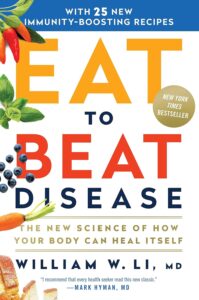
Our guide through this beautifully unsettling biology is Dr. William Li, the physician-scientist and bestselling author behind Eat to Beat Disease: The New Science of How Your Body Can Heal Itself, whose research spans angiogenesis, cancer drug development, and the frontier of food as actual medicine. William walks us from the grim origin of chemotherapy (a leaked shipment of wartime mustard gas) to a genuine paradigm shift, where the goal is no longer to napalm the tumor but to raise the body’s shields so it does the fighting itself. Along the way he unpacks the five defense systems keeping the whole circus running: angiogenesis and its Goldilocks rule where too many blood vessels feed tumors and blind the elderly, the stem cells stored in your bone marrow like extra cans of paint, a microbiome of 39 trillion bacteria texting your brain and brewing your own GLP-1, DNA repair crews patching potholes from sunlight and radon, and the immune system that clears the mess. He also plays honest broker on the biohacker gold rush, explaining why gray-market peptides and mail-order stem cells amount to “Breaking Bad biology,” and why cruciferous greens, matcha, and purple potatoes have real mechanisms behind the “food is medicine” slogan. For the health-anxious it’s a reassurance, for the biohacker a reality check, and for anyone who eats it’s a quietly radical reframing of the fork as a tool. Listen, learn, and live longer!
Please Scroll Down for Featured Resources and Transcript!
Please note that some links on this page (books, movies, music, etc.) lead to affiliate programs for which The Jordan Harbinger Show receives compensation. It’s just one of the ways we keep the lights on around here. We appreciate your support!
- Sign up for Six-Minute Networking — our free networking and relationship development mini-course — at jordanharbinger.com/course!
- Subscribe to our once-a-week Wee Bit Wiser newsletter today and start filling your Wednesdays with wisdom!
- Do you even Reddit, bro? Join us at r/JordanHarbinger!
This Episode Is Sponsored By:
- Article: Visit article.com/jordan for $50 off your first purchase of $100 or more
- BetterHelp: 10% off first month: betterhelp.com/jordan
- Boll & Branch: 15% off first set of sheets: bollandbranch.com, code JORDAN
- Chime: Open an account in two minutes: chime.com/jhs
Thanks, Dr. William Li!
Click here to let Jordan know about your number one takeaway from this episode!
And if you want us to answer your questions on one of our upcoming weekly Feedback Friday episodes, drop us a line at friday@jordanharbinger.com.
Resources from This Episode:
- Eat to Beat Disease: The New Science of How Your Body Can Heal Itself by Dr. William W. Li | Amazon
- Eat to Beat Your Diet: Burn Fat, Heal Your Metabolism, and Live Longer by Dr. William W. Li | Amazon
- Evidence-Based Information and Practical Tips on Health and Nutrition | Dr. Li’s Newsletter
- Dr. William Li | Website
- Dr. William Li | YouTube
- Can We Eat to Starve Cancer? by Dr. William Li | TED
- Cancer Immunoediting: From Immunosurveillance to Tumor Escape | Nature Immunology
- Pulmonary Nodules: Common Questions and Answers | American Family Physician
- Immunotherapy to Treat Cancer | National Cancer Institute
- How a Chemical Weapons Disaster in WWII Led to a US Cover-Up—and a New Cancer Treatment | Smithsonian Magazine
- A Real-World Observation of Patients with Glioblastoma Treated with a Personalized Peptide Vaccine | Nature Communications
- Rebecca Devine (@thatbrainyblonde) | Instagram
- First Case of HIV Cure in a Woman After Stem Cell Transplantation Reported at CROI-2022 | World Health Organization
- Structure and Distribution of an Unrecognized Interstitium in Human Tissues | Scientific Reports
- Application and Mechanism of Anti-VEGF Drugs in Age-Related Macular Degeneration | Frontiers in Bioengineering and Biotechnology
- Endometriosis-Associated Angiogenesis and Anti-Angiogenic Therapy for Endometriosis | Frontiers in Global Women’s Health
- A Review of Judah Folkman’s Remarkable Achievements in Biomedicine | PNAS
- BPC-157: A Prohibited Peptide and an Unapproved Drug Found in Health and Wellness Products | Operation Supplement Safety (U.S. Department of Defense)
- REGRANEX (Becaplermin) Gel — Recombinant Human Platelet-Derived Growth Factor: FDA Prescribing Information | U.S. Food and Drug Administration
- Diet Pills and Supplements | Skeptical Sunday | The Jordan Harbinger Show
- Stem Cells: What They Are and What They Do | Mayo Clinic
- G-CSF: From Granulopoietic Stimulant to Bone Marrow Stem Cell Mobilizing Agent | Cytokine & Growth Factor Reviews
- Saturday Night Palsy (Radial Nerve Compression) | Physiopedia
- Japanese Scientists Use Stem Cell Treatment to Restore Movement in Spinal Injury Patients | Medical Xpress
- Matcha Green Tea (MGT) Inhibits the Propagation of Cancer Stem Cells by Targeting Mitochondrial Metabolism, Glycolysis and Multiple Cell Signalling Pathways | Aging
- Anthocyanin-Containing Purple-Fleshed Potatoes Suppress Colon Tumorigenesis via Elimination of Colon Cancer Stem Cells | Journal of Nutritional Biochemistry
- The Appendix Plays a Hidden Role in Gut Health | NPR
- Short-Chain Fatty Acids Stimulate Glucagon-Like Peptide-1 Secretion via the G-Protein-Coupled Receptor FFAR2 | Diabetes
- The Vagus Nerve at the Interface of the Microbiota-Gut-Brain Axis | Frontiers in Neuroscience
- The Role of Gut Microbiome in Modulating Response to Immune Checkpoint Inhibitor Therapy in Cancer | Annals of Translational Medicine
- Johann Hari | The Skinny on “Magic Pill” Weight-Loss Drugs | The Jordan Harbinger Show
- Molecular Mechanism of DNA Damage Recognition for Global Genomic Nucleotide Excision Repair: A Defense System Against UV-Induced Skin Cancer | Springer
- Ultra-Processed Food Consumption Is Associated with Chromosomal Changes Linked to Biological Ageing | American Journal of Clinical Nutrition (via EurekAlert!)
- Temporal Efficacy of a Sulforaphane-Based Broccoli Sprout Diet in Prevention of Breast Cancer Through Modulation of Epigenetic Mechanisms | Cancer Prevention Research
- FDA Approves First-Ever Gene Therapy for Treatment of Genetic Hearing Loss Under National Priority Voucher Program | U.S. Food and Drug Administration
- Survival of the Probiotic Lactobacillus plantarum 299v and Its Effects on the Faecal Bacterial Flora, With and Without Gastric Acid Inhibition | Digestive and Liver Disease
- Effects of Live and Pasteurized Forms of Akkermansia from the Human Gut on Obesity and Metabolic Dysregulation | Microorganisms
1357: Dr. William Li | Working with Your Body to Beat Disease Naturally
This transcript is yet untouched by human hands. Please proceed with caution as we sort through what the robots have given us. We appreciate your patience!
Jordan Harbinger: [00:00:00] Coming up next on The Jordan Harbinger Show.
Dr. William Li: We've broken the glass ceiling on cancer. What was impossible before now is possible. Turns out we're actually forming cancers in our bodies all the time, but we are beginning now to see the end of cancer with treatments that are actually able to take very advanced cancers and literally dry erase them.
We've all heard about people who had breast cancer, and they had surgery and chemo, radiation, and they're getting to five years, and there's no cancer. And then year six or year eight, boom, the cancer's back. The cancer had stem cells, and the stem cells came back. So one of the holy grails of cancer research is finding a drug, a treatment that could actually kill cancer stem cells.
That way you'd get rid of everything, and then you don't-- the termites won't come back
Jordan Harbinger: Welcome to the show. I'm Jordan Harbinger. On The Jordan Harbinger Show, we decode the stories, secrets, and skills of the world's most [00:01:00] fascinating people and turn their wisdom into practical advice that you can use to impact your own life and those around you. Our mission is to help you become a better informed, more critical thinker through long-form conversations with a variety of amazing folks, from spies to CEOs, athletes, authors, thinkers, performers, even the occasional arms dealer, four-star general, or Russian chess grandmaster.
If you're new to the show or you want to tell your friends about the show, I suggest our episode starter packs. These are collections of our favorite episodes on topics like persuasion and negotiation, psychology and geopolitics, disinformation, China, North Korea, crime and cults and more, that'll help new listeners get a taste of everything we do here on the show.
Just visit jordanharbinger.com/start or search for us in your Spotify app to get started. Today on the show, we're talking with Dr. William Li, physician, scientist, best-selling author, and the guy who somehow found a way to make you probably have cancer in your body right now sound less like a death sentence and more like your immune system clocking in for another double shift.
Dr. Li's work flips the usual health conversation on its head. Instead of waiting around for disease to kick in the door like a [00:02:00] meth-addled raccoon, he looks at the systems your body already uses to keep threats under control: blood vessels, stem cells, your microbiome, your DNA repair machinery, and your immune system.
And yes, we're talking about food as medicine, but not the Instagram version where somebody with a ring light tells you blueberries can heal your childhood trauma. Actual science only. How food interacts with biology, how it can affect inflammation, blood vessels, metabolism, immunity, and the microscopic fights happening inside you every day without your permission or appreciation.
We'll get into why cancer often starts long before it becomes a diagnosis, how the body keeps dangerous cells from turning into full-blown disaster, what doctors still miss about prevention, and why your diet is not just about abs, cholesterol, or fitting into jeans from two thousand and eight like some kind of denim-based hostage negotiation.
Here we go with Dr. William Li. You open the book saying something pretty unsettling, which is that we all have cancer in our bodies right now. That's kind of terrifying, I suppose, at some level, but [00:03:00] what do you mean by that exactly?
Dr. William Li: As a physician, I was trained to see patients who are generally well, and then if you think that they're unwell, among the many things that you look for from a diagnosis perspective is obviously cancer.
The C word is one of the feared letters, uh, when it comes to health in general. But actually, the fact is that cancer is really misunderstood, or perhaps I should say we are now understanding cancer from a medical science perspective in a completely different way that upends how the public understands it, which is, "I was healthy one day, then I got diagnosed with cancer, and now I'm heading to the end of my life."
Turns out, and this is the actual new biology of cancer, we're actually forming cancers in our bodies all the time. Even kids are forming cancer in our body, and, and here's the reason why. The fact of [00:04:00] the matter is, is our bodies are made of about 40 trillion cells. Those are the building blocks of our body, every cell, and these cells have to copy themselves over and over and over again over the course of our lives.
And by the way, that's why you're still-- you and I are still here today compared to yesterday, and that's why we're still going to be here tomorrow. Our cells is, are copy and pasting each other. Now When you copy and paste a cell, you're copying everything, including its DNA, and DNA is really, they're the blueprint of the cell.
They've got to work the right way. When you have an error or a mutation in your DNA, that's how we understand cancers can actually form. Okay, so I'm telling you a story here. 40 trillion cells that have to copy and paste themselves more or less every single day, and the DNA that has to get copied along with it has to be perfectly copied or you're going to get a mutation, which could be a setup toward cancer.
So just think about that. 40 trillion cells [00:05:00] copying and pasting each other. Do they make an error, mistake? And the answer is yes. So Jordan, let me just te- uh, say, if I read a rhyme, "Row, Row, Row Your Boat," and I ask you to get onto your laptop and copy that on a Word document or a Google Doc 10 times, you're going to get it perfectly right.
Every 10 lines are going to be perfect.
Jordan Harbinger: Okay.
Dr. William Li: If I ask you to copy it 1,000 times, there's probably going to be a mistake.
Jordan Harbinger: Yeah.
Dr. William Li: All right? Now imagine if I ask you to copy that "Row, Row, Row Your Boat" 40 trillion times. That's what the body has to do, and guarantee you it makes a mistake, and those mistakes become microscopic cancers, abnormal cells that are dividing, but they can't get any larger than about the size of a pencil tip because they don't have a blood supply, so they sit there abnormally until our immune system wings by, finds them, and then knocks them out.
Jordan Harbinger: I see. That's why we're not dropping dead const- everyone's not dropping dead constantly from cancer is because they- most of this stuff [00:06:00] gets taken out before it becomes even detectable, let alone a problem.
Dr. William Li: And that's actually the key. Most of this stuff gets taken out by our body's health defenses, meaning that when our defenses are working well, shields up, these kinds of things are going to get taken out.
We're not going to be worried about them. And so I'm glad that you actually said that the opening line of my book, Eat to Beat Disease, kind of was, uh, unsettling to you, because that was the point.
Jordan Harbinger: Yeah.
Dr. William Li: The point is we can't take our health for granted. Our health is a result of our body's defenses firing on all cylinders from the day we're born until our very last breath.
Jordan Harbinger: I've seen a little bit of this firsthand, and it is scary. I went to, I went to Taiwan, and I got a bunch of these, I don't even know what you'd call them, optional health scans where you kind of... Here it would be, like, $25,000, and there it's, like, three. And they scan everything, and you do MRIs of everything and CT scans of everything, and they're like, "You have..."
They're going through the scans with the doctor and, and it's like, "You have two nodules in your lungs." And I was like, "Oh, my God." And they're like, [00:07:00] "Yeah, look, it might be cancerous. It might not be, but here's the thing. It's, like, stage zero, or whatever you would call it. It's essentially everyone has this at age 46.
You are not an exception. You have two little things here. It's only a problem if you come back next year and they're bigger or there's a lot more of them. But chances are you'll come back next year and they'll be exactly the same or they'll just be gone. And then there'll be two different ones in a different place, and then they'll be gone the next year.
So it's like, don't worry about it." And I said, "Oh, my God. How come- Don't people panic?" And they said, "Yes, but the reason you don't have to is you're catching them now. If you let these go for 10 years and then you said, 'Hey, I'm having trouble breathing,' and you go in and they're the size of a golf ball, then you've got a real problem."
And so that's why I kind of liked these early health scans. But yeah, it's scary, because they're s- essentially telling you, you might have cancer, and you're f- you know, you, you start hyperventilating, and they're like, "Relax, pal. Everybody's got these, and it's a coin toss."
Dr. William Li: The other upside to your experience is that it tells you it matters [00:08:00] and it's in your own interest to try to be as healthy as you can.
And if you can get your body's health defenses up, next year they'll probably be gone. That's the key thing.
Jordan Harbinger: So cancer, this sounds weird to say, but cancer's really not the problem. It's losing control of the process or losing control of something that's the problem.
Dr. William Li: Having your shields down is really the problem.
Jordan Harbinger: Yeah, that's a good way to put it. So this sounds like a totally different way of thinking about disease in many-- Are doctors thinking about this, I hate to say wrong, because I'm not a doctor and I have no reason to point to doctors being wrong about things, but are you thinking about this differently than most doctors, or what?
Dr. William Li: I'm a researcher as well as a physician, so being a doctor and a scientist gives me an unusual lens, which is that I can actually look at problems that doctors recognize, but at a much, much deeper level. So as someone who's a cancer researcher, this is how I think about cancer, not as this big scary thing you find on a scan, and then you've got to give the, quote, "bad news" to the patient.
I think about sort of what's the biology that's underneath, [00:09:00] what's going on, uh, here? And things that seem really scary, even to doctors, once you have a better understanding o- of what's going on at the deeper cellular level, that's actually the unlock to figure out what the solutions might be. In disease, most doctors will say cancer doesn't have a good solution.
But I've been actually working in cancer research, even cancer drug development, treatment development. I've worked on well over a dozen of them, and I can actually tell you today The diagnosis of cancer is still a big deal, but we are beginning now to see the end of cancer with treatments that are actually able to take very advanced cancers and literally dry erase them.
Uh, you could take stage four to stage zero, and the developments are happening so fast now. You know what it's based on? It's based on raising your body's shields. A shield elevator rather than chemo. Chemo, by the way, came from this whole history of [00:10:00] cancer, fighting cancer in the modern era from wartime.
Do you know what the history of chemo is?
Jordan Harbinger: I actually don't. I'm, of course, super curious to hear what this is. Uh, it comes from wartime, you said?
Dr. William Li: Yeah, yeah, yeah.
Jordan Harbinger: Okay.
Dr. William Li: Basically, for 10,000 years, right, there was no good treatments for cancer, but I will actually tell you that the war on cancer, even though US President Richard Nixon came up with the bill for the National Cancer Act that led to the National Cancer Institute and others, the reality is, is back in the early 1940s during World War II, there was a ship, a, an American ship that was carrying mustard gas secretly, violating the Geneva Conen- vention, by the way, bringing this chemical warfare into the Bay of Bari, as in Bari, Italy.
And the intelligence actually got leaked out somehow to the Germans that there [00:11:00] was this boat bringing weapons into the it- harbor in Italy. So they flew war planes over and bombed the ship, not realizing that there was mustard gas in those ships.
Jordan Harbinger: Who were the weapons for? Because Italy was also Axis.
Dr. William Li: The weapons were actually to fight the Axis.
It's inside a US ship.
Jordan Harbinger: Oh, I see.
Dr. William Li: So think about it. Americans and the, and the English got together to sneak chemical warfare to get the Axis.
Jordan Harbinger: I see. Okay.
Dr. William Li: Axis heard about it, flew planes over, didn't know that it was actually chemical weapons, bombed the ship. Mustard gas came out everywhere, as you could imagine, blew it into the town of Bari, killed a ton of people, and in the investigation afterwards that took place, they actually discovered that some cancer patients actually survived the chemical warfare.
And when they actually scratched their heads and say, "Well, how did this work out? How is it that chemical warfare actually didn't kill the cancer patients?" It turned out that that chemical mu- mustard gas was actually killing [00:12:00] cancer cells, and that was the origin story of chemotherapy.
Jordan Harbinger: Huh.
Dr. William Li: Because then researchers said, "Well, maybe we can take mustard gas and treat cancer."
And then at Yale, they actually came up with this idea, Yale University, that we can actually use, uh, chemical weapons, like nasty, destructive chemicals to treat cancer. So everything that we've actually been conditioned to think about cancer originally was based on wartime. War against cancer, kill cancer, burn the cancer.
Yeah. Right? Chemo destruction. So what I'm telling you is really the new way to think about cancer Is really not killing the cancer, but rather healing the body
Jordan Harbinger: And letting the body go to work and kill the cancer.
Dr. William Li: And letting the body go to work. Shields up. That's the paradigm shift.
Jordan Harbinger: That's good news because chemo is such a blunt instrument from the outside looking in.
I'm not a physician obviously, but when I look at chemo, it's like, "Yeah, it's going to knock your hair out, and it's going to knock down your immune system, and it's going to probably get rid of this and this and this and this, and you're going to have to take this, and you might need an organ transplant for that." And it's like holy smokes, but you're going to [00:13:00] die otherwise, so you do it.
It's just such a blunt instrument, right? It's kind of like saying, "Hey, I got this really deep cut on my finger," and somebody brings out an ax, and they're like, "All right. You're probably going to lose your whole arm, but we're going to get rid of that thing."
Dr. William Li: That's right. Well, think about the wartime analogies, collateral damage.
Jordan Harbinger: Mm-hmm.
Dr. William Li: You know? You've got to destroy a village to save it kind of thing. But I can tell you that we've now moved way forward. So 60-some years later, actually 80 years later, we are now entering the era of immunotherapy, and your immune system is actually what actually clears off those microscopic copy-and-paste mistakes.
So by raising the shields, getting your own immune system to be basically the Mike Tysons of your body to knock out cancer cells naturally, then we're actually starting to see the results that we didn't see when it was just all napalm, the whole body.
Jordan Harbinger: So we got Mike Tyson biting off cancer's ear in your body.
You know, this actually makes a lot of sense because a friend of mine actually just a few days ago told me [00:14:00] that his father, who's, I don't know, 70s, 80s, has a... What is it called? Is it glioblastoma? It's a brain tumor of some kind.
Dr. William Li: Glioblastoma, yeah.
Jordan Harbinger: And he was given something like a year to live or two years, I can't remember, and he said the latest thing they did is they just got back from Germany, where he had taken a custom vaccine.
And I said, "What good is a vaccine going to do against cancer? Cancer's not a virus or whatever. You know, how is a vaccine going to work?" And he basically explained in part what you're telling me right now, which is that it can tell your immune system, "Hey, this particular genome of this particular cancerous tumor, this is bad.
You need to send your," what are they, T cells or whatever they're called? "You need to send these immune system cells to attack it." And it cuts the tumor in half in a few months, this... Well, on average it does something like that, and it extends your lifespan, like, 50%, which is crazy to me. I never heard of this.
Dr. William Li: I'm actually involved with that technology, so I know a lot about it. Uh, we published a paper in Nature Communications about two years ago in, uh, [00:15:00] glioblastoma, which is a lethal brain tumor. Up until a few years ago, virtually nobody lived longer than two years. It was as close to a death sentence of a cancer diagnosis as you could get.
Today, this approach that you were describing your friend had is just one very, very promising approach among many that are actually coming out of the gate. But this approach, I, I've got to describe it to you because you brought it up. You take the cancer from the biopsy, so you take the sample of the cancer that a surgeon would remove, standard pathology biopsy, and then you take a normal vial of blood, of healthy blood cells, all right?
In the same person. Send it away to a lab. The lab will do the genome sequencing of the, the whole cancer. So you look for 20,000 human genes in the cancer, and now there's no secrets. You know everything there is to know about what's making the cancer tick. Then you repeat [00:16:00] that and sequence the entire human genome in healthy blood cells from the same person Now you use artificial intelligence and machine learning to do what the human brain could never do, which is to compare them back and forth and back and forth, and what you're looking for by...
is subtracting out the mutations that are found in both normal and cancer cells. Now you're left only with those mutations that are in the cancer. That's what we call the smoking gun of the cancer. The who done it, it's those guys. And then what you can do, if you remember in that Spielberg movie Minority Report?
Jordan Harbinger: Yeah.
Dr. William Li: There was a scene where Tom Cruise is wearing his gloves, and he can actually on a glass board lift up different figures.
Jordan Harbinger: That's right.
Dr. William Li: Well, conceptually, that's what we can do now with those tumor mutations. Pick 20 of these mutations, move them up, connect them, okay, with a linker. So think about a pearl necklace.
Every cancer mutation is a pearl, and then you put [00:17:00] a string to string the pearls together. All right? String necklace, mutation, cancer mutations. And then you hit print, and actually you can print out a protein. I'm making it sound a lot s- more simple than it is.
Jordan Harbinger: Sure. Yes, thank you for that, by the way.
Dr. William Li: You're printing out w- this dust that actually is your own personal cancer proteins that you inject under the skin, and now you're vaccinating yourself against your own cancer. Your immune system, it's just kind of like being... getting allergy shots or a vaccine against the, the, like the flu shot. Now your, your immune system goes, "Wait a minute.
Those guys," meaning the cancer signals, "are abnormal. Let's start forming immune cells, an army of super soldiers to go find those guys." It's like giving a bloodhound a, a bloody rag to sniff.
Jordan Harbinger: Yeah.
Dr. William Li: And now all the dogs are going after it, and that's actually how this whole treatment works. It is... I can tell you there are people that I know who have received this with brain tumors who are [00:18:00] now eight years healthy.
Jordan Harbinger: Crazy.
Dr. William Li: Stage four to stage zero. This is where we're at.
Jordan Harbinger: Let me ask you this. So I asked my friend this, and he didn't know. He said he was going to ask the doctor. He said, "Okay, if you do this vaccine, it goes after the mutations. It gives you a bunch of extra time to live." They'd also taken, like, a lemon-sized tumor out of his dad's brain as well.
So they got rid of, I guess, the stuff you can get at without destroying the brain to get at the rest of it probably. I don't know. And then they give him this custom vaccine. And I said, "How come it doesn't get rid of the whole tumor, or the whole... How come it doesn't just cure you?" And he said, "Well, eventually the tumor," and this is where I need your expertise again.
He said, "Eventually the tumor adapts, and there's other mutated cells." And I said, "Well, okay, how come you can't just get yet another custom vaccine until you live a full life doing this?" Like, w- what is the limitation on this particular treatment?
Dr. William Li: We're still figuring this out Some people are getting cures.
Jordan Harbinger: Wow, okay. So some people do get r- lucky and it just stops.
Dr. William Li: I'm going
to
Dr. William Li: actually tell you one person who has a social media account [00:19:00] who is an advocate for, uh, glioblastoma patients to look for this treatment. Please. Her name is Rebecca Devine, and her handle on social media is That Brainy Blonde. Nice. I see it.
And it's a triple entendre. She's blonde, she's super smart, and she had a glioblastoma eight years ago. She got the peptide vaccine. She's completely cancer-free today So anybody who wants to see an example of the impossible becoming possible, and to witness somebody who is the living, breathing epitome of how fast research is moving, like not just research in terms of like science for science sake, but really insights into what we can do.
When you're taking a look at technology, right? You develop the, uh, semiconductor, then you develop the chip, and then you can actually really zoom ahead. That's where we are with cancer research. We obviously don't have the final solution yet, but I'll tell you that I never thought in my medical [00:20:00] career I would see, ever see stage four cancer going to stage zero, and it's happening.
Jordan Harbinger: I had a friend who died from glioblastoma, and she was like 22. And Rebecca Divine here, I'm looking, she's, I don't know, 30s or something like that. So this is... It's not just going after people who've had a full life. That would be bad enough, but it's going after people who just have really bad luck. This sounds another weird thing to say.
It'd be great to see this turn into, like HIV or AIDS, where you just have to take shots for the rest of your life, and you're ca- it's kind of like relegated to almost a minor inconvenience at this point.
Dr. William Li: Yeah. Well, I'll tell you, we don't know how long you need to take these shots, because your immune system is...
Once it's actually ramped up, it should keep on going. And so by the way, I'm glad you brought up this idea of, of HIV, because if you remember at the very beginning of the AIDS pandemic, I think it was called back then-
Jordan Harbinger: Yes ...
Dr. William Li: the reality is, is it was such a scary thing. But now, you know, it's really become accepted that if you got the diagnosis, you got a treatment, you can actually live a normal, healthy life.
Jordan Harbinger: Yes.
Dr. William Li: And I think that this is [00:21:00] ultimately where we're going with cancer. This approach in immunotherapy doesn't work for everyone yet. In fact, most medicines don't work for everyone. But we're still figuring it out. What I'm, what I'm telling you is that like we're br- we've broken the glass ceiling on cancer.
What was impossible before now is possible. We don't know how to make it work for everybody yet, but that's actually where really interesting things like what you eat and your lifestyle and your gut, your epigenetics all starting to come into play.
Jordan Harbinger: This is all fascinating. Yeah, and it's funny, man. I was just talking about this with a friend where it's...
I'm an '80s kid, so I remember it was like, "Be careful. Don't share," I don't even remember, "drinks with your friends because we don't know how this spreads. Maybe you can get it from a toilet seat." And then we had these units in school where it was like, "Look, calm down. You're not going to get this from sharing a Diet Coke with your buddy.
You're not going to get this from using a toilet that, of somebody who has AIDS. And oh, by the way, it's not just gay people who have it." And then it was like, I don't know, I went to high school and dot, dot, dot, Magic Johnson got it, and suddenly it wasn't a big deal anymore, and you just had to [00:22:00] take medicine.
And now it would only be lethal if you had no access, which of course a lot of people across the world don't. But if you live in a Western country, it's kind of like having, I don't know what's comparable, hepatitis or something like that. You just take medication for it, and hopefully you don't need an organ transplant.
Dr. William Li: And there's some really exciting clues that there have been a few people who had HIV For years, and they get a bone marrow transplant that replaces their immune system, and guess what? With a brand-new defense system, new shields, new super soldiers, in a few people it's been able to completely wipe out the virus in their body.
Jordan Harbinger: I always thought, Dr. Li, I was like, "Okay, we're going to get these nano robots that are the size of, I don't know, really small cells or something like that, and we're going to have to inject those, and they're going to be programmed to fight things for us," and it turns out we actually have a much better solution already in our body.
They just need the targeting information.
Dr. William Li: That's the really remarkable thing about a career like I've had in science and medicine. If you think about it, uh, Jordan, here's a [00:23:00] interesting and slightly stunning thing to think about. You know, we talk about medicine and overuse of medicines, the cost of medicines.
We've only had pharmaceuticals for 100 years.
Jordan Harbinger: Like real ones.
Dr. William Li: Like real ones.
Jordan Harbinger: Before that you drank mercury or something, I don't know. I don't know, I don't know what they did.
Dr. William Li: Well, before that we really only had diet and lifestyle and witchcraft.
Jordan Harbinger: Yeah, witchcraft, yeah, yeah. Burn the sage and leave it in your apartment and close the windows or something, yeah.
It was like that stuff.
Dr. William Li: Exactly. And so just to make this point that we've gone in 100 years from witchcraft, diet and lifestyle, we're coming back to diet and lifestyle now, we're leaving the witchcraft alone, but we've actually been able to go in 100 years to develop medications that can actually completely manage a previously lethal disease like HIV, AIDS, and also starting to look at the beginnings of the dawn of an age where we can actually c- uh, overcome cancer.
That's in 100 years, man. That's pretty amazing.
Jordan Harbinger: Yeah, that's a couple of [00:24:00] lifetimes. Uh, a- Yeah ... lifetime and a half-ish really. We'll be right back with Dr. William Lee, but first, since apparently our bodies are already suppressing microscopic cancer while we complain about email, let's support one more system that keeps this whole circus from collapsing: our sponsors.
We'll be right back. This episode is sponsored in part by Article. First impressions matter, and whether we like it or not, your home says a lot about you, your taste, your personality, how put together you are, whether your space feels thoughtful and intentional or like it was randomly accumulated over the years.
That's why we love Article. We've loved every piece we've gotten from them, including the wooden console in our entryway. It's one of those pieces people notice right away. It's stylish, solid. It makes the space feel more intentional the second you walk in. Article makes it easy to get your home looking pulled together without spending luxury showroom money.
Their collection feels really curated. Mid-century modern, coastal, and Scandi-inspired pieces that look great on their own, but also mix and match well so your home feels cohesive without looking overly designed. And the quality is noticeable. The pieces feel substantial, the finishes are clean, the packaging [00:25:00] is thoughtful, and a lot of items come mostly assembled, which I deeply appreciate because nobody needs more tiny Allen wrench projects.
Article offers fast, affordable shipping across the US and Canada, so you can support us now with this one, Canadian listeners. Optional professional assembly, which may be recommended depending on how handy you are with this stuff, customer care seven days a week, free interior design services, and a 30-day satisfaction guarantee.
Jen Harbinger: Article is offering our listeners $50 off your first purchase of $100 or more. Visit article.com/jordan and the discount will be automatically applied at checkout. That's article.com/jordan for $50 off your first purchase of $100 or more.
Jordan Harbinger: This episode is also sponsored in part by BetterHelp. The stigma of mental health can be quiet.
It's the idea that you should be able to handle everything yourself. It's feeling guilty for asking for help. It's telling yourself that other people have it worse, so you shouldn't complain. It's waiting until you're completely overwhelmed before deciding you deserve support. BetterHelp's 2026 State of Stigma report surveyed 2,000 Americans and revealed that 85% of Americans believe getting support [00:26:00] is wise, yet 74% say society discourages people from doing so.
While we agree support is valuable, a lot of us still carry around these old messages that tell us we should just push through all this on our own, and part of changing that is recognizing that getting support isn't a sign that you're failing. It's just a sign that you're human. BetterHelp connects people with licensed therapists based on their needs and preferences through a brief questionnaire.
They have more than 30,000 therapists on the platform, have served over six million people globally, and live sessions have an average rating of 4.9 out of 5 based on more than 1.7 million client reviews. Don't let stigma stand in the way of support. Start therapy with BetterHelp. Sign up and get 10% off at betterhelp.com/jordan.
That's better H-E-L-P .com/jordan. Using our promo code does not just get you a discount, it helps out the show. It lets our sponsors know that you're interacting with the ads from our show specifically. So if you buy anything, you sign up for anything, please use our codes. It's usually Jordan, but sometimes it's not, and those are listed on the deals page, jordanharbinger.com/deals.
It's a double win because you get a great deal and you help keep the show [00:27:00] running strong. Thank you for your support. Now back to Dr. William Li. It's also wild to me that our body is actually fighting this stuff all of the time. It's so low level that we don't even notice it. There's not even a way to figure this out unless you do some maybe sort of advanced blood test looking for antibodies or something like that.
It's just being taken care of at any given moment. And when things go wrong, it sounds, well, part of it is of course random bad luck, but a lot of it is maybe s- a system breaking down, a shield breaking down. Is that accurate?
Dr. William Li: Yeah, I think that's a great way to think about it. You know, like, you don't get sick just because you're going out and hanging out with people.
You get sick because your immune system's slightly down, and now you happen to be inhaling some of the germs, and now you're actually going to get sick. I think that the flipping the script on disease is rather than asking why did I get this disease, as if you were just a victim of disease, the reality is that maybe there was something else going on where your body's defenses went [00:28:00] down.
Listen, health defenses are just like how we defend our, our homes. We lock the door, we have a, a switch on our, uh, stove to turn off the gas. We got fire smoke alarms in our house. Imagine if you didn't have any of those things. It's only a matter of time before something's going to happen and you're not going to catch it, and that's why I think we're, our new way of thinking about health, and listen, I am actually a believer in new technology.
I do think that those little nano robots or the cameras that you can swallow that'll take pictures of your inside- Yeah ... and then Bluetooth them, you know, to the app on your phone, like, those are amazing things, and they're going to happen. I mean, they're here and they're going to continue to happen. But I think that it's really hard to beat Mother Nature, meaning how the human body's evolved, and we're just scratching the surface.
You know that we're still discovering new brain cells. We're still discovering new cells in our body, and even new organs, believe it or not.
Jordan Harbinger: Really? How is that possible? Have we not disassembled enough people if we don't know what's in there?
Dr. William Li: I would've thought [00:29:00] so, you know? Like, didn't Vlad the Impaler, you know, kind of figure it all out?
Jordan Harbinger: Yeah, thought we had diagrams from centuries ago. E- even if we didn't know what everything did, we still knew it was in there.
Dr. William Li: Well, I'll tell you, one of the latest organs that got discovered, you're going to like this, I've got to describe it to you first. It's called the interstitium. It's an organ system, and this organ system is so important that it actually, it transports hormones and signals from one or- part of the body to the other in order to be able to help us work, function.
And then you go, well, okay, exactly you're saying, like, don't we have cadavers? Doesn't, you know, don't we actually, haven't we dissected bodies for all these times? Yes, we have, and I'll tell you, we missed it. And the reason we missed it is because that when I went to medical school, I did anatomy. I dissected a body.
What do you see when you open up, you know, you do your incision and you open up this, uh, uh, embalmed body in formalin? You see all these shrunken organs that are sitting there, and what we have to do with masks and gloves and gowns is to pick through [00:30:00] them and look and identify the ones that we recognize.
Here's the heart, here's the liver, here's the lungs, and here's the kidneys. You know what we missed? When the body was closed up and the person was alive, there was spaces in between the organs Filled with fluid. The new organ is the space between the organs. It's its own organ.
Jordan Harbinger: The space between organs is the organ.
Dr. William Li: Exactly.
Jordan Harbinger: Aren't we just stretching the definition of what an organ is at that point?
Dr. William Li: No, it's actually fluid-filled, and it actively transports-
Jordan Harbinger: I see. Okay ... it's
Dr. William Li: fluids, and it tr- actively transports. It's like if you only looked at the, uh, corn fields and not the highway.
Jordan Harbinger: Okay, this makes sense.
Dr. William Li: Now you look at the highway, and you're really like, "Man, there's traffic going through there all the time."
So-
Jordan Harbinger: Huh ...
Dr. William Li: we are in an era of discovery. It's like, not archeology of the body, but kind of like archeology of the body. You know, but, like, archeology is looking backwards. We're s- we're still looking forwards. There's a lot of stuff, Jordan, that's been hidden in plain sight.
Jordan Harbinger: Okay, this is way [00:31:00] outside the scope of the show, but who cares?
The audience is going to dig it, I think. How does the interstitium cause, I don't know, let's say testosterone or some other hormone to move in a specific direction if it's just essentially a bag of fluid? There's got to be something that pumps things in different directions, right?
Dr. William Li: We don't understand it fully yet.
Jordan Harbinger: I see.
Dr. William Li: But I will tell you that there are particles that are much smaller. Like, we talk about nanoparticles and nanotechnology, right? Our body already had beat us to it a long time ago. We've got little nanoparticles that move around from cell to cell and within the interstitium. And so one day we're going to be able to do a scan, I'm predicting this, where we're only scanning the interstitium and we're watching that traffic moving around.
This
Jordan Harbinger: makes sense,
Dr. William Li: yeah. Can't do it yet, but someday we're going to get there.
Jordan Harbinger: I suppose if there's little ... If you think about things like sperm, they find their way, and they're essentially these really s- quote, unquote, "simple organisms," right? So there could just be a similar type of thing that just binds to different hormones and floats around in there, and when you drain the body and [00:32:00] fill it up with the embalming fluid, right, it's just that stuff's gone.
So you never see it.
Dr. William Li: You never see it. And basically when you do a dissection, it's dried. All the fluid is gone. Right. And so basically we were staring at it, but we couldn't see it because it only exists in the living state. Now, I will tell you that most signals in the body actually have a receptor, so it's like a lock and key.
The signaling substance is like the key fitting into a lock, and so there are locks and keys all over our body where they know actually how to, where to go and open things up. And by the way, like a great example that most people don't appreciate is that we have our own stem cells, and when our, uh, stem cells come out to heal or regenerate us, ourselves from the inside out, they fly around our bloodstream and our body everywhere, and they only land, they only stick their landing wherever you need to repair something.
And so that's another way that we're designed is- Things only happen where they need to happen in most cases.
Jordan Harbinger: Your book [00:33:00] mentions the five defense systems, and you mention something along the lines of health is not the absence of disease, it's the strength of these five defense systems. So basically like you said before, the shields, right?
So I would love to go over these, because I don't think most people have heard of some of these things. Like angiogenesis is the first one. I had to look that up, and now it's one of the most interesting things that I've probably read about in the past couple of years.
Dr. William Li: So step back first on the body's health defense, and I'll dive into angiogenesis, because that's actually my field.
So if you look at the body like a fortress, like a castle, most of us have seen a castle, been to the Disney castle- Sure ... gone to Europe to look at a real castle.
Jordan Harbinger: Right.
Dr. William Li: But what do you see with a castle? You see all the defenses that have been set up and engineered into it. Little slit holes to shoot out arrows, the moat to prevent people from walking right up and invading, you got the drawbridge.
And by the way, there's something in a castle that you may not have noticed if you walked into a real castle. Right at the doorway, at the entrance when you walk [00:34:00] in, if you look straight up, you actually see a hole going from the second floor down to the first floor where you're standing. That's called a murder hole, and what that was is that if people managed to breach the moat, get onto the drawbridge, bust into the door, they still could drop rocks or pour oil on you from above.
Jordan Harbinger: Savage.
Dr. William Li: I'm just making the point that a castle-
Jordan Harbinger: Yeah ...
Dr. William Li: is designed to defend its inhabitants inside who live in there. Our body is designed the same way. It's got these incredibly clever, well-designed ways of protecting us, and there's five of them that I write about in my book, Eat to Beat Disease. Each of these defense systems is like something a ca- designed for a castle to keep our body fortress protected.
So angiogenesis is one of our most important defense systems. Sounds like a complicated word Very simple. Angio, blood, blood vessel. Genesis, how your body grows blood vessels, your circulation. And what most people don't [00:35:00] realize is that our s- is how important our circulation is. You and I have 60,000 miles worth of blood vessels packed inside our bodies.
Jordan Harbinger: Wow.
Dr. William Li: That's so extensive that if you were to pull out all the blood vessels and line them up end to end, you'd form a ribbon that would wrap around the Earth twice.
Jordan Harbinger: That's so crazy to think about. That includes all the little capillaries
Dr. William Li: and things you can't- All the- Okay ... especially the capillaries, okay?
Now, those are the highways and byways of life itself. They carry the oxygen that you breathe, the nutrients that you eat, the medicines that you take, and the cells like your immune cells to wherever they need to go. If your blood vessels are sick or damaged, you don't have a chance to be optimizing your health.
Forget about it. Not going to happen. On the other hand, if your blood vessels are well-functioning, you get good blood flow, you're able to bring every s- stuff, what you need to everywhere, and organ in your body, now you can optimize your health. And in fact, studies have been done recently on centenarians. You know, there's all this [00:36:00] interest on longevity.
People who have lived to 100 and older, and if you look at their genes, like their genetic material, you'll find that one of the things that sets them apart is how healthy their circulation is, how their angiogenesis defense genes are actually super strong So you want to actually have that as one of your defense systems.
And what's amazing about the defense systems, your defenses will do just what it needs to keep your body perfectly healthy. Not too many, not too few, just some of... I call it the Goldilocks zone.
Jordan Harbinger: Yeah. Okay. Not too many. So you can have too many blood vessels? Because I don't think any, um, most people probably don't know that.
I would not have thought that. It's like having too many roads. You just have less traffic. What's the problem?
Dr. William Li: Well, okay, let's sort of kind of review this.
Jordan Harbinger: Yeah.
Dr. William Li: Imagine, like, the beautiful lawn of a country club. If you don't have enough grass, you're going to have bald patches. Your golf course is going to look like crap.
Jordan Harbinger: Yeah.
Dr. William Li: All right? So you've got to put some more [00:37:00] seed in there and then grow it right up. Now, on the other hand, if you had too many tufts of, of lawn growing, patches of grass growing up, that's going to look like crap, too. So then your gardener's going to come out and mow it down, and now that's how you actually maintain that country club looking lawn, perfect all the time.
That's our circulation. Let me give you the analogy. If you don't have enough blood vessels, what happens? Well, your organs start dying. You don't have enough blood vessels in your heart, you have a heart attack. In your brain, your brain dies after a stroke. What you really want is just the right amount of blood vessels so your body, like the landscaper in the country club, knows how to seed the area in order to be able to grow blood vessels, that's angiogenesis, to go bu- get blood vessels where needed.
Now, what happens if there's too many blood vessels grow? There's a problem. If you have too many blood vessels growing, I'm going to give you an example. In your eyes, our eyes are crystal clear little, like, marbles. There are some blood vessels, but not very many. If you actually have excess blood [00:38:00] vessels growing in your eye, they're going to start leaking fluid into your eye, they're going to start bleeding, and by the way, that's the most common cause of blindness in the elderly.
Really? If you hear about grandma going blind, it's probably due to macular degeneration. Oh, I've heard of that. Age related- Of course ... macular degeneration.
Jordan Harbinger: Yeah.
Dr. William Li: That's angiogenesis going out of control. You know that Girls Gone Wild on spring break? These are blood vessels gone wild in the back of your eye.
Jordan Harbinger: Oh my God, I was... Okay, I did not see that, I did not see that analogy coming at all. Okay, that's a winner. So this is actual- actually this is quite alarming because one of, and I'm sure you've heard of this, one of the most common fitness influencery kind of new things, biohacker things, is this peptide called, I think it's, I might get this wrong, BPC 157.
Yeah. Is that
Dr. William Li: it? Yeah.
Jordan Harbinger: And it's supposed to be like, "This is great for angiogenesis." And it's like, well, that's true if you can never have too much angiogenesis. Sure, take something that increases it, but, like, maybe I don't want to go [00:39:00] blind or have a tumor be able to grow a blood supply really easily. I don't know.
Is this... Am I on the right track with this?
Dr. William Li: You're catching the right wave. So let me first tell you that if you have too many blood vessels in the eye, you can go blind. Yeah. So the treatment is actually to get rid of those blood vessels. We've got treatments that can actually mow away those extra blood vessels, dry up the blood vessels.
Jordan Harbinger: Sclerotic?
Dr. William Li: No, it's, it's called an anti-VEGF therapy. It's an injection in the eye right now. Ugh. There are pills that are actually coming, but what they do is they prevent blood vessels from growing, so they amplify your body's natural lawnmower for extra blood vessels. Oh,
Jordan Harbinger: so our body's also pruning blood vessels all the time.
Dr. William Li: All the time.
Jordan Harbinger: Wow.
Dr. William Li: So, like, we have our own country club landscaper for blood vessels.
Jordan Harbinger: Sure.
Dr. William Li: We're mowing those away all the time. Uh, another place where you have excess blood vessels, you ever see somebody with psoriasis, itchy plaques, about 2% of the world's population?
Jordan Harbinger: Is that the, like, eczema kind of thing?
I don't know the difference.
Dr. William Li: It's a big, red, scaly, itchy plaque-
Jordan Harbinger: Yeah, I've
Dr. William Li: seen it ... growing on the skin, and man, [00:40:00] about 2% of the world's population have it. That's inflammation and angiogenesis and what... Underneath that red plaque, red raised plaque, are tons of blood vessels growing. Now, endometriosis in women who wind up having every month like this terrible crippling pain, it's because they have little bits of their uterine tissue implanted in their belly where it doesn't belong.
Every month during a hormonal surge, angiogenesis flares up and causes pain. And the worst possible situation of which glioblastoma is almost the poster child for this, tumors, which are normally harmless because they're tiny, they're restricted to the size of the tip of a pencil point, tumors will try to hijack your blood vessels and grow more blood vessels.
So there's something called tumor angiogenesis. It's a bad kind of angiogenesis. They hijack our systems, like kicking in the cockpit door to take over the plane. They grow blood vessels, and in the lab where I trained, in the pioneers [00:41:00] lab looking at angiogenesis, a guy named Judah Folkman, I'll tell you, when a tumor could not get blood vessels, it stayed tiny and small, just the same size that the immune system would find and knock it out The moment you actually grew blood vessels to touch the tumor, microscopic cancer, it could grow 16,000 times in two weeks.
Jordan Harbinger: Holy cow.
Dr. William Li: That's an explosion because it's being fed.
Jordan Harbinger: This just has a gasoline pipe essentially straight to the engine.
Dr. William Li: Fueling it, right? You're pulling the trigger on cancer, and the same blood vessels that feed the cancer are also allowing cancer cells to leave the cancer and spread elsewhere to your body.
Jordan Harbinger: Oh, man.
Dr. William Li: So anti-angiogenic therapy is a whole modality of treating cancer like immunotherapy is, that we talked about earlier. We can now cut off the blood supply to cancer using medicines, just like we can boost immune system using medicines, but we can also eat foods that will cut off the blood supply to tumors, just like we can eat foods that can amplify our immune system as [00:42:00] well.
And so this is where food is medicine. Some of the real latest stuff on food is medicine is actually coming from our knowledge about medicines. Medicine is medicine. It leads to insights on how foods can be used as medicine. But so you've got angiogenesis. A second, uh, health defense is our stem cells.
This is not the kind of stem cell that you go to the strip mall to get injected into your knee. I began my career looking at and discovering peptides that could stimulate angiogenesis. Now, BPC 157 actually is one of a number, hundreds of peptides, proteins that have been discovered, protein pieces that have been discovered, that can help to control, either stimulate blood vessels or stop them.
So it's really interesting. It came actually out of gastric juice, stomach juice, and the idea from a research perspective, okay, scientist in the lab, is that the stomach is dealing with all this roughage all the time. I mean, you know, like the tiger shark will eat like [00:43:00] a garbage can or, or a license plate- Right, right
and it doesn't bleed to death, right? Well, the humans, even though we don't eat the license plates, the reality is that we eat a lot of roughage.
Jordan Harbinger: Yeah.
Dr. William Li: And amazingly, our stomach doesn't get shredded.
Jordan Harbinger: I always wondered about that. I... When I was a kid, I ate all these... I mean, I'm outing myself here, but I ate a lot of plastic toys.
You know, there's probably a Lego still in there from 40 years ago. Who knows?
Dr. William Li: They didn't pick it up on your scan?
Jordan Harbinger: No, it wasn't on a scan. Inside one. Hey, I digested it. That's a good point. Um Hey, look,
Dr. William Li: there's a, there's a little dinosaur in there.
Jordan Harbinger: Yeah . But, like, I always wondered, I'm like, what happens if you accidentally eat, I don't know, a staple that was in a piece of food that was in a package?
Surely this has happened, but you're not puking up blood for the rest... You don't die.
Dr. William Li: So the stomach has all these defenses And we also know the stomach, when it's injured, can heal itself really, really fast.
Jordan Harbinger: Yeah.
Dr. William Li: So BPC-157 actually is one of those peptides that was discovered in the lab from stomach juice that is thought by researchers to help heal the stomach, to prevent injury.
And by [00:44:00] the way, you know, like, it's part of this, they call it the Wolverine stack.
Jordan Harbinger: Oh, cool. Yeah, I didn't know that. That makes sense though.
Dr. William Li: You know, the Wolverine, right? Like, from Marvel.
Jordan Harbinger: Yeah, he heals super fast.
Dr. William Li: I think it's a cool name, but it's actually not really ready for prime time idea. Sure. So these peptides, and there, by the way, there are other protein, peptide proteins, polypeptides that have been actually FDA approved.
Takes a decade, billion dollars- Yeah ... clinical trials. We've actually had one, I was, been involved with it, it's like a gel of a growth factor, platelet-derived growth factor you can squirt onto a wound. Somebody with diabetes, you squirt it on the wound. It's not a single peptide, a fragment. It's actually a whole polypeptide.
It'll actually trigger angiogenesis and blood vessels will grow, and it'll zip the wound shut.
Jordan Harbinger: This is like something out of the Predator movie where he sprays his wounds and they just close up right before your eyes. I c- if you can't tell, I'm a little bit of a geek with the Wolverine thing too.
Dr. William Li: I gotcha, I gotcha.
Jordan Harbinger: Yeah. That's really cool.
Dr. William Li: But I will tell you that's the difference between these [00:45:00] gray market peptides that now can't even be really gotten legitimately from compounding pharmacies where they came from, and you've got to order them from companies that are producing research grade, lab grade stuff.
Jordan Harbinger: Ex- I was going to say, research chemicals, yes, including LSD and BPC-157, yeah.
Dr. William Li: So I will tell you that for me, as a doctor who knows a heck of a lot, I pretty much know whatever there is to know about angiogenesis as applies to clinical medicine, I would not use that myself. All right? And the reason is- That's good to know ... there may wind up being, and I know that's being studied now, there may wind up being a day in which it gets validated, the safety is being tested, there's regulations on how it's generated.
But who knows where these things are being made and what else is in them, and who would want to inject something that you get from, you know, the back of a comic book- Yeah ... that you mail order, and you inject it into your body because some influencer says it or some weightlifter, bodybuilder says it. You know, to me, I'm just telling you as a medical researcher, [00:46:00] I know when things are ahead of their time.
Maybe BPC-157 is, and other peptides are ahead of their time. They're not ready for prime time yet because they haven't yet gone through that rigorous safety testing first. Always safety first. And you know, there's every reason to believe that it would work. The biology makes total sense. But what's the dose?
Everybody goes from microdosing. Well, how do you know what the right dose is before you microdose it?
Jordan Harbinger: Yeah, you need to know the right dose before you can micro it.
Dr. William Li: I've been involved with drug development my whole career. I'm involved with foods, supplements. I certainly appreciate- these really innovative approaches.
But what's a little, uh, scary to me is when you actually have this sort of rip-roaring enthusiasm on products that are not ready for prime time yet, that people can buy from research grade level
Jordan Harbinger: Yeah, gray market basically.
Dr. William Li: Gray market. And by the way, you know, we know that gray market biological products can be contaminated.
That's the problem.
Jordan Harbinger: Dr. Li couldn't answer [00:47:00] patients when they asked what they should eat, which is wild because medicine can transplant a face, but somehow nutrition advice is still, I don't know, maybe try salad? We'll be right back. This episode is sponsored in part by Boll and Branch. Sleeping hot is the worst.
You know that sweaty summer sleep where the sheets are stuck to your legs, your pillow feels humid somehow, your hair is matted to the back of your neck. You're cranking the AC down to meat locker temperatures so much that your throat feels dry. I used to think that was just summer, kind of #Michigan or whatever, but a lot of the time it's your bedding.
That's why I upgraded our bed linen to Boll and Branch. Their summer bedding is breathable, lightweight, and designed to keep you cool all night. Their sheets are 100% organic cotton, woven specifically for airflow, not just softness. So unlike synthetic cooling tech or chemically treated fabrics, the cooling is structural.
It's literally how the cotton is woven. The percale sheet set is the summer hero. Crisp, cool, and breathable. You get into bed, it has that fresh, cool, side of the pillow feeling, except it's the whole bed. I use Boll and Branch. We will never go back to regular bedding.
Jen Harbinger: Sleep cooler this summer with Boll and Branch.
Get 15% off your first order, plus free [00:48:00] shipping at bollandbranch.com/jordan with code Jordan. That's Boll and Branch, B-O-L-L-A-N-D branch.com/jordan. Code Jordan to unlock 15% off. Exclusions apply.
Jordan Harbinger: This episode is also sponsored by Chime. Banking should not feel like you're being nickel-and-dimed by a company that already has your money.
Monthly fees, overdraft fees, ATM fees, at a certain point it's like, "Wait, why am I paying you so I can access my own money?" That's why Chime is such a smart upgrade. Chime is fee-free banking built for you, not the 1%. They're changing the way people bank with more rewarding fee-free banking, thousands of fee-free ATMs, and real customer service from actual humans 24/7.
And direct deposit unlocks the most rewarding way to bank at Chime. Members can benefit from up to $1,150 in annual rewards fee-free. Plus, with a Chime checking account, you're upgrading to America's number one choice for banking. My younger self would have really benefited from Chime. Having a bank that helps you avoid ridiculous fees and actually feels like it's on your side, kind of a big deal.
Jen Harbinger: Chime is not just smarter banking. It is the most rewarding way to bank. Join the millions who are already banking fee-free [00:49:00] today. Head to chime.com/jhs. That's chime.com/jhs. It only takes a few minutes to sign up.
Chime is a fintech, not a bank. Banking services for MyPay and Chime Card provided by Chime's bank partners.
Optional products and services may have fees or charges. Stated annual percentage yield and cashback for Chime Prime only. No minimum balance required. Checking account ranking based on a J.D. Power survey published October 20, 2025. For more information on APY rates, MyPay, SpotMe, and travel perks, go to chime.com/disclosures.
Jordan Harbinger: If you liked this episode of the show, I invite you to do what smart and considerate listeners do: come on and support our sponsors. All of the deals, discount codes, and ways to support the show are searchable and clickable on the website at jordanharbinger.com/deals. And if a code's not working for you, something fishy's going on, or you just can't find it, email us: Jordan@jordanharbinger.com.
We're happy to surface codes for you. It's that important that you support those who support the show. Now, back to Dr. William Li.
A friend of a friend makes, I guess, other things, but also anabolic steroids, and I was like, "Oh, you run a lab?" And he was like, "Yes." And I said, "Isn't that super expensive?" And they're like, "Yeah, it, [00:50:00] it is."
And it was basically a longer conversation that arrived at the destination, which was that they are essentially renting a not laboratory space and making things in there kind of as best they can. So they're, you know, they're wearing gloves, and they keep a cooler in there, and they've got a fridge, but, like, it's not a lab.
If the power goes off, the refrigerator turns off, and then hopefully they throw everything away. And if they didn't know the power went off for an hour and everything turned back on, they don't necessarily know, right? And, and, and they keep it in a storage unit on the side of the 405 or whatever for a few weeks while they sell it on the internet.
It's not a pharmaceutical company. It's a guy making it And that's good enough for people who don't want to spend a lot of money, but I could see that going horribly wrong and that guy ending up in prison for manslaughter or something like that.
Dr. William Li: You know what I call that? I call it Breaking Bad biology.
Jordan Harbinger: Yeah, exactly. That's ex- yes, it's quite like that. If you were making pills that did that, I, it would be worrisome, uh, because of the dosing, but you're talking about things you're injecting past the [00:51:00] skin to get past your liver. You don't need to make a huge mistake to die from injecting something, right?
You're already bypassing all of the defense systems your body would say, "Hey, I'm getting rid of this through the digestive tract or through the liver." It's like, "Nah, we're just going to bypass all that." Now you really don't need a big dose of bad stuff to kill you.
Dr. William Li: It even gets simpler than that. If you're contaminated with bacteria and you inject that into your body, you could actually become septic and die.
But look, I want to make it really clear. I'm not against peptides. I actually study peptides from a research perspective. It's very exciting. The biology is very real. Every reason to believe that these things could work. The question is, are they ready for prime time to be just injected without supervision, without the data to show the safety, and then we don't know what the dose actually is.
And very importantly, there's no regulation on manufacturing and the sourcing. It's the same problem in the supplement world, too.
Jordan Harbinger: Sure.
Dr. William Li: If you don't know where the stuff is coming from, who knows what you're actually putting in your body.
Jordan Harbinger: Yes. I'll [00:52:00] stop killing people with anecdotes here, but a friend of mine, he's a mushroom supplier, and he goes to China and he's, he's like, "Oh, I'm going to test all these mushrooms that we're buying from China because you never know what you're getting."
And he says routinely when they get a new supplier or even just another batch from a, a, a supplier they've had for a while, they'll say, "Hey, these are not actually," I don't know, "lion's mane mushrooms. These are some totally different thing." And when they're vetting new suppliers, he's told me sort of low-key, "I've tested numerous batches of colored sawdust before"-
Dr. William Li: Wow
Jordan Harbinger: that are being sort of paraded around as a, I don't know, wood ear mushroom. I- probably not that. That's edible. But some sort of mu- dried mushroom supplement, and he's like, "Yeah, and it'll be like 90, 80, 90% sawdust and other filler material, some kind of starchy thing in, in a dye." And he's like, "Th- so we're testing these," because yeah, you don't know what you're getting, and it's like by the time it's in the bottle, that company thinks they bought mushrooms.
Dr. William Li: Exactly. So, you know, we've kind of just- Already talked about this gamut of cutting [00:53:00] edge peptide s- you know, vaccinating yourself against your own cancer to colored sawdust.
Jordan Harbinger: Yes.
Dr. William Li: That's the spectrum of where we are today in kind of this consumer accessible information about research related to health and medicine.
It's really an exciting time, but I think it is a buyer beware, and even listener beware kind of world where we have to get savvy because we now have m- in- access to things that we didn't have before so easily. With a simple click, you can actually have it delivered to your doorstep.
Jordan Harbinger: Right.
Dr. William Li: Find your credible
This is what I tell people about peptides. Do your research, make sure you know what's in it and where's it coming from, and that if, if it's safe. If you have any doubt about it, don't do it. And o- obviously if it has to do with injecting yourself with something, I would definitely talk to your doctor about it.
Yeah. Like, seek professional healthcare information before you make a move like that.
Jordan Harbinger: Typically, a good idea to talk to a doctor before starting to inject yourself with something you've purchased on the internet. Yeah. Okay. So the, so [00:54:00] the second, the second defense system, um, the first one was angiogenesis.
The second one, I think we were talking about regeneration, but we didn't really get into it.
Dr. William Li: Yeah, so the second health defense system that's really amazing is stem cells. Not the stem cells that you, you know, hear about going to a wellness clinic or go to a strip mall to get injected into your knee or your joints or your back.
You know, and by the way, there are gray market stem cells you can mail order- Yeah ... and have delivered to you from Latvia or wherever, some other- I've
Jordan Harbinger: heard of that. Yeah. Going into sexual organs as well, which is mildly terrifying and sounds extremely painful.
Dr. William Li: And by the way, like you, you will not be able to get a qualified physician, an MD in the United States to inject it.
So people go to Mexico, or they'll hire their own private clinics and do it. And look, you know, again, it's kind of crazy, but- Let's talk about what your body does better than what you can do- Yeah ... you, you can find anywhere. Please. Our body is loaded with stem cells from the time we're [00:55:00] born, and stem cells are amazing because they're capable of regenerating our organs and our tissues.
They're help- they're able to make more of us from the inside. When I say more of us, I'm saying replacing and repairing and regenerating. So when I was a kid, I'm sure same as you, my kindergarten teacher told me starfish regenerate, salamanders regenerate, people don't regenerate. I don't know if you guy- if you heard that.
Jordan Harbinger: I mean, I know that salamanders regenerate their tail, but I've never heard of the ... And I know the starfish do, but it, it seems obvious that humans regenerate. I mean, if I get a cut, my skin heals and my hair grows out.
Dr. William Li: That's because you're into the Wolverine.
Jordan Harbinger: That's, that's right.
Dr. William Li: But I will tell you that the textbook chapter that says humans don't regenerate's been thrown out.
The new one's being written, and it turns out you're absolutely correct. We're all made of stem cells originally. So when your dad's sperm met your mom's egg and it was just a ball of cells before you had a face, before you had a big toe, before you had any heart or organs or any type [00:56:00] of organs whatsoever, we were just all a bunch of stem cells kind of getting together and trying to figure out what to do.
By the way, those stem cells start forming organs. First organ system that gets formed, you know what it is?
Jordan Harbinger: Oh, I don't know. Circulatory system?
Dr. William Li: Our circulation.
Jordan Harbinger: Okay.
Dr. William Li: Angiogenesis happens right from the get-go. That's how important it is.
Jordan Harbinger: I see.
Dr. William Li: Now, these stem cells wind up over nine months forming your ear, your chin, your thyroid, your lungs, bones, everything gets formed, all right?
And then it's nine months, you're ready to come out of mom, so you're born. The doctor cuts the umbilical cord, and you've probably seen this if, if you have children or if you've, if you know somebody who has kids.
Jordan Harbinger: Yeah.
Dr. William Li: You can collect the stem cells from the cord. They call it cord blood.
Jordan Harbinger: We just let the cord
at home. We're not that hippie, but it, she gave birth at home. There was a doctor there, don't worry, and we just waited until the cord was, like, empty.
Dr. William Li: Okay.
Jordan Harbinger: I don't know if they normally do that.
Dr. William Li: No, you can collect the cord, you can clamp off both sides, and you can squeeze out all the cells into a [00:57:00] bag and, and then keep them, and those are stem cells from the baby.
The point is that once the cord is cut- And you've separated the baby from the mother from the circulation perspective. That baby has all the stem cells it's ever going to have, and they're still floating around. We got... Remember I told you, that it's forming your, all the organs in the body, all the parts of the body, but you've got overage.
Like, Mother Nature designed us so that when you're f- over nine months, we have more stem cells than we need to create an entire human being. It's like you're going to paint a room, right? You're going to go to the paint store, but you're going to probably buy a couple of extra cans of paint. You don't want to be running out when you've got, like, one little s- section left, and you're like, "Damn, I ran out of paint."
Jordan Harbinger: Right, I do have a garage full of paint, that's right, because of that exact reason.
Dr. William Li: Exactly. And I'm just telling you, our body's designed so that we have extra cans of stem cells, so to speak, left over when we're born. Those stem cells, we know e- we know how many we have. We have 70 million extra stem cells that we're [00:58:00] blessed with when we're born.
Cord is cut, those stem cells are floating around. As soon as we are coming out, those stem cells take a beeline to be stored away for the rest of your life so that they're packed away like shirts in a suitcase. Huh. They're going to go where they go. You know where they hide?
Jordan Harbinger: Where? Yeah.
Dr. William Li: They live in your bone marrow for the most part.
Oh,
Jordan Harbinger: that makes sense. Okay.
Dr. William Li: Okay? That makes sense. And your bone marrow, which is, like, the dark stuff in the middle of a chicken bone, you break it, it's dark, that's where blood cells are made from stem cells. White blood cells, red blood cells, all made from the stem cells. But those stem cells can come flying out through your bone marrow whenever you're injured They come flying out like bees coming out of a hive.
They circulate through your blood vessels, looking for any injured spots, and they home in right to wherever is injured, and they fix it like a road crew, then they go away.
Jordan Harbinger: So here's a ... This is possibly a question with a creepy answer, but when people are ordering stem cells from Latvia, where are those from?
Because if we don't make more, then who's losing their stem cells?
Dr. William Li: I don't know. [00:59:00] Maybe it's colored sawdust.
Jordan Harbinger: Yeah, I, I almost hope so because otherwise it's like, well, wait a minute. Who got their stem cells stolen and sold online?
Dr. William Li: Well, you can get stem cells from lots of different sources. Okay. Actually, one of the
There are real stem cell efforts by the biotech and pharmaceutical industry. I've been involved with those, too. Believe me, we've been trying to grow spinal cords and repair spinal cords. We've been trying to actually fix brains after a stroke. We've been trying to fix hearts after a heart failure and heart attack.
It's pretty amazing what stem cells can do. Yeah. None of those stem cell studies really have met the bar where they're, it's approvable yet. But it's coming. It's just slow in coming. One day we'll get there, and so I'm not against the idea of stem cells. Amazing that you can do this. It's just not ready for prime time, so I, again, just like, you know, we were talking about the peptides, I wouldn't order stem cells from a gray market because we don't know where that stuff comes from and what the safety or dose is.
But I will tell you, the body already has stem cells, and we can activate our own stem cells [01:00:00] with medicines. So there's a medicine called G-CSF, uh, filgrastim. You inject it. It'll automatically make your stem cells come out, and we actually give it, uh, into your blood. We actually give it to cancer patients because when we need their, to build back more stem cells for their w- their, um, blood cells to grow back, we actually just give them an injection, and man, their bone marrow starts becoming really active.
But I will also tell you that if you have an injury, a wound- Let's say that you're, you have a, some kind of construction project in your, around your house, and you cut yourself with a blade.
Jordan Harbinger: Sure.
Dr. William Li: The injury to your tissue, you're going to bleed, but inside your body, the injured area, ruptured area's sending out red alerts, little proteins all throughout, into your bloodstream, and basically those proteins are saying, "Help.
Help. We need fixed here." And so what happens is that, you know, you put the Band-Aid on on the outside, you put pressure on or a suture or stitch, but inside your body, those signals activate your stem cells. Some stem cells come out of your bone [01:01:00] marrow, they fly around, they whiz around your body. They go, "Oh, right here, this place that got injured," and they will descend like a swarm of bees to fix that area.
In a typical wound that heals, 2 to 5% of the healing cells are stem cells.
Jordan Harbinger: I see. 'Cause I was because say, what if you lose a lot of blood? Do you just lose a bunch of stem cells, and then y- you can't make
Dr. William Li: any more? You lose some, but listen, you got 70 million of them in your, in your bone marrow.
Jordan Harbinger: I don't know.
It just doesn't sound like enough if you're really bleeding or you really got a serious injury or, I don't know, maybe... Uh, d- and because they die, too, right, over time? I m- surely they do.
Dr. William Li: They will replenish themselves over time. Oh,
Jordan Harbinger: they can. Okay, that's a relief, I suppose.
Dr. William Li: They can replenish thems- well, I mean, they can actually replenish the, the...
But when you get older, they don't actually maintain themselves that well and they're not as active as they used to be, and that's one of the i- very interesting areas, because I'm actually working on healthy aging and longevity now.
Jordan Harbinger: Sure.
Dr. William Li: So one of the areas is, like, how can we actually keep those guys active, stem cells active?
So anyway, so our stem cells are in a [01:02:00] very important health defense system. And by the way, it's connected to our gut health. You know, like, some of the most easiest and most important stem cells in our body actually line in our gut as well because our gut stem cells, you know, our gut turns over, meaning th- all the cells are replaced in every, within a week.
Jordan Harbinger: Really? That's crazy fast.
Dr. William Li: Right, it's really crazy fast. I mean, think about it. You're continuously moving stuff through it- Sure ... and you've got to replenish it. Those stem cells actually keep the gut lining intact so it's not leaky. If you don't have good stem cell, uh, behavior, the lining won't be intact, and guess what?
The stuff inside your gut will leak out, cause inflammation.
Jordan Harbinger: And then you get the inflammation, like you said, yeah, and it causes all kinds of-
Dr. William Li: Exactly.
Jordan Harbinger: Yeah, so if your body's constantly rebuilding itself, how fast are we talking? You said the gut does it in a week. I assume I'm not getting a new femur every week.
Dr. William Li: That's correct. And, and, you know, some organs we need to, like for hearts and brains, they grow, uh, pretty slowly. We don't actually know the speed for a lot of the regeneration, except [01:03:00] we do know for nerves. Nerves will regenerate. Have you heard of something called, um, a medical condition called Saturday night palsy?
Jordan Harbinger: No. That's... What could that be?
Dr. William Li: Saturday night palsy is, like, you know, you go to a frat party on Saturday night, get really drunk, rip roaring drunk- Okay.
Jordan Harbinger: I somehow knew it had to do with that. Yeah, continue.
Dr. William Li: Stagger back fall asleep in your kitchen with your arm draped over the chair, and you got your whole body weight, like big football player, slamming down their entire body weight on their arm, and you will kill the nerve, the radial nerve that innervates your entire arm.
Jordan Harbinger: Oh, man.
Dr. William Li: And you're so drunk you're not going to wake up. You just cut off all the blood fl- that's called Saturday night palsy, is kind of like the term that doctors actually use for it. We see it in the emergency room all the time. You know, some gigantic dude comes in kind of like with a hangover, and he's like, "I can't move my...
Doc, I can't move my arm." Yeah, because you, you frigging killed your nerve.
Jordan Harbinger: Wow, so it's actually dead. The nerve is actually
Dr. William Li: dead.
Jordan Harbinger: Dead.
Dr. William Li: Dead. Oof. Because it doesn't, it didn't have blood flow for, like, the whole night. Now, we do know that that nerve will grow back [01:04:00] at one millimeter a day.
Jordan Harbinger: That sounds like a long recovery if you killed the, a nerve that goes down your whole arm.
Dr. William Li: Yep, because you, you got the whole arm, right?
Jordan Harbinger: That's like a couple of months though, isn't it?
Dr. William Li: A couple of years.
Jordan Harbinger: Oh, okay. Yeah, good point. Millimeters are really- Milli-
Dr. William Li: millimeters ...
Jordan Harbinger: I guess it depends on the size of the guy, but yeah, that's terrible. So you can screw up your football career if your arm falls asleep from drinking too much.
Dr. William Li: Oh, any kind of career you want to talk about. Oof. You can actually really screw it up. Yeah. My point being, that's an example of regeneration of an actual tissue that where we actually can calculate the rate of regeneration. So it is true, we do regenerate. We regenerate slowly. The gut is fast. The skin is fast.
You know, when people say dandruff, that's skin, came off your scalp-
Jordan Harbinger: Sure ...
Dr. William Li: uh, rained down. Like, that regenerates pretty quickly. Oh, here's another fast regenerator that's, like, kind of part of your gut You ever, like, eat something really, really hot, like super hot pizza or, uh, I don't know, like some really s- spicy chips or something, you scrape the top of your m- mouth?
Jordan Harbinger: Yeah, it's ta- that's an awful feeling.
Dr. William Li: Totally awful. Yeah. [01:05:00] You get this dangling piece of tissue.
Jordan Harbinger: Ugh, yeah. Yeah, yeah, yeah.
Dr. William Li: You know what I'm talking about?
Jordan Harbinger: Yeah, of course.
Dr. William Li: Sadly. Everybody knows what I'm talking about, because it's happened to all of us. Well, guess what? That's an injury. But you know, by the next day, two days, completely gone.
Your tissue regenerated.
Jordan Harbinger: How come my spinal cord doesn't regenerate if I get in an accident, if a n- my nerves regrow even when they're dead? What's going on there?
Dr. William Li: Okay, so this is real science, all right? The problem with most regeneration is that it's very, very slow, way slow. So one of the things that we th- think about doing is, how do you speed that up?
We don't have the answer yet, but if you can speed it up, that's one thing. But the second thing is that besides regenerating, which is a natural healing response, you also have inflammation and scar formation. So what happens in the spinal cord, unfortunately, most people who have severed their spinal cord, they want to start regenerating very, very slowly, but the inflammation goes in there and messes up the whole area, and then scar starts to form first, and [01:06:00] now you wind up actually having scar blocking the ability to regenerate, and now you're not going to able to regenerate properly.
So, but in the future, there's going to be ways to be able to, you know, manipulate that system. There's a famous case study that was published, uh, in a neuroscience journal of, uh, of somebody that was a quadriplegic, couldn't move their arms or legs, who got their spinal cord, like up in their neck, injected with, uh, stem cells, and amazingly, I think this was after eight weeks or so, they could actually move their arms and legs.
Jordan Harbinger: It's amazing. Gosh, that's so cool. Is there a trade-off to regenerating? I mean, or, or just like sometimes it causes cancer.
Dr. William Li: Okay, great question. All right, so like I tell you, because all cells have the capacity to regenerate, that's, so every tissue, every organ usually have some stem cells that can actually contribute to regenerating or healing parts of those organs.
But- You asked about cancer, and that's a really, you know, like, that's a [01:07:00] B-side question, which is do cancers have stem cells? And the answer is yes.
Jordan Harbinger: Okay.
Dr. William Li: We've all heard about people who had breast cancer, and they had surgery and chemo and radiation, and they're getting to five years, and they're, you know, there's no cancer.
And then year six or year eight, boom, the cancer's back. Yeah. Like, where'd that come from? Yeah. Stem cells. The cancer had stem cells, and the stem cells came back. So one of the holy grails of cancer research is finding a drug, a treatment, that could actually kill cancer stem cells. That way, you kind of get rid of everything, and then you don't- the termites won't come back kind of thing.
Now, what's interesting is that there's no drugs yet that can kill cancer stem cells, but there's a food. Researchers have found that matcha tea-
Jordan Harbinger: My wife loves it. She loves
Dr. William Li: that stuff. Yeah ... actually has been shown in the lab to kill breast cancer stem cells.
Jordan Harbinger: Wow.
Dr. William Li: Amazing. We don't have a drug that can do that, but tea polyphenols in matcha seem to be able to do that.
Really [01:08:00] quite amazing.
Jordan Harbinger: That is amazing.
Dr. William Li: What can kill colon cancer stem cells? Colon cancer's getting, happening in younger and younger people.
Jordan Harbinger: Yes.
Dr. William Li: We're fighting that now. Turns out that purple potatoes can actually kill cancer stem cells, colon cancer stem cells.
Jordan Harbinger: That's amazing. Those are tasty as heck, by the way.
Dr. William Li: Oh, yeah. So if you haven't
Jordan Harbinger: tried a purple potato, go for it. You'll thank me later. Your colon will thank me. Your gut has trillions of bacteria making decisions down there, which is either fascinating or a hostage situation with probiotics. We'll get back to Dr. Li and the tiny civilization living rent-free in your colon after this.
Come check out our newsletter if you're not already. It's called Wee Bit Wiser. It's every Wednesday almost. It's an under two-minute read, and it's highly practical. It's usually a gem from a past episode, but sometimes it's a little bit more current. It's a really good companion to the show.
Jordanharbinger.com/news is where you can find it. Now for the rest of my conversation with Dr. William Li. I actually got super freaked out because a friend of a friend [01:09:00] passed away from colon cancer, and he was, like, 42. So I went when I was 40 or so and got a colonoscopy, which I woke up during. That part wasn't as fun.
And they said that that never happens, which I believe, because they would be drowning in lawsuits if that happened all the time. I thought it was more interesting than anything. But okay, uh, in the interest of time, the next defense system is the microbiome. We, I ... Probably it's another show to go deep into this, but there's 40 trillion bacteria, I think, in the gut?
Or is it in the whole body? I can't remember. Most of it's in the gut.
Dr. William Li: 39 trillion bacteria in the gut. Most of the gut bacteria, when you hear about healthy gut, you're really talking about healthy bacteria, beneficial bacteria that live in there. Do you know where the bacteria is located in the gut? The gut's about 40 feet long.
Jordan Harbinger: I don't know, large intestine, small
Dr. William Li: intestine? It's in the large intestines. Okay. Okay? It's in the colon, and it's right at the area where the small intestines plugs into and becomes the large intestines. There's a big sacky area. It's very loose and baggy. It's called the cecum. It's [01:10:00] spelled C-E-C-U-M. And that baggy area is where a lot of the gut bacteria, healthy gut bacteria live.
By the way, it's actually where the appendix also is located.
Jordan Harbinger: Ah, I wondered
Dr. William Li: about that. So you remember-
Jordan Harbinger: Yeah ...
Dr. William Li: years ago, we used to say, "Eh, the appendix, we don't need it. It's a vestigial organ. Like, I don't know, maybe some caveman had it one time, but we don't need it anymore." Sure. And so they used to whip it out all the time.
We're beginning to rethink that idea. Because all that healthy gut bacteria there, we're beginning to think that the appendix may play a role either as part of the immune system or, here's a crazy idea that's a hypothesis, but it's being worked on, it's taken seriously, we think the appendix might be a ammo clip for healthy bacteria, meaning it keeps on flicking out, like a Pez dispenser, more healthy bacteria into the cecum whenever you need it.
So again, another things that are being, that were hidden in plain sight, we're having, we're making new discoveries about them. I think it's really, really amazing to think about that. [01:11:00] So gut bacteria, what do they do? We give them a place to live, and we feed them. So we give them room and board, and what we feed them is the s- same stuff that we're eating.
So when we eat food, healthy food, our human selves absorb them to feed our organs. Anything that we're not absorbing to feed our, our own cells, C-E-L-L-S, goes down, trickles down to the bottom part of your gut and feeds our b- gut bacteria. And just like if you have a cat or a dog, every day you're dutifully feeding your pet, that's what we're actually doing for our gut bacteria as well.
They're like our pets that live inside us. All right, now, if we provide them room and board, how are they paying for their rent? The way that our gut bacteria pays us back for room and board is they eat the food that we feed them And if it's the right kind of foods, meaning plant-based foods that with polyphenols and dietary fiber, they will convert those healthy foods into metabolites, meaning they digest the stuff and they [01:12:00] spit out another substance, and those substances are, are really important.
They're called short-chain fatty acids. Sometimes they, we call them SCFAs. And guess what? Those short-chain fatty acids are powerful inflammation suppressors. So they lower inflammation in our body, the whole body So it's like Mother Nature's nonsteroidal anti-inflammatory drugs, only made by 39 trillion pharmacists that actually live inside our body.
Jordan Harbinger: Yeah. They can get right to the heart of the issue, I would imagine, right? They're, they're not guessing. They've got the recipe.
Dr. William Li: Now, there's something else that's interesting because lowering inflammation's so important, but these bacteria also release substances, like one of these short chain fatty acids, butyrate, actually that can cause our gut to release our own natural GLP-1.
Now, you've heard about Ozempic and Wegovy, you know, these GLP-1s? Sure. Weight loss drugs. Terzepatide. Our gut makes it ourselves, and when you actually treat your gut bacteria the right way, they themselves prompt our gut to make that stuff, the stuff [01:13:00] that people are, are, are injecting. The other thing that gut bacteria do that's really important, they help us heal from the inside out.
They send signals to heal from the inside out. Without us even knowing it, they're healing. They also control our lipid metabolism. People take statins to lower their cholesterol. Our gut bacteria, actually, they keep a baseline going to reduce your cholesterol, and they also communicate to our brain, which is amazing.
You know, you've heard of the gut-brain axis, right?
Jordan Harbinger: Yes, of course, and the vagus nerve and everything.
Dr. William Li: Exactly. So basically, out of our brain there's this gigantic nerve which is the thickness of a shoelace. Comes out of the base of our brain, goes down our neck, wraps around our esophagus like a fishnet stocking, and then it penetrates our diaphragm, and it ramifies like a horse's tail all over our gut.
And basically, our gut bacteria text messages our brain and vice versa through this vagus nerve. Now, when I was in med school, I was taught, well, you know, the vagus nerve is part of the [01:14:00] parasympathetic system. It's our brain's way of controlling our gut, our digestion, all right? Squeezing of our gut. Turns out of all the traffic, all the text messaging going up and down, the brain only does 20% of the text messaging to our gut.
Our gut bacteria, they ... 80% of the messages go from the gut up to the brain.
Jordan Harbinger: Yeah. Wow.
Dr. William Li: And what we're realizing is that these, the instructions, the text messaging, the SMS that bacteria send to the brain are telling the brain to release social hormones like oxytocin. Oxytocin, for example, is the neurotransmitter, the brain hormone, that gets released when you see a friend at an airport you haven't seen in a long time.
You go to pick them up- Yeah ... and you give them a big hug and it feels really great. Or a kiss, not a peck on the cheek by Grandma, good French kiss, you feel really good. That's oxytocin, and the best example of a massive blast of oxytocin is when you have an orgasm. Boom. Comes pouring out. Our gut bacteria controls by dribs and drabs through [01:15:00] text messaging through our nerve, vagus nerve to our brain to release that.
So this gut bacteria ... Oh, by the way, the most important thing, the gut bacteria talk to neighbors in our gut, and that is our immune system because 70% of our immune system is actually in the walls of our gut, lives in the wall of our gut. We didn't know that, by the way, when I went to medical school. Like, I don't even know where we thought the immune system was.
Mm-hmm. Now we know most of it's inside the wall of our gut, and our gut bacteria talk to our immune system kind of like college roommates in a freshman dorm with really cheap walls between the rooms.
Jordan Harbinger: Yeah. "
Dr. William Li: Hey, dude, what do you want on your pizza?" And he shouts back, you know, "I don't know, whatever you want."
Jordan Harbinger: Yeah.
Dr. William Li: And so basically your bacteria are shouting through the walls of the gut to your immune system and vice versa, and this is, turns out to be so important for cancer immunotherapy We've talked about immunotherapy before, waking up your own immune system, your shields up against cancer to fight cancer.
That one [01:16:00] type of immunotherapy called a checkpoint inhibitor, researchers have found that if you don't have the right bacteria in your gut to talk to your immune system when you've got cancer, your immune therapy not going to work. One bacteria can make that difference. So this is the how important this health defense is.
Lowers inflammation, boosts your immune system, communicates to your brain, helps you heal, makes your metabolism go, uh, smoother, so it increases the insulin sensitivity. We don't even think about our gut bacteria, and yet we risk damaging them every single day. If you eat junk food, ultra-processed food, if you have diet sodas, a lot of that stuff, uh, those chemicals will actually damage that ecosystem.
You'll actually make a dent and change the makeup of that bacteria, and I can just tell you, you want as much anti-inflammatory immune capabilities as possible. Remember we talked about this at the [01:17:00] top of the hour. What happens when you, you know, when you have a disease like cancer? It's not that the cancer has somehow invaded your body, because you're forming all the time.
It's because shields went down.
Jordan Harbinger: So if you're hammering processed food, not sleeping well, you're messing with the microbiome, you're messing with the regeneration stuff, you're messing with, I don't know, angiogenesis somehow.
Dr. William Li: Messing up your defenses.
Jordan Harbinger: You're messing up your defenses, yeah, the... Messing with your immune system, which is the fifth one.
I'll spoil that one because we probably only have time for the next one. That makes sense, and then your body can't fight off the thing that everybody else's body is fighting.
Dr. William Li: Exactly, so that, that analogy I gave you of you don't get a cold because you walked into a room of people who had the cold virus is floating around.
You get the cold because your immune system is down, and then no one else is getting the cold, but you're getting it.
Jordan Harbinger: Yeah, this makes a lot of sense because I, I, I've been sick a bunch this year because I have little kids, and I feel like they're just always... I'm sleeping less, and I'm always surrounded by these crazy viruses.
But when I used to fly, I would fly, and everybody on the plane is sneezing, coughing, a- and I'm like, "Oh, [01:18:00] I'm definitely getting that." And then I'd come back home, and four days later I'm like, "Well, I guess not." Or a week later, "No, nothing." And it's because back, back before kids I used to sleep really well, and I used to, you know, work out r- as, as regularly as I do now.
But also I ate a little bit be- I mean, just things... I was just generally kind of a little bit healthier when I was pre-kids, uh, I would say. And I'm working on getting back there, but yeah. It's, uh, you sacrifice for your kids a little bit, at l- at least the sleep part.
Dr. William Li: Totally.
Jordan Harbinger: So I n- I know we're running out of time here.
The, the, we mentioned the immune system is one of the defenses, but the one that we skipped over that I'd love to cover briefly here is DNA protection It sounds from the book like food can literally turn certain genes on and off, which is crazy to think about. We probably don't have time to get into how we know that that's causal and how that can happen, but tell me how food can turn genes on and off, because this is a bit crazy.
Dr. William Li: Well, first of all, again, with my background in drug development, I've been involved with programs doing gene therapy. So you engineer a human gene, [01:19:00] you tuck it into a virus, you inject it some place to see if you can have that gene become activated to make a protein or do something useful in the body.
Again, not ready for primetime, okay? You definitely don't want to do gray market gene therapy.
Jordan Harbinger: Yeah.
Dr. William Li: I have to say, this is important, Jordan, the FDA has just approved a gene therapy for rare conditions. There's one for deafness that looks like it's going to get approved. There's a rare form of deafness. You put the gene into the ear- Oh, I've seen this
of a newborn- Yeah ... that actually will make the protein that the kid, the child, couldn't make genetically, and they can ac- you can restore their hearing. Which is, again, it's just like what I was telling you, that when the impossible becomes possible, that's a day that we should celebrate whenever that happens.
But our body actually ha- is already hardwired with this defense for DNA. So most people think about, accurately, our DNA as the genetic code, so the blueprint for all the [01:20:00] proteins in our body so that we function properly. That's really what won the Nobel Prize many years ago, uh, for discovery of the structure of DNA.
Our DNA's designed to protect us against the ravages of the environment in which we live. So remember we talked about at the very beginning, top of the hour, you know, if you actually wind up having damage to your DNA, well, that causes a mutation, and a mutation is a basis for cancer and other kind of conditions as well.
So how are, is our DNA defense system? It is hardwired to fix itself like a road crew. So if you imagine damage to your DNA like potholes that can actually form on a highway. You know those, those potholes that you're driving along and like you just like slam your car down and you're like-
Jordan Harbinger: Yeah ...
Dr. William Li: amazing, I didn't do a, have a blowout with that.
Basically, our DNA, whenever there's damage from the environment, I'm going to talk about that in a second, it will send its own road crew to fix that damaged part so you don't wind up having a mutation. So you can actually counter [01:21:00] mutations by having the DNA fix itself. Now, what are some of the ways that DNA is damaged?
When I talked about the errors of copy and pasting, it's more than just simply copy and pasting. That's just a mistake of, of accuracy. But think about the fact that every time we go outside in the sun, we are getting ultraviolet radiation, which feels really good. We need it for vitamin D. We get a little bit of a tan.
But It's damaging our DNA. So how come we don't get skin cancer every time we go outside?
Jordan Harbinger: Yeah, good point.
Dr. William Li: Got to think about that, right? Because if any DNA that's gotten a little dinged by ultraviolet radiation is fixing itself right away. It's like the spellchecker on that copy and paste. It automatically fixes itself.
Now, where else are you getting stuff besides going outside? Think about it. Mother Earth, when we stand on... When you go down to your basement, there's a good chance there's radon, radioactive- Radon gas, yeah ... coming out from your ground. How come your foot doesn't turn cancerous? You're standing on it. Because any damage to your DNA gets [01:22:00] fixed right away.
How about that alcohol? And how about that beer you drank the other day? It's going in and it's actually damaging the DNA in your liver. How come you don't have liver cancer right away? Because it's fixing itself. And what I'm telling you is that our DNA is hardwired to protect itself from harm fix harms that are there, and then what's really remarkable that you were getting to is sort of this epigenetic effect.
There are foods like, uh, broccoli, kale, cruciferous vegetables, brassica, that can actually manipulate the genes in your body to uncloak certain genes that are normally blocked, remove the block, and all of a sudden you've got, like, this fresh gene that's waiting to produce a protein. What protein is that?
It is a tumor suppressor gene against breast cancer, so you can actually remove a block to unmask a healthy, useful gene that was previously put in a sock drawer. You didn't see it, and there are certain foods that will open up the sock drawer, take out all the socks with [01:23:00] holes in it, and bring out a brand-new one, and now you can actually put it on and go skiing with it.
It's amazing. Like, that's the kind of impact that we're discovering. Food is-- It's a kind of gene therapy in the kitchen- Yeah ... is what I call it. One more thing that your DNA is designed to do: it protects itself from being degraded. So let me explain what that means. Inside our cells, we've got the genetic material from mom and from dad, and they're all packed together like, uh, somebody who kn-knits, you know, like knits a sweater.
They're knit into something called chromosomes. These are Xs and Ys, and we get half of them from mom, half of them from dad, and they actually are packed into, um, uh, chromosomes that actually have at the very end, they've got these protective caps, like the tip of your shoelace that doesn't let the shoelace fray apart.
A-and so basically, during our lives, that protective cap of our DNA starts to burn down like a candle wick, and when it burns down to the very bottom, boom. Like, your genetics are-- You're [01:24:00] screwed, kind of. So we want to actually slow that burn down, which is what our body's designed to do. Now, you can speed it up.
You eat a lot of ultra-processed meats, you eat a lot of colorful candy with, uh, artificial coloring, you'll start speeding up the burn. All right? So people who are interested in longevity, they're injecting peptides and doing all the crazy stuff they're doing, ultraviolets, you know, saunas and doing lots of crazy stuff.
You know what? This is why diet's so important because one step forward with the sauna, you might take two steps backwards by what you're not paying attention to that you're eating. It's speeding your cellular aging down. So you've got to start with fundamentals, and I like what you said at the very beginning, which is our body's hardwired with a lot of these defenses, that if we actually start at the fundamentals Take care of your own house first before you go out there and clean up the neighborhood.
Clean the trash up in your, around your own yard first.
Jordan Harbinger: Yes.
Dr. William Li: That's actually one of the best ways to actually optimize your health.
Jordan Harbinger: You mentioned some food can help get [01:25:00] the socks with holes in them out of your sock drawer. Do you have any examples of those foods, just because people are, are probably wondering?
Dr. William Li: Yeah. Well, berries will help to do it, and they actually have bioactives, polyphenols called, like, ellagic acid that will actually help. Leafy greens that you would find in any produce section of the grocer- of any grocery store, broccoli, cabbage, kale, Swiss chard, Brussels sprouts, they actually can ... That sulfury stuff that you kind of taste, uh, that's characteristic, that stuff is called sulforaphane.
That actually unmasks some of the useful genes in our body, specifically cancer-fighting genes.
Jordan Harbinger: Okay. Thank you for that. And I know that we are, like, overly out of time, but I'm going to end on this. Do probiotics and prebiotics and all that stuff that we're always taking or being sold, do those survive the gut, and do they do anything, or do we just not know?
Dr. William Li: Oh, man. We've got to do a ... Listen, if you have me back, we'll do a- I will ... whole thing.
Jordan Harbinger: Okay.
Dr. William Li: Maybe we could break it down simply A [01:26:00] probiotic is really kind of a commercially packaged version of healthy bacteria that you swallow and you hope that it'll get down and populate your gut.
Jordan Harbinger: Right.
Dr. William Li: As it turns out, it's not that easy that you swallow the bacteria and they will automatically set up shop.
Jordan Harbinger: Sure.
Dr. William Li: Some of them don't stick around. Some of them just alter the neighborhood a little bit, and, um, some of them are degraded, uh, uh, in the stomach acid, right? But it turns out there are some bacteria, one of them's called Lactobacillus plantarum, just one of hundreds of bacteria that we can get as probiotics, that actually is well known to resist stomach acid.
So you can swallow that. Okay, it's, by the way, most commonly found in yogurt, for example. So you have that, it'll trickle all the way down and survive stomach acid. Now, here's something really mind-blowing that we're finding out. You don't always need living bacteria to get the benefit of the healthy gut bacteria.
And you're like, "Say what?"
Jordan Harbinger: Yeah.
Dr. William Li: So think about a [01:27:00] bacteria like a little... You ever, like, see those little, when you were a kid, a potato bug? You know, a little tiny bug underneath a rock. Yeah. Okay.
Jordan Harbinger: Sure.
Dr. William Li: So it's got a hard shell on it, and it turns out bacteria also have hard shells. We've now discovered that you can actually take some, uh, bacteria, one of them's called Lactobacillus, uh, rhamnosus, another one is actually called Akkermansia, and you can take an ultrasound, hit it with sound waves, and blast it into a million pieces.
Okay? You totally nuke the bacteria with energy.
Jordan Harbinger: Okay.
Dr. William Li: And if you put it into an, uh, a living system, it'll still give you the benefit.
Jordan Harbinger: Wow.
Dr. William Li: And it turns out it's a fragment on the shell of the potato bug, on the shell of the bacteria, that actually does the job. So even if the bacteria is messed up, dead, you could still get some of these benefits.
Pretty amazing.
Jordan Harbinger: That is amazing. Man, wow, this has been fascinating. I, we got to like one third of my notes. Always the mark of a good show is there's so much to talk about. Dr. Li, thank you very much. This is, again, it's just mind-blowing [01:28:00] stuff, really fascinating. I think everybody's interested, at least to some extent, in their body and how it works, and I appreciate you coming on.
Dr. William Li: Well, it's a pleasure, uh, being on, and thanks for having me.
Jordan Harbinger: Benn Jordan reveals how 100,000 license plate readers are quietly tracking your movements, how vulnerable that data really is, and why "I've got nothing to hide" may be the most dangerous assumption of all.
Benn Jordan: Right in the beginning, when we first found the security vulnerabilities and when I first realized how bad it was, I basically went to some senators and was like, "Hey, we have a national security problem."
Above all things, if we're banning TikTok because we're worried about China getting people's data from their phones, this is 10 times worse than that. This is actually a major problem. There is Flock all over the place, but there's also Verkada and Axon, which is, uh, different companies more or less trying to do the same thing.
I initially assumed that they were just monitoring traffic. It's a third-party company that leases the cameras and the technology to cities and police departments. And every single time that you pass the [01:29:00] camera, it logs your license plate using a mixture of AI and license plate readers, and they're putting it into a massive database.
So your police, if they want to get a notification every single time that you pass a camera, they could find out everywhere that you've been over the last 30 days. I ended up being able to just get these really advanced profiles on people that if I wanted to rob them, I would now know when they were home.
I would know the kind of stuff that they have in their house. Even to some extent, you could even zoom in on somebody's front door when they're putting the code in. And so just because you don't have any secrets doesn't mean that you don't have anything to hide. Like, a lot of people wonder if it's constitutional, and I don't see a way that it can be.
When a company like Flock turns it into this organized system that law enforcement can access, open source intelligence, it's just really bad. There's a lot more bad things that could happen than good things with that.
Jordan Harbinger: To hear more on why you should rethink every safe camera you drive past, check out episode 1308 of The Jordan Harbinger Show.
I have learned so much today, [01:30:00] namely that I can't do math at all, especially when the metric system is involved. Of course, it takes years for an arm nerve to recover at one millimeter per day. Come on, unless you have short arms, in which case you're not a football player probably because you have arms like a T-Rex.
I also learned that my body is basically running a 24-hour homeland security operation, and I've been supporting that with airport nachos. And the real takeaway here isn't eat this one magic berry and live forever because that's how you end up buying $80 powder from a guy who calls himself a cell shaman.
It's that food is information. It tells your body what to do, sometimes helpful things, sometimes things that make your arteries look like a hoarder house. So the next time somebody says, "Hey, man, food is medicine," you can ask, "Great, what's the mechanism?" And if they just point at a smoothie and whisper toxins, you're free to run the other way.
All things Dr. William Li in the show notes on the website. Advertisers, deals, and discounts, ways to support this show, all at jordanharbinger.com/deals. Please consider supporting those who support the show. Don't forget about Six Minute Networking as well over at sixminutenetworking.com. I'm @JordanHarbinger on Twitter [01:31:00] and Instagram.
You can also connect with me on LinkedIn. And this show is created in association with PodcastOne. My team is Jen Harbinger, Jase Sanderson, Robert Fogarty, Tadas Sidlauskas, Ian Baird, and Gabriel Mizrahi. Remember, we rise by lifting others. The fee for this show is you share it with friends when you find something useful or interesting.
In fact, the greatest compliment you can give us is to share the show with those you care about. If you know somebody who's interested in health, especially the gut biome, cancer, or any of the topics we discussed today, definitely share this episode with them. In the meantime, I hope you apply what you hear on this show so you can live what you learn, and we'll see you next time.
Sign up to receive email updates
Enter your name and email address below and I'll send you periodic updates about the podcast.


 Tiktok
 Spotify
 Apple Podcasts
 Overcast