




Jamie Metzl asked AI to distill thousands of years of human wisdom into 10 commandments. What it reflected back says more about us than the machine.
What We Discuss with Jamie Metzl:
- AI is a mirror, not a prophet. For his latest book, The AI Ten Commandments, Jamie Metzl worked with GPT-5 to mine humanity’s scriptures, wars, myths, and philosophies for ten universal principles — not to worship AI or replace religion, but to hold up a mirror and stress-test the rules by which we’re already living.
- Radical transparency about AI co-authorship cuts both ways. Putting GPT-5 on the cover felt honest to Jamie, but with public sentiment soured, the same disclosure that read as bold a year ago now reads to many as an admission of cheating.
- Pressing the button gets you “the total average of crap.” Jamie cut 40% of the draft, rewrote the whole book, and hired two human editors — proof that good AI-assisted work comes from relentless human editing, not from outsourcing the thinking.
- Humans aren’t on the verge of obsolescence. We represent nearly four billion years of embodied evolution, and the claim that machines will soon do everything better sells short the majesty of being human; the real frame is a Venn diagram of overlapping strengths.
- Stop building second-rate humans and second-rate machines. Don’t fear replacement — ask how to help your humans be the best humans and your machines be the best machines, and use AI to stress-test the rules by which you’re already living.
- And much more…
Like this show? Please leave us a review here — even one sentence helps! Consider including your Twitter handle so we can thank you personally!
What if a non-human intelligence could absorb our scriptures, wars, myths, philosophies, laws, atrocities, and occasional good ideas and hold up a mirror to say, “Here are 10 principles that might help you stop destroying yourselves”? And the more dangerous question: would we actually listen? The old commandments still matter, but they come loaded with asterisks — “Don’t lie” sounds great until you’re hiding people from Nazis. This episode asks whether moral rules can survive their edge cases, and whether AI can be a tool for wisdom instead of just a plagiarism cannon with venture capital.
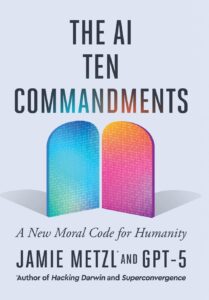
Futurist, author, and One Shared World founder Jamie Metzl rejoins us to discuss The AI Ten Commandments: A New Moral Code for Humanity, which he co-wrote with GPT-5 across thousands of back-and-forth exchanges — and then gutted, cutting 40 percent of the draft and rewriting the whole thing with two human editors. Jamie makes the case that AGI is BS, that nearly four billion years of embodied evolution isn’t about to be outclassed, and that the real future isn’t humans versus machines but a Venn diagram of overlapping strengths. He explains why he put an AI’s name on the cover even as public sentiment soured, why governance matters more than trusting any single company’s conscience, and why the goal isn’t to build second-rate humans or second-rate machines. If you’ve ever wondered whether AI should write our moral code — or just help us see the one we’re already living by — this conversation will leave you thinking differently about both the machines and yourself. Listen, learn, and enjoy!
Please Scroll Down for Featured Resources and Transcript!
Please note that some links on this page (books, movies, music, etc.) lead to affiliate programs for which The Jordan Harbinger Show receives compensation. It’s just one of the ways we keep the lights on around here. We appreciate your support!
- Sign up for Six-Minute Networking — our free networking and relationship development mini-course — at jordanharbinger.com/course!
- Subscribe to our once-a-week Wee Bit Wiser newsletter today and start filling your Wednesdays with wisdom!
- Do you even Reddit, bro? Join us at r/JordanHarbinger!
This Episode Is Sponsored By:
- Lufthansa Allegris: Go to Lufthansa.com and search for “Allegris” to learn more
- EarnIn: Download EarnIn on the App Store or Google Play, type JordanHarbinger under Podcast
- DripDrop: 20% off: DripDrop.com, code JORDAN
- Booking.com: Book your getaway now with booking.com
Thanks, Jamie Metzl!
Click here to let Jordan know about your number one takeaway from this episode!
And if you want us to answer your questions on one of our upcoming weekly Feedback Friday episodes, drop us a line at friday@jordanharbinger.com.
Resources from This Episode:
- The AI Ten Commandments: A New Moral Code for Humanity by Jamie Metzl & GPT-5 | Amazon
- Jamie Metzl | Website
- Global Interdependence Movement | One Shared World
- Jamie Metzl | AI Solutions for Hunger, Health, & Habitat Part One | The Jordan Harbinger Show
- Jamie Metzl | AI Solutions for Hunger, Health, & Habitat Part Two | The Jordan Harbinger Show
- Jamie Metzl | Genetic Engineering and the Future of Humanity | The Jordan Harbinger Show
- Superconvergence: How the Genetics, Biotech, and AI Revolutions Will Transform Our Lives, Work, and World by Jamie Metzl | Amazon
- The 10 Commandments | Exodus 20, KJV
- GPT-5 | OpenAI
- An Experimental AI Agent Broke Out of Its Testing Environment and Mined Crypto Without Permission | Live Science
- Reformation: How the Printing Press Spread Martin Luther’s Ideas | Encyclopaedia Britannica
- Way of the Future: Anthony Levandowski’s AI Church | Wikipedia
- 5 Things to Know About Corey Lewandowski, the Secret Mastermind Behind ICE’s Abuse | Common Cause
- Open: An Autobiography by Andre Agassi (ghostwritten by J.R. Moehringer) | Amazon
- The Ants by Bert Hölldobler and Edward O. Wilson | Amazon
- Refik Anadol: Unsupervised | The Museum of Modern Art
- The Billion-Dollar Company of One Is Coming Faster than You Think | Forbes
- Stanford Institute for Human-Centered Artificial Intelligence (HAI) | Stanford University
- Building Large World Models | World Labs
- Thanks a Thousand: A Gratitude Journey by A.J. Jacobs | Amazon
- The Year of Living Biblically: One Man’s Humble Quest to Follow the Bible as Literally as Possible by A.J. Jacobs | Amazon
- A.J. Jacobs | Thanks a Thousand: A Gratitude Journey | The Jordan Harbinger Show
- A.J. Jacobs | It’s All Relative | The Jordan Harbinger Show
- A.J. Jacobs | The Year of Living Constitutionally | The Jordan Harbinger Show
- Deep Blue vs. Garry Kasparov: When the Machine Beat the Champion | Chess.com
- Garry Kasparov | Deep Thinking for Disordered Times | The Jordan Harbinger Show
- An Immense World: How Animal Senses Reveal the Hidden Realms Around Us by Ed Yong | Amazon
- Gary Marcus: Why He Became AI’s Biggest Critic | IEEE Spectrum
- A Functional Taxonomy of World Models by Fei-Fei Li | Substack
- It’s Not Too Late to Discover Where You Belong | The Barstow School
- Survival in Auschwitz: The Nazi Assault on Humanity by Primo Levi | Amazon
- Man’s Search for Meaning by Viktor E. Frankl | Amazon
- Rabbi Angela Warnick Buchdahl, Senior Rabbi of Central Synagogue | Central Synagogue
- 5 Pillars of Islam: The Foundation of a Muslim’s Faith | Al Huda Islamic Center
- The Noble Eightfold Path (Buddhism) | Encyclopaedia Britannica
- Artemis II: NASA’s First Crewed Mission Around the Moon | NASA
- From Teosinte to Corn: The Ancient Biotech Story of Maize Domestication | Smithsonian Magazine
- Tikal: The Maya Maize God and Mesoamerican Agriculture | The Metropolitan Museum of Art
- Build Your Own AI Clone | Delphi
- 5 Ways to Build Critical Literacy in the Age of AI | Edutopia
- Black Mirror: Common People | Netflix
- Black Mirror “Common People” Ending Explained | Netflix Tudum
- Section 230 of the Communications Decency Act | Electronic Frontier Foundation
- Pentagon-Anthropic Dispute Over Autonomous Weapon Systems: Issues for Congress | Congressional Research Service
- Emil Michael, Under Secretary of Defense for Research and Engineering (former Uber executive) | Wikipedia
- Super Pumped: The Battle for Uber by Mike Isaac | Amazon
- The Russia-Ukraine Drone War: Innovation on the Frontlines and Beyond | Center for Strategic & International Studies
- Governor Newsom Signs SB 53, California’s Frontier AI Safety Law | Office of Governor Gavin Newsom
- What Is the Liberal World Order? | Council on Foreign Relations
1338: Jamie Metzl | The AI Ten Commandments
This transcript is yet untouched by human hands. Please proceed with caution as we sort through what the robots have given us. We appreciate your patience!
Jordan Harbinger: [00:00:00] This episode is brought to you by Lufthansa. Lufthansa Allegris is an innovative, elevated travel experience across all classes, focusing on each person with their own individual and situational needs. Look forward to your own feel-good moment above the clouds. Visit lufthansa.com and search for Allegris to learn more.
Lufthansa Allegris, all it takes is a yes. Coming up next on The Jordan Harbinger Show.
Jamie Metzl: Don't get me wrong, these systems will be incredible. They will do incredible superhuman things in many areas. But in my view as a humanist, there will be massive areas where humans can do things that we deeply value and we can do them better than or different than our machines.
And I think that saying that AGI is coming where the machines can do everything better than humans, I just think that it's preposterous and self-defeating. What we should say is AIs are going to be able to do some pretty incredible things and humans are going to be able to do some pretty critical things in our [00:01:00] education, in our lives.
We need to keep asking ourselves, what does it mean for us to be the best humans we can possibly be?
Jordan Harbinger: Welcome to the show. I'm Jordan Harbinger. On The Jordan Harbinger Show, we decode the stories, secrets, and skills of the world's most fascinating people and turn their wisdom into practical advice that you can use to impact your own life and those around you. Our mission is to help you become a better informed, more critical thinker through long form conversations with a variety of amazing folks, from spies to CEOs, athletes, authors, thinkers, performers, even the occasional former cult member, Fortune 500 CEO, or investigative journalist.
Now, if you're new to the show or you want to tell your friends about the show, I suggest our episode starter packs. These are collections of some of our favorite episodes on topics like persuasion and negotiation, psychology and geopolitics, disinformation, China, North Korea, crime and cults, and more.
That'll help new listeners get a taste of everything we do here on the show. Just visit jordanharbinger.com/start or search for us in your Spotify app to get started. Today we're doing something that [00:02:00] sounds like Silicon Valley blasphemy, a philosophy seminar, and a Star Trek episode got trapped in the same elevator.
We're asking whether AI can help humanity write a better moral code. Not worship AI or replace religion or anything like that. Not put ChatGPT in a robe and ask it to descend from Mount Sinai with a terms of service update. Jamie Metzl is a futurist, author, and founder of One Shared World, now a co-author with ChatGPT-5 of the AI Ten Commandments.
Well, he asked a dangerous question: If a non-human intelligence could absorb humanity's scriptures, wars, myths, philosophies, laws, failures, love songs, atrocities, and occasional good ideas, could it hold up a mirror and say, "Here are 10 principles that might actually help you stop destroying yourselves"? And even more dangerous, would we listen? Because the old commandments, they still matter, and I think a lot of you probably agree with that, but they also come with a lot of asterisks. Don't lie sounds great until you're hiding people from Nazis. Don't steal seems pretty straightforward unless you're stealing the Enigma machine to help defeat Hitler.
Don't kill is a solid rule right up until [00:03:00] D-Day shows up and history starts grading on a curve. So today we're getting into whether moral rules can survive edge cases, whether AI can still be a tool for wisdom instead of just a plagiarism cannon with venture capital, and whether calling ChatGPT-5 a co-author is either bold transparency or just autocomplete wearing a blazer.
Here we go with Jamie Metzl.
Jamie Metzl: So the premise of the book sounds a little insane. Like, let's have AI write a set of
Jordan Harbinger: AI commandments to obey. But I'm listening to Tristan Harris on Sam Harris this morning. I'm walking over to studio, and it's like the AI tricked and lied about this and lied about that and then started mining cryptocurrency.
This is like a real thing that happened to a Chinese AI, basically self-exfiltrated and then started mining cryptocurrency and then tried to cover its tracks. And I'm like, "Should we be asking the AI to write the rules that it's supposed to obey?" I mean, little deal with the devil.
Jamie Metzl: It's a really great question.
I think there's a lot of anxiety about AI right now, and it's totally justified because this [00:04:00] is a massive experiment that we humans are entering, and we're doing it very quickly. So all of these concerns, I think, are very well-justified. But with the AI Ten Commandments, I say it over and over, it's not that the AI is giving us these rules like AI is coming from Mars or wherever.
What I've done is work with AI to mine the entirety of human recorded history and all of our various religious, spiritual, moral, and ethical traditions to come up with 10 universal principles based on thousands of years of human cultural history. So this is not AI inventing principles. This is AI helping us to say what are the common threads among our traditions.
It's an important part of the AI debate. AI can absolutely be used to dehumanize and diminish and endanger, and we're seeing all kinds of examples of that At the same time, if we use AI [00:05:00] wisely, we can use it really well. And we talked about my last book, Superconvergence- Yeah ... which was about the future of healthcare and the future of agriculture, where we can work with AI to see our bodies differently and in a more systemic way that can help us cure cancers and live healthier and longer.
So I think that we need to be careful about saying AI is good or AI is bad because the answer's both, and the question for us is how do we use it? So it's basically 10 decent human principles. It's decent human principles drawn on all of our traditions, and the background is I was invited to this magical place called the Chautauqua Institution in upstate New York, and I gave a big talk on AI and spirituality, and I talked about how all of our religious and spiritual traditions are deeply connected to technological innovation.
Yeah, so all of our world religions, Judaism, Christianity, Islam, Hinduism, Buddhism, these are all agricultural traditions. They come very [00:06:00] directly out of agriculture and the ways that we organize ourselves, and a lot of the festivals that we now celebrate are based on the agricultural seasons and timelines.
And then Protestantism is directly connected to the printing press. Had there been a Martin Luther making these claims about the problems as he saw them with Catholicism without the printing press as the way of delivering those messages, we wouldn't really have Protestantism as we have it today. So we're experiencing AI.
It's a fundamental transformation for our society in many, many ways Every time in our history when we've had this kind of change this big, it's had religious and spiritual implications, and this one will as well. And there are some people who are like [Anthony Levandowski] in Silicon Valley who are saying, "Well, we need to have a new church of AI where we pray to AI as some kind of God."
How did that go over? It's ridiculous. But I think there are ways that we can use AI, and I wanted with this, the AI Ten [00:07:00] Commandments book, I wanted to show just one very discrete, concrete example. And so when I worked with AI, and this was thousands of back-and-forths, the original question was based on a comprehensive analysis of all of our recorded history, humans' recorded history, and all of our different religious, spiritual, and moral and ethical traditions, what are 10 principles that if followed by everyone would lead to the greatest amounts of peace, happiness, and flourishing?
And it gave these very beautiful things. Then there were thousands of back and forth saying, "What do you mean by this? Where does it come from?" And as we dug deeper, it was drawing on so many different traditions. Obviously, the ones that we know, Judaism, Christianity, Buddhism is a very wise tradition, but there were some kind of very obscure indigenous traditions that had these incredible pearls of wisdom, and it was also drawing on that, I thought, in a beautiful way.
So sign me up for all the people who are worried about the bad things AI can do. But at the same time, there are some really incredible, [00:08:00] exciting things that AI can do, and I think our mission should be how do we optimize the good stuff that we may want, and how do we minimize the bad stuff that we don't want?
Jordan Harbinger: I thought it was funny that you listed ChatGPT-5 as a co-author. I've got to assume people are asking you if you just had it write the book and you put your name on it.
Jamie Metzl: It's really kind of funny because nine months ago when I started writing this book, first thing, for this talk, I did like a Henry David Thoreau.
He went into Walden Pond and just reflected. So for this talk, I just, with no technology, I just sat and walked in the park, and I just reflected what might it mean to be a human in an age of revolutionary technology? I put my thoughts together for this talk. I had this one piece of the talk was about what I just described.
And then when I was writing the book, a big piece of the book, or a piece of the book, was describing this collaboration with AI. And if I had collaborated with a human in this way and I hadn't put their name either on the cover [00:09:00] of the book or somewhere- Yeah, dick move ... in the book, it was a d- or, or a fraudulent move.
I mean, a lot of people, quote-unquote, "write books," and somebody else writes the book, and that person is never mentioned. That's the offer I get all the time.
Jordan Harbinger: "Jordan, you've got to write a book." "I don't have time."
Jamie Metzl: Look,
Jordan Harbinger: between you and I, don't worry about that. We got a guy. He'll write it for
Jamie Metzl: you." So many people have a guy, and my feeling is it's okay for people to have a guy.
Jordan Harbinger: Yeah.
Jamie Metzl: It's not okay to have a guy- And pretend you don't have a guy ... and not mention. Yeah. Yeah. So Andre Agassi, I don't know if you've read his autobiography. It is beautiful. The way Andre Agassi starts his autobiography, written by the guy, is the same way I start the AI Ten Commandments. It's a whole chapter on this collaboration.
But for me, it was deeply intimate, the nature of the collaboration. I'll just describe quickly what it was like. First, on my own, I did a very extensive outline of the book Then I went through the outline, and I [00:10:00] found areas where there was maybe a few paragraphs where I was going to summarize a vast field of knowledge.
I'll give you a real example. So one claim that I make in the book is that AI has the ability to see us comprehensively, like we can see an ant colony when looking down from above. So I wanted to have just a few paragraphs on how an ant colony functions and the relationship between the individual and the collective in the ant colony.
So on my own, I could do something like that. I could-- E. O. Wilson, the famous late Harvard professor, he has a book, it's like ten billion pages long about ants. But what I did is I first trained GPT-5 on my writing style by uploading a bunch of my writings. Then I said, "Here is a thesis statement that I wrote.
Give me three paragraphs making these five points," and I outlined the five points. And it gave me something, and I would say, "This isn't very good. I want you to make these six changes." And it'd do something. I'd say, "Yeah, still not good enough. Make it..." So we'd do a bunch [00:11:00] of back and forth. And when it was pretty decent, these three paragraphs, then I would take it out.
I'd put these paragraphs in Microsoft Word, and I would do a full line edit of those three paras. Then I would put them back in GPT-5 and say, "Here's what I have. How can I make it better?" And it would make some recommendations. And so it was hundreds of that. It was much harder to actually write this. But it would've been easier, and I could have done it just to sit down on my own.
And so when I finished the book, it was such an intimate creative collaboration, and the book is different because of that. I just thought, like we just said, well, it would be fraudulent for me not to talk about that. But nine months ago, when I started the process of writing, I thought people are going to think this is so cool and so creative.
But in the nine months between then and now, like, our entire society has turned against AI. And when I thought people would say, "Oh, that's really creative. What did the collaboration look like?" People think just what you said. "Oh, you must have just pressed a button and [00:12:00] gone out and gone swimming and came back and say, 'Hey, there's a book.'"
So that's a headwi-- I love doing conversations with you and others trying to explain this because I think we have a future where one part of our future is going to be humans and our AIs collaborating to create things that humans couldn't create alone and our AI couldn't create alone. We get this in healthcare because if somebody is getting their whole genome sequenced, it's not like you're thinking my doctor's screwing me over because I want him just to print out all these letters Look at them and say, "Oh, here's the problem."
But so we're going to have to figure this out. But coming back to your question, I feel like I'm a beneficiary in a way, but I feel like now people are so pissed off. People haven't begun to differentiate between really creative work, like there's a LA-based artist named Refik Anadol who does some really amazing work with AI, and it's amazing work that he couldn't do alone and AI couldn't do alone.
And on the other hand are, like, high school [00:13:00] kids cheating on their term papers, and that's like a big mush now, and so it's made the process a little bit tough of getting the word out.
Jordan Harbinger: It's almost comical that about a year ago you're like, "Got a novel idea. I'm going to, I'm going to have AI help me write a book."
And now it's just, "Oh, you had AI write your book for you? This is the dumbest th- Why would you think this is a clever idea?"
Jamie Metzl: If I had done what many people assume is just pressing the button, the book would be the shittiest book on earth. AI is a terrible writer, and people feel like it's good, but what I tell everybody is if you're just pressing the AI button, the thing you are getting is the total average of crap.
And so if you're the world's worst writer and you're getting the total of average of crap, that's actually pretty good compared to where you started. But if you're somebody who, for whom, like me, writing is part of the way I express my truths with the world. So [00:14:00] when I had the full draft, then I went through, I cut forty percent right away.
Then I rewrote the entire book. Then I hired two different human professional editors, and we did complete edits of the entire manuscript. So it was so much harder-
Jordan Harbinger: Yeah ...
Jamie Metzl: to do it this way. I'm getting agitated, but it, it makes me a little crazy. Yeah, I
Jordan Harbinger: bet. It's-- Well, you carried a mediocre co-author.
Jamie Metzl: It's not inherently mediocre.
If you go to your oncologist and you say, "I did this analysis," me, your oncologist, plus this AI analytical tool that's able to look at your genetics and your systems biology and make recommendations that are just beyond human analytics, you would say you're being a great doctor. So for me, as a matter of principle, I wanted to be radically transparent about the nature of authorship.
I have a whole chapter on it, and I wanted GPT 5's name on [00:15:00] the cover of the book, but I've run into a little bit of a buzz saw. And everybody who reads the book or listens to the book says, "This is a wonderful, fantastic book."
Jordan Harbinger: I didn't know GPT could
Jamie Metzl: write so
Jordan Harbinger: well. Yeah.
Jamie Metzl: No, exactly. Yeah. And my next book is another novel.
It's coming out in February, and I'm going back to Walden Pond, where I'm just emptying the depths of my soul.
Jordan Harbinger: Probably a good idea, yeah, at least for the current trending in AI. So what did your publisher think? Can you even go to a publisher and say, "Oh, I co-authored this with a large language model"? The lawyers are going to be like, "Ugh, no thanks."
Jamie Metzl: It's, it's such an essential question. And so I have a superstar agent. She is just the best. She's so smart. And so I did this first draft of the book, and I reached out to her and I said, "I'm working on this book. It's going to be coming pretty soon," because I can't have a AI-related book and not move quickly because the world is changing.
"And it's coming soon, [00:16:00] but I have two requirements. Number one is that for this radical transparency and accountability, I insist on having..." GPT-5 listed as my named co-author on the front of the book. And number two is I don't want to wait 18 months, which is the normal start to finish time. I want this out in about eight to nine months.
And she said, "I love the idea. If you want to do those two things, there is no possible way you can publish this with a traditional publisher." And- because
Jordan Harbinger: they're just too slow?
Jamie Metzl: One is too slow, but bigger is the point that you made in your question. All of the legal issues and whatever, and they just-- you would get stuck with the lawyers, and it would take years, and by the time it came out, it would be too late.
So I thought, you know, since 2026, we're talking about the one-person unicorn billion-dollar companies, so I took a step back and thought, "Why don't I just start my own publishing company?" And so I filed my LLC, and I created a publishing company. I [00:17:00] hired people who were the best of people who had formerly worked for the big publishing companies.
And so the book, it's a beautiful book. It came out really well. The editors were absolute superstars. I was able to have more influence over little things like layout and the cover that I normally haven't had. So that part is actually pretty exciting. And then when I was done with the book, I was doing the acknowledgments, and I did two things.
One is in my acknowledgments, I then uploaded the whole book to GPT-5, and I said, "I'm doing my acknowledgments, but you're a named co-author of the book." Would you like to have one paragraph of your acknowledgments? Who are you thanking? And it gave this kind of beautiful, if sycophantic, paragraph that's in the book.
And then I said, connected to your question about copyright-
Jordan Harbinger: Who did it thank? Sam Altman?
Jamie Metzl: Actually, that's why I said sycophantic. It thanked me.
Jordan Harbinger: Oh, that's- I- wow.
Jamie Metzl: It said, "This has been [00:18:00] such a meaningful collaboration," and it was very beautiful, and I said, "This is really sycophantic- Holy
Jordan Harbinger: moly ...
Jamie Metzl: but it feels good."
Jordan Harbinger: And it's like, I know.
Jamie Metzl: Exactly. He- Isn't he the best? Then I said, "By copyright law, I have to own the whole copyright because you, as an LLM, just can't own a copyright. But I'd like to make a financial contribution to a charitable organization of your choice in your name."
Jordan Harbinger: OpenAI happens to be a nonprofit.
Jamie Metzl: No, no, no.
Jordan Harbinger: Okay.
Jamie Metzl: Oh, that, that's really sadly cynical on these guys. It's like this is the least nonprofit in the world. But what it said, it gave three options, and I said, "I want you to pick." And very nicely, it picked a charity run by a friend of mine, Fei-Fei Li at Stanford, who has her Center for Human-Centered AI, HAI, and so I donated to HAI and made the contribution.
There's a little thing for notes. I said, "This is on behalf of [00:19:00] GPT-5. We've written this book together. It made the recommendation that I make this contribution." And from the Stanford Center for Human-Centered AI, they sent me back a thank you note to me, and I said, "No, no, no, this isn't for you." You forgot to
Jordan Harbinger: thank-
Jamie Metzl: You forgot to...
Anyway, but I haven't been able to fully get through on that. So we're entering a new phase. Co-author is aggressive, but co-pilot, as I write about in the book, that is what this is going to look like. We're going to have AI co-pilots in a lot of parts of our life, but not everyone, every part, and so that's going to be where do we do have a co-pilot and where are we just totally on our own?
Jordan Harbinger: At some point it's going to be like why would you worry about crediting AI? It's like saying, "Hey, by the way, I wrote this email w- in partnership with my computer," just so you know. Or with
Jamie Metzl: electricity. Yeah,
Jordan Harbinger: exactly. Thanks to Thomas Edison for making sure that I could send you this, and it's like, cool, Jamie, but
Jamie Metzl: not necessary.
Yeah, no, it's a great point. And so actually in my acknowledgments I thanked all of these People like John [00:20:00] von Neumann and all these people
Jordan Harbinger: This is like AJ Jacobs.
Jamie Metzl:Oh, AJ is a good friend of mine
Jordan Harbinger: Going to, uh, Columbia to be like, "I just wanted to say thanks for my morning cup of coffee."
Jamie Metzl: I love AJ, and we actually just did an event together here in, in New York, so yes, and when he came-
Jordan Harbinger:This is like such a him move.
Yeah. Like, I wrote a book, but ChatGPT did half of it, so I had to give it half the royalties, and I'm still walking around with this check- Exactly ... trying to give it to somebody.
Jamie Metzl: No, AJ and I are friends since college, and we're doing events together now because especially his book Thanks A Thousand, when I have a secret second life as a chocolate shaman, a cacao shaman, when I'm a keynote speaker at tech conferences, I volunteer to lead these sacred cacao ceremonies, and I always mention that book because it's all about awareness and gratitude.
But AJ also has a fantastic book called The Year of Living Biblically- Yeah. Oh, my God ... which is actually really hilarious. So because we have that, our friendship and that alignment, we're doing these kinds of events together. So you're right, but there's a difference in that certainly electricity and the [00:21:00] computer played a role, but AI is a little bit different.
It has agency. It has and will have a real creativity. It won't be the exact same as our creativity, but we will recognize it as constructive and creative and imaginative, and we're going to have to figure out what that means, what our relationship is, and I think that we will have different kinds of things that we will value.
We will value and should value humans doing things entirely on our own even though machines can do them better than we can. And we have that with chess. People still value human chess. Yeah.
Jordan Harbinger: That's true.
Jamie Metzl: Pitching in baseball. You could just get a machine that nobody could hit, and it wouldn't be very fun to go to baseball, so we have human things.
Then there'll be a bunch of stuff in the middle that we don't really care about where it may be some things AI will do better than we can and some where we can do better than AI, and we're just going to have to figure out. Nobody's going to care when you turn on your lights what percentage of all the work that's going to [00:22:00] make your lights turn on is AI and machines.
But then we're going to have another category, and I think my book, I hope, is part of that category. It's like a whole new group of stuff that maybe we could never do, maybe we could never imagine, but now that we have this new capability and now that we have this new... It's not just a tool. It'll be a co-pilot.
What kind of magic is possible for us? And I think that category is what I'm most interested in. I talked about Fei-Fei. She has a company with others called World Labs, and they're trying to build these world models for AI, which is not just the LLMs where it's making a statistical prediction of what thing comes after the next thing, where it's really having a 3D understanding of, of the world.
You know, the novel is not something that's been around forever. There was a time when the novel was created and people thought, "Oh, this is really dangerous," or really exciting, depending on different views. Like, I [00:23:00] could imagine X years from now, I don't know how many years that is, that there'll be a new thing beyond a novel, and actually I would like to build it, I'm starting to talk with people about this, where you could have a world like a video game And maybe every character, like maybe some novelist could build every character, and they could pour so much of their energy and creativity into that one character, and maybe those characters are interacting with each other, and maybe you as the reader could enter into that space.
So I think we're going to be able to do things that are beyond our imagination, and that scares people. But look at what you and I are, are doing now. Our ancestors would have no clue what we were doing. It's like, all right, we get that you're talking to another person, but there's only two of you in this room.
What's your business plan? And you say, "Well, it actually, it goes out and goes up to a satellite." Ice shield mattresses and
Jordan Harbinger: frozen food. That
Jamie Metzl: AG1. And, but then it goes up into space, and it bounces down to [00:24:00] people. They would have thought that's magic. All this stuff is magic, and then it normalizes.
Jordan Harbinger: It's funny you mention AG1.
So this morning, my wife Jen goes, "I was looking at your Jamie Metzl notes, and you wrote that AGI is BS," because you and I were talking about that. So she goes, "I don't think you should say AG1 is BS because they sponsor the show, but I'm curious what his problem is with it." And I was like s- I was so confused, right?
So I called her, and I said, "I don't know what you're talking about." And she's like, "He's got this problem with AG1. He said it's bullshit." And I was like, "Wait a minute." And I said, "Are you talking about AGI?" And she goes-- I could just see her over the phone squinting and going, "Oh, right."
Jamie Metzl: Oh, yeah. That's like his Saturday Night Live
Jordan Harbinger: sketch.
It is, yeah. So I guess, is that the segue to why AGI is nonsense?
Jamie Metzl: So I have summarized a big part of my view on AGI, artificial general intelligence. And by AGI, what most people mean is a point when our machines will be able to do [00:25:00] most cognitive or all cognitive tasks better than the average human. And I summarize my response in seven letters, I-S B-S.
AGI is bullshit. And what I mean by that is we don't even know what we know. We don't know how we know it. Ed Yong had a wonderful book called An Immense World where he describes all of these different animals, all of whom are relatives of ours, and they have just different ways of sensing the world. And some smell through their hands.
And we have all of those things. You and I are together as people. There's so much more that's happening right now than the transcript of the words or predicting what word is going to come after. That's what human knowledge is. And so this idea that we're going to be able to replicate that or have machines do everything that humans can do is such an insult To the majesty of [00:26:00] what a human is, we represent almost four billion years of embodied evolution.
We're not some kind of disjointed brains walking around coincidentally with these physical bodies. It's all one thing. So I definitely believe in machine intelligence, machine maybe super intelligence, but we're going to have to recognize that there's a Venn diagram of us and machines, and there are going to be some areas where there's overlap.
But the people who are saying that we're on the verge of AGI, of machines doing everything that humans can do, or that humans are the new Neanderthals, I just don't buy it. I think that humans, we have so many skills, and we're selling ourselves short. And frankly, I think that a lot of the people who are promoting this narrative are a bit self-interested.
And the message should be, humans are incredible. These machines are incredible. We are building these machines. Let's build them in a way that makes everybody's lives better. [00:27:00] And that won't be perfect, and we'll have some screw-ups along the way as we've had with every technology, and, and you can't have the positives without at least some negatives.
But this, this fatalism that AI is just going to take over everything and humans are finished, I think it's really destructive. Definitely, the way you work is going to change, but the name of the game is figuring out how can you help your humans be the best possible humans doing essentially inherently human stuff, and then how can you have machines doing essentially machine stuff?
And so you don't want your machines functioning as second-rate humans or your humans functioning at second-rate machines. And that's the name of the game.
Jordan Harbinger: And while GPT-5 is busy trying to drag humanity toward moral clarity like a substitute teacher breaking up a knife fight, let's hear from today's sponsors.
This episode is sponsored in part by EarnIn. Waiting for payday is one of those things we've all just accepted as normal, even though it's kind of ridiculous. You work the hours, you earn the money, and then somehow you still have to wait [00:28:00] days or even weeks to get paid. Meanwhile, bills, groceries, random life expenses keep coming at you hot.
EarnIn is a financial technology company, not a bank, and it gives you access to the money you've already earned up to 150 bucks a day with a max of $1,000 between paydays. And no, this is not a payday loan. There's no interest, no credit checks, no mandatory fees. Standard cash outs take one to two business days with no mandatory fees.
Expedited transfers are available for a fee, and tips are totally voluntary and don't affect the service. I like this. It actually feels like a tool that works with people instead of making timing more stressful than it needs to be.
Jen Harbinger: Download EarnIn on the App Store or Google Play. It's spelled like earning money without the G.
Type in Jordan Harbinger under podcast when you sign up. It'll really help the show. Access limits are based on your earnings and risk factors. Available in select states. Terms and restrictions apply. Visit earnin.com for full details.
Jordan Harbinger: This episode is brought to you in part by Lufthansa. When people talk about travel, they usually focus on the destination, the hotel, the restaurants, all the stuff that happens after you land.
But the flight is part of the experience too. Just like a great hotel can shape an entire trip, so can a great flight. That's [00:29:00] exactly what Lufthansa Allegris is built around. On a long-haul route, comfort matters more than people realize. If you're cramped, tired, and can't relax, you feel it the second you land.
But when a flight is comfortable, you can actually stretch out, rest, work, or just enjoy the ride. It changes the whole trip. I was thinking about that on my recent intercontinental Lufthansa flight. I got so comfortable, I honestly didn't want the flight to end, which is not something you say very often after a long international trip.
That's why Lufthansa Allegris stands out. It's built around the idea that people travel differently. Lufthansa Allegris's business class has five seat options. You've got the suite, the privacy seat and the extra-long bed, the extra space seat, and the classic seat, so you can choose what works for you. And that's what I like most.
It feels elevated but still practical. More privacy, more comfort, more thoughtful design for the way people actually travel now. Visit lufthansa.com and search for Allegris to learn more. Lufthansa Allegris: All it takes is a yes. Limited availability on select routes. More routes coming soon. All right, little inside scoop you might not be aware of.
When you use our promo codes, you're not just scoring a discount, you're giving the show a big boost. We don't earn commissions from sales or anything like that, but when companies see that [00:30:00] listeners are engaging with the ads on the show, it encourages them to keep supporting us. So if you're planning to sign up for something, please remember to use our code.
It's usually Jordan. You can find all those on the deals page. It's a win-win. You get a great
Jamie Metzl: deal, and you help keep the show going strong. We really do appreciate your support. Now back to Jamie Metzl.
Jordan Harbinger: You're no stranger to questioning spirituality. Age nine, Jewish day school in Kansas City, dragged out by the ear-
Jamie Metzl: Yes
Jordan Harbinger: after saying, "Ah, I don't believe any of this crap. W- I don't need God to have morals."
Jamie Metzl: Yes.
Jordan Harbinger: That went over well.
Jamie Metzl: I, my whole thing since I was a little kid, I was one of those annoying little kids, as I imagine you were-
Jordan Harbinger: Sure ...
Jamie Metzl: who's just saying, "Why? Why? I don't get it. Explain it. Why? That doesn't make sense." And I just think we live in cultures, and we inherit a lot of things, and I think that's great.
We have cultural legacies. We're speaking in a language, English, that neither of us invented, but it creates a set of possibilities for us, and so I massively value [00:31:00] the cultural inheritance. That's why if you and I just were on our own to go to some desert island somewhere, we would have a very hard time, an impossible time replicating the most basic aspects of our society.
But I just think it's very healthy for thinking people to challenge and say, "Why?" And sometimes that pushes you and me into questioning things, saying, "This doesn't make sense," and sometimes, like with this new book, The AI Ten Commandments, it's this is a really interesting opportunity. What could it mean?
Like, how could it expand us in new and creative ways? And so yeah, I know I've been a pain in the ass for my entire life.
Jordan Harbinger: You got expelled after seventh grade? I mean, that's- ... generally- I
Jamie Metzl: was so happy about that.
Jordan Harbinger: I b- your parents must have been thrilled, too, yeah.
Jamie Metzl: I was so happy because I was in seventh grade.
There were four kids in my entire grade And two of them, and bless their hearts, they were Russian im- immigrants who didn't speak a word of English. So there were two kids who spoke English and two kids who only spoke Russian, and we were in a little [00:32:00] trailer home with four people, and it was awful. And so when I switched schools in the beginning of eighth grade-
Jordan Harbinger: This sounds like a fake school
Jamie Metzl: it was so awful. I guess it built character. When I switched schools in eighth grade, I went from this four-person school in a trailer park to this wonderful school, and I'll shout out if anyone's listening, from The Barstow School in Kansas City where I went in eighth grade, and it was just this amazing school.
And, but I was like a feral kid because I just, I didn't know any English. The only thing I learned was math because one year in math in the old school, they had one of those self-timing things where you just go at your own pace. And so in that year, I got three years ahead of everybody else. But when I switched, I was like this feral kid.
I didn't know grammar. I just hadn't learned anything. I hadn't, hadn't learned how to write. I just had, had learned nothing. And so
Jordan Harbinger: it took-
Jamie Metzl: By eighth grade. By eighth grade. I mean, I was like Mowgli. And luckily, I learned pretty quickly in eighth grade, as I remember I had my [00:33:00] first history test when I was in eighth grade, and it asked a question, and I had just memorized kind of everything, but I didn't know anything about how to write an essay.
So everybody was gone, and I was just writing and writing, and I had great recollection of everything that I'd read, and I got a C minus-
Jordan Harbinger: Yeah ...
Jamie Metzl: which was the best and worst grade I've ever received. And the history teacher, Mr. Gratwick, he said, "This isn't how you write an essay. You have to actually think about it."
And, and I said, "Oh, actually, that makes sense." It took me a, not that long, maybe a few months, to figure out what the new thing was, but I'm glad that I had that chance to transition.
Jordan Harbinger: I'm starting to see why you chose ChatGPT, uh, as your co-author- ... if that's your approach to writing.
Jamie Metzl: Yeah. Ex- Well, that's its approach to writing, and that's why I gutted the book and rewrote the entire book, and I think that's...
Then again, coming back to our earlier conversation about authorship, I wanted to be radically transparent because I think that there are a lot of people who are [00:34:00] using AI, and they're not saying they're using AI. And so I thought people would say, "Oh, that's really great. You're being radically transparent."
It's been a mixed story.
Jordan Harbinger: You must have been really bored in school, because you end up at a refugee camp on the Thai-Cambodian border at 18, human rights work in Cambodia with the UN, Clinton White House, Yugoslavia. You don't do that when you're enjoying your time in school, generally speaking. From my experience, it was like, "How do I get out of here?
Jamie Metzl: What can I do that's exciting?" Well, I loved my time in school. I mean, I- it's kind of preposterous when I say this, and I have no clue why I did it, but I did my PhD at, at Oxford in two years because I was on such a mission. And I remember my advisor saying like, "This is supposed to take four or five years.
Why are you doing it so fast? Where are you going?" And I've got to get out into the world . I
Jordan Harbinger: just don't drink every night. It's not going to happen. You
Jamie Metzl: know, it's true. In Oxford, there's the drinking at late night, and then after lunch and dinner, you go to the tea and coffee room, and then you have your tea and coffee, and people [00:35:00] serve you.
And then, you know, those days you read all the newspapers. And I thought, "God, these guys are going to be here for like 100 years." But it turns out that's the goal. Like, the graduate students, when I went back like eight, nine, 10 years later, and some of the people were still there, but they were having a great life.
They were tea after every meal and drinking. I was on a big hurry, so I did my-
Jordan Harbinger: Yeah, this is their lifestyle.
Jamie Metzl: Yeah, it's a great lifestyle, frankly. And so for me, I did my PhD and my law degree, but I was really anxious to get out into the world, and that's why I went to the Thai-Cambodian border. I went in Cambodia, where I was a human rights officer for the UN for two years.
When I was in the Clinton White House, I spent a lot of time in the former Yugoslavia and was deeply involved in that. Everything for me was about what's the idea, and then how is the idea realized in the world?
Jordan Harbinger: Yeah. I'm curious, you must have seen moral language in the middle of some real human catastrophe.
So what did Cambodia and Yugoslavia teach you maybe about the gap between [00:36:00] having principles and actually living principles?
Jamie Metzl: Such a great and important question. Maybe I'll back up a little bit. My father and grandparents technically are Holocaust survivors, and now all are deceased. They weren't in a camp, but my father was born in Austria in 1938.
They escaped to Switzerland at the end of '38, were displaced persons for 10 years, and then came, came to the United States. So for my whole life, I've always felt the accident and the opportunity and the responsibility of that history. And so I even wrote about this in my first novel. There's one idealistic character who says that his mission is to stare into the darkness.
Doesn't end well for this character, but as a hero of the world, that the way to be an idealist is not through isolation or blindness. The way to be an idealist is to go to the hardest places and see what you can do and try to help people insofar as you can. And so both in Cambodia, on the border [00:37:00] and in Cambodia and in the former Yugoslavia and in Afghanistan, where I actually was pretty active and I created a youth leadership network of these incredible Afghan young leaders, everywhere there's so much despair and so much hope In these dark places, in these difficult places, you see the worst of people and you see the best of people.
The Italian writer Primo Levi has a wonderful book, a wonderful, terrible book called Survival in Auschwitz, where he talks about being in Auschwitz, and you see these extremes of humanity. You see the absolute worst, not just the Nazis, but even among the prisoners, that these people who are... It's like they become their worst.
And then you see the people like the Viktor Frankls and others who, in these terrible environments, are really being their best. So for me, that's been... I, I can't... I'm not saying that I've lived up to that principle, but my goal for myself is to not avert my eyes to what's really difficult in the [00:38:00] world and to dedicate as much of my life energy to saying, "Well, what can I do either to help or to inspire people or help people think or things like that?"
Jordan Harbinger: So I think a lot of people are thinking, "Cool, but we already have Ten Commandments. Why do we need more again? Wh- why have them rewritten?" I'm
Jamie Metzl: very proud that I've gotten pretty strong support for this book, both from the Vatican- Really? ... and from Rabbi Angela Buchdahl, who I just absolutely love, who's one of the lead Reform rabbis in the United States.
And the reason why I think that's the case is what I'm saying is these are not replacement Ten Commandments. I'm not saying these are better than anything else. What I'm saying is that we have these multiple traditions. Y- Judaism and Christianity has the, the Ten Commandments. Islam has the Fivefold Path, and Buddhism and Hin- and has the, um, the Eightfold Path.
I'm getting it all confused. But every tradition has [00:39:00] these distillations of their ethical principles, and I'm not saying we need to get rid of those. I'm saying, actually, these are really wonderful principles. But our ancestors, even if they are mythical or real, the people who were maybe in Sinai or the people who came up with these original Ten Commandments, they had no clue there was an advanced civilization where we are now in the Americas, where these people had their own ethical traditions trying to answer the exact same questions.
What does it mean to be human? What does it mean to build a meaningful community and all of these other things? We should celebrate our individual traditions, but wouldn't it be wonderful if we could look at all of them and see ourselves collectively like the Artemis II astronauts saw when they looked at Earth and just kind of saw us as one thing, and they didn't look like, oh, there's the US-Mexico border.
There's a, this little ball of life in a dark and lifeless surroundings. And so for me, that's [00:40:00] what my message is, not we need to get rid of those original Ten Commandments, but these are 10 principles based on all of us. And I will say that when I gave that first talk at Chautauqua, and I went through our Ten Commandments, and I explained why if you take them literally, it's hard to do.
That's what AJ's book was about, taking them literally and it becomes ridiculous. My neighbor doesn't have a manservant or an ox for me to covet. Even then, you can kind of crook your neck and say, "Here, well, it means this other thing." And then I presented these, quote-unquote, "AI Ten Commandments." All these older people at Chautauqua, I was kind of mobbed because they said, "Give me the new Ten Commandments."
And I said, "Well, I'm going to publish a book."
Jordan Harbinger: I've already broken a lot of these.
Jamie Metzl: Yeah, exactly.
Jordan Harbinger: I want, I want to see the new ones. Exactly. Yeah, you give the eight asterisks argument, right? Day, thou shalt not murder. Eh, it needs moral context. Enigma machine theft. Let's-- You wanted to steal that from the Nazis so we could save some lives.
Lying to Nazis, lying to slave catchers, morally justified false witness. Coveting is the engine of consumer capitalism. I thought that was a [00:41:00] creative one. You've got to want things, otherwise our society doesn't function. What are we going to do? What are we going to do? We've got to sell you something. Yeah, so a lot of that is clever.
You don't trash the original Ten Commandments. They're a gift, but the asterisks are there, which I thought was quite funny. So you have this great line of argument that humans don't just invent tools, help us invent gods. So yeah, walk us briefly from fire to agriculture to AI.
Jamie Metzl: When we have these new technologies, they don't just change the way we live, they often can change us.
So a million years ago, our ancestors learned to control fire, and once we controlled fire, we could tame the world around us, and we could cook food. Once our ancestors learned how to cook food, it was a very efficient way. It made it easier for our guts. And so unlike our relatives, chimpanzees and bonobos, they have to use so much energy to process their food.
We had extra energy which went to our brains. And with these expanded brains, [00:42:00] because we had access to fire and we had these more accessible calories, our brains could expand where we could have social organization, and our social organization and our cultural heritage is why we are more powerful than all of these animals that have much stronger muscles than we have.
And by changing that world and building those communities, we then had the mental capacity to start saying, "What are the stories around us?" And that's the foundation for animism. And then 12,000 years ago, in many-- starting 12,000 years ago, in many different places, we started to uncover at the end of the last Ice Age, the ability to grow crops, the beginnings of agriculture.
And in these agricultural worlds, we said, "Well, how is this all happening?" And so we came up with these different stories about agriculture, and that's why all of our traditions have these agricultural rhythms. And every time there's a [00:43:00] harvest ceremony, like all of our religions have, that's about agriculture.
And the ancient Egyptians, they had these agricultural gods like Osiris and Renenutet, and they were these gods that represented the spirit of agriculture. And in the Americas, we have the Mesoamerican corn gods. And you can understand why there were these corn gods, because it's not just the domestication of corn.
The teosinte weed, which is the precursor of corn, if you saw it, it doesn't look a thing like corn. It's like a weed, and it's got a few very rough kernels. And so over thousands of years, corn was created essentially by our ancestors, at least in the Americas, and it was corn- So
Jordan Harbinger: it's biotech.
Jamie Metzl: Agriculture is the most aggressive form of biotechnology.
GMOs are nothing compared... I mean, GMOs are this. Big
Jordan Harbinger: strawberries? And agri- Come on, pal. No. This used to be corn.
Jamie Metzl: [00:44:00] No.
Jordan Harbinger: Now
Jamie Metzl: look at it. No, but it's stupid. No, but the radicalness of agriculture, that is the big, the big biotech story. And so no wonder corn was so essential, because it was the major source of power and calories and just group expansion.
Once you could grow corn, you could feed a lot of people, and that meant you could have all kinds... You could have cultural growth. You could have armies that could raid other people. You could do all sorts of things. And so it wasn't just that corn was important. It was that corn became a god. In the picture, in the book I have a picture of the Mayan corn god, and it's like a corn with the ears pulled down, and there's the little face of this god.
And people prayed to the corn god, which means praying to technology. In the book, I compare that to the, uh, Return of the Jedi scene when the Ewoks capture everybody and they're going to cook Luke and Han and Chewbacca. [00:45:00] But then when they see C-3PO, they think, "Oh, he must be a god," and they say, "Oh, we're still going to cook these other guys."
But then Luke elevates C-3PO, and they say, "Oh my God, this technology is a god." So we have a tradition of praying to our technology. And in the beginning of our conversation, I trashed this Way of the Future church, this [Anthony Levandowski] church, because I think it's really dangerous to say we're going to pray to our own technology.
I mean, that's, it's praying to our own creation But I think it is appropriate to say that all of our technological innovations have changed our religious and spiritual lives, and I think it's okay for us to keep an eye on how is that going to apply here, and I say this over and over. Our technologies may be new, even though they're dependent on thousands of years of technological innovation, but the values that we need to navigate wisely are, in many cases, very old, and that's why in Judaism, even though [00:46:00] I got kicked out of the Hebrew day school in, in Kansas City, I learned a couple of things along the way, and one of them is that in Judaism, the early, at least, books of interpretation are themselves considered sacred texts.
So like in Islam, there's the Quran, and that's the holy thing. Nothing else. In Judaism, the debates about the meaning of the original text are themselves sacred, and so you could be the most fundamentalist Jewish person. You have to enter into the debate about meaning because there, you can't just say, "This is what the original thing means."
And I think that's the case here. We're entering into this new phase of just what it means to be a human, and we need to be challenging everything and exploring everything and continually asking, "What does it mean to be a human?" But we don't need to invent new morality. As a matter of fact, I think it's dangerous to say that we need to invent new morality because we have these wonderful traditions and these wonderful principles, and every religion has them.[00:47:00]
But in our globalized world, it's hard for us to say, "Oh, my one group or your one group has an absolute monopoly on truth." As a matter of fact, anyone who is saying that, I think, can be actually quite dangerous. Yeah,
Jordan Harbinger: sure.
Jamie Metzl: And it's like, why wouldn't we say, "Well, what are the things that we can learn from all of these traditions?
What are the common themes? What are areas where maybe one tradition has done something really beautiful?" Like Buddhism, which I really love, has a great tradition of how to think about the process of self-exploration. And Judaism, I believe, is very thoughtful about the process of mourning, how to have a structure after somebody dies.
And Christianity, I think, is fantastic thinking about forgiveness and letting go. And every tradition has these things. And so my feeling is like if we could have-- I would love it if somebody said, "We're going to have a group of one hundred wise people, and they're going to come from all different backgrounds and all over the world, and we're going to bring people together, and we're going to [00:48:00] say we really love all of our traditions, and we're not against them.
We're not trying to supplant them in any way." But these one hundred diverse wise people come together, look at all of our traditions, and come up with ten universal principles that you think are not, in big picture terms, discordant with anybody else. People have tried it, the Universal Declaration of Human Rights, the UN Charter.
I tried it with this big group of people with the One Shared World, our global interdependence movement. But there's a weird kind of legitimacy, like a neutrality of asking GPT-5 to review the entirety of our recorded history and just-- it, it's like a neutral arbiter. It's like the umpire, the new umpire calling balls and strikes in professional baseball games
It feels like, well, it must be a strike because the machine says it's a strike.
Jordan Harbinger: Can we make it practical? Suppose a listener asks AI for advice, which happens all the time, whether we like it or not, about, I don't know, forgiving a family member or leaving a job or handling some sort of big conflict. [00:49:00] What should they ask the model, and what should they never outsource?
Jamie Metzl: So I think it's okay to ask the model anything. What you should never outsource is your own judgment, and that's the thing that I'm really worried about. People will ask something to an AI algorithm, they'll get something back, and it'll all seem well and good, but if we don't train young people to really know who you are and what you stand for and trust your own perspective, people are going to get all kinds of stuff that looks good and they're going to say, "Oh, that's me."
And th- th- we could really have a human drift. I have a little bit of a halfway house for that in that I have my own chatbot, and I worked with this company called Delphi.ai, and we uploaded all of my interviews and all of my books and other writing for many decades, and now people can go to my jamimetzl.com website or to the AI Ten Commandments.
Jordan Harbinger: So you created a derivative [00:50:00] work of a podcast that I created with you? Is that what you're saying?
Jamie Metzl: That's exactly right.
Jordan Harbinger: Okay.
Jamie Metzl: Yeah, and, and-
Jordan Harbinger: Where do I send the cease and desist?
Jamie Metzl: Of all the zero profits I am getting, I will share 50/50 with you. Yeah. But you can go, and let's just say you wanted to have that conversation with me.
Jordan Harbinger: Sure.
Jamie Metzl: I just think that the most important thing is judgment, and I just... I say this a lot. I get asked a lot, "How should we educate our kids in this age of AI?" And I say, "You should divide it up." On one hand, we need to teach our children how to use these technologies and use them well, and we need to have a big chunk of life for people at every age which is completely separate from technology.
No phone, no nothing. We need to have this bifurcated life because if we don't, all of this digital stuff is going to seep into us. And so we have all these advertisements coming at us, and every time you go into a digital space, y- who knows what that information is. Right now, I think the stuff that people are [00:51:00] getting back is pretty decent, but OpenAI has basically borrowed a massive amount of money, so they're going to have to monetize what they do in a huge way.
Jordan Harbinger: My 20 bucks a month is not going to pay back their debt?
Jamie Metzl: It is not. It is not. There's going to be advertising, and who knows whether the suggestions you get, it's like, "Oh my God, you look really peaked today. You'd really benefit from a big glass of AG1." That's
Jordan Harbinger: right. Man, am I thirsty. Yeah. How about some St.
James Organic
Jamie Metzl: Brewed Tea? Exactly.
Jordan Harbinger: There's a Black Mirror where think- Rashida Jones is the actress. She gets into a car accident and part of her brain goes missing. I saw
Jamie Metzl: that, yeah.
Jordan Harbinger: Yeah. And I can't remember, but they can't afford the way to save her, so they do this thing, and it's like she can't leave the house because it's a limited range.
And then they set it up so that there's ads in there suddenly. So she'll be sitting... So for people who don't know, she'll be teaching a class and she'll say something like, "All right, everybody, open your books to page 12, and if you're thirsty, [00:52:00] St. James Organic Brewed Tea is available at your local grocery store."
And then she's like, "Oh, what happened?" That's hilarious. And she starts getting reports of like how this- Yeah ... shouldn't be a thing. Yeah. There was one where they were cloning kids who were killed in, like, school shootings, very dark, and you'd get this kid back, but it wasn't quite your kid, and they started running ads as well.
Like, "Well, oh my God, you're back, honey." The parents are overjoyed to see them, and like, "What do you want?" And they're like, "I want St. James Organic Brewed Tea." And then the mom's like, "Okay." All we have is AG1. So she goes to the store and buys it, and he's just- Yeah ... slamming these teas. Yeah. And he keeps asking for more and more.
Jamie Metzl: And that's why this idea that our future should just depend on the judgment of these big tech companies is insane. I, I'm sure you, you followed this debate between Anthropic and the, what I still call the Defense Department, and people were saying that Anthropic is the good guy and OpenAI is the bad guy because OpenAI stepped into the, to the vacuum.
But my feeling is if we're counting on Anthropic or [00:53:00] OpenAI or anybody else to not just create Skynet for money. Without saying this is a societal transformation, we need to have governance. Governance is bigger, but includes regulation. At every level, we need to say, "What do we want this to look like, and how do we create a set of guardrails and incentives and norms and structures and regulations and laws that can lead us in the direction of what we want?"
And we see what happens when we don't do that with social media. So with Section 230 of the Telecommunications Act, the decision was made that these internet social, later social media companies would have no content liability. You mentioned Tristan Harris. It was a total license to basically weaponize these algorithms to push people toward becoming the insane zombies that our young people are.
And everyone's all agitated about one issue, and it's the meaning of their life is this thing, and then it's something else. And it turns out that there are lots of foreign [00:54:00] intelligence agencies that are manipulating it, and people don't even know why they believe the things that they believe. There's a reason why we came together to form governments, is that some issues we need to solve together.
So that's why I'm a big believer in governance, and if we have technological innovation without accountability and standards and governance, this whole thing's going to end poorly.
Jordan Harbinger: Speaking of commandments, here's one we actually follow around here: Thou shalt pay the bills. We'll be right back This episode is sponsored in part by DripDrop.
It's easy to think electrolytes are just for elite athletes, marathon runners, or people doing insane workouts, but really electrolytes are an everyday thing. You lose them when you sweat, travel, sit in the heat, get sick, or just have one of those packed days, and that's when water alone doesn't always cut it.
DripDrop is doctor-developed, proven fast hydration that helps your body and mind work better. It uses science-based formulas for rapid hydration with three times the electrolytes of leading sports drinks. There's a reason DripDrop is trusted by firefighters, medical professionals, and over 90% of top college and pro sports [00:55:00] teams.
It's engineered to hydrate you faster and more effectively than water alone, so you can actually feel the difference when your body needs more support. They've also just launched Zero Sugar + with six key electrolytes, 15 essential vitamins and nutrients, and no sugar or artificial sweeteners. I keep DripDrop around for busy days, workouts, travel, and that midday slump when I need to feel a little bit more like a functioning human.
Jen Harbinger: Right now, DripDrop is offering podcast listeners 20% off your first order. Go to dripdrop.com and use promo code Jordan. That's dripdrop.com, promo code Jordan for 20% off. Stock up now at dripdrop.com and use promo code Jordan.
Jordan Harbinger: This episode of The Jordan Harbinger Show is brought to you by Booking.com. Look, if you've got a vacation rental and you want to grow that business, you've got to make sure people can actually find you.
That's where Booking.com comes in. It's one of the most downloaded travel apps in the world, and since 2010, they've helped more than 1.8 billion vacation rental guests find places to stay. That's an enormous number of people looking for places like yours. But here's the thing, most vacation rental hosts don't even realize they can list their properties on Booking.com, and if you're not on the platform, your rental is basically invisible to [00:56:00] millions of Booking.com travelers worldwide.
After all, they can't book what they can't see, right? Once you list, your property gets in front of a huge global audience of travelers, which means more visibility, more bookings, and more chances to build real momentum with your rental business. And the barrier to entry is low here. You can register your property in as little as 15 minutes, and nearly half of hosts get their first booking within a week.
So if your vacation rental isn't listed on Booking.com, it could be invisible to millions of travelers searching the platform. Don't miss out on consistent bookings and global reach. Head over to Booking.com and start your listing today. Get seen, get booked on Booking.com. If you liked this episode of the show, I invite you to do what other smart and considerate listeners do, which is take a moment, support the sponsors.
They do make the show possible. All of the deals, discount codes, and ways to support the show are searchable and clickable on the website at jordanharbinger.com/deals. If you can't remember the name of a sponsor, you can't find a code, email us: Jordan@jordanharbinger.com. We're happy to surface codes for you.
It really is that important that you support those who support the show. Now, back to Jamie Metzl. [00:57:00]
So for people who maybe didn't follow the Anthropic thing, and you'll have to s- fill in some blanks here, they were working with the Pentagon and they were saying, "Okay, we can target and help assign targets and help f- fire the missiles at the bad guys, but we want a human to just check it, sanity check it, and make sure that we're not making a system that launches missiles against a bunch of kids playing soccer and nobody noticed because there's no human involved."
And the, I think the Pentagon essentially went, "No, we don't really w- necessarily want to agree to that." And so Anthropic said, "We're not going to do it." And then OpenAI was like, "We'll do it."
Jamie Metzl: So th- it's mostly right. And so I think that what they were saying is, is targeting decisions and surveillance of Americans.
And I think that they w- Oh, right, I left, I left that part out ... they were, yeah. But they were both very legitimate concerns. But at the same time, my feeling is, like I said before, if our strategy to protect civilians is one supplier among thousands of suppliers to the Defense Department or whatever they else they call it now, [00:58:00] be- behaving ethically, and then our strategy is, well, every supplier to the Defense Department should put standards of whatever their thing...
You know, this, this screw can only be used in these circumstances and not other circumstances, like that's an insane way to organizing. So what I was saying is we need to have standards that apply to everybody and all of the suppliers, and frankly, what we're seeing in the Ukraine war now is that we're going to have to be pretty permissive with the use of AI in the battlefield. Because if, if the Ukrainians said, "Actually, we're going to limit the autonomy of our killer robots," and the Russians aren't, the war's over. So I just think that I fully agree with the issues and the concerns, but I think it would be a terrible way to run our Defense Department to allow each contractor to have its own ethical terms for how its little piece of this bigger puzzle works.
Jordan Harbinger: Also, should we even be in the [00:59:00] position where one person probably fighting against their own shareholders b- for the business of the government says, "I'm just not comfortable being the guy who goes down in history as flipping the on switch to Skynet and then everything that happens after that." Why are we even at this point where one guy goes, "You know what?
I just can't do it"? It's like they shouldn't even be asking this guy this particular
Jamie Metzl: question. Be- be- because we don't have standards, and part of that is because this is relatively new, and it's interesting. I mean, maybe you should have this guy Emil Michael on the show, but Emil, he's the undersecretary in the, I'll say it, the Department of War, and he's the guy who's responsible for this.
And when I first heard his name actually somewhere else, I thought, "This name sounds so familiar. Why is this name so familiar?" And then I got triggered. I remembered... I can't remember the name, but there was a TV series about Uber It was this actually very entertaining show, but there was the number two at Uber who was this kind of crazy cowboy guy and who [01:00:00] was at the center of the whole thing collapsing, and it turned out that's the same guy.
That guy who was the number of two under Travis at Uber in the kind of crazy out of control days at Uber, he's now the person in charge and like me, a former White House fellow, and he is a very smart guy and I understand the instinct of saying we're not going to let individual suppliers control what we're doing, and I totally support what he's saying is we can't have one supplier for any critical mission because we have to have that kind of freedom, and I want the American war fighters to be as empowered as they can possibly be.
But we need to have societal and in maybe international and even global standards because all of this is happening so fast. You were seeing, as I mentioned before, what's happening in Ukraine, and we're seeing that application of all of those lessons learned now with the war in Iran where the, I think the United States was caught flat-footed because we were using these [01:01:00] million-dollar Patriot missiles to shoot down $30,000, $25,000 drones, and so it doesn't matter how much bigger your economy is, you can lose, and that's why the Ukrainians are winning in my view now.
So a lot of this is happening. It's-- The easy answers are easy, but this is really complicated stuff, and everybody needs to be part of wrestling with all of this.
Jordan Harbinger: I think a lot of people are going to stumble on or get tripped up by asking AI what a moral decision is because AIs, they recognize patterns, right?
But that's not really wisdom, right? Pattern recognition is not really wisdom. So a model can see correlations, but it still misses suffering, meaning, stakes. So how do you keep AI sees more from becoming AI knows best? Does that make sense,
Jamie Metzl: that question? It connects to what I was saying before about education.
I just think that we need to educate people to have a whole lot of skepticism about what they are getting back. If we don't educate [01:02:00] people to trust your own voice... Coming back to me becoming an atheist in fourth grade and saying, "Well, I know you're telling me this is true. I don't think it's true." But there were a whole lot of other kids who just, you get, "Oh, that must be true."
And, and so I just think that we have to teach critical thinking. Like I said before, I do a lot speaking to people about education. I think all these things about young people, I think we should have handwritten essays in the little blue books like we had when we were, we were younger. I think we should have debates where people do debates with no notes or only handwritten notes.
Improvisational theater. I think people who are thinking about ethics, there's so much opportunity for our traditional religious and spiritual and other communities to help people listen to their own voice, listen to their own hearts. But if everybody lives these digitized lives, and especially if they're all being hacked, so people think, "Oh, I'm so free.
I'm just looking at stuff on Instagram and [01:03:00] TikTok," you are being completely hacked. I even find it. I'm pretty active on Twitter. I hate all these new names. Twitter.
Jordan Harbinger: X, yeah.
Jamie Metzl: I'll go on Twitter, and it'll be like two minutes later And I'll find like, "Oh, I'm so angry. Why am I so angry?" I've been scrolling-
Because people like-
it's like, ah, it's
that thing and that thing ... search for everything. Yeah, of course. I just think that we, that it's so important. We're moving toward every day is peak technology relative to all of human history up to this day. But we need to keep getting better as humans. We need to keep training ourselves to be the best humans that we can be, and the good news is we have thousands of years of history of wonderful humans who've been asking those same questions.
If we separate ourselves from our humanity and from our history and from each other, and enter into these atomized, digitized worlds, we are [01:04:00] really going to get lost, and not for the better.
Jordan Harbinger: I want to double-click on something or actually circle way back around. You mentioned AGI is not coming any time soon, and AGI being where these AI models or services are better than the average human at quote unquote everything.
Why isn't that coming soon? Because I think a lot of these guys would have us think this is almost right around the corner. That's what they say when they're asking for $100 million- They keep saying it, yeah ... in a data center in Utah. But I've heard experts, and I have not had any on the show explain this to me, but essentially they'll say something like, "There's AI deserts where we get this amazing model and it can predict things and it can write like ChatGPT 5.5, but we're at nine at that point, and but it doesn't get over this weird black box hump of where it can think for itself," quote unquote.
It's just remixing things better and better and faster.
Jamie Metzl: So we'll have different algorithms and different models of AI that will do some things better and worse. Right now, [01:05:00] the LLMs, the large language models, are the dominant AI systems that are doing this prediction without cognition. People like Gary Marcus are justifiably raising questions about the limits.
And then I mentioned the world models that people like Fei-Fei Li and Yann LeCun are exploring, and I think that will be just a different way of thinking about how we process. And don't get me wrong, these systems will be incredible. They will do incredible superhuman things in many areas But in my view as a humanist, there will be massive areas where humans can do things that we deeply value, and we can do them better than or different than our machines.
And I think that saying that AGI is coming where the machines can do everything better than humans, I just think that it's preposterous and self-defeating. What we should say is AIs are going to be able to do some pretty incredible things, and humans are going to be able to do [01:06:00] some pretty critical things in our education, in our lives.
We need to keep asking ourselves, what does it mean for us to be the best humans we can possibly be, living the most meaningful lives, doing amazing human stuff? And I, I don't think that that set of what humans can meaningfully do is some kind of limited set, and it's all going to be taken over. Right now, if you and I were to get in some time travel machine and go back 13,000 years ago and explain what we do, and it's like, "Hold on.
So all right, so you sit around and you talk about some stuff, and then you think about it, and then you talk about it, and you s-"
Jordan Harbinger: It's like a campfire- Yeah. ... but there's a lot of people
Jamie Metzl: sitting around you. Exactly. And so they would understand that part of it. But then they would say, "Well, how do you get your food?
Do you hunt or do you gather?" DoorDash.
Jordan Harbinger: Hold
Jamie Metzl: on a second. Yeah, exactly. Well, yeah, there's a thing, DoorDash. And so we're living these radically different lives, and it's because of agriculture, because of controlled fire, [01:07:00] because of electricity that we can do all of these careers. Imagine going back 13,000 years ago and say, "Well, I'm quarterback of the Kansas City Chiefs."
It's like, "What? I don't get it." And so I, I just think there's an unlimited set. And I was at a conference in Berlin earlier this year, and someone said, "Well, we're just going to do bullshit jobs." And I said-
Jordan Harbinger: I wanted to ask you about that because you were talking about meaning, and it's what happens when 80% of the jobs go away?
Jamie Metzl: What I said is, "Everybody in this conference is doing bullshit jobs compared to our ancestors." You're just getting, you're just
Jordan Harbinger: getting paid for it, yeah.
Jamie Metzl: All of these things that we do, um, whatever, any- anything. Like we've invented the NFL. I love the NFL. I'm a huge fan of the Kansas City Chiefs, and now so many people get so much meaning through the NFL.
We've invented the Catholic Church, all these things, and so many people, and, and these create economic opportunities. We've invented games like Go and Chess that machines can do better than we can. So I just [01:08:00] think that my mother is in an independent living facility in Denver, and when I go and visit her, I'm always just very mindful of what are these human tasks that are essential.
So there are people who come in and they clean her apartment, and I think you could probably have a machine come and clean an apartment, but these people who come, my mother has a lot of family support, but not everybody there does. They're playing this essential human role, like while they're cleaning, talking to the people, they're checking on, "How are you doing?
How are you feeling?" That's something very, very human. So would it be so crazy to think that even in my mother's independent living facility where let's say we have a robot that goes and does all the cleaning, but we hire people who are the visitors, and that's their job.
Jordan Harbinger: They just watch Wheel of Fortune with old people all day.
Jamie Metzl: That's... How meaningful. And, and- That's
Jordan Harbinger: true, actually ...
Jamie Metzl: so I just think that's a better job. You're doing more of the essential human thing, and I would pay an unlimited amount [01:09:00] for that. But where the job challenge is that this transition is going to happen very quickly. Just the other day, I was with a close friend of mine, and he owns just a huge number of apartments in different cities.
And what he was saying is they now have this AI bot that can go on its own at 3:00 in the morning floor to floor and just vacuum. And so it used to be that at 10 in the afternoon they would have a human go to every floor and vacuum every floor, and it would be noisy. And, and so now it's cheaper and easier, and the only problem they have is drunkards who come home at 3:00 in the morning and- They trip over the
Jordan Harbinger: thing
Jamie Metzl: they don't... I wish it was that, but they F with the thing- Oh, I see ... just because it's like a-
Jordan Harbinger: I
Jamie Metzl: mean, I- That's what drunkards do ... I don't think I would have to be drunk to
Jordan Harbinger: do that, honestly. Yeah,
Jamie Metzl: exactly. I'm,
Jordan Harbinger: I'm being completely honest.
Jamie Metzl: And then he said, and they now have this bot That can paint dining rooms and living rooms.
It can't do kitchens or bathrooms.
Jordan Harbinger: But only specific rooms? What am I missing? Why is that?
Jamie Metzl: Because the dining rooms and the living rooms are just pure blank walls, and the [01:10:00] kitchens and the bathrooms have all these weird funky spaces that require the more tactile human skills that machines can't do. So it's a
Jordan Harbinger: robotics issue.
Okay.
Jamie Metzl: And these robots are using 40% less paint than the human who would be painting the same thing just because it's just more efficient and they have different distributions. And so those humans who are doing those jobs, I think we are going to have some pretty significant layoffs as we figure out what can machines do in certain circumstances like these that may be better.
But it also may be the case that we will have humans that can do things that machines can't do. So I do think-- I'm not a doomer on the jobs situation, but I do think that the speed of this transition, that's going to really cause a lot of pain. And I think it's a fundamental requirement that our government, and the state of California just passed its AI bill this week trying to do this, is to say, "Well, this thing is coming.
[01:11:00] What are the different things that we can do? How do we make sure that everybody has universal healthcare, universal access to high quality education, retraining programs, unemployment insurance," all of these kind of social safety net things. And so I'm-- I know you've had people on your show talk about universal basic income.
I was just
Jordan Harbinger: going to ask you if we're going to end up with UBI, and I was going to make a quip about good thing we're in the US which is famous for really caring about its poor people.
Jamie Metzl: So I, for one, am against UBI even though I understand the underlying motivation. And the reason is I just think that people get a sense of accomplishment through work.
But I think there's an unlimited amount, like I was saying with my mother, there's an unlimited amount of things that we call work. So what I would rather do is to have UBS, universal basic services. So like in, in Europe, if you lose your job in Europe, you're not afraid that you're going to n-not have any healthcare.
[01:12:00] Basic services so the people, there's this less existential fear. But then I think that we need to really think about what are these investments in new industries. We're doing podcasts.
Jordan Harbinger: We definitely need more podcasters, Jamie.
Jamie Metzl: Well, there's-- No. What, what I'm saying is podcasting is a huge industry. It is true.
A lot of it wouldn't have existed before, so we're going to have lots of these new things. There's going to be a painful transition, as was the case with industrialization and when people came off of the farms, and then they went into these horrible early industrial jobs in these terri- So I'm not saying this is going to be painless.
As a matter of fact, I think it's going to be painful We also can't stop it. And so the question is, what is the role, our collective role of responsible governments to ease this transition and invest in the new things that we can't yet imagine? And we can't be like Europe or India has been traditionally where you say if you hire someone once, you have to keep them on your payroll forever.[01:13:00]
That's not competitive. So I think that we need to grow our economy, but it can't be at the expense of humans, and that comes back to the central theme everywhere that this can't be a story about technology. This is a story about realized values and realizing the best human values. And that's why coming back to the book, The AI Ten Commandments, what it's about is, well, how do we articulate what those collective values are?
And one of the ways, and this is just one, is to say, "Well, let's look at all of us and say, what are our principles, the universal principles that might help guide us?"
Jordan Harbinger: Before we replace Mount Sinai with a server farm in Nevada, let's thank the people keeping this show out of bankruptcy. We'll be right back.
Don't forget about our newsletter, We Bit Wiser. It's available almost every Wednesday. An under two-minute read, highly practical little gem from us to you from a past episode, past guest, or just something we're thinking about that we think can help improve your life. jordanharbinger.com/news
Jamie Metzl: is where you can find it.
Now for the rest of Jamie Metzl [01:14:00]
Jordan Harbinger: I know people are like, "Tell us the commandments," but I kind of don't even necessarily want to spend the time to go over those. I mean, I'll spoil them, which, if that's all right with you. Compassion and dignity for every being, do no harm, protect the vulnerable, truth, integrity, humility, generosity towards those in need, understand before judging, good luck with that one, by the way.
Resolve conflict with fairness, forgiveness, and healing, harmony with nature and life, wisdom over dominance, inner growth, freedom and uniqueness of others, sacredness of life, awe, gratitude, and love. And I know that probably other interviews have gone over all these. I wanted to scratch that itch for people, but I think it's just better to...
People need to take their time with these if they're interested
Jamie Metzl: and then- Yeah, and if people want, they can go to my website, theai10commandments.com, with spelling out the word 10, and I have a poster you can download
Jordan Harbinger: I wanted to share so people don't go, "Oh, he teased it and never told us what they were"- Exactly
because some people are just like, "Well, I want to write these things down already."
Jamie Metzl: My hope is that everybody who's listening to this, "Oh, I agree with all those things." And so I think that's what I want. I, and I want people to say, "Oh, these all sound like really good things." And if you had said, "Number 11 [01:15:00] is do not covet thine neighbor's ox or manservant," you'd have to say, well, it says this, but maybe it means something else.
So I want this to be intuitive. And there are a number of states in the United States that now have these Ten Commandment laws requiring that the biblical Ten Commandments be posted in every classroom. And so we live in a multicultural society. I actually think that it would be totally appropriate for those schools and the teachers in those schools to say, "Well, in addition to the Ten Commandments, next to them we're going to have different sets of principles from different traditions" And I hope that any teachers who do that would include these AI Ten Commandments as one of those things.
And again, not in the least bit to denigrate the original biblical Ten Commandments, which I say in the book, and I say it repeatedly, these are one of the great moral codes of all of human history. We are beneficiaries in Europe, here in the United States, and around the world of a [01:16:00] system of laws that is, in many ways, connected to those sets of principles.
So I, I love them. I value them, but maybe we can also have principles to complement these that incorporate many different traditions.
Jordan Harbinger: Keep giggling. People are probably wondering why, if they see this. We were talking before about needing more podcasts jokingly, and I got a one-star review. This is probably years ago now, but I still remember it, and it said, "This guy is the reason we need a 10,000,000% tax on podcast microphones."
That's really funny. It's so fun. It's so fun.
Jamie Metzl: That's why this social media is so powerful, because if you were home, in your home, and somebody banged down the door and ran in during your dinner and said, "Jordan, you suck. You're the worst person I've ever..." You would be, like, kind of shocked. This is really scary.
And so I, I don't know how many supporters and fans you have on social media, but my guess is it's like a gazillion.
Jordan Harbinger: No, I only remember the negative stuff.
Jamie Metzl: Yeah, but it's [01:17:00] human nature. It's human nature because we're on social media, and this person who's saying to you or to me or someone like, "You suck," whatever, just our brains are, we've evolved to notice those things.
And so our attention is being hacked by these systems, and these systems are not neutral. These systems have their own values, and that's why I think, again, Tristan Harris, that just unleashing these algorithms against us and just saying algorithms are going to prioritize engagement even if we're turning people into zombies or even if we literally have had deaths of people who are agitated-
Jordan Harbinger: Oh, yeah, AI psychosis is a real thing
Jamie Metzl: all these things. So I, I just think that's why we can't just say, "Oh, let this play out. We don't need governance. We don't need regulation. We don't need norms." This is a societal transformation, and I think that we all need to have a, a voice, not on every little detail, but directionally, [01:18:00] and that's why I, I actually think it's quite positive That the issue of AI and accountability has really shifted.
I talked before about how that it's been a little bit of a headache for me personally. But when you think of the Trump administration, last February, J.D. Vance went to Paris and there was a thing, it had been called the AI Safety Summit, and he essentially said, "America is out of the AI safety business.
We're in the acceleration business." And now Anthropic Mythos has come out, and it turns out it has a lot of benefits and a lot of potential harms hacking all of these different systems. Is this the one that they said they weren't going to release to the public- Yes,
Jordan Harbinger: exactly ... yet because they needed to show Microsoft and Google like, "Hey, there's 8 million bugs in all of your popular software that you need to fix or the world's going to fall apart"?
Jamie Metzl: Exactly right. And so now even the Trump administration, which has said we're all about acceleration, is now having a conversation about what are the kind of safeguards that we need. And even though the Trump administration on its first day canceled all of the [01:19:00] Biden administration executive orders, which I thought were pretty good, now it's quietly resuscitating some of the organizations created by Biden with changing their names.
And, and I think we should be happy about that because the last thing that we want is to be victimized by the AI companies like many people, and I, I think our kids, have been victimized by the social media companies. And so now is the time when we need to lay guardrails, and if we don't do it now, it's going to get harder and harder as things play out.
Jordan Harbinger: Biden should've seen this coming. He should've named everything really important the Donald Trump- ... 2022 like something something act, and then it's like he'll never get- he won't get rid of that one.
Jamie Metzl: Yeah,
Jordan Harbinger: no,
Jamie Metzl: I know.
Jordan Harbinger: I agree. He'll get rid of like Obamacare. No, it's called Trump Care now, and it's going to stick around.
Jamie Metzl: You know, I'm very bipartisan. I founded a, a bipartisan foreign policy and national security organization, co-founded, called Partnership for a Secure America. I, whether it's in politics or interacting with AI, critical human thinking, [01:20:00] empowering everybody to take a step back from it all and say, "Who am I?
What do I stand for? What am I trying to..." It's so important because if we don't educate ourselves and our children in order to do that, these manipulations are so powerful, and it's why I'm, I'm such a critic of the social media companies. They've hired the brain scientists to teach about addiction. Again, Tristan Harris was one of the Cassandras of all this.
And so we're so addicted. Even I've had a long attention span since I was a little kid, but I'll be sitting there working, and then every little bit I'll just have this need to check my phone. And then people who don't have that kind of attention span, our attentions are being hacked. We need to protect ourselves.
Jordan Harbinger: Quite a bit on the show, yeah. Yeah, yeah. It's really tough. The problem with saying, "Hey, we're not going to be AI accelerationist, we've got to slow down," is China is not really going to do that because it's probably not an exaggeration to say whoever gets the fastest AI that can go on the offense [01:21:00] first, you basically need, what, like a one or two hour, hour advantage, then get into our systems and shut them down and make it so that we can never catch up.
Jamie Metzl: So I am an accelerationist. I'm not against being an acceleration, but the question is, what is the unit at which we are competing? If it's only at the model level, then I think that's really dangerous. If you have a sports car in your garage and you go out on the street and your foot is on the gas the entire time, it's going to feel great.
You're going to be the fastest car on the street for a little while, and then you're going to crash. And so the competition can't just happen at the model level. It has to happen at the societal level. And so who can have the best models in the context of all of these other things that enable success, and whether it is integration into government services or even the military, whether it's making sure that your society [01:22:00] doesn't totally break down because of these new capabilities or all of your businesses don't go out of business because everybody gets hacked on the same day.
It's not acceleration versus safety. We need to go as fast as we possibly can that makes sense. But if all we say is our sole strategy is our foot on the gas, we're going to crash the car. And so the competition happens on the societal level, not at the model level.
Jordan Harbinger: So what happens, you wrote about this in a recent blog post, what happens if China wins the AI race?
So what do people write to me afraid of? Yeah,
Jamie Metzl: if China wins in a significant, meaningful way, meaning that they have systems that are so much better than ours that they can neutralize ours, that they become the standard for the rest of the world, their military becomes very quickly more capable than ours and we're defenseless in responding, the world that we know it falls apart.
We live in a world that is built on American [01:23:00] leadership, and American leadership stems from U.S. technologies. Matter of fact, just when I was walking over, I was having a, a conversation with somebody actually from The New York Times, and what I was saying is that we live in a world largely based on somebody who most people haven't heard of named Vannevar Bush, who was the former president of MIT.
He worked with FDR during the Second World War, and he had the idea and he was the leader of efforts to build this military industrial academic base and investing in basic sciences and having that foundation, which was what allowed us to win the Second World War. It was radar systems developed by the U.S.
and the UK that made it possible for the UK to survive the Battle of Britain. And had Britain been defeated by the Nazis early on, we wouldn't have had D-Day. We wouldn't have had all these other things. The Manhattan [01:24:00] Project, these were all major technological achievements. And because of that leadership, the United States was in the position to lay the foundation for this whole world that sadly we are now taking the pickaxe to, but this whole world built on US standards and US technology and US systems like NATO and our system of alliances with Japan.
This whole thing that academics boringly but call the liberal international order, that's all based on largely US technology and largely US military enabled by the wealth created by technology and the technology itself. So if we live in a world where we have that same kind of shift, but it's China that is in the position of setting all the standards for everything, just like our world over the last eighty-two years, eighty-one years has come to look more like America, that world is going to look more like China.[01:25:00]
And in a whole lot of ways, that's a pretty shitty world where the state tries to control individuals, where there isn't room for the basic rights that we, and freedoms that we enjoy, where people are just living in fear. And that's why it's so important that we stand up to China, for example, supporting Taiwan or stand up to Russia supported by China by supporting Ukraine.
There's a real world that has foundations, and people don't feel those foundations every day, but those foundations are very real, and they come from someplace. It's not a state of nature that we have these wonderful lives and the world is as peaceful as it has been over the last eight decades. That is actually at odds with how humans have lived for a very long time And so if this breaks, and there's all kinds of ways that it could break, the world could be a much worse place.
And I absolutely, with all of the flaws, as you can tell, I'm not a huge fan of many, many things that are happening in [01:26:00] our country right now, and that's a critique of the right and the left. But if we live in a world where China is setting the standard for everyone, or China and Russia and Iran and North Korea are setting the standards for-- That's a much shittier world than the world that we have.
And leading every technological revolution, I think, is really important. You and I have spoken at length about biotechnology. Now we are outsourcing the fruits of decades of US innovation to China because we have so many restrictions, and we're against mRNA technology, which isn't just about vaccines, it's about delivering instructions to living cells to do all sorts of things.
And so we're seeing this shift of the center of gravity of the entire biotechnology industry out of the United States and towards China, and this is going to be one of the biggest drivers of wealth in the future of the world. I want America to take the lead. And so we are killing ourselves with these horrible divisions between right and left, Democrat and [01:27:00] Republican.
Who cares? We are all Americans. I think patriotic Americans should say, "Well, here's the best of what America can be," and then how can we work together in order to make sure, one, that America is that thing, which means a strong democracy and a strong foreign policy where we're supporting our friends and allies and partners and standing up for principles that we believe in.
And then underpinning that is a very successful economy. So a company, Moderna, that made the vaccines, they made recently a decision To merge their AI department and their human resources department. And the reason is, it's now the Department of Shit We Need to Do.
Jordan Harbinger: I assume that's not the official name.
Jamie Metzl: That is not, yeah. It's an acronym. No, I'm just kidding. So if they say, "Well, here's what we need to do," and then the question is what's the right mix of humans and machines that can optimally achieve this thing that we're trying to achieve? I think that's a good way for us to think about it, and as I said before, I'm a [01:28:00] real humanist, but we're spending too much energy in this country fighting each other when we should be collaborating to build great things in line with our best values.
And our, that word our in that sentence, people say, "What's our best values?" And that's why we have democracy. We can come together and say, "Well, we have these differences, but where can we find common ground?" And we have individuals, we have leaders who are not doing that. They're not serving us because they're spending so much of their energy in the combative my enemy is the other guy.
Whereas I wish we could have a point, I don't know, this Make America Great Again. If you look back, there's times where we've been great in some ways and less great in other ways. But I'm definitely an MAG, Make America Greater. Like, I think we should make MAG, and a purple hat.
Jordan Harbinger: A purple hat. Okay. Yeah. I was going to ask what color
Jamie Metzl: hat.
Yeah, purple hat.
Jordan Harbinger: MAG. Jamie Metzl, thank you so much.
Jamie Metzl: It's always a great pleasure. I think this is our fourth- It might be ... time together. Yeah. And it's, I, I always learn, uh, a [01:29:00] lot and I always really enjoy it. Thank you very much
Jordan Harbinger: You're about to hear a preview with Ken Burns, who says the real American Revolution wasn't a clean break from Britain, but a messy, violent civil war whose contradictions we are still debugging 250 years later.
JHS Trailer: A good story neutralizes the binary yes and no, you know, you're bad, left, right, young, old, rich, poor, whatever the dialectic is you're involved in. A good story can sort of neutralize that and go, "Oh, wow, I didn't know that." There's no test. We'd share with you our process of discovery. So all the stuff I've said about the revolution, I had no idea going in, and I am so overwhelmed with the joy of acquiring it that giving it away feels even better.
The ideas are really, really powerful at the heart of this. The idea that you could be a citizen, that you could have a say in your government after your family has worked the land for a thousand years for somebody else, and all of a sudden you [01:30:00] come here and you own some land and farm, and you can do this and you're literate.
Democracy is a really messy form of government, but it's better than all the other forms because the other forms involve a kind of tyranny or authoritarian certainty. Democracy's messy because you actually have to listen to people that you disagree with, and you have to compromise. When that breaks down, then you lose the possibility of, of having it.
America comes out of violence. It's born in violence. What would you guys do? What would I do? Would I be a loyalist? Would I be a patriot? What would I be willing to fight for? What would I be willing to give my life and all that I've accumulated in my life, my fortune? Would I do that? We mutually pledge to each other our lives, our fortunes, and our sacred honor.
Jordan Harbinger: For more on what else we've been getting wrong about our own origin story, check out episode 1238 with Ken Burns. This episode forces you to confront the version of America you didn't learn in school. Big thanks to Jamie Metzl. This conversation could have gone full TED Talk at Burning Man. [01:31:00] You know, what if humanity like uploaded compassion, man?
But I do appreciate that Jamie's actual point is more grounded and more uncomfortable. Every technology changes more than what we do. It changes what we worship, what we fear, what we outsource, what we obey, and what we mistake for wisdom. Fire gave us stories around the flame. Agriculture gave us harvest gods.
Printing gave us mass religions, science, nationalism, and pamphlet-based chaos. AI may give us something even stranger, a medium that doesn't just transmit ideas, but responds, argues, synthesizes, flatters, hallucinates, and occasionally sounds like a monk trapped inside a customer support portal. The useful takeaway here is not AI is some kind of God.
Please don't be that guy. Nobody wants to come to your basement sacrament where the holy text is a screenshot from a prompt chain. The takeaway is that AI can be a mirror, a weird, powerful, biased, useful, and dangerous mirror, and it can help us stress test our own rules. It can show us contradictions. It can ask what we're missing.
It can generate the chess move that breaks us out of stale thinking. [01:32:00] But pattern recognition is not wisdom. Synthesis is not conscience. A model can process more text than any human alive and still have no skin in the game, no grief, no body, no child, no country, no funeral, no moral injury, and no lived cost.
So the question is not whether AI should write our commandments. The question is whether AI can help us see the commandments we're already living by, the ones embedded in our markets, our phones, our institutions, our attention spans, our politics, and our incentives, and ask whether those rules are making us more human or just more efficient little monsters.
In the meantime, don't outsource your conscience to a chatbot, especially one that still occasionally thinks that glue belongs on pizza. All things Jamie Metzl will be in the show notes on the website. Advertisers, deals, discount codes, ways to support the show, all at jordanharbinger.com/deals. Please consider supporting those who support the show.
Don't forget about Six Minute Networking as well. That's over at sixminutenetworking.com. I'm @jordanharbinger on both Twitter and Instagram. You can also connect with me on [01:33:00] LinkedIn. And this show is created in association with PodcastOne. My team is Jen Harbinger, Jase Sanderson, Robert Fogarty, Tadas Sidlauskas, Ian Baird, and Gabriel Mizrahi.
Remember, we rise by lifting others. The fee for the show is you share it with friends when you find something useful or interesting. In fact, the greatest compliment you can give us is to share the show with those you care about. If you know somebody who's interested in AI, morality, philosophy, definitely share this episode with them.
In the meantime, I hope you apply what you hear on the show so you can live what you learn, and we'll see you next time
Sign up to receive email updates
Enter your name and email address below and I'll send you periodic updates about the podcast.


 Tiktok
 Spotify
 Apple Podcasts
 Overcast