





Mind Your Body author Nicole Sachs explains how pain is your brain’s alarm, and why facing buried feelings can reverse symptoms once thought permanent.
What We Discuss with Nicole Sachs:
- Pain is the brain’s protective alarm, not a malfunction. The brain can both create and remove pain. It generates real symptoms to force you to slow down and stop returning to environments it has flagged as unsafe.
- Symptoms are real, but the source may be misdiagnosed. Chronic pain, IBS, migraines, fatigue, and long COVID aren’t imaginary, but the nervous system — not the body part being treated — is often where the real trouble originates.
- A nervous system stuck in fight-or-flight produces physical illness. When the brain perceives constant “predators” — a hostile boss, money stress, unresolved trauma — it stays in survival mode, driving inflammation, muscle spasm, and nerve pain.
- Repressed emotion is read by the body as a threat. When difficult feelings go unseen and unfelt, the nervous system treats them as a predator — surfacing as flares, migraines, or chronic conditions long after the original event.
- You have far more power to heal than you realize. By learning the neuroscience and processing buried emotions through tools like JournalSpeak, people teach the nervous system it’s safe — and many reverse chronic symptoms once thought permanent.
- And much more…
Like this show? Please leave us a review here — even one sentence helps! Consider including your Twitter handle so we can thank you personally!
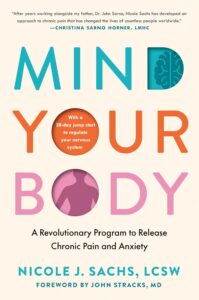 If you suffer from chronic pain, migraines, IBS, fatigue, long COVID, or other mystery symptoms that send you from specialist to specialist while every test comes back clean, this episode is a must-listen. When it comes to addressing the body’s distress signals, we tend to treat the alarm that’s screaming on the wall while the actual fire rages somewhere else entirely. The nervous system, it turns out, can keep sounding emergency signals long after the danger has passed, mistaking a backlog of unread emails for a saber-toothed tiger and your buried grief for a predator at the door.
Nicole Sachs, LCSW, is a psychotherapist, co-author of Mind Your Body: A Revolutionary Program to Release Chronic Pain and Anxiety, and the creator of chronic pain tracking tool JournalSpeak, and she’s spent 25 years watching people reverse symptoms that medicine called permanent. Nicole makes a careful, science-grounded case that the pain is absolutely real — the question is whether its source is always where we’ve been told to look. She walks through how a nervous system stuck in fight-or-flight produces genuine inflammation, spasm, and nerve pain, why repressed emotion gets read by the body as a threat, and how facing those feelings on the page can teach your system it’s finally safe. If you’ve ever been told you’re perfectly healthy while feeling anything but, this conversation offers a genuinely different place to look — and real reason for hope. Listen, learn, and enjoy!
Please Scroll Down for Featured Resources and Transcript!
Please note that some links on this page (books, movies, music, etc.) lead to affiliate programs for which The Jordan Harbinger Show receives compensation. It’s just one of the ways we keep the lights on around here. We appreciate your support!
- Sign up for Six-Minute Networking — our free networking and relationship development mini-course — at jordanharbinger.com/course!
- Subscribe to our once-a-week Wee Bit Wiser newsletter today and start filling your Wednesdays with wisdom!
- Do you even Reddit, bro? Join us at r/JordanHarbinger!
This Episode Is Sponsored By:
- The Cybersecurity Tapes: Listen here: thecybersecuritytapes.com
- AT&T: Get an iPhone 17 Pro for $0: att.com/iphone or visit an AT&T store for details
- IQBAR: 20% off: Text “Jordan” to 64,000
- Booking.com: Book your getaway now with booking.com
Thanks, Nicole Sachs!
Click here to let Jordan know about your number one takeaway from this episode!
And if you want us to answer your questions on one of our upcoming weekly Feedback Friday episodes, drop us a line at friday@jordanharbinger.com.
Resources from This Episode:
- Mind Your Body: A Revolutionary Program to Release Chronic Pain and Anxiety by Nicole J. Sachs, LCSW and John Stracks, MD | Amazon
- The Cure for Chronic Pain Podcast | BreakAwake
- JournalSpeak | BreakAwake
- Nicole Sachs | BreakAwake
- Nicole Sachs | Instagram
- About Adverse Childhood Experiences (ACEs) | CDC
- How Therapy, Not Pills, Can Nix Chronic Pain and Change the Brain | University of Colorado Boulder
- Bodily Maps of Emotions | Proceedings of the National Academy of Sciences
- Overprescribed: High Cost Isn’t America’s Only Drug Problem | STAT
- Fibromyalgia: What It Is, Symptoms & Treatment | Cleveland Clinic
- What Does Fight, Flight, Freeze, Fawn Mean? | WebMD
- Stress Effects on the Body | American Psychological Association
- Repression as a Defense Mechanism | Simply Psychology
- What Is Central Sensitization and How Does It Relate to Pain? | Mayo Clinic Press
- Psychophysiologic Symptom Relief Therapy for Post-Acute Sequelae of Coronavirus Disease 2019 | Mayo Clinic Proceedings: Innovations, Quality & Outcomes
- The Impact of Stress on Pain | The Physiological Society
- Spondylolisthesis: What Is It, Causes, Symptoms & Treatment | Cleveland Clinic
- Healing Back Pain: The Mind-Body Connection by John E. Sarno | Amazon
- The Nocebo Effect: History and Contemporary Applications | Mayo Clinic Press
- Jo Marchant | Placebos and the Science of Mind over Body | The Jordan Harbinger Show
- Placebo & Nocebo Effects | Skeptical Sunday | The Jordan Harbinger Show
- Effect of Opioid vs Nonopioid Medications on Pain-Related Function in Patients With Chronic Back Pain or Hip or Knee Osteoarthritis Pain: The SPACE Randomized Clinical Trial | JAMA
- Systematic Literature Review of Imaging Features of Spinal Degeneration in Asymptomatic Populations | American Journal of Neuroradiology
- Emotional and Physical Health Benefits of Expressive Writing | Advances in Psychiatric Treatment
- What Are Emotional Flashbacks? Plus Coping Methods | PsychCentral
- Rachel Zoffness | Managing Pain in Your Body and Brain | The Jordan Harbinger Show
- Researchers’ Novel Mind-Body Program Outperforms Other Forms of Treatment for Chronic Back Pain | Beth Israel Deaconess Medical Center
- Re-evaluating Red Flags for Back Pain | American College of Emergency Physicians
- Putting Feelings Into Words Produces Therapeutic Effects in the Brain | UCLA Health
- Emergency Rooms Are Less Likely to Give Female Patients Pain Medication | Science
- Adverse Childhood Experience Is Associated With an Increased Risk of Reporting Chronic Pain in Adulthood: A Systematic Review and Meta-Analysis | European Journal of Psychotraumatology
- Comparison of Spinal Fusion and Nonoperative Treatment in Patients With Chronic Low Back Pain: Long-Term Follow-Up of Three Randomized Controlled Trials | The Spine Journal
- That Chronic Pain Is Not All in Your Head, but the Solution May Not Be in Your Body, Expert Says | CNN
- Trauma Processing: When and When Not? | Psychology Today
- The Real Power of Placebos | Harvard Health
- Nets’ Michael Porter Jr. Says Psychotherapy Played Key Role in Overcoming Early Back Injuries | Yahoo Sports
1337: Nicole Sachs | How Your Nervous System Might Be Keeping You Sick
This transcript is yet untouched by human hands. Please proceed with caution as we sort through what the robots have given us. We appreciate your patience!
Jordan Harbinger: [00:00:00] Welcome to the show. I'm Jordan Harbinger. On The Jordan Harbinger Show, we decode the stories, secrets, and skills of the world's most fascinating people and turn their wisdom into practical advice that you can use to impact your own life and those around you. Our mission is to help you become a better informed, more critical thinker through long-form conversations with a variety of amazing folks, from spies to CEOs, athletes, authors, thinkers, and performers, even the occasional drug trafficker, economic hitman, gold smuggler, or hostage negotiator.
And if you're new to the show or you want to tell your friends about the show, I suggest our episode starter packs. These are collections of some of our favorite episodes on topics like persuasion and negotiation, psychology and geopolitics, disinformation, China, North Korea, crime and cults, and more.
It'll help new listeners get a taste of everything we do here on the show. Just visit jordanharbinger.com/start or search for us in your Spotify app to get started. Today on the show, what if your body isn't broken? It's just running a terrible emergency response protocol. You've got chronic pain, anxiety, [00:01:00] IBS, migraines, fatigue, long COVID, mystery symptoms, normal test results, and a doctor shrugging at you like, "Good news, you're healthy.
Bad news, you're still feeling miserable all the time." Today we're talking with Nicole Sachs, LCSW, psychotherapist, author of Mind Your Body, and creator of JournalSpeak about the idea that the brain can generate very real physical symptoms as part of a protective response. And before you throw your earbuds across the room because this sounds like I'm telling you it's all in your head, but with better lighting, that's exactly what we're going to challenge here, because the pain is real.
The symptoms are real. The question is whether the source is always actually where we've been told to look. We'll dig into how stress, trauma, emotional suppression, and a nervous system stuck in fight or flight can keep the body sounding alarms long after the house has stopped burning. We'll also ask the uncomfortable questions.
Is this science or spicy placebo? When is journaling useful and when is it just trauma fan fiction with a nicer notebook? And how do you know you're not ignoring something serious while trying to feel your feelings like a hostage in a wellness [00:02:00] retreat? So if your body's been acting like a smoke detector screaming at burnt toast, this one might help you figure out whether there's a real fire or whether your nervous system just needs to stop treating your inbox like a saber-toothed tiger.
Here we go with Nicole Sachs. Thanks for joining me on the show.
Nicole Sachs: Thanks for having me.
Jordan Harbinger: Yeah, of course. Now, I'm going to take so much flack for some of the things I'm pushing back on because I was talking with Stacy, who runs the studio here. Save your hate emails till the end because there's going to be a lot more you're going to want to write in about, but we're adults, right?
We all know people that we think are a little bit, like, kooky, and I happen to notice that a lot of people who have chronic pain that's undiagnosable or, like, falls into some mystery category, they also have, like, 10 other things. But then when you get to know them, they have a lot of horrible things that have happened to them maybe during childhood.
The scientist in me says, "Hey, look, correlation is not causation," but at some point I go, "Why is it that somebody who has 10 autoimmune disorders and 10 different chronic pain things and [00:03:00] 10 things over here also has a lifetime of trauma? Is that a coincidence?" It starts to look like not so much.
Nicole Sachs: I would definitely say it's not a coincidence because there's so much to look at when it comes to health.
But one thing that I really focus on is, more than anything, is slowing down and looking at the human animal, not just the human body, the human mind-body, and how it functions optimally. And how we function optimally is that we are regulated, right? We're not super stressed. We're not stuck in fight or flight.
We are able to pause and not react to life. We can respond, not react. It affects our relationships. It affects our ability to make money. It affects our ability to sleep, and it probably affects our ability to even eat healthily because when you're super stressed and you're not pausing, you're just going to grab whatever crap is in front of you.
So all of health [00:04:00] kind of needs to be seen, in my experience, through neuroscience and through nervous system regulation, and why are we all so intense and stressed and neurotic? And so when you look at someone who has a laundry list of issues, trust me, I have been doing this for 25 years, so I've seen it all.
Oftentimes it does track back to what has happened in your life, and there's ACEs studies and all sorts of things that track
Jordan Harbinger: ACEs is a adverse childhood experience?
Nicole Sachs: Exactly. And many, many people who have multiple chronic illnesses also score high on the ACEs scale.
Jordan Harbinger: I want to be really clear. I'm not saying, "Oh, they had a traumatizing experience in their life, so now they're imagining that they're in pain about something like their back."
I don't think they're imagining this at all. I don't think people can imagine insomnia either. These things are happening to them, but I just wonder what causes it. And I know that doctors also wonder because I know pain doctors that are like, "Yeah, we just don't know [00:05:00] why some people have chronic neck pain even though they've been doing physio for a decade, and they don't sit all day.
They're active. What's going on here?" And it's like, well, it couldn't be because I was raised by abusive narcissists. And it's like, I don't know. The causation part is hard because, like, why would your parents ignoring you turn into neck pain when you're 60 or 30? Why would that happen? But it's like, man, that's...
Sure know a lot of people that have a bucket list of symptoms like that
Nicole Sachs: So let's start with the most basic things that people already believe, because that is one way that I start to debunk anything that people could confuse me to say as, "The pain is in your head. You're making it up. You're hysterical.
You're oversensitive." These are things that have blocked people from healing for decades because it is a misunderstanding of any kind of mind-body medicine or anything rooted in neuroscience or anything that mentions the mind, emotions, or anything, immediately people go to, "No, no, no, you don't understand.
I [00:06:00] can't stand up, my back is so bad." Or, "You don't understand, my IBS is so bad, I'm down to three foods and I still can't be 10 feet from the bathroom."
Jordan Harbinger: That's exactly what I'm talking about. And my friend's mom developed IBS at a later stage in life, and it happened just so coincidentally happened right after her, the father left the family right after they had emigrated to America and she was a single mom in a foreign country with no education and no job, suddenly gets IBS.
And it was like, well, obviously it's a stress response, and doctors were like, "Nope, it's just a coincidence. We don't know what causes this." And it's like, dude, again, correlation is not causation, but how much does this have to hit you in the face for it to be obviously related to this? Come on, man.
Nicole Sachs: Exactly.
When I help people understand what's going on, the first thing I say to them is, "What I'm teaching you, you already believe. Let me show you."
Jordan Harbinger: Yeah, try it, because I'm highly skeptical. I'm like, "Okay, get out of here."
Nicole Sachs: I love that because I love a skeptic because it gives me an opportunity to really talk about this slowly and [00:07:00] carefully so people have the opportunity to change their own lives.
Let's face it, we're in a society where we are taught to give away our power. We're a take a pill society, go to this specialist, try this alternative treatment, and then when you're really, really desperate, try this ultra alternative whatever, which-
Jordan Harbinger: Go to ayahuasca in the jungle.
Nicole Sachs: Well, I mean, I'm not here to judge anything.
I'm just saying- That
Jordan Harbinger: one, it might actually work for some people.
Nicole Sachs: I'm not willing to puke all night, so maybe I'm not the best candidate, but I'm not saying- Yeah, my producer
Jordan Harbinger: loves it ...
Nicole Sachs: I'm not saying that people don't have amazing experiences. But what I'm saying to people is we are bred to give away our power, and it's not because we are weak or we don't research.
It's truly a societal paradigm that I seek to shift, because I could lecture to a room of 1,000 people and I could say, "Okay, okay." Everybody raise your hand if you've ever gotten a headache because it's been an overwhelming day, your kids are this, your boss is this, your partner's this, it's a long freaking day, and you get home at night and your head [00:08:00] is pounding.
Every single person in the room is going to raise their hand. And I say, "Okay, keep your hand up if you ran to the ER that night for a CT scan of your brain because you were certain you had a brain tumor." No. Everybody laughs, all the hands go down, and I say, "Okay."
Jordan Harbinger: Well, the neurotic person was too shy to raise their hand.
They did that, the one in a thousand.
Nicole Sachs: Maybe there is a person that has felt the need to do that, but probably it's after weeks or months, right, of these headaches. So I say, "Okay, I need to take this one moment of clarity to tell you that what I'm teaching you, you already believe. An emotional stimulus Stress, overwhelm, everybody's annoying, causes a physical reaction, a headache.
And I'm like, "Okay, stay there." Who's ever heard of a comedian that is about to go on stage and they run to the bathroom and throw up? Everybody.
Jordan Harbinger: Eminem,
Nicole Sachs: right? E- exactly. Ex- Mom's
Jordan Harbinger: spaghetti.
Nicole Sachs: Exactly. Okay. It's fine. Everyone raises their hand, and I say, "Who," keep your hand up, "you think he just got the worst stomach virus?
Or wow, that bad oyster he [00:09:00] ate just kicked in." Everybody laughs. Emotional stimulus, stress, anxiety about going on stage, physical reaction, vomiting. And then of course, the most ubiquitous, what happens when you're really moved or really sad? Water falls out of your face, okay? So emotional stimulus, physical reaction.
So all I want people to start with me, and this leads literally no room for skepticism or hate, is that we are a body, we are a human species, that we have emotional things. You get broken up with, you lose your appetite. You're in a panic, you break into hives, right? You have a system, and this is the way we operate.
We respond to emotional stimuli often with physiological changes in the body, changes in respiration, heart rate, elimination, digestion. We all know this. So here's the problem. When anything becomes chronic, you could have a headache and say, "Okay, it was a stressful day," but if you have a migraine disorder, [00:10:00] it's time for medication, diet changes, what have you.
And I'm not even here to even have an opinion. I want people to understand, like, I come by this honestly. This is not just theoretical for me. But the point of this whole situation is we are constantly responding to our worlds, whether we feel safe, whether we are able to speak our minds, whether we have dealt with maybe trauma from the past.
And because there is no understanding that is important, that there's no understanding in terms of anything chronic that the mind, the emotional experience, and the safety of the animal is actually affecting the physical body, because that's not the lens we're looking through. We see it as maybe additive.
Maybe people who are, like, real seekers, they see it as helpful, but it is not foundational to our healthcare system. And so what's happening is When you're desperate enough, you're going to do whatever it is [00:11:00] that is the latest thing, and I absolutely get it
Jordan Harbinger: I have friends who have chronic depression. This is funny because the one guy I'm talking about, cluster migraines, insomnia, had depression, and then he was trying all these different things and all these pills and they all have side effects and da, da, da.
And then he did crazy ketamine experiences with a doctor for a few months, and he's pretty much been fine since then. And surprise, not getting as many migraines, and surprise, sleeping better. And it's like, okay, so a lot of this stuff was actually tied together. And he's just a happier person now. Well, one, when you're not unable to get out of bed, there's part of that.
But then it's like he got married and fo- finalized a nasty divorce. Like, all this stuff is under the bridge now, and it's, again, probably not a coincidence that all of these things are on the upswing at the same time, and that the horrible side effects of just having a tough life have largely abated.
Nicole Sachs: Of course.
And I feel like everybody listening will be like, "Yeah, that makes sense." But it's very hard to concretize between that and how can I actually [00:12:00] change my life? And I think one of the things that is most important to me anytime I'm talking to anyone is to help people understand you have so much more power than you realize to affect your physical and emotional health.
It is astonishing. I'm in this now for 25 years, and I'm watching people, and I am not shitting you, who are going from wheelchair-bound on a regular basis to running a marathon fully free. I know it sounds crazy
Jordan Harbinger: You took the words out of my mouth. Like, that actually sounds crazy. And I... What... This is the reason people are going to be like, "Jordan, what the hell are you thinking having this person on?"
Because this sounds like the person who goes up in front of the church and goes, "I can walk. Jesus has healed me." And it's like, that's not what we're talking about here, hopefully. Otherwise, we can wrap right now. But people will also mischaracterize what I'm saying about pain because it really sounds like I'm saying, and I don't mean to do this, it sounds like I'm saying it's in their head because they have something else wrong, and I'm not doing that.
I'm not trying to do that.
Nicole Sachs: So how about let me just do a very basic explanation of why these stresses and this [00:13:00] unresolved trauma and the emotional overwhelm is causing physical chronic illness? Yeah,
Jordan Harbinger: please. If we can get to how this actually causes, I think it might help people wrap their mind around it. Because it is hard for me to even go, "Okay, fine. You got bullied a lot. Why can't you walk now?" Like, I don't understand how you suddenly have arthritis. Or maybe it's unrelated. Again, maybe it's unrelated and you're just really unlucky, but I don't know. Then they go to therapy and their arthritis goes away.
Something's going on here.
Nicole Sachs: So there are more ways that the human being suffers, but the four biggest ways that the human being suffers: inflammation, muscle constriction, spasm, and neuropathy. Those are the four things- What's neuropathy again? Neuropathy is when you have nerve pain, like fibromyalgia is neuropathy, but neuropathy could be like tingling or pain in the hands and feet.
Neuropathy really spans the gamut. It's, there are so many ways in which your nerves are over-firing or your nerves are causing problems in your body. I see. Okay. So those four things are directly related to a nervous system that is stuck in fight or flight. So I'll just [00:14:00] say like really basically what's going on.
We are built to withstand predators, right? So from the earliest dawn of civilization, we are built, and everybody knows this one, fight, flight, freeze to- There's
Jordan Harbinger: fawn now.
Nicole Sachs: And there's fawn, and we- Got a updated model ... oh, we can get into fawn, because I'm a therapist, so I love fawn. But like I don't think anyone's really fawning in the cavemen, you know?
Jordan Harbinger: They're all dead. Those people are
Nicole Sachs: dead. No one's there to tell us. But we all know about fight or flight, and everybody's been in a situation where, let's say, you're walking down the street and like you see a thing, and that thing in your perception may be a person or a predator of some kind. Maybe somebody who looks shady that could be jumping out of the side of the building.
You're walking. Now let's say you've got to walk down the street and you can cross the street, but like if you're going to not ruin your entire night, you have to get where you're going. So you're walking down the street and you're eyeing this thing. Now here's what's going to happen, and everybody's been there.
Your heart rate's going to quicken. Your breathing is maybe going to get a little bit more shallow. If you were a little [00:15:00] tired, all of a sudden you are wide awake. You are paying attention. There are all these different changes in your body, and if indeed it really were a situation, there'd also be changes in digestion and elimination, meaning if you were starving, you wouldn't be hungry anymore, and if you had to go to the bathroom, that feeling would kind of go away.
The human being is like freaking amazing. We are a miracle. Okay, so you're walking down the street. Now you kind of turn the corner and you're still looking at all this stuff activated in your body, and you're like, "Goddamn." You feel so stupid. The wind has been blowing and it's a bush, and the bush is like leaning into the street and pulling out, okay?
Your perception is your reality. So while it was a predator, your whole body is lighting up like a Christmas tree. It's getting ready to help you fight, flee, or freeze, whatever's going to save your life. And this is the most basic foundational functioning of the human being because if we're not alive, it doesn't matter if your boyfriend broke up with you or if you have a migraine, right?
Got to be alive. So the second you get that it's a bush and you really understand, you [00:16:00] believe that it's a bush, your system's going to start to regulate. It might take a few minutes, but you are going to come back to baseline in all of those ways. We are not built for long-term fight or flight. We are built for bursts of being able to save our own lives.
What's happening in modern day society is we are in an onslaught of predators all the time.
Jordan Harbinger: Whether it's an email or somebody in a cubicle next to you, or just like an argument that's ongoing with someone in your fa- like, there's all kinds of crap that you're just, yeah, I feel it.
Nicole Sachs: Infinite. And then, like, I know you have kids.
I have three kids. Kids are the worst predators in the world. First of all, because of all the reasons that kids are a pain in the ass, but that's not even what I'm saying. I'm saying, you know how it feels for your child to look up at you. I don't, actually, how old are your kids?
Jordan Harbinger: Four and six.
Nicole Sachs: Okay, you're getting there.
They are sentient human beings. When a kid looks up at you and they're like, "So-and-so was so mean to me."
Jordan Harbinger: Oh, I hate it,
Nicole Sachs: yeah. Ugh. Or like, you know that they have to go do something, you're like, "I'm not going. I hate this. I won't..." Whatever it is, and now [00:17:00] I have 23, 21, and 18. Problems get even more complex.
With the heartbreak, so the heartbreak of having children is not just also that you are sad for them. It's that you are them, okay? You were also four, and you were six, and you were 12, and you were 18, and you suffered in the little, many big and small ways we suffer. And so then you have this precious human who's walking around, and they're suffering, and there is something that happens inside of you.
Most of the time it's largely unconscious, which we'll talk about. You are so inflamed emotionally by what you have to tolerate that what happens is something very amazing and adaptive happens in the human animal which is you're aware of a certain portion of what you're feeling, enough basically to take action in whatever way you need to.
Most of it gets repressed. Repression as a defense mechanism is adaptive. It's actually really helpful. We cannot walk through our day and feel every [00:18:00] single thing that's happening.
Jordan Harbinger: I can't even identify my feelings most of the time. And my dad was worse. My dad has like two emotions, happy and angry. When I was a kid, he would get angry when he was frustrated.
He would get angry if he felt bad for me. He would get angry if he was impatient. He would get angry if he was unhappy, obviously. He would get angry if he was going to get angry anyway. We can
Nicole Sachs: analyze him if
Jordan Harbinger: you want. There, there was like, there was like 10 different emotions that he would have had if he was like a normal person.
Instead he just had angry and then he had like not angry.
Nicole Sachs: Yes.
Jordan Harbinger: And then there was happy somewhere in there. So he had three emotional states, nothing, happy, and some version of angry that was a placeholder for literally any negative emotion was always went straight to anger. I'm a little bit better, but not that much really.
Nicole Sachs: But the point is that when we're in these heightened states, the nervous system, I want you to picture that a building is on fire. So what happens when a building is on fire is that the alarm gets tripped, okay? And the alarm is screaming, and it is [00:19:00] alerting the fire department and, of course, the owners of this building, "you've got to come here and attend to this thing.
It's going to burn down." So I want you to picture that the fire department gets there and they see the alarm. Now, the alarm is screaming. The alarm, and let's picture for our example, the alarm is also visually screaming, right? Some like big whirling light, and it's so loud, and they come, and they see why they've been called.
They've been called to this, and they start training their hoses on the alarm. So everyone with all the best intentions is training their hoses on the alarm. Now, the fire's over here consuming the building, but nobody's turning to the fire because they know why they're here. It's this screaming thing that's on the wall.
The migraine, the back flare when it goes out, the IBS flare, the autoimmune flare, the neck, shoulder, all this stuff, and I can go on and on. Long COVID is a big one that we can talk about.
Jordan Harbinger: And while your nervous system is busy mistaking unread emails for a saber-toothed tiger, let's hear from
Nicole Sachs: some sponsors that are [00:20:00] slightly less dramatic.
We'll be right back
Jordan Harbinger: This episode is sponsored in part by Dell and AMD. Cybersecurity isn't just an IT issue. It touches everything that keeps businesses running: operations, customer trust, revenue, how quickly a team can recover when something goes wrong. What's great about The Cybersecurity Tapes podcast is that it takes cyber risk out of the abstract and turns it into stories you can actually follow.
They use realistic scenarios where one overlooked vulnerability, rushed rollout, or bad assumption starts rippling across an entire organization. And if you work in enterprise, that hits different because the story isn't just about hackers or malware, it's about leadership, communication, resilience, and whether your infrastructure is built to hold up under pressure.
What's great is Steve and Max don't just leave you in the chaos. After the story, they break it down in plain English, what happened, what failed, why it mattered, what organizations can do to prepare before a crisis. So if you want a smarter, more engaging way to understand cyber risk and why secure infrastructure matters, check out The Cybersecurity Tapes wherever you get your podcasts.
This episode is sponsored in part by [00:21:00] AT&T. You know why I love summer? All those plans we made, they finally make it out of the group chat. Seems like there's more time
to fit everyone in. Whatever you've got in store this summer, capturing those moments is a must. That's why I love the iPhone 17 Pro I picked up from AT&T.
Its center stage front camera auto-adjusts the frame to fit everyone in group selfies. You don't even have to turn your phone. No awkward cropping or asking strangers to take it, just the perfect group selfie every time. And AT&T makes sharing those moments with everyone easy because you've got to share the pic or it didn't happen, right?
Right now at AT&T, ask how you can get the iPhone 17 Pro on them with eligible trade-in. Requires eligible plan. Terms and restrictions apply. Subject to change.
Visit att.com/iphone or visit an AT&T store for details.
Let me share a little tidbit of behind-the-scenes info that you might not know. Using our promo code doesn't just get you a discount, it really does help out the show as well.
We don't get a commission or anything like that from sales, but when companies see that people respond to the ads, they're more likely to continue their partnership with us. So if [00:22:00] you decide to sign up for something or buy something, please use our code. It's usually Jordan. They're all listed on the deals page.
It's a double win. You get a great deal, and you help keep the show thriving. Thank you so much for the support. Now, back to Nicole Sachs.
I think people are going, "Dude, I actually have symptoms. What are you talking about? I'm, I'm not mentally ill. I had COVID, and now it's, I can't walk up a flight of stairs."
That one I feel like I know tons of just normal people who were athletic before, and then they got long COVID, and they're like, "Okay, my life is different now."
Nicole Sachs: This is a really important thing because, quote, "normal people are the most afflicted." So we're going to talk about that. It's like anything that gets your attention, you pay attention to the person with the 10 autoimmune diseases and- Yes, the person who has 10 different things
and the significant childhood trauma. But so often normal people are afflicted because the alarm bell is ringing. Whatever the symptom is, you're treating it. So your hose on the alarm is the next specialist, the next pill, the next supplement, the next diet change, whatever, okay? So you're doing that.
Meanwhile, the fire is raging. What is [00:23:00] the fire? Your nervous system that's stuck in fight or flight because as far as your system is concerned, predators are coming left and right, and every time you defeat one, for lack of a better word, another one pops up, so you are constantly stressed. What happens when that fire is raging and no one's attending to it, because everybody's busy at the specialist following the alarm, is that your system decides you need protection, okay?
This is very basic. Just like when you see the predator, which is really a bush, and your nervous system starts getting you ready to flee or to fight or to freeze, the same thing is happening with these internal and external predators. So the external predators are like your kid, your partner, your boss, your money situation, whatever, your career, and the internal predators are your self-worth, your fears, your concerns over panic over your health or longevity or whatever is going on, okay?
Internal and external. There are many complex structures [00:24:00] of the human brain, but the most basic, what they call the primitive or the reptilian brain, the nervous system, the amygdala, here to keep you alive. So what's it going to do when you're being attacked by these predators left and right? It is going to search for a way to protect you.
Now, here is the thing that I want everybody to listen to who could be slightly skeptical. The most effective way that the nervous system and the brain have to protect you is pain. I'll explain why. Let's call it back in the day. Once again, we're going back to our early humanity, and you cut your arm. If you didn't feel pain in your arm at that site of that cut, you've got important things to do.
You've got to gather and kill things and bring it back to your family. You would not stop to attend to this. So what's going to happen? We all know what happens to a dirty cut that's being exposed to all sorts of bacteria. It's going to become septic, and you'll die, okay? So pain by its very nature is protective, and what's amazing about the brain, and this is all irrefutable, is [00:25:00] it can give pain, but it can take it away So for example, if you are running from someone who's pursuing you, who you perceive is going to hurt you and or kill you, and you f- step in a hole and break your ankle, you will be able to run on that broken ankle without pain- You
Jordan Harbinger: see those people who get shot, right?
And they run and it's like, "He got shot by the cops five times. How is he still alive?" The people are like, "Wait three minutes, dude. He's just going to run out of blood and pass out."
Nicole Sachs: If he's actually dying, that's where that's above my pay grade. But if he is actually not dying and he just has a broken ankle, he will run on that broken ankle until he perceives himself to be safe.
So let's say he gets into a room, he slams the door, he locks it. Now, the police might still be circling the building, but he is now out of full-blown fight or flight. That ankle is going to erupt in pain because it's only understanding that this is an injury in a person that needs to be attended to, or he could maybe be so damaged that you [00:26:00] lose your ability to walk.
If that's the case, obviously you're stuck on the savanna, you're going to get eaten by a lion. So the reason that pain continues in this modern-day society is because it's the only way to get you to slow down, to attend to yourself, and to stop putting yourself back in the predatory place. So if your boss is just a total asshole, and he talks to you in a way that just totally reminds you of your abusive father or of that bully in high school or whatever, but you've got to make money and this is the best job you can get, and so you're going to go there every single day.
Your nervous system at some point will probably say, "It is not safe here. You are walking into the literal lion's den every day." What will keep you what I call safe in the unsafest way? I don't know. What if your back goes out? You can't go. What if you have a migraine disorder, you're on the bathroom throwing up?
You can't go. Who could blame you? What's incredible is once you start understanding and then you stop all the skepticism and [00:27:00] you're like, "Let me learn about the neuroscience." I don't want somebody to believe me. I want someone to be curious. And you start to learn, which is why in my book I have a whole chapter on it and all the studies, and Harvard has recently come out with a bunch of them, Michael Dinino.
When you start to understand this is actually happening And all the skepticism goes away. You're like, "Wait, what if I can reverse chronic illness?" And that's what I see every day. My skepticism will
Jordan Harbinger: never go away, Nicole. But tell me how you got interested in this. You unfortunately had some personal experience with serious pain.
Nicole Sachs: Yeah, and unfortunately is a lovely thing to say, but I have to say in the rear view, like thank God this happened to me. I really do believe that in the most unreligious way possible. I just really value life experience. But when I was 19, to say it in a nutshell, I was a freshman in college and my back went out completely to the point where I couldn't walk.
So my parents had to come and collect me and bring me home. And of course, as any responsible parent would do, as I would do for my child, I love doctors, have to say. I love doctors. I love antibiotics. I love medicine. [00:28:00] Like I am not an anti-doctor person. Go get checked out. They take me and I have X-rays, MRIs, and I have a condition, still do, called degenerative spondylolisthesis.
It's an abnormality of the lower spine, and it's a ... I have a very severe, apparently, abnormality of the lower spine. I'm at the surgeon's office and they throw my film up on the screen and he's like, "Okay, this is what you have." It's 1990, mind you, not that it really matters, but it was 1990.
Jordan Harbinger: Everything was black and white.
Nicole Sachs: My kids once asked me, "When you were little, did you see in black and white?" I thought it was really funny.
Jordan Harbinger: That is funny.
Nicole Sachs: But anyway, he said, "This is the reason for your pain." And so here is our recommendation for a 19-year-old. No more exercise, no more travel, no more riding in the car for more than an hour because the bumping motion could really destabilize your back.
Don't lift anything over 20 pounds. Very specific sleeping positions with elevated knees. And the most devastating at the time was the likelihood that you'll have a biological child [00:29:00] is slim to none. Maybe one with seven months of bed rest, but this condition is so serious that if you are going to allow for that risk, you could end up in a wheelchair.
Jordan Harbinger: Yeah. You're 19, and it's like your life is kind of over. Hey, all those things you like doing, you can't do any of those. I hope you like television because that's the rest of your life.
Nicole Sachs: And it's so funny because I remember the day, I remember the doctor, I remember the whole thing. But there was something in me, and maybe it's like being 19, whatever it is, where I was just like, "Okay.
I'm going to stop doing all those things," and I did. And it was really sad. I used to love riding horses. I was, like, a very avid rollerblader. The 19- It was 1990. It was the '90s. And I just stopped doing all those things. But I kind of put the more dire stuff on the side burner. I was like, "All right. Whatever.
We'll see about that. I'm too young to even think about this anyway." Yeah.
Jordan Harbinger: Kids, what are you talking about? I have 10 years before I'm even thinking about that.
Nicole Sachs: Yeah. Exactly. But still, it was like a looming thing. So anyway, I was an undergrad in [00:30:00] psychology, and then I was going for my graduate studies. I found the work of Dr.
John Sarno, and I don't know, I think you hadn't heard of him.
Jordan Harbinger: I looked him up after we talked, and it's divided, right? Some people online are like, "Oh, yeah, I saw that, and then what a fake ass whatever." And then other people are like, "You know what? You have your opinion, but I use this thing, and, like, I used to have, I can't even remember, this debilitating condition."
Reddit, which is usually really hard on people who are pseudoscientific, for example, they were really divided on this. And I thought that was interesting because usually somebody who's relatively credible has one little thing that happens that's negative, and then forget it. Especially Reddit.
Nicole Sachs: Ugh. Reddit is just
Jordan Harbinger: destroying them.
Nicole Sachs: Reddit is rough.
Jordan Harbinger: And I looked you up on Reddit too. We can talk about that later. Don't worry. It's not-
Nicole Sachs: I'm not scared ... divided. No, no. I have a 21-year-old son. Shout out to Oliver.
Jordan Harbinger: Mom, they're talking about you on Reddit. Only half of it is terrible.
Nicole Sachs: Yes.
Jordan Harbinger: That's- Congratulations ...
Nicole Sachs: actually true. Like I said, I'll- I love the skeptic.
Bring it so I can compassionately explain why you block [00:31:00] yourself from your best life if you choose to jump right into the fray of skepticism and hate. At least look into it.
Jordan Harbinger: It was a few people Thought you were running a cult, so I was going to go there eventually. No, I'm
Nicole Sachs: kidding. Yeah, no, let's ta- I-
Jordan Harbinger: I don't think you have a cult.
Nicole Sachs: No, what's really funny about the whole- Your
Jordan Harbinger: entourage is too small to be running a cult. You need to bring a few more people into this to
Nicole Sachs: be a- I know. I came here all by myself.
Jordan Harbinger: Yeah, that's not a very culty
Nicole Sachs: having- And the thing about ... Okay, there's nothing I'm closing the door on. I will talk about the cult stuff, but here's the thing with the Sarno.
I think the reason why Dr. Sarno even is so divided, which is of course, like, great for him that he has positive as well, but even the fact that all the negative is just, it was before any of the science had caught up. So all Dr. Sarno had was anecdotal evidence of people that would come to him, and he would explain the brain science, and he would explain what's going on in your emotional reservoir, and that it's overflowing and kicking the nervous system into fight or flight, and he would explain this.
And people would understand it, would [00:32:00] believe it. Now, I know belief is a very interesting topic because people can say, "Yeah, well, you can believe in a lot of things," right? You can believe in monsters. You can believe in fairies are flying around this room, and whatever. I mean, if that's your thing, I don't judge it.
But belief also is a scientific concept because if I believe the bush is a bush, my nervous system and my whole body is doing one thing, and if I believe the bush is a predator, it's different. So it's very important to understand that your nervous system only has your conscious and unconscious input to determine if you're safe, to determine if all of these changes have to happen in your physiology
Jordan Harbinger: I have a question, I'm sorry.
So when they're telling you you're 19, your life's basically over and we can't fix it, why can't they just give you pain meds and you can do all the things you want to do? '
Nicole Sachs: Cause pain meds don't work. Pain meds are temporary, and they don't touch ... Many things they don't touch. Now, this is where I'm a full expert because I'm now 25 years.
I [00:33:00] was private practice for 18 of them, and then when I started my podcast and started writing books, I no longer see people one-on-one. But, like-
Jordan Harbinger: But wait, what do you mean pain meds don't work? Because if you have your wisdom teeth out and they give you codeine, you don't feel that bad after that.
Nicole Sachs: Acute pain.
Jordan Harbinger: Oh, okay. Okay.
Nicole Sachs: They don't work for chronic pain.
Jordan Harbinger: I see, okay. Because we ... I think people are like, "Wait a minute. I take Vicodin when I have my knee flare up or whatever, and it works, man. What is she talking about?"
Nicole Sachs: I had three babies. Yeah. I know that the Vicodin works. Yeah, I was going to say, you- After I had those babies, it was really funny because I was scared to take the, uh, opioids, just to be really TMI, because I didn't want to get constipated.
After you have a baby, the last thing you want to do is think about being constipated. Oh my God, yeah. Like, there's a lot going on down there.
Jordan Harbinger: My wife's going to kill me, but yeah, that's a dangerous thing to have. You don't want to be pushing anymore. You've already pushed a lot.
Nicole Sachs: Exactly.
Jordan Harbinger: We'll leave it there.
Nicole Sachs: We're just going to leave it right there.
Jordan Harbinger: Yeah.
Nicole Sachs: But the point is- Oh, man ... that my first two kids are 22 months apart, and I called my doctor because I'm like, "I have a [00:34:00] 22-month-old, I have a newborn, and I am hurting for certain." It was Percocet. "Take the Percocet." And I'm like, "Uh, I'm scared." He goes, "You want to function?
Take the Percocet." And it's so funny because I remember I was, like, sitting on the couch in the playroom and I said, "Fine," and I took the Percocet. 20 minutes later, I'm cleaning the playroom because I actually was in no pain with my incision and all my stitches and everything. Having said that, and anyone listening who's had anything chronic, from migraines down to foot pain, first of all, opioids will make you into an addict, which is a whole other story.
Jordan Harbinger: That's a thing that's happened to a few friends of mine. Back injury from wrestling, dot, dot, dot, heroin, dot, dot, dot. You're lucky to be alive, basically.
Nicole Sachs: Exactly. But pain meds do not help for chronic pain because chronic pain is a consistent firing of pain signals based on a nervous system that is dysregulated.
And so you might get some relief. If you take an opioid, you're just going to basically be high for a little while, and so you probably will care less about what's going on. So when I was [00:35:00] diagnosed, they did give me pain meds. I was on steroids, muscle relaxers, and pain meds to get out of acute pain.
Jordan Harbinger: That's a gnarly mix, though.
Nicole Sachs: Yeah. It's not sustainable.
Jordan Harbinger: No, that's terrible. Even if you feel great, that's just gro- That's icky-
Nicole Sachs: Exactly ...
Jordan Harbinger: thinking about taking all that stuff.
Nicole Sachs: And you have to- Yeah ... if you can't function. But then it c- it becomes chronic pain. There is no adequate medicine for chronic pain. If there were, we wouldn't be having this conversation because, hey, listen, man, I love a pill, right?
Wouldn't it be nice? Wouldn't it be easier? Like the whole Ozempic thing, right? Like I don't need Ozempic, but if I did, I feel like I would want to take it because life shouldn't have to be this hard.
Jordan Harbinger: I agree with you, man.
Nicole Sachs: No judgment. So when I think about if there were a pill, I probably never would've even become what I am.
And so the point is it's not working. Let's talk about long COVID actually for a moment because you had mentioned all these, quote, "normal people."
Jordan Harbinger: Just have so many friends that are, like, not the kind of person I associate with, "Oh, you've got another [00:36:00] thing?" This is the only thing they have. And it's, "Oh, you were a semi-pro volleyball player, and now you can't walk up the stairs to your apartment."
It's not a person who just does stuff for attention or whatever. It's, yeah, they're not one of those. And
Nicole Sachs: also, I know you know this, but no one's doing it for attention.
Jordan Harbinger: You know what I'm talking about, though. Like, when people have 20 different things, I feel
Nicole Sachs: bad for them. It's hard to not, it's hard to not feel skeptical of
Jordan Harbinger: like-
Nicole Sachs: Yeah
what's the common denominator?
Jordan Harbinger: Yeah, it's like buy a lottery ticket. Wow, you have 17 different disorders that all happened after the age of 18. Okay, well, you're the unluckiest person in Burbank.
Nicole Sachs: And if you are the unluckiest person in Burbank, come sit by me. I'll help you. But I get it. I get it. And so let's talk about long COVID.
I have a podcast that I've been doing once a week since 2018, so there are hundreds of episodes. I have at least 10 that are long COVID recovery stories, and of those people, I'm trying to think if there's any outliers, and I think there aren't. One is a 32-year-old travel journalist who had traveled the world and now is [00:37:00] bedbound.
One was a man in his late 50s who was in the hills of New Zealand hunting, fishing, and he was a contractor. Normal, healthy, athletic, often young people. Here's what happens with any epidemic that seems like it's hard to explain Nobody is immune to this societal onslaught of this fight-flight-freeze nervous system dysregulation.
Nobody's immune. As long as you are a thinking being that is out in the world, that you care about things, you're not immune. Oftentimes, kind of like me with my back when it went out when I was 19, you are walking through the world and you don't think anything's wrong. I had my shitty childhood, not shittier than everyone else's, just my brand, my brand of shitty childhood, and I dealt with it, right?
We deal with our stuff. Go through life, you deal with your stuff. And I get to 19 not thinking ... I'm away from home for the first time, not thinking there's anything particularly [00:38:00] wrong. I don't even remember what I did when I wrenched my back out. I was bending down to pick something up and I couldn't stand back up.
Jordan Harbinger: Oh, so this is an injury, not something you were born with.
Nicole Sachs: It's neither. It is a nervous system reaction that sent signals of muscle constriction and spasm that were severe, that were correlated with an abnormality that I have in my spine. They found this abnormality. They said, "Obviously this is the reason for your pain."
I said, "Okay." I took all the pills. I got back to school. I had a handicap thing for my car. I could drive to class. My friends loved that. Exactly, which was really helpful on my campus. And so I am going through my life. I find Dr. Sarno. I understand the neuroscience. It clicks for me, okay? For whatever reason.
Different things click for different people. And so I start doing this mind-body work through understanding that I need to put a ladle in my emotional reservoir and get it down because it [00:39:00] keeps triggering my nervous system into fight or flight, and that continues to create these pain signals, the alarm that keeps going off So I understand this, and I want to talk more specifically about how I constructed a way to do the work in a methodical way, because that's basically what I'm teaching others, and I completely eliminate my back pain.
So now you have to understand, I had three children. I exercised till the day they were born. I've traveled the world. Just two weeks ago, I hiked the Na Pali Coast in Kauai. I'm 53. I can run five miles, at least, when I'm in good shape. I have no back pain, I have no back problems, and my MRI is exactly as scary.
Jordan Harbinger: That was my next question. I'm not a doctor, and I, I love doctors, and I think they're amazing, and they're not getting paid enough for what they do a lot of the time. But I also wonder, maybe a doctor can tell me, what percentage of diagnoses are essentially, like, an educated guess that they maybe dress up sometimes as maybe near [00:40:00] certainty? Because I'm imagining the doctor that looked at that went, "If you're having back pain and we did a scan on your back and I see this abnormality, okay, it's almost certainly related to that, because why else would you be having back pain?" They're not going, "Huh, that could've just been there and done nothing, and also you could've had back pain for a set of reasons that are not psychological."
Neuropsychological? Is that what you said
Nicole Sachs: before? Well, let's call it as a result of brain science, that the brain science behind why the human being hurts is the reason for this. Because the word psychological, the word psychosomatic, it's a misunderstanding, so I have to be very careful with that. This is why I'm like,
Jordan Harbinger: don't want people to think I'm saying the pain is in their head, because I know I, I'm inadvertently doing that, like, over and over, I think.
Nicole Sachs: No, you aren't though, actually. You're doing a really good job. There was once a day when the Earth was flat.
Jordan Harbinger: Right, right.
Nicole Sachs: But of course it was, because I am here in my Earth and I'm riding my horse from point A to point B, and it's flat. And if I'm lucky enough to live near a huge body of water, and I go up to the ocean or to a huge lake [00:41:00] and I look out the horizon, it's flat.
What I could see, what I could prove, what my colleagues and friends and peers in my life believed was that the Earth was flat. I, I can even bring myself into that moment and say, "Duh, obviously." Who would've thought anything else? Because that's what you could see, and it felt like you could prove it, okay?
I think we are in a flat earth moment with our health because the three categories of people that come through my door are you have a bad abnormality of some sort, whether it be what I have, like a structural abnormality, or you have like a super messed up gut microbiome, or you have markers in your blood for certain autoimmune diseases, or you have viral markers for long COVID, right?
So there are structural findings that are showing that you have a problem in your body, and that problem is correlating with some pain or suffering that you have. That's the first group that comes to [00:42:00] me. But it's still unresolvable. Like medicine can tell you there's like a treatment or a way to make it feel a little bit better, but there's no cures.
Jordan Harbinger: You're saying the brain is doing this to us because it's kind of saying, "Hey, if you're not going to deal with this thing in your life, I'm going to cripple you until you do."
Nicole Sachs: That's one category. But then there are two other categories. There's the category of, "I'm really sorry, we can't find anything wrong with you."
People who go for test after test and they have all these symptoms, doctors are really well-meaning and they're like, "We just can't find anything wrong with you." And then the third category is Here's a diagnosis that a lot of people get, like fibromyalgia or migraines or whatever, and there's no cure. So there's ways to manage it, and you can try this diet, or you can try this supplement, or you can try this injection or whatever.
But those three categories span, like, 90% of the population. There are just almost everybody has something. And if you don't, count yourself lucky, but what you probably have is little, tiny things that you just don't think about [00:43:00] are chronic pain, like a lack of energy, trouble sleeping, chronic anxiety or worry, maybe OCD kind of adjacent stuff, any number of things, skin disorders, right?
Or people who get, like, rosacea or acne. Like, why are we all so inflamed? So what I help people understand is when you are that healthy person that has long COVID, what happened is similar to what happened to me. Each of us has an emotional reservoir. You'd picture, like, a clear science beaker in the middle of your body from your belly to your chest, and in it is several categories.
The three big ones are childhood, anything, and it doesn't have to be trauma, capital T, little T experiences, your daily life, which is partner, kids, money, stress, career, self-worth, body image, right? And then there's the third category, which is personality characteristics, perfectionistic, codependent. You care so much what other people think, so you're always, like, [00:44:00] scanning the landscape for, like, do people like me?
These are the three things that make up our emotional worlds. What happens is they're all getting dumped into the reservoir every day because the word trigger is so overused, but if you really, like, dial down into what the word trigger is, it's a moment that takes you from where you are somewhere else really fast.
And so what's happening when the jerk that cut you off in traffic, whatever, yes, that moment is happening. But what's also happening is you're being unconsciously, all the stuff in the reservoir, triggered into every time someone made you feel small, every time someone disrespected you, and then we go into childhood where you are totally powerless.
If you have a father who got angry over everything, right, and someone gets angry at you and it's not fair, it's about them and not you, and you know it, you're mad, but you're more than mad. You're up to here. I'm
Jordan Harbinger: triggered.
Nicole Sachs: You're triggered.
Jordan Harbinger: That's right.
Nicole Sachs: Because, and you have a right to be, really, truly, because-
Jordan Harbinger: My dad's great, so I don't get
Nicole Sachs: [00:45:00] triggered by that anymore
this is not, it's not about your dad. I
Jordan Harbinger: know, I'm just kidding. But, like-
Nicole Sachs: I don't know him ...
Jordan Harbinger: what's funny is never heard anybody explain it this way, that being triggered is being transported back in time to a-
Nicole Sachs: When you pull the trigger on a gun, what happens? Pew.
Jordan Harbinger: Yeah.
Nicole Sachs: The bullet comes out.
Jordan Harbinger: Before your brain gives you back pain because you didn't process a Slack message from 2019, let's pay some bills.
We'll be right back
This episode is brought to you in part by IQBAR, our exclusive snack, hydration, and coffee sponsor. IQBAR protein bars, IQMix hydration mix, and IQJoe mushroom coffees are the delicious low-sugar brain and body fuel you need to win your day. I'm a big fan of things that make my day easier without being a massive lifestyle overhaul.
IQ fits that perfectly. Their plant protein bars are easy to throw in a bag, keep at a desk, or stash for those moments when you realize you're suddenly hangry. They got plenty of plant protein, tons of fiber, no added sugar, so it's a smarter snack that actually tastes good. And IQMix is great when you need to hydrate like an adult.
Zero sugar, electrolytes, ingredients designed to support mood and clarity. The ultimate sampler pack is the way to go because you get nine IQBARs, eight IQMix [00:46:00] sticks, and four IQJoe sticks, so you can try the bars, hydration mixes, and mushroom coffees and find your favorites. With over 20,000 five-star reviews and counting, more people than ever are fueling their busy lifestyles with IQBAR's brain and body-boosting bars, hydration mixes, and mushroom coffees.
Their ultimate sampler pack includes all three.
Jen Harbinger: And right now, IQBAR is offering our special podcast listeners 20% off all IQBAR products, including the ultimate sampler pack, plus free shipping. To get your 20% off, text JORDAN to 64000. Text J-O-R-D-A-N to 64000.
Jordan Harbinger: This episode of The Jordan Harbinger Show is brought to you by Booking.com.
Look, if you got a vacation rental and you want to grow that business, you've got to make sure people can actually find you. That's where Booking.com comes in. It's one of the most downloaded travel apps in the world, and since 2010, they've helped more than 1.8 billion vacation rental guests find places to stay.
That's an enormous number of people looking for places like yours. But here's the thing. Most vacation rental hosts don't even realize they can list their properties on Booking.com, and if you're not on the platform, your rental is basically invisible [00:47:00] to millions of Booking.com travelers worldwide.
After all, they can't book what they can't see, right? Once you list, your property gets in front of a huge global audience of travelers, which means more visibility, more bookings, and more chances to build real momentum with your rental business. And the barrier to entry is low here. You can register your property in as little as 15 minutes, and nearly half of hosts get their first booking within a week.
So if your vacation rental isn't listed on Booking.com, it could be invisible to millions of travelers searching the platform. Don't miss out on consistent bookings and global reach. Head over to Booking.com and start your listing today. Get seen. Get booked on Booking.com. If you like this episode of the show, I invite you to do what smart and considerate listeners do, which is take a moment and support our sponsors.
They make the show possible. All of the deals, discount codes, and ways to support the show are searchable and clickable at jordanharbinger.com/deals. If you can't remember the name of a sponsor or find a code, email us Jordan@jordanharbinger.com. We're happy to surface codes for you. It's that important that you support those who support the show.
Now, back to Nicole Sachs. [00:48:00]
Whenever you see somebody just go off the rails and you're like, "Sorry I didn't bring you coffee." "It's not about the coffee." And you're like, "What the, what, what?"
Nicole Sachs: Then what is it?
Jordan Harbinger: What is it? Oh, you're a middle child, and your mom never took care of you because they were always doting on your younger brother, and your older brother was the all-star, and you felt like you were invisible, and me not getting you coffee reinforced that by accident, and now you're pissed off at me.
And, like, that's, like, super- Have
my
Nicole Sachs: coffee ... super valid.
Jordan Harbinger: Yeah.
Nicole Sachs: But here's the thing. That goes beyond just annoyance. It's actually causing your nervous system to have that alarm bell go off because it doesn't feel safe to be with someone who t- how dare they not think of you for the coffee order? Because what you're really in, like I said, in the reservoir unconsciously, is back in eighth grade, where your parents moved you to a new town and you had no friends, and you arrived at school every day, and everybody was in the club except you.
Jordan Harbinger: Everyone got a valentine but me.
Nicole Sachs: Right. Everybody was getting coffee.
Jordan Harbinger: Everybody getting f- coffee in first grade.
Nicole Sachs: Coffee for [00:49:00] everyone. Not you.
Jordan Harbinger: So this is a feature n- of our brain, not a bug, basically, that's doing ... Or what would you say? I don't know. It's a little bit of both, kind of.
Nicole Sachs: I have to tell you, and maybe this is me having the worldview that I have.
I don't think anything's a bug. Okay? Let's look at, have you ever heard the Sufi parable good thing, bad thing, who knows?
Jordan Harbinger: This is, like, also, like, that Chinese one, right? Where the Chinese farmer, the army comes and his son had fallen off the horse. Okay,
Nicole Sachs: that's the one. That's the one? It's funny. Okay. I've heard it to be Sufi.
Maybe it is Chinese. It, I
Jordan Harbinger: think it's ... You know what? What, it's a Chinese Sufi. How's that?
Nicole Sachs: Neither of us are Chinese or Sufi. That's right. So we don't know shit.
Jordan Harbinger: If only there was a place to type that in a search box and get the answer instantly.
Nicole Sachs: If only there was, like, an internet. So I'll say it for your listeners just in case they don't know it.
I'll say it. A man in the community saves all his money. He buys a horse. A horse is incredibly valuable. All the, uh, villagers come and they say, "You're the richest man in town. Oh my God, how amazing. You have this horse." And the man says, "Good thing, bad thing, who knows?" The next day, the horse jumps the paddock and runs away, so now he has no money and no horse.[00:50:00]
And the villagers come, and they say, "Oh, it's terrible. What a tragedy. You have no horse." And he says, "Good thing, bad thing, who knows?" The next day, the horse has made 10 horse friends out in the world, and it comes galloping back. Everyone jumps back into the paddock, and they, the villagers come, and they say, "Oh my goodness, now you're, like, a billionaire.
You're the richest guy in town. How lucky for you." He says, "Good thing, bad thing, who knows?" The next day, his only child, his son, is trying to break one of the horses, and he falls and breaks his leg. Villagers come in. "What a tragedy. Now you don't have anyone to help you around your farm." And the guy says, "Good thing, bad thing, who knows?"
And then the next day, the neighboring villages go to war, and they come through for all the eligible young men to go and fight and probably die, and this man's son has a broken leg and can't go. And the villagers say, "What a blessing." And he says, "Good thing, bad thing, who knows?" And the reason that I'm telling that story is because philosophically it is the most accurate And the most compassionate and the most successful way [00:51:00] to go through life.
I don't think that anything is a bug. I just don't. I think that things can feel like problems because they are in the way of what we want. But I think the human body, if you take away the static between health and all of these emotions that are causing fight or flight, you will find That the things that are happening in your body are all adaptive because they're taking you on this journey of where you need to go.
Jordan Harbinger: So how do we differentiate between, okay, this is emotional versus you're going to ignore something serious and you have pancreatic cancer and should have gotten that scan?
Nicole Sachs: It's funny because when my book came out last year, and I got a chance to go on The Today Show, which is live TV at 7:00 in the morning, it's very scary, and I was sitting there and I was thinking, "All right, no matter what he asks me, the first thing I have to say is, 'Go to a doctor and get checked out.'"
Because it is so important that people never misunderstand two things. First is I'm not saying the pain is in your head. You are not [00:52:00] hysterical. You're not making it up. One million percent, this is neuroscience. Second is I don't want you to try to use emotional work or mind-body work for a tumor, for a blood disorder, for anything that needs medical attention.
I love doctors. I love medical advancements. But what I don't love is the millions of well-meaning doctors that are not able to help because they don't understand why all of these treatments are continuing to fail. And what I'm saying is a nervous system in fight or flight that thinks you need the protection of these pain and syndromes to keep you small and safe and away from the big, bad world, which is full of predators, that nervous system is not going to stop.
Jordan Harbinger: Do you know Dr. Rachel Zoffness, by the way?
Nicole Sachs: I do.
Jordan Harbinger: Yeah, so she was on the show, and she... This is reminding me a little bit of what she teaches, and she uses, I think, CBT kind of behavioral therapy. And she goes after pain, too, and it, a lot of it is quite similar. Like, somebody went and [00:53:00] got pills, but they don't help, and it's chronic, and they, they're at the end of their rope with their back pain, and she can help a lot of those folks as well.
And it's, yeah, it's just, like, straight science. It's, it's- She
Nicole Sachs: and I are under the same umbrella. That's
Jordan Harbinger: what I thought. Okay, yeah. Man, that episode helped a ton of people, too.
Nicole Sachs: This is why I get excited to get on platforms that have a wider reach. I have emails that I get, and not infrequently, okay? Because I have a podcast, and I have books, and I have global community, the cult stuff.
Jordan Harbinger: Yeah, you have your cult.
Nicole Sachs: It's a cult of great love.
Jordan Harbinger: Sure.
Nicole Sachs: Um-
Jordan Harbinger: As many of them are.
Nicole Sachs: Yes. Yes. No, it's not a cult, and I also actually freaking hate anyone who looks at me and like, "You're my guru." I go, "Please, I am no one's guru."
Jordan Harbinger: Sitting here telling Sufi parables.
Nicole Sachs: I am trying to get through this life. But the point is that if your nervous system is in that fight or flight state, you cannot decide that something is going to stop.
It will keep going. Like, for example, I was once in London when I was, like, in my early 20s, and I've been to London a bunch. My family [00:54:00] lives there. And for whatever reason, I was talking. I was involved in something. I stepped off the curb, and I looked the wrong way.
Jordan Harbinger: Ugh. We, that- Okay? That's why it even says on the ground, "Look left-
Nicole Sachs: I'm sure it does
look
Jordan Harbinger: right."
Nicole Sachs: I'm sure. I was, like, 21. But the point is I stepped onto the street. And by the time I jumped back onto the curb and the double-decker bus whizzed in front of my nose, no, I'm not joking, I would be dead times 100. It was like 50 miles an hour, and it came around the ... And I'm standing, my heart is beating out of my chest.
I don't remember jumping back on the curb. I don't remember thinking that it was on its way. Your nervous system-
Jordan Harbinger: I'm triggered now. That's scary to think about
Nicole Sachs: It's freaking scary. Your nervous system will protect you without your permission and without your opinion. There is no time. You don't touch a hot stove and think, "Oh, I don't know."
Like, as your skin is- That sound sure
Jordan Harbinger: feels hot ...
Nicole Sachs: burning off, yeah, you're off. Okay? And so what's happening with chronic illness, whether it is related to a structural abnormality, which is correlation, not [00:55:00] causation, which I can also talk about in terms of the brain science, you are stuck in a loop, and no medication, no diet change, no supplement can change it without going underneath and understanding why the nervous system keeps firing these signals.
And the reason you've got to go to a doctor is because you have to know if you have something underlying that is medically curable. And if you do, I am so thrilled. I don't want people doing this if they have something that medicine can solve. I'm here for the many millions that medicine isn't solving it.
Jordan Harbinger: Yeah, that is just trying to give them symptom management medication.
Nicole Sachs: And it's doing its best.
Jordan Harbinger: Sure.
Nicole Sachs: But-
Jordan Harbinger: Yeah, like I said, there's so many doctors that listen to this, and I love doctors in general. I mean, modern sciences and medicine is a miracle. But yeah, I think a lot of times, I've got plenty of doctor buddies, and I ask them like, "What do you do with this?"
And they go, "I just prescribe a few different pain pills, and they tell me which one works the best." And I'm like, "Doesn't that seem like a blunt instrument?" And they're like, "It really is, [00:56:00] and but what are you going to do when somebody has, like, ambiguous tailbone pain?"
Nicole Sachs: Tailbone pain is a big one. If you can stop wondering if somebody is trying to trick you, like especially with the internet, we're living in such a society where you're like, everybody's trying to get away with something.
Everybody's trying to sell you something. And if you stop and say, what if? I don't want people to believe me. I want them to just replace their skepticism with curiosity. What if? I wonder if we're in a flat Earth moment. I wonder if there's so much more to understand about how my body functions and my brain, which is the central command for everything, if it's sending these pain signals because there's a confusion going on, how might I right that ship
Jordan Harbinger: Are there warning signs before symptoms hit with the stuff that you're talking about?
Like, you mentioned the reservoir. How do we know when that thing is approaching maximum density? Does the question make sense?
Nicole Sachs: Makes great sense, yeah. And unfortunately, the answer is rarely.
Jordan Harbinger: Okay. You targeting cluster migraines or whatever?
Nicole Sachs: It's not [00:57:00] even about cluster migraines. It's just that similar to fight or flight and rest and repair, the most primitive nervous system is like a switch that flips, meaning I think it's a guy with a gun, my whole body's doing quite another thing.
There is no medium. There is no a little bit I'm about to die. There is there's something here to hurt me or there's not. So the thing with the reservoir is we've got those three categories and then the big five emotions that are the ones that are not interesting to discuss over coffee. You don't want to tell your friends.
You don't want to discuss this maybe even with your therapist. The big five, and I hope I'm going to remember them, shame, despair, terror, rage, and grief. Yes, I did it. Those five. Now, you might say to your friend, "I'm so bummed out. Nothing's going my way," but you wouldn't say, "I am stricken with grief." You might say, "Ugh, I'm so pissed off."[00:58:00]
Jordan Harbinger: That I didn't get a promotion. Yeah.
Nicole Sachs: Yeah. "I'm so pissed off. That should've gone my way." You're not going to say, "I'm so enraged I can't even breathe." These things are less convenient to think about, so most of them, as we discussed earlier, get repressed out of necessity. It's normal. Every person, every healthy person that gets stricken with long COVID, every person who's 19 and happy in college whose back goes out.
And so the nervous system is paying attention to are we safe or are we not? It's is there a predator or is there not? Which is why there's not some big buildup to this. It's really more of the reservoir reaches the maximum capacity and it starts to spill over and it starts knocking on the door of consciousness because a lot of these repressed emotions are rather unconscious.
You get like a tip of the iceberg, but you don't know fully how you feel about it. And it starts threatening to inform your conscious mind of how scared or stuck or hopeless or whatever, [00:59:00] ashamed or enraged you feel Then what happens? The nervous system senses a predator because you can't feel your rage.
If you're a man, that's dangerous. You're going to get tagged with anger issues. You're going to be seen as someone who's not safe to be around.
Jordan Harbinger: Yeah. Toxic masculinity.
Nicole Sachs: Right?
Jordan Harbinger: Yeah.
Nicole Sachs: And then if you're a woman, it's you're shrill, you're hysterical. Our society does not allow for normal, healthy anger, and so what happens is when your nervous system senses that there's too much of that and you might be too consciously aware in order to control yourself, whether it be to cry in public or to get enraged at someone or to sink into your shame so much that you can't even do what you need to do, it's going to look for somewhere to protect you.
I have a good friend who was sexually assaulted when she was in high school at a college program, and it was a very serious thing that she, as many young people [01:00:00] do, blew off. She didn't want to talk about it. Maybe she told one friend. This was in, like, the '80s or '90s. So now cut to she's in her 30s or 40s and she gets invited to a rape crisis center gala, and it is a great cause, and she is supportive of her friend who is chairing this committee, and she says yes, and she buys her ticket.
And on the day of the gala, never having any health problems, she gets a migraine that is so significant she's vomiting and she cannot leave her bathroom. So of course, she can't go with regrets. She communicates that she can't go. And then she started getting chronic migraines after that. She started to understand that there was like a toxicity in her for the level of repression of this event.
Jordan Harbinger: Well, when you, when you say toxicity, what are we talking about? Because it's not an actual toxin in your bloodstream or something like that, because that's
Nicole Sachs: buzzwordy- Correct. Sorry. Yeah, no ... buzzwordy
Jordan Harbinger: thing you want to avoid, right?
Nicole Sachs: I don't want to cause any [01:01:00] confusion. There was an emotional toxicity, meaning there was a buildup of a conscious understanding that she couldn't let this thing lie anymore, and she didn't want to, and so she kept trying to press it down.
The nervous system goes into fight or flight and says, "You're not safe at that gala." This person was having 15 migraines a month. She was pretty much completely debilitated. She had tried everything, and when I met her, she was on injectable medications, rescue medications, had tried the Botox, diet changes, supplements.
I started to help her understand back when I was doing clinical work, meaning one-on-one work, and she started to be able to talk about it. She started to be able to journal speak about it, which we'll talk about in a moment, which is the tool I created so people can do this stuff on their own. Little by slowly, it doesn't happen overnight, the nervous system starts understanding in case-by-case moments she's safe.
Why? Because when repressed emotions are not seen, heard, and felt, the nervous system has [01:02:00] no choice but to see them as a predator because why would the human run from something that was safe? No. If you're running from it, we are going to come in. This is your support system. We're going to protect you. We're going to keep you away.
You start feeling things. You start looking at them. It's not that your pain is emotional, and it's not that your pain is psychological. There is a neurological process that's causing the pain, but in order to right that ship, you have to teach your nervous system that you are safe to feel. So I walk her through this work.
Now it's going on four years she hasn't had a migraine. Now, you could say I'm the preacher at the front of the room that's putting my hands on someone, but I'm not doing anything. They're doing it. I'm teaching you- I see what you're saying ... to heal yourself.
Jordan Harbinger: And while your emotional reservoir is apparently one passive-aggressive text away from becoming a medical event, here's a couple sponsors
Also, our newsletter, We Bit Wiser, is just waiting for you. The idea is to give you something specific and practical that'll have an immediate impact on your decisions, psychology, and/or relationships in an under [01:03:00] two-minute read just about every Wednesday.
Nicole Sachs: Jordanharbinger.com/news is where you can find it.
Now for the rest of my conversation with Nicole Sachs
Jordan Harbinger: So let's talk about that. We don't have to get super in the weeds on the how-to with the journal stuff because we have other podcasts about it, and there's, it's in the book and- A million There's a million free resources. Yeah, I don't want to spend, like, 20 minutes on journaling.
But I would love to hear about journal speak because why would somebody write if they're angry at their spouse but they won't admit it? I have questions about this, and also it sounds too easy. So I want you to puncture that idea, poke holes in that idea.
Nicole Sachs: In my book, I tell this whole thing, and on many interviews, so if anyone's interested in the whole shebang, you will find it.
But essentially, my story is in two chapters. I first learned about Dr. Sarno's work. I believed it. I didn't really do anything about it. I think I just skimmed one of his earlier books, which is called Healing Back Pain, which is when he first laid out all his theories. I don't know that there's anything to do about it except for understand what's going on in my system.
I understood. That was when I was in grad school. I [01:04:00] believe I'm fine. I don't need to worry about my spondylolisthesis. I believe Dr. Sarno, and I had two children, like I said, exercised till the day they were born. My son Oliver is now 21. He was 10 months old, and he's toddling around our deck at the time, and you know this well.
You turn around and you're like, "If I turn around one more time, this kid could hurt himself." There were, like, two steps from the deck to the driveway, and I don't want him to, like, toddle over them. He was in a, like, a baby walker. So I take the walker, and I pick it up, and I start going down these two steps to just put it onto the driveway where he's going to be safe, and it feels like a hot knife is being dragged through my back.
It was an electric pain. It was... I thought I was going to throw up. It was the most intense pain I've ever experienced in my life, including 19, including anything. So I can't straighten up. I call out to my friend in the yard, and I'm like, "Something bad really happened." Like, I can't even speak. I, like, hobble into my house, and this begins the worst year of my life.
This was [01:05:00] back in the full medical model. I take the Dr. Sarno, and it's in the garbage. I'm like, A, I'm in a pain spiral that is intense. B, I'm in a shame spiral because look who fucked the whole thing up, me. I shoulda listened. I was dumb. I was irresponsible. I was full of hubris, whatever it was. So now I'm spending a year, three days a week in physical therapy, electric stim treatments on my back.
I'm taking opioids. I'm taking muscle relaxers. I'm taking steroids when I need them.
Jordan Harbinger: Oh, man,
Nicole Sachs: you're on the- I'm in the full. Yeah. You're all in. You're in it. Okay? So I have been there, so I speak from experience. And so my life goes on. I struggle with my two kids. I had two young children. And we reach a moment that will be my good thing, bad thing, who knows moment, where I'm in a deli and I'm looking to pay and get my kids out of there.
I have the diaper bag over my shoulder. I have two toddlers, and they are at the impulse buy section at the deli where, like, the chocolate-covered pretzels and the [01:06:00] gummy bears... My children were very spirited Let's say that in a very nice way. And-
Jordan Harbinger: Brats.
Nicole Sachs: Yeah, impossible. No, they really were enthusiastic for life.
And honestly, look at me. How can I blame them? The apple doesn't fall far from the tree. So I'm trying to pay. I've got my two kids by their wrists, and I start walking to the car. And I'm in an active parking lot, so there's cars whizzing by. I've got my two toddlers. I don't have a stroller. And I get to my car, and my back is locking up.
Pain is growing. The tension is growing as I'm getting to the car, and I get to the car, and I cannot get my children in the car. So now I've got two wrists with these two toddlers. I'm literally in abject terror, but still somehow oddly embarrassed enough that I'm not going to, like, scream out to a stranger to help me.
Like, it takes a lot.
Jordan Harbinger: Sure.
Nicole Sachs: It takes a lot to go there. And so what happened was, and this is all to the letter true, I remember it like it was yesterday. I just leaned my forehead on the driver's side window of my car, and I just wept. I just [01:07:00] cried for my broken life and my shameful failings and my poor children that now were going to have to be raised by this debilitated parent.
It was, like, a very intense moment. I do not know how long I stood there. I don't remember how my kids just went limp probably. Like, when the kid looks at the parent, and they're like, "This is not the time to misbehave." This
Jordan Harbinger: is the origin of their back pain, this
Nicole Sachs: traumatic moment. Well, actually, that's another story about how this has affected their lives in such an amazing way.
But I finally get them in the car. Don't really remember how. I get them home. Somehow I get them to bed. And I sat. This is the closest thing I would say to a spiritual awakening, a spiritual moment. I look out of my window, and I just see the world. The stars and the trees. It's a beautiful evening, and I surrendered.
I thought, "I don't know." It is this moment that I wish for every single person listening, where you have a moment where you struggle against something and you struggle, and you try so genuinely, and you get to the point where whatever you're trying doesn't work. And instead of saying, [01:08:00] "I'm angry, I'm closed, I'm broken," you open your hands and you say, "I don't know.
I don't know what to do." And Dr. Sarno popped into my head, and I thought, "I don't know if this is bullshit or not, but I need to see for myself," as human beings we m- most often do. So at the time, he's long passed, but at the time, he was in his probably late 70s, and he was an attending physician for 50 years at the Rusk Center for Rehabilitation at NYU Medical Center.
So I drive into the city. I was living in New York at the time. I'm from New York. And I go see him in person And he explains to me what I'm explaining to you, whatever way he was explaining it at the time. And then he said something that literally almost made me laugh out loud. He said, "The best way to get into this emotional reservoir and to stop your nervous system from being in fight or flight is to journal."
And I'm like, "All right, buddy."
Jordan Harbinger: Sure, pal.
Nicole Sachs: All right. I can't lift my children. I had trouble walking into your office today. I am basically almost ready to go on disability.
Jordan Harbinger: [01:09:00] Tell your diary.
Nicole Sachs: Yeah. Freaking kidding me. And so I like... I'm a very polite person, which is probably half the problem, but I did not say that to him, but I thought it.
And what I thought as he's giving me these instructions of just make these lists of like childhood and daily life and personality and journal about them, I'm thinking, A, this sounds like the biggest load of crap I've ever heard, but B, okay. I have nothing. There is no medication that's taking this away.
Even back surgery. So I was told that spinal fusion surgery was the recommended surgery at the time I said, "Okay, will it eliminate my pain?" And that's where the surgeons get, like, a little, like, shifty because they want to help you, and this is the tool that they have. Not one surgeon, and I went for three different opinions, told me that would get rid of my pain.
They said, "It'll fuse your spine, and the hope is that it will get rid of your pain." Eventually the pain
Jordan Harbinger: goes away.
Nicole Sachs: Like, yeah. Yeah. And I was like, "Okay, so you're saying decreased mobility for life in an, a serious surgery, invasive surgery, and there is no guarantee or [01:10:00] even, like, even a optimistic pain cessation."
Okay? So I'm like-
Jordan Harbinger: That's like getting a vasectomy where they go, "Hey, you know what? Sometimes you're just going to have a kid."
Nicole Sachs: Or, like, most of the time.
Jordan Harbinger: Or yeah, just doesn't even do anything, but I'm still cutting your penis open.
Nicole Sachs: Exactly.
Jordan Harbinger: Or your scrotum.
Nicole Sachs: Yeah. No, thank you.
Jordan Harbinger: No, thank you.
Nicole Sachs: I, I don't have a scrotum, but no thank you from me as well.
Jordan Harbinger: Yeah. No. You're ... So
Nicole Sachs: the point is that here I am in this situation. He's saying this thing about the journaling, and I'm like, "Fine." Okay. Cut to I get a legal pad. Okay, it's 19 whatever. It's actually at this point 2002. And I am writing, I'm journaling, and I'm picking, like, categories, and it feels like a whole lot of nothing.
I'm, like, playing my tapes. Woe is me, my parents' divorce. Woe is me, bankruptcy. Like, all the things that happened in my childhood. And I'm like, "Yeah, okay, I know this stuff." So I look at the topic that I had written down, motherhood, and I'm like, "Okay, let's go." So I'm journaling about motherhood, and I'm journaling about, like, I had two kids [01:11:00] under two, so, like, at the time it was, like, two kids in cribs, two kids in diapers.
This is not what I planned for. And then my ex-husband, who I love, who is one of my best friends, but at the time I was like, "He's working all the time, and I feel alone all the time." All the stuff. And I had a moment, let's call it the next spiritual awakening, where a voice came into my head, your own best thinking, and it said, "You're lying."
And I was like, "I'm not lying. I do have two kids under two. What are you talking about?" But this voice was saying to me, my intuition was saying, "This is not the shit that is keeping you in such fight or flight that you are having, like, debilitating pain." My feeling is most suffering in life comes from making a decision and not coming into full alignment with it.
You make a decision, but then, like, you're like, "Oh, I don't know if I should do this or not," so you're always anxious. So I was like, "I'm making this decision. I paid money to go see this doctor." He didn't take insurance. I'm like, "I am doing this. Let's freaking go, right? Let's do it." So I start writing, and it was like, "You're lying," and I'm like, "Then what is it?"
And I literally started [01:12:00] writing on the page, and I use all my words, and so I'm not going to sit and swear like a sailor even though I probably already have in this podcast. But what the F? What is this? What is it? And I started feeling myself getting a little angry, which is interesting because my father was a very angry person and a rageaholic.
You would not know when he was going to go off. It was very unpredictable. And so, like, when Dr. Sarno said, "You probably have some rage," I go, "Oh, no, no, you don't understand. I don't get angry. That was my childhood. I don't do that." And I really was not in touch with feeling angry at all. So I'm feeling this feeling arise, and I wrote down what I call the first line of journal speak ever penned, because journal speak is not journaling, which I'll explain.
And that was, "I hate being a mother, and I hate my children."
Jordan Harbinger: Oh man, that's harsh.
Nicole Sachs: And you have to realize this is not 2026. There was no internet. Th- not really.
Jordan Harbinger: You can't ask ChatGPT if this is a normal set of feelings.
Nicole Sachs: No. Nor was Facebook or Instagram or anyone [01:13:00] telling, or a, even a blog. There was no one telling the truth ubiquitously about anything.
And so I write this down, and I kind of look at it on the page, and this is where I really will tell you I was brave, and I invite everyone to be brave. And I just started going, and I was like, "I hate this. I'm failing it. I'm terrible. I thought I was going to love it. I was wrong." And all these things are coming.
And then it turned into, "F my parents. Screw those people. They made terrible choices, and their choices led me to be this and this, so now I'm going off on my parents." And pretty soon, that klieg light turned, and it was on me. Self-loathing, self-loathing. You're a failure. Like, really going at myself. You can't enjoy being a parent.
Like, every moron in the world is a parent. What's wrong with you? Blah, blah, blah. Then something happened, Jordan, and I will tell you it is, like, a very important moment that I want everyone to know is in each one of us in some fashion I'm venting, I'm saying all the things. I am [01:14:00] completely unabashed. And I had this realization, and I connect deeply.
There was a moment, it must've been when I was around 11 or 12, where I was in a very bad place. My parents were just a misery, and we were just really financially unstable. We had moved several times. I felt very alone. And I remember laying in my bed, I- p- such a complete memory I never would've come up with, and I made a sacred, quiet promise to myself, which is, at 11, "One day you're going to get out from under these people.
One day you will be in charge of your own life, and one day you will be a mother, and it is going to be magical. And it is going to be glorious, and you are going to be Mother Earth, and your children are going to look to you with such love because you're going to do it right, and you are going to heal the wounds of this childhood by doing that right."
And that is something, you could have had a hand, my hand on a Bible and a gun to my head, I would not have known that was something that was in there. And I felt such [01:15:00] a wash of compassion for myself. No wonder you think you're failing. Two toddlers are not the recipe for joy, happiness, and healing the wounds of your childhood.
But I had this very young part of me that was holding onto that, so every day that it didn't feel like a total celebration or that I felt like I didn't understand what to do right, it was compounding that betrayal of my younger self, okay? This might sound very deep, but it was huge. And I just started feeling, "Wait a second.
I don't hate my children. I don't hate being a parent." I kind of didn't even feel that resentful of my parents anymore. It was like, I get it. I just get it, what's going on. Now, this is just one topic. I wake up the next morning and my back pain was 80% gone, never to return. I called Dr. Sarno and I said, "You're never going to believe it," and he goes, "Try me."
And I told him, and he said, "Just keep going." And I started journal speaking. Now 23 years, I've not had a [01:16:00] day of back pain. Same spine, third child, all the exercise, and this is what I help people do.
Jordan Harbinger: It's so woo-woo compared to what I have normally on the show. It's so... Some people are like, "Whatever," and turning this off, like, reaching for the dial.
Nicole Sachs: Tell me how it's woo-woo, though, if it's your nervous system is no longer in fight or flight because you're no longer repressing something, okay? It's not woo-woo. It will push back. It
Jordan Harbinger: sound- but it sounds woo-woo compared to what I'm used to. Okay, tell me why. Just because people are going to say, "Yeah, right.
You just journal some stuff. You vent about your negative feelings and And then the pain goes away. So what's the difference between this and just venting in a diary?
Nicole Sachs: It's not really that different. The journalspeak practice is you do 20 minutes of journalspeak and then you throw it away. It's like blowing your nose into a tissue.
You are not here to look at it again.
Jordan Harbinger: Yeah.
Nicole Sachs: Flush it. Okay? You're getting something out that needs to get out to clear space to live with a mind-body alignment.
Jordan Harbinger: And then how do you know you're not just reinforcing negative thoughts [01:17:00] by writing them and journaling them? How come you're getting rid of them instead of just reinforcing them?
Nicole Sachs: What I will tell you though is when you align with the process and you lock into it, what ends up happening is you start coming to these kind of realizations where things start to release. Haven't you ever had a really healing conversation with someone, let's say, and afterward, like, you had been stressed about it and, like, miserable about it for however long, and then you've, like, really finally.
I will never beg anyone to believe me, but if you think this is woo-woo, slow down and just take a look at what I put out there, because if you understand that there is straight up neuroscience that is now, there are two studies that just came out of Harvard, one on back pain and one on long COVID, both of which Statistically significant beyond any shadow of a doubt that doing this work is eliminating people's symptoms
Jordan Harbinger: Send me those.
I'll put them in the show notes because people are going to be like, "I want to read that."
Nicole Sachs: I'm desperate for people to read them. I don't want anybody to, A, just dismiss this because this could save their lives, truly, and [01:18:00] two, it is simply neuroscience. If you believe that a stressful day can give you a headache and if you believe that being super anxious can make you throw up, you must believe that doing journal speak and getting to the things that have been causing you to be in a heightened state of fight or flight will stop your chronic symptoms of inflammation, muscle constriction, spasm, and neuropathy from stop firing.
You have to. It is the same exact thing, which is why I really love when people are skeptics because I want to tell you, ignore this at your peril. This is neuroscience, and it is the way the human body has to function in order to not be eaten by a predator.
Jordan Harbinger: So this is like structured emotional journeying.
You have a methodology for this so that people can grab. Is it just sort of raw, unfiltered expression? Is that kind of the idea behind it?
Nicole Sachs: So yeah. So the idea behind it, and as you said, we don't have to delve so deep into it because I have so many resources, and it really is important for people to understand how to do it.
I don't want to say how to do it right because I don't want people to get caught up in [01:19:00] perfectionism, but how to do it effectively so that it's getting to where you need to go. But there are really three facets of my work. One is education, knowledge, and belief, meaning if you're sitting here saying, if you're the guy on Reddit saying that this is all bullshit, I'm pseudoscience, and I'm a cult leader, that's a bar to any sort of progress because all you are is just stuck in your certainty that you're right or that this is bullshit.
So that's one thing. So the first thing I seek is my prescription is knowledge. Let me just explain to you. Even if you read or you listen to the podcast and you're like, "Okay, that's crap," that's fine, but at least learn because that's the first umbrella. The second is do the work, which is a structured journal speak practice, simply cause and effect.
You're putting a ladle in the reservoir once a day. What do you have to lose? You're doing an unbridled rant. You're throwing it away. You're sitting, I like to say, 10 minutes of meditation of any sort. It could be walking meditation with your face in the sun. It could be breathing. It could be guided. It could be quiet.
It doesn't matter. Build a bridge [01:20:00] between this kind of ranty thing you have to do and going back into your kitchen where your kids are, where your partner is. I have never felt such love or compassion for my children, my partner, my friends than when I have to journal speak about them because it's just, almost nothing is about the other person.
Everything is about us. Everything is about, like, what is getting your goat for whatever reason. And so it does not ruin your relationships. It doesn't call in bad things. It's literally like blowing your nose in a tissue. It's getting the gunk out It's like as if there was static in your life, okay? And there's a wall of static, and I can see you clear as day right now, but let's say there was a wall of static in front of us and I couldn't see you.
It's like clearing away the static. It helps you align and see your life more clearly. The third leg of the stool is self-compassion, and I only want to say that because people think self-compassion is bullshit and unnecessary. I am one of you. I used to think that who even, first of all, knows what self-compassion is, and second of all, who cares?
And I have learned that doing any healing work, I don't care what you're [01:21:00] doing, if you want to feel better than you are without understanding the difference between the way you talk to yourself and the way you talk to other people that you love is like bailing out a boat with a hole in the bottom. Do you want to continue having to face the rise of a reservoir because you're always saying, "Ugh, you're failing again, you piece of shit"?
Like, this is the way we all talk to ourselves. So that's the third leg of the stool.
Jordan Harbinger: What is the biggest mistake people make when they try this kind of thing? Where do people usually drop the ball?
Nicole Sachs: I honestly... It's a great question, and it's a very reasonable question, but I don't really think it's so much that people make mistakes when trying this.
I think people don't fully understand what it is I'm teaching, and so they try it lightly the way they'd try anything, and then they're like, "Yeah, that didn't work for me." And what I really want for everybody is that you give yourself the chance to allow your body to be your proof. Because another thing when you say, "Oh, people are going to turn this off and say it's bullshit," before you do- They won't
Jordan Harbinger: turn it off.
They'll listen to the whole thing and then- And
Nicole Sachs: then they'll write you
Jordan Harbinger: something ... and then they'll write [01:22:00] me something, which you know what? Fine. I'm fine with it.
Nicole Sachs: I don't know about that. But what I will say is if that's the pr- if that's what you're feeling compelled to do, I invite you to come over and listen to one to five million episodes of my podcast.
I started this podcast and I'm like, I could teach. I teach retreats. I teach all the time, and that's good. But I really want you to hear from other people. That's why the last part of every chapter of my book is a person's story in their own words. That's why I have hundreds of episodes. None of these people pretty much I've ever met.
These are people from all over the world who are so much better that it's like, what's the use of being hateful and skeptical when this could be your life? This is your life. You could believe if you're Hindu and you believe we come back here over and over again, fantastic. Hope it's true, but this is your one life to be Jordan, to be Nicole.
This is it. You sometimes
Jordan Harbinger: come back as a squirrel or something. Yeah, that's part of it. I
Nicole Sachs: don't know if I like that. I mean, it'd be super fun to be a [01:23:00] squirrel. But the point is, no matter what, this is your life. What's it worth? Is it worth maybe a little bit of curiosity that leads you to maybe read one of the science studies, that maybe l- leads you to read Mind Your Body, my book, or come listen to the podcast and say, "Oh, wait, that sounds a lot like me.
I thought this was BS, but I'm listening to this person talk about their long COVID or their back pain or their IBS or their pelvic pain, and I'm just relating to something here." And then they explain how they use this work to literally be completely well and thriving in life. It's, isn't it worth just being curious?
Jordan Harbinger: Where does this not work? Who should not try this? W- where is it inappropriately applied?
Nicole Sachs: There are a few places where I would say just to use caution. The first is if you have extreme, capital T, trauma. And it doesn't mean that this can't work for you, it just means I would really suggest doing this with support.
Jordan Harbinger: A therapist kind of situation?
Nicole Sachs: A therapist, but if you wanted to, like, let's say, like we have this [01:24:00] whole team of coaches that is certified in our work and teaches people and brings them through one-on-one. That's an option. Or you could do it in community. Like, we have a global community, and we meet online all over the world.
Thank you, COVID, for making us all get on Zoom.
Jordan Harbinger: Everybody got Zoom, yeah.
Nicole Sachs: And there's that. I've worked with people with such extreme trauma that are completely symptom-free, so it is not ... Oh, and this is another thing. This is not a cure for human pain. I have pain all the time. I get headaches. I get stomach aches.
I'll get a day where- What do you
Jordan Harbinger: mean human pain?
Nicole Sachs: There's no cure for human pain, and there's no cure for the human condition. But there's a cure for chronic pain, because chronic pain is an epidemic of nervous system dysregulation, fear, and meaning.
Jordan Harbinger: So we're talking about the acute pain.
Nicole Sachs: Right. Like, people, like some people have made fun of me, like, "Okay, Nicole, if I drop a hammer on my foot, should I go grab my journal?"
And I'm like, "Uh, no." So when I say people are healing and they have no symptoms, I don't mean they never feel pain again. I mean they don't have chronic migraines. I mean they're not on injectables. I mean they're not having their third or fourth back surgery. You know what I [01:25:00] mean? Like, I look at a guy like Tiger Woods, and I think to myself, "I wish I got my hands on him 15 years ago," because the guy just continues to get more surgeries and then, of course, has an opioid problem and continues to crash his car.
And I feel a ton of compassion for him. I feel bad, because he's such a genius athlete. But we work with a ton of professional athletes. We work with people in the NBA. Michael Porter Jr., who has been interviewed on my podcast, I've been interviewed on his, had three back surgeries. He was the number one draft pick when he was 17, number one c- player in the country, and was almost completely sidelined.
And he found me, and he's like, "I give up. I've done it all." He has the best care that money can buy, PTs. He was on the Denver Nuggets. Now he's on the Nets. He has done the work with me, and he has now not missed a game for his back, because, you know, his back was his problem, for, like, I guess it was two and a half years.
Jordan Harbinger: So what about people who say, like, "Okay, great, you found a way to trigger the placebo effect with a journal"?
Nicole Sachs: It's interesting, the concept of the placebo effect. I think the placebo effect has a negative connotation similar to the word [01:26:00] psychosomatic.
Jordan Harbinger: Yeah, people will go, "How dare you?" But honestly, the placebo is one of those well-documented medical concepts in the world, and if it works, then that's awesome.
Nicole Sachs: And as is the nocebo effect-
Jordan Harbinger: Yeah ...
Nicole Sachs: which is the opposite of placebo, meaning that bad things happen because you're terrified that they will or that you're convinced of bad outcomes. So here's what I'll say about the placebo effect. The placebo effect is predicated upon the fact that you do something that you believe is helping you, which if we go to the neuroscience, it's because your nervous system has regulated.
You're convinced that it's a bush, not a predator, so that's why you are feeling better in whatever way. Like when people get a sugar pill instead of the pill that they think is going to help them, but they believe they got the real pill. What if those effects that are very real and, like you said, widely documented, is a sustainable, actionable way of living that you are able to do yourself by believing and understanding the work, doing the journal [01:27:00] speak, getting the reservoir out, and operating with self-compassion?
What if this is a permanent placebo effect? Because going to the gym or eating healthily, you have to keep up with it. It's not something you have to do every single day, but anything that requires maintenance in your body, you have to do, but it's in your power. That's why I say you have so much more power than you realize to affect your physical and emotional health because the expert is you.
What's going on is an inside job, and I know that I am probably never going to be talking at a big pharma convention or anything for, like, the surgeons of the world. However, I do believe, and especially in the day and age that we are, that real societal change is going to come from millions of people who decide individually, "I'm sick and tired of being sick and tired.
I'm sick and tired of being either at the whim of what I'm being told by big different models in our society, pharma or medicine, or [01:28:00] I'm just sick of being at the will of my own bullshit." Oh, I hear something on this show, and it has to be crap, so I'm going to go over and diss it on Reddit. What if your life could be different?
That's all I want. I want people to understand the what if because I have nothing to gain whether or not you do this. I will never know whether or not you do this, but it has changed my life so profoundly and in thousands and thousands of people I've worked with that it's like, why not try? That's what I have to say.
Why not
Jordan Harbinger: try? Nicole Sachs, thank you for coming in and introducing us to your cult this morning.
Nicole Sachs: And you're very welcome, and I don't have a cult.
Jordan Harbinger: Yet. Thank you.
Nicole Sachs: Thank you.
Jordan Harbinger: What if the next 20 years bring more change than the last 200, and we're not remotely ready for it? Jamie Metzl joins me to unpack the mind-blowing collision of AI, biotech, and genetics that's already reshaping what it means to be human.
If you look at all of the scientific progress [01:29:00] of the last hundred years, and you compare that to the hundred years before that and a hundred years before that, we see this rapid acceleration. Because these systems are so complex, we need a language, and understanding the language of biology, which already exists, for us to understand it, we need these capabilities, and AI with all these other technologies will be that.
And as we as humans and as our machines learn more about how to learn, more learning becomes possible. Acceleration begets acceleration. If we think this is a conversation about technology, we're going to get lost. This is a conversation about humanity, and it's a conversation about values. It's about who are we as we guide these revolutions.
But humans have co-evolved with our technologies for thousands of years and more likely tens of thousands of years. So it's not [01:30:00] us versus our technology. Our technology is us, and the question is, what's the best way for us to co-evolve in a healthy, sustainable way? But we need to know what we're trying to achieve.
Every single person has a role in deciding how these technologies are used or not used as individuals and as a community, and that needs to guide us going forward. This is about all of our future.
To hear more about the breakthroughs coming faster than we can comprehend and why we urgently need to figure out how to steer the ship, check out episode 1014 of The Jordan Harbinger Show.
Big thanks to Nicole for coming on the show today. I really appreciated how this conversation walked the line between hope and skepticism, because nobody wants to hear, "Your pain is in your head." That is dismissive, it's lazy, and frankly, the kind of thing that makes people want to throw a foam roller through a window.
But how about your brain and nervous system may be generating real symptoms as a protective response? Now, that's a very different conversation. The big takeaway here is not ignore your doctor or [01:31:00] journal instead of getting checked out. Please don't turn this episode into a malpractice speed run. The takeaway is that the body and the brain are not separate departments with different HR portals.
Emotional stress, trauma, fear, and suppression can absolutely show up physically even when we don't consciously feel them. And if you've been stuck, normal tests, no clear answers, doing all the right health stuff and still feeling like your body's staging a coup, this might be another lens worth exploring.
Nicole's core idea is that pain can be a signal, not an enemy. Sometimes it's structural, sometimes it's protective. Sometimes your nervous system is just an overpaid mall cop pepper spraying shadows. As always, the goal is not blind belief. It's curiosity, discernment, and doing the work without outsourcing your brain to either the medical system or the wellness industrial crystal circus.
All things Nicole Sachs will be in the show notes on the website. Advertisers, deals, discount codes, and ways to support the show all at jordanharbinger.com/deals. Please consider supporting those who support the show. Don't forget about Six Minute [01:32:00] Networking as well over at sixminutenetworking.com. I'm @JordanHarbinger on Twitter and Instagram.
You can also connect with me on LinkedIn, and the show was created in association with PodcastOne. My team is Jen Harbinger, Jase Sanderson, Robert Fogarty, Tadas Sidlauskas, Ian Baird, and Gabriel Mizrahi. Remember, we rise by lifting others. The fee for the show is you share it with friends when you find something useful or interesting.
In fact, the greatest compliment you can give us is to share the show with those you care about. If you know somebody who's interested in chronic pain or possibly has chronic pain and is dealing with that right now, definitely share this episode with them. In the meantime, I hope you apply what you hear on the show so you can live what you learn, and we'll see you next time.
Sign up to receive email updates
Enter your name and email address below and I'll send you periodic updates about the podcast.


 Tiktok
 Spotify
 Apple Podcasts
 Overcast