




A little of something beats a lot of nothing every single time. How a Little Becomes a Lot author Eric Zimmer explains the math of meaningful change.
What We Discuss with Eric Zimmer:
- Real change isn’t the cinematic rock-bottom epiphany we love to romanticize — it’s the thousands of unglamorous, repeated micro-decisions that follow it. Calling the sponsor instead of the dealer. Driving the long way home. The watershed moment only matters because of what comes after.
- What feels permanently insurmountable can genuinely vanish as a problem. Eric drove oxycodone to his mom for weeks without flinching, when years earlier he’d have robbed someone at gunpoint for those same pills — proof that cravings don’t always require lifelong white-knuckled willpower.
- All-or-nothing thinking is the silent killer of progress. The protein-powder-and-two-hour-gym-sessions fantasy keeps people doing literally nothing, when a 15-minute walk after dinner would honor the underlying goal and keep momentum alive. A little of something beats a lot of nothing.
- You can’t pull a “feel happy” lever — emotions don’t have one. But behavior does, and acting your way into right thinking is often more reliable than thinking your way into right action. Show up, shake hands, do the small thing, and the inner state tends to follow.
- Get honest about what you actually value by noticing what stays constant across different rooms and moods, not what flickers based on whoever you were just hanging out with. Then make those values easier to live — shrink the action, remove the friction, and let the next good choice be the path of least resistance.
- And much more…
Like this show? Please leave us a review here — even one sentence helps! Consider including your Twitter handle so we can thank you personally!
 We’ve all fantasized about reaching a cinematic rock bottom where the violins swell, the clouds part, and we emerge as a totally new person who drinks green juice, journals daily, and somehow owns matching Tupperware. It’s the change-your-life narrative we’ve been sold a thousand times, and it’s almost entirely a lie. The slightly deflating truth is that the people who actually transform their lives don’t do it in a single watershed moment, but in a thousand tiny, boring, unglamorous decisions that nobody claps for. Calling the sponsor instead of the dealer. Taking the long way home to avoid the bar. Putting on the running shoes at 6 a.m. in the freezing rain. The lightning bolt is the story we tell at dinner parties; the slow drip of micro-choices is the thing that actually rewires a life. And the most uncomfortable part of all this is that your brain doesn’t want you to change. It wants snacks, scrolling, and the same bad decision wearing a slightly different hat.
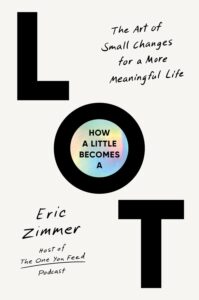
On this episode, we’re joined by Eric Zimmer, host of the long-running podcast The One You Feed and author of How a Little Becomes a Lot: The Art of Small Changes for a More Meaningful Life — A Guide to Lasting Transformation Through Behavioral Science and Wisdom. Eric knows the territory of change better than most — he’s a former heroin addict who once weighed 100 pounds, had hepatitis, and was staring down prison time before slowly, unglamorously building the life he has now. In this conversation, Eric breaks down why motivation is largely garbage, why willpower behaves like a superhero who keeps showing up drunk, and why the all-or-nothing trap (the protein-powders-and-two-hour-workouts fantasy) keeps people doing absolutely nothing. He explains how cravings that feel permanently insurmountable can genuinely disappear over time, why you can’t think your way into right action but you can act your way into right thinking, and how to spot the difference between values you actually hold and values you absorbed from Instagram twenty minutes ago. Whether you’re trying to quit something, build something, or just stop pretending “I’ll get serious next week” is a workable strategy, this one will hit you right between the excuses. Listen, learn, and enjoy!
Please Scroll Down for Featured Resources and Transcript!
Please note that some links on this page (books, movies, music, etc.) lead to affiliate programs for which The Jordan Harbinger Show receives compensation. It’s just one of the ways we keep the lights on around here. We appreciate your support!
- Sign up for Six-Minute Networking — our free networking and relationship development mini-course — at jordanharbinger.com/course!
- Subscribe to our once-a-week Wee Bit Wiser newsletter today and start filling your Wednesdays with wisdom!
- Do you even Reddit, bro? Join us at r/JordanHarbinger!
This Episode Is Sponsored By:
- BetterHelp: 10% off first month: betterhelp.com/jordan
- Article: Visit article.com/jordan for $50 off your first purchase of $100 or more
- Booking.com: Book your getaway now with booking.com
- ButcherBox: Free protein for a year + $20 off first box: butcherbox.com/jordan
Thanks, Eric Zimmer!
Click here to let Jordan know about your number one takeaway from this episode!
And if you want us to answer your questions on one of our upcoming weekly Feedback Friday episodes, drop us a line at friday@jordanharbinger.com.
Resources from This Episode:
- How a Little Becomes a Lot: The Art of Small Changes for a More Meaningful Life by Eric Zimmer | Amazon
- About the Podcast: The Parable of the Two Wolves | One You Feed
- Increases in Hepatitis C Virus Infection Related to Injection Drug Use Among Persons Aged ≤30 Years | CDC MMWR
- Health Risks and Dangers of IV Drug Use | American Addiction Centers
- He Played the Tape Through and Opted to Survive | American Addiction Centers
- “You Can’t Think Your Way Into Right Action, but You Can Act Your Way Into Right Thinking” — Bill Wilson | Goodreads
- Dashrath Manjhi: The Man Who Moved Mountains for Love | Times of India
- Homeostasis: Definition, Function, Examples, and Facts | Britannica
- Why We Resist Change | Psychology Today
- Fogg Behavior Model: B=MAP (Motivation, Ability, Prompt) | BJ Fogg
- Tiny Habits: The Small Changes That Change Everything by BJ Fogg | Amazon
- BJ Fogg | Tiny Habits That Change Everything | The Jordan Harbinger Show
- BHAG (Big Hairy Audacious Goal) by Jim Collins | JimCollins.com
- Built to Last: Successful Habits of Visionary Companies by Jim Collins and Jerry Porras | Amazon
- How to Play the Tape Through for Relapse Prevention | Alta Loma
- The Impossible Journey: Akshay Nanavati’s Solo Antarctica Ski Crossing | Fearvana
- Fearvana: The Revolutionary Science of How to Turn Fear into Health, Wealth and Happiness by Akshay Nanavati | Amazon
- Akshay Nanavati | Fearvana: Finding Bliss from Suffering | The Jordan Harbinger Show
- EvoDARK Darkness Retreat in the Black Forest | Evolute Institute
- Alien Hand Syndrome | Wikipedia
- Corpus Callosotomy and Split-Brain Syndrome | Wikipedia
- Dr. Strangelove Demystified: Disconnection of Hand and Language Dominance Explains Alien-Hand Syndrome After Corpus Callosotomy | Seizure: European Journal of Epilepsy
- Why Mimetic Desire Is Key to Understanding Social Media | Psychology Today
- Scott Galloway: Stop Trying to Follow Your Passion for Your Career | Time
- The Algebra of Wealth: A Simple Formula for Financial Security by Scott Galloway | Amazon
- Scott Galloway | Solving the Algebra of Wealth | The Jordan Harbinger Show
- Balancing Work and Family | Pew Research Center
- Are You an Abstainer or a Moderator? | Gretchen Rubin
- Better Than Before: What I Learned About Making and Breaking Habits by Gretchen Rubin | Amazon
- Gretchen Rubin | Four Tendencies: The Framework for a Better Life | The Jordan Harbinger Show
- Atomic Habits: An Easy & Proven Way to Build Good Habits & Break Bad Ones by James Clear | Amazon
- James Clear | Forming Atomic Habits for Astronomic Results | The Jordan Harbinger Show
- Think Like a Monk: Train Your Mind for Peace and Purpose Every Day by Jay Shetty | Amazon
1327: Eric Zimmer | Making Small Changes for a More Meaningful Life
This transcript is yet untouched by human hands. Please proceed with caution as we sort through what the robots have given us. We appreciate your patience!
Jordan Harbinger: [00:00:00] Welcome to the show. I'm Jordan Harbinger. On The Jordan Harbinger Show, we decode the stories, secrets, and skills of the world's most fascinating people and turn their wisdom into practical advice that you can use to impact your own life and those around you. Our mission is to help you become a better informed, more critical thinker through long form conversations with a variety of amazing folks, from spies to CEOs, athletes, authors, thinkers, and performers, even the occasional arms dealer, Russian chess grandmaster, war correspondent, or special operator.
And if you're new to the show or you want to tell your friends about the show, I suggest our episode starter packs. These are collections of some of our favorite episodes on topics like persuasion and negotiation, psychology and geopolitics, disinformation, China, North Korea, crime and cults, and more that'll help new listeners get a taste of everything we do here on the show.
Just visit jordanharbinger.com/start or search for us in your Spotify app to get started. Today, we're talking with my friend Eric Zimmer, host of The One You Feed podcast, about why changing your life is usually not some [00:01:00] cinematic rock bottom epiphany where the clouds part, the violins swell, and suddenly you're a brand new person who drinks green juice and owns matching Tupperware.
Eric's story, I've known him for a while, but I, I actually had no idea about most of this. His story starts in a much darker place. Heroin addiction, hepatitis, weighing around 100 pounds, facing prison, and still somehow not being able to stop even when the consequences were just glaringly obvious. And what's fascinating and honestly pretty brutal is that the big dramatic, "Okay, fine, I'll go to treatment" moment was not the thing that actually fixed him. Because that's the fantasy we all want, right? One breakthrough, one realization, one giant emotional lightning strike that rewires our personality and makes us stop doing the stupid thing. But Eric says that real change is a lot less sexy than that. It's not one huge decision. It's tiny, boring, repeated decisions, calling the sponsor instead of the dealer, not walking past the bar, making a good choice when you're tired, annoyed, ashamed, or absolutely convinced t- tomorrow you will magically become a Navy SEAL with a meal [00:02:00] plan.
We'll get into why motivation is mostly trash, why your brain fights change like it's defending a hostage situation, why habits don't always become automatic even after decades, and how values only matter if they actually show up in your behavior on a random Tuesday when nobody's clapping for you. So if you've ever thought, "I know what to do, so why the heck am I not doing it?"
This one is going to hit you right between the excuses. Here we go with Eric Zimmer. So you open this book, which we'll link in the show notes, with what honestly sounds like the worst possible version of your life. You're about 100 pounds or whatever you said you were. You got hepatitis. You're a heroin addict.
You're maybe going to prison at some point or just killing yourself inadvertently with drugs. What does that actually feel like day to day? It
Eric Zimmer: was a long time ago, so it's hard to fully bring it into view, but I would say it's a pretty miserable existence because there- It is essentially a few moments a [00:03:00] day where you get high and feel good for five minutes at that point, and the rest of it is fear and craving and despair and shame.
You know, having to hustle to figure out how to get the money that I needed, so there's crime involved. It's really a lousy, lousy way of life.
Jordan Harbinger: I mean, it sounds miserable, and everybody who sees it, it looks miserable. But obviously... Well, I guess the appropriate next question is how do you get started with something like that?
Because it seems like you see heroin addicts and you go, "Wow, I would never do that." But that somehow didn't happen with you.
Eric Zimmer: It's ironic that I became a heroin addict as afraid of needles as I was and am. I mean, it started like probably most everybody starts, with you start experimenting with alcohol and drugs as a teenager, and I reacted oddly from the very beginning.
I remember drinking, one of my first times drinking, and waking up the next [00:04:00] morning and there was, the vodka was still there. And I went to the fridge and I pulled out orange juice, I poured the vodka in, and I started drinking. That is just an unusual behavior. I learned that you could get drunk drinking Scope mouthwash.
Jordan Harbinger: Oh, man.
Eric Zimmer: Then I learned that in order to offset the problems with that, you could drink half a bottle of Pepto-Bismol, and I took a ... I was on a church youth trip where I unleashed this secret upon all my fellow people, and they, uh, but none of them wanted to do the Pepto-Bismol trick, so everybody was vomiting.
Jordan Harbinger: This is a church trip. Y- they must have, the pastor must have loved you for sharing this with the group.
Eric Zimmer: Oh, exactly. I was invited back promptly. And then strangely enough, I stopped using drugs and alcohol in high school because I had started this tutoring program for disadvantaged kids, and I just saw what alcohol and drug use was doing to their lives.
But when I was 18, my best friend started dating my girlfriend.
Jordan Harbinger: That hurts a lot.
Eric Zimmer: It hurts. Yeah. And so somebody said, "Have a [00:05:00] drink." I said, "Sure." And from that moment on, I was rarely sober again. It was alcohol, it was weed, and then I was in, I played music in bands, and I had joined a new band. And I was, you know, going to band practice, and these folks were, I mean, more messed up than I was, and I was like, "What is wrong with these people?"
Well, I mean, what was wrong with them was they were heroin users. And one of them said, "You want to try it?" And I said, "Sure." And that began several years of misery.
Jordan Harbinger: Yeah. I mean, it just does not... Well, it all starts from pain, I suppose, but then it just gets worse from there. You tell this story about getting money from your grandpa.
Take us through this, because I think a lot of us can put ourselves in your shoes, and it's upsetting.
Eric Zimmer: Yeah. I had been sober about a week at this point, and I was convinced that I was done. I was able to see, like, I'm dying, I'm going to jail. I was done and was sort of [00:06:00] excited about the next chapter of my life.
And it was around Christmas, and I went to the Zimmer family Christmas party, and my grandpa handed me my gift, which was an envelope. I opened the envelope, and in it was $25, which just happened to be the exact amount that one thing of heroin was, a baggie. I don't know what the hell we called it then.
And immediately, that voice that I wished wasn't there in my head just started up, you know, yelling to go get high. And I resisted it for a little bit, but not for very long. And I called my dealer, who said, "Meet me at AutoZone," which was the shitty place in Columbus we'd meet behind to buy drugs. And I remember the drive there.
It was winter. It was snowing. Aerosmith's Dream On was playing on the radio, and I was sobbing because I so desperately didn't want to do it, and yet I had no ability not to do it at the same time, which is a really awful feeling.
Jordan Harbinger: Well, yeah. A- and, and I think a lot of people can put your, [00:07:00] themselves in your shoes.
Maybe not with the heroin part, but in the feeling that you're doing, you're doing something, and you're letting other people down, and you're letting yourself down, and you can't help yourself, and you feel shame, but also compulsion at the same time. And a- again, you know, most people aren't probably f- heroin addicts or former heroin addicts, but I think we've all eaten something we know we shouldn't be eating or, and, or have done something that's making us sick or have drank or whatever, done something to someone that we regret.
And even in the moment, and we're like, "I shouldn't do this," and then it's like, "But I'm going to do it anyway." And you're just like, "Why? Why am I this person?" And I think a lot of us can imagine letting down your grandpa. I mean, for most of us, the only thing that's worse than letting down your grandpa is, like, letting down your own kids or something like that.
I mean, it's way up there.
Eric Zimmer: Yeah, it's gotta be up there. Luckily, he, I didn't take him with me to AutoZone, so I spared him, spared him that indignity.
Jordan Harbinger: Yeah.
Eric Zimmer: All of us know that feeling of watching ourselves make exactly the wrong choice. And by wrong, I mean the choice that, you know, the best part of us knows [00:08:00] we shouldn't make.
Jordan Harbinger: Well, in your life and in the book, there's this moment, and, and people love to latch onto this, right? You walk back into the room, and you're like, "All right, I'm going to get clean." And, like, in the Hollywood version of this, you do. You just get clean. There's a montage of you, I don't know, jogging or hitting a punching bag and, like, going and volunteering at an old folks' home instead of doing heroin.
And it's like, "Oh, good job, buddy." But you're saying, and with the book, you're largely saying it's not this moment that changes your life. So what does?
Eric Zimmer: Yeah, what you're describing is a moment in the book where I agree to go to long-term treatment, and that would be the big moment. Or we often talk about hitting rock bottom, or w- we, these, this one thing occurs.
But that moment is only significant because of all the thousands of little choices I made after. If I had not made those choices, I would not have stayed sober, and that moment would be just like all the others that I thought I was going to get clean and failed at And so we over prioritize sort of the epiphany, [00:09:00] the watershed moment, and we tend to under appreciate all the little steps that we make along the way after that, that are how we actually change.
Jordan Harbinger: Why do you think people latch onto the watershed moment? Is it because it's sexy? It's kind of, like, easy to wrap our minds around the time that this thing happened?
Eric Zimmer: Yeah, it's a good story. I mean, we love stories. We like drama, and the truth is a little more boring. You know, the truth as I'm saying it here is a little bit more boring to say, like, "Well, yeah, that was important, but I didn't hit the punching bag three times, visit four old people in the nursing home, and suddenly I was fixed," right?
I got better little bit by little bit, day after day, you know, choosing to go to a meeting, choosing to call my sponsor instead of my dealer, choosing to drive a different route home instead of going by a bar. All those little choices, none of which are monumental in and of themselves, though, are what makes the difference.
Jordan Harbinger: I [00:10:00] guess makes sense to go buy drugs there behind AutoZone. Now you can't go buy new windshield wipers because you have to go to AutoZone. I mean, what do you- Yeah. Do you have to avoid those triggers forever?
Eric Zimmer: Yeah, I, I, I still take the bus everywhere. I haven't, I haven't owned a car since.
Jordan Harbinger: Oh, man. Yeah. Yeah.
Can't-- Oh, man, I, I can't refill the wiper fluid. It's triggering for me. Honey, I need you to do it. Uh, how long are you going to lead on this excuse, Eric? All right. Um, yeah, you told me on the phone, th- I mean, this is years hence, right? I mean, you told me this a couple of months ago. You ended up having to drive, was it OxyContin or oxycodone to your mom.
You said something kind of, I don't know if funny is quite the right word, but you said something that I thought was, in the moment, quite funny, is you were like, "I would have robbed you at gunpoint for those a few years ago, and I didn't even think about popping those instead of driving them to my mom."
So you, you have kind of, like, completely turned the ship around when it comes to this.
Eric Zimmer: Yeah. The story that we told about me driving to AutoZone [00:11:00] opens up a chapter in the book, and the last, uh, story in that chapter is exactly what you said. I had been picking up oxycodone at the pharmacy and driving it to my mom for several weeks before I even thought about it.
And yeah, I would have probably robbed you at gunpoint for those, and now they had about as much emotional significance as a loaf of bread, which is incredible. I don't tell that story to brag. I tell the story because it shows that what often seems completely insurmountable to us can become second nature down the road.
I don't struggle not to do drugs anymore. It's not there in that kind of day-to-day struggle. Now, there's things that I do that I think keep myself mentally and emotionally healthy enough that those cravings or those feelings don't come back. But yeah, it- it's disappeared as a problem for me. And for anybody that's dealing with a compulsion That's part of what's hard is you think about life without it, and you just imagine that [00:12:00] you'll always want it.
Like, yeah, maybe I could give up whatever your thing is, gambling. I don't know. Maybe I could give up gambling, but w- life would always feel ... Like, I'd always miss it. I'd always wish I could do it. And the truth of people who get over these things is that's not true. The thing just ceases to be attractive to you, which seems impossible.
From where I was sitting at one time, I would not have believed you if you told me that. I might have believed, yeah, maybe, maybe I could stay sober, but I would not have believed that I no longer would care about heroin. That was inconceivable.
Jordan Harbinger: Yeah, you just, what, thought you'd eventually develop willpower to resist it on a daily basis?
Eric Zimmer: Exactly, yep.
Jordan Harbinger: So it turns out that it's the boring stuff, the unsexy stuff, that actually helps you change. So I would love to talk about this because first of all, why does the boring stuff work?
Eric Zimmer: Well, I don't think it works because it's boring.
Jordan Harbinger: Well, of course not. But there's no montage, right? It's just kind of [00:13:00] like, all right, I slowly recovered from this situation.
Eric Zimmer: I mean, I think part of it, right, is that anything that we are trying to change that is meaningful tends to be something that is just going to have to continue to go on for a long time. You don't get in shape once, and then it's over. You don't eat healthy once, and it's over. These are, like, lifestyle changes, and so they have to be something that we can continue to do.
And the problem for most of us a lot of the time is we take on too much. We think that we can start working out 90 minutes a day, also add cold plunges in, journaling, and meditation, and I'm going to make all that happen.
Jordan Harbinger: And you gotta quit smoking at the same time.
Eric Zimmer: Yeah. Yeah. And so we try that, and we inevitably fail, at least part of it, and then we have a tendency when we don't succeed at doing something, we have a tendency to then conclude we can't do it and give up.
What the small [00:14:00] little-by-little approach allows us to do is to set our goals reasonably enough that we can succeed at them, and success builds upon itself, right? We know motivation goes up when we feel good about ourselves and good at our chances of something happening, and it goes down when we feel bad about ourselves or we doubt our ability.
So by doing something that we're able to do, we become more motivated, and we can build over time if we need to. And little by little, I mean something actually very specific. I mean low resistance actions done consistently over time in the same direction. So it doesn't necessarily mean tiny. Low resistance for you and I might be different.
You might be in really good shape, and so going to the gym for 45 minutes for you is not that hard. I, on the other hand, might be wildly out of shape. And going to the gym for 45 minutes would be j- way too hard. I could never sustain it Right. It's like
Jordan Harbinger: a near lethal experience, uh, [00:15:00] if you're in terrible shape.
Eric Zimmer: Exactly. So it means what can I get myself to do? And then consistently over time is how it starts to accumulate. And then in the same direction is also important because you could hop on Instagram and by, within an hour you could have 10 new changes you think you need to make in your life. And we can't make 10 changes.
We can make a couple at, at best usually. And so having the patience to say like, "I'm going to work on this. This is the thing I'm going to work on," and staying with it, is how a little actually does become a lot.
Jordan Harbinger: How do people not lose motivation? Because it seems like with motivation, with the idea that you have to stick with something, it's good to have a big emotional payoff, and that's really hard when it's
The big emotional payoff is washboard abs and a spray tan or whatever, not I went to the gym on Monday. You see what I'm saying? Like, I think a lot of people, they get motivated by this like big-
Eric Zimmer: Yeah ...
Jordan Harbinger: what is it called? Big, hairy, audacious goals. That's like the- Yes ... that's a [00:16:00] trendy thing people talk about.
They have those because it's like so insanely motivating to think, oh, I'm going to, I don't know, have a YouTube channel that a million people watch all of my vlogs about Pokemon. That's motivating. Showing up and turning the camera on, not motivating maybe.
Eric Zimmer: Well, yeah. And I don't think there's a one-size-fits-all prescription for anybody on anything.
You know, this book is for people who have found themselves struggling to make changes. If you can set a big, hairy, audacious goal and you can change your life overnight and you can just keep doing it, I would set this book down.
Jordan Harbinger: Sure.
Eric Zimmer: And I would keep going. But for the rest of us, this is an approach that works.
But I agree with you, because you're right, we do things emotionally, and one of the problems of little by little is you get into this long middle where not much is happening. So I think there's a few different ways to work on that. Even if you have a big goal, it always makes sense to [00:17:00] deconstruct it into smaller goals along the way, because then you are getting emotional payoff, right?
I had to write a book, or I got to write a book.
Jordan Harbinger: Yeah. I was going to say, you- Right. Yeah, yeah ...
Eric Zimmer: you did choose to make
Jordan Harbinger: that choice. That one's on you, Eric.
Eric Zimmer: It is. That one's on you. It 100%. I got to write a book. It's a big undertaking. And so what I divided the book up into to begin with was simply writing sessions.
And if I did the writing session, I tried to celebrate that, and then I got to divide it into chapters and be like, "Oh, look, the intro's done. Oh, look, the first chapter is done," even though the end goal was certainly a whole book. But there's emotional payoff along the way. There's a couple other things too that we can tune into, and one of them is that when we do what we say we're going to do- Essentially, if we make and keep promises to ourselves, there is a satisfaction in that.
There's an internal alignment that we feel when we do that. [00:18:00] And so if we can tune into that, there is emotional payoff every time there. And we can also tune into when we don't do what we say we're going to do. We know how that feels. It doesn't feel good. So those are more subtle clues than the six-pack abs, but they're real clues.
Jordan Harbinger: That's a good point. I've never regretted making a workout, right, in the morning. It's never, probably never happened to me.
Eric Zimmer: Never.
Jordan Harbinger: But I always feel like such crap if, even if I'm sick and barfing and have a fever of 104, if I skip a workout, I'm like, "I feel guilty." And my trainer's like, "Why? You, you, I don't even want to see you in this condition.
What are you talking about?"
Eric Zimmer: Yeah.
Jordan Harbinger: Uh, and you still feel bad skipping a workout.
Eric Zimmer: Exactly.
Jordan Harbinger: There is the parable of a little becomes a lot. Tell me about this man who chiseled through a mountain. It's funny because you told me that story on the phone, and then I heard it again from a friend, like, five days later, which I thought was an, a story I've never heard before was told to me by two different friends in the same week.
I thought that was kind of a fun coincidence.
Eric Zimmer: Yeah, strangely enough, I [00:19:00] came across it sometime in the last few months too, and I was like, "Huh."
Jordan Harbinger: When did it happen? Is it recent, or is that why?
Eric Zimmer: No, it's not recent. It is not recent. I don't know exactly when it happened, but I feel like it's, like, maybe my parents' generation- Oh, okay
or maybe my grandparents' generation. Oh, okay. It's not new. So
Jordan Harbinger: totally not recent at all. All right.
Eric Zimmer: Not at all. So
Jordan Harbinger: it took its time making its way over to the West.
Eric Zimmer: Yeah. There was a guy named Dasrat who lived in rural India, and his wife became sick, and he took her to the nearest hospital, which took about two hours to get to, and she died on the way.
As the crow flies, it's about 15 minutes to that hospital, but there's a, a ridge in between them. And so this guy comes back, and he takes out a chisel, and he starts chiseling away at the wall. And people think, "What? This guy's nuts. Okay, everybody responds to grief differently, but this guy's saying he's going to chisel through this mountain to get to the town faster?
That's crazy. It's never going to happen." Well, he just keeps showing up. [00:20:00] Day after day, he keeps chiseling away, and slowly, he begins to make progress. And so the people in the town are starting to become kind of impressed by this, and they're like, "Okay, well, you know, here, here's a new hammer. Here's a chisel.
Eh, let me help for a little while. You know, here's some food." Well, eventually, the guy chisels this small little passage, not very wide, and not very far, actually. It's, I don't know exactly. Far enough, but he basically makes a cut-through, a little path to the other place, and now people can get medical care in 15 minutes.
Jordan Harbinger: Wow.
Eric Zimmer: And so what seemed impossible, a guy did by just showing up and, and doing his little bit again and again and again and again. And I think that's a, a really powerful story in that regard. I think luckily for most of them, you talk about to your point like the emotional payoff, this guy had nothing until it went all the way through.
Jordan Harbinger: If you stop one foot from the end of that, you have wasted your [00:21:00] time essentially.
Eric Zimmer: Exactly. Now, for most of us, luckily that's not the case, right? We start taking positive action in our life towards things that matter to us. We start getting benefits. So our little bit, we don't have to wait till it's a lot for us to get some degree of benefit from it, but he did.
But it's still a very inspirational story of, again, what seems impossible can be done if you just have the persistence to do it.
Jordan Harbinger: And speaking of relying on motivation, which is basically hiring a flaky intern to run your entire life, let's talk about something that
actually shows up when it's supposed to, our sponsors.
We'll be right back.
This episode is also sponsored in part by BetterHelp. Everybody's got stuff. No matter where you are in life, how successful you look on paper, or how well you think you're holding it all together, challenges come for all of us, and you don't have to just white-knuckle your way through it.
BetterHelp is now accepting insurance in many states with average copays around 23 bucks. I've been using BetterHelp for years now, and therapy has become non-negotiable for me. [00:22:00] Working with a licensed professional helps me stay grounded, get out of my own mental spin cycle, handle life like a reasonably sane adult, which is good news for everyone around me.
Just fill out a quick questionnaire, check your coverage in minutes, and they help you match with a licensed therapist based on what you need. They've served more than six million people globally, me included, and members rate live sessions an average of 4.9 out of five based on over 1.7 million client reviews.
Jen Harbinger: BetterHelp is in-network with major health plans like UnitedHealthcare, Cigna, Aetna, and more, with average copays around $23 for eligible members. Fill out the questionnaire and check your coverage today at betterhelp.com/jordan. That's betterhelp.com/jordan. Average copay is based on eligible members.
Actual cost and coverage may vary by plan.
Jordan Harbinger: This episode is also sponsored by Article. Buying furniture online can feel like a total gamble. It looks great on the site, then it shows up and suddenly it's smaller than expected, cheaper feeling than expected, somehow both. That's why I've been impressed with Article.
We've gotten leather couches from them, and the whole experience from ordering to delivery was smooth, fast, and [00:23:00] completely hassle-free. Article takes the guesswork out of making your home look cohesive. Their pieces have that elevated modern look, mid-century, coastal, Scandi-inspired, and everything is designed to play nicely together, and the quality is obvious when it arrives.
The weight, the materials, the finish, the sturdy hardware, it feels like furniture that's built to last. And I also love that a lot of it comes mostly assembled. Shipping is fast and affordable across the US and Canada. They offer professional assembly, and their customer care team is available seven days a week.
They even offer free interior design services if you need help pulling a room together. Plus, Article has a 30-day satisfaction guarantee so you can shop with confidence.
Jen Harbinger: Article is offering our listeners $50 off your first purchase of $100 or more. To claim, visit article.com/jordan and the discount will be automatically applied at checkout.
That's article.com/jordan for $50 off your first purchase of $100 or more.
Jordan Harbinger: Don't forget about our newsletter, Wee Bit Wiser. It's very practical. A lot of the drills and exercises from the show end up in the newsletter, and it's an under two-minute read just about every Wednesday. You can find
it at [00:24:00] jordanharbinger.com/news.
Now, back to Eric Zimmer.
So when I first read this in your book, I, I was like, "Well, is this real? Or is this one of those, like, once upon a time," right? And nobody knows who it is, and I actually just looked this up. It is a real story. This happened. His name is Dasrath Manjhi. I'm probably butchering that, but he was a poor laborer.
He spent 22 years, so it was 1960 to 1982, chiseling a 360-foot long, which is quite impressive, 30-foot wide passage.
Eric Zimmer: Okay.
Jordan Harbinger: This is not a crack you can slide through. No, you could drive a car through here. Um, through the Gehlaur Hills in Bihar, India, probably again not saying that correctly at all, hopefully not too bad, using only a hammer and chisel.
So no power tools. It's not like later on somebody gave the guy a bulldozer. But yeah, he was motivated by the death of his wife due to lack of immediate medical access. He reduced the travel distance to the nearest town from 55 kilometers to 15 kilometers. There's a little graphic, and I guess he had to [00:25:00] walk around this thing in order to get there, and he basically...
She died in 1959. He worked daily from 1960 to 1982. Unbelievable. It's 7.7 meters deep, so 25 feet deep, 30 feet wide, 360 feet long. This is a tunnel. This man dug a tunnel by hand, and he got a state funeral in 2007 when he passed away because obvious reasons.
Eric Zimmer: Because he should have one, yeah.
Jordan Harbinger: Right. That is quite a feat.
I'm going to ruin it right now by saying, "Okay, fine, Eric, cute story, but what if I pick up one piece of litter a day off the ground? That's not going to do anything."
Eric Zimmer: No, it's not.
Jordan Harbinger: Unless people stop littering, in which case I'll eventually clean it up. I guess that's the, where my analogy breaks down.
Eric Zimmer: But you probably could.
I was actually... It's funny that you bring this example up because I was just walking last night, and I've got this little trail that goes around, like, w- where I live, and there's a fence and, and there's a freeway over there. Mm. On the other side of it is just trash, lots of trash.
Jordan Harbinger: Yeah.
Eric Zimmer: And I came around, [00:26:00] and there was just this little corner, and it occurred to me, like, you know what?
I could clean that corner up. You know, if every time I came by here I picked up a piece or two of trash, eventually this little corner would not have litter in it. So no, I cannot solve all the world's litter problems by picking up a couple of pieces of it, but we're all faced with that to some degree.
There's nothing we can do that solves a lot of problems in general- But it doesn't mean that we can't make situations better, and it certainly doesn't mean that we can't make our lives better by doing little things. You know, a 15-minute meditation practice a day done very consistently over a long period of time, if meditation is the right thing for you, so I'm not saying it's right for everybody, but for some people it's very beneficial, will make a really big difference.
Jordan Harbinger: Why do we resist change so much? I mean, it seems like my brain, even when I know something is wrong, is kinda like, "Hey, maybe don't change anything ever." And not for [00:27:00] even a good reason, just, like, homeostasis just feels good to me, maybe.
Eric Zimmer: I use the example in the book of the biological idea of homeostasis, which means that our systems are always trying to balance themselves out.
Your body doesn't want you to get too hot, it doesn't want you to get too cold. It kinda wants to keep you in the same place. And I think that we, particularly in today's world, can find a little place that's mostly comfortable, that we don't really want to leave because it kinda feels good in there, and it's easy, and it doesn't demand anything more of us.
And yet for a lot of us, there's a nagging feeling underneath it that says like, "Oh, I could be more than this. I could do more than this. I want to do more than this. I want to be different than this." I don't know why we always have resistance. I mean, I, I've asked this question a ton of times on my podcast because I'm like, like you, every single time I do a workout, when I'm done I'm like, "I'm so glad I did that."
Jordan Harbinger: Yeah.
Eric Zimmer: [00:28:00] 100%.
Jordan Harbinger: Yes, e- every time. Like, there's not been one time where I'm like, "Oh, I shouldn't have done that."
Eric Zimmer: And at this point in my life, we are talking thousands upon thousands of repetitions. You should think I would run to exercise every day.
Jordan Harbinger: Yeah. I still think about what excuse I can come up with that would be
Eric Zimmer: convincing enough.
And yet I don't. Yeah. Yes, which amazes me. And the best answer I've been able to come up with is, you know, from evolutionary psychologists who are like, "Look, the body just does not put out more effort than it needs to unless there is a very clear, tangible, survival-based-" Yeah ... reason to do it." Right,
Jordan Harbinger: like I'm going to run if I'm being chased by a leopard.
Like, but otherwise- Yeah,
Eric Zimmer: yeah ...
Jordan Harbinger: I'm not doing it, man. Forget about it.
Eric Zimmer: Or there's an entire field of strawberries over there that's going to supply me and my family with food for two weeks. It's worth the caloric output, but if you just ran around all the time back then and you didn't, and, and didn't gather your caloric input, you die.
Yeah. You see it in animals. They [00:29:00] just don't do anything they don't need to do generally. They tend to just sort of hang out, and I think we're a little bit the same. So I do think that we need nudged into places That we want to be because there is a better, wiser part of us that wants more, wants things to be different, and there's an animal inside of us that's like, "Eh."
Jordan Harbinger: Yeah, I hear that. Some of it's biological, right? Like, you want to eat better and suddenly you're craving potato chips or carbs or whatever the heck it is. There's a biological reason for that. But there's other things I do that I just can't wrap my head around the level of self-sabotage. So I wanted to go to bed earlier.
This is a while ago, before I had kids. Uh, now, now I go to bed with my kids. I don't have a choice. And actually, that's been the best thing for my sleep ever in some ways. But, uh, before I'd be like, "I'm going to go to bed and it's, I'm going to be in bed before 10:00." And then I'm scrolling on my phone for hours until the normal time I would do, go to bed.
And I'm like, "Ugh, I slept the same." Well, I did look at Instagram for two... It's just the dumbest thing in the world. Or I would [00:30:00] want to be productive, and I would go and sit in this pl- like lock myself in my office, and I would come out, and I'd be like, "Okay, I didn't do anything, but you know what? My desk is clean, it's organized.
Everything is parallel and perpendicular in all the drawers. I got some boxes I threw away. I replaced the Kleenex box." I mean, just the dumbest busywork, and it's like anything to avoid sitting down and n- uh, typing the notes for this podcast, basically.
Eric Zimmer: Yeah. A lot of the book is about that question.
Jordan Harbinger: Yeah.
Eric Zimmer: Less about why, because I don't know always why, but more about how do we solve it.
Jordan Harbinger: Yeah.
Eric Zimmer: And I think there are two things we have to figure out when it comes to making a behavioral change. And the first I call structural. This is like knowing why you want to do something, knowing exactly what you're going to do, how you're going to do it, being very specific about it, making sure you have the tools to do it, making sure you have people to support you in doing it, setting up your environment to make it easier to do it.
It's all structural. And [00:31:00] that often solves a lot of problems. It's stupid things. Like if I look at my task list, the things that sit on there for a while are the things that are not one task. They're actually like five tasks that I've called one thing.
Jordan Harbinger: Oh, I've made this mistake before. Your to-do list has like write book on it.
Eric Zimmer: Exactly. Like, what, what are you doing? It's ridiculous that I should need to deconstruct getting taxes done into the first step, which is go gather up all the mail that's in the eight different places in my house.
Jordan Harbinger: Right.
Eric Zimmer: But it does matter when I do that. When I get that specific, I do it. So the structural carries us a long way.
And then there is what I would call the inner, meaning I know exactly what to do. I know how to do it. It's all clear. The moment is here. I call it a choice point. I'm at that moment, and I don't do it. That is something's happening inside me. I'm saying something to myself or I'm feeling something in that moment that I don't know how to get over, [00:32:00] and I just turn away.
And so in the book, I identify, I call them six saboteurs of self-control, which are like six categories of the sort of things that go wrong in that moment. And all we have to learn to do is not change our entire psyche. We have to learn, how do I navigate that moment? So writing a book for me, a big one was I just doubted I could do it.
If I'm going to be more specific, I doubted I could write a good book. I mean, I was sure I could get a book out, but I, I doubted I could do a good book. And so that I call, you know, in my little six saboteurs, I call the self-doubt stalemate, which can stop us from doing something. I just find myself not writing, and until I really pause and get myself to the point where I'm like, "It is time to write right now," so I'm not procrastinating generally, I'm procrastinating very specifically, I can then look and go, "All right, what am I thinking?
What am I feeling?" And when I would do that, what I would see is [00:33:00] there's a voice in me that was like, "You can't do it." And so nobody wants to feel that. You turn away. That's a yucky feeling. Instead, I could learn just to say to myself something along the lines of, "Well, I don't know if you can write a good book or not, but I do know that if you sit down and write, you're going to feel better about yourself, and you have a way better chance of getting better at writing in order to write a book."
I didn't have to give myself a pep talk like, "Look out, Hemingway. Here comes Zimmer." I just needed to get that voice to just settle down just enough to do it. But most of us are not aware of what that is because either we haven't gotten specific enough to push us to a choice point, or we blow right by it without really understanding what we're thinking or feeling.
Jordan Harbinger: You talk about this behavior model in the book, motivation, ability, and prompts, and most people think motivation is the key, but you're k- you kinda make the argument that motivation is unreliable at best, which I would completely agree with. I [00:34:00] think a lot of people, I should include myself, we think we get motivated, and then we do something.
But often, as we alluded to with our gym analogy, we often act, and then the motivation follows after that.
Eric Zimmer: Yeah. I do think motivation is part of the equation. You can't take it out of the, the equation. We do things for a reason, and we need to feel like what we're doing matters, and we need to reconnect to that.
And it is very fickle, right? If you don't feel good one day, your motivation is naturally going to be lower. So what we need is to be able to make the ability, how hard something is to do, easier to do. So for example, if we go back to our exercise one, if I'm not feeling particularly perky in the morning, which is pretty much every morning, and I need to go get on the Peloton bike, that's my goal, my brain tends to do, like, uh, I, I'm sort of oversimplifying, but I think what it does is I think it does this little calculation.
It's like, "All right. We're going to go get on the bike for an hour. That's going to take 10 units of [00:35:00] energy," and I check in, and my brain is like, "Well, but wait, we've only got one. That's not going to work." You know, I keep scrolling Sub Stack. But when I change it to, like, "Just get your bike shoes on-" My brain can sort of do the math, like, "Oh yeah, that takes about a unit of energy.
I've got a unit of energy. Okay, maybe we can do this," right? And I get there. Getting started is a surprisingly powerful trick, because once I get that far, I almost always keep going. And then about 10 minutes in, I'm like, "Oh, I'm so glad I'm doing this."
Jordan Harbinger: Oh, yeah. This is the whole, like, instead of saying you're going to go run five miles, just put your running shoes on.
As cliche as that is, that's ... When I ran, I don't anymore, because I decided I didn't like it after two years, but, uh, that was what I did. I mean, that's a fair shake, right? Two years of running, and then I was like, "I don't like it." Yeah, yeah.
Eric Zimmer: That's
Jordan Harbinger: fair. Yeah, yeah. At some, at some point, you have to admit to yourself that you're allowed to tell yourself that something sucks.
Um, but yeah, I remember I would get up in the morning, this is while I was in law school, and I was like, "Oh, it's snowing. It's Michigan. This is terrible. All right, I don't have to go run. I [00:36:00] just have to put my shoes on and then go stand outside, and have ... like, get that initial blast of cold air." And if I'm like, "Screw this," and I go back in the house
I did it once. It was, like, freeze ... sleet, uh, we call it, so, so freezing rain. And I was like, "It's so dang cold. It's still dark. It's freezing rain. Everything is slippery. I almost fell. This is just dangerous. I'm not doing it today." But every other time, I ran, and I would run five miles in the stinkin' snow in Michigan in the winter.
So, j- you're not saying try harder, though. You're basically just saying make it easier, which sounds almost too simple, but it does sort of hack that part of our brain, that motivational part.
Eric Zimmer: Yeah, it d- I mean, it is a cliche. It's been talked about a lot, and yet I accomplish a good 50% of anything I accomplish in life basically using using that trick.
I'd like to think I don't, you know, oh, I, I wouldn't need it anymore. I don't
Jordan Harbinger: need it anymore. Yeah, no, not the case.
Eric Zimmer: You know, because resistance is real. And so how do we get started? There was a line that I heard early in recovery, and it, it said, "Sometimes you can't [00:37:00] think your way into right action. You have to act your way into right thinking."
And that really made a big difference, because I could not, particularly then, control whether or not I wanted to get high. My thinking was just all messed up. But what I was given was clear things to do. Go to the meeting. Then when you get to the meeting, shake hands, and then afterwards, clean up the coffee m- I mean, I was given actions.
And what I found, though, is when I did the action, my inner state started to change. So my sponsor might say, "Go to the meeting and j- and walk around the room and shake hands with everybody," which sounds like the worst possible thing I could ever imagine doing.
Jordan Harbinger: Why?
Eric Zimmer: Why would he ask me to do it?
Jordan Harbinger: Why is it so h- bad to shake hands with people in a room?
I'm confused.
Eric Zimmer: Well, because, A, I'm a shame-filled introvert- I see ... addict, and doesn't, uh, who's shy and feels like I don't belong anywhere. But I would do it, and suddenly what I would feel is now I [00:38:00] would feel more like I did belong there, not by thinking, "Oh, I belong. I belong. I bet I belong." But by doing something that shifted my inner state into feeling like I belonged, and that's often the case.
I think about it this way sometimes, like we know that, uh, you know, emotion, thought, and behavior are all kind of interwoven with each other. Emotion doesn't have a lever on it. You can't just reach out and pull the feel better, feel happy lever. It doesn't have one.
Jordan Harbinger: You tried that. It's called heroin. It's not good for you.
Yeah.
Eric Zimmer: Exact- exactly. Exactly. Um, thoughts we have a little more control over. You can't control what shows up in your head, but you can control what you do. But behavior is absolutely something we do have control over. So it is often a really useful starting point. Even if what you want is to change emotion, behavior is a useful way to do it.
It's a starting place. Now, it's not always the starting place, and you do need to [00:39:00] work on all three, and that's what the book is really trying to bring together, but behavior is a very useful starting point.
Jordan Harbinger: So essentially, the, th- we pull the lever that we can easily reach, or the, the one that exists, I guess, in this case.
Eric Zimmer: Yeah. It's the easier one to pull. Now, not always, because our emotion controls, you know, uh, uh, dictates our desire to do behavior. I'm ... So I'm not trying to oversimplify something, but I am saying it is a more reliable lever. It's the exercise. Once you start, once you do the behavior, you pull the lever, suddenly you feel like doing it now that you're doing it.
Jordan Harbinger: So if somebody's sitting there right now, it sounds like we're talking essentially about momentum. If somebody hasn't worked out, hasn't been productive, hasn't done anything, whatever it is, someone sitting there with zero momentum, what is the first move? Not something aspirational, but something that, that somebody can actually do.
Eric Zimmer: What that's going to be is going to be different per person.
Jordan Harbinger: Sure.
Eric Zimmer: But what I would start with is I would start with what [00:40:00] is a small version of this that I can do right now or in an hour or as soon as possible? What is a version of this that gets me moving towards where I want to be that I can get myself to do?
Jordan Harbinger: Yeah, this is smart. I've heard people tell me they don't have time to work out, and I said, "What are you talking about?" And they're like, "Well, if I'm going to work out, I'm going to go all in, and I want to do it every day, and I want to do it for an hour." And I was like, "Okay, so you're waiting until you're retired, I guess, to start exercising even though you could just do something for 20 minutes?"
It's not a real excuse kind of. It's fake, I think. It's to keep them from having to do anything. Well, I can't do it my way, so you know. One of my friends was like, "Oh, I can't work out because," he's overweight, said, "I can't work out because I go all in on everything, and I'm going to be doing, like, protein powders and peptides, which I can't afford right now, and working out, like, two hours a day."
And I'm like, "So your other choice is to be literally 200 pounds overweight?" Like, I just don't buy it.
Eric Zimmer: It doesn't make any sense, [00:41:00] and people are this way. We, uh, we ... There's a lot of all or nothing thinking. I mean, I've seen this For a number of years, I did a lot of coaching, and I called myself a behavior coach essentially, and people would hire me, and you only hire someone like me when you just are not being successful at doing something.
I mean, the number of people that were like that, that were either they're doing it perfectly or they're not doing it at all, and that is a huge trap because it can stop you from even getting started, and it can also knock you off track because if we're going to do anything like exercise over a long period of time, you've probably noticed this to some degree, you've gotta have some degree of flexibility in it because your life changes.
You're traveling, your mom gets sick, your kids get sick, your dog gets sick. Our lives are not simple enough that we can be like, "Every morning, 8:00 AM, no matter what, I'm exercising." Not if you've got kids. Like, there's plenty of mornings at 8:00 chaos is going to reign.
Jordan Harbinger: Yeah. [00:42:00]
Eric Zimmer: So my mantra is a little bit of something is better than a lot of nothing.
So if I plan to exercise in the morning, and I don't for whatever various reasons, I won't give up on the day completely. I might say, "You know what? All I can do today is a 15-minute walk after dinner," but I've honored the underlying desire to be healthier, and I've kept a little bit of momentum going because I've done something, and it avoids that all or nothing trap because once we are in nothing, when we are totally stopped, it's harder to get started than it is when we have some degree of momentum.
So I'm always just adjusting and being flexible in order to keep moving.
Jordan Harbinger: Your brain does not want you to change. Your brain wants snacks, scrolling, and the same bad decision in a slightly different hat. Luckily, our sponsors are more useful than the deranged raccoon operating most of our impulses. We'll be right back.
This episode of The Jordan Harbinger Show is brought to you by Booking.com. [00:43:00] Look, if you got a vacation rental and you want to grow that business, you gotta make sure people can actually find you. That's where Booking.com comes in. It's one of the most downloaded travel apps in the world, and since 2010, they've helped more than 1.8 billion vacation rental guests find places to stay.
That's an enormous number of people looking for places like yours. But here's the thing: Most vacation rental hosts don't even realize they can list their properties on Booking.com, and if you're not on the platform, your rental is basically invisible to millions of Booking.com travelers worldwide.
After all, they can't book what they can't see, right? Once you list, your property gets in front of a huge global audience of travelers, which means more visibility, more bookings, and more chances to build real momentum with your rental business, and the barrier to entry is low here. You can register your property in as little as 15 minutes, and nearly half of hosts get their first booking within a week.
So if your vacation rental isn't listed on Booking.com, it could be invisible to millions of travelers searching the platform. Don't miss out on consistent bookings and global reach. Head over to Booking.com and start your listing today. Get seen, get booked on Booking.com.
This episode is also [00:44:00] sponsored by ButcherBox. Jen loves to host, and every month we'll have family over. It's usually potluck style. Jen handles the meat, everyone else brings the sides and desserts, which is a pretty solid system. Last month she made these ridiculous braised short ribs that slow-cooked for an entire day. People walked in and immediately went, "Okay, what is that smell?
When do we eat?" This weekend we're doing tacos with the family, and Jen's using ButcherBox pork for carnitas and wild-caught shrimp for shrimp tacos. And this is where ButcherBox really shines. The quality is just there. Grass-fed beef, wild-caught seafood, no antibiotics, no added hormones, no fillers. Just clean, reliable protein.
They have over 100 premium protein options. It is super flexible. You customize your box based on what you actually eat, and it ships free. We keep ButcherBox stocked in our freezer so we're never doing that last-minute grocery store scramble hoping we can find some good meat for dinner. It just shows up at our door, and we've always got something great ready to go.
Jen Harbinger: As an exclusive offer, new listeners can get their choice between free sirloin tips, ground beef, or chicken wings in every box for life, plus $20 off when you go to [00:45:00] butcherbox.com/jordan. That's right, your choice of free sirloin tips, ground beef, or chicken wings in every box for life, plus $20 off your first box and free shipping always.
That's butcherbox.com/jordan. Don't forget to use our link so they know we sent you.
Jordan Harbinger: If you like this episode of the show, I invite you to do what other smart and considerate listeners do. That is take a moment and support our amazing sponsors. They make the show possible. All of the deals, discount codes, and ways to support the podcast are searchable and clickable on the website at jordanharbinger.com/news.
If you can't remember the name of a sponsor, you can't find the code, please do email us Jordan@jordanharbinger.com. Someone here will surface that code for
you. It is that important that you support those who support the show. Now back to Eric Zimmer.
You know what? I just had a, a realization, uh, here in real time.
I think this is kind of why I'm a little bit of a workaholic, I think, because if I completely unplug, which I occasionally do but is very, very rare, I almost always go like, "Ugh, I don't want to start working yet. I just don't want to. I'm not in the [00:46:00] mood. I don't want to, like, read a book, and I don't want to sit in my office. I just want to play video games and hang out with my kids."
And but what if I go on vacation and I check my email for half an hour every morning and I just, you know, to keep the inbox down. My wife's like, "You really need to unplug. You r-" And I know I do, but I also don't want to because I know the amount.
It's like just a cold start in January when I have to get back to work, for example, if I unplug over Christmas like a sane person would do. I just can't do it because I'm like, "Oh God, it's going to be so... I'm going to look back at this inbox in January, and if I do a little bit every day, there's going to be t- 30 emails in there, and if I don't do any, there's going to be 300, and I really don't want to see 300."
You know? Yeah.
Eric Zimmer: My old joke was nobody needs a vacation more than the person that just got back from vacation. Oh my God. Tell me about it. Because, because you just are rolling in. Now, I have gotten to the place where I do turn off completely, give myself time away.
Jordan Harbinger: I need that.
Eric Zimmer: And, and I face the dread that you're talking about.
Yeah. It starts to come, and I just try and [00:47:00] remind myself, like, you'll feel that way for, like, six hours, and then you'll just get past it.
Jordan Harbinger: Yeah, if that, honestly.
Eric Zimmer: It's worth it to take the time away to face that six-hour misery.
Jordan Harbinger: Yeah.
Eric Zimmer: But I'm just like you. I love what I do, but give me two weeks off, I will, coming back, I'm like, "Uh-uh."
Jordan Harbinger: Uh-uh. It's terrible. It's funny you should mention that because I was like, how long is the dread? And so last time I timed it, and it was under two hours for me to feel like I basically had caught up. I basically need to go to a coffee shop, get one of those Vietnamese coffees that has like 18 shots of espresso in it or something , one of those drippy ones, and then I go through my inbox and I make a huge-ass to-do list, and then I, that sort of erases my panic.
Th- but it, and yet, knowing that I'm basically 90 minutes away from feeling like I have my head on straight, I still have trouble taking time off. I guess what I'm trying to say is I almost have too much momentum. It's not a good thing. I'm not bragging about that. I mean, I need, I, like I, I should not be building a Lego tractor with my son and thinking [00:48:00] about how to, I don't know, optimize some workflow on Google Drive.
That's not healthy.
Eric Zimmer: I mean, ev- you know, to each their own as to what works for them, right? I know some people who are like, maybe they, you know, they should be able to completely unplug, but they're like, "You know what? If I check my email for 30 minutes a day while I'm gone, it reduces my anxiety about what's happening back there enough-
Jordan Harbinger: Yes
Eric Zimmer: that I can be present the rest of the time here." I mean, everybody's gotta do what works for them. We are not all the same.
Jordan Harbinger: I hadn't really thought about that, but you're right. I do feel like an itch, which is anxiety, if I don't just go, "There's nothing important in there. I know because I looked. I got rid of a lot of low-hanging fruit that I won't have to deal with later.
I delegated a few things. Now I can go to the beach and watch my kids throw shells at each other or whatever, and I don't feel guilty or like there's some kind of water tank fill- or like I'm in a water tank that's slowly filling up, uh, b- at my neck level," which is kinda how I sometimes feel if I don't do that stuff.
[00:49:00] And there's some awareness happening in real time here, I think, for me, um, which is making me feel a little bit better. All right, so how small, you said do something small that makes you feel like you've got some momentum. People are going to game this because I would've gamed it, I think, if I had no momentum.
How small is too small? You don't want people to go, "I want to read more," and then they open a book and read one page and then close it and say, "Okay, growth achieved." I mean, that's a ridiculous example, but people are going to do that in some fashion or another up to the point where they can convince themselves that they're still moving forward even if they're not.
Eric Zimmer: Well, yeah, I mean, I think I would be questioning, you know, what's the point of gaming that?
Jordan Harbinger: To trick ourselves into doing something we know we have to do when we secretly don't want to do it because homeostasis.
Eric Zimmer: Yeah, yeah. Well, so I would, I would start, though, to make sure, like, we actually do know that some part of us wants to do it.
Jordan Harbinger: I see.
Eric Zimmer: What's too small depends. It's different for everybody, but my experience is not that- People start too small and trick themselves. My experience is [00:50:00] almost always that people start too big and fail.
Jordan Harbinger: Uh, that totally makes sense. Yeah.
Eric Zimmer: That's been my experience. With people who are sincerely wanting to make a change and are, are reasonable people who are not locked in deep self-denial all the time, those people tend the error is they try and do too much. Because to be like, "Hey, I'm going to meditate for three minutes," sounds stupid. You're like, "That's dumb." And the reality is if you meditate for three minutes a day, it's probably not going to change your life. You do it every day, you might get a little bit more peace, but three minutes can become five minutes, which can become 10 minutes, and that's often the path, right?
We start small, and we get some momentum, and we're better able to do it while keeping it at the same difficulty level. So meditation is a good example. I had tried to meditate on and off for a long time. This is w- pre-internet. The only way to learn meditation was from a book or the weird guy in [00:51:00] Columbus, Ohio, who taught TM.
Jordan Harbinger: Dude, I'm telling you, that's h- I had the same experience.
Eric Zimmer: That's it.
Jordan Harbinger: There's one weird guy that your parents are like, "Is he a pedophile?" And you're like, "No, he's just really weird." And you're like at his-
Eric Zimmer: Yep ...
Jordan Harbinger: trailer staring at a wall, and everyone's like, "I ... If you're not back in two hours, I'm calling the police."
Eric Zimmer: 100%. Yeah. And so I would pick up these books, and they would say, you, you know, "You should meditate 30 minutes, 45 minutes, an hour a day." And so I would try that, and that was incredibly hard for me because my brain was pandemonium. I would sit down, and it was like the dark circus came to town. It was misery for me.
Jordan Harbinger: Yeah.
Eric Zimmer: I couldn't get myself to keep doing it. I might be able to do it for a week, maybe a month, but I would eventually give up. And then I would come back around, I'd pick up the book again, I'd start reading. It would say, "You should meditate for 30 to 45 to an hour." I would try it. I would fail. This happened two decades perhaps.
Jordan Harbinger: Yeah, okay. That makes me feel a little bit better. I think a lot of people probably feel a little bit
Eric Zimmer: better. A long time.
Jordan Harbinger: Yeah.
Eric Zimmer: So finally, at one point, once I started, uh, it was after I started the [00:52:00] podcast, and I started to get introduced to some of these ideas a little bit more and, and get some clearer thinking.
I was like, "You know what? I'm going to meditate for three minutes, but I'm going to do it each day. I can do three minutes." There was a dignity level for me where I was like, "I ca- no excuse I can make is going to pass muster for why I can't spend three minutes." And so that was easy enough to do. It was low resistance, and it
I didn't need a whole lot of motivation to do it. Well, what turned out to happen was that before long, I could sit for five minutes, and it was the same level of difficulty because I was getting better at it. Then I could sit for 10 minutes. Then I could sit for 15 minutes, and then I could go on week-long retreats.
Jordan Harbinger: Oh, God. That feels horrible even thinking about having to be quiet for a week.
Eric Zimmer: Yeah. Well, you, you don't have to. Yeah. That's the good news. The good news is you, you certainly don't have to, but that was where I wanted to get with it, but I got there by starting stupidly small. And establishing consistency and momentum.
And then as I got better at it, [00:53:00] as I became more capable, we all know this, it's the way you work out. You don't start by bench pressing 250 pounds. You can't do it. But you can start wherever you're, you're capable of. Yours and I's would be different. If we both took six months off and we came back to bench press, you might bench press, uh, 150 pounds and I might bench press 110 pounds.
If I tried to do what you were doing, I would give up because it would be too hard But I could start where I'm at and get better and better and better.
Jordan Harbinger: Have you ever done a darkness retreat? Have you ever tried one of those as opposed to a silent retreat?
Eric Zimmer: I have heard about them, but I have never tried one.
Jordan Harbinger: For people who don't know what this is, my friend Akshay, do you know Akshay Nanavati? Does that name ring a bell?
Eric Zimmer: Yep. Yep.
Jordan Harbinger: So he's been a friend of mine for a long time. He's crazy, I guess, is the best way to put it. He's-
Eric Zimmer: That'd be a decent
Jordan Harbinger: description ... his last thing that he did was he told me that he was going to go to Antarctica and cross over land, which he tried to do, which no one has done before.
There's one guy who, like, kinda says he did it, but there's, like, no proof or something like [00:54:00] that. I can't remember. But anyway, he's gotta push his food on a sled across Antarctica, and he almost made it. The, in fact, the reason he didn't was not because he wasn't tough enough or whatever. It was because it was snowing, and instead of walking across, like, ice pack, he was in deep snow, which made it a million times harder, so he ran out of time. Because you have to ha- h- you basically have to pay a rescue crew to, like, wait for you on Antarctica.
Eric Zimmer: Oh, wow. Yeah, I imagine.
Jordan Harbinger: You can't just be like, "Yeah, I'll call you when I need..." It's like, "No, we need to be on the continent that you're on when you're dying, uh, or fall into a crack." So he just basically ran out of, I think, money, and also g- you know, I'm sure he was sore.
But anyway, so he does these darkness r- I've, I'm sure he was relatively sore. Uh, he does these darkness retreats where he'll be, like, in Germany, which is pr- because you, I don't even know if it's legal to do this kind of s- thing here because you're basically imprisoned by someone. You gotta go to
Eric Zimmer: the Black Forest for
Jordan Harbinger: that.
Yes. And there's no noise, and there's no light, and they feed you a smoothie a few times a day to keep you from dying, [00:55:00] basically, and it's the most tasteless thing that they can find because the point is you're not getting any stimulation. And you mentioning that the darkness comes into your head, this is, like, the whole point for him, right, is you can't get away.
You, there's nothing to distract you from these thoughts and things that are in your head because there's no light. There's nothing you're tasting. You're not looking forward to anything. You're in there for a lo- like a week at a t- or 10 days or whatever, and you can't even see anything. Like, you can't even start looking at things to distract yourself And he said it's just like you're just facing all of your demons in this dark room alone, which sounds awful to me, but we're built different.
Eric Zimmer: There's a part of me that's like, "Huh, I want to do that," but it does sound awful. I mean, the, you know, the thing about, like, on a silent meditation retreat is you- oftentimes you're encouraged also not to read anything, so there's no stimulation, and you find yourself, like, looking at, like, oh, can I go read the, uh, emergency evacuation instructions on the back of the door to have anything?
Jordan Harbinger: Yeah.
Eric Zimmer: Anything except my own thoughts, but at least you get to see [00:56:00] things.
Jordan Harbinger: Right. Yeah, you can look at a butterfly, and it's like that's kind of the point. You're enjoying nature and enjoying the wonders of nature. No, you're in a dark room, which I guess has carpeted walls somewhere in the suburbs of Frankfurt, and you're dealing with that.
But Oxy is legitimately, like, on another level with this stuff. This is an interesting tangent I hope for people listening, but, like, we... I met up with him for breakfast, I don't know, it was probably three years ago now. We're at, like, Soho House, which is this, like, bougie, you know, whatever, New York or LA, can't remember, London, whatever club.
And we're having breakfast. I'm like, "Let me buy you breakfast." And he's like, "All right, now that we're done eating, I gotta show you something." And I'm like, "What, what could it be?" And he had just gone on like a training trip to Antarctica or some other cold, or maybe it was Iceland. He, he went somewhere where he was practicing whatever he was going to do, and he goes, "Check this out."
And he puts his hand on the table, and it's like, you know when you see something that you've never seen before, but you're an adult, and you think, "What I'm looking at can't be real because I'm 46 years old. I've seen everything. Like I ... [00:57:00] What am I looking at, and is it real?" And on his hand, it was a regular hand, and then two fingers were totally black except for the tips, which were bones protruding out of the black like a zombie.
And I was, like that, it just looked fake to me. And I said, "What is that?" And he goes, "Oh, they're frostbitten, so they're dead, and the tips have fallen off, but the bones are still there." And I'm like, "Why have I never seen this?" And he goes, "Oh, yeah, usually when this happens, doctors amputate them, but I just decided to let nature take its course."
So his doctors were like, "Hey, we should saw those off." And he was like, "No, bro, I want to walk around with this for, I don't know, 18 months or whatever as they, like become necrotic, turn hard, fall off, and leave only bones that look like, you know, old bones that have been buried for a while and have been in, you know, in a shower m- hundreds of times that are just sticking out of my hand."
It was like looking at a zombie hand. It really, honestly, except part of it was like perfectly healthy, and then part of it was dead. [00:58:00] And I'm like, "Thank you for waiting until we were done with breakfast." Done
Eric Zimmer: eating. Yeah,
Jordan Harbinger: exactly. Yes. But that was, the reason I'm telling you this a- and telling everyone this is because this is the kind of person that goes to a darkness retreat for 10 days, right?
Like that's somebody that hardcore. Because if I get frostbite, they're sawing it off. That's final.
Eric Zimmer: I get frostbite, if I, it has to happen and they do have to saw it off- Yeah ... I'm never going anywhere that's under 50 degrees again. That's right.
Jordan Harbinger: That's right.
Eric Zimmer: That's it. I'm moving to the desert in- Yeah
Arizona, and that's it. Like, I'm never leaving.
Jordan Harbinger: Precisely.
Eric Zimmer: But not him. I haven't connected with him in a while, but it does not sound like he's changed one bit.
Jordan Harbinger: No, he's not changed one bit. He's just looking for the next hardest, most impossible thing to do. So speaking of unique folks, you tell the story in the book about this woman whose hand literally fights her, which s- again, speaking of things that sound fake, alien hand syndrome, apparently a real thing.
Tell me about that.
Eric Zimmer: Yeah. Well, if you go in and you, you, uh, sever someone's corpus callosum, I think is how you say it, although, uh, n- now that I [00:59:00] say that out loud, I feel like I've just done a Harry Potter spell. So perhaps- Yeah,
Jordan Harbinger: yeah ...
Eric Zimmer: I'm not right there It's the thing that connects the two sides of your brain together, and if you have epilepsy, one of the ways that they help treat that is they get rid of that.
Jordan Harbinger: They still do that? That sounds-
Eric Zimmer: Yeah ...
Jordan Harbinger: like bloodletting, but with your bra- You know what I mean? It sounds
Eric Zimmer: like- No, no, I think they still do. Yeah.
Jordan Harbinger: Wow.
Eric Zimmer: Because it generally works, but it, it will cause some unusual things. Sure. And one of those things is that the different sides of your brain can get up to different things.
And so this woman had had this happen, and a doctor went to see her shortly after, and one hand was buttoning up her shirt, while the other hand would turn around and just unbutton it. And he was like, "Uh-oh."
Jordan Harbinger: Yeah.
Eric Zimmer: Called some people in to look at it, and well, it's called alien hand syndrome. And what it basically means is that the hands, which are mapped to a side of the brain, have a different agenda.
Your right brain, your left brain, they want different things. There's all sorts of... Look into, like, the split brain studies. They are fascinating.
Jordan Harbinger: Yeah.
Eric Zimmer: You think you're, like, a, a [01:00:00] rational, unified creature, and then you start reading this stuff, and you're like, "Oh, man, we are weird." So a- yeah, alien hand syndrome.
You know, one hand's lighting a cigarette, the other hand puts it out, that kind of thing. And I use it, because it's, A, it's a great story, and to sort of say that we all have a little bit of that. We talked about it very early on, where we want lots of different things. I want to exercise and I want to sit on the couch.
I want to write this book, and I don't know, what's the way I w- and I want to play my- Play
Jordan Harbinger: video games?
Eric Zimmer: Yeah. Or yeah, I want to play my guitar, or whatever, whatever your thing is.
Jordan Harbinger: Sure.
Eric Zimmer: We all want multiple things. We're motivationally complex creatures. And so starting to unravel that a little bit can be really helpful because if we don't, it does feel a little bit like the alien hand thing.
Some part of me's going this direction, another part of me's going another direction, and that doesn't feel good.
Jordan Harbinger: What do we do if the things we want conflict with each other? It's probably good to give an example of this because alien hand syndrome essentially says about the brain that those two [01:01:00] conflicting wants coexist.
It's just that usually our brain, I don't know, figures out one way to pick one, whereas with her... Which by the way, that sounds like a, a Batman villain, someone whose one hand does one thing, and then the other hand does the opposite thing. I mean, that would be... I don't even know who could play a complex role like that, but that would be incredible, right?
They light a cigarette, and then in a menacing way, and the other hand puts it out immediately or, like, takes it out of their hand before they can take a drag. The, the fact that that's real is mind-blowing.
Eric Zimmer: Totally mind-blowing. I'll give you an example. So even when we think about what's most important to us, like, we get down to the levels of, like, values.
Like, what do I value? We still have conflict. One of the things I've realized is I have a value on adventure. Like, I feel most alive, I feel most myself, I feel happiest when I'm out on some sort of adventure. Now, now not a, not an Akshay adventure, a normal type adventure, right? A normal adventure. It's when I feel most alive.
I also have a real [01:02:00] value on being content right where I'm at Those are two things that are, they pull on each other, and I don't think there's a resolution to the two of them. Knowing that they're both there and they're each pulling and that that's totally normal helps me to work with it more skillfully.
Recognizing that we want multiple different things and that that's normal, I think is, can be very helpful instead of thinking there's something wrong with me-
Jordan Harbinger: Yeah ...
Eric Zimmer: that I'm that way.
Jordan Harbinger: Sort of acknowledging that there's a war inside our head and that all of us have this, it's just that we don't all have a hand that can think with the other mind that's back there, is an interesting way to look at this.
So in the book, though, you do a pretty good job. You mentioned values. You, you broke this down into values are what we want most, but desires are what we want most right now.
Eric Zimmer: Yeah, the question that, that I use is, you know, oftentimes of what a lot of us will look at is we're trading what we want most, what we value, for what we want right now, and that's a pretty common thing that most of us wrestle with.
You'll [01:03:00] notice that a lot of your day-to-day struggles fall into that camp, and so that's a particular type of thing that we have to learn to work with. And then there is, the example I gave is, like, what do you do when two things that you really do want most, that are really valuable to you, are in conflict?
Uh, you know, anybody that's got children and a career feels some degree of this. You value both. You value your career and you value your children, and there is a tension there. There is a natural tension there. It's why everybody talks about work/life balance, because it doesn't go away, and that's okay. I wish it went away.
I wish it was simpler, but knowing that everybody feels that, I think does make things better. But when we look at, like, what do I want most versus what do I want now, what we're really dealing with is how do I make the future more real? Because what I want most is the thing that's out in the future usually, and what I want now is the thing that's, like, right here.
You know, how [01:04:00] do I make that more real? In recovery, we called it playing the tape all the way through. It was one of the... I mean, I learned it in my first week of recovery. What my brain did was just think about how good it would feel to get high.
Jordan Harbinger: Right. I see.
Eric Zimmer: I have to keep it going. I have to go, "Okay, well, then what?
Oh, yeah. Well, what'll happen after that is I'll feel good for 20 minutes, and then the shame will rush in. The despair will rush in. The desire to use even more will rush in. Oh, and then the fact that I don't have money, that's there. Oh, and I'm already facing 50 years in prison," and you roll it all the way through.
Jordan Harbinger: Yeah. Were you really facing 50 years in prison?
Eric Zimmer: I was, yeah.
Jordan Harbinger: For what?
Eric Zimmer: Multiple charges of grand theft and forgery.
Jordan Harbinger: Oh, okay, because I'm like 50 years, that's, those are murder numbers, man.
Eric Zimmer: No murder, and those are max sentences.
Jordan Harbinger: Yeah.
Eric Zimmer: But yeah, I, I had something like six of each.
Jordan Harbinger: Future you is always going to wake up early, work out, meditate, meal prep, answer emails, and become fluent in Spanish.[01:05:00]
Future you is also a pathological liar with excellent branding. Present you, however, is going to hear from our sponsors. We'll be right back.
And don't forget, you can join us on The Jordan Harbinger subreddit if you want to talk about any episode or any element of the show. If you're a Redditor, come join us on The Jordan Harbinger subreddit. Now, back to Eric Zimmer. Forging checks or whatever to buy drugs is, like, 50 years when you're 20 or 30 years old is essentially a life s- almost a life sentence.
I mean, why would you? That doesn't make any sense to me. Although, a- again, they're maximum sentences. I would like to think there's no chance he would've gotten that, but who knows?
Eric Zimmer: Yeah, yeah. Well, what I got was the s- I got the, the sweetheart upper middle class white kid deal, which was diversion. They basically said, "If you complete this program, we'll make this all go away."
And the program was I had to, you know, probation officer, I, I mean, just all the, the normal things. [01:06:00] And if I did that, they made it go away. And if I didn't, then I would be facing a, a very stiff sentence. But I got that opportunity, thank God, because my life would've been radically altered if I had been toting around eight felonies.
Jordan Harbinger: I don't mean to get sidetracked here, but there's a guy who listens to this show who sent me an email. He was a Mormon, but he became a drug dealer. That's, of course, we're going to talk about that at some point. But, basically, he, you mentioned the upper middle class white kid deal, and I'll- I think a lot of people bristle when you say things like that.
But he, he told me that this is very real. He went to court for... He had, I don't even know, pounds of drugs, like a ton of drugs, right? And the guy before him had a little bit, a, a couple of bags of drugs, and that guy got, like, multiple years sentence. And he was like, "Oh my God, I have 10 times more than that guy.
I'm never getting out of jail." And the judge was like, "What's a nice boy like you doing in here? Probation." And he was like, "I won the judicial lottery, and I cannot screw this up." And that's what, one of the, you know, how he got out of it. But he was also like, "But wait, that [01:07:00] other guy, he had way less than me, and he's in prison now for, like, five years.
What happened there?"
Eric Zimmer: Yeah, 100%. I will always take a, a Mormon drug user story if I can get one.
Jordan Harbinger: There you go. Yeah, Mormon drug dealer.
Eric Zimmer: That's what I meant. That's even better. Mormon drug user's kinda boring, but drug dealer- Right ... that's interesting. So we, we, we play the tape through, and the key is we have to try to make it f- is real.
We have to see it. We have to feel it. You know, really try and embody the future situation Because most of us don't really do that. We may recognize like, "Ah, yeah, maybe I should put the phone down and stop scrolling." But in your case, right, you would have to really imagine, put yourself in the morning person's shoes.
Like, "Oh, God, I'm going to feel like shit again, and I'm going to feel like an idiot because yet again, I scrolled." Embody those feelings if we can, because our job is how do we make the future feel more real? Because the present is always [01:08:00] very real to us. And as humans, we're not good at this. There's a reason we all struggle with it, right?
It's not easy to do.
Jordan Harbinger: The way you put it is perfect. The present is always, it's more urgent, right? That this is what's happening now. So I do have a lot of sympathy for people who say like, "I want to build a business, but I also have bills, and I have the stability of this career." And it's like, yeah, you could step into the wild unknown and take a ton of risk, or you could stay at your job.
And there's all these influencers that are like, "Burn the ships!" And I'm like, "Easy for you to say, pal. You're a multimillionaire. What are you doing telling this teacher who's a single parent to burn the ships? Like, you have no place, you have no right to do that at all." Uh, it doesn't make any sense.
Eric Zimmer: No.
This podcast, like I, you know, I knew I wanted to do this show, but I had a job in the software business. There was no wa- I had two kids in high school, I had a mortgage, I mean, I had all that stuff. I kinda picked the middle route for me, which was like, I was like, "All right, I'm going to, I'm going to do the job and I'm going to [01:09:00] kinda noodle away at this thing over here."
And, and I was lucky enough that the podcast went well enough that eventually, and I did that for five and a half years before I was able to do it full time. But yeah, I agree 100%, telling people to burn the ships is advice that most often comes from the people who already are set.
Jordan Harbinger: Yes, exactly. I know. Uh, it sort of reminds me of Scott Galloway, who you probably know, says something like, "The person on the podium telling you to follow your passion made their billions in iron smelting or inherited most of it."
And it's like, yeah, that's exactly right.
Eric Zimmer: That's fair. Yeah, yeah.
Jordan Harbinger: In the book, you add another layer to the values thing, which is that half the stuff we want, or values and desires for that matter, half the stuff we want isn't even ours, right? We absorb it through social media, status games with other people, or whatever.
So how do we tell the difference between I want this and I saw somebody else want this on Instagram and now I think I want it, but I'm not sure?
Eric Zimmer: The thing for me that I can tell is how much does it change? [01:10:00] So I was in LA recently, and I got invited to a party up in the Hollywood Hills, and when I was there, what I was thinking of was money.
You know, this incredible house, I'm looking around, and the people there, they all have money, and suddenly what I really want is money. And then two nights later- I was at a different event with more the starving artist type person, and I found myself wanting that
Jordan Harbinger: You wanted to be broke? I- I don't think that sounds right.
Eric Zimmer: No.
Jordan Harbinger: Tell me. Fill
Eric Zimmer: that in. I wanted a, I wanted a bohemian, cool, creative life.
Jordan Harbinger: Right. Okay You
Eric Zimmer: know?
Jordan Harbinger: In Echo Park or whatever, yeah.
Eric Zimmer: Yeah. And so if I look back and forth between those two, which of those tends to be more steady in my desires, right? And for me, it's almost always been the more authentic life where I'm doing something that I like doing that feels valuable to me.
That's the part that doesn't change. Now, would I love you to heap a bunch of money on top of that? [01:11:00] Sure.
Jordan Harbinger: Yes. The rockstar method where you're super- Yeah ... loaded, but you can pretend that you're broke and wear ripped clothes?
Eric Zimmer: And I tried that for a, a number of years, and it did not work. So I'm looking oftentimes trying to discern, like, what patterns hold over time?
Because I do tend to want what you put in front of me and make look good. Yeah. It's part of the reason I do not like TV commercials. I feel like I'm unusually susceptible.
Jordan Harbinger: Really? I never pay attention to those at all.
Eric Zimmer: Yeah. Well, uh, no. I mean, like, I... When they're on, I'm looking and I'm suddenly like, "Yeah, I really do need to be on a beach-
uh, with a beer, and I need a- Yeah ... I need a woman that hot. And, you know, uh, everything I'm doing up till now has been a waste of my time. Let's redirect," until the commercial's over. And then you've got Pampers commercial, and I suddenly think I need two more kids. Right. And, uh, uh, on, on-
Jordan Harbinger: Maybe you are susceptible.
None of these things occur to me. I totally tune these things out. Sheesh.
Eric Zimmer: Yeah. I think we all have different levels of that, but I, I tend to get influenced by what, what is around [01:12:00] me, so I have to come back to like, what do I consistently want? What do I consistently value? And that tends to work for me because you, you go on social media, and I mean, our whole culture is based on how do I get you to want something you don't have so you will spend money on this thing?
That is the engine that drives a lot of it. I'm not saying that's bad. I'm just saying that's kind of the reality of it. So I come back to what things do I consistently, over a period of time, keep thinking are valuable to me and important?
Jordan Harbinger: On that same token here, sometimes it seems like my values kind of fight each other.
I mean, you mentioned this earlier, money versus, I don't know, cool bohemian lifestyle. So security versus freedom, family versus ambition is a common one that I see in the inbox. Maybe the original, the OG, health versus enjoyment, right? I should stop drinking and smoking, but it's fun. If there's no clear right answer, how do you decide?
Eric Zimmer: Ideally, [01:13:00] you find a way that you do both. I think that's the ideal world. The ideal world is one in which, yeah, you're mostly healthy, but you go have a few drinks if you want to have a few drinks once in a while. You go, you do eat the chocolate ice cream when you're on vacation. You do those things. In the same way that ambition and family don't get sorted.
Most people are not in a position to-- You don't just go, "Well, you know what? It's going to be ambition, and that's going to be the one, and, and screw you, family." I mean, some people do, right? Some
Jordan Harbinger: people do
Eric Zimmer: that, yeah. But most of us are not going to make that choice, nor are we going to be like, "Well, you know what? I'm just going to stay at home with the kids all, all day and, you know, we'll live under the bridge.
Who cares?" For most of us, we're finding the place in between those two things that is best for us. But I don't think they resolve. As I said earlier, I think you-- it's an ongoing negotiation. It's an ongoing dance between those two things. Now, sometimes you find yourself, like me with mind-altering substances, where the answer is none.
[01:14:00] But I don't think that's ideal. If I could be in the middle, I would, because having a few drinks is enjoyable. Lots of people love it. I'd do it if I could. My experience just shows that doesn't work for me. And so you might be that way. There's certain people that are this way, that, like, once they open the, the sugar genie up, it just takes over every time, and they're like, "It's easier to have none."
And so there are times that that is the wiser move. Gretchen Rubin came up with an idea that I thought was useful. She was like, "Are you a moderator or a abstinence person?" And I think it's an interesting question to ask yourself about different things. Would it be easier to just have none of this than trying to do an ongoing negotiation?
For me, there is a beautiful clarity to zero when it comes to substances, right? I mean, it's just, it's zero. There's no, no debate. And I know a lot of people who might do better with that, but they stay in the [01:15:00] middle. But I don't think there's a simple answer for how we do it, except we find our place and we continue to negotiate it and think about it is really the key thing, right?
To bring some consciousness to it.
Jordan Harbinger: Yeah, this is, is true. It's funny, the m- the moderator idea. I always assumed you had to be abstinent or you were going to get addicted to something. But when I got older and people started putting drugs in front of me, I was like, "Oh, I can just do this and stop." And other people were, like, awake till 7:00 or 8:00 in the morning, and I was like, "I don't-- Why are you doing that?"
And they're like, "You don't want more?" And I'm like, "No, I kinda do, but, like, also, I want to go to bed, so I'm just going to go to bed." And th- like I r- remember later as, as I got older and older and older, I was like, "Oh, this is not the usual way people's brains react to, to, uh, you know, white powders," for example.
Eric Zimmer: Yeah. Although strangely, even with white powders, the vast majority of people do not slide into what we would call addiction.
Jordan Harbinger: Yeah. Otherwise everybody in my law firm w- would have been-
Eric Zimmer: All of LA would be in a treatment center.
Jordan Harbinger: Yeah. There, there's some additional points that I'd love to highlight [01:16:00] here.
Values don't matter unless they show up in behavior. So you would kind of have to ask yourself, you know, what does this look like on a random Tuesday night? Not the final product, not the way that I want this to look or how pretty I want to make this, but like what does this look like at 8:00 AM tomorrow when you don't want to work out again, for example?
Do you think people lie to themselves about their values? Because it, it sort of looks to the casual observer that this happens constantly.
Eric Zimmer: This is an interesting one because there is a certain school of thought that says if you look at what somebody does, you'll know what they value. And there's a certain logic to that, but I also think it's reductive because even though, yes, on one hand I did value drugs over everything else in my actions, that's not what I truly valued.
I didn't have the skills to do anything different. I didn't have the ability to do anything different. I do think we can lie to ourselves about our values. I think it's really [01:17:00] important to do our best to get to like honestly, like what do I really value? Like adventure. Adventure is not anything that would have made it on my values list earlier in my life because I would have thought, "That's not a good value.
Like who cares? I need freedom and justice and compassion and..." But as I looked at who I was, I was like, "No, I do value that. I do want that. That feels important to me." So I think being clear about what we really do value is important. It's hard to do. Values work is challenging. I have a bunch of different exercises in the book because I think it reveals itself to people differently with different exercises.
The least useful is usually to be given a list of 100 values and circle the 10 that you like most because you agree with everything that's on the page. And we used to say in project management, if everything's a priority, nothing's a priority. And so we have to make [01:18:00] some choices about those things. So I don't think that our behavior is always a reflection of our values But it is a reflection on some hand of our ability to live into our values for sure.
Jordan Harbinger: I wanted to mention, I know we're out of time, there are a ton of drills and practicals in the book, and if you buy the audiobook, there's like a PDF that it comes with, so you're not going to miss that stuff. But a lot of stuff about habit change, willpower, setting up your environment for success, because we didn't even get, kind of just don't have time to get into all that stuff.
If, if people liked Atomic Habits or BJ Fogg, who was on the show, th- they're going to like that stuff as well, because that stuff is also important. You don't have to rely on willpower to make change, and you've got your little system there for that as well. Thank you so much, man. I know we sort of blew past the scheduled time, but that's usually a good sign.
And, uh, yeah, thank you very much for coming on, man. I'm glad you're not a heroin addict and that you're a successful human being. Congratulations.
Eric Zimmer: Me too. The fact that you mentioned James Clear, I'll just say my publisher pitched the book as Atomic Habits [01:19:00] meets Think Like a Monk, right? So it's got that whole practical side of habit and behavior and also a, a deeper side to it also.
And yes, thank you very much for having me on, Jordan. I'm really appreciative of it.
Jordan Harbinger: What if the safest way to send a secret is something anyone can hear but no one can trace? You're about to hear a preview where former CIA officer Andrew Bustamante pulls back the curtain on a hidden world where global conflicts are quietly connected.
There's actually 161 active conflicts around the world right now where bullets are being fired and explosions are going off. When you look at each of those conflicts, it's not just one group against another group in the same country or even across a state boundary. It's multiple countries engaged in supporting one side or another side, proxy conflicts.
Right now in the United States, we're focused on Israel, we're focused on Ukraine and Afghanist- and Russia, and then sometimes we're focused on something else. When people think World War III [01:20:00] The common misconception is that a nuclear weapon must be used. If you're waiting for a nuclear weapon to go off, that's not going to be World War III.
It's a whole different evolving landscape, and that's what we need to understand. And I don't think our chances of a nuclear weapon going off are getting less each year. I actually think they're getting to be more each year, but I don't know why people think it's going to look like a thermonuclear weapon being launched from a missile silo and going off in the middle of a first world country.
That's not what it's going to look like. Israel's MO is to do incredibly brazen acts of violence and take public credit for it, and then air footage and everything else because they know that there's a fear-mongering element that deters its enemies even further, whereas China goes in and just breaks everything and they don't really care if they get caught, and Russia doesn't want to get caught.
The United States also doesn't want to get caught, which is why the United States denies everything. It seems to me like we have more indicators that we are in a world war rather than we are not in a world war.
To hear more on why Cold War tech still outsmarts modern [01:21:00] surveillance and why Andrew Bustamante believes World War III may already be happening, check out episode 1220 of The Jordan Harbinger Show.
Big thanks to Eric Zimmer. What I really appreciated about this conversation is that Eric doesn't sell us the usual self-help fairy tale. Hit rock bottom, have a breakthrough, become a walking TED Talk with abs. His point is harder and way more useful. Change is not usually dramatic. It's small, it's repetitive, it's annoying, it's unglamorous, and it works because you keep choosing the next slightly better thing before your brain can talk you into doing the dumb thing again.
And that question he comes back to, what do I want to do? Who do I want to be? It sounds simple, but it's a hell of a filter because your values are not what you post, preach, or privately fantasize about becoming after you finally buy the right notebook. Your values are what you do when you're tired, hungry, triggered, resentful, bored, or staring directly at the bad decision and already negotiating with it like it's a used car salesman.
So maybe the move today isn't to reinvent your life. Maybe it's just to make the [01:22:00] next good choice easier. Remove the friction, set the prompt, shrink the action, stop relying on willpower like it's a superhero who keeps showing up drunk. And remember, the smallest move that actually happens beats the grand transformation plan that you abandoned by next Thursday.
Thank you for listening. Share this one with somebody who's stuck, starting over, or pretending that I'll get serious next week as a strategy. We've all been there. Hell, some of us have leased office space there, present company included. All things Eric Zimmer will be in the show notes on the website.
Advertisers, deals, discount codes, ways to support the show, all at jordanharbinger.com/deals. Please consider supporting those who support the show. Our course, Six Minute Networking, is at sixminutenetworking.com. I'm at Jordan Harbinger on Twitter and Instagram. You can also connect with me on LinkedIn.
And this show is created in association with Podcast One. My team is Jen Harbinger, Jase Sanderson, Robert Fogarty, Tadas Sidlauskas, Ian Baird, Gabriel Mizrahi. And remember, we rise by lifting others. The fee for the show is you share it with friends when you find something useful or interesting. In fact, the greatest [01:23:00] compliment you can give us is to share the show with those you care about.
So if you know somebody who's stuck or always starting over, definitely share this episode with them, as I mentioned before. And in the meantime, I hope you apply what you hear on the show so you can live what you learn. And we'll see you next time.
Sign up to receive email updates
Enter your name and email address below and I'll send you periodic updates about the podcast.


 Tiktok
 Spotify
 Apple Podcasts
 Overcast