




Want to live longer, sleep better, and feel sharper? Start walking. Dr. Courtney Conley is here to show you how to make every step pay compound interest.
What We Discuss with Courtney Conley:
- Walking isn’t optional cardio you bolt onto your week — it’s a core biological input on par with breathing and sleeping. Courtney Conley argues we’ve engineered it out of daily life, with the average person logging just 4,700 steps a day, running what amounts to a slow systems failure on the body.
- The longevity sweet spot is 7,000 to 8,000 steps per day, not the famous 10,000 — that number was literally a marketing campaign for a Japanese pedometer during the Tokyo Olympics, with zero science behind it. Past 10,000 to 12,000 steps, the benefits plateau hard.
- A 10 to 15 minute walk within 30 minutes of eating is a metabolic cheat code. Muscle contraction pulls glucose out of your bloodstream alongside the pancreas — sit after a meal and you’re only using half your blood-sugar regulation system, which is brutal news for anyone with insulin resistance.
- Your toes are a longevity marker hiding in plain sight. Toe strength declines before grip strength, correlates with glucose levels, and predicts falls as you age — and the foot loses sensitivity so dramatically that by age 80 it takes 75% more pressure to stimulate the same sensory receptors as it did at 50.
- Start with a five-minute “micro walk” — that’s roughly 500 steps, and for sedentary folks under 2,500 daily steps, that tiny addition meaningfully decreases all-cause mortality. Pair it with a post-meal walk and a “relationship walk” with a spouse, kid, or friend, and you’ve stacked metabolic, mental health, and social benefits into one ridiculously simple habit.
- And much more…
Like this show? Please leave us a review here — even one sentence helps! Consider including your Twitter handle so we can thank you personally!
When was the last time you actually thought about walking? Not as exercise, not as a chore your smartwatch nags you about, but as the quiet, unglamorous engine that’s been keeping your species upright for roughly six million years? Here’s the strange paradox of modern life: we’ve spent untold billions optimizing our diets, hacking our sleep, and chasing the perfect protein macro, while quietly engineering away the single most fundamental human movement there is. The average person now logs 4,700 steps a day. Cars haul us to drive-throughs. Standing desks pose as movement. Treadmill workstations promise we can multitask our way to vitality. Meanwhile, our bodies, which evolved as endurance walking machines, are running a slow, silent systems failure — metabolic, neurological, structural. Walking, it turns out, isn’t a hobby. It’s not even exercise. It’s biology’s lowest-hanging fruit, and we keep stepping right past it.
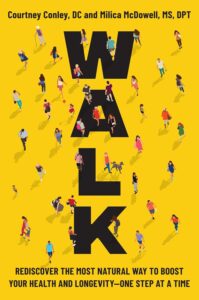
Enter Walk: Rediscover the Most Natural Way to Boost Your Health and Longevity ― One Step at a Time co-author Dr. Courtney Conley, foot specialist, longevity researcher, and the rare clinician who treats your toes like the longevity markers they actually are. In this conversation, Courtney unpacks why a humble post-meal stroll outperforms most blood-sugar interventions on the market, why the famous 10,000-step target is a 1960s Japanese marketing campaign with zero science behind it (the real sweet spot is 7,000 to 8,000), and why your toe strength might predict your future falls more accurately than your grip ever could. She walks listeners through the “micro walk” — five minutes, 500 steps, statistically significant drops in all-cause mortality for sedentary folks — and explains why your feet are sensory organs that lose 75 percent of their sensitivity by age 80 if you don’t use them. She also dismantles the cult of intensity, makes a tender case for “relationship walks” with teenagers and spouses, and reveals why the busiest machine in any gym should be the seated calf raise (it never is). Whether you’re a desk-bound professional, a weekend warrior who thinks an hour at the gym buys you a sedentary afternoon, an aging parent worried about falls, or simply someone who’d like to feel better tomorrow than you did today, this episode is a quiet revelation: the most powerful longevity tool you own is already strapped to the bottom of your legs. Listen (maybe while taking a leisurely stroll), learn, and enjoy!
Please Scroll Down for Featured Resources and Transcript!
Please note that some links on this page (books, movies, music, etc.) lead to affiliate programs for which The Jordan Harbinger Show receives compensation. It’s just one of the ways we keep the lights on around here. We appreciate your support!
- Sign up for Six-Minute Networking — our free networking and relationship development mini-course — at jordanharbinger.com/course!
- Subscribe to our once-a-week Wee Bit Wiser newsletter today and start filling your Wednesdays with wisdom!
- Do you even Reddit, bro? Join us at r/JordanHarbinger!
This Episode Is Sponsored By:
- Dell PCs: Find technology built for you: dell.com/dellpcs
- Aura Frames: $35 off: auraframes.com, code JORDAN
- BetterHelp: 10% off first month: betterhelp.com/jordan
- DeleteMe: 20% off: joindeleteme.com/jordan, code JORDAN
- I Told You So!: Scientists Who Were Ridiculed, Exiled, and Imprisoned for Being Right by Matt Kaplan
Thanks, Courtney Conley!
Click here to let Jordan know about your number one takeaway from this episode!
And if you want us to answer your questions on one of our upcoming weekly Feedback Friday episodes, drop us a line at friday@jordanharbinger.com.
Resources from This Episode:
- Walk: Rediscover the Most Natural Way to Boost Your Health and Longevity — One Step at a Time | Amazon
- Dr. Courtney Conley’s Foot Health Platform | Gait Happens
- Sole Switch: Functional vs. Minimal Footwear Course | Gait Happens
- Footwear Suggestions | Gait Happens
- Shop Page | Gait Happens
- Dr. Courtney Conley | Website
- What Happened When ‘Sons of Anarchy’ Star Charlie Hunnam Met the Real-Life Jax Teller | HuffPost
- Sons of Anarchy | Prime Video
- How Many Steps Do You Need a Day to See Health Benefits? | UCLA Health
- Focusing on 10,000 Steps a Day Could Be a Misstep | UT Southwestern Medical Center
- A Walk After Eating Can Change How the Brain and Body Respond to Food | National Geographic
- Positive Impact of a 10-Min Walk Immediately After Glucose Intake on Postprandial Glucose Levels | Scientific Reports
- Daily Steps and Health Outcomes in Adults: A Systematic Review and Dose-Response Meta-Analysis | The Lancet Public Health
- Stepping Into Better Health: Overcoming Hallux Limitus | The South Bend Clinic
- The Arch Myth: Investigating the Impact of Flat Foot on Vertical Jump Height — A Systematic Review and Meta-Analysis | BMC Sports Science, Medicine, and Rehabilitation
- Foot Health: Preventing and Treating Common Injuries, Enhancing Strength and Mobility, Picking Footwear, and More with Dr. Courtney Conley | The Peter Attia Drive
- Pedometer: History of the Manpo-kei and the 10,000-Step Goal | Wikipedia
- No, You Don’t Need 10,000 Steps a Day | Popular Science
- Walking Linked to Lower Dementia Risk | Harvard Health Publishing
- Max Lugavere: Prevent Dementia and Eat Like a Genius | The Jordan Harbinger Show
- Can’t Hurt Me: Master Your Mind and Defy the Odds | Amazon
- Understanding the Stress Response | Harvard Health Publishing
- Hammertoes: Causes, Symptoms, and Treatment | Cleveland Clinic
- Toe Weakness and Deformity Increase the Risk of Falls in Older People | Clinical Biomechanics
- Age-Related Reduction and Independent Predictors of Toe Flexor Strength in Middle-Aged Men (Toyota Motor Corporation Physical Activity and Fitness Study) | Journal of Foot and Ankle Research
- Are Foot Deformity and Plantar Sensitivity Impairment Associated with Physical Function of Community-Dwelling Older Adults? | Brazilian Journal of Physical Therapy
- Losing Touch: Age-Related Changes in Plantar Skin Sensitivity, Lower Limb Cutaneous Reflex Strength, and Postural Stability in Older Adults | Journal of Neurophysiology
- Earthing | Skeptical Sunday | The Jordan Harbinger Show
- Walking Speed: The Functional Vital Sign | Journal of Aging and Physical Activity
- Gait and Walking Speed as a Predictor of Health | Hebrew Senior Life
- Brisk Walking Lowers the Risk of 5 Cancers | World Cancer Research Fund
- Should You Add Rucking to Your Workouts? | Cleveland Clinic Health Essentials
- Andy Morgan: How I Finally Got Shredded (And You Can Too) | The Jordan Harbinger Show
- Daily Activity in Minimal Footwear Increases Foot Strength | Scientific Reports
- Plantar Fasciitis Rehab: Evidence-Based Loading and Strengthening | E3 Rehab
- How Recovery Sandals Can Relieve Plantar Fasciitis | OOFOS
- Stepping Forward Together: Could Walking Facilitate Interpersonal Conflict Resolution? | American Psychologist
- 5-4-3-2-1 Grounding: A Simple Sensory Exercise to Calm the Mind | Calm
- Effect of 6-Week Retro or Forward Walking Program on Pain, Functional Disability, Quadriceps Muscle Strength, and Performance in Individuals with Knee Osteoarthritis | BMC Musculoskeletal Disorders
1322: Courtney Conley | The Step-by-Step Guide to Living Longer
This transcript is yet untouched by human hands. Please proceed with caution as we sort through what the robots have given us. We appreciate your patience!
Jordan Harbinger: [00:00:00] Coming up next on The Jordan Harbinger Show.
Courtney Conley: Oh, mother and daughters, they actually can build relationships when they're walking and like who would have thought? Teenage girls are their own little animal. Okay. Just come walk with me. Just give me five minutes. I had her walk with me after dinner. We'd be a couple minutes into that walk
and then the floodgates would just open.
That doesn't happen when I'm sitting across from her at a dinner table. It doesn't happen when I go up into her room. It's when we're outside and she can just kind of relax a little bit. Walking together is so important. People need socialization. They need to have community you cannot lose, especially when you're walking with someone.
I say, "Okay, we've got some work to do."
Jordan Harbinger: Welcome to the show. I'm Jordan Harbinger. On The Jordan Harbinger Show, we decode the stories, secrets, and skills of the world's most fascinating people and turn their wisdom into practical advice that you can use to impact your own life and those around [00:01:00] you. Our mission is to help you become a better informed, more critical thinker through long form conversations with a variety of amazing folks.
We got spies, we got CEOs, we got athletes, authors, thinkers, and performers, even the occasional arms dealer, organized crime figure, cold case homicide investigator, our tech luminary. And if you're new to the show or you want to tell your friends about the show, and I appreciate it when you do that, I suggest our episode starter packs.
These are collections of our favorite episodes on topics like persuasion and negotiation, psychology and geopolitics, disinformation, China, North Korea, crime and cults and more. It'll help new listeners get a taste of everything we do here on the show. Just visit Jordanharbinger.com/start or search for us in your Spotify app to get started.
Today on the show, walking might be the most powerful health tool you have and most people are kind of screwing it up. Not, you could afford to optimize this a little type of screwing it up, kind of just fundamentally misunderstanding what walking even is. I know that's a little depressing, but hey, walking lowers your risk of death.
It improves mental health, predicts in a way how long you'll live, and we've somehow turned it into this optional choice that your watch nags you about. [00:02:00] Today's guest says walking isn't exercise, it's survival. And if you're not doing enough of it or you're doing it wrong, you're basically running a slow, quiet systems failure on your own body.
Now, here we go with Courtney Conley. So I'll just ask the most obvious, probably dumbest question first, which is, how can we walk wrong? I mean, we learn it as a baby. Nothing has changed much for me other than I, I fall down less and I don't wet the bed as much as I used to. How can I be doing that incorrectly?
How can I be doing the most basic human movement that I learned through instinct incorrectly? How is that possible?
Courtney Conley: That's a great way to start. Believe it or not, it's probably one of the most common questions I get in my clinic is patients will come in and they'll say to me, "You know, I just feel like something's off."
Or they're having difficulty with efficiency. Now they don't quite use that term, but us being a biped, so walking on two [00:03:00] feet should be something that we do very well and we should be able to do for very long periods of time. We are endurance walkers, if you will. As we age, if suddenly this becomes difficult or the efficiency becomes a problem, then people start saying, "Hey, this seems weird.
Why can't I walk normally, if you will?" It poses a great question because I don't think that we were all designed to walk the same. I mean, that's the beautiful thing about watching someone's walking gait. It's a window to their soul, really. You can tell if someone just got a promotion or just got fired.
They kind of wear their emotions with how they walk. It's kind of a, a footprint or a fingerprint, if you will. So when I'm always working with improving someone's walking gait, it's about making them more efficient, not necessarily making us all look like soldiers.
Jordan Harbinger: Got it. Yeah. You know, it's years ago, a friend of mine [00:04:00] was waiting for me in my apartment and I lived on Hollywood Boulevard and I was probably like four floors up.
And he was looking out at Hollywood Boulevard and I came in the door and I was like, "Aaron, I haven't seen you in so long." And he's like, "I saw you walking down the street." And I was like, "Man, you must have really good vision." He goes, "No, you just have a really specific gait." And I unfortunately know what that means.
It's weird because my dad has this. He walks like he's got a broomstick up his keyster and I probably have some version of that's, you know, getting worse as I age. I know what you mean, but it's very unfortunately really true with me. Like you can really tell who I am in a crowd even from up above four floors.
Like I just, it's obvious. Plane is day. I'll never disappear into a crowd in a spy movie. They would never pick me for that.
Courtney Conley: If you pay attention, there's a lot of people that have very unique gaits to them. People in the military, for example, will often say they'll have a gunslingers gait because the gun will be on one side, so they'll only be swinging [00:05:00] one arm.
I don't know if you're familiar with the show, Sons of Anarchy, but the main character-
Jordan Harbinger: I am, yeah.
Courtney Conley: Charlie Hunnam, I believe is his name.
Jordan Harbinger: Jax Teller. Is that who that is?
Courtney Conley: Yes, Jax Teller. He has like this kind of macho gait and he was being interviewed once and I thought this was really interesting. And they were like, "Did you have to, you know, learn how to walk like that for this show?"
And he was like, "No." He's like, "Actually, I just grew up in a rough part of town and you just adopted this don't mess with me gait." And that's what he has now utilized. So I think it's interesting when you see people's environments in the gait that they've adopted over the years.
Jordan Harbinger: Yeah, that is interesting.
So he basically was playing some version of himself, right, as many actors do. I always find it so impressive when you see ... I remember him having an interview and I was like, "That guy has an Irish accent? Holy moly." That's always so funny and shocking. Or you see somebody who's like really tough and menacing and then you see an interview with them and they're like a flamboyantly gay man and who's really not scary at [00:06:00] all.
And you're like, "Wow, you're such a good actor. Holy smokes." I would never have thought for one second that you're this like fun, friendly guy who you'd love to hang out with in a bar. Like you're a really good villain, man. And yeah, Jax Teller, same thing with that accent, but I guess it is funny that he didn't need any of that.
Just nope, I grew up in a place with a bunch of pipe fitters and if you didn't walk like that, you got beat up more. So here we are.
Courtney Conley: Tells a story.
Jordan Harbinger: Yeah. I wonder, is there any sort of connection between the testosterone level a man has and the way that they walk or anything like that? Is, has that ever been studied?
Courtney Conley: That has not been studied, but I would be curious to see the results on that one.
Jordan Harbinger: You've said in your book, walking is not an exercise, but a biological necessity. That's, I think, bad news for 99% of us. I timed how much I was sitting because my trainer was telling me, "Hey, you, the reason you're so stiff here and here is because you sit too much."
I was like, "I don't sit that much." I sit eight plus or 10 hours a day, depending on how much work I have that day. So the sitting and versus walking thing, I assume people used to [00:07:00] walk the amount that we now sit. Is that accurate?
Courtney Conley: Yeah, I mean, it is ... When I was doing the research for this book, it was really shocking to me to see actually how many of us are not doing a necessity to allow us to live well and live long.
That's why I was so intriguing to write this book because I was like, "We're looking at this all wrong." Walking shit is a physiological necessity. It's a core biological input, similar to breathing and sleeping, and these things are necessary for our survival. It's that repetitive low to moderate intensity motion that stimulates every system in our body.
It's very different than your one hour spin class or your one hour workout. It's an activity that needs to be trickled in throughout the day to stimulate our system. And when we have that input, that biological input, and that's working well, and we're sleeping well, and we're breathing well, these are the [00:08:00] stacking of behaviors that allow us to really live well and live long.
And I'll tell you, it's really hard. It's hard to be alive right now and say to yourself, "What am I supposed to be doing? I have to eat all this protein. I have to strength train three times a week and I have to ... " And I'm sitting here like going, "We're making this really difficult." Yes, these things are important, but if you look at baseline necessity, the average step count for people is around 4,700 steps per day, which means that there's a lot of us doing less than that.
And so when you say, you know, you don't realize how many steps you're taking or that sitting has become more part of your day, I was pretty shocked to hear that myself. Now, the first thing I ask my patients when they come into my office, I'm like, "How many steps a day are you getting?"
Jordan Harbinger: Yeah. How much are we supposed to get?
'Cause I'm looking at my phone right now and I'm like, "Okay, some days I have 15,000 or 10,000, but like most of this week it's been 3,000, [00:09:00] 4,300." I mean, I'm sick, so that's part of it, but it's not great.
Courtney Conley: So any movement is better than nothing. So in the book, we talk about, you know, meeting people where they are.
So I have plenty of patients that are in chronic pain and I'm sure we'll get to foot pain, but that is a big part of it when people can't walk because something hurts. And I will have patients come in where their step count is below 2,500 steps a day. That is sedentary. So at that stage, even f- adding 500 steps, which is five minutes, a five-minute micro walk is about 500 steps.
When you have someone who is having the least amount of activity, those 500 steps make such a huge impact in their health, decreasing all cause mortality. I mean, that's where the big bang for your buck is when the step count is low. '
Jordan Harbinger: Cause you're getting like a 20, 25% increase in daily step count. What'd you call it?
A micro walk?
Courtney Conley: A micro [00:10:00] walk. So we define that in the book as five minutes. I wanted to make things digestible for people. So if we talk about this walking spectrum, these are the people that, you know, are pretty sedentary, whether it's because they've been in pain or they've just engineered their way out of walking or what have you, whatever their reason may be, adding five minutes to your day adds 500 steps, that's game changing.
Jordan Harbinger: That seems really easy, but we are, to your point, engineering walking out of our lives. I know people have treadmill working stations now and stuff. Well, actually, what do you think of that? Because you want people to walk more, but something about that doesn't seem right to me because you're not, you're probably not getting a variation in how you strike the ground and you're not getting any fresh air or sun.
I'm curious what you think of it. Is it better than nothing or is it just like a silly biohacker thing?
Courtney Conley: I think it's better than nothing. A lot of my patients will be like, "I don't sit at my desk, but now I have a standing desk." You're still not moving. Gravity is, is still winning here. So whether you're sitting or you're [00:11:00] standing, there's no movement variability happening, and it's that movement variability that our bodies crave.
So these walking treadmills that people have under their desks, I'm all for it, because especially in environments where it's cold all winter, or someone has fallen and they're hesitant about getting outside, things like that, this can be a safe, controlled environment for people to get movement in their bodies.
And in that controlled environment, you can regulate things like speed or incline, which I think also has a positive benefit.
Jordan Harbinger: Most of the people I know that have these treadmill desks, they're already athletes, and it's like, "Okay, you're probably not adding a ton." But my former producer, he was shaking an alcohol addiction and, like, losing weight because he had a stroke and he got one and he's like, "This is a game changer."
So I guess the good news is the more sort of sedentary and the less you move, the more you stand to benefit from something like a simple treadmill or whatever walking pad onto your desk. You mentioned before that when you remove walking, you're not getting any of the benefits from walking. Yes, there's a [00:12:00] calorie burn, but what's happening in your body when you're walking?
This sounds simplistic, but other than you're moving, like, what happens when we are moving that needs to happen that doesn't happen when we're sitting? I guess that's what I'm asking.
Courtney Conley: It's such a great question. I want to touch on one thing before we go there that you had mentioned. When you think of this whole walking treadmill, you got me thinking here, we have so many people that will do their one hour workouts in the morning, right?
So they'll go, like, hit it really hard, and then they'll go to their job and then sit there for eight to nine hours a day.
Jordan Harbinger: Okay, that's me.
Courtney Conley: That, just because you got your one hour workout in, that doesn't negate you from moving for the rest of the day. And this is where the second part of your question comes in.
Let's just take eating, for example. Let's take your metabolic system. When we eat, we have a glucose spike. So let's say we eat a meal that has higher carbohydrates or more sugars. You get a lot of glucose that goes into your bloodstream and that level can rise very quickly. And so we have to get that [00:13:00] glucose out of our bloodstreams and into our cells where it can be de- utilized.
There's two systems that do that, your pancreas, and also the contractile motion of your tissues when you move.
Jordan Harbinger: Mm.
Courtney Conley: So we have the pancreas and we have contraction of tissue. So if I'm eating and I sit after I eat, I'm only taking advantage of one of those systems, the pancreas. We're not taking advantage of the other system, which is movement, which is activity.
And so the pancreas doesn't like that too much. And so when you have people that have diabetes, for example, or insulin resistance, or pretty much anyone in general, the research is awesome. It's after you eat, go quickly, go within 30 minutes, and go for a 10 to 15 minute walk. It's that walking that will grab the glucose out of the bloodstream, work with the pancreas, and now you have this [00:14:00] metabolic system that is working more efficiently.
I love that. It's like the lowest hanging fruit. I feel like we should be screaming that from the rooftops. Everybody, when you're done eating, take a 10 to 15 minute walk. You will feel so much better. That's the metabolic system. But if you were to look at your nervous system, for example, when you look at mental health and walking for mental health, again, the research is astounding.
Getting outside and having that repetitive gait, that repetitive motion, we're stimulating neurotransmitters in our brain. We're decreasing cortisol. You're increasing your parasympathetic state, which is the chill state. These are all very, very good things. Getting to 5,000 steps a day decreases the risk, the symptoms of depression.
This is a very, very big thing that I think we need that should be on every prescription pad. That if you have [00:15:00] ever suffered from depression or have symptoms of it, this should be the number one thing on the prescription pad. Your goal is 5,000 steps per day. And if you can get to 7,000 steps per day, you're reducing the risk of getting depression.
This is like a no-brainer, I think.
Jordan Harbinger: Yeah. W- well, I've had some pretty stressful business and life situations, and fortunately, I live in a nice California, right? So I went outside in February or whenever this sort of last one was several years ago, and I remember walking for, like, five to six hours per day for months, or at least weeks, several weeks.
And I would be on the phone talking with my friends and family, which sort of coincidentally is one of the best ways to lower cortisol, right? I'm outside getting some sunlight, getting some exercise and socializing with people, and I felt not as horrible as I would have if I was just in my room sulking and wondering if I was going to fail at life, I guess you could say.
I mean, it [00:16:00] just seems like your body kind of knows that. I mean, I couldn't sit in the house. It w- my body wouldn't let me do it.
Courtney Conley: I think we all have personal experience with that somehow, whether we knew that's what it was doing or not. I used to live in Chicago before I moved out to Colorado and, you know, it was a rough time in my life personally.
And when I moved out to Colorado, I was like, "You know what? I'm just going to keep walking up that mountain until I feel better." And it's why this topic is just so passionate for me because it changed my life. It took me from really not having a grasp on things. It was a constant struggle. And if someone were to say to me, "You can't walk," it would be a very dark place for me.
And so it was really life changing for me.
Jordan Harbinger: So we covered the digestion thing, but what else is going on, you know, the cortisol and, and exercise elements. Is there anything else that's happening? Because I, I think what I'm trying to get at here is the opposite then would happen when you remove walking from daily life, which most of us have [00:17:00] done.
Courtney Conley: Yeah, I think so. If we look at walking as this core biological input that basically stimulates every system in your body, so we've talked about the metabolic system, we talk about the nervous system. If you go to the musculoskeletal system, for example, walking is considered a mid-range of motion activity.
So what that means is if when I'm walking, I have to push off my foot. I get about 40 degrees of range of motion in my big toe. That's what we're looking for there. So end range of motion at the toe is about 65 degrees. So it's a mid-range range of motion that happens at the toe, it happens at the ankle, it happens at the hip.
So it's a safe activity for people. It puts loads into your system. It puts load into your tissues, into your muscles, into your tendons, in an environment that is safe for people. So if you were talking to your endurance athlete or your ultra athlete, for example, we need to say to them, "Hey, listen, walking should be a part of [00:18:00] your everyday life because it's a different type of load.
It's going to take stress off your system. You need recovery. This is good for you. " And then on the other hand, when you have people that aren't putting enough loads through their system, you basically can coach it in a different manner saying, "Hey, if you start walking more, you're going to be putting more loads through your tissue.
This is good for your system." So that's why everyone, I think, if you're on this planet, you fit along the spectrum of why this has to happen for you.
Jordan Harbinger: And the people like me who are like, "Ah, I go to the gym, I'm fine." We're missing out on all that because we're not getting most of that most of the time.
We're just, like you said, going hard and then not doing most of the things we need to be doing for, I don't know, 55 minutes and that's it.
Courtney Conley: Jordan, if I could say one thing that I would love to get across to people, it is exactly what you just said there, that regardless if you're an athlete and you're getting your one to two hours of work in a day, and it might be a good workout, you want to get to about seven to 8,000 steps [00:19:00] per day.
That number right there is your key to maximizing these longevity benefits. And so I think a lot of us, even though we think we're active, if you look at your step count at the end of the day, I know when I'm in my clinic, I'm like, "Man, I haven't sat down today." And then I'll look at my watch and I'm like, "Yeah, I'm only at 5,000 steps though."
And it's a reminder for me that when I get home, I'm going to grab that seven to 8,000. That doesn't mean I didn't work out in the morning because I did, but it's having that consistent behavior that happens day after day, and that's an important conversation to have.
Jordan Harbinger: For me, it's airports. You, you take like a 5:00 AM flight and then 6:30 AM you're sitting on the plane and it's, "You've completed half your activity goal today."
And you're like, "Man, just from going from one gate to the next at an airport like the one in Denver, for example, I'm at 9,000 steps and it's 7:30 in the morning- ... And the rest of it's gravy. It's actually really incredible. But yeah, on other days, not so much. I swear, [00:20:00] even when I try to walk, I still can't walk as much outside as I do randomly in an airport going from Chipotle to wherever, whatever gate.
Courtney Conley: I love going to airports. It's a great place for me to watch people walk. Well, I think what something you said too about hitting that 9,000 steps, there is a law of diminishing return. So we talk about this in the book that, you know, when you look at the research, that sweet spot is about seven to 8,000 steps a day.
I will have patients who will come in and they'll say, Dr. Conley, I'm walking 15, 16,000 steps a day, which great, but know that after about 10 to 12,000 steps when you look at the research, it plateaus from a benefit perspective. And so I will ask them, "Are you strength training? Are you doing any type of aerobic activity?"
And if they say to me, or high intensity aerobic activity, and if they say, "Well, no, I don't have time because I'm getting 15,000 steps in. " This is the perfect time to have that conversation of back down your step count. Even [00:21:00] take it to 10,000, this will free up more time for you to strength train and to do the other activities that are necessary for healthy aging.
So I like that conversation too, that there's this plateau that can also be hit.
Jordan Harbinger: You mentioned earlier the toes are, I don't know, 40 to 65 degrees. This is probably, possibly only me, but my toes do not bend back like anybody else's toes. I remember when I was doing karate as a kid, they'd be like, "Move your toes back."
And my toes would go up like one centimeter off the ground and other people could basically put their toes at 90 degrees and I stretched and stretched and stretched and it improved, I don't know, 50% or 100% and other people who never stretched at all can still do five times more. Is that a problem or is it just some people are built that way and it's no big deal?
Courtney Conley: I mean, I'm a little biased, I'm a foot person, but I think the mobility at the big toe is probably one of the most important joints in the human body. When you're walking in order to have that efficiency that we're talking about, [00:22:00] that big toe has to get to 40 to 45 degrees, and there's a reason for that because it sets up
I think people forget that the foot is attached to this body. So when you have a big toe that can't get to that range of motion, you're still going to be able to walk from point A to point B, but you're going to take down that efficiency, you're going to find a way to compensate. So for example, one way might be to lift your foot up, right?
So instead of rolling through the foot, we talk about this in the book, rolling through the foot, you end up ... It's like a step gait.
Jordan Harbinger: This is what my dad does. I mean, he's 83, but like he doesn't roll through the foot.
Courtney Conley: And then people will say, "My hip flexor hurts." Because now you're not creating efficiency, you're picking up your foot and you're dropping it down.
So that range of motion at that toe not only sets up for efficient movement at the foot, but also at the knee, at the hip and at the low back, I cannot tell you how many patients of mine that I [00:23:00] have treated for low back pain coming from their foot.
Jordan Harbinger: Yeah. I had a massage therapist years ago that said, "Oh, you have flat feet?
Your back's going to be shot by the time you're 40." True or not, because I'm 46 and my back is totally fine.
Courtney Conley: Yeah, I love the conversation of flat feet. Let's just break this myth right now. Flat feet are not bad. So just because you see a foot that looks flat, there's so many variations to the foot. There's so many different structural variations that just because when you see a foot that is flat does not mean that is bad, how does it function?
A foot needs to be strong, it needs to be mobile, and it needs to be able to adapt to the ground, meaning it needs to be able to change shape. So when we look at strength training our bodies, for example, which everybody is doing now, more so than 20 years ago, I'm all for it. Don't forget about below the knee, because there's a lot of muscles in the foot.
There's a lot of [00:24:00] tissues that help us create power and strength as we age, and when we forget about them, that is a very, very big problem. So when I see a flat foot, I say, "Well, can you lift just your big toe? Can you lift your foretoes? Can you do certain amount of calf raises? How does your power look?"
And if they start failing these tests, then I say, "Okay, we got some work to do. "
Jordan Harbinger: Now, get off your butt and, I don't know, walk around in circles while you visit our sponsors. We'll be right back. This episode is sponsored in part by Dell. Dell PCs with Intel inside are built for the moments that matter. For the moments you plan and the ones you don't, built for the busy days that turn into all night study sessions, the moment you're working from a cafe and realize every outlet is taken, the times you're deep in your flow and the absolute last thing you need is an auto update throwing off your momentum.
That's why Dell builds tech that adapts to the way you actually work, built with long-lasting batteries so you're not scrambling for the closest [00:25:00] outlet, and built in intelligence that makes updates around your schedule, not in the middle of it. They don't build tech for tech's sake, they build it for you.
Find technology built for the way you work at Dell.com/dellpcs.
This episode is also sponsored by Aura Frames. Mother's Day coming up real fast instead of the usual playbook, Crowded Brunch or a card you grab last minute, get the Aura frame. We love our Aura Frame because it actually gets our family trip photos out of the black hole that is my phone and everyone else's phone.
We all take a million photos on vacation and they sit there buried in the camera roll forever. And with Aura, we load those photos onto the frame, which is super easy to do, and we can see them displayed on rotation. And I also love that it displays live photos, short videos. It's this constant little reminder of all the fun, ridiculous moments that we've had together as a family.
And when friends come over, a photo pops up, suddenly we're telling the story behind it, the trip, the mishap, the moment we forgot about until Aura brought it back. And of course, you can update it whenever you want. And that's just what makes it feel different from a regular gift. It's not just at the frame, it's a way to keep those memories alive instead of letting them [00:26:00] disappear into the cloud.
Jen Harbinger: Named number one by Wirecutter. You can save on the gifts moms love by visiting or frames.com. For a limited time, listeners can get $25 off their best-selling Carver mat frame with code Jordan. That's A- U-R-A frames.com, promo code Jordan. Support the show by mentioning us at checkout. Terms and conditions apply.
Jordan Harbinger: Obligatory Six-Minute Networking plug goes here. You've heard me prompt this a thousand times. It's free. sixminutenetworking.com, no shenanigans, down to earth, just a networking course that'll help you no matter where you are in your career, and yes, even if you're retired, again, free no shenanigans at sixminutenetworking.com.
Now, back to Courtney Conley. Okay. I'm quite strong. I have really good balance. And my mom used to always joke, you should because your big toe is the size of most people's fist, right? I have this, like, really strong, big toe. I can balance quite well, and it probably honestly is because my big toe, I mean, it's really strong.
And there's these surgeries where if somebody loses a thumb, they'll replace it with a big toe and I'm like, "Oh my God, if that ever happened to me, I'd [00:27:00] be such a freak because it's enormous." So I do wonder if my flat feet are actually okay because you mentioned the degrees 45 degrees. I bet I could do that if I was pushing off of something.
I don't think I can do it just standing there where I have to lift my toe up on its own. So is that different? 'Cause, like, if I'm walking, I can push my toes in a certain direction. I just can't lift them in a vacuum directly upward. You know what I'm talking about?
Courtney Conley: So passive range of motion. Can you see Eddie here, my foot model?
Jordan Harbinger: So the people who are listening can't, but yes, there's a fake bony foot that you're holding up.
Courtney Conley: I bring ev- Eddie everywhere. Passive range of motion would be, can you take your big toe and can you lift it? And we should be able to get 60, 65. Some sources would say even more range of motion there.
Jordan Harbinger: Now the trick is going to be, can I lift my foot up?
This is a standing desk. This is going to be tricky. Let's see what happens.
Courtney Conley: We'll talk about hamstrings next.
Jordan Harbinger: Ugh, what angle?
Courtney Conley: Yeah.
Jordan Harbinger: That's not 60, that's not 65 degrees.
Courtney Conley: No. So [00:28:00] passively, you should be able to lift your toe up. So if you were at home and 90 degrees would be up, straight, up and down, you'd want to go to about 60, 65 degrees, passive range of motion, lifting your toe.
Active would be how high can you lift it? We want those range of motions to be close together. So when I'm pushing off in the gait cycle, so when I'm walking and I'm pushing off of my foot, that big toe has to get to about 40, 45 degrees. If I was sprinting, that's when I want to grab that 60, 65 degrees.
It's more range of motion. But that's why it's so important. We have to train movement variability because you start decreasing range at joints in the foot, and again, you will still get from point A to point B, but you're going to pay for it somewhere.
Jordan Harbinger: So what do I do? I mean, I've stretched this for years, not, not recently, but like when I was younger, I stretched for years and I feel like it barely improved.
Courtney Conley: The first conversation you have to have is, is there pain associated with it? [00:29:00] Oftentimes when I'll have my patients lift their toe, they'll be like, "It's pinching on the top of the foot."
Jordan Harbinger: No, I don't have that.
Courtney Conley: That is not what you want. You can start to, when a, a joint starts to reduce its range of, range of motion, especially at the big toe, you can develop arthritis on that joint.
And so people will be like, "It feels stiff, so I'm just going to keep trying to increase this range." If you do that and you irritate the joint, you will make things worse. So you have to be able to assess, can I lift my toe and is there any pinching pain at the top? These are, we, in the book, we have a whole foot assessment chapter.
So it's, can you lift your big toe? How do you improve your range of motion?
Jordan Harbinger: It doesn't hurt me at all to do it. It's just that if I push hard enough to stretch it, like I feel like it could just it could break or something. I mean, I can really hammer down on it hard and it just, it doesn't hurt or anything like that.
Courtney Conley: Well, I guess my next question to you would be, I'd want to see what your calf raise looks like because calf rays [00:30:00] Is, I say this all the time. When you go to the gym, the busiest machine in the gym should be the seated caf raise machine and there's never anybody on that thing.
Jordan Harbinger: No.
Courtney Conley: People don't realize what happens as we age is we lose power.
We lose power faster than we lose strength. Where do you think you get power from? You get it from your foot and your calf. That's what propels us forward. That's what creates efficient walkers as we age. Those tissues need to be strengthened just like your glute. And so when you're doing a calf raise and you'll see people that don't have good range of motion of their big toe, when they do their calf raise, they load the outside of their foot.
Almost looks like they're going to sprain their ankle.
Jordan Harbinger: Yeah, I've seen that. I don't do that because I deliberately don't do that though. It's not that I don't want to do that.
Courtney Conley: Yeah.
Jordan Harbinger: It's that I force my feet to move properly or Chad yells at me on Zoom. My trainer. Because it's like the cheat way, right? Yeah.
You just, especially if you're balancing when you do it, you load the other four [00:31:00] toes and your feet go out weird and it's like-
Courtney Conley: But low gear push off. You want to push through the big toe and the second toe. And, you know, for people that have had ankle sprains, for example, that is a very common thing you will see when they do a calf raise because the peroneals, the muscles on the sides of the leg, if those aren't retrained or we don't improve these movement patterns, those tissues stabilize the big toe.
And so you'll often see people do calf raises that have had ankle sprains and it looks like they're just going to sprain their ankle again.
Jordan Harbinger: I'm apparently quite strong in that position. I mean, I don't have much of a reference, but my trainer trains a lot of people and he's like, "Oh no, this is like a good calf raise with a decent amount of weight."
So hopefully that's a good sign because again, my toe has very low mobility. In fact, I almost trade mobility for strength in a lot of different movements, legs aside, just other things like I can do certain things really heavy or do a lot of pull-ups, for example, or like do weighted pull-ups, but I can't move things passively even with no weight past a certain point.
It just depends on the joint.
Courtney Conley: All [00:32:00] joints need to have mobility and stability. That's important to realize that we have to have access to range of motion and we have to be able to control it. When we're looking at training patients, we always say, you know, we, we want to train into all these various ranges of motion and that's where we're going to start to train for power and strength.
Jordan Harbinger: Where did the 10,000 steps thing come from? 'Cause you, you haven't said that number one single time, right? You said 7,000, then you said 12,000. And I'm like, "Where's the urban legend, I guess, where you need to get 10,000 steps a day?"
Courtney Conley: It's pretty wild, right? If you Google like, "How many steps should I take a day?"
You'll find 10,000 somewhere. And there's no science based on this number. It was a Japanese pedometer that was created during the Tokyo Olympics and it was a company that had created this pedometer and I believe the name is a manpoque, which actually means 10,000 step meter. So it was a marketing campaign for this pedometer, and that's where the 10,000 steps [00:33:00] came from.
And I was really excited to read this research because I think when we're talking to people about getting their steps in, that number can often seem daunting. I got all this stuff to do, and now you got to strengthen your big toe, Jordan, and now you got to get 10,000 steps in, you know? So it's kind of a daunting number, but when you look at the research where we get the most benefit from a longevity perspective, that number's digestible.
And I think that's very reachable for a lot of us in conjunction with the other training that we're doing and still having a life and still doing the thing.
Jordan Harbinger: You mentioned in the book that walking can reduce the risk of things like dementia. And I want us to highlight the risk of things, not walking will cure your dementia.
But like, tell me about the effect on that, because I think that's really important. I mean, this is personal to me. My mom is, she's been diagnosed with Alzheimer's, my audience knows that. But one of the things she stopped doing because she got depressed about it was going out as much and walking as much.
And I mean, it's too late because she's already been diagnosed with it, but I think [00:34:00] me personally, I don't really want to have to deal with that if I can avoid it.
Courtney Conley: It's such a, an interesting topic when you think about this tool that we have at our hands to help patients like this. When we look at walking and the benefits for mental health, we have
When you think about this activity, we know that it decreases cortisol. We know that it improves parasympathetic nervous system, if you will, and we also know that it improves blood circulation to our brains. And so there's a lot of things that occur when we are engaging in this motion, and when you get to this repetitive step count, 5,000 steps per day, you really start to see these, the risks start to drop for patients with dementia.
And this is, you brought up such a good point, Jordan, that I think it's stacking behaviors. I don't think we can say to people, "If you hit 5,000 steps per day, [00:35:00] that's it. Oh, this is all you have to do to reduce your risk of dementia." But when you start getting people outside, and now they have sunlight and they have movement, they start to feel a little bit better.
And so when you start to feel better, you're sleeping better. Your respiration rate is better. Maybe now, your mom's walking with her friends, or you go and take a walk with her. The research on relationship walks, walking with people, it warms my heart. It was so great to read. So I think that's the conversation when we look at dementia and Alzheimer's is not only what it does to our biological systems, what it does to our brain, what it does to our cardiovascular system, but also what it does to us socially as human beings.
And I think that's a very big conversation and it's a bigger conversation.
Jordan Harbinger: I think a lot of people in the exercise world, or especially the online sort of influencer segment of the exercise [00:36:00] world, they love to lean into more intense is better. And I get that. I mean, it's, you don't get attention for running a normal mile or something like that, right?
You get attention for running a five-minute mile with one lung functioning while you're bleeding or something like that, right? You have to David Goggins your way into internet fame, but I think a lot of people are sort of over-indexing on intensity when it comes to physical fitness and maybe under investing in consistency.
And it sounds like maybe you support that just given what you're telling me about walking, because you're not telling me to do hillsprints necessarily.
Courtney Conley: It's really interesting. For those who know me, my background has always been ... My nickname is actually Max, if you can believe that. Everything I have ever done has been to max capacity.
I was a triathlete, I always trained very hard, and, and it caught up with me. It really did. And I've had to learn over the last probably decade once I turned 40 that this is not going to be the way. I can't just keep pounding the pavement. [00:37:00] And once I learned how to recover, and I still train quite a bit, but now there's this component of recovery that I now respect a lot more, and I see it a lot with my patients.
I tell them all the time, "It is harder to turn tissues off or to quiet things down than it is to build things up." So what I mean by that is when we're looking at improving someone's strength and capacity. If they come into my office and they're like, "More, more, more, and I want to sh- and I want to load, load, load, and I can't get their systems to chill out and reset," these are the people that continuously are getting injured.
Because they're running around in this high sympathetic nervous state, it's always more and more and more, and there's no calming to their system. You cannot survive like that. You cannot survive in fight or flight mode forever. And I think, especially in our society, there's a reason for that. It was a survival [00:38:00] mechanism, you know?
We need to be able to run from a line. The problem is, is in today's society, we don't know if we're running from a lion or running from a deadline, so it's this constant state of stress. And if you can't dial it down, you can't build it back up. And that is why I think this conversation of walking is so important, especially for those who have been in pain.
Jordan Harbinger: You mentioned earlier that feet can tell you what's going on in part in the rest of your body. So how do problems in the feet show up elsewhere in the body? I mean, yes, okay, foot, pain, knee pain, hip pain, but I'm talking about maybe above the waist, or am I reaching with that?
Courtney Conley: The coolest thing about the foot is if you were to look down at your feet, it's the only place in the body where you can look at it and see aberrant loads, right?
Something isn't right. Do you see a bunion? Do you see a hammer toe? This is my favorite one because the toes should be the widest part of your [00:39:00] foot. So when you look down at your foot, does your foot look like a shoe? So where the toes would be tapered or does it look like the toes are splayed in wide because that's what it should look like?
Jordan Harbinger: You got me looking at my feet. My toes are kind of wider than the rest, but they're not splayed per se, but they are definitely wider than the rest of my foot.
Courtney Conley: You should be able to lift up all your toes, spread them, and so when you spread your toes, you should see daylight between each toe.
Jordan Harbinger: This is ridiculous.
Let me try that.
Courtney Conley: It's what I do all day long.
Jordan Harbinger: I can ... There's very little, but I can see between each toe. It's not a lot. It's not like my fingers.
Courtney Conley: I mean, there's going to be a lot of people listening to this that I guarantee you cannot. Number one, lift up just their big toe, for example, or lift their four toes.
Oh,
Jordan Harbinger: I can do that.
Courtney Conley: But a lot of people will not be able to splay their toes and their foot looks like a shoe.
Jordan Harbinger: Huh.
Courtney Conley: That is not a stable position for the foot. When we walk, [00:40:00] when we go to push off, there's a lot, many times our body weight going through our forefoot. That's why most of the injuries in the foot occur at the ball of the foot.
And that ball of the foot better be wide and it better be stable and it better be strong to handle the loads of walking, which are several times your body weight, running those numbers increase significantly. So when I see numbers like one out of three people over the age of 45 have foot pain, we shouldn't be scratching our head going, "Hmm, I wonder why."
Because people don't pay attention to their feet. People's feet are weak, the footwear is compromising the function of their feet, and this is what we get. And I test toe strength in my office with every single patient. How strong are your toes? There is a very interesting study looking at some men in Japan.
They worked at a Toyota factory. There were 1400 of them, and they looked at the toe strength versus hand grip strength. So we know that hand grip [00:41:00] strength has been a big tester for longevity, like, can you grip something? And what they found was actually toe strength diminishes first. You will lose toe strength before you start losing hand grip strength, and that toe strength is actually associated with your glucose levels, with your exercise activity.
So it's a marker, it can be a marker of your metabolic health. And I don't think we ever think about the toes like that. And one of the biggest things I deal with in my office is getting patients to make sure that they feel confident when they're walking and they're not falling, because falls are a problem.
And one of the predictors of falls as we age is a weakness in our toes. I'm very passionate about that because my goal is to keep people walking as much as they want to as they age, and that's going to happen by making sure that their foot is strong.
Jordan Harbinger: What are the first signs that your feet are dysfunctional?
You mentioned toe strength, but let's say I'm [00:42:00] listening to this at home or while I cook dinner, I don't necessarily know if I have strong toes. Is there something where it's like, oh, if you have this, that's a canary in the coal mine for your foot strength or your feet are dysfunctional in some way.
Courtney Conley: If you look at the foot from a structural perspective, so bunions, for example, there's a bump on the inside of the toe, the big toe, and you can have a tailor's bunion on the out pinky toe.
Things like hammer toes. If you have a bunion or a hammer toe, those two things can increase your risk of falling because it compromises balance.
Jordan Harbinger: What's a hammer toe?
Courtney Conley: So like the claw toe. It looks like a claw almost when the toes are like scrunched.
Jordan Harbinger: Oh, that sounds gnarly. How do you get that? What is that from?
Courtney Conley: So the best way to explain this would be, if you were to do a calf raise, for example, and you come up onto the ball of your foot, your toes should be soft. They shouldn't be gripping the ground. So if you do a calf raise and your toes are gripping the ground, you're not using the intrinsic strength of your foot.
[00:43:00] What you're doing is you're clawing to try to stabilize your body. When you see toes that claw or grip, that should tell you, "Hey, why is this person trying to stabilize by gripping the ground?" So again, that's that conversation, quiet things down. So when I start to see hammer toes, is it what's called flexor stabilization?
Are they trying to stabilize their bodies by gripping the ground? And if so, we got work to do. We got to strengthen your foot. And it's early intervention. So when I see hammer toes that are flexible, right, where they can still move, this is a muscle imbalance. We're going to work through that. You're going to get in the right footwear and you're going to exercise your foot.
But the longer you wait, those hammer toes start to get rigid, and then they become very, very painful. And now the solution is we got to get in there and surgically start cutting tendons and try to strengthen the toes. I will tell you, I see people with foot surgeries every single day, and there is a [00:44:00] time and a place, but I want to educate people so much that if you start paying attention to this stuff, it will save you so much in the long run because I see people every single day that cannot walk because of foot pain, every single day.
Jordan Harbinger: You might throw your back out when you tie your shoes, but you can support our sponsors injury free. We'll be right back. This episode is also sponsored in part by BetterHelp. I've been with BetterHelp for years now, and therapy has become non-negotiable for me. It's helped me stay grounded, get out of my own head, generally become a much saner person, which if you know me is really saying something.
I recommend it to pretty much everyone, and BetterHelp is now accepting insurance in many states with average copays around 23 bucks. So if you've ever considered therapy but just haven't taken the first step, let this be a sign. BetterHelp makes that first step simple. You fill out a quick questionnaire, check your coverage in minutes, and they help you match with a licensed therapist based on what you need.
BetterHelp has over 30,000 licensed therapists with a wide range of experience and specialties so they can help match you with somebody who fits what you're [00:45:00] actually looking for. They've served more than six million people globally, myself included, and members rate live sessions an average of 4.9 out of five based on over 1.7 million client reviews.
Jen Harbinger: BetterHelp is in-network with major health plans like UnitedHealthcare, Cigna, Aetna, and more. With average copays around $23 for eligible members. Fill out the questionnaire and check your coverage today at betterhelp.com/jordan. That's betterhelp.com/jordan. Average copay is based on eligible members.
Actual cost and coverage may vary by plan.
Jordan Harbinger: This episode is also sponsored by DeleteMe. DeleteMe makes it easy, quick, and safe to remove your personal data online at a time when surveillance and data breaches are common enough to make everyone vulnerable. Most people don't realize how much of their information is just out there.
Your phone number, home address, family members, all sitting on these random data broker sites and getting it removed is a full-time job. That's why DeleteMe is so useful. They basically do all the heavy lifting for you, wiping your personal information from those data broker websites, so you don't have to chase them down one by one.
And this is not a one and done thing either. They're [00:46:00] constantly monitoring and removing new stuff as it pops up because once your info's out there, it tends to keep spreading. As somebody with a pretty active online presence, obviously, privacy is a big deal for me and you don't have to be famous, not that I'm famous, but you don't have to be famous in any respect to have your personal information exposed.
It happens to regular people all the time. And once that data's out there, getting it back under control is basically a huge pain/impossible. That's one reason I use DeleteMe. It's easy to set up. Honestly, it's satisfying to get a regular report showing what they found and what they removed.
Jen Harbinger: Take control of your data and keep your private life private by signing up for DeleteMe.
Now at a special discount for our listeners. Get 20% off your DeleteMe plan when you go to joindeleteme.com/jordan and use promo code Jordan at checkout. The only way to get 20% off is to go to joindeleteme.com/jordan and enter code Jordan at checkout. That's ... joindeleteme.com/jordan, code Jordan.
Jordan Harbinger: If you like this episode of the show, I invite you to do what other smart and considerate listeners do.
That is take a moment, support our sponsors. They make the show possible. All of the deals, discount codes, and ways to [00:47:00] support the podcast are searchable and clickable over at jordanharbinger.com/deals. If you can't remember the name of a sponsor, you can't find a code, email somebody over here, Jordan@jordanharbinger.com.
We're happy to dig these up for you. It's that important that you support those who support the show. Now, back to Courtney Conley. I just did a little calf raise as you ... Anybody watching on YouTube is going to be like, "What is he doing? 'Cause I keep doing things with my feet here." I'm just resting kind of on the ball of my foot, and then the toes are keeping me balanced from falling forward, but they're not, like, tensed up or anything.
And if I was doing a calf raise and I was holding onto something or I had the shoulder pads, like, on the machine, I wouldn't even need to flex my toes at all because I would be using that for balance.
Courtney Conley: Yeah, you're using your foot, you're using your calf.
Jordan Harbinger: That's good, right?
Courtney Conley: Yes.
Jordan Harbinger: Okay. Thank God. I'm not used to getting good news about my body on this show.
Courtney Conley: You know, another, like, you mentioned, like, tests that people can do. If you were to stand up, it's actually called an anterior fall envelope. Most falls occur at the initiation of [00:48:00] gait. So if I was going to walk towards you, this is when a lot of these falls occur, and there's a reason for that, because if we lose strength in our toes, this is one of the things that helps us feel the ground.
So if you were to stand up near a wall, and your feet are flat on the floor, and you lean into the wall, straight body, as far as you can, what you'll feel is your toes pressing into the floor. Your toes are what's stopping you from your head smacking up against the wall. That distance we measure in my office, it should be about, I look for about four and a half inches.
So you should be able to lean forward about four and a half inches and control your fall. And if you can't do that, toe strength, we need to focus on that. And here's the other unfortunate event that happens as we age. Sarcopenia is a very real thing, right? We know we lose muscle mass as we age. People need to start [00:49:00] realizing that we lose that also at our foot.
But the other thing that happens with our feet is we have all these beautiful sensory receptors on the bottoms of our feet. Think of the foot as a sensory organ. And so it tells us where we are in space. How are we moving? It's gathering sensory information, driving it to our brains, and telling us, "Hey, you need to be upright.
You need to be balanced when you walk." So you start screwing around. In diminishing that sensory information, you're going to have a problem. But when you turn 50 years old, it takes 25% more pressure to stimulate those same receptors in your foot. And when you turn 80, it takes 75% more pressure. So we lose sensitivity to these receptors as we age.
We lose strength in the foot as we age. And do you know what improves all of that? Exercise. So [00:50:00] exercise increases circulation in our foot. It increases nerve fiber branching. So even for those who have peripheral neuropathies, things like that, exercising the foot helps. It's such an important conversation to be had.
Jordan Harbinger: I think a lot of people are going to listen to this and be like, "Wow, you know, you can tell toes predict longevity and the foot strength and this, but I want to hear your opinion on things like reflexology because my family's Chinese, right? My wife's side of the family. My mother-in-law booked this foot reflexology appointment for me and basically this woman from Tibet or whatever is rubbing my feet and she's like, " Oh, you have knee pain.
"And I was like, " Nope. "And then she's like, " Uh, but you get headaches. "And I was like, " Nope. "And she's like, " Ah, hip pain. "And I was like, " Look, you're just guessing at this point. ""No, not at all. " And then she gave me this dirty look and was like, "You said you're 45." And I was like, "Yeah." And then she just kept massaging my feet and she was like, "Go home, you're fine."
I thought that was interesting because to me it seemed a little bit like [00:51:00] you ever go to a fair and there's a psychic there and they're like, "You have some uncertainty in your life." And I'm like, "Yeah, you're guessing until I nod and then you're going to go down that road." I felt like that's what she was doing, but with my foot.
Courtney Conley: I've been doing this long enough. My background with all of this is kinesiology with exercise, looking at what happens with loads to the system.
Jordan Harbinger: Yeah, science.
Courtney Conley: Science.
Jordan Harbinger: Yes.
Courtney Conley: I also have realized that there's a lot of modalities out there that claim to do something. And I think as a clinician, we need to educate our patients and say, "Listen, if this is what you're going to do, you also have to understand what happens to tissues when you don't load them."
If they want to use Epsom salts and rub their foot with whatever, if that makes them feel better, by all means, rub your foot [00:52:00] with whatever you want, but understand this. If you want to continue to load your foot and walk and age and have efficiency, we're also going to have the and conversation, which is you can do this and you have to strengthen your foot and you have to mobilize your foot.
So it's such a difficult conversation because I don't have the background in those fields. My background, I, I have to stay in my scope and what I know is that tissues need to load. When I teach my courses, we talk about, uh, Achilles tendinopathy a lot. So when you have pain at the Achilles tendon, and if you were to ask 10 people what they do for their Achilles tendon pain, it's pretty interesting.
I've heard to rub lemongrass on your tendon, I've heard to wear a boot, to use a scooter, all of these things, and we know from science [00:53:00] that tendons need load, that you have to load the tendon. So that's where I come at from all of this, is looking at it from, "We need to get your foot on the ground, we need to start loading your foot."
That's where I come from.
Jordan Harbinger: Yeah, that's a good diplomatic answer. I guess for me, I was just wondering if this reflexology thing was bullshit, but we're not going to get that from you. No. And that's okay. I'm not going to hold your feet to the fire on that one, no pun intended. I am the fastest walker of anybody that I know, and I think I got it when I started living in New York, and I basically never slowed down because I don't want to.
Courtney Conley: Good for you.
Jordan Harbinger: I've heard you talk about walking speed being a good vital sign. So if walking speed is a good vital sign, I'm the equivalent of the guy who runs every ... I'm like Forest Gump, I run everywhere.
Courtney Conley: You're passing all the tests here, Jordan. You're really crushing it today.
Jordan Harbinger: Really? Uh, even though I can't move my toes, I'm still-
Courtney Conley: That would be-
Jordan Harbinger: Getting in a-
Courtney Conley: I'll write you a little program on how to increase your toe mobility when we're done here.
Jordan Harbinger: Please. But I do, I walk really fast, and it's ... I think one of the reasons I married my wife was she was [00:54:00] like, "I like how fast you walk." And I was like, thank God, because if I date someone and they don't walk fast, I'm like, "This just isn't going to work out.
I can't wait for you all the time. Like you're driving me crazy. I can't do it. "
Courtney Conley: I love this conversation. So we talk about in the book how walking speed is the sixth vital sign. So when you go to the doctor, for example, they check some vital signs. They check your temperature, they check your blood pressure, they check your oxygen saturation, and the reason they do that is because if something is awry there, it's an indicator of, "Hey, let's pay attention to this.
Something is not right. And when they looked at this research of making walking speed a sixth vital sign, one of the reasons for that is it is a predictor of something going wrong. So for example, we've talked about dementia. A slower cadence, so walking at a slow speed can be a predictor of dementia up to seven years in advance.
This is amazing to me [00:55:00] that if we start assessing how fast someone's walking and we see that their cadence has slowed down, we should take a timeout and say, "Hey, what's going on here? Is further testing required?" Are they walking slower because it's a musculoskeletal concern? Could this be a predictor of falls?
Do they have weakness in their foot? Do they have weakness in their calves? But that walking speed is a predictor of dementia. That's a big one and we need to pay attention to that. There is a certain clip we should walk at. A lot of the research, when you look at the benefits of walking, they will refer to a brisk-paced walk.
So if you were to assess that, it's how many steps you're taking per minute. When we look at the reduction of certain types of cancers like breast and colon cancer, which walking does, again, stacking behaviors, right? We talked about that. Brisk-paced walking, a 135, so about 130 to 135 steps per minute. And so if you were on a [00:56:00] treadmill, 3.5, maybe 4.0 miles per hour.
Now, I don't know if any of you have done that recently, but that is not slow.
Jordan Harbinger: No, it's not.
Courtney Conley: I live in Colorado, and so I live on the side of a mountain. So walking at 3.5 miles per hour or trying to get 135 steps per minute is a very, very fast clip. You got to move. You have a shortened stride. Your heart rate is getting up there into zone two, zone three, depending upon your fitness levels.
And to maintain that for 30 minutes is what the research will tell you. This is not a walk in the park, if you will. And that I think is a, another great conversation to have for those of us who are like, "Oh, why do we got to, why walk when I can run?" It's like, "Hey, walk for 30 minutes at a brisk pace on one of your recovery days when you're not running."
And if you're not a runner, try to shoot for 30 minutes at a brisk pace. You need to really have some good endurance [00:57:00] and good strength to be able to do that.
Jordan Harbinger: What about rucking? You know what that is? I, I'm a hu- I've, I love it, but people, they'll be like, "That's bad for you. You have weight on your back."
And other people are like, "Oh, it's the best exercise you could possibly do bar none." And then other people are like, "Oh, it's too much weight on your knees and your feet." And I, as someone who's actually qualified to talk about this, I'd love to hear what you think.
Courtney Conley: So in the book, there's three different programs, right?
So the base program is for people that are below 2,500 steps. Then we have a build program, which gets you into that sweet spot, which is seven to 8,000. The BOOST program is when we talk about rucking or weighted walking. I think the weighted walking conversation is a little softer. I think when people think rucking, it's like this.
I got to be in the military and I got to have like 50 pounds on my back. Weighted walking can be something is adding five to 10% of your body weight, so lower weight. It can be very beneficial. It can increase calorie burn, for example. It can put more loads through our tissue. Remember, we talked about that.
Increased loads are not bad. They're just bad if you go [00:58:00] zero to 100. So when you add a small amount of weight with small amount of time, so less duration, that can be a very good way to add loads into the system. I think where a lot of people get all excited and go crazy is they'll put a 40 pound pack on their backs.
Jordan Harbinger: Yeah, I wear 60, but I'm a hun- I'm almost 200 pounds, so there's that.
Courtney Conley: And then they go too fast, too soon. I mean, that's really the conversation with everything. It's ... Tissues need progressive loads. So I think it can be very beneficial. I don't think everybody needs to do it. There's a time and a place, but if that's a way for you to increase loads into your system, go for it.
Go with small amount of weight and small duration to start.
Jordan Harbinger: Well, it took me almost a year to get there. Yeah. When I started, I couldn't walk two miles with no weight before I was like, "Oh, this is tiring. My back hurts." And now it's 60 pounds with a special pack on-
Courtney Conley: Get the right equipment.
Jordan Harbinger: Five to 10 miles.
Tens of stretch, but I'll do [00:59:00] usually five to seven miles.
Courtney Conley: Yeah. I think it can be very beneficial for people.
Jordan Harbinger: I was curious because, of course, a lot of folks are like, "That's not good for you to carry weight like that. " And I'm like, "Is that not good for you? I don't, that's like a bold statement to say it's not good for you to carry weight."
I don't understand that.
Courtney Conley: If you were to talk to some very well-respected researchers in our field, they would tell you that that's what we're missing is carrying loads.
Jordan Harbinger: That's what I'm saying is like, am I not evolved to literally do this?
Courtney Conley: I mean, if you look at, you want to get into like hunter gatherer conversation, it wasn't just walking, it was walking and carrying.
Jordan Harbinger: That's what I'm saying, like farmers carry except now I got a cushy backpack. It's not even that. My arms aren't even getting any, anything from it, really. Okay, that's good news. I appreciate that. What sort of everyday habit do you think is quietly destroying people's bodies? I mean, lack of walking, yes, but is it just sitting down at every opportunity or what do you think?
Courtney Conley: I think it's lack of continued motion throughout the day. In the book, we have what we call movement snacks. In my patient files, when I write them their emails [01:00:00] after each visit, I give them what they're going to work on, and then at the end of the email, I'm like, "These are your movement snacks." And I'll give them one or two things that I want them to do to break up their day because it's that continuous, like they get into their project and they're sitting for three hours at a time.
That's what I want to change is these little snacks of movement that people can take. That could be as easy as standing up and doing 10 squats. It could be doing 20 calf raises. It could be taking a five minute walk, preferably outside, but you would be surprised at a productivity perspective, getting creative with your job, calming down your nervous system throughout your day when if you were to say to your team or to your staff, "You guys are all taking two to three, five minute walks every day."
Everybody would be very happy about that, and I think that's important.
Jordan Harbinger: One of my friends walks everywhere barefoot, yes, even airports until they make him put shoes on, which to me is disgusting, but are you a big proponent [01:01:00] of like, "Don't wear shoes anywhere?" I know a lot of people are kind of like, there's this whole movement of like, "You should never have shoes on.
Courtney Conley: Yeah.
Jordan Harbinger: You know what I'm talking about?
Courtney Conley: I do. The footwear conversation is a big one. Our foot is very, very well designed to handle the loads of walking and running, for example.
Jordan Harbinger: Even flat feet, because again, that's what I've been told that I'm like, uh, designed to sit down and not do anything.
Courtney Conley: Even flat feet.
Jordan Harbinger: Okay, good.
Courtney Conley: When you look at footwear, the biggest thing I talk about with my patients is the footwear has to respect the anatomy of your foot. Number one, if the widest part of your foot should be your toes, then the widest part of the shoe, your, the toe box and the shoe should also be wide. It shouldn't be tapered.
I was on my flight here and I was on the train in Colorado, and of course I'm like staring at everybody's feet, and I'm looking at everyone's shoes. And this man had on a pair of leather, business casual shoes, and you literally could [01:02:00] see his bunion, the bump on the outside of his foot, trying to protrude through the leather because the shoe was so tapered.
It, it was so pointed. And I'm sitting there going, "Oh my gosh, this is not a hard conversation. Like, just wear a shoe that allows your toes to splay." So that's my kind of number one is get a wide toe box shoe. The next thing you want to look at is the heel to toe drop in the shoe. So that is the heel and the toe.
If you were to stand barefoot, the foot would be on the ground. Most shoes that we put on, that is not the case. The heel is elevated above the toes. So this is called a heel to toe Drop.
Jordan Harbinger: Even men's shoes, because I'm thinking, like, my shoes are pretty flat, but they also get beat flat because I got these flat ass feet.
So when I say flat feet, I know people are like, "Oh, my feet are flat too." My, every part of my foot [01:03:00] touches the ground to the point where my friends used to make fun of me as a kid because they would be like, "Damn, you have literally no arch. Like, there is no part of your foot that does not touch the ground completely flat."
So I beat my shoes down. Like you could look in there, there's just like that footprint on the insole or whatever that is completely flat with no gap.
Courtney Conley: Most athletic shoes out there, even if you were to look at any type of running shoe, eight millimeters is common, 10 millimeters of heel to toe drop. So if you were to go onto any website and you Google the model of the shoe and then say, "What is the heel to toe Drop?"
It will give you a number. And so a lot of these shoes are eight millimeters, 10 millimeters. That means your heel is sitting above your toe.
Jordan Harbinger: And we want zero, pretty much.
Courtney Conley: In an ideal world, you want zero because that is where the foot is flat on the ground. But again, most shoes do not have that. And so I thought it was really interesting when COVID happened and everybody [01:04:00] was inside, and then all these articles started coming out where it was like, "Don't walk barefoot at home because everybody's getting plantar fasciitis and everybody's getting heel pain and everybody's getting foot pain because they're walking barefoot."
And I'm like, "They're missing the boat here." That isn't the problem. The problem is that for so many years, people who have been wearing shoes that have prevented the proper function of the foot, people haven't paid attention to the strength of their foot, and now they actually are using their foot because they're walking at home barefoot.
It's not the fact that they were barefoot. It's the fact that they went from an environment that was weakening the system to an environment where now they did not have that crutch anymore.
Jordan Harbinger: I definitely went through this, not during COVID, but I married several years ago. I married an, an Asian lady who was like, "You cannot wear your shoes in the house.
That is disgusting." And she's absolutely right. It is when you think about it, it's absolutely vile. But I grew up that way. Wear your muddy ass Michigan winter boots in the house and then wonder why your carpet's filthy. So I [01:05:00] started taking my shoes off and then I started working from home and I realized that my feet were freaking killing me, like right from the, I guess you'd call it the palm of your hand, like the ball of
Straight down to the heel was just like a knife that was just wiggling around in there every step I took. It was terrible. And I was like, "It can't be because I'm walking barefoot because this is like how you're supposed to be. " So I just let it take care of itself by walking without shoes in the house and it went away on its own.
And it sounds like what you're saying is I had that because I spent my life in shoes and then I was like, "Hey, foot, do this thing you were supposed to be doing for the first 35 years and never got a chance to do. "
Courtney Conley: It's like if you never squatted before and then you were like, "I'm going to go into the gym and squat 200 pounds."
Jordan Harbinger: Yeah, you're sore.
Courtney Conley: You would be sore. So instead of saying, "Hey, you're not going to squat anymore," we're going to say, "Hey, you're going to squat, but you're going to use 10 pounds. So you're going to go barefoot, but you're going to go for five minutes and you're going to do these strength exercises. And [01:06:00] then the next day, you're going to go for 10 minutes and then we're going to slowly progressively add load."
But what happened was people would experience pain and then they'd say, "Oh, I better go hurry up and put my shoe back on. " And so we never got to the solution. It was, "I feel pain, I don't like to be uncomfortable, and so now I'm going to go put that shoe back on. " And I'm not saying, Jordan, by any means that people have to go run around barefoot all over the place.
That is not what I'm saying. There is a time and a place. We live in, in a concrete world. So you do need to have shoes at times where you have something underneath your foot. This is this cushion or their stack height. But when you have the opportunity at home, just let your foot feel the ground, start with five minutes.
You know, there's a lot of benefit with small introductions of things like this.
Jordan Harbinger: The way they, by the way, recommended I solve the problem with the foot pain, because I went to the store where they have the expert marathon, runner, person, and a treadmill in the store, and they were like, "You got to wear [01:07:00] Ofos, Op-" I think I'm pronouncing pronouncing that wrong.
You know what I'm talking about? Those Ofa like- Like
Courtney Conley: a recovery sandal.
Jordan Harbinger: They're so comfy, but also, am I supposed to be walking on clouds all the time or do I want some hard ground underneath my feet?
Courtney Conley: Well, let me ask you this. That shoe is considered a recovery sandal. So if you break that down, when would someone want to wear a recovery sandal?
Because they need to recover from something. So if I just ran a marathon and I'm tired and my feet are sore, I'm going to go into a sandal that's going to have what's called a toast spring on it. It almost looks like a boat. So when you step on it, it rockers you through the foot and people put that on and they're like, "Man, this feels awesome.
I can, like, roll my way forward." And I say to them, "Nobody gets a free lunch." So when you think something is that easy, someone's going to pay the price and the person or the thing that is paying the price are your foot muscles because they're not working. [01:08:00] So a recovery sandal, there's a time and a place when you need to recover, but you cannot wear a recovery sandal all the time.
It doesn't make any sense.
Jordan Harbinger: Well, I like that.
Courtney Conley: And so that's the conversation there.
Jordan Harbinger: I'm going for a walk. Maybe you should too. We'll be right back.
Don't forget about our newsletter, We Bit Wiser. The idea is to give you something specific and practical that'll have an immediate impact on your decisions, psychology, and/or relationships in under two minutes, almost every Wednesday. If you haven't signed up yet, I invite you to come check it out. It really is a great companion to the show.
Jordanharbinger.com/news is where you can find it. Now for the rest of my conversation with Courtney Conley. People on the show know that I'm not a very, like, woo-woo kind of guy, but I do default to the idea that our bodies are pretty well designed for a lot of stuff, especially things that you have to do every day, like walking on the ground.
I'm not saying that that's true for absolutely [01:09:00] everything, especially in modern society, but like walking on the ground seems like a thing that I would be dead by now if I wasn't pretty good at already by nature. So I'm glad to hear this. And also I can nix my, uh, recovery sandal budget for the year because I do prefer to be barefoot.
But again, I was afraid because it was like, oh, you're going to get plantar fasciitis and then your back's going to hurt because you're 46 years old and you're not supposed to be walking on hard things anymore. I guess you're supposed to be dead by now. I don't know.
Courtney Conley: That whole, like, plantar fasciitis, plantar fasciopathy conversation, I mean, we wouldn't treat any other diagnosis in our body.
Like if you were to Google, "What do I do if I have plantar fasciitis?" And you'll see ice, wear a very cushioned shoe, get a foot orthotic or foot orthosis. These are all acute treatments, so when something is initially bothering you, so there's an acute thing happening, yes, we want to modify load, you want to take load away, but if you take away load forever, [01:10:00] the system is going to weaken.
If you had low back pain and I said, "You're going to wear this low back brace forever." You would look at me like I was insane. You'd be like, "I'm not doing that, " because you know you're like, "That doesn't make sense."
Jordan Harbinger: Right, shouldn't I just strengthen my back?
Courtney Conley: Shouldn't I just strengthen? I'll do core muscles, core strength.
I'll strengthen my glutes. That's the conversation we need to be having at the foot. Yes, foot orthoses can be very beneficial for patients who have heel pain initially, but you can't be wearing a foot orthosis for 10 years. It has to be the and conversation. Wear this foot orthosis and strengthen your feet because we're going to have an exit strategy.
We're going to have a strategy to get you out of that thing so that you can put your foot on the ground and regain strength and regain power so that I can keep you walking for as long as you want.
Jordan Harbinger: This is, it's funny because you have to, as a Western sort of guy, I had to wrap my mind around this. At first, I thought my trainer was kind of nuts and I actually asked my friend who hooked me up with him, I was like, "Hey, man, are you sure this guy's qualified?"
[01:11:00] Because I told him that my back was hurting and he has me working out my legs and I told him I had knee pain and hip pain and he has me working out my legs. I'm like, "Is this one of those, like, hoo-rah, go for it kind of guys because I don't want to get injured." And he's like, "No, this guy's really, really good."
He is. He's like trained Olympians and things like that. I just didn't know that. I didn't understand that. And then my knee pain and hip pain went away after a few months and I was like, "Hey, Chad, how come working out got rid of the thing that hurts? Shouldn't it have made the thing that hurts worse?" And he's like, "No, it's be- you're hurting because the muscles that you use to do this, which you shouldn't be doing all day long, don't have any opposition, so we strengthen the op- the opposing muscles and the musculature around all this and dot, dot, dot, your back doesn't hurt, your hip doesn't hurt, your knee doesn't hurt."
So I'm actually in better shape now at 46 than I was at 36 by a lot.
Courtney Conley: I feel the, the exact same way. I'm going to turn 50 this year and I feel better than I have ever. And so I think that's really encouraging for people, especially as they age that you can age well and you can age and feel good and we just have to [01:12:00] mix it up a little bit.
Like my training looks a lot different now than it did 10 years ago.
Jordan Harbinger: This one surprised me. You say that walking actually improves relationships. Tell me about relationship walks.
Courtney Conley: This was some of my favorite research I did for the book. I have a 14-year-old daughter and it's tough. Teenage girls are their own little animal and she comes home some days and I can always tell by how she's walking what I'm in store for.
Is it a good day? Was it a bad day? And I used to wait and I'd be like, "How was your day?" And then we'd sit there and I'd try to talk to her and she'd be like, "Fine. Can we go to Starbucks? Fine." And I'm like, "Okay, Addie, just come walk with me. " And it would be like I was asking her to climb Mount Everest. I'm like, "Just give me five minutes.
That's it. " And so we would start walking and I had her walk with me after dinner. We'd be a couple minutes into that walk
and then the [01:13:00] floodgates would just open. "
This is what happened with so- and-so and this is what happened with ... "And she would just start talking to me and it brings me to tears because it's been so special for her and I because that doesn't happen when I'm sitting across from her at a dinner table.
It doesn't happen when I go up into her room. It's when she's outside and she can just kind of relax a little bit. And then I found research that was like, " Oh, mother and daughters, they actually can build relationships when they're walking. "I'm like, " Who would've thought? "And then you look at relationships, walks with spouses and how that can also improve communication, especially the aging population.
That social community that is built when you have people walking together is so important and that kind of brings us full circle back to that dementia conversation. People need socialization. They need to have community. And I think that walking really is an [01:14:00] opportunity for us to take advantage of that.
You cannot lose, especially when you're walking with someone.
Jordan Harbinger: Why do people open up more when walking versus sitting? Do we know why that happens?
Courtney Conley: That's a good question. I think it's a combination of, you know, number one, just kind of letting your guard down, you know, neurologically distracted, if you will.
You're getting increased blood flow to your prefrontal cortex, and I think all of those things just start to put the guard down. It reminds me of a story. Whenever I'm watching someone walk in my office, you know, you can tell that I'm watching them so their gait gets stiff. And I had this one guy in there, God bless him, he was such a smart guy.
He was like building rocket ships. And he was one of those guys that, you know, was slightly socially awkward. So I started watching him walk and he was so stiff. And I said," Can you just start naming states? "So I wanted to neurologically distract him. And he starts walking and he's like, " Fear, [01:15:00] anxiety, depression.
I
Jordan Harbinger: thought you meant like Texas, California. That was, that's exactly what I
Courtney Conley: said. I was like, " I was looking for New York, but-
Jordan Harbinger: Okay.
Courtney Conley: I don't know. Anyway, that's a total side note there. That's funny.
Jordan Harbinger: You know where his head's at at least.
Courtney Conley: You know, that neurological distraction is a thing. And that's why one of the chapters, one of my favorite chapters in the book is the chapter on pain, and it's such a complicated topic, but the movement snacks in that chapter, one of the things we talk about is kind of a sensory walk.
So if you were walking outside, you'd pay attention to five things that you can see, four things that you can hear, three things that you can smell. So you're engaging in the environment. And for someone who's been in pain, this distraction, if you will, can be very beneficial for them to get time on their feet.
And I think that was really fun to research, and I, I do that a lot with my patients. People are afraid to put one foot in front of the other if they've been in pain for a while.
Jordan Harbinger: Is there anything that you do barefoot that most people don't? Like, are you in the gym barefoot? Are you, like, in [01:16:00] your office barefoot or is it- If you
Courtney Conley: were to come into my office, you would see me with my toe spacers on barefoot.
Jordan Harbinger: Okay.
Courtney Conley: So-
Jordan Harbinger: That's what I was wondering. What about walking backwards? I've, I have a friend who walks backwards as much as possible. As you can tell from this podcast, I have a lot of slightly mentally ill friends. I don't know. Sound like
Courtney Conley: my kind of friends. They want to hang out here.
Jordan Harbinger: Is he onto something or not really?
Courtney Conley: Yeah, so a, a kind of running joke where I live in Colorado is if you see people walking backwards, they're one of Dr. Conley's patients.
Jordan Harbinger: Okay.
Courtney Conley: I love the concept of walking backwards. Number one, if you look at it from a research perspective, there is tons of research on walking backwards, for example, in reducing knee osteoar- the pain associated with the knee osteoarthritis.
So patients who have knee pain, walking backwards with that toe to heel push off, it is activating different tissue. It's going to get more quadricep strength, and we know that's very important. Quad load for patients who have knee pain, for example. So that's one way that we will do it. The other reason I love it is, again, that conversation of neurological distraction.[01:17:00]
I have many patients who, walking forward, they'll be like, "Oh, my toe is going to hurt at push off." And I'll say, "I want your five-minute microwalk." Let's say you're two minutes in and you start feeling the pain at your toe, just start walking backwards, walk backwards for 30 seconds, and then you can walk forward again.
So I'll use it in that manner too. Walking backwards on a treadmill too, again, not easy. And so we'll have our patients five to 10 minutes a day, especially if they have knee pain on a treadmill. And it's also different visual stimulus, right?
Jordan Harbinger: Yeah.
Courtney Conley: So when I'm moving backwards, I have different visual inputs, which again, very important for movement variability.
Jordan Harbinger: This is so stupid, but I don't care. I lived in Europe for a while and I would tour all these castles and when you walk up, you're so wrecked because you're walking up this humongous ramp or like a thousand stairs or whatever. So going down, you're walking down this steep decline and it's really, really tough.
So I started to, on my, I don't know, 100th [01:18:00] castle or whatever, I was like, "What if I just walk down backwards?" So I started doing that much to the entertainment of everybody else walking up and I was like, "Try it on your way down." And it would make it so that your quads and hips and knees didn't hurt afterwards.
Courtney Conley: Hey, you mix it up.
Jordan Harbinger: To this day, whenever I have to go down a decline, I always try and do it backwards. Even if I'm like at the airport and I have to go down, instead of the escalator, I'll take the stairs. I try to go down backwards. It depends how much luggage I have, but I get a lot of funny looks doing that.
But I feel like this is almost the same thing. It's like you change up the load and where it goes on your foot. I think I should start walking around the house since I'm barefoot anyway. I might as well start doing it backwards. I know where everything is in the house. I might step on a few more Legos, but maybe it's worth it.
Courtney Conley: Yeah, you have to mix things up. A lot of people as they age will say, "I don't like to hike anymore. I don't want to walk down stairs because I don't like coming down." And so this is actually in the book. I had a patient that came in and she had knee pain and she went to see her physician and they told her she needs to sell her house and buy a ranch because she was having [01:19:00] pain going up and down stairs.
Now, there was always a time and a place for that conversation, but this was not the time or the place for this woman to be hearing that. And rather than say to her, "Hey, why don't we train you to walk up and downstairs rather than eliminating that movement?" That is not what you want to say to somebody.
It's not what you can't do. It's how can we modify these behaviors so we can figure out what you can do? Walking down a stair should not be something that we say to people you cannot do. You cannot squat. That means you can't sit on a toilet. That means you can't sit on a couch. So in my office, everybody's squatting.
To some capacity, everybody is learning to squat. You're definitely learning how to walk down a stair and a lot of that, or the reason why people don't like to go down is it takes eccentric strength or a lengthening strength to go down a stair. You have to have good ankle dorsiflexion, which we lose as we age.
These are all things that can be retrained. And so those are [01:20:00] conversations that we need to have. It's not what you cannot do. If we start taking movement options away from people, then you're right. People aren't going to be walking. We're going to see step counts diminish. We're going to see rates of diabetes and dementia and all of these things continue to rise because we're taking away people's options to move.
Jordan Harbinger: So let's land this. If someone listening forgets everything else from this conversation, what are three things they should actually do starting today? 7,000 steps is one of them?
Courtney Conley: Yeah, I think first identifying where you are. I think figure out what your s- daily step count is. Take a week and figure out what that is and see how you can improve that.
If you sit on the lower side, if you're under 3,000 steps, start with just adding 500 steps, that's a five-minute microwalk. If you're close to that range, that seven to 8,000 steps, that's an optimal range for the benefits of movement longevity. I had a conversation with my father this morning, actually.
He said, "Well, [01:21:00] does this differ if he's 80, depending upon your age?" For someone who's 80, if you can get to 5,000 steps per day, you have a lot of benefit there, like we talked about dementia and things like that. So that would be figure out what your baseline step count is and see where you can improve.
The second would be, please pay attention to your feet, look at them. Can you move your toes? Can you splay your toes? And if not, start to work on things to improve the strength of your foot. Maybe you start by walking five minutes at home, barefoot. Start with very, very small doses, but allow your foot to feel the ground.
And then third would be assess your footwear. Your footwear should be functional. You shouldn't be in a shoe that doesn't look like a foot all day long. I'm not saying go throw all of your shoes away. We talk about having a, a shoe clock. If you have to wear a certain type of shoe to work, for example, then when you get home, wear a shoe that's more functional, that [01:22:00] respects the anatomy of your foot.
If you do just those things, you'll probably stay out of my office. It, it doesn't have to be hard.
Jordan Harbinger: What's something people pay money for that actually makes their foot health worse?
Courtney Conley: High heels. Jimmy Choose.
Jordan Harbinger: Okay. That was probably too easy. I should have put that one earlier. What's something people pay money for that they think is actually helping them that instead makes their health worse?
How's that?
Courtney Conley: There's a lot of passive modalities out there that people like to use for the quick fix. This will make my bunions straighter. I'm just going to have to wear this brace at night. I always encourage people to have the and conversation. One of my favorite tools is toe spacers. I wear them every single day.
Jordan Harbinger: What's going on with that? Why do you do that?
Courtney Conley: I was a dancer when I was younger, and I've, that's what got me into this. I had very poor feet. I had pain in my foot, bunions, neuromas, stress fractures, and I wore foot orthoses all the time. It was just a, a disaster. And it wasn't until I started strengthening my feet that [01:23:00] things started to get better all around.
And my feet developed bunions on both sides. And so these toe spacers align my toes. They keep my toes in this position. Now, I also have the and conversation. I strengthen my foot. I walk around barefoot. I wear the right shoes. So with these tools that people can buy that I think are very helpful, you got to put the work in.
You know, you have to put the work in for anything that's worth doing. Toe spacers, wonderful in conjunction with the right footwear and strengthening your foot. When you think of a lot of these ... One of my dreams in life, Jordan, is when I walk into a grocery store, you know when you go to the foot section?
It's all products for symptoms. Buy a heel cup if you have heel pain. Buy a pad for your toe if you have a hammer toe. These are symptoms. These are products that take care of symptoms. I want there to be products up there that it's like, strengthen your foot. Don't [01:24:00] just wear a cushion underneath your heel and think that's going to solve the problem because you're taking care of a symptom you're not going after the cause.
So that's the conversation. The maximal cushion footwear, it's like the alien invasion of footwear. I don't know what's happening with all of that. We're getting further and further away from the function of the foot. The least amount of cushion necessary to complete the task.
Jordan Harbinger: What do you think about those vibrant five finger, like the toe shoes that were in with biohackers?
Maybe they still are. I don't know. But what do you think about those? 'Cause besides looking ridiculous, I can get past that if they're really good for you.
Courtney Conley: The conversation of minimal footwear or footwear that allows your foot to function is not new. You know, the vibrant five fingers came out, I believe, in 2007, and that's when it was like, "Hey, what's happening?
Why, this is a new concept." And when you wear that shoe, you are putting more load through your muscles, through your tendons, and through your ligaments. That is not a bad thing. That's an [01:25:00] environment where your foot gets stronger. Do it too fast. If someone's listening to this podcast and they were in a very aggressive shoe with an orthotic and they said, "I'm going to go buy the vibrant five fingers because what she said made sense."
And you go and wear that every day, you're going to be in my office because you're going to be like, "My foot hurts."
Jordan Harbinger: Yeah. I definitely mess myself up with those trying to be like, "I'm going to go jogging now, which I'd never done in my life with these on. " You're going to have a bad time after about a week of that.
Courtney Conley: Some people can run in those shoes, more power to you. Go for it. Some people will never run in that shoe, and that's also okay.
Jordan Harbinger: Wouldn't sandals do the same thing though, or is it you have to have each toe independent and that's the benefit?
Courtney Conley: Like a running sandal?
Jordan Harbinger: Well, uh, okay, my buddy Allen, who's a little bit of a hippie-dippy kind of guy, will be hiking in Laos, literally like on a mountain, and he's wearing basically flip-flops that are really thin that you could get anywhere.
And obviously the guy has super strong feet, and I asked him if he got the tow shoes, he's like, "I don't really like 'em." I'm curious if [01:26:00] it's important to have that individual toe separation or if he's just got those super strong feet because he's wearing sandals and that's good enough.
Courtney Conley: Yeah, I mean, if he, if you have the ability to splay your feet, you're fine.
So if he's in a sandal where his toes can splay and-
Jordan Harbinger: Yeah. ...
Courtney Conley: and function, the thing I always caution people with a flip flop is when you wear a flip flop, you have to actually curl your toes to keep it on during the swing phase, and that's not what you want.
Jordan Harbinger: He's wearing flip flops. I should've clarified.
He's wearing flip flops, not like a Teva sandal. Like he's wearing a fricking flip flop on a mountain because he's crazy.
Courtney Conley: Yeah. The sandal's at the backstrap so you can like, are a little more, you don't end up gripping your toes so much.
Jordan Harbinger: I see. Okay. You have a shoe list somewhere I'll link in the show notes.
D- is that still up?
Courtney Conley: Yes. Yeah.
Jordan Harbinger: Okay.
Courtney Conley: I guess that's a good point to bring up is there's a difference between functional footwear and minimal footwear. So functional is the Y toe box, low heel to toe drop, right? So six millimeters or less, and then [01:27:00] variations on the cushion or the stack height. So that's a, a nice transition shoe for people who are in footwear that is not the shape of their foot.
One step down would be minimal footwear. Why toe box? Zero Drop. So the heel and toe are on the same plane in thin and flexible soul. It's that thin sole that people have a tough time with because that's a, you know, if you're on concrete all the time, you know, that's a tough conversation. But that functional and minimal footwear, there's so many shoe companies out there now that are respecting the function of the foot, and I'm very, very happy to see that.
It is my mission in life to see more people wearing the right footwear.
Jordan Harbinger: We'll link to that in the show notes. Dr. Courtney Conley, thank you very much.
Courtney Conley: Thank you so much.
Jordan Harbinger: Urologist Dr. Justin Houman reveals why fertility, testosterone, and erections can be your earliest warning signs of heart and metabolic disease, and why most men miss the signal.
JHS Trailer: Our testosterone levels start to decline starting at the age of 30. We say [01:28:00] one to 2% every year. The reproductive health is a snapshot of overall health. So if you do have low sperm counts, it's kind of a wake up call. Hey, fix your overall health picture. I try to keep it simple. What's good for your heart is good for your testicles, it's good for your sperm.
So lifestyle is one of them. Within that, I talk about diet, exercise, sleep and stress. Optimize your diet, minimize your processed foods, vegetables, lean proteins. Exercise-wise, combination of cardio, heavy weightlifting, that's good for your hormonal health. We know you need good testosterone levels within the testicle in order to have good sperm health.
Testosterone replacement therapy that shuts down your testosterone. There's genetic aspect to sperm health. There's not much you can do from a genetic standpoint. And then supplements is something a lot of guys talk about. So there's certain supplements within the fertility category that can help.
That's how you optimize. There's no question about it. We're unhealthier, right? We're less healthy now than we were 20 years ago, 40 years ago, 50 years ago. We're eating more processed foods and we wake up and we're sitting at a desk all day, coming back, [01:29:00] watching Netflix all day and rinse and repeat.
That's the whole thing. It's unhealthy living, really. It's poor food, poor exercise. We're consumed by screens and all of that just ultimately leads to unhealthy life. Men really aren't engaging in the healthcare system, but at the end of the day, it's not so objective as your cardiovascular health. We've been reproducing for however long as humans.
All you've really got to do is what's good for your heart health, your overall health is good for your reproductive health.
Jordan Harbinger: Whether you're in your 20s, your 40s, or facing infertility, episode 1254 of The Jordan Harbinger Show could change how you think about men's health. Interesting, if not slightly alarming conversation, walking is not exercise, it's just maintenance.
And most people, myself included, are running way below the minimum. You don't need a new program, you don't need a new supplement, you don't need some extreme routine. You probably just need to move more and move consistently because this is not about optimization. It's about not falling apart later on.
All things Courtney Conley will be in the show notes on the website, advertisers, deals, discount codes, ways to support the show, all at jordanharbinger.com/deals [01:30:00] plus Please consider supporting those who support the show. Don't forget about Six Minute Networking as well over at sixminutenetworking.com.
I'm @Jordanharbinger on Twitter and Instagram. I'm also on LinkedIn if you're over there hanging out. This show is created in association with PodcastOne. My team is Jen Harbinger, Jase Sanderson, Robert Fogarty, Tadas Sidlauskas, Ian Baird, Gabriel Mizrahi. Remember, we rise by lifting others. The fee for the show is you share it with friends when you find something useful or interesting.
In fact, the greatest compliment you can give us is to share the show with those you care about. If you know somebody who loves walking or needs to do more of it, definitely share this episode with them. In the meantime, I hope you apply what you hear on the show so you can live what you learn and we'll see you next time.
Taking a quick break to tell you about my friend's new book, I Told You So. This one's for anyone who's ever wondered why the smartest person in the room is sometimes the one that everybody ignores. Author Matt Kaplan, who's been a science correspondent at The Economist for two decades, he looks at the history of scientific breakthroughs that were obvious in hindsight, but threatening at the time.
And when an idea threatens people's careers, [01:31:00] reputations, funding, or worldview, things can get pretty ugly pretty fast. Scientists who pushed ideas we now take for granted were mocked, sidelined, pushed out before anyone finally said, okay, maybe they were right. Hand washing before surgery, sterilizing instruments.
These were once controversial enough to ruin reputations, which sounds completely insane now, but Matt shows this still happens today with funding, politics, peer-reviewed gatekeeping, fraud, ego, and fear of career retaliation. That's what makes I told you so quite fascinating. It's not just a book about science, it's a book about human nature, status, fear, group think, how hard it is to admit somebody else saw the truth before you did.
So check out I Told You So by Matt Kaplan. The book is linked in the show notes.
Sign up to receive email updates
Enter your name and email address below and I'll send you periodic updates about the podcast.


 Tiktok
 Spotify
 Apple Podcasts
 Overcast