




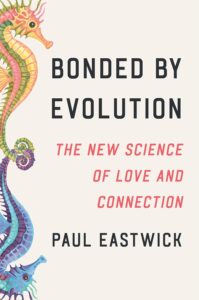
The dating industry profits by exploiting your insecurities. Bonded by Evolution author Paul Eastwick brings science to prove that even you can land love!
What We Discuss with Paul Eastwick:
- The concept of “mate value” — the idea that everyone is a fixed number on a scale of attractiveness — is largely unsupported by science. Studies show people only agree about who’s attractive roughly 65% of the time, meaning a full third of the equation is purely subjective. Your “score” depends heavily on who’s doing the scoring.
- Dating apps force people into artificial filtering habits — like screening for height or income — not because those traits genuinely matter in face-to-face attraction, but because users are drowning in options and need some way to narrow the pile. In speed-dating studies, traits like height barely register as factors when people are actually interacting in person.
- Your romantic partner likely sees you through a generous — and scientifically real — perceptual lens. Partners in happy relationships tend to rate each other as more attractive than outsiders would, and they instinctively “derogate alternatives,” meaning they perceive potential rivals as less appealing. These biases aren’t delusion — they’re relationship glue.
- The “evo script” — a set of ideas spun out of 1990s evolutionary psychology — overstates gender differences in attraction. Research shows that when men actually meet ambitious women face-to-face, they find them more attractive, not less. The gendered “money-for-looks” tradeoff doesn’t hold up either — women trade resources for attractiveness just as often as men do.
- Compatibility isn’t something you discover on a profile — it’s something you build in person. Give potential partners at least three dates in three different contexts, use fewer filters, and treat early dating less like an evaluation and more like a collaboration. The science says the best relationships often grow from repeated, low-pressure, real-world interactions — so get offline, get curious, and give people a real chance.
- And much more…
Like this show? Please leave us a review here — even one sentence helps! Consider including your Twitter handle so we can thank you personally!
Imagine you’re standing in front of a mirror, and instead of your reflection, you see a number floating above your head. A six, maybe a seven on a good hair day. Now imagine making every romantic decision based on that number — who you’re “allowed” to approach, who’s “out of your league,” whether you even deserve to be in the game at all. That’s the world modern dating culture has built for us, and it turns out the whole framework is about as scientifically sound as a horoscope written by a guy trying to sell you a gym membership. The trillion-dollar dating advice industrial complex — from apps that gamify your love life to red pill influencers hawking “sexual marketplace value” like it’s a stock ticker — runs on one core fuel: your insecurity. But here’s what nobody profiting from your self-doubt wants you to hear: the science of human attraction says the scoreboard doesn’t exist.
Relationship scientist and Bonded by Evolution author Paul Eastwick has spent his career studying what actually happens when humans are drawn to each other, and his findings demolish nearly every assumption the dating world treats as gospel. Paul reveals that people only agree on who’s attractive about 65 percent of the time, meaning a third of your so-called “rating” is completely subjective. He walks us through why dating apps force users into absurd filtering habits — like screening for height — not because those traits matter face-to-face, but because a woman with 3,000 unread messages needs some way to make her inbox survivable. Paul explains how happy partners genuinely perceive each other as more attractive than the rest of the world does (and instinctively view potential rivals as less appealing), why ambitious women are actually more attractive to men in person despite what Instagram comment sections would have you believe, and how the old “money-for-looks” gender tradeoff completely falls apart under scrutiny. Whether you’re swiping through a wasteland of profiles wondering what’s wrong with you, happily partnered and curious about the science behind why it works, or just ready to stop taking romantic advice from anyone who uses the phrase “mate value” unironically — this conversation is the reset you didn’t know you needed. Listen, learn, and enjoy!
Please Scroll Down for Featured Resources and Transcript!
Please note that some links on this page (books, movies, music, etc.) lead to affiliate programs for which The Jordan Harbinger Show receives compensation. It’s just one of the ways we keep the lights on around here. We appreciate your support!
- Sign up for Six-Minute Networking — our free networking and relationship development mini-course — at jordanharbinger.com/course!
- Subscribe to our once-a-week Wee Bit Wiser newsletter today and start filling your Wednesdays with wisdom!
- Do you even Reddit, bro? Join us at r/JordanHarbinger!
This Episode Is Sponsored By:
- Booking.com: Book your getaway now with booking.com
- DripDrop: 20% off: DripDrop.com, code JORDAN
- Marathon Rewards: Sign up today: marathonrewards.com
- Saily: 15% off: saily.com/jordanharbinger, code JORDANHARBINGER
- Booking.com: Book your getaway now with booking.com
Thanks, Paul Eastwick!
Click here to let Jordan know about your number one takeaway from this episode!
And if you want us to answer your questions on one of our upcoming weekly Feedback Friday episodes, drop us a line at friday@jordanharbinger.com.
Resources from This Episode:
- Bonded by Evolution: The New Science of Love and Connection by Paul Eastwick | Amazon
- Love Factually Podcast with Paul Eastwick and Eli Finkel
- Website | Paul Eastwick
- Orion Taraban | Understanding Relationship Economics Part One | The Jordan Harbinger Show
- Orion Taraban | Understanding Relationship Economics Part Two | The Jordan Harbinger Show
- Hot or Not: The Forgotten Website That Shaped the Internet | Mashable
- The Biggest Myths about Attraction — Debunked by Science | Next Big Idea Club
- Hypergamy — The Concept of “Trading Up” in Mating | Wikipedia
- Dunbar’s Number — The Cognitive Limit on Stable Social Relationships | Wikipedia
- How Many Friends Does One Person Need? Dunbar’s Number and Other Evolutionary Quirks by Robin Dunbar | Amazon
- A Historical-Genetic Reconstruction of Human Extra-Pair Paternity | Current Biology
- Low Historical Rates of Cuckoldry in a Western European Human Population Traced by Y-Chromosome and Genealogical Data | Proceedings of the Royal Society B
- The Effects of Being in a “New Relationship” on Levels of Testosterone in Men | Evolutionary Psychology
- Assortative Mating — The Tendency to Pair with Similar Partners | Wikipedia
- The Role of Self-Regulation in Derogating Attractive Alternatives | Journal of Experimental Social Psychology
- Evolutionary Psychology — The Scientific Framework behind the “Evo Script” | Wikipedia
- The 5 Love Languages: The Secret to Love That Lasts by Gary Chapman | Amazon
- The Dark Triad — Psychopathy, Machiavellianism, and Narcissism in Dating | Wikipedia
- James Fallon | How to Spot a Psychopath | The Jordan Harbinger Show
- Kevin Dutton | The Wisdom of Psychopaths Part One | The Jordan Harbinger Show
- Kevin Dutton | The Wisdom of Psychopaths Part Two | The Jordan Harbinger Show
- Four Weddings and a Funeral | Prime Video
- Arranged Marriage — Cultural Variations in Partner Selection | Wikipedia
- 90 Day Fiancé | Prime Video
- Speed Dating — The Face-to-Face First Impression Research Model | Wikipedia
- Leg-Lengthening: ‘I Had Surgery to Get Taller but Then It Went Horribly Wrong’ | BBC
- Jason Shih Hoellwarth: How Does Leg Lengthening Surgery Work? | TED-Ed
- Thomas Erikson | How to Protect Yourself from Psychopaths | The Jordan Harbinger Show
- Should I Fudge My Age in Dating Apps? | Feedback Friday | The Jordan Harbinger Show
- Help! I’m Too Physically Attractive! | Feedback Friday | The Jordan Harbinger Show
1309: Paul Eastwick | Science Says You're More Attractive Than You Know
This transcript is yet untouched by human hands. Please proceed with caution as we sort through what the robots have given us. We appreciate your patience!
Jordan Harbinger: [00:00:00] Coming up next on The Jordan Harbinger Show.
Paul Eastwick: Your wife probably thinks that you are a 10. Otherwise, your relationship would not have gotten to this point. This is the beautiful part of the perception of compatibility that really it's all in what people think and because I'm a psychologist, the subjective is beautiful to me.
Yeah. Your wife thinks you're more desirable than other people think. That's why you work so well together. I'm sorry, ripped guys. When you come along, maybe you are an eight on average, but she doesn't think that she thinks you're a six because people also do this thing called derogation of alternatives, which means because she's happily partnered with you, she looks at these other guys and thinks they're worse.
Jordan Harbinger: All right. Welcome to the show. I'm Jordan Harbinger. On The Jordan Harbinger Show, we decode the stories, secrets, and skills of the world's most fascinating people and turn their wisdom into practical [00:01:00] advice that you can use to impact your own life and those around you. Our mission is to help you become a better informed, more critical thinker through long form conversations with a variety of amazing folks, from spies to CEOs, athletes, authors, thinkers, and performers, even the occasional Russian chess grandmaster, astronaut, hacker, or hostage negotiator.
If you're new to the show or you're looking for a handy way to tell your friends about the show, I suggest our episode starter packs. These are collections of our favorite episodes on topics like persuasion and negotiation, psychology and geopolitics, disinformation, China, North Korea, crime, and cults and more.
That'll help new listeners get a taste of everything we do here on the show. Just visit jordanharbinger.com/start or search for us in your Spotify app. To get started today on the show, we're letting a pile of pickup artist books and dating books on fire and warming our hands on the ashes. We're talking about mate value, that weird spreadsheet brained idea that you're a six and she's an eight, and somehow romance is just, I don't know, competitive accounting or something.
Spoiler. That whole framework is mostly nonsense and not backed by science. We're breaking [00:02:00] down the whole dating market thing. Why that's not actually a market. Why your score is probably irrelevant and how most of what you think you want in a partner, you actually don't. We'll get into why online dating feels like a rigged casino.
Why being friends first might actually be the slowest path to pretty much nowhere. And why people who claim to have dating all figured out usually have it the most wrong. Also, testosterone, cheating myths. Why hotness fades faster than your last situationship, and how humans actually evolved to choose partners.
Hint, it was not swiping while half watching something on Netflix. And if you ever thought, Hey, am I just not attractive enough? Or Why is this so hard? This episode is for you. And if you just want to sort of revel in the fact that you're no longer on the dating market, you'll enjoy this one even more. And if you've ever taken advice from a guy with a YouTube channel and a ring light telling you that women are hypergamous robots, yeah, we're going to fix that too.
So here we go with Paul Eastwick. I'm actually really excited to talk about all this stuff because I don't know if you knew this, I used to teach like [00:03:00] men dating and meet women and stuff, and our angle was like, Hey, you can not be a total piece of crap and you can like not lie to people and you can be the best version of yourself and do this, which was a really unpopular sentiment in the community of guys at the time, because at the time what was trending was like, I have all these cool fake stories that demonstrate my mate value or whatever. You know what I'm talking about?
Paul Eastwick: No, and I'm fascinated to hear about this too, because I could only imagine what it might have been like to come in with some less aggressive and yeah, less pickup artisty strategies, but really trying to help people. So, yeah, it actually kind of bummed me out that people were skeptical.
Jordan Harbinger: Not only skeptical, the bad guys kind of won in a way because if you look now at like the dating advice realm, they call it red pill stuff now.
It's basically red pill. That is [00:04:00] all of the worst stuff that we never wanted to do that I always thought was gross. And they're right about a couple like small things here and there, which makes it even more dangerous because if it was totally wrong, smart people would just discard the whole thing. But instead, smart people are like, but this and this and this and this.
And you're like, yes, but also not all women are terrible and looking for your money. But like there's just enough truth in it to hook people, and so they kind of won like the whole, Hey, you can improve yourself and be the best version of yourself, and like you're going to meet a nice person who wants the same things as you based on your values.
That is sort of like, okay, boomer. That's kind of the sentiment that I hear now for that,
Paul Eastwick: and that is what I've experienced too, talking about this book in various places. I guess some people are into the Hey boomer angle, and those interviews are straightforward, but in some cases. It does feel like there is this tidal wave of stuff that, yeah, I'm having to push back against.
It's a little bit daunting, but it's kind of exciting too. I'm a scientist and the most [00:05:00] boring kind of science is where you're making a claim, but you're not really pushing back against anything. Nobody's ever argued the opposite. So there is something exciting about pushing back against something that is out there and that is big and that it's a little bit right, but it's also like mostly wrong and gross,
Jordan Harbinger: mostly wrong.
Yeah. Let's talk about this. Because the old way of thinking is you have mate value. It makes sense in a way on its face at first glance, right? Like you have mate value. Are you a good looking, healthy person who can provide from a men's perspective, for a woman and family and offspring that's more attractive than somebody who's like, not those things.
Okay, so mate, value's real, and everybody who doesn't have this is going to die alone and never reproduce.
Paul Eastwick: The point that I always want to make, I will agree with that sentiment and point out that for these things to be true, it really relies on this thing we call consensus is people have to agree that people possess a certain thing.[00:06:00]
And when we think about attractiveness, we think obviously, like we agree about who's attract and who's not. It's just right there. You can see it on their face. But when you look at the studies, when you look at the science consensus is not as powerful as we think. I like to start with first impression context.
If we had to make a judgment about whether this guy in front of us here was hot or not, or this woman in front of us was hot or not. We'd never met her. We'd agree like 65% of the time.
Jordan Harbinger: That's it. I'm surprised because you remember the website hot or not. Remember that?
Paul Eastwick: Yes. I was a, a, a, uh, happy user of that website.
I do, I do remember.
Jordan Harbinger: I remember. Refusing to use it. Because I thought, oh gosh, not that I didn't rate other people, I just mean I would didn't have the balls to put myself on there. Because I was like, I don't want to face the bad news around this. And I remember that my friend put me up there because,
Paul Eastwick: oh [00:07:00] that's funny.
Jordan Harbinger: It was like a rule. And he was really upset when I scored higher than him. He was really up upset. So it was kind of funny because I was like, I don't want to know what my rating is because it's going to like mess with me for the next multiple decades. And then I got this kind of like really high rating that really excited me like crazy.
And he got like a mid rating and that blew up in his face so bad that it actually, this is totally a tangent, but it actually affected our friendship for a few weeks where he, oh no. Yeah, like he was, that's a bummer. He was mad at me. He was angry, but he knew I didn't do anything. You know when somebody's like feeling upset because you exist.
That's what I was dealing with. And it was like somebody lived on my floor and I thought to myself. Well, I'm really glad this whole looking at other people online thing is a passing trend and will never catch on.
Paul Eastwick: Oh yeah. No. Doomed to die in 2002. Yeah, that's totally how it went. You know what would've made that website less of a bummer for your friend if it showed you more than just the mean, if it showed you the variability?
Because in real life, especially when [00:08:00] we're interacting with people face to face, that is what we experience. So some people might think that you're exceptionally unattractive, but some people are going to think you're attractive. And that's another thing that we show is that as people get to know each other over time, it's not 65%.
It starts going down and it actually gets remarkably close to 50 50 chance. There's always still a little bit of agreement left, even among people who have known each other for a long time about who's hot and who's not. But there is a lot of variability. So for most people, and we might all agree that this person's a six, but there's a very good chance that somebody in that group thinks you're a nine and somebody in that group thinks you're a three.
Jordan Harbinger: Yeah, okay. That makes sense. And I suppose is either a huge relief or really depressing depending on the tack you take with it. Because it's really nice to think somebody out there thinks, you know this [00:09:00] guy, Jordan's a nine man, what a good looking guy. But it's also like, ugh. So there's people out there that are just like, this man is hideous.
Who would marry this guy?
Paul Eastwick: Right.
Jordan Harbinger: That's sad. That's annoying.
Paul Eastwick: If the goal is to get a bunch of likes online, I agree, it's a bummer. But when we're talking about relationships, most people only need one or a few close relationships in their lives. And so it's handy that we see this democratizing process as people get to know each other over time.
What that means is that if you spend enough time in the right context, it's going to work out for many of us. And I worry that this is the simple bit of logic that we've forgotten a little bit.
Jordan Harbinger: You're right. When I was learning all this stuff about women, because I wanted to improve my chances of being with more than zero of them in my life,
Paul Eastwick: right?
More than zero. It's actually profound. But go on.
Jordan Harbinger: My buddy was like, dude, everyone gets married. And I was like, yeah. I mean a lot of people get divorced, a lot of people settle. I'm trying to sort of avoid that, but your [00:10:00] point does still stand that even if you really blow it, most of us, as long as you're not just an insufferably negative, terrible person who is unkind, as a matter of course, you're probably going to be fine.
Paul Eastwick: Yeah. And look, I want to encourage people to not be terrible. Yes. And to be kind. But even a lot of the terrible unkind people get. Partners too.
Jordan Harbinger: I worked at a law firm, so I, I know.
Paul Eastwick: There you go. Here's the real kicker is that those terrible unkind people get in relationships and their partners genuinely think.
They are great and that they are kind. Again, it can be a little bit mystical because you think like, how does she see good qualities in him? I really don't get it. But again, it's part of this process that makes relationships work for many of us where we don't feel like we're always striving to get something better.
Jordan Harbinger: Yeah. Let's highlight that because I think that's one of the [00:11:00] core beliefs. I don't just want to pick on the red pill guys because it's not necessary, but it is one of the core beliefs of, let's say, like internet male culture, dating culture. There is a belief that, let's say women are always going to look for, what do they call it?
There's like a monkey. It's monkey branching when she is hanging onto one guy, but looking for the other one. And then there's like the bigger, better deal.
Paul Eastwick: The hi hyper gamy. Hyper.
Jordan Harbinger: Hyper,
Paul Eastwick: yeah.
Jordan Harbinger: Yes. Can you define what that is and then tell us what that's all about?
Paul Eastwick: Yeah, so it's a concept that gets applied to women and the suggestion is that they're always looking to trade up E, especially relative to their own value.
So I'm a woman, I look at myself, okay, I'm a six, so I've got to try to land a seven, and if I can le land a seven, then maybe, I don't know, I can leverage that to get an aid, or I'm not doing my best,
Jordan Harbinger: yeah,
Paul Eastwick: to channel this perspective, but this is how some men online think about women. It's pretty nasty. And [00:12:00] importantly, it's really not backed by the evidence when it comes to attraction, relationship formation, any of that.
People actually don't pay attention at all to things like, oh, what is your mate value relative to mine? Yes, attractive people will be more appealing, but people aren't doing this trade up thing as they get to know people over time.
Jordan Harbinger: That's the key though, as they get to know people over time. Because I will be the first to admit that if you put me in a room or on an app with 50 women in me, right?
Because I'm not dating men, I'm just going to look for the ten five most attractive because I need to filter by something in the first one second, right? So like I'm looking for the, but if you put me in a room with those 50 women and we have to work on a project together. There's got to be a way to run this experiment, but the ones I would've initially picked, I'm going to bet that very few of them are left standing for the people I want to be around [00:13:00] most of the time.
Because why would those two things overlap when I'm starting to like, oh, Sharon is really funny and my stomach hurts. I'm laughing so hard at the things she doesn't says, and this one is so talented. And wow, the voice on this one is, I didn't even know I had a thing for that. That's all. And then it's like, why did I pick the girl with the tan earlier?
Like the tan. That was it. That's just not going to matter anymore. And I can see that
Paul Eastwick: you are describing the dating app that we all need, but we don't deserve.
Jordan Harbinger: Right, exactly.
Paul Eastwick: We get to hang out in groups with people over time. Now these things exist. They're not called apps. They're called like intramural sports leagues.
Jordan Harbinger: Bars. Bars. You stay for 12 days. You're right. They're called college classes. And then alongside it, you learn about the ancient Egyptians or something.
Paul Eastwick: Exactly. That doesn't sound terrible. Now we can't do that for everybody, but there are other contexts out there. I honestly think like improv classes are probably another one.
Jordan Harbinger: Yeah, I always recommended back in the day, that was one of my top recommendations. Go take improv. You'll meet [00:14:00] cool people. You'll joke around with them. And even if everyone there is just a terrible stick in the mud, you come away with no friends and no dates, you've gotten funnier. Win win, win.
Paul Eastwick: Yeah, that is outstanding advice.
Jordan Harbinger: Yeah. And it's 50 bucks because they're taught by broke comedians. So you can name your price and go take improv 1 0 1.
Paul Eastwick: You could probably just buy them a coffee and they'll let you in.
Jordan Harbinger: Hey, I'll let you sleep in my garage tonight if you teach me improv.
Paul Eastwick: Oh gosh. It's sad but true for
being
Jordan Harbinger: dicks. Yeah.
Anyway, rescue me.
Paul Eastwick: Yeah. Okay. I love these ideas, and I think another thing that's important to realize about like when we're using the apps and we're swiping in things, is that even if we're not just filtering on the universally desirable stuff, if we're like, okay, like I really want to date people who are in, I don't know, certain industries or something, like many times we are getting in our own heads there too.
So we're needlessly filtering these things. We end up meeting people who actually, we [00:15:00] don't have a particular preference for somebody who's a an aerobics instructor. Or somebody who is not in finance because you think that absolutely turns you off. But these sorts of filtration exercises too also tend not to do all that much.
So again, it's like to the extent that you're using the apps to artificially limit who you're meeting, I think they're not great in that sense too.
Jordan Harbinger: I agree with you and I've got a little theory that I want to run by you specifically because you might actually know the answer to this. My friend Zach Broman is still teaching guys like how to meet women and he's, the apps are like a nightmare scenario for dating because.
As you probably are aware, it's like the top 1% or top 5% of guys are getting all these matches and it's probably all the women are getting like 10,000 messages and they don't have any idea how to screen it. And then there's this misconception or real conception that, and I'll leave that up to you, women are looking for guys over six feet tall.
But my friend Zach, who explained this to me, he said, I don't think women are generally [00:16:00] looking for men over six feet tall. I think women on apps are looking for men over six feet tall. And I was like, why? And he goes, we are having lunch. He goes, during this lunch I will open my dating app and I will have zero messages other than the ones I saw this morning, the two I saw this morning.
If your wife makes a profile right now, when our appetizers come by the time we're done with dessert, she's going to have 40 or 50. Maybe more messages in there. How is she going to screen? She's going to make sure he is employed. She's going to make sure that he makes over, I don't know what the top income thing is.
It's probably like 80 or a hundred grand a year. Okay, now what? There's 3000 people in there at the end of the month. Alright, just turn the height thing up all the way then, whatever. So now you're screening for guys that are over six feet tall, just so you can have under 400 unread messages in your inbox.
That's the reason
Paul Eastwick: I think this is a perfect description of what's happening and, and look, I can tell you. That when we look at what people like speed dating, so we're still talking about first impressions, but at least you're [00:17:00] there interacting face-to-face. Are the women all going for the tall guys? Not really.
There's a tiny preference for height, but you would need like a foot and a half difference in order to see it. So at that first impression, face-to-face context, height barely matters at all. But we get really bent outta shape about it when it's online. I mean, spoiler for materialists, that's like one of the huge subplots of the movie is that the guy was short, but then he like added some inches to his legs and then became.
Much more desirable. This is a complete misunderstanding of what happens when people are actually interacting.
Jordan Harbinger: Yeah, this is fascinating because I'm five 10 and I'm maybe like that with shoes on or something. It's hard to say.
Paul Eastwick: Five 10 with shoes on. I like it.
Jordan Harbinger: It's above average, but not by much. And it's not six feet.
I have never ever thought about my height in dating, but also I'm not a product of dating in the 2020s. I've met my wife in [00:18:00] 2013, so I'm sympathetic. That maybe has changed a little. But I also remember when I was in Europe, I was an exchange student in Germany in high school, and my brother, my host brother at the time was like, don't you think it's weird that your girlfriends are all taller than you?
because every girl I dated was really tall. And I was like, no, I is Peggy taller than me? And he's like, dude, yeah, she's six feet tall. She's a bikini model. She's really tall. And the girl you dated before that, Lara was this tall, she was taller than you. And then when she wore shoes, she was much taller than, and I was like.
Who notices this. And he's like, everybody that's so funny. And I was like, not everybody, because I am sitting here going like, uh, with my hands. And I'm like, Wayne, if I do, and I'm like, I guess I do look up to Laura when she puts the shoes on and we go out. It just never occurred to me. And then I realized what a superpower that actually what Now my wife's five feet tall, so I guess it didn't use it, but what a superpower this actually was because I remember guys being like talking to the girl, I'd be with, what are you with this shrimp for?
And I'd be like, shrimp, that's funny. He thinks I'm short. [00:19:00] And we'd just walk in and I'm just like, oh wait, he's six foot five and taller than you and I'm five foot 10 and shorter than you with those shoes. Oh, am I supposed to care about that? And it was just like this big thing. But now it's like a pathology man.
You see these guys who are like five foot 10 and they're going to Turkey to have their legs broken so that they can be six one. And it is this mental illness or what's happening here,
Paul Eastwick: it's terrifying. But I want to just point out, I think you identified the real superpower in there. Which is your ability to have people say this to you and then to say, what am I supposed to care about this?
I'm not a dating coach, but if I were, I think I would start with that because I think so much of what men and women, I'm sure too, are experiencing out there are these like weird pressures where online life is like sneaking in to our offline life and getting us to worry about things that we never would've worried about before.
And when we're interacting with other people face to face, we tend to focus on the right things. We focus on how do I [00:20:00] feel around this person? Am I laughing? Yeah, right. Does she seem exciting and tell engaging stories, but also how do I feel about myself? Does she make me feel small in comparison, or is her confidence rub off on me?
Like I think people do these things pretty well. I just worry like when the offline starts infecting the online.
Jordan Harbinger: I will tell you in this, what year was this? 2003? Approximately. Maybe 2000? Yeah, something like that. We moved into a house in Ann Arbor and we moved something and we found a journal in the corner and I was like, oh, we should definitely read this because it's somebody's private thought and we have no respect.
It was a sorority girl diary, and it was one of the most fascinating things that I've ever read in my entire life, especially at the time, because I remember several entries about how this woman loved going to these frat parties and she would connect with a guy, but he would be short and her sorority sisters would go, you need to date somebody who's taller than him.
And she was very upset because she's like, I'm connecting with these [00:21:00] guys, but they're all shorter than I'm supposed to be dating. And she's like, I don't care, but if I date one of these guys, I'm never going to hear the end of it from the other girls. And so I have to date tall guys and every single one of them that I've met has been a total jerk and blah, blah, blah.
And I just thought that was fascinating. Because I thought to myself. This is the dumbest thing to be upset about. Just forget what other people are saying. But I not being cool enough to be in a fraternity had no idea of the pressure this woman was under from her sorority sisters at the time. She couldn't do it.
It was not allowed. She was not allowed to date short guys that she liked. Period.
Paul Eastwick: This is a bummer, and look, it's true in every context that the people surrounding you, it really matters that people feel like the people nearby support their relationship. This is just another one of these classic findings in the science, that people feel better about their relationships when their friends are supportive and when your friends like your partner and they like you with your partner so many times, we can leverage that for good.
But this is really [00:22:00] capturing the downside of that experience, especially when who you're surrounded by. Is this sort of broad group. I mean, she's probably not exactly friends with all of these folks, yet they have this big influence over her life. So I am often touting the importance of groups and that people can introduce people to each other, and this is often where the magic happens.
But this story's a good reminder too. Like there are real downsides, especially when it's a larger group. They're not all exactly your friends and they've got ideas about what you should be doing.
Jordan Harbinger: Speaking of wildly overestimating your own value, let's talk about something that won't disappoint everyone around you, our sponsors.
We'll be right back. This episode is sponsored in part by DripDrop. Lately I've noticed that when my energy drops or I'm feeling a little bit off, it's usually not lack of sleep or too much work. More often than not, I'm just not hydrated enough and plain old water doesn't always do it for me, especially when I'm traveling, stacking interviews back to back, working out, pushing [00:23:00] through a long day.
That's why I keep DripDrop around. DripDrop is doctor developed, proven fast hydration that helps your body and mind work better. It's one of those simple things that makes a real difference when life gets busy. DripDrop uses science-based formulas for rapid hydration, so you feel results fast when getting three x, the electrolytes of leading sports drinks.
It's also trusted by firefighters, medical professionals, over 90% of top collagen pro sports teams, which tells you that stuff is the real deal. They also have zero sugar plus with an advanced blend of six key electrolytes, 15 essential vitamins and nutrients. No sugar, no artificial sweeteners. Best part is it actually tastes good.
I like the watermelon and lemon zero sugar flavors, plus flexible subscriptions make it easy to always have DripDrop on hand.
Jen Harbinger: Right now DripDrop is offering podcast listeners 20% off your first order. Go to dripdrop.com and use promo code Jordan. That's dripdrop.com promo code Jordan for 20% off.
Stock up now@dripdrop.com and use promo code Jordan.
Jordan Harbinger: This episode is sponsored in part by Marathon. At Marathon gas stations, every stop is the start of fun. Like the awesome fuel savings you can get with [00:24:00] Marathon Rewards. Join Marathon Rewards today and start earning rewards on every gallon of gas. You can redeem rewards at any time, saving up to $1 per gallon. And don't forget, Marathon stations are packed with all the conveniences you need to stock up and live life on the go. Marathon, where fun runs on full, available at participating Marathon locations. Terms and conditions apply. See marathonrewards.com for details.
Don't forget about our Six Minute Networking course. I shill this thing all the time. I'm going to keep this short. It's free at sixminutenetworking.com, it's not as cringey as my ad pivots, and many of the guests on the show subscribe and contribute to the course. Come on and join us. You'll be in smart company where you belong. Again, all free at sixminutenetworking.com.
Now back to Paul Eastwick. I think about this now as an adult, and I can't help but think that these other women in the sorority, they don't care if she's happy. That is the least of their concerns. What they care about is look at the girls in our club that reflect on us. They're all dating the right kind of guy, [00:25:00] in our opinion.
I don't care if he cheats on her or doesn't want to hang out with her, and she likes the other guy from the other frat who's too short. We want it to look a certain way in the photos. That's all I care about. And so that to me was really the core of her criticism in the diary. She didn't articulate it like that, but looking back 25 years or whatever, hence.
It totally makes way more sense. That's exactly how she was feeling. Tell me about the ego script. You mentioned this in the book. Is this kind of part of that whole thing? Is this kind of dovetailed with that?
Paul Eastwick: I think so. When I talk about the Evo script, I'm referring to some of these ideas that originally grew out of evolutionary psychology in the 1990s.
This was genuinely part of the science, but it's really gotten spun out in our culture and online, especially in a bunch of nefarious ways. And one of the components here does have to do with these standards that we assume that we have to meet made [00:26:00] value is part of it. We talked about that you feel like you've got to be an eight or a nine if anybody's going to pay attention to you, and the only way to get there is to engage in radical acts of self-improvement, which can be very demoralizing for a lot of people.
Some of it ends up being pretty gendered too. The early phase of evolutionary psychology really had a lot of components in there that were about how different men and women are, how different their concerns are, how different their wants and desires are. And look, there are many domains of life where men and women are quite different, of course.
But what we've tended to see in the more recent science of attraction, that again, when you step away from those broader pressures and you look at what people actually like when they're meeting each other face to face. We usually don't see much in the way of gender differences. That's even true with stuff that seems obviously gendered, like [00:27:00] earning potential ambition.
Like it's surely more important for a guy to be ambitious than for a woman to be ambitious. But what we actually see is that this is surprising to some folks, but when men meet ambitious women, they tend to like them more than the less ambitious women. That
Jordan Harbinger: is not what I've been told on Instagram comments
Paul Eastwick: Exactly.
On Instagram where the women are quite ambitious. But let's setting that irony aside, that little boost that you get in terms of your appeal for seeming a little bit more ambitious seeming like you've got your life together. It's there for both men and women, and I think the fact that women will say on surveys, they care about earning potential and ambition more than men do.
Doesn't reflect their real life experiences of attraction. I think that's one great example of how they're, you know, you get gender differences over here and what people think, but not over here in terms of what actually appeals to people.
Jordan Harbinger: That's actually quite inter, [00:28:00] I was not expecting that. Tell me how we've internalized some of this ego script in modern society because one, it's at odds with how humans actually evolved and at odds with science, but also it does us no favors because it's wrong.
Paul Eastwick: Yeah. I think one of the biggest problems is this idea that we need to make ourselves appealing to strangers. We've got this idea that, okay, to succeed at the mating game, you have to go out there and attract people from ground zero, deliver the perfect pickup line in order to reel somebody in. Or just be exceptionally attractive and exceptionally good looking and let them come to you, I suppose.
But what this misses is that a key part of the way that we evolved as humans was in these small social groups. If we imagine living life on the Savannah 150,000 years ago, or 500,000 years ago, you likely lived in a group of maybe 50 people, give or take. It could [00:29:00] be 70, but it's not that big. And there might be a few other groups nearby that are about the same size, and you probably know these folks.
But now let's just do the math on how many people are roughly your age, how many people are of the gender you prefer, and how many people are not partnered already. It's a pretty small number, but at least what you have going for you is that you're going to get to know these people over time. That's the context that shaped the way we think about ourselves and the way we think about romantic partners.
This deluge of strangers. That we get today. Like we've been primed and told, oh, this is the evolved way. Attract strangers. No, it wasn't. This is a weird modern skill that few people have. So I, I worry about this.
Jordan Harbinger: That is a really good point. This is a weird, modern skill that few people have. And in the past you didn't need to do that.
I was watching a documentary, there's a show fan who runs this show in France where he goes and [00:30:00] lives with tribes that don't speak any English well or French and don't have modern techno. Like he'll just get dropped off in the middle of the desert in Tanzania and walk for two days and then he finds this like uncontacted tribe and he'll just like hang out with them and live there for a couple of weeks.
It's really incredible. And one of the things that he had mentioned, which I think maybe you touched on similarly in your book, or maybe I read this elsewhere. The tribes are small, right? I mean, there's maybe 120 people living in a village that has like sticks around it to keep the livestock in basically.
And when you want to get married. The way you do it is either you marry somebody inside that little circle or like you're out hunting and you run into some other hunters from the other village thing that's 10 miles or five miles or however far away. You're like, Hey man, do you know any girls that are my age that are like not married?
And they're like, yeah, my sister. And if you get that lion, I'll introduce you and it's okay. I met this guy in the middle of the Savannah, he [00:31:00] killed a lion. He's like 15 like us. He should come here and meet dad and bring some goat milk. That's the game, you know?
Paul Eastwick: That's the game.
Jordan Harbinger: Yeah.
Paul Eastwick: I do have a thought experiment like this in the book where I talk about it's important to meet people through networks, but sometimes like it feels like your networks have dried up and there's no options and you've got to hit the road.
I love the studies. This is the work that the anthropologists conduct. I'm a psychologist, not an anthropologist, but I love their work. And so what they look at are these neighboring groups, exactly like what you described. Again, these groups are so small that it's not uncommon that, okay, who's in their, you know, late teenage years looking to partner up?
Oh, whoops. In this group we got five guys and one woman. Oh, so four guys are left. They hit the road and they can travel together, but they keep their ear to the ground. Where is the balance in the other direction? Where are there some [00:32:00] unpartnered women? Let's go seek our fortunes elsewhere. I kind of love that.
I love this idea that, yeah, like we do have this ability to seek out new horizons. And one cool thing about humans is that's not gendered either. So if you look at the other apes. It's usually one gender that moves around and it varies, whether it's the males or the females that tend to move. But humans, like if you look at these human hunter gatherer groups, sometimes it's the men that are taken off.
Sometimes there's an abundance of women and the girls look at each other and they say, like, we heard there are some pretty nice looking guys. There are about a hundred miles to the west. This is going to take us a few days. But time to go,
Jordan Harbinger: well this, this is when I moved to New York City, everyone, there's a transplant almost.
Not everyone, everyone but a lot of people. And you get to talking to somebody and be like, Hey, so what made you move here? And for guys often it'll be like, well, I got a job here. And for a lot of the women, it was like. Well, I lived in this really small town and I always wondered what it would be like to live here.
And it's like, okay, so reading between the lines, you lived in [00:33:00] a really small town and it was either marry the guy that you dated since eighth grade, or go somewhere and look at what else is out there because this is your chance to do that. So now you work at Sirius XM Satellite Radio as a receptionist at the desk, and you're meeting all kinds of like famous people and corporate dudes and stuff like that.
And I remember one gal. She was a receptionist there. And I ran into her years later in Los Angeles, on the street in Hollywood, and she was like, Jordan, oh my god, small world. And we were talking and she's like, yeah, I'm here because my friend that I moved to New York with married an A-list celebrity, and they're getting married.
Their wedding is this weekend. And so I'm here for that. And I remember thinking like, wow, your plan totally worked. Totally worked. This girl from a small town in New York, upstate Schenectady or whatever, right? Cousin marries this super famous dude and like you're dating his cousin or friend or whatever.
And it was like, yeah, it was either that or a [00:34:00] dude from church, not there's anything wrong with that, but she wanted to see what was out there. And apparently this guy was out there.
Paul Eastwick: And sometimes this perspective I'm advocating, it sounds like I'm saying like, ah, stay in Schenectady. Although I think Schenectady is probably pretty big, but smaller place.
Ah, stay in your small town like you'll do fine. I love the modern ability. I'm a humanist. I love the modern ability to move to where you want to go. But it's important to keep in mind that mentally we still think about people in these concentric circles. This is the Rim Dunbar idea that it's like there are 50 people that you can conceptualize as being very close to you, and the more people that you're quote unquote friends with.
The more they're really becoming more like acquaintances. You actually aren't that close anymore, but I think it's an amazing thing that humans can move in these modern cities, but still maintain that sense that you have these close others nearby [00:35:00] and good for her that she was able to meet such terrific people using this kind of approach.
Jordan Harbinger: One thing that you mentioned in the book is that mate value has nothing to do with compatibility. You touched on that on the top of the show. I think this is worth exploring because. People might not want to date you. Not because you're a six and they're a seven, but because of compatibility or they might want to date you anyway even though you're a six and they're a seven because of compatibility.
That's a huge realization because it does trash the whole, oh, okay. You've got a looks max and hit your cheekbones with a hammer. Have you seen these guys online by the way?
Paul Eastwick: Yes, absolutely. Terrified.
Jordan Harbinger: You've got to hit your cheekbones with a hammer and you've got to be ripped and have a six pack. And I've talked to these guys and I'm like, do you really believe that my wife would leave me if you showed up with your abs and your Bitcoin?
That is like a delusional, weird cope. Of course, it usually makes up for the fact that their entire personality is ABS and Bitcoin, right? And they have nothing else going for them. Because otherwise, why would you think that? I never think, Hey man, I bet that guy's wife would leave [00:36:00] him for me because I'm rich.
I never think that it, now, it does not occur to me outside the context of using it as an example for this podcast.
Paul Eastwick: That is the first time I've ever heard somebody call that a cope. But of course that's what it's,
Jordan Harbinger: yes,
Paul Eastwick: of course, that's what it is. So I will now explain why it is indeed a cope. So let's say that your wife is an eight and you are a six.
Okay? Your wife, the thing is probably thinks that you are a 10, otherwise, your relationship would not have gotten to this point. This is the beautiful part of the perception of compatibility that really it's all in what people think. And because I'm a psychologist, the subjective is beautiful to me. Yeah, your wife thinks you're more desirable than other people think.
That's why you work so well together. Now, add on top of that, I'm sorry, ripped guys. When you come along, maybe you are an eight on average, but [00:37:00] she doesn't think that she thinks you're a six because people also do this thing called derogation of alternatives, which means because she's happily partnered with you, she looks at these other guys and thinks they're worse than they actually are.
So what you have to overcome. To do what these guys assume apparently they can do. It's an enormous gulf most of the time. And again, it's these sorts of motivated perceptions, motivated biases that people have that are really responsible for often keeping relationships going.
Jordan Harbinger: Yeah, the derogation of alternatives is interesting and it makes complete sense.
I've done this myself where I had a friend who wanted to introduce me to somebody, and I had a girlfriend at the time and I was like, oh man, you really think she's attractive? And he's like, are you crazy? And then years later he's like, I still can't believe you didn't want to meet so and so. And I was like, yeah, what does she look like?
Y? And he showed me a picture and I was like, oh my God, she's gorgeous. What was I thinking? And he is like, yeah, he had a girlfriend. And I was just like, oh [00:38:00] yeah. Her like, what?
Paul Eastwick: I mean, it's a funny thing because when we're with somebody and they make us happy, we put on these blinders. We don't notice the other desirable people around us.
Yeah. In some cases like yours, maybe you come to regret that decision later.
Jordan Harbinger: Yeah, no, it's fine. Look, I'm happily married now, but it's funny because my Adam will always be like, oh, Jordan doesn't like hot women because he sh this, the woman he showed me was like, objective. Like, I don't know what I was thinking.
I guess I was just like head over heels for whoever it was at the time that I was dating because yeah, I don't know, man. Still kicking myself maybe.
Paul Eastwick: We do this in all sorts of other ways too. So in ongoing relationships, look, everybody's got negative qualities, okay? Everybody's a little messy or they get a little overly stressed out at times.
We all have issues, but our romantic partners, it's not that they don't acknowledge those issues, but they have ways of putting them in a box. So your friend also might have been like, why are you with Erica? Like, she's such a stress case all the time. But to you, [00:39:00] you would honestly say back would be something along the lines of, yeah, but like it's kind of exciting.
That's why I love being with her. I never know what's coming next, and you're not lying. You are honestly perceiving her in that particular way when nobody else does. Again, these sorts of biases are really important for people's ability to maintain their relationships. Otherwise, we'd get so frustrated with all the negative aspects of our partners.
We wouldn't be able to keep it up for.
Jordan Harbinger: That's true. Do people tend to marry those of similar attractiveness? because I'm only thinking of counter examples that you see on TV where this like Lyle Lovett marries Julia Roberts and everyone's, what the heck is going on here? And it's like, yeah, you don't think about, I don't know everyone else on planet Earth.
Paul Eastwick: Yeah. So it is true that people tend to marry other folks who have similar levels of attractiveness. We also tend to marry folks who are like similar levels of SES too, right? Socioeconomic status, income and things along [00:40:00] those lines. That's usually because that's who you're meeting. But on the attractiveness side, usually because Yeah, when people do form relationships quickly, when they have initial impressions of each other, yeah, the attractive people are better at attracting the other folks who are going to be similarly hot.
But ultimately. If your relationship is matched or mismatched, it doesn't predict that much. It doesn't predict how long your relationship is going to last.
Jordan Harbinger: That was my next question. Yeah. Because I think a lot of people go, oh, he's so much better looking than her, or She's so much better looking than him.
This isn't going to last. And the other assumption is, tell me if this is true. Oh, he's rich, I guess because look at that.
Paul Eastwick: Yes. Oh yeah. This one's fascinating because there's long been this idea that there's a particular gendered trade off where men can trade their money for a woman's looks. And [00:41:00] I'm fond of pointing out this little nugget that when the studies were conducted to show this.
In the middle part of the 20th century, they didn't even assess how hot the guy was, and they didn't even assess how much money she had. It was that they'd never read Jane Austen, where the women's money matters a lot. Okay, so when you do the studies the right way, there's no gendered trade off at all.
Like sometimes people trade money for looks, but actually women do that like just as often as men do. There's a mean difference. Men have more money. On average, women are actually considered hotter on average. So you're going to see in the average couple that she is hotter than him and he has more money than her.
But that, that's just like a mean difference in how men and women are. But I think that's where we get this illusion that there's a trade happening out there. It's just the mean levels in the population.
Jordan Harbinger: Yeah. Okay. That's a really [00:42:00] interesting explanation because yeah, in my head. As somebody who's just chugging the same amount of pop culture as anybody else, I guess on average.
Maybe a little bit less. It does really seem, oh, well my buddy, he's okay looking, but he's loaded and his wife is a total smoke show. And then, but if you think about it, I'm like, well, no. I mean, he's in great shape and he's cool. And he's fun and I like him a lot. Well, oh wait, maybe these are the same reasons his wife likes him maybe.
And I'm not really in a good position to judge what other people attach to their preferences. Like do they care about physical fitness that much? Or maybe they like him because he's taller, he's really witty and maybe she prioritizes that. In fact, my friend who I'm thinking of is all three of those things and married a really gorgeous gal.
And people will write into me as a sort of semi want tobe, whatever public figure who's on the internet. I get all manner of messages in my inbox and people will go, oh my gosh, your wife only married you for your money. And I'm like, yeah, so what? But because my wife is quite attractive, but it has occurred to me now after reading your book that [00:43:00] maybe she actually believes that I'm attractive, which is really good news.
Paul Eastwick: And no really is good news and odds are. That she genuinely does, and maybe she's willing to say at some point, okay, like, insert movie star here. Does she have like a movie star guy that she's at least willing to admit is super attractive?
Jordan Harbinger: Yeah. Who knows?
Paul Eastwick: Yeah,
Jordan Harbinger: I'll have to ask her when I want to have nightmares for the next 20 years.
Paul Eastwick: Right. There you go. So maybe don't, but even in that case, I think she still genuinely thinks that you're basically in the same category. And that even if this guy came along, ah, you have so many other things going for you. This is how people tend to think about romantic partners when their relationships are going.
Well want to point out too that this explains where relationships go badly as well. Because some of that is motivated reasoning too. You're not actually being a dick to your partner. The various ways that you were once connecting, you're not connecting anymore. And now we start seeing and amplifying all this [00:44:00] negativity.
It can go in the other direction too, but so much of it is in our subjective perceptions.
Jordan Harbinger: If dating were actually a marketplace, some of you would've been delisted years ago. Luckily, our sponsors still see potential. We'll be right back. This episode is sponsored in part by Saily. We travel internationally a lot.
I'll tell you, there are a few things that could instantly derail a trip. One of them is landing somewhere new, realizing our phone basically turns into an expensive paperweight. No maps, no Uber, no way to text anyone that used to be us. But this new Saily thing has completely fixed that. Saily is a global eSIM service.
From the team behind Nord VPN, it's one of the easiest upgrades we've made to how we travel. You install it once, pick your plan, and when you land, you're just connected. No SIM cards, no hunting for Wi-Fi. No surprise charges later that make you question your life choices. We used it on our last international trip to London and Paris.
It was seamless. We would move in between countries. I didn't have to think about it once. Phone worked the entire time. Maps, messaging, everything like I never left home. It works in over 190 countries. Plans are affordable. They've got built in security features like ad blocking and web protection, which is [00:45:00] great when you're on random hotel Wi-Fi, if you travel even occasionally.
This is one of those, why didn't I do this sooner kind of things.
Jen Harbinger: Get an exclusive 15% discount on Saily data plans. Use code JordanHarbinger at checkout. Download the Saily app or go to saily.com/jordanharbinger today. That's saily.com/jordanharbinger.
Jordan Harbinger: This episode of The Jordan Harbinger Show is brought to you by Booking.com.
Look, if you've got a vacation rental and you want to grow that business, you've got to make sure people can actually find you. That's where Booking.com comes in. It's one of the most downloaded travel apps in the world, and since 2010, they've helped more than 1.8 billion vacation rental guests find places to stay.
That's an enormous number of people looking for places like yours. But here's the thing. Most vacation rental hosts don't even realize. They can list their properties on Booking.com, and if you're not on the platform, your rental is basically invisible to millions of Booking.com travelers worldwide.
After all, they can't book what they can't see. Right? Once you list your property gets in front of a huge global audience of travelers, which means more visibility, more bookings, and more chances to [00:46:00] build real momentum with your rental business. The barrier to entry is low here. You can register your property in as little as 15 minutes, and nearly half of hosts get their first booking within a week.
So if your vacation rental isn't listed on Booking.com, it could be invisible to millions of travelers searching the platform. Don't miss out on consistent bookings and global reach. Head over to Booking.com and start your listing today. Get seen, get booked on Booking.com. If you like this episode of the show, I invite you to do what other smart and considerate listeners do.
Take a moment, support our amazing sponsors. They make the show possible. All of the deals, discount codes, and ways to support the podcast are searchable and clickable on the website at jordanharbinger.com/deals. If you can't remember the name of a sponsor, you can't find a code, do email me: Jordan@jordanharbinger.com.
I'm happy to surface codes for you. It is that important that you support those who support the show. Now, back to Paul Eastwick. Correct me if I'm wrong here. All this stuff kind of applies mostly slash only to. Western societies, because I'm thinking of, and hear me out [00:47:00] here, I'm thinking of the example where, let's say you're in an Islamic society and it's like you are going to marry this 50-year-old man when you're 25 because he's my third cousin and this is why I'm introducing you to, and if you don't like him, my other friend is a professor and you can marry him.
And it's like all these guys are in their late forties and I'm 22 and I have to marry one of these guys. I guess my point is the woman is not necessarily exercising her choice about who's attractive and interesting to her at all.
Paul Eastwick: Yeah. So this is an important point. And you do see major cultural differences in, you know, how common it is, arranged marriages, uh, marriages where there's going to be a lot of parental involvement versus what we often call love marriages in contrast.
Like, oh, people get to freely decide. But here's a key point, I think when we think about arranged marriages, we think about the form that you just described, but that's actually not the most common way that it happens. It is. Usually, you can think about it like intense [00:48:00] parental involvement. The parents will be introducing you to various folks, but you still have a lot of control typically, and whether you want this thing to proceed or not, you're being given a few different options for who to consider.
And the key thing is this. If we just look in these cultures, so cultures where this is common at the distinction between how happy are women when they're in a love marriage versus when they are in a quote unquote arranged marriage. There's not much of a difference. But where you do see the difference is when you ask them, how much control did you have over the person you married?
And regardless of whether it was an arranged marriage or a love marriage, if the women feel like they had control, they feel great about it. If they feel like the person was selected for them and they essentially had no control. That's when they're super bummed out. So there are indeed major cultural differences in [00:49:00] how much parents are playing a role in this way, but I tend to think about it more, not in like a systemic thing that's causing the problem.
It's really about the cases where people feel like they don't have a say in who they get to marry.
Jordan Harbinger: That makes sense. You ever watch 90 Day Fiance?
Paul Eastwick: No. No, I haven't.
Jordan Harbinger: I feel like you'd either love it or hate it. I, it's one of my guilty pleasures. I haven't seen it in years. Usually it's guys, they meet some girl on an app and she's like 20 years younger and lives in Kazakhstan.
You're like thinking that she's either not real or whatever, and then of course you're surprised that she exists. But then the family hates her because clearly she just wants a green card because she lives in a igloo and it's just like this whole mess of things. And as I was reading your book, I was thinking like, let's lay 90 day fiance over top of this or over top of that.
And that's I guess, a different case, right? Because these are like clearly people going, oh, a different economic situation for me and my family for the rest of my life. That's pretty appealing.
Paul Eastwick: I think [00:50:00] that's right. That is an important point. This is something that we humans do. I think it explains too, like we're these creatures that have all in small groups to evaluate folks that we've met for a long time.
Then what have the apps done to us? We're also pretty flexible and we can make mating work within a variety of different contexts. Sometimes we do things like we turn mating into a shopping exercise. In reality, that's what the apps have done to us. But we can also imbu meeting with all of these important social connections too, a way out of poverty.
I think there can be cases where people still engage in the same kind of motivated reasoning processes. If she's thinking this is a way to a better life, she's probably motivated to think this guy is going to be pretty good, at least at first. That would just be my guess though. I'm now like way beyond the data here, but at least that's how I like to think about it.
There's always going to be a tendency to hope for the best, try to [00:51:00] perceive things in ways that make interactions smooth and make things go well, at least at first. Whether or not I want to like recommend marriages like that for folks, I genuinely wouldn't want to do that.
Jordan Harbinger: Is it safe to say that hotness, I love that we're using that as a technical term, by the way, are we, is it safe to say that hotness loses its pull over time?
Paul Eastwick: Absolutely. And in fact, this one has shocked me a little bit too, as we've really dug into the research on this. So look, yes. Attractive people are more appealing at first. People agree at first about who's attractive and who's not. But what's so interesting is that, again, this is just another one of these cultural ideas that has way too much currency is that, all right, you meet somebody and you know, you impress them and bang, you're dating like 20 minute coffee date.
I know how I'm going to feel about you. It's not usually how it works. What the common thing is that people kind of grow on each other over time, right? The initial like lightning bolt thing, it happens. But if, [00:52:00] if you take a sample of relationships and then you rewind time and you say like, okay, how did you feel at moment one?
I don't know. Like 20% will tell you it was a bolt of lightning. Everybody else was like, eh, I thought you were all right at first. So here's why that ends up being important. Because if we look at that stretch of time when people are starting to think like, Hmm, maybe I like her. She seems pretty funny. I like the way she tells stories.
She makes me feel confident. What's also happening during that stretch of time. Is that I might think she's exceptionally hot. And in fact her confidence makes her seem hotter. But the extent to which she is objectively hot, the extent to which other people think she's hot is starting to wear off. So being an attractive person, it matters at first, but then your ability to reel somebody in over time, which is often a required part of this process, your hotness, your objective hotness, is not [00:53:00] going to help you as much as what's going on Dia, between the two of you.
And again, depending on whether you are objectively hot or not, maybe that's good news or maybe that's bad news.
Jordan Harbinger: So the more you get to know people, the less looks matter. So
Paul Eastwick: Exactly.
Jordan Harbinger: Maybe it doesn't matter if we pick a partner with similar attractiveness. Maybe I want to shoot for the moon. I don't know.
Paul Eastwick: This is definitely part of it. And you can shoot for the moon
Jordan Harbinger: or just not care.
Paul Eastwick: Yeah, right. Exactly. And it can be tough to get in the door. I mean, God, I remember because like embarrassing stories of me in eighth grade, I'd like started to figure this out. I knew that if I could just get super hot girl in this class, her name was Alex and I don't know, she just absolutely knocked me sideways.
Like I didn't like get any time with her. And so I remember like going to my eighth grade social studies teacher and being like, can you put me in Alex?
Jordan Harbinger: No, you did this too. I did this. It's a brilliant strategy.
Paul Eastwick: But my teacher was like, absolutely not. Absolutely. Come on [00:54:00] onto me. And she's, no, I'm not doing this.
I'm not part of your game. I'm not a matchmaker. Get outta here. But it would've worked.
Jordan Harbinger: It's so funny that that's your example because I have it in my notes, which I wish I could prove to you by showing them, but I can't. I have that exact example because I was like, Hey, can you put me in the same group as Lauren?
And he was like. Why? And I was like, she's lives near me and is really smart. And he was like, yeah, right. And he did, man. He did. I wasn't creepy though. I wasn't creepy. I think that helps, right? Not that I'm saying you're creepy. Did you ask a female teacher to do it?
Paul Eastwick: Yes, I did.
Jordan Harbinger: That's why she was like, ah, this is weird.
Paul Eastwick: That was my mistake.
Jordan Harbinger: No, my male teacher was like, yeah, this is actually a really good play. I'm sure at somewhere he was like, okay, kid gets it. He's thinking ahead. I feel like if I'd asked a female teacher, she would be like, no, this is creepy. You're trying to artificially create a situation that shouldn't exist.
Whereas the [00:55:00] guy probably just understood instinctively that, yeah, if this kid's going to have a chance in hell, then it's going to be this one. And so he threw me a bone.
Paul Eastwick: I don't advocate for teachers being matchmakers, but the funny thing is I think that, yeah, your teacher, not mine, was acting with some wisdom there.
And in seeing that people spending time together, like anything can happen. It could have been the case, you'll have to tell me, but in this group it might have been the case that Lauren liked you less as she got to know you. That's actually just as likely
Jordan Harbinger: that checks out, okay,
Paul Eastwick: You've got to keep trying. This is what we gotta do.
We gotta get out there, we gotta keep trying. We gotta keep getting into Lauren's group. Take a shot. Maybe it works, maybe it doesn't. Then you try again and you try not to take it personally. Looks maxers like this is the thing. It's really hard to predict whether somebody's going to like you more or less as they get to know you, you've got to get in there and keep doing it.
Jordan Harbinger: What about people who think that [00:56:00] they're going to date from their friend pool? Is that more successful, less successful? because it seems like the science we're talking about now, it should work better. Right?
Paul Eastwick: It's actually still quite common. I know we think like online dating has totally taken over. Online dating is the most common, but even still, there's still a lot of friends introducing friends kinds of relationships that happen out there.
Even some of the online dating relationships that form, it's like you meet this person online and then you're friends for a while before you actually get together. So anyway, there's a lot of ways it can happen. But when I advocate for people dating in friend groups, there are a couple, uh, important wrinkles there.
One is that, at least for heterosexuals, it's important that those be like mixed gender groups. And it's not just because like it's a popularity thing. It's because what's often going to happen is that the women in that group, it's not that you're going to date them, it's that they're going to advocate for you.
[00:57:00] They're going to get to know you, and then they're going to advocate for you to like their friends or like their friends of friends. Like sometimes the connections can be a little distant, but that's why you like start. With the mixed friend group, and then things go out from there. I don't know, when was the last time you watched the movie?
Four Weddings and a Funeral?
Jordan Harbinger: Uh, it's been a minute. Yeah.
Paul Eastwick: Yeah. But that's exactly what's happening in that movie. There's this core group of mixed gender friends. They're not exactly dating each other, but they're like branching. And as they branch, it's like people get pulled together, I think is really a perfect demonstration of this idea.
Jordan Harbinger: Yeah. Wow. I've never actually done the friends first dating thing. That was never it for me. I was always like, go out with somebody and try to hook up or sleep with them depending on how old I was. And then after that I start dating. It usually did not start dating and then hook up. It was like. I would just hook up a bunch of times and then it never start dating and then it would just end.
I almost did it backwards, which I wanted to ask about. Because I basically [00:58:00] had like sexual relationships at an appropriate age, let's say starting in college, and then it was like either that turned into something or it didn't turn into anything.
Paul Eastwick: I think a lot of times what people are doing. Yeah, this is a tendency to look at hookup culture and be like, oh, this is terrible.
But I think a lot of times, again, when it's perfectly consensual, this is people working it out trying to work out how they feel about each other. Oftentimes people don't know how they feel, they hook up and then if it's good, then they're like, let's do that again. And if it's not good, they'd think like maybe one more time, or maybe not.
Jordan Harbinger: I think a lot of it was kind of like. Jordan doesn't have the guts to do what he kinda wants to do, so let's drink too much. She'll drink too much at the same time. Then we hook up and then it's like, Hey, was that okay? Yeah, let's do it again. Okay, awesome. Now I don't have to be drunk next time because the, we ripped off that bandaid.
Kinda like that.
Paul Eastwick: That's really interesting. Yeah, so the reduction in [00:59:00] inhibitions is the thing that gets over the initial concerns. I mean, I do think this is why especially young folks are more likely to do that, but sometimes when we think about friends first, it's tempting to think, oh, you're like best friends for a long time, and then all of a sudden something happens.
But look, that happens. But think about it more like you're just in each other's orbit, but maybe you've only spent time one-on-one for a grand total of 45 minutes, but you'd still call the person a friend. It might be somebody you would text 30 years ago, maybe somebody you'd call. I think that's also a useful way for thinking about how this happens.
Sometimes it's a simple matter of getting to know somebody in multiple different contexts. You ever had that experience of like, if I see this person on like my dorm floor, I say hey, but if I see them like at the grocery store, I like stop and talk to them. Because it's kind of interesting and exciting to see this person in a different context.
So many times that's where it's coming from. It's like I've [01:00:00] now seen you in four different contexts and we've talked in different ways in these four places. I'm starting to feel like I'm getting to know you and that can be like how the ball gets rolling.
Jordan Harbinger: You know, it's funny you should mention this.
This is one of the first concepts that I came up with with my friends when I want to say either middle school or like freshman year of high school. We were trying to figure out girls and my friend was like. Okay, so I like Meg and I saw Meg before at a football game and like she looked at me and I said Hi, and I got introduced by Mark and then I saw her today downtown Birmingham.
And I saw her and she saw me and then I like didn't really say anything to her. You invite her and Danielle over and then invite me and Jordan over and we'll like hang out at the house and this will be like the third time. So for some reason seeing people in different places, multiple times in different contexts is like a good thing for attraction.
We didn't really understand what we were doing, but we figured that out.
Paul Eastwick: Like I firmly believe that the average Gen [01:01:00] X theory of dating forged in the late nineties is better than almost everything that exists online today. And I don't think bold talk, it's just a bias coming from my own age. And look, I hope that people hear that story.
And younger folks today and that they're like, yeah, that's what we do. You have this awful stereotype of the way the young folks date today and the we're all on our phones and it's not actually what we're doing. We're actually doing exactly what you described. I don't know for sure, but I really hope that the average 21-year-old today, here's what you just described and says, yes, that is what I'm doing and what we're trying to do out here.
It's like light matchmaking that we do for our friends and acquaintances. It's a wonderful thing.
Jordan Harbinger: Let's kill some sacred cows. We already crushed one. Which is that women date rich men or men who make more. But also, it's true that rich women date men or women who make more date, men who make less, but they're just harder to find.
So that's why we often [01:02:00] see women dating men who make more, it's just like a probability thing. What about the idea that women usually date older men? Of course, I've seen plenty of examples of this not being true, but I don't know. I feel like with my friends it's mostly true. Is that real or sample bias?
Paul Eastwick: Okay. It is absolutely true that on average, if you look at couples, the man is older than the woman. I actually think this is one of the enduring mysteries that we only half understand because we look at that average age difference, and it's in every country in the world where we've measured it, it varies.
It can be like two years over here and seven years over here, but you always see, see that average difference. Now there have been some studies. Initial impression studies where you look at, okay, but what are people attracted to? Who are we drawn to? And again, I come from like a speed dating tradition, but we've also got like blind dates where we've looked at this and you can look to see, okay, so are [01:03:00] people more popular?
Do they seem more dateable when they're younger? And indeed, when men are evaluating women, yeah, they like the women more to the extent that they're younger, it's actually not a huge effect, which is I think, probably good.
Yeah.
Paul Eastwick: Or average.
Jordan Harbinger: Yeah. That's uh, let's leave that one there. Yeah.
Paul Eastwick: Yeah. Alright. It's a small effect, but yes.
The men like the women more to the extent of the event.
Jordan Harbinger: Leave it there. Epstein. Yeah,
Paul Eastwick: exactly. Ay yi y. But again, this has surprised me, but we've now seen it over and over again. The women also like the men to the extent that they're a little younger now. That's age, again, abstracted from everything else.
So we're not looking at things like. I'm sure that if they earn more, they're going to like those guys a little bit more. But there is something about the appeal of youth, maybe in men specifically, where this gets a little flipped around. Like women actually don't realize they might like the younger guys once they're on the actual dates with them, [01:04:00] maybe they're a little more charming, maybe they're a little hotter, whatever it is.
So it kind of leaves us with this unusual mystery, which is that women are liking the younger guys again, just a little bit more than the older guys. Why do we see this average difference? I've got ideas, I got speculations. One of them is simply that if you look at the pool of Dateable folks, like who's in the dating market?
Jordan Harbinger: Younger people.
Paul Eastwick: Yeah. Well it's so, it's younger people, but we start out in this funny place where like there are teenage girls who are dating and boys. Who are not, but they're like in the same class together. And that is what starts to create this average age difference that from an early age when girls start dating, they look older because they look around and they see what are essentially boys who have not gone through puberty yet.[01:05:00]
So that essentially we just kind of get used to dating folks of a particular age range in that way, and it kind of carries forward. This is kind of speculative, but it is an intriguing mystery why it is that women like younger guys a little bit more on dates, but they end up partnering up with men who are a little.
Jordan Harbinger: Look, I can't make you more attractive in the next 60 seconds, but I can introduce you to products and services that'll make you a little bit less of a disaster. We'll be right back. Don't forget about our newsletter, Wee Bit Wiser. The idea is something specific and practical that'll have an immediate impact on your decisions, psychology relationships in under two minutes every Wednesday.
If you haven't signed up yet, I invite you to come check it out. It is a great companion to the show. Jordan harbinger.com/news is where you can find it. Now for the rest of my conversation with Paul Eastwick, I mean, I look at guys my age, and I don't mean this sounds rude, but whatever. I'll look at guys my age and I'm like, what happened?
Did you just [01:06:00] not work out at all for the last 15 years or what? And then I'll talk to some of my friends and I'm like, Hey, how often do you like sleep with your wife? And it's not that often sometimes, and there's a really big difference between the relationship and physical health of guys who hit the gym three times a week.
And maybe they take testosterone or they are, testosterone appears to be normal and the guys who are like not doing any of that and it's quite interesting. And you mentioned that testosterone affects your relationships. It's expensive for the body to make testosterone in terms of energy. Tell me more about this.
I don't think anybody's ever talked about this on the show and it does jive with my observations that like my friends who are healthy and like Vera or whatever you want to call it, they seem to be doing better relationship wise.
Paul Eastwick: I think we often think about testosterone as an individual difference, as something that differs between people.
And of course it does. It's something that changes quite a bit with [01:07:00] age, average gender differences too. But what testosterone does to our relationships is a little funny because testosterone varies a lot within a person, depending on what exactly they're going through in their life at the moment. And one of the biggest contributors is, are you single or not?
Because when people are single, they know it and their body seems to know it and they produce more testosterone. And that testosterone is part of what we get. A little bit of that edge, a little bit of that energy. You want to go out and socialize and spend time with people when people get into a relationship, and especially if that relationship is a happy one.
Their testosterone tends to decline because they don't need that late night energy in the same way anymore. So I think that's useful in that sense. Testosterone, it's not a thing that's like going to exactly make you more desirable. It's [01:08:00] something that's responding to your social contact. Now, this is all independent of like people like taking supplements and things like that.
Jordan Harbinger: So wait a minute. So then if you're single and your testosterone's higher, does it follow that? If you're committed, your testosterone, it drops?
Paul Eastwick: Yeah, that's exactly what you see. Nice. If you're committed, it is going to be lower on average. It's especially true if you're in a committed relationship and you are happy in that relationship and you feel committed to it, but those folks tend to have lower testosterone.
I was actually part of a lab where we would assess each other's testosterone and you'd go around the room and everybody was looking at their values and chuckling about it. But it really followed a few very simple things. The older folks in the room, I was one of the older folks at the time, we had lower testosterone.
The partnered folks had lower testosterone and the women had lower testosterone, but you could see all three things happening simultaneously.
Jordan Harbinger: So actually my friends who look like they're young and virile and in shape, they might be miserable in their relationship because their testosterone is as high.
Paul Eastwick: Um, it's [01:09:00] possible that that's an indicator of, I mean, if I were using it to measure how happy you are in your relationship, it would be one of the worst measures I could devise.
Jordan Harbinger: Okay.
Paul Eastwick: And I'd rather just ask somebody. Yeah. But yes, testosterone tends to follow all three of those things. And it was funny to look around.
There'd be like a young girl who was single who would have more testosterone than an older partnered guy. Right. It'd be very common to see that.
Jordan Harbinger: What's our number for science? No kidding. So what if we start taking exogenous testosterone? Does that make us more likely to stray, or is, is that just a not a thing that connects?
Paul Eastwick: This is a great question. I don't know the answer to this now. I don't think the studies have been done that are that compelling. What I would absolutely buy is that it's going to increase like your sex drive and your sexual desire and for your relationship. That might be a good thing. You hear these stories these days about women microdosing testosterone to improve their sex drive, but whether or not it'd make you more likely to stray, my [01:10:00] prediction is no, that it would not.
It would make you want to have sex with your partner more, but it wouldn't make you more likely to stray. But I'm pretty sure nobody's really done the studies. Because another funny thing happens, like when it comes to like sex and sexual fantasy and stuff, is that the partners always playing a role in there.
And there are studies that do this. They actually get people into the lab, partnered people, and they say, who would you want to be with if you weren't with your partner? And you can picture somebody. And then they say like, please now have an elaborate sexual fantasy about this person.
Jordan Harbinger: Mm-hmm.
Paul Eastwick: And what they show is that if you do that, yeah, you will experience more sexual desire for the person you just had a sexual fantasy about.
But you'll also have more sexual desire for your partner at the same time. And I think that Al, there's something intuitive about that as well. That, okay, I'm taking this supplement, or I've had this experience, I've just seen something hot. But it like rebounds onto the partner in a good way. I [01:11:00] think it's like I had this experience where like I got hit on and then I'm more interested in sex with my partner.
It's kind of a great thing in that sense
Jordan Harbinger: that for sure jives with my personal experience. Sometimes I remember this doesn't happen that much anymore, but like back in the day, my wife would try to make me a little bit jealous probably before we were married, where she'd be like, I went to a coffee shop and this guy like asked me, you know, for my number or whatever, and she's just started needling me and testing me a little.
It's, it's good natured. It's not malicious. And I'm like, oh, okay. And like now I'll be like, tell me, was he good looking? Like I don't play into it. Like what? That's what you
Paul Eastwick: do. No, you are correct. You're objectively correct.
Jordan Harbinger: Yeah.
Paul Eastwick: To do that. To be like, oh no. To tell me how hot he was. Tell me about his guns.
Jordan Harbinger: Yeah.
Paul Eastwick: No. Oh, because she's being worked up for you
Jordan Harbinger: now. Oh yeah. Yeah. Tattoos. That's going to What were the tattoos? Did you touch 'em? Yeah. And she's like, shut up. You know? And I was just like, because it didn't work. Her plan didn't work, but then it became my plan.
Paul Eastwick: That's right. I love this. This is brilliant stuff.
These are the real dating tips right here. The Real Science bank dating tips.
Jordan Harbinger: This is actually what I used to teach. I remember, because guys would say like, what happens when [01:12:00] a girl says, my ex-boyfriend was a Navy Seal and it's what you do. Instead of going, oh, well I go to the gym like six days a week and I ran an ultra marathon.
Instead of that, go, oh wow, he sounds perfect for you. Do you have his number? Maybe I'll call him. And then they're like, no, you were supposed to get upset and compare yourself in a negative way and then chase me more. It's like, no, no, no. Maybe I'll introduce him to my, my sister. Maybe he needs a workout partner I'd.
In fact, I want to meet the guy. Sounds awesome.
Paul Eastwick: Exactly. There's a lot of wisdom in that. And look, I think what's going to happen in a lot of cases is okay, like he was hot, but. There were all of these things that weren't great. And again, if she's in the relationship with you, odds are she's motivated to perceive you to be better than this guy in a variety of ways.
Okay? Like he was hot, but there were all of these things that weren't great. And again, if she's in the relationship with you, odds are she's motivated to perceive you to be better than this guy in a variety of ways. So you can lean into that without getting [01:13:00] needlessly jealous about the components that you don't have and to try to have fun with it.
Because so much of what makes relationships work is the ability to like laugh at ourselves, laugh at our partner, have these kinds of like in jokes and stories that you can riff off of. In many ways, this is like the lifeblood of what a relationship is. It's like the history you have together and anything that creates tension, it is so much better to be able to laugh at it and to be able to like enjoy it and work it into your story and exactly the way you describe.
Jordan Harbinger: Before I let you go here, I would love to kill a few more sacred. I got a few more things here. Is it a myth that casual sex is what men want, but not women?
Paul Eastwick: It is true that men are more interested in general in casual sex than women. Yeah. You see that one on average. I want to add the caveat. That is really true when it comes to strangers.
It is true, but far less true when it comes to people. You actually know for many of the reasons we've discussed that when you get to know people over time, [01:14:00] that decreases the threat level, makes women feel a little more comfortable. So again, if you're a guy and you are out for casual sex, if that's your thing, the whole stranger approach thing, really that is the worst case scenario that really heightens the gender difference.
Jordan Harbinger: I see. So try to bang your friends.
Paul Eastwick: You said it, not me.
Jordan Harbinger: Okay, so on the other side of that coin, what about the idea that women want commitment more than men? Is that true?
Paul Eastwick: Absolutely not. In fact, if anything that gender difference is like a tiny bit the other direction. Romantic relationships matter a little more to men than to women probably because men don't have great social networks outside of their relationships.
So they're like always we're walking around a little desperate. Because we like forget as we get older how to be friends with other men. So if anything like men need them a touch more than women, I think this is worth keeping in mind.
Jordan Harbinger: There's this trope online, especially [01:15:00] once again in this sort of red pill subreddits and wherever else that's something like, and they always seem to pick a different number.
It's like one in five or one in three children is fired by a father, not paired by the mother. That sounds high to me. What does science say?
Paul Eastwick: I am glad you asked this one. This one is shocking. The answer is 1%. 1%, yeah. And they do this with these fascinating genetic studies. They go back well before birth control with these studies, and they look to see basically, does your Y chromosome match the person who shares your last name with the assumption that the last name is passed through fathers, and in 1% of the cases it doesn't match.
It's a very clever way to capture paternity over centuries. That these folks have devised. So yeah, 1%. Way less than birds, way less than other purportedly monogamous mammals. Cheating happens, but it's not as [01:16:00] common as we think.
Jordan Harbinger: That must have been an interesting study because especially in the United States, you'd have to control for like slavery stuff.
Paul Eastwick: Yeah, I do think it was conducted elsewhere in the world, but that's a very good point
Jordan Harbinger: because that could get kind of like icky and uncomfortable and like then you've got to control for stuff where you're like, how do I even do this? Yeah. I don't know.
Paul Eastwick: Yeah, that's complicated.
Jordan Harbinger: You mentioned in the book, this is just a one-off thing, Tinder dates are more likely to be psychopaths.
Did I get that correct? What is that all about?
Paul Eastwick: Yeah, it's true. And I think that's probably just because there are some folks out there who Yeah, hiring in psychopathy. Hiring Machiavellianism, right. That's like you're being very manipulative.
Jordan Harbinger: Yeah. The dark triad stuff. Yeah,
Paul Eastwick: exactly. So these folks are overrepresented on Tinder and presumably other online platforms.
They only sample Tinder. I'm sure it's not a Tinder specific thing.
Jordan Harbinger: Yeah. Like people are like, oh, thank God I'm unhinged, you know? No, no.
Paul Eastwick: I wouldn't be too happy about that.
Jordan Harbinger: Plenty of [01:17:00] fish to the rescue.
Paul Eastwick: Yes, they are more likely to be out there on the apps, or in other words, app users tend to be a little bit higher in these qualities than non-AP users.
And that's not just a function of, oh, like the partnered people are off of the apps. So it's just something to be watching out for.
Jordan Harbinger: Do you know why that is?
Paul Eastwick: My guess is that if you are higher on these qualities, you've found a way to use the apps in a way that works for you. I mean, and maybe these are folks.
If you're a little bit higher in the dark tribe, actually, all these approaches I'm recommending. Oh, you know, hang out with people face to face, meet each other in groups that people are then onto you.
Jordan Harbinger: Yeah. They sniff you out pretty quick and you've got to move towns unless you're on Tinder and you can just jump into a random new bubble every weekend.
Paul Eastwick: Yeah. So again, I'm guessing, but that would be where I'd land, is that it's something along those lines.
Jordan Harbinger: Interesting. What do you think about the five love languages? For people who don't know, this is like, [01:18:00] I don't know. You pick a part of this diagram and it's like. Do you like gifts? Is it acts of service that people prefer or is it a physical touch or whatever?
And it's this relationship scientist and his claim to fame is he can predict if people are going to get divorced years in advance or something based on a two hour session. I'm curious what real scientists think of this stuff.
Paul Eastwick: Yeah, it's all like nice. I don't know. You should do nice things for your partner and you should tell them that you love them.
These are wise things to do, but the idea that like you have a language and you need your partner to speak that language or else you can't ever meet or understand each other, this is just totally untrue. There's nothing in the love language matching. Part that predicts anything like, so you should do nice stuff for your partner.
That's great. And if learning about the love languages makes you realize, oh, I guess I could be doing more chores for you. Or I could be telling you more how much I appreciate you. Like that's great, but the idea that we're explaining compatibility this way, no, no, no. It's not how it works.
Jordan Harbinger: [01:19:00] Good. I like that.
Last but not least, okay. A lot of people are going great. So online dating arbitrarily limits our options. We filter for a sweet dog walker making six figures, who's tall and likes Metallica. That's great. But then I end up with somebody who has one or two of those traits that I'm perfectly happy. Okay.
But where do I begin? How do I make online dating more workable for me? You know, man or woman.
Paul Eastwick: Yeah. Again, if you're going to continue to use the apps, and I understand why people would, my suggestion generally is use the filters less. And then when you do meet people face to face, give them more of a chance.
So setting up like a 20 minute date here and a 20 minute date here, sandwiched in between some more dates, you're spinning your wheels and kind of wasting your time. I would rather people give everybody that they're willing to consider three dates, preferably in three different contexts. So you get to see how they react in different ways.
You can try to build something together. I think we tend to think, oh, I'm in [01:20:00] evaluation mode. I'm trying to figure out what I think about you. And of course there's some of that. Let's think about it like a building process. Are we building something between the two of us? A set of stories, a set of in jokes and other things like that?
If we think about it a little bit more that way, I think the whole process will become more enjoyable and more fun.
Jordan Harbinger: Paul Eastwick, thank you very much. Really interesting conversation and I needed that because as you can tell, I'm congested and under the weather and I needed something that I could really get fired up about and this was absolutely it.
Paul Eastwick: I don't know, you don't need people telling you this, but you're really good at this because other people I can like tell, they're like going through their question and it's like not building. But anyway, that was really fun.
Jordan Harbinger: Thank you for coming on the show. You're about to hear a preview with Jamie Mustard, who signed a billion year contract at age five, while he still believed in Santa Claus and spent his childhood inside Scientology's Sea org, where kids were warehoused like livestock and denied even basic education.
JHS Trailer: The story of the [01:21:00] Lost Children of Scientology has never been told, and I really do believe if people knew what happened to us in the seventies, eighties, and nineties, what happened to us kids in that environment, they would stop it. There's a line for the suffering of children. By the age of five or six years old, I just basically started to go completely numb.
These thousands of kids, they have autoimmune disease. They're all doing construction, most of them. Some of the more successful ones get lucky because they become contractors. But if people knew it would happen to us, which is the story that I wrote, that people would stop, it would be the end. On the day of my birth, I was.
Handed over to a religious paramilitary organization, high control authoritarian group in a slum tenement where I spent the first two and a half years of my life with little to no human touch. And that would be the beginning of pretty much a 20 year gauntlet where I wouldn't go to school and I would literally be analyzed.
We weren't looked at as anything of value until we could work or contribute [01:22:00] labor. I never went to school the age of 20. I could barely write characters, and I didn't know how to use a comma or construct a sentence or a paragraph. The reason I never spoke out is what I write about that happened to me.
It's humiliating. I don't want anyone to know any of the things that we've talked about today. I mean, I think Scientology is the most sophisticated mind control system, probably in the history of the human species. I'm starting for the first time in my life to be shame free.
Jordan Harbinger: To hear what happened during the largest FBI raid in US history, which makes you wonder how this all stayed hidden in plain sight and when he finally escaped, nearly illiterate, at age 19. Check out episode 1270 of The Jordan Harbinger Show.
All right, great convo. So here's the takeaway. You are not a number. Dating is not a marketplace, and the idea that you're losing because somebody else has a higher score is mostly garbage. What actually matters is compatibility, context and proximity.
Not some imaginary ranking system cooked up by guys who treat relationships like fantasy [01:23:00] football. The real problem is not that you are not high value. It is that you are playing a game that does not exist. So get offline more. Stop filtering people to death. Meet humans like a fellow human. And maybe just maybe stop taking advice from anybody who uses the phrase sexual marketplace value, unironically.
All things Paul Eastwick will be in the show notes on the website, advertisers Deals, discount codes, ways to support the show, all on our website as well at jordanharbinger.com/deals. Please consider supporting those who support the show. Don't forget about Six Minute Networking as well over at sixminutenetworking.com.
I am at Jordan Harbinger on Twitter and Instagram. You can also connect with me on LinkedIn. This show is created in association with PodcastOne. My team is Jen Harbinger, Jase Sanderson, Robert Fogarty, Tadas Sidlauskas, Ian Baird, Gabriel Mizrahi. Remember, we rise by lifting others. The fee for the show is you share it with friends when you find something useful or interesting.
In fact, the greatest compliment you can give us is to share the show with those you care about. If you know somebody who is [01:24:00] interested in dating science, the science behind attraction and mating, or they're caught up in all that weird, icky red pill stuff, definitely share this episode with 'em. In the meantime, I hope you apply what you hear on the show so you can live what you learn, and we'll see you next time.
Sign up to receive email updates
Enter your name and email address below and I'll send you periodic updates about the podcast.


 Tiktok
 Spotify
 Apple Podcasts
 Overcast