




Beyond Belief author Nir Eyal returns to break down why belief — not motivation — is the missing piece behind every goal you’ve abandoned too early.
What We Discuss with Nir Eyal:
- The number one reason people fail to reach their goals isn’t a lack of knowledge or resources — it’s that they quit. Motivation isn’t a straight line from behavior to benefit; it’s a triangle that includes belief. Without belief in both the process and the payoff, perseverance crumbles.
- Limiting beliefs are invisible cages we mistake for facts. Phrases like “I don’t have time,” “I’m too old,” or “someone like me can’t do this” feel like objective truths, but they’re actually tools that sap motivation and increase suffering — and most people never stop to examine them.
- Venting feels productive but actually reinforces the distorted mental image you’ve built of someone. Instead, Nir uses a “turnaround” technique — asking if the opposite of your grievance could also be true — to collect a portfolio of perspectives and reduce suffering.
- Visualizing dream outcomes doesn’t motivate you — it physiologically relaxes you into inaction. Research shows people who “manifest” goals actually achieve less. What works is mental contrasting: rehearsing how you’ll handle the inevitable obstacles and discomfort.
- Your beliefs are tools, not truths — and you can swap them out like a carpenter reaching for the right instrument. Start examining one belief that’s been holding you back, test it with honest questions, and try on a more liberating perspective for a week. Growth is possible at any age!
- And much more…
Like this show? Please leave us a review here — even one sentence helps! Consider including your Twitter handle so we can thank you personally!
You know what you need to do to achieve your goals. You’ve read the books, bookmarked the podcasts, and maybe even pasted together a vision board that would make a life coach weep with pride. So why are you still stuck? Counterintuitively, knowing what to do has almost nothing to do with actually doing it. If information were the missing ingredient to success, we’d all have six-pack abs, thriving businesses, and Duolingo streaks longer than our attention spans. In truth, the real engine behind every goal you’ve ever abandoned isn’t a lack of knowledge or willpower — it’s a belief you didn’t even know was running in the background, quietly filtering what you see, what you attempt, and how quickly you give up when things get hard.
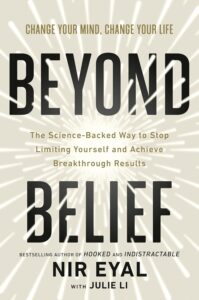
Beyond Belief: The Science-Backed Way to Stop Limiting Yourself and Achieve Breakthrough Results author Nir Eyal returns to the show (check out his past appearances here and here!) to walk us through the science of how beliefs shape not just what we feel, but what we literally see, attempt, and achieve. Drawing from six years of research, Nir shares how he broke free from a cycle of yo-yo dieting by realizing his convictions about food were tools he could swap out, not sacred truths worth defending. He introduces a deceptively simple “turnaround” technique that reframed his relationship with his own mother in minutes, reveals why manifesting culture actually backfires (visualizing success makes your brain think the work is already done), and explains how diagnoses like ADHD can become cages when we let labels become limits. Whether you’re stuck in a career rut, battling an old identity, or just tired of watching the same New Year’s resolution collect dust year after year, this conversation is a compelling case for auditing the beliefs you didn’t even know you were subscribed to. Listen, learn, and enjoy!
Please Scroll Down for Featured Resources and Transcript!
Please note that some links on this page (books, movies, music, etc.) lead to affiliate programs for which The Jordan Harbinger Show receives compensation. It’s just one of the ways we keep the lights on around here. We appreciate your support!
- Sign up for Six-Minute Networking — our free networking and relationship development mini-course — at jordanharbinger.com/course!
- Subscribe to our once-a-week Wee Bit Wiser newsletter today and start filling your Wednesdays with wisdom!
- Do you even Reddit, bro? Join us at r/JordanHarbinger!
This Episode Is Sponsored By:
- BetterHelp: 10% off first month: betterhelp.com/jordan
- Bombas: Go to bombas.com/jordan to get 20% off your first order
- Progressive Insurance: Free online quote: progressive.com
- The Perfect Jean: 15% off first order: theperfectjean.nyc, code JORDAN15
- Zocdoc: Find and book a doctor you love today: zocdoc.com/jordan
- Land Rover Defender: landroverusa.com
- The President’s Daily Brief: Listen here or wherever you find fine podcasts!
Thanks, Nir Eyal!
Click here to let Jordan know about your number one takeaway from this episode!
And if you want us to answer your questions on one of our upcoming weekly Feedback Friday episodes, drop us a line at friday@jordanharbinger.com.
Resources from This Episode:
- Beyond Belief: The Science-Backed Way to Stop Limiting Yourself and Achieve Breakthrough Results by Nir Eyal and Julie Li | Amazon
- Free Belief Change Guide | Nir Eyal
- Bonus Content and 30-Day Belief Transformation Journal | Nir Eyal
- Website | Nir Eyal
- Nir Eyal | Control Your Attention and Choose Your Life | The Jordan Harbinger Show
- Nir Eyal | How to Manage Distraction in a Digital Age | The Jordan Harbinger Show
- Counterregulatory Eating (the “What the Hell Effect”) | Wikipedia
- Learned Helplessness | Wikipedia
- Learned Helplessness at Fifty: Insights from Neuroscience | Psychological Review
- On the Phenomenon of Sudden Death in Animals and Man | Psychosomatic Medicine
- The Remarkable Power of Hope | Psychology Today
- Power Posing | Wikipedia
- Longevity Increased by Positive Self-Perceptions of Aging | Journal of Personality and Social Psychology
- Thinking Positively about Aging Extends Life More than Exercise and Not Smoking | Yale News
- Breaking the Age Code: How Your Beliefs about Aging Determine How Long and Well You Live by Becca Levy | Amazon
- Placebo | Wikipedia
- Jo Marchant | Placebos and the Science of Mind over Body | The Jordan Harbinger Show
- Placebo and Nocebo Effects | Skeptical Sunday | The Jordan Harbinger Show
- What Is Mental Contrasting and How to Benefit from It? | PositivePsychology.com
- Rethinking Positive Thinking: Inside the New Science of Motivation by Gabriele Oettingen | Amazon
- The Work of Byron Katie | TheWork.com
- Elizabeth Loftus | Wikipedia
- Lost in the Mall Technique (False Memory Implantation) | Wikipedia
- Hypnosedation: Is It Possible to Have Surgery without General Anesthesia? | MD Anderson Cancer Center
- Tummo (g-Tummo Meditation) | Wikipedia
- Koro (Genital Retraction Syndrome) | Wikipedia
- Koro Syndrome: Epidemiology, Psychiatric and Physical Risk Factors, Clinical Presentation, Diagnosis, and Treatment Options | Cureus
- Mass Psychogenic Illness | Wikipedia
- Identity Foreclosure | Wikipedia
- Rachel Zoffness | Managing Pain in Your Body and Brain | The Jordan Harbinger Show
1295: Nir Eyal | Why Your Beliefs Matter More Than Your Willpower
This transcript is yet untouched by human hands. Please proceed with caution as we sort through what the robots have given us. We appreciate your patience!
Jordan Harbinger: [00:00:00] Coming up next on The Jordan Harbinger Show.
Nir Eyal: People who have positive views about aging live seven and a half years longer. Now this is true to put that in perspective, seven and a half years longer. That is more than the effect of quitting smoking. It's more than the effect of a healthy diet. It's more than the effect of exercise.
Yet for all we talk about exercise, diet, and smoking. We never talk about positive views about aging. Beliefs are tools, not truths. The person who repeats themselves, oh, my achy back going in this, oh, I'm having a senior moment. What are they going to do? Versus the person who says growth is possible at any age.
The person who says growth is possible at any age. They go work in the garden. They go see their friends. They exercise a bit, they take walks. They do things that actually increase their lifespan, but that emanates from that positive belief.
Jordan Harbinger: Welcome to the show. I'm Jordan Harbinger. On The Jordan Harbinger Show, we decode the stories, secrets, and skills of the world's most fascinating people and turn their wisdom into practical advice that you can use to impact your [00:01:00] own life and those around you. Our mission is to help you become a better informed, more critical thinker through long form conversations with a variety of amazing folks, from spies to CEOs, athletes, authors, thinkers and performers, even the occasional Fortune 500 CEO, rocket scientist, arms dealer, or former drug trafficker, maybe former.
If you're new to the show or you're looking for a handy way to tell your friends about it, I suggest our episode starter packs. These are collections of our favorite episodes on topics like persuasion and negotiation, psychology, geopolitics, disinformation, China, North Korea, crime and cults, and more.
It'll help new listeners get a taste of everything we do here on the show. Just visit Jordan harbinger.com/start or search for us in your Spotify app To get started today, we're talking about belief, not positive thinking, not manifesting a Lamborghini with your vision board and as scented candle, I mean the stuff underneath your motivation, the operating system running quietly in the background that decides whether you quit or whether you persist long enough to win.
Because here's the unfortunate truth, knowing what to do isn't enough. If it were, we'd all have six packs, thriving businesses, perfect [00:02:00] marriages, and Duolingo streaks longer than our attention spans. But we don't. Why? Because belief, not motivation is what determines perseverance. Today we're diving into why fake science and magical thinking feels so good and why they quietly sabotage you.
The cruel rat experiment that explains human behavior better than most. Self-help books, why rumination feels productive, but is actually mental quicksand. Why placebo works even when you know it's a placebo, and how to build beliefs that serve you. Even if they're not technically true. Also, we're going to poke the bear on manifesting culture Grifters who blend neuroscience with nonsense and the billion dollar magical thinking industry.
If your beliefs shape what you see, what you feel and what you attempt, you might want to choose 'em carefully. Nir Eyal is back on the show and we're going beyond belief. Let's do it.
I can imagine writing a book, we say, Hey, I wrote the book for myself. But it's kind of like, but my publisher really wants other people to read it is the only, uh, flaw with that.
Nir Eyal: It's true, but I think it's, it's going to help a lot of people. What'd you think of it actually, you read it.
Jordan Harbinger: I did read it, I liked it. [00:03:00] And I was surprised, actually, at least the beginning came from personal experience. I've known you for a really long time. It's hard when you know someone in a certain way, but I'll tell people, oh yeah, I was all used to be like a chubby guy and they're like, what, you? 'Cause I'm in good shape now, right?
And I have been for half a decade or even more, but people who knew me in my twenties, they're like, oh, you look so good. Like most people, my face gets fat first. So if I gain 10 pounds, nine of it are in my face and then I got a love handle and it's dang it. But when I lose it, everything swims down. So it's really noticeable right away.
And I just, so for you, when you're like, oh yeah, I used to be overweight my whole life, it's like, huh, okay.
Nir Eyal: We'll compare fat kid pics.
Jordan Harbinger: If we can do that, you, it reminds me of you ever watch a series or a movie and then you see the actor interviewed and you're like, they have a British accent. I had no idea what is going on.
That's what it's like when you find out somebody was like really skinny or really overweight or something vastly different than what they are. As you've known them, you're like, wait a minute. It's all a lie. She's not really a child with special magical power. She's a British actress. I've been tricked.
He's not a [00:04:00] biker, he's an Irish guy. It's just so shocking. So I think that it's kind of that same thing you mentioned in the beginning of the book, that dieting and changing the way that you eat, it's a matter of belief and I found myself nodding my head along to was dieting really is like a pseudo religious belief, right?
If you go online and someone says, Hey, diet soda. Probably not that bad for you. There's no study showing this. People are like, but insulin this, and then I'm keto, and you're like, okay, if you're a keto or paleo person or you do CrossFit or a certain type of workout, you apparently by law not allowed to shut up about that until you find the next trendy fad diet to jump into and make your entire personality.
Nir Eyal: This was kind of me. That's exactly right. That I was espousing all the benefits of metabolic flexibility and before that it was vegetarianism and before that it was a low fat diet and I went from diet to diet and my bookshelf filled with books, all, all kinds of different diets, and every one of them actually worked.
They all worked until they didn't. When I [00:05:00] lost the conviction that I had this belief in the one and only true diet and someone would poke a hole in that conviction, then it all crumbled because that belief is what sustained me. Because what we know, Jordan, is that. The number one reason someone doesn't meet their goals, whether it's physical fitness goals, whether it's financial goals, whether it's relationship, family goals, business goals, the number one reason people don't reach a goal is because they quit.
It's as simple as that. It's not rocket science. That's the number one reason, which is actually quite amazing because for all the time we spend on, I don't have the right resource. I don't have the right information. Let me buy another book on this topic. Let me find out what to do, how I do it. Actually, the number one thing you can do is learn how to persevere, and so with me with dieting, when I had what I thought was the one and only true diet.
I could sustain that motivation. But as soon as somebody gave me some piece of information that put a crack in that facade that I had built around why this was the one and only true diet, I stopped dieting. And I would do things like, I'd have a [00:06:00] piece of pizza and I'd say, ah, you know what? None of those diets work anyway.
I just have a slow metabolism. I'm big boned, I'm whatever. It's the food industry is doing it to me. No diet works. And then of course, after the pizza comes the beer chaser and the french fries, right? And so as opposed to realizing a liberating belief, I kept holding onto these limiting beliefs. And the liberating belief that I have since adopted is that I can change the next thing I put in my mouth as opposed to what I used to do, which was the what the hell effect.
Jordan Harbinger: Otherwise known as the effect.
Nir Eyal: Yeah, exactly. This is a real psychological phenomenon that when you feel like, okay, it's too late. I've already messed it up, okay, I might as well go ahead and enjoy myself. I'll start the diet tomorrow or next New Year's or whatever. And so that fundamental shift of. Examining those limiting beliefs and realizing that those beliefs are tools, not truth.
That's the big revelation for me over the past six years of research with this book, is that I was holding onto a belief as if they were facts. I was looking for them to be true, but beliefs are not facts. I think, in [00:07:00] fact, most of our problems today in the world, interpersonal problems, geopolitical problems come from the fact that far too many people think that their faith is a fact, and the things that they think are facts are actually nothing more than beliefs.
And so we have much more leeway than we think.
Jordan Harbinger: As much as I'd love to keep crapping on diets, I'd love to move on because you're right. I find that a lot of times when I'm really either disgusted or totally confused by somebody's perspective, this might be online or in person. All I have to do is ask a few questions and then I realize, oh, I see.
I. You are falsely equating your personal moral outlook on the world with the quote unquote fact of this is how everybody should live, or this is what everyone believes, or something like that. And I'm not one of those people who's like, all beliefs are equal. You're allowed to treat your daughter like a piece of cattle and sell her, or like sexually assault women because they're wearing shorts.
Like those are defective belief systems. And if your entire culture adopts that, then there's something seriously wrong. To my earlier quip about how some of my friends are like, Jordan's a fricking fascist, right? I don't believe that all these [00:08:00] particular beliefs are equal. And it seems like maybe you also agree there, but I don't know if it's humanity or just, is this a recent phenomenon where people just go, I believe this and I've always believed this, therefore it's true.
And anybody who doesn't believe that they're just wrong, either because they're mistaken or more likely because they're a bad person and their beliefs are bad, and thus we should, I don't know, kill them or fight them tooth and nail because our beliefs are correct and the right way to do things.
Nir Eyal: I think this is the source of so many of our problems, and we see it as you're mentioning in political disputes.
My policy is that I don't want to hear from anyone who can't argue both sides, and frankly, if you can't do that, let's say there's an issue you really care about and you think, oh my God, there's clearly the good guys and the bad guys on this issue, and you think it's so simple, try arguing a steelman of the opponent's perspective.
Try convincing your friends who agree with you to your opponent's perspective. If you can't do that, shut the hell up.
Jordan Harbinger: Yes.
Nir Eyal: You don't deserve to espouse your opinion on social media, and frankly, I think it's [00:09:00] the vast majority of people who actually agree with me. It's just the loud people on either side who actually don't know what the word nuance actually means, and they think everything is black and white.
I think that's pretty convincing to me, at least from a perspective of what we talk about online. But when it comes to our own opinions. About ourselves, about the people we love, about the way we see the world. We don't realize that a fact has a very specific definition. A fact is an objective truth, right?
The world is more like a sphere than it is flat. That's true whether you believe that or not. Sorry, flat earthers. That's just a fact. Then on the other side of the spectrum, you have faith. Faith is a conviction that does not require evidence. So what happens in the afterlife? Maybe the faith that God will reward the righteous.
That's a matter of faith that does not require evidence in between. Fact and faith is belief. A belief is a strongly held conviction that is open to revision based on new evidence. It's not blind faith, it's not fact, it's belief, and most of the important things in our life [00:10:00] we do based on beliefs. It's not the the conviction of perfect certainty with evidence.
It's not that we have matters of blind faith. Most of our decisions, should I take this job? Should I go into business with this person? Should I marry this person? Should I move to this city? These are things that are unknowable because they are matters of what will happen in the future. And so they are solely based on belief.
And so if most of our big decisions in life are based on beliefs, we better get 'em right. We better examine them and see, wait a minute, is this a limiting belief? Is this reducing my motivation and increasing suffering? Or is it a liberating belief that it gives me more motivation and reduces my suffering?
Jordan Harbinger: So belief is essentially the key to perseverance instead of motivation. Is that accurate? Would you agree with that?
Nir Eyal: I think it's the key to motivation. I think it's also the key to reducing suffering. And that's really my goal. Jordan. I think in the earlier part of my life I was like, David Goggins, just God kill yourself.
And like, ah, you know, like, and I think David GOGI is, is amazing. I think he's an incredible example of what is possible when mind [00:11:00] is stronger than matter, right? That you can will things into existence. And there's some limitations when you actually look in the studies about how this all works. And I talk about the downsides of positive thinking.
There's a lot to this. But what I'm really interested in these days, as a father of a teenager who's going to go to college soon as my career, my relationships, I'm looking for peace. The world is just too crazy to have more things to do on my to-do list and higher expectations. I am looking to live healthier, to live longer, to live better, and to be at peace.
And what I noticed in my own life is that so much of my suffering, the suffering from people around me, it was caused by these limiting beliefs. These things that we hold onto as if they are true, as if they are facts. And we don't take them out. We don't examine them. It's almost like your face. Okay, we all have faces, but if I asked you to look at your face, you can't look at your face unless you're looking in a mirror.
You can't see your own face. And it's the same exact thing with our hidden limiting beliefs. They're always hidden to us. Now what's interesting. We can [00:12:00] see them in others, you could probably spout off all of their limiting beliefs. But when it comes to our own, and we all have them, but they're hidden because we think they are facts, and I hear them all the time.
Number one, limiting belief. I don't have time. There's not enough time in the day. Time for what? Well, the human race is 200,000 years old. The planet is billions of years old. Where are you going? It's just a limiting belief that we're all running out of time that, oh my God, hurry, we all have to be busy so I don't have enough time.
It's too late. I'm too old. I'm too young. I'm too this, I'm too that. I have this diagnosis, I have this limitation. All of these things, we are so committed to proving that they are true, that we will begin to see reality as we believe it is. That to me was a huge shift that I used to say that seeing is believing.
We've heard that, right? That if you want to believe something, you have to see it to be true. But what is just as true is that believing is seeing. It's also true in reverse, that we know that what you believe literally can change what you're able to see.
Jordan Harbinger: Seeing these [00:13:00] limiting beliefs in others is funny.
'cause I remember back when I used to be sort of like self helpy and coachy and I know people are like, this episode is self helpy. Kind of starting that way. But I'm more interested in the science now because the positive thinking stuff is silly and doesn't work. And a lot of this stuff that I thought was like a magic key to stuff turned out to be bs.
Remember that whole Amy Cuddy power posing thing and it was like, you do this and then Tony Robbins or whatever was like, yeah, you gotta do, and it just turned out to just be made up nonsense. I used to be so into that stuff.
Nir Eyal: Or the maid study.
Jordan Harbinger: Was that the one where they told 'em, this is exercise and it's like they burned all these calories and it was like, no, they didn't.
Nir Eyal: Yes. Well, the study was never actually published. It turned out it was just hearsay. And then there's the milkshake study that apparently raised ghrelin. Yeah, it raised ghrelin in microscopic little amounts, but, and then also didn't actually affect hunger at all, or the study where they took old guys and they put them in the 1950s so that they felt like they were in their youth and then they acted more sprightly.
So the maid study turns out, didn't replicate. It [00:14:00] was published, but it didn't replicate, they didn't show the same results. The study about the guys where they took the old guys and they put them in the house like it was the 1950s, that one was actually never published. And so, you know, couldn't be replicated either.
Jordan Harbinger: They took old guys and they were like, here's old music and old paintings and old TV shows, and basically it's your 20 again. And then they were like, look, everyone's acting younger and their brain function is increasing. And it's like, oh, actually no, that's just urban legend.
Nir Eyal: It was anecdotal. It was never published.
It was called the Counterclockwise Study. Never replicated and never even published. That being said, okay, so that's actually some of the studies that got me interested in this stuff. 'cause it's, wow, that's amazing. Like why are we all not doing this intervention? If you could do that, just place us all in environments that look like our youth.
We would all be younger. That should be done on a mass scale. When you dig into the research, beliefs don't become your biology. That's a myth around this whole field, that there's some kind of magical power that when I believe certain things, my mitochondria do this and that, and then it, no, that's not true.
That is not how it works. However, it is [00:15:00] still super powerful once you understand how it actually works. So I'll give you a study that is real and has been replicated many times is this study around steroids where they gave two groups of guys an intervention. They said, okay, here's your workout protocol.
And one group was a control group. They did nothing to them. Another group, they gave a steroid, which was actually a placebo. They told them, here's a steroid, but they didn't tell 'em. It was actually completely inert. Now, what's amazing about this study is that these guys who thought they were taking a steroid put on more muscle mass placebos can increase muscle mass.
That's pretty fricking amazing.
Jordan Harbinger: This is probably explained in the study, but I gotta say just as somebody who lifts weights. Did the placebo put on the muscle mass or did they lift harder knowing, quote unquote, knowing they were on steroids and thus their body reacted differently? Because that's different than, Hey, I just believed really hard and I put on muscle it.
This is, no, I just worked out harder because I thought I would get a bigger benefit and that actually had a result. You know, if that's the [00:16:00] case.
Nir Eyal: So it is true that your beliefs will change your biology, but the path is not direct. The path goes through behavior. And so that's why when we started the conversation, it is about motivation.
'cause you're exactly right. It turns out that the guys who thought they were taking the steroid, they did one more rep, they pushed a little bit harder, they added on a tiny bit more weight.
Jordan Harbinger: I'm a machine. I'm on gear right now. Right? Like, that'll make you work out harder. Of course it will.
Nir Eyal: But that doesn't mean that placebo effects are fake or that they don't work.
They work. And in fact, we should use them more because if you want to take that bit of creatine or the extra BCAA or whatever, if it's not hurting you and it's not too expensive. It might be worth it. It actually might have these benefits, so why not? We should actually be using these more. Another great example of something that you don't have to ingest anything into your body, which actually does increase lifespan.
This was a study at Yale, found that people who have positive views about aging live seven and a half years longer. Now, this is true. This has been run, replicated. I look at the study, it actually is a very [00:17:00] well run study. They live seven and a half years longer. Now, to put that in perspective, seven and a half years longer, that is more than the effect of quitting smoking.
It's more than the effect of a healthy diet. It's more than the effect of exercise. And yet for all we talk about exercise, diet, and smoking, we never talk about positive views about aging. Now, why did this happen? It's not magic. It's not that they were vibrating at the quantum valid field vibration, whatever.
No, it was that people who have positive views about aging behave differently. Right. So somebody who has the view of aging involves inevitable decline. That's a negative view of aging. Aging involves an inevitable decline versus someone who says growth is possible at any age. Now, Jordan, which one of those is true aging involves an inevitable de decline or growth is possible.
Jordan Harbinger: Both of them are true, actually.
Nir Eyal: That's exactly right. So both are true. So beliefs are tools not true. The person who repeats themselves, oh, my achy back going in this, oh, I'm having a [00:18:00] senior moment. What are they going to do? Versus the person who says growth is possible at any age. The person who says growth is possible at any age, they go work in the garden.
They go see their friends, they exercise a bit, they take walks. They do things that actually increase their lifespan, but that emanates from that positive belief.
Jordan Harbinger: Honestly, I'm kind of excited to be old. You can get away with so much more when you're older. Anything you do is kind of amazing. Wow. Look at you.
You're going for a walk. You're like, yeah. In order for me to get that kind of reaction, I'd have to run a marathon. Oh, you ran an ultra marathon in the desert. Wow. That's pretty impressive. Meanwhile, you're 80 and just like, oh look. He's driving there. He's driving. Yeah. You know, like.
Nir Eyal: What's amazing about this too is that the beliefs, it's not something that if you wait until you're that old to change your beliefs, we don't know, but it could be too late because this study was done where their beliefs were tracked when they were in their thirties.
That's when they started tracking your beliefs at a young age around aging. That's when it's important to change them. So taking out these limiting beliefs, like why do we say to ourselves, I'm not a morning person, or I'm a [00:19:00] Sagittarius, or, you know, whatever. Like these labels that we attach to ourselves, they become our limits.
They become these cages that we've designed for ourselves.
Jordan Harbinger: Yeah, that's funny. There is a person that I know that they're often in a bad mood and they kind of joke about it, but really they're in a bad mood. They're just trying to play it off because it's more fun that way. And I'm always like, what's Tommy?
What's the deal? I'm an Aries, and today my horoscope said, you know? And it's like, oh God, not this crap. You know? You can just not read that and be in a good mood if you want to. Right. It's all optional, man. But it's part of his identity is I'm a grump. I'm a sassy grump, and it's just gotta be kind of a miserable way to live.
It's, he's like a sassy, petty, grumpy guy, and it's like, ha ha. Just joking. But it's also totally your personality most of the time.
Nir Eyal: Yeah. And if he's happy and if he's flourishing that way, hey, who am I to tell him to change it?
He
Jordan Harbinger: is not.
Nir Eyal: That's the thing. If you're not, why do we do this to ourselves? We do this to ourselves.
I know why? Because it turns out that our default [00:20:00] is to. Revert to passivity. We used to have this theory in psychology called learned helplessness, sigman admire, and so we were all taught that, oh, you see, when people have hardships in their life, they learn to just give up. And so this explains a lot about why people are stuck in cycles of poverty, because if you try and you learn, nothing works, you just default into passivity.
Turns out a couple years ago, didn't make any waves. Nobody really heard about it. Turns out that Seligman and Meyer, these giants in the psychology research literature changed their mind. They decided that the exact opposite was true, that when they actually looked at their research and now they had research that they could update based on new technologies that we have, they were able to determine that from the data they collected, that we don't learn Helplessness.
Helplessness is our default state that we will always go back to. This has been safe for me in the past, so I'll continue to be safe with this limiting behavior in the future. What we have to learn is not hopelessness. What we have to learn is hope. That is actually what we have to teach. We have to teach ourselves [00:21:00] agency constantly, or we will revert into passivity.
And frankly, that's what most people do. They just revert into, well, this is the way I've always done it. My least favorite words in the, in English language are, that's just how I am now. You're in stasis, you're stuck. It doesn't matter if it's true or not. I'm a this, I'm a that. If you've decided case closed, we're not changing nothing.
Jordan Harbinger: Speaking of learned helplessness or hopelessness, tell me about that wild rat experiment. I feel like the reverse of this particular process learned hopefulness.
Nir Eyal: Yeah, so this study was done by Curt Richter in the 1950s. It's a an amazing study a. Where he took these rats, wild rats, and he put them into a cylinder of waters filled about halfway full with water.
And he sat there and he times a pretty cruel experiment. You can't do something like this anymore, but the rats are already dead, so I can tell you all about it. He put the rats in a cylinder of water and he sat there and he timed how long the rats could swim for. Turns out a wild rat, if you put it in a cylinder of water, can swim for about 15 minutes.
Okay? So 15 minutes of swimming before the rat gave up and died. Now he knew this and he did another round of [00:22:00] experiments. So now he took a new batch of wild rats. He put them in a cylinder of water and he allowed them to start swimming, and he measured right before the 15 minute mark. Right before he knew they were about to give up.
He pulled his hand in, he pulled out the rat from the cylinder, dried it off, let the rat catch its breath and plunk back into the cylinder. The rat went. And he did this a few times. He conditioned the rat to expect that salvation might be possible. And now he wanted to see would that intervention change how long the rat would swim for.
You know, there's a trick. There's always going to be a trick here, right? In every psychology study, there's a surprising result if I'm going to share it with you. And so the rat went from 15 minutes, so most people think, okay, maybe the rat swam double 30 minutes, maybe four times longer, 60 minutes, which would be insane if I could give you some kind of intervention that would increase your perseverance four x for you.
Run the marathon for four times longer, work on that hard project four times longer. Take that hard exam four times longer. Wow. That would be [00:23:00] earth shattering if I could give you that kind of invention. But the rats didn't swim four times longer. They didn't swim from 15 minutes to 60 minutes. They went from 15 minutes to 60 hours.
Jordan Harbinger: That's crazy.
Nir Eyal: 60 hours, they became 240 times more persistent. Now, what had changed? Nothing in their body. They weren't better physically conditioned. They didn't suddenly, you know, gain strength in their bodies. The experiment didn't change. Nothing changed in the environment. Same experiment. We can't ask them what they believe, but the only variable left was that something must have changed in their minds, some switch must have been flipped, and now what was already in them, they had the 60 hours in them the whole time, but something flipped in their brains.
Once they knew, Hey, I might be saved. That kept them going. That kept them motivated, that kept them persevering. And so that's what this is all about. When you understand the power of beliefs and it's not just about positive thinking. In fact, there are very negative repercussions to positive thinking if you don't have the right beliefs, if you don't do it the right way.
We could talk [00:24:00] about that in a minute, but the point here is when you can't unlock this motivation, wow, there's a whole nother world that you can find for yourself.
Jordan Harbinger: Placebo works even when you know it's fake, which means your brain is powerful also, it means it's incredibly gullible. Now let's put that gullibility to use.
We'll be right back. This episode is sponsored in part by BetterHelp. March Includes International Women's Day, and it's had me thinking about how much women carry that. Most of us don't fully see. I look at my wife, Jen. She's the architect of fun in our house, birthday parties, little adventures. Special outings that make life feel bright.
She's also running the behind the scenes operations schedules, school logistics, all the moving pieces that keep everything from falling apart. There's an invisible mental load that's basically always on, and because she makes it look effortless, it's easy to forget. It still has weight. I think a lot of women operate like that.
Capable, organized, steady, while quietly carrying more than anyone realizes. Therapy can be a space where you don't have to hold everything together. You can talk through what you're carrying, set boundaries, find some balance. BetterHelp connects you with licensed therapists who follow a strict professional code of [00:25:00] conduct.
You take a short questionnaire, they match you based on your needs, and you can switch any time With over 30,000 therapists, 6 million people served, and a 4.9 outta five rating from 1.7 million reviews. It's helped a whole lot of people.
Jen Harbinger: Your emotional well-being matters, find support, and feel lighter in therapy.
Sign up and get 10% off at betterhelp.com/jordan. That's betterhelp.com/jordan.
Jordan Harbinger: This episode is sponsored in part by Bombas. One of the goals this year and all year round is to stay comfy, and Bombas is leading that charge in my house. We love Bombas so much. It's all we wear. We even gifted to our family and our friends and our nanny.
We're big fans of the grip socks, so we don't slip around on our floors. Bombas just launched their new sports socks, which are amazing for whatever you're into. Running golf, hiking. We're planning to do more snowboarding this year, and these things are cushioned, sweat wicking, and packed with techy features that make it feel like your feet are finally on your side around the house at night, I'm living in their Sunday slippers, which keep my feet cozy during those cold winter nights.
And Bombas also has underwear and teas. Buttery, soft, breathable, the kind of base layers that ruin every other brand for [00:26:00] you. Plus, for every item you purchase, Bombas donates an essential clothing item to somebody facing housing insecurity. One purchased, one donated over 150 million so far.
Jen Harbinger: Head over to bombas.com/jordan and use code to Jordan for 20% off your first purchase.
That's bombas.com/jordan. Code Jordan at checkout.
Jordan Harbinger: Don't forget about our Six Minute Networking course. I'm too lazy to shill it right now. I'm just tired. If I'm tired of it. You're tired of it, sixminutenetworking.com.
All right, back to Nir
Jordan Harbinger: Eyal.
Obviously we can't do this and nobody should, but imagine your boat sinks and you're treading water.
Do you tread water longer if you see helicopters and airplanes looking for you in the sky, or do you think, oh, they're so close, they're going to eventually see me down here. Look, that's the third plane I've seen in two days, and you're just sitting there treading water or trying to float on your back. I would be so curious.
About something like that. I hope I never have to find out that particular scenario firsthand, but it's crazy to me that that's an unbelievable increase in motivation, [00:27:00] but it proves your earlier point, right? Our default state has learned helplessness. If they only swam for 15 minutes and then they were like, ah, screw it.
The rats had been conditioned to humans thought, no, no, no. They always pull me outta this mess. They always pull me outta this mess. It's just a matter of time. That's so interesting. I love that one. I thought that was fascinating in the book. The good news is that beliefs can be learned, right? I mean, even rats can do it.
All they had to do is be pulled outta the water. What was it one time before they learned, Hey, this might happen again?
Nir Eyal: It was a few times.
Jordan Harbinger: It was a few times, okay.
Nir Eyal: And so this actually can relate to us. I didn't write the book for rats. I wrote it for me and I wrote it for my fellow humans. But essentially what we do is we have to condition ourselves to expect that difficulty that everything worth having in life is on the other side of heart.
Right. You want to build a beautiful family. That's going to be hard, right? Raising kids is not easy. You want to build a business, it's going to be hard. You want to get in shape, it's going to be hard. So the critical trait becomes, can you learn how to persevere through that difficulty, or do you think it's pointless and you give up?
And so what successful people are able to do is that they're [00:28:00] able to believe something different about that difficulty. They're able to see it from a different perspective. And we can do this in every facet of our life.
Jordan Harbinger: Knowing what to do and why isn't enough. 'cause if it were, we'd just all be successful at everything.
But that's not the case. We always have to believe that something will happen or we just won't persist. Is that an accurate statement?
Nir Eyal: Exactly. So when we think about motivation, most of us, you know, we think about it in the economic sense of, if I want this benefit, I have to do this behavior. It's a straight line.
If I want to get paid, I gotta do this job. I gotta do my work function. So we've got behavior and we've got benefit, but there's something missing. If it was that easy, if all we had to do was do the behavior to get the benefit, we'd all have six pack abs and be multimillionaires, because we all basically know what to do.
Who doesn't know? If you don't know how to do something, you ask ChatGPT, you ask Google, you can find the answer to do pretty much anything and everything. But what we're missing is that motivation is not a straight line. Motivation is a triangle that you have the behavior, you have the benefit, but then you have the belief as well.
So for example, if [00:29:00] I want the benefit, let's say I want that raise, I want that promotion at work. But if I don't believe that my boss has my best interests, what's that going to do? My motivation? I'm not going to be very motivated to work for that boss. Now what about the behavior? Let's say I know what to do, but I don't believe in my ability to do it.
Maybe I think I'm ha I have imposter syndrome. I have whatever. There's no time in my day. Someone like me couldn't possibly do this. If I have those limiting beliefs about the behavior, I also won't persist. I'll lose motivation. So underlying the behavior and the benefit is the belief you need all three.
Jordan Harbinger: We can't always act on fact. I suppose belief is somewhere between total faith with nothing behind it, versus there's facts where it's like the earth is round whether people like it or not. And then there's arguments of faith. I don't mean religious faith necessarily, but a lot of flat earthers will say.
Nir Eyal: Things that don't require evidence.
Jordan Harbinger: Yeah, there's, and there's no evidence that the earth is flat other than your weird cognitive bias and lack of understanding of how your own perceptions work. So belief is what, somewhere [00:30:00] between those two things.
Nir Eyal: It's a conviction that is open to revision based on new evidence. So it's something that is changeable as opposed to a carpenter uses a hammer and doesn't say, oh, this hammer, this is the one and only true tool.
No, A carpenter says, okay. Sometimes they use a hammer, sometimes they use a wrench, sometimes they use a saw. There are different tools for the job, but when it comes to our beliefs, oh, it works for us in the past, so we're going to hold onto it forever and ever. And so most people never take out those limiting beliefs.
Look at them, see if they serve them or hurt them, and they just keep using them year after year. And then they wonder, why am I still stuck in the muck? Why does this relationship still suck? Why is this still annoy me? Why can I still not accomplish that goal? Why do I still have this New Year's resolution that's been there for years and years and years?
It's because underlying all of that muck is always some kind of limiting belief that hasn't been examined.
Jordan Harbinger: Beliefs. They don't necessarily have to be true, right? Because many times they are not.
Nir Eyal: And they're in the future. How could they be true? Should I marry this person? Is that a fact? How do I [00:31:00] know it's based on the best possible evidence I have?
Should I start this business? Should I move to this city? No. No. It's based on a belief open to revision based on new evidence.
Jordan Harbinger: There's a world in which having slightly but not two delusional beliefs is a good thing, right?
Nir Eyal: I would argue we're actually all already delusional.
Jordan Harbinger: Yeah, for sure. That's true.
Nir Eyal: We're already gaslighting ourselves because the brain just cannot process all this information. So right now your brain is taking in 11 million bits of information. 11 million bits of information is the equivalent of reading, war and Peace every second, twice. That's the information going into your brain right now.
The light entering your eyeballs, the sound of my voice in your ears, the ambient temperature of the room, that information is being processed by your brain, but your conscious attention can only process about 50 bits of information. So 50 bits versus 11 million bits. So that means that only 0.0, 0, 0, 0 4 5% of the information going into your brain is [00:32:00] actually your view of reality.
So you don't see reality. You see a simulation of reality that your brain is inventing every minute to predict what is going to happen next. There's just too much happening. So how does your brain come up with these predictions? How does it know what keyhole of attention to look through? It's done through your beliefs, and in fact, we barely can handle the information that we're processing.
It's really impossible to try and think how other people see reality, and this is of course, why we get into conflicts. It's because two people can see the exact same event, hear the same exact words being said and interpret what just happened completely differently.
Jordan Harbinger: What are some elements then of good beliefs, right?
Beliefs that serve us in fact, good and bad? Let's talk about good and bad beliefs, because I feel like there's clearly two categories here, some of which serve us and some of which don't. It's that whole liberating versus limiting beliefs. Yeah?
Nir Eyal: Yeah, that's exactly right. Limiting belief is one that SAP's motivation.
It makes you less likely to pursue whatever it is you're out there to go get, and it increases [00:33:00] suffering. Whereas a liberating belief is one that increases motivation and decreases your suffering, but it also, what is an at you ask, what is an attribute of a good belief? It must be open to revision, right?
It's not something that we say, oh, I found the perfect belief. That's all I'm going to ever believe for the rest of my life. What the research literature shows us is that we want what's called cognitive flexibility. We don't necessarily have to change our mind all the time. The smartest people. The people who do best in life are the ones who can look at a portfolio of perspectives.
They can look at a variety of different viewpoints, and then they can pick and choose. They're not glued onto just, this is the way things are. Maybe I can relay, you know, like to make this concrete, I want to relay a quick story of what happened with my mom. There was no better example of how this stuff has changed my life.
This research has changed my life, other than the relationships I've had with my family and people around me. I'm just so much better off now. And I'll share a quick example. So a few years ago, my mom had her 75th birthday and I wanted to send her some flowers. I want to [00:34:00] do a nice thing for her and send her some flowers.
Problem was, I was in Singapore and she was in central Florida where I grew up, and that wasn't easy to get flowers for her delivered, but I stayed up till one in the morning. I found the best florist. I called around, I made sure that they were going to deliver on time, and I went to bed that night and I said, all right, Nir. Good job. You did a good job there. She's going to love these flowers. I woke up the next morning, I called her up for her birthday and I said, Hey mom, did you get the flowers I sent? Happy Birthday! She said, yes, I did get the flowers. Thank you very much. But just so you know, they were half dead. And I wouldn't order from that florist again.
And I said something to the effect of, that's the last time I ever buy you flowers.
Jordan Harbinger: Ouch. Dang. She's probably just telling you the flowers are dead. I don't know. Feel like I'd want to know.
Nir Eyal: I know, right? Well, yeah, exactly. So it went over about as well as you'd expect. And then after the call, my wife turned to me and she said, Hey Nir, do you want to do a turnaround on that?
To which I said something to the effect of, I don't want to do your hocus pocus mumbo jumbo, touchy-feely. [00:35:00] I need to vent. What are you talking about? I'm not going to do this. This silly psychology stuff. Like you heard what she said, that was rude. And yes, okay, maybe I didn't respond perfectly appropriately, but clearly it was her fault and I just was reacting to what she was doing.
And I wanted to vent. But of course at that point I had known enough of the re research literature that shows that venting is actually not good for you. It doesn't help the situation. Venting does nothing more. It turns out that venting about somebody does nothing more than solidify this effigy that you've built about somebody.
Because we don't see reality as it is. We don't see people as they are. We see our past beliefs about them. That's what we see in others. I have a lot of friends, this always disappoints me, but I have some friends who are super nice to me, are super nice to strangers, are super nice to those around them.
And then you go to their house and they are just complete jerks to their family. Have you ever met these people? They're short with their children. They're mean with their spouse because they don't see the people closest to them in their life as they really are. They see the past history they've had with those people.
They see their [00:36:00] worst traits, they see their beliefs about them. So I had known that venting was not something I wanted to do. The literature's pretty clear that it's not a healthy behavioral pattern. So instead I did this turnaround. Now, what is a turnaround? A turnaround is a technique that comes from the work of Byron Katie and she's did a beautiful job.
I need to give her credit for creating what I'm about to share with you. I've adapted it a bit and she essentially channeled Aristotle. So this is a very old technique. It's 2,500 year old type of technique, and essentially what it does is it allows us to collect this portfolio of perspective. So I took the belief that I came outta that conversation with my mom with was My mom is too judgmental and hard to please.
Okay? Clearly that's what I believe. That's a fact in my mind. The first question that we poses to ourselves is that belief. True? Okay, is that belief true? Obviously, Jordan back me up here. My mother was who does that? I just spent all this time buying you flowers and the first thing you say is that the flowers weren't very good.
Don't look a gift horse in the mouth. I just did something nice for you. [00:37:00] You should say something nice back, right? You clearly you are being too judgmental. Okay, next question. Number one is a stupid question. Let's do number two. Second question, is it absolutely true? Absolutely.
Jordan Harbinger: No. She could just be tactically telling you, Hey, by the way, this florist dropped the ball, but I appreciate the flowers, is what she should have said.
But she didn't lead with that. So you felt, I don't know, 47 years of pent up grievance against the way she communicates came out. And that particular response, I don't know.
Nir Eyal: Could be, yeah. So the goal of that question is just to ask yourself, by the way, you can do this with everything. You can do this with any relationship, any belief that's holding you back, anything that you think I'm stuck in something and it's because of this situation, it's because of this belief that I have that I think is a fact.
Let's test if it's really a fact so that we don't have to change our minds. We're just creating that portfolio of perspective. So is it absolutely true that my mother's too judgmental.
Jordan Harbinger: Based on that one comment? No, I can't really say that.
Nir Eyal: Can't be, right? May. Maybe there's a 1% chance. 'cause absolute means always, never is it without exception.
It's always that [00:38:00] case. And there could be a 1% chance that there was another factor at play that I didn't realize. Okay, fine. I'll give you that now. The third question. Who are you when you hold onto that belief? So when I held onto that belief that my mother's true, judgmental and hard to please, I was short-tempered.
I wasn't very nice. I said something, I later regretted. So that belief, when I was honest with myself, wasn't really serving me. Now the fourth question, who would you be without that belief? If I had a magic wand and I could suddenly tap my brain and dissolve that belief forever, I'd probably be better off.
Honestly. Like I can't see how I could do that. But wouldn't that be nice? If I could magically get rid of that belief? I'd be more patient. I'd be more myself. I wouldn't be a 13-year-old and say something I later regretted. So in just four questions I showed myself that one, this belief may not be true.
Something that I thought, absolutely, that's a fact. My mother's clearly being too judgmental, right? I [00:39:00] showed myself that belief was actually not serving me, that it was causing me suffering, and that I'd be much better off without it. Okay, so now comes the next phase. The next phase is to do the turnaround.
The turnaround asks us to consider something completely ridiculous, not to convince ourselves of changing our mind, but the thing we're trying to do that's ridiculous is to ask ourselves, could the exact opposite be true? Could it be true if the exact opposite thing? So what's one example of a turnaround?
My mother's too judgmental and hard to please. A turnaround. Could be My mother, is not too judgmental and hard to please. How could that be? You said something very smart. You said, you know, maybe she was just trying to give you some information. She was just making a statement of fact the flowers were wilted.
Maybe she was trying to help me not get scammed by this florist and not necessarily hurt me.
Jordan Harbinger: I, I feel, what's funny is I can totally see myself saying the same thing. I can see my wife getting me a cake or something and be like, this cake was smashed, and she's like, you don't appreciate anything. And it's no, no.
I'm telling you the cake was, why did I start with that? Why did I lead with that? They're telling you the cake came with a dent in it. It's not that I don't [00:40:00] appreciate. It's that these knuckleheads delivered it after they dropped it. I can totally see myself slipping into that position.
Nir Eyal: That's now we have two beliefs.
Jordan Harbinger: I sympathize a little bit with your mom. I think.
Nir Eyal: Yeah, you might be on her side of this argument. Let's do another turnaround. Another turnaround could be, I am too judgmental and hard to please. That's the opposite. How could that be true? I sat with that for a minute and I realized, you know what? If I'm honest, I had rehearsed in my head that I wanted a very specific profuse sign of gratitude from my mom.
And when those exact words didn't come out of her mouth, I lost it. So who was being judgmental? I was being judgmental. Now there's a fourth turnaround. I am too judgmental and hard to please to myself. And that one actually stung the most and was the most true. It turns out that really because I had put so much effort into getting her the perfect flowers and it didn't work out, I took that to mean that was a sign of my own incompetence that I had messed up, that I was somehow inferior, [00:41:00] that I couldn't do this simple task correctly, and I was being judgmental towards myself.
And this is what we call a misattribution of emotion. When we feel shitty about something that we've done, we look for the first person's face in front of us, and that's what we're going to take it out on. And so I put that emotion on her and I blamed her for how I was feeling. So now, which one of those four beliefs is true?
All of them. None of them, who cares. I'll tell you what, that first belief and my mother is too judgmental and hard to please only had one way out. The only way out was that she had to change so I could be happy. It's not going to happen.
Jordan Harbinger: No.
Nir Eyal: Don't hold your breath. You're going to suffocate the other three beliefs I could do something with.
Now, they were on my side of the net. I could change in order to make myself happy. So it's not about which is true. Let me prove to you, this is how most of our arguments go. No, I'm going to prove to you that I was right and you're wrong. Well, that doesn't get us anywhere. Versus how can I collect a portfolio of perspectives that now reduce my suffering?[00:42:00]
And so what I've learned to do, and I do this technique probably 10 times a day in different situations, whenever I get annoyed, whenever I find myself suffering, this is a very quick practice that I've done. Now it takes me now maybe a minute. 'cause now it's on autopilot. I can quickly run through this.
And it has brought me so much more peace and so much more motivation to get through the hard tasks and hard situations in life. That's just one example of how you can use these beliefs to find your liberating beliefs.
Jordan Harbinger: It's interesting, it's almost like our judgments of others are just judgments of ourselves a lot of the time.
I mean, it sounds like when you turn that around, it's gotta be quite uncomfortable to do this to yourself. I dunno if I'm interested.
Nir Eyal: Yeah, no, this is exactly right. I wish I could figure out how to help people through this because I've been through this very much myself, that your brain has this immunity to change.
If you've got a splinter in your finger, your biological immune system is going to send white blood cells and it's going to fight that invader. Any kind of bacteria that gets in there, it's going to get inflamed so that it can protect your body from these foreign particles. Your [00:43:00] brain does the same thing. Your brain will trick you into believing nonsense into believing stupidity, into believing things that are actively harming you, and you won't let yourself change because you'll be cock sure that it's a fact.
It will do everything it can to try and protect you from having to change your mind. Because again, we default into passivity. Our passive state is helplessness. We want to stay static. And so it's only by shoving yourself outta the mud, you're like, if your foot got stuck in mud, it's hard. You gotta pull it out, right?
Ooh, it takes some effort. And that's that emotional effort that I think is very difficult for us to do, but it has huge payoffs. And look, 99% of people, they're going to hear this message. They're going to be like, nah, I don't want to do that. I'm good thinking my mom's a jerk and this person traumatized me and I have this and I do that, and they're going to get you stuck in the mud.
That's cool. If that's good for you, stay stuck. But if you want more, if you know you're capable of better, trust me, take out those limiting beliefs. The goal is not to change your mind. The goal is to collect their portfolio perspectives and then choose, Hey, [00:44:00] let me try this on for a week. How does the world look when I look through the world through this set of lenses versus this other pair of glasses?
Sometimes it's going to look better, sometimes it's going to look sharper, sometimes it's going to look fuzzier, but I can choose the right lenses that I can look at reality through so that it serves me rather than hurts me.
Jordan Harbinger: Yeah, it's interesting how beliefs filter how we see and communicate with other people, and you can just choose a different filter.
I think most people, myself included, hadn't really thought about that.
Nir Eyal: Me neither. Took me six years of writing this to realize it.
Jordan Harbinger: Wait, you can just choose a different way of looking at things like, that's pretty darn cool. I would love to separate this from regular old garden variety. Positive thinking.
I mean, you touched a little bit on this earlier where it's like you have to. Change your behavior. You can't just sort of will something into existence with beliefs. And it reminds me of there used to be this guy who was really trendy and I refuse to interview him because something didn't sit right with me.
And now it's obvious why I'm going to name check him. 'cause who cares? He's a bullshitter. His name's like Joe [00:45:00] Dispenza and he's like, you could heal your mind. Quantum something, whatever. I healed my spine with beliefs. And it's like, no you didn't. You're uh, full of shit and you're a grifter.
Nir Eyal: He is full of shit.
I talk about him in a chapter of the book where I talk about the negative side of positive thinking. By the way, he's just an example. This type of bullshit has been around for a very long time about the manifesting and the vibrating at the universe, at the quantum level. And if you vibrate correctly and if you send out positive thoughts and good things will happen to you, and what exactly happens when you get sick, does that mean you didn't vibrate hard enough?
Of course you didn't. Now you have to buy my upgraded program so I can teach you how to vibrate properly.
Jordan Harbinger: There's a whole industry built on sprinkling real neuroscience on top of absolute nonsense. It's kind of like putting a lab coat on a fortune cookie. Sounds smart. Still empty calories. Fortunately, our sponsors deal in reality.
We'll be right back. This episode is sponsored in part by Progressive fiscally responsible financial geniuses, monetary magicians. These are things people say about drivers who switch their car [00:46:00] insurance to Progressive and save hundreds because Progressive offers discounts for paying in full, owning a home and more.
Plus, you can count on their great customer service to help you when you need it. So your dollar goes a long way. Visit progressive.com to see if you could save on car insurance. Progressive casualty insurance company and affiliates. Potential savings will vary not available in all states or situations.
This episode is also sponsored by The Perfect Jean. There's a big difference between these jeans technically fit and I look good in these. Most denim makes you choose comfort or style. If they're comfortable, they look sloppy. If they look sharp, they feel like medieval armor. The Perfect Jean nails it with a clean tailored look.
But they stretch like performance gear. So you're not adjusting all day. You're not having to suck it in. You're not avoiding stairs. And here's what I like. They're built for real bodies, six different fits. Waist size is 26 to 50 lengths up to 38, over 5,000 fit combinations. So whether you're lean lifting dad, Boll in progress, or thick thigh king, or blessed with a little extra height, you don't have to force yourself into some weird fashion template.
They started 79.99, which compared to the 150 bucks I've spent in the past on premium jeans that later betrayed me, it's [00:47:00] solid value. Highly recommend The Perfect Jean.
Jen Harbinger: Our listeners get 15% off their first order, plus free shipping at theperfectjean.nyc. Or Google The Perfect Jean and use code Jordan 15 for 15 percent off.
Jordan Harbinger: If you like this episode of the show, I invite you to do what other smart and considerate listeners do that is take a moment, support our amazing sponsors. They make the show possible and they're all searchable and clickable on the website at Jordan harbinger.com/deals. If you can't remember the name of a sponsor, you can't find the code, email meJordan@jordanharbinger.com.
I'm more than happy to surface that code for you. It is that important that you support those who support the show. Now, back to near ael. Okay, so the kids in Africa who are starving, they just didn't manifest hard enough because they're not vibrating at the right frequency. This whole country, 97% of the people who are living on a dollar a day, they're, it's just their vibration issues.
It's like, I'm not one of those people who usually says stuff like this, but I gotta say that is some suburban, white ass white people. Shit. Like it really is. Maybe stretch this out [00:48:00] beyond Saratoga, California, where you live and apply this to people who are really going through some actual stuff. Not somebody who lost a golf tournament last weekend or something, and maybe just, maybe this person had spina bifida because of bad prenatal care, not because their parents something, something, vibration, the universe, whatever.
That's what just bugs me about the secret and the law of attraction. It's okay, so everybody who's not doing well, somehow this is just their fault because metaphysics some nonsense thing.
Nir Eyal: So not only is it ridiculous, it actually backfires. So Gabrielle Tigen did this wonderful research where she had people do these visualizations.
They did the manifesting, they did the vision boards. They were thinking about the outcomes of what they wanted, standard gobbledygook in this space. And as they were doing this, she connected them to these blood pressure monitors and track their heart rate and their blood pressure. And what she found was that when people were visualizing the outcomes of their efforts, the things they were dreaming of, the things that they wanted to manifest, they became more [00:49:00] relaxed physiologically.
And when she followed up with them, they were less likely to do the things. That would get them to those goals, they actually were less likely to achieve those goals. Why? Because the brain was receiving the message. Ah, I already got it. I can see it in my mind's eye, it's already here. And they became less likely.
So students who had visualized doing really well on a test, studied less when they did this visualization now. But you say, okay, I hear a lot. Yeah, but look, athletes visualize,
Jordan Harbinger: but they're doing something different. Yeah.
Nir Eyal: Exactly. What are they doing differently? Athletes don't visualize outcomes. They're not visualizing, oh, I'm going to stand on the podium with my shiny new medal.
No, an athlete, once they visualize the obstacles in their way, so if I'm on offense and defense is coming at me, what am I going to do? If I'm skiing down the mountain and I take a wrong turn, what's going to happen? They're visualizing what they will do when difficulty rears, its inevitable head. And that's what we forget.
And so this is called mental [00:50:00] contrasting what you want to do the right way to visualize. Is to prepare yourself for the negative sensations that are going to come. So here's what I did when I started losing weight, I didn't visualize myself with a beach body and six pack abs. That doesn't work. What does work is I would rehearse to myself, okay, when I go to that party and someone offers me a drink too much, or someone asks if I want a piece of chocolate cake, and I feel uncomfortable around saying no, what am I going to say?
How do I get through that discomfort? You're having a mental rehearsal of the exposure to that difficulty, okay? You're imagining that worst case scenario is going to happen. By the way, this is what I do when I'm on stage. I'm a professional public speaker. I do these talks all the time. I rehearse what happens when I mess up and I look for a different viewpoint.
I look for a perspective that actually serves me. So the other day I was on stage and the day before I had this awful cold, right? Like snot running down. Like it was terrible. It was really disgusting, and I couldn't do anything about that right outta my control. What I would've done before [00:51:00] I, I did this line of research freaked out.
Okay. I'm not prepared for this. I can't do it. It's going to prepare. I would've catastrophized the whole thing. Rather, I decided to collect a portfolio of perspectives, one of which included, I'm glad I'm sick, I'm glad it's an extra challenge. 'cause now I know I can do it. If I can rock this talk, hey, I've proven to myself, this is no longer a barrier.
It's nothing to get scared of. So by having that mental rehearsal of what is it going to be like when it's difficult, that's the right way to visualize. That's the right way to change your beliefs, to serve you.
Jordan Harbinger: I think this is worth highlighting that whole idea, that fantasy, which is really what that is, SAP's our energy and takes focus away from our goals because that really is one of the core false promises of this magical thinking industry.
They twist real science and they blend in their nonsense. Because if you talk to the guy we mentioned before, Joe Dispenza, he just spouts buzzwords, right? He's just quantum this, quantum that. If you hear somebody talking about quantum anything and they are not a. Physicist, you can safely tune out.
Anything else they say is going to be complete utter bull crap.
Even the physicists [00:52:00] when they talk about quantum don't really understand what they're talking,
Nir Eyal: but at least they will tell
Jordan Harbinger: you they don't
Nir Eyal: understand. They, they will tell you it's a big mystery.
Jordan Harbinger: Exactly. So the whole idea that you start high in crash, man, that's a real nail in the coffin of this magical thinking industry.
Anytime you go to a seminar and they say something like, visualize yourself in the car that you want, what does it smell like? I don't go to these anymore, but at that point, 10 years ago when I did, I would just get up and leave because that's how, you know, they read a couple of self-help books and I don't know, threw it into a PowerPoint and here we are.
It's really, I'm quite shocked at how the whole magical thinking industry took off, but I guess it's comforting to people to just think you don't have to do anything. You just have to believe hard, which is somehow also quite American. I mean, there's a lot of people making decisions based on essentially just faith in our society.
Do you find that to be an American thing or is it a human thing?
Nir Eyal: I think we like easy answers, although I do think that America tends to lead the way. And I'll tell you something, I can come on your show and say this stuff. I wouldn't say this on most people's shows because it's, it would be too [00:53:00] controversial, but we, I think we're cut from the same cloth of being very skeptical, not cynical.
I don't think either of us are cynical, but we're both pretty skeptical. I think when you say like, okay, what does America lead the way at? We lead the way in looking for easy solutions and I think, unfortunately, I think we will see that a lot of psychiatry these days has gone the way of pseudoscience as well.
And particularly when it comes to these kind of exclusionary diagnoses, these diagnoses that when we can't see it on a blood test, we can't see it on an x-ray. We can't see it in any way, shape, or form. We will medicalize, we will over-diagnose. There's a wonderful quote, I can't remember who said it. He said, one day medical science will advance to the point where we're all sick, and that is exactly what's happening.
There's no check and balance on this industry of continuing to diagnose. I don't want people to think that I'm antip. Psychiatry quite the opposite. There's a lot of benefit to it, but we need to look at these diagnoses as maps. When someone says, I have ADHD, [00:54:00] which by the way, I have been diagnosed with ADHD.
Jordan Harbinger: Yeah, same.
Nir Eyal: Yeah. So what I used to do, I don't know if this happened to you when I was first diagnosed and before I started along this line of research, whenever I ha would have the smallest distraction, whenever I would go off track, there's my ADHD.
Oh,
Jordan Harbinger: I'm ADHD. Yeah, exactly.
Nir Eyal: I'm ADHD. I've got this stupid thing.
That's what's causing this. And so what would happen in that second, I would be thinking about my diagnosis rather than the thing I was trying to concentrate on. And people do this all the time, right? I'm not a morning person. I'm having a senior moment. I'm this, I'm that. As soon as you do that, as soon as your diagnosis becomes your identity, it focuses your attention away from the things that you have agency over.
So the right way to look at these diagnoses and to not look for the easy answers. 'cause there's a what's called a Rumpelstiltskin effect. Remember the story of the princess, and when she names the little g Noam guy, she remembers Rumpel stills, skin's name. That's when the spell is broken. She has power over him.
And so that's what we do psychologically. We love to name our troubles when we have a nice little package. Oh, that's [00:55:00] why I've been struggling. I'm a so-and-so. I'm a this and that. That gives us a lot of comfort. Now, oftentimes that is super, super helpful, especially when we're so lucky to live in an age where you could say, oh, you have this condition here.
Here's the medication that will cure you. The problem is, it's a lot of things that can't be cured through a pill. So, for example, with my ADHD, I had to figure out how to use the diagnosis as a map. Here's something that I am struggling with. What can I do about that to overcome it so that I no longer feel these symptoms?
The problem is a lot of people, they become the map. The diagnosis becomes who they are, and now they've built this cage of their own creation, so their labels have become their limits.
Jordan Harbinger: Yeah, this is interesting. I don't take medication for my ADHD because. At this point, it's like a personality trait, right?
So I have it and I can just structure my life around it. Luckily, I'm my own boss, right? If I don't want to work on something, I just move to something else, cancel something. But I can [00:56:00] see that one is a little bit of a position of privilege. I just don't like the idea of taking amphetamine for my entire life so that I can maybe focus better on things that I don't want to focus on in the first place.
I don't know.
Nir Eyal: And look, I want to be very clear, 'cause I know I'm going to get shit for this. I'm not saying that ADHD is not real. I'm pretty sure it's real. In the extreme cases, I do think it's way over diagnosed. Yes. I think if you want to diagnose it for ADHD, it is not that hard. It's pretty easy to get.
But there are some cases, there's clearly something going on. I'm not anti-medication. What I am worried about is does this belief serve us? Let's say I'm completely full of crap, discount everything I've just said. Does it serve you? To believe that this is a chronic condition, that I can't do things that other people can do, does it serve us?
What does that do to your motivation? What does that do to your suffering around finding a new answer about finding behavioral solutions? The the quick solution is take a pill. There are dozens and dozens of behavioral interventions, skills you can learn scheduling your [00:57:00] time, you know something, things that emotion regulation.
These are not sophisticated techniques, but when we foreclose in our identity and believe, oh, this is who I am, it only gives us a very, very narrow path. What I'm advocating for is to consider these other perspectives, to ask ourselves. I don't know for a fact the test you took for ADHD, that I took for ADHD, it's a subjective test. How often do you get distracted? Sometimes, never often compared to who I've never been inside. Your brain feels like it's a lot to me, but what is a lot? I don't know if you have interventions that could change how often you feel those things. You wouldn't score on that test, you wouldn't have that diagnosis.
So it's just a change of belief. It's just change of perspective to see which one serves as best.
Jordan Harbinger: Yeah, I like this. I'll be honest. My diagnosis for ADHD, the first one anyway, the doctor goes, you are tapping your foot a lot. How often do you get distracted? Yeah, all the time. All right, try these amphetamines.
I guess now they take it way more seriously. Back then, the reason I even went in the [00:58:00] first place was my girlfriend goes, you are ADHD. And I go, no, I'm not. And she goes, I am and all my brothers are, trust me, you are too. And I was like, no, I'm not. She goes, take this pill and tell me how you feel. So I took one of her adderalls and I was like, whoa.
This is how normal people feel all the time. What is going on here? I just did all my homework and paid attention in class and went home and cleaned my room and I was like, this is unbelievable. So I got a prescription for that and made it through law school, and then I was like, you know what? Maybe this isn't good for me because I forget to eat for 12 hours and I get a headache.
Maybe this isn't good for me because my resting heart rate is 120 BPM. They're amphetamines, man. They're not good for your body. So I just decided this is unsustainable. I can't take this for 50 years. I just can't do this to myself. So yeah, I think now maybe there's a test that's actually more substantial for it.
I literally told my doctor, I took my girlfriend's ADHD medication and it worked really well, and he is like, well, you are tapping your foot a lot. Here's a prescription. I was just like, that's it. One of the doctors at the University Health [00:59:00] Services back in the University of Michigan, he followed me out of there and was like, please don't take this prescription.
It can kill you. And that's when I was like, I'm done with this. He said, look, this killed a kid in Canada. He was like 17. He had a heart attack. Please do not just keep taking this. And he wrote me the prescription, but he like begged me not to take it. And so I've never had a doctor look like to care that much.
Maybe I should look into this, this whole please don't take it thing. So that was my last bottle of Adderall.
Nir Eyal: Yeah, I think we've become smarter around it. It's because we've seen the consequences that there are studies that show that children who took Adderall in younger age become actually shorter.
They actually can see this physiological effect of shorter later in life. There's a lot of now questioning of how good is it to medicate this way psychologically too. What does it teach someone that, hey, there are no behavioral interventions that I could do right now. I just jumped straight for the pill.
Especially when you're a child. What does that do to our psyche? What does that do to our self perception? Our image of what we're capable of? That I can't concentrate without a pill. And now we're starting to see that actually performance doesn't improve. Your [01:00:00] perception of performance improves with Adderall, but your actual performance on cognitive tests.
Turns out many studies are showing isn't actually any better.
Jordan Harbinger: I did not know that. That's crazy to me. That's good to know.
Nir Eyal: Partially because of the placebo effect. When we give people a placebo and we tell them this is a concentration pill, they do better and they feel better because placebos are incredibly effective.
Doesn't mean they're fake. It's that you feel what you expect to feel.
Jordan Harbinger: It reminds me of when you tell people drinking wine. This is bougie fancy wine. It comes from this region of France and they're like, oh, it's delicious. And then you're like, just kidding. It's two buck chuck from Trader Joe's. And then they're like, ah, I knew it, I think.
And you're like, dude, you're a sommelier. You're fired.
Nir Eyal: What's fascinating about that study, so that study was that at Harvard where they gave them a cheap bottle of wine and expensive bottle of wine, and they asked them about what they thought about these two different wines, which turned out to be the same wine.
They were just told they were different prices, is that they were monitoring inside their brain what was happening to the blood flow in their brain so they could actually see what areas of the brain became more active when they received the [01:01:00] cheap wine versus the expensive wine. So the kicker is that when they received the, what they thought was the more expensive wine, even though it was the same wine, they didn't just say it tasted better.
Their brains became active as if it were better, if it, they were enjoying it more, so they weren't lying, they weren't making it up. Their brain was actually expecting it to taste better, and then delivered the signals to their conscious attention that, wow, this wine is better even though it's the same wine.
Jordan Harbinger: I was talking with a guy who makes supplements. He goes, can you try this? And I go, dude, I gotta be honest with you. This tastes terrible. It's sour, it's bitter, it's everything I would not want to eat. And he's like, okay. And then he gave me another version that was sweetened with Stevia, like way too much stevia.
And I go, now it's bitter and disgusting and way too sweet. And he goes, okay. I won't tell you what other ingredients are in there. Can you take it for a few days and tell me which one you think is better? Not just taste but works better. And I was like, I can't really tell, but unfortunately I think it's the one that was [01:02:00] more disgusting, works better.
And he goes, great, same ingredients. I just wanted to see if people thought that this supplement that's supposed to do something would be perceived as more effective if it tasted like absolute crap, as opposed to just absolutely bitter. And I was like, yeah, it's more palatable when it's too sweet because it doesn't make me like want to spit it out, but it's actually an objectively worst or subjectively, I suppose, worse taste.
And he is like, perfect. That's the one they went to market with. And I was like, oh, interesting.
Nir Eyal: Yeah, we know that big pills are more effective than smaller pills. We know that injections are more effective than pills. We know that sham surgeries where they'll open you up, do nothing and then just suture you up.
Actually are more effective than that and can be incredibly effective that these sham surgeries, when they do these placebo surgeries, they can be incredibly effective at curing people's subjective symptoms. Now, what's important to realize is that there's a difference between sickness and illness.
Sickness and illness. There's two different things. Sickness is in the body, illnesses in the brain. That [01:03:00] sickness is when you have a broken bone. Cancer placebos suck at that. Placebos do nothing to cure any of that stuff. What they are very good at is illness. Illness is in the mind, pain is in the mind.
Where else could pain be? Pain isn't in here, it isn't here. It isn't in your back pain. All pain is in the brain. All pain is real, and also all pain is in the mind. And so what we've learned through these powers of belief, the power of attention anticipation agency, is that when you can control these dials and we all have it within us, you can do amazing things.
Like, for example, this guy Daniel Giesler. Who has an operation for 55 minutes where scalpel is cutting into his skin, where screws are being pulled from his bone. And I've seen the video, Jordan, I wouldn't believe it if I didn't see the video. And he's doing all of this with zero sedation, no general anesthesia, no local anesthesia, nothing.
He's completely conscious and awake. And it turns out the crazy thing is that it's not that crazy. Tens of [01:04:00] thousands of people have done what's called hypno sedation. They do it in Switzerland, France, Italy. It's not that uncommon. And they do this by training their power of the mind, that keel of attention we talked about earlier, to focus on just a few of those data points.
So as the brain is getting in 11 million bits of information, they're able to shift that keyhole of attention. It sounds crazy, but I've seen the tapes. They're actually able to do this. I'm not advocating for anyone to do this. I'm not going to do this. I'm telling you this because if a human being has this power, right?
The same with those rats who kept swimming for 60 hours. If humans can do this, and this is documented, there's tens of thousands of people who have done these operations. We not only don't hear them screaming in pain, we can actually see in their blood pressure and their heart rate, their vital signs, totally normal.
They just stay completely calm. If humans can do that, what are we all capable of? This is the 60 hours that those rats kept swimming. We can manage our pain. Oh, you had a little fight. Oh, the exercise is difficult. Oh, that business isn't going so well. It's just pain management. All of [01:05:00] these problems we have in our life are about managing the discomfort, and so if our brain has that power, we can deploy it in ways that we never expect it.
Jordan Harbinger: That's such a cool thing. It's the closest thing to a superpower is being able to do something like that. I wonder, can those people who can go through a surgery without sedation, can they also run an ultra marathon? Is there an overlap between these or is it just, yeah, I'm a normal Joe and I just get surgery with no anesthetic.
Like if I could get a root canal with no anesthetic or a surgery with no anesthetic and be totally fine with it, I feel like I'd want to deploy that in some other area other than a party trick that I pull at the hospital.
Nir Eyal: We do see lots of documented cases of people who can do that. Like we talked about David Goggins before.
David Goggins can do something with his brain that the rest of us can't do, or at least we haven't learned how to do. We know that there are these monks in Tibet, that practice g-tummo where they can actually elevate their body temperature and this has been studied. Again, I need to see the studies. These guys are able to elevate their body temperature to a fever state.
Something that we can only do when we get sick [01:06:00] because we think, oh, when we have a fever, think about what you do when you get a fever. You go to the pharmacy and you say, give me a fever reducer. Why do we have fevers? Fevers are not caused by the pathogen. It's not caused by the virus. It's not caused by the bacteria.
Fevers are caused by your body. Your body creates an inhabitable environment for that bacteria to try and kill those foreign invaders. That's your immune system. So we all have the ability to create a fever. If you ever had a fever, you have that power, but these folks have figured out how to tap into their conscious mind to create that sensation, and they're not running around.
They're just sitting there meditating. So we have these hidden powers that we just don't believe we have access to, but in fact, humans can demonstrate. We can do. It means we actually all have access to it.
Jordan Harbinger: Speaking of magical thinking, how about something more reliable than a moon charged crystal in a Pinterest quote?
We'll be right back. This episode is sponsored in part by Zocdoc, calling around getting put on hold. We're not taking new patients. We don't accept that insurance. Then you finally find somebody in the [01:07:00] next available appointment is in like three months. At that point, you're back to doom scrolling symptoms and just hoping for the best.
That's why I like zocdoc. Zocdoc is a free app and website that lets you find and book high quality in-network doctors so you can find someone you love. You can book in-network appointments with more than 150,000 providers across all 50 states. You need a dentist, you need a derm. You got primary care eye doctor.
They get over 200 plus specialties, and you can search by specialty or by symptoms, so you're not guessing which kind of doctor you even need. You can choose in-person video visit, read thousands of verified patient reviews, see real time availability, then click and book instantly. No phone tag, no waiting around and appointments through.
Zocdoc happen fast, typically within 24 to 72 hours, and sometimes even same day. So if you've been putting off that checkup, this is the easiest way to just handle it.
Jen Harbinger: Stop putting off those doctor's appointments and go to zocdoc.com/jordan to find an instantly book a doctor you love today. That's zocdoc.com/jordan. zocdoc.com/jordan.
Thanks, Zocdoc, for sponsoring this message. [01:08:00]
Jordan Harbinger: This episode is sponsored in part by the Defender. Most of us like to think we're adventurous, but real life is usually school runs errands, maybe a weekend hike if we're lucky. That's why I like the Defender. It fits both versions of you. The everyday driver and the Let's Get Outta Town Version Defender is engineered for exploration.
It's got that tough, purposeful look because it's built with robust materials in a rigid body design that's made to handle real world challenges. Inside it's comfortable and functional. Lots of usable storage, plenty of room, and the kind of cabin you actually want to spend time in. There's a whole Defender family.
The two door Defender 90, the Defender one 10, and the Defender one 30, which seats up to eight. So whether it's you and a buddy heading for the trail, or the whole Family Plus gear, there's a setup that works. The tech is what dials you in 3D surround cameras with ClearSight Ground view, so you can see beneath the vehicle and spot obstacles.
ClearSight Rear View keeps your view clear even when the cargo area is packed. Driver assist features make driving and parking easier, and the PV Pro Infotainment system gives you customizable, easy to use displays. If you're ready to bring a little more adventure into your day to day, the defender is ready to.
The [01:09:00] Defender event is on now. Explore enhanced offers at
Nir Eyal: landroverusa.com.
Jordan Harbinger: Don't forget about our newsletter, Wee Bit Wiser. It is specific, actionable. You can apply it right away. It's a two minute read every Wednesday. If you haven't signed up yet, I invite you to come check it out. It's a gem from the show.
Makes it a great companion to the show. jordanharbinger.com/news is where you can find it. Now for the rest of my conversation with near ael, I've talked to some people who can do similar things and a lot of them have trauma as a child, and I feel like a lot of this whole, like I can put pain in a different compartment.
It comes from being forced to endure a lot of pain. Unfortunately, at an early age, I think David Goggins is pretty open about this, I think he was like a horribly abused kid, and it's like, is that a coincidence that you can do this as a result of that? I don't know. I'm not sure. I'm not so sure. It's a coincidence.
Nir Eyal: This is one of those things that the perspective of history gives you a new understanding. Where did placebo science come from? Where did it first start? It started on the battlefields of World War I, where soldiers would [01:10:00] bring to the medic, they would drag their buddies to the medic and say, medic, medic, you gotta help my buddy.
My buddy's been shot, my buddy's been shot. And the medic would turn to the soldier and say, soldier, your arm is blown off. And the soldier would look down and say, oh my God, I'm missing my arm because the brain is able to decompartmentalize for 200,000 years. Humans didn't have the kind of pain-free existence we have today.
We live a very special life that we are not in constant pain. The kings of France had abscesses and cavities and parasites and viruses, all kinds of oozing, pustules all over their bodies for their whole life. How did they function? How did anything get done? Because they didn't feel the suffering that we do.
Whereas if we have a tiny little back pain, oh my God, now I got chronic pain now and I need all kinds of interventions because we don't have that skill anymore. Thankfully, thank God I don't want to go back and to a time machine to that age, but people have always been able to compartmentalize pain. It's only [01:11:00] because we don't experience it these days that we have lost that skill.
Jordan Harbinger: It reminds me of like when you read old literature, it's like, oh, what happened? He had something in his belly and the doctor prescribed arsenic pills and it's like, Hey, well, and how did he die? He drank mercury and arsenic, and it's like, whoa, my God. Why did he do that? Oh, he wanted to get rid of this parasite.
Did it work? No, but he did die. Yeah, so it worked. He died also though, unfortunately, all those old medical interventions and yeah, you always think like what happened before dentistry when you had a toothache, and the answer was you had a really bad couple of weeks. Really bad.
Nir Eyal: That's right. The people were always in these states of pain, and there's some crazy stories around US presidents. Thomas Jefferson died on 4th of July, and that was considered, wow, what a coincidence.
And then it was John Adams after that, that also died on the 4th of July, and then there was another third American president that also died on the 4th of July. Three cases are well documented. There's also documented cases of Chinese women and Jewish people who also have significant days in the calendar when they're more likely to die, they will [01:12:00] prolong their life to die on significant dates.
So it works both ways that the powers of belief. Again, none of this is magic. I am not a woowoo type of person. I need to see the documentation. I need to see the evidence. And there's a lot of crappy studies out there that are not well run, but there are quite a few studies that show that the brain has way more power than we give it credit for.
Jordan Harbinger: I've done episodes on pain, one with Rachel Zoffness, which is extremely popular, episode 661, and I forget the word she uses, but it's basically not just physical, it's also mental slash mostly mental, it's this holistic way to treat pain and people who have chronic pain, so they'll have like fibromyalgia, which is, look, I'm not trying to belittle anyone's disorder, or like say that a disorder doesn't exist.
I definitely believe it does. But to me and others, fibromyalgia, it's almost like a diagnosis you get when the doctor goes, I don't know. I guess it's that. And so your pain is real.
Nir Eyal: You're not dismissing it. That's what they call it. They call it an exclusionary diagnosis when we can't figure out what's causing the symptoms.
Same with chronic pain, by the way. So chronic pain is defined as pain that [01:13:00] persists six months after any kind of physical damage. We can't find any physical damage, and yet you still have it six months later because the brain, I should say, should learn to tune down that pain. Why does chronic pain persist?
Why does fibromyalgia persist? The symptoms of it, which by the way, the illness accounts for 80% of healthcare spending. Only 20% of our healthcare spending is actual sickness. 80% is to treat illness. It's to treat the symptoms of those maladies. So why does the brain do this? It's called the fear pain. Fear cycle.
When I have fear that something's going to hurt me, I focus more attention on it. That keyhole of attention starts narrowing on those signals, right? Because pain is just another signal. Pain is not suffering. Those are two separate things. Pain is a sensation. It's your interpretation of that signal that makes it into suffering.
So this is what happened to me when I had back pain, that if I had a little twinge in my back, oh, I'm getting older, so this is just the beginning of something terrible. I better ice it. I better heat it. I better light better elevator. And what if it doesn't go away? And [01:14:00] is it going to last forever? And oh, it's only going to get worse.
And I would psych myself up with this constant fear to focus my attention on the pain, which magnifies it, made the pain worse. And then my brain would remember that and the cycle would continue again and again. So pain reprocessing therapy, which is exactly what Dr. Loftus talks about, it's about reversing that cycle.
It's about telling your brain, I'm safe. Pain is just a signal. And so what I started doing after I learned pain reprocessing therapy is to do the exact motion. That caused the pain in the first place. So I used to get pain a lot. When I sat down in a chair, that's where I would get my back pain. And before it would freak me out and it would be terrible, and I'd have to lay down for the rest of the day.
Now, whenever I feel that tinge of pain, I do the same movement 10 times because I'm teaching. My brain pain is just a signal, just data. There's nothing wrong here. Another thing I do is that it's going to take time. Like part of the curse of having instant relief all the time is that when instant relief doesn't come.
So you try some kind of treatment, you ice it, you take a pill, you do this, and the relief doesn't come instantly. Now that starts to create [01:15:00] more fear. What if that treatment doesn't work? Now I'm going to be stuck with this forever. And of course we know that the fear perpetuates the pain and the pain perpetuates the fear.
Jordan Harbinger: You said in the book something that I assume is a common refrain, which is pills don't teach skills. Not that medication doesn't work, but you need skills and medication to regain agency when it comes to something like pain, and it dovetails nicely with this idea of identity foreclosure that you touched on earlier in the show, which is labeling people limits their abilities.
If you say, oh, I'm just ADD, I can't do that, or I have this condition, I can't do that, or my son or daughter has this condition, she can't do that. It's that dumb self-help quote, like, whether you think you can or you can't, you're right. That's one of those kind of things that of course, that people say to make things unlimited.
This sort of is the inverse of that, but it's a good idea generally not to make trauma or some kind of condition the center of your entire identity.
Nir Eyal: That's exactly right. Unfortunately, we see this all too much. I think with trauma. You said trauma. I [01:16:00] think trauma therapy is going through a second, kind of like pain a few years ago now we're really reassessing pain.
It used to be that pain was considered another vital sign. They took your blood pressure, they took your heart rate, they took your temperature, and they said, how much pain are you in? What did that create? And by the way, they don't do this anymore. They used to have these charts at every clinic. How much pain are you in? Rate how much pain? Tell me all the times.
The
Jordan Harbinger: smiley face. Yeah.
Nir Eyal: Yeah, exactly. The smiley faces. That's right. And they don't do that anymore because what we were doing was hyper fixating on the pain that was causing more pain. And so we're doing something, we're starting to find something similar when it comes to trauma, trauma-focused therapy.
That trauma-focused therapy constantly reliving the source of this trauma and bringing it out turns out doesn't help everybody. That's to be expected and no treatment can help everybody. But also turns out that our memories are highly fallible. I was telling a friend of mine. About this work that I've been doing, this research around beliefs.
And he says, you know what? That reminds me of something that happened in my life. This is my friend Chris. He says, you know, I have not had the ability to cry for my entire [01:17:00] adult life. This would really hurt my relationships. I get into a relationship with a girl I'd like a lot, and we fall in love. And it would invariably, two or three times it would happen that we would get in these big fights because I couldn't cry.
We would have an emotional moment, and I couldn't reciprocate. I couldn't cry. And the reason I couldn't cry was because when I was a child, I went to the funeral of my cousin and I remember there being so much sadness that everybody was so distraught about my cousin passing away, that I decided right there and then that I would never cry again.
And ever since I was eight years old, I have not cried once in my adult life until I told my sister that this was the reason that I couldn't hold my romantic relationships. And she turned to me and said. Hey, Chris. This was his older sister. He said, Chris, I was at that funeral and you weren't. You stayed home with the babysitter.
You never went to that funeral. Turns out he had made up this story from somewhere. He didn't mean to. He believed it was a fact. He believed it was a fact, but it wasn't a fact. It was just a [01:18:00] belief, and he had chosen to hold onto it all these years and never actually look back at the fact that memories are incredibly fallible.
Look at the work of Elizabeth Loftus, how she implants memories of a balloon ride that people never took. Not only will they talk about how fun the balloon ride was, they'll talk about how the wind was going through their hairs and they remember the outfit they wore, and they'll have all these vivid details for something that never happened.
And so we do this all the time, and that every time we recall a memory, we are reliving that memory and rewriting that memory based on our current mood, based on what's happening in our lives.
Jordan Harbinger: Man, this is interesting. I know we're running out of time. I'd love to talk a little bit about the prayer stuff because I am essentially an atheist.
I have to qualify this with, I'm not one of the atheists who's like, people who are religious are stupid and should be mocked. I'm not that kind of atheist. I'm just an atheist who's like, eh, whatever. Not for me. I wasn't raised with it. You have a different take on it and I'd love to hear the science of prayer, and I know a lot of my listeners are people of faith and I think they'll be especially interested [01:19:00] in this.
Nir Eyal: Yeah, so this is something I definitely changed my mind about. I used to pray when I was very young. When I was six years old, my family had come to America and been scammed out of basically every penny they had by an unscrupulous American who saw my parents barely spoke English, and they stole everything they had basically, and they went into business together and they, he scammed them anyway.
I remember my parents had terrible fights. They almost got a divorce. We almost had to go leave the country because they didn't have any money. And that's when I used to pray. And then as I got older. I thought, who am I talking to? Nobody's listening. I became agnostic, atheist. And for years and years and years, I just, I never pray.
It didn't, it didn't talk to me. And then as I was doing this research around beliefs, I couldn't avoid all the research showing how powerful prayer is. And I thought that was something that just would never be for me because I thought, well, if I don't have faith, how can I pray? Despite the fact that prayer has been shown, that it shows that people who pray live longer, they're happier, they have better relationships, they make more money, they [01:20:00] contribute more to the community.
All these good things happen for people who pray. I thought, well, that's just not for me 'cause I don't connect to a particular faith tradition. And then I came across this study that blew my mind. And in this study. They ask participants to do this standard pain tolerance test that we have, that basically what you do is you ask people to put their hands in a container of very cold water, so super cold water, and we want to test how long you can deal with that cold temperature before you yank your hand out.
And in these studies, they look at your face and they measure how many times you grimace and complain. And that's how they assess basically how much pain you're tolerating. They had these three groups. One was a control condition, one was a group of people who had a faith tradition and prayed. And another one was people who did not have a faith tradition, who they taught how to pray.
And they said, instead of using the word God, use anything that's meaningful to you. So mother nature, the sum of all forces, universe, whatever's meaningful to you, but we want you to follow this prayer practice. And they found that when they brought them back [01:21:00] in and determined how long they could last in this pain tolerance test, that not only did the people who had a faith tradition and prayed last way longer than the control group.
The people who didn't have a faith tradition, but prayed also had that increased pain tolerance. So the very act of prayer seems to have this amazing placebo response. It seems to do something to us that allows us to tolerate pain longer. It's probably the fact that we are doing exactly what we talked about earlier.
You're rehearsing in your mind the pain you're going through. So when people pray, they're thinking about their problems. They're thinking about the things that they're challenged by, and they're gaining meaning from some kind of higher being, from some higher power to help them get through that circumstance, right?
They have a mechanism to deal with that discomfort, but they're imagining they're doing kind of the mental contrasting we talked about earlier to problem solve their way through that discomfort. So I took that research and I thought, wow, that's really cool, but how do I pray without faith? So what did I do?
This sounds like a setup for a joke, but this really happened. [01:22:00] I went to a rabbi, an imam, a priest, a monk, and a swami. Walk into a bar. I went to all these five religious practices and it wasn't a scientific survey. I just went to five religious leaders and I asked them all the same question. The question was, how do I pray even when I have doubts about God, even when I'm not certain about God?
And I took away these five practices that anyone can do, including people who are questioning, even if maybe you don't believe at all in a a supernatural power, which I don't believe in a supernatural power, maybe you have some faith tradition, fantastic if that benefits you. Wonderful. The worst category to be in turns out are people who are spiritual but not religious, which is actually the biggest religious community today.
Today we call them Nones. NONE, right? Not NUN, not the Catholic nuns. NONE. This is actually the largest religious community in America, are people who have no faith. And it turns out that people who have no faith tradition and call themselves spiritual but not religious, they have higher incidences of phobia.
They have higher rates of anxiety and higher [01:23:00] rates of depression. So that's actually the worst of all worlds. So what I discovered for myself is that I can pray even without the certainty and the supernatural, I still get the benefits. I've used these prayer practices in my life, and why not? It doesn't cost me anything.
It improves my wellbeing. I feel calmer. I feel more at peace, and it's wonderful. So that's something I've changed my mind on.
Jordan Harbinger: That's interesting. Why is it that spiritual but not religious people have it worse? Do we know?
Nir Eyal: Yeah. We think it's because they gave up many of these practices that turns out, hey, what do you know?
For thousands of years people have been doing them and there must be some kind of psychological benefit. For example, connecting with community. So if you don't have some kind of faith tradition. You don't have that place to go to like a church, a synagogue, a mosque, where you know that if someone's sick, it's your job to take care of them.
And if you're sick, they're going to come take care of you. You're kind of left all on your own. So that's one that they don't have these regular practices. They don't have the rituals in their life that remind them of connecting to something [01:24:00] bigger. They don't have those, necessarily those practices because they kind of have to make them up on their own.
So what I try to do is to give everyone, whether you're secular or religious, these tenets that I learned from these five great faiths that anyone can adopt. For example, from Judaism, I took away what the rabbi told me was a verse from the Bible where the Israelites receive the 10 commandments and they receive them and they don't ask, Hey, is this true?
They say, which means we will do and we will hear. So the doing comes first. And the rabbi was funny. I asked, I said, rabbi, how does one pray even when you have doubts about God? He like looks at his fingers like, ah. So there's this omnipotent, omniscient force that is the creator of everything and you have no doubts.
Is that right? No doubts at all. He is. Everybody doubts. It's all right. So you doubt a little bit more than maybe others. We all doubt. Doubt is healthy. So he instilled this practice of doing the ritual, doing the practices. You don't have to have certainty about anything. And in fact, what I'm [01:25:00] advocating for is for people to go back to their religious traditions to incorporate that in their life.
There's so many benefits to it, and also these religious institutions need to stop asking you for a purity test. Nobody's asking the Pope if he believes everything in the Bible. We shouldn't ask people when they come to a church. Do you believe every single thing we lose out when we try and hold this standard?
That's what I used to do. I can't step a foot in a religious institution unless I know it's a fact. Therefore, it's not for me. I was missing out.
Jordan Harbinger: That's so interesting, man. The book has even more social media effects of belief, social media. I'm convinced that there's social contagion for a lot of things, not just shopping or trends.
I'm treading lightly here, but I think a lot of things we're seeing today that some people have strong beliefs or opinions about are maybe caused in part by social contagion. There's a. Relatively innocuous example of the fainting epidemic. I'd love to talk about that. And then there's the shrinking dicks, which we can maybe end on as well.
These are the [01:26:00] lighthearted examples. 'cause I really think a lot of eating disorders and stuff like that, you can probably find a social contagion element in part caused by social media. That stuff's dark though, and I'd rather, I think maybe a doctor should handle that. But let's talk about something a little bit lighter, like the fainting epidemic and the shrinking dicks.
I like saying shrinking dicks. I think the people who believe that their beliefs are, they think they're the independent thinkers. Those are the people that are in some ways even more susceptible to social contagion.
Nir Eyal: Yeah, that's right, because they're not. Able to let in those other perspectives that you have to be able to articulate those other points of view in order to see the validity in them.
And then when you do that, you're also seeing how your view could also be incorrect. And these social contagious effects, they're fascinating. There was an amazing case in Portugal where one night these hundreds of girls between the age of 12 and I think it was 16 or 15, started flooding hospital emergency rooms.
Like all of a sudden all these girls were getting sick, but they were only in a [01:27:00] very specific age range, and they all came down with the same condition. They all had these stomach cramps and they were coming into the ERs and nobody would figure out why. Like how could a virus only affect girls of this age?
Or was it food poisoning? Nobody knew what it was. Turns out there was an episode of a soap opera where a character on that show had got some kind of weird rare disease, and she was particularly that age. Everyone who watched that show, who was in that age, not everyone. A lot of these girls showed these symptoms as well.
We know that there's a similar phenomenon when medical school students go to school for the first year and they hear about all these diseases. They're convinced they have all of them. There is this effect. There is a social contagious effect. It makes many, many examples. Of course, the shrinking dicks, which comes out every few years.
There's an epidemic where people are convinced that somebody in the community that they think is a witch is stealing their dicks. And this is a very old practice. This belief has been around all over. Now it's confined to parts of Africa, but it used to be in parts of Europe as well. We have documentation of these type of epidemics, fainting spells.
It turns out that's exactly what can happen is [01:28:00] that your limiting beliefs can actually be contagious. And of course, the phenomenon we see today that you mentioned on social media where this self-diagnosis epidemic, that it's bad enough that psychiatry is feeding us with this, in many cases over medicalization of different phenomenon.
It's not that you're nervous, no. You have an anxiety disorder, you have a social disorder. Everything is diagnosed. That's not bad enough. Now we have people who are creating out of whole cloth diagnosis that don't exist. Imposter syndrome, that's not a syndrome, that's not a thing. It's a limiting belief.
You just lobbed it onto yourself because you think it helps explain. It's that rumpel still skin effect, but for many of us, it's not helpful. It becomes a limitation.
Jordan Harbinger: It's a pleasure to talk to you. Super interesting. The book, there was a whole lot of stuff we didn't cover from agency and benefits of agency.
The internal external locus of control, the pain stuff you go into, a little bit more anxiety you get into. There's just a whole lot including how brands leverage some of this. We didn't even have time to get into that with the whole business aspect of this, which I thought was also quite [01:29:00] interesting.
Thank you very much. Really appreciate it and I know that a lot of people are going to hopefully be rethinking some of their limiting and negative beliefs based on what we talked about today.
Nir Eyal: Thanks, Jordan. I appreciate it. It was fun.
Jordan Harbinger: You are about to hear a preview of The Jordan Harbinger Show with a pain psychologist that helps people manage chronic pain when all else has failed.
JHS Trailer: None of us are going to escape pain. Pain is part of being human. All of us, at some point, if we haven't already. Our going to experience pain seems about time we understood it, knew how it worked, and knew what to do about it. So I am what's called a pain psychologist, which no one has ever heard of.
People say, oh, well you must treat emotional pain. The answer to that is no. Pain is always both physical and emotional. That's what neuroscience says. And in fact, what we know is that negative emotions like stress and anxiety or depression or anger or frustration, turn up pain volume. [01:30:00] In the brain, we think and are trained that pain lives in the body, like in your back or in your knee.
It is of course, true that things may be going wrong in your back or in your knee, but that isn't where pain lives. Pain lives in the brain. Pain does not always indicate danger. When you have chronic pain and your brain has become sensitive, small bits of non-dangerous input from the body are being interpreted incorrectly as dangerous.
You've seen that car alarm. You're looking out your window and that car, the lights are flashing and the horn is beeping, and you're like, bruh, no one's breaking in. You're safe. The glass isn't even broken. That's a brain on chronic pain. So it's just so important for people with pain to know that part of what's happening for them is that their brain has become extra sensitive and it is alarming when it doesn't need to and it can be hacked.[01:31:00]
Guess what you and I are doing today?
Jordan Harbinger: To hear more from Dr. Rachel Zoffness about how pain works in the body and brain, check out episode 661 of The Jordan Harbinger Show.
Beliefs don't have to be true. They have to serve you. That's the takeaway. You don't need fantasy. You don't need certainty. You don't need to pretend you can bend the universe with your thoughts.
You need beliefs that increase agency, encourage persistence, expand opportunity instead of filtering it out and survive contact with reality. Because here's the thing, if you believe nothing works, you won't try long enough to succeed. And if you believe everything is magic, you'll crash. When reality shows up, belief lives in the middle.
And if you build a portfolio of flexible, useful beliefs, you don't just feel better, you see more, you attempt more, you endure more, and that's where the results happen. So question your beliefs. Upgrade the ones that shrink. Keep the ones that build agency, and remember, even expectation can change outcomes.
It's not metaphysics, it's [01:32:00] psychology. All things Nir Eyal will be in the show notes on the website, advertisers, deals, discount codes, ways to support the show, all searchable and clickable at jordanharbinger.com/deals. Please consider supporting those who support the show. Don't forget about Six Minute Networking as well. That's over at sixminutenetworking.com.
I'm at Jordan Harbinger on Twitter and Instagram. You can also connect with me on LinkedIn and the show is created in association with PodcastOne. My team is Jen Harbinger, Jase Sanderson, Robert Fogarty, Tadas Sidlauskas, Ian Baird, and Gabriel Mizrahi. Remember, we rise by lifting others.
The fee for the show is you share it with friends when you find something useful or interesting. In fact, the greatest compliment you can give us is to share the show with those you care about. If you know somebody who's interested in psychology, the science of belief, or just doing better, maybe reframing some of their beliefs, definitely share this episode with 'em.
In the meantime, I hope you apply what you hear on the show. So you can live what you learn and we'll see you next time.
If you like this show, there's another podcast you should check out. If you want to stay informed about what's happening around the world without drowning in noise, check out The President's Daily Brief.
It's built for people who [01:33:00] want the big stories fast and clear. Think 20 minutes in the morning, then a quick 10 minute update in the afternoon. Just focus coverage of the developments shaping the world right now from the Middle East and Venezuela to China, Russia, and beyond, with an emphasis on what actually has real world consequences for the United States.
The show's hosted by Mike Baker, a veteran of the CIA with decades of firsthand experience. So you're getting smart analysis from somebody who's been inside the system. You get straightforward context to help you understand what's happening and why it matters. Follow The President's Daily Brief wherever you get your podcasts and stay ahead of the curve.
Sign up to receive email updates
Enter your name and email address below and I'll send you periodic updates about the podcast.


 Tiktok
 Spotify
 Apple Podcasts
 Overcast