

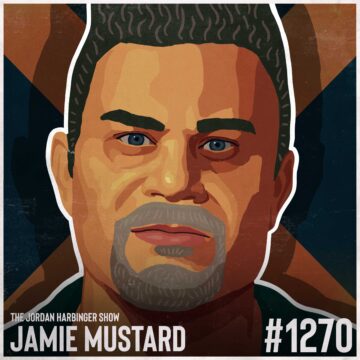



He couldn’t read or write until age 20. Now, Child X author Jamie Mustard is exposing how Scientology’s Sea Organization warehouses children like livestock.
What We Discuss with Jamie Mustard:
- Children in Scientology’s Sea Organization, where Jamie was raised, were treated as “livestock” — penned in squalid dormitories, denied education, and cared for by untrained adults deemed too unstable for public-facing roles. Jamie didn’t attend school until age 20 and could barely write at that point.
- The psychological conditioning began at age five, when Jamie signed his first “billion year contract” while still believing in Santa Claus. Children were taught that emotion was weakness — labeled “human emotion and reaction” — and punished or stigmatized if they got sick or hurt.
- Jamie was present during the largest FBI raid in U.S. history (Operation Snow White), yet agents never investigated the children’s living conditions. Scientology strategically moved kids between rooms during the raid, hiding evidence of what Jamie calls “animalization.”
- The organization weaponizes family bonds through “disconnection” — if you leave or question the doctrine, you lose everyone you’ve ever known. Jamie’s own mother, still in Scientology, has been turned against him as part of ongoing psychological operations.
- Despite being functionally illiterate at 19, Jamie escaped and rebuilt his life from scratch — earning admission to the London School of Economics and eventually authoring six books. His story proves that no amount of early deprivation can permanently define your trajectory.
- And much more…
Like this show? Please leave us a review here — even one sentence helps! Consider including your Twitter handle so we can thank you personally!
 What happens when you’re five years old, believe in Santa Claus, and someone hands you a contract binding your soul for a billion years? Most kids that age are learning to tie their shoes. But inside Scientology’s Sea Organization, children were signing away their futures while being told their mothers couldn’t visit because they were too busy saving the planet. It sounds like dystopian fiction, except this particular dystopia operated in plain sight on the streets of Hollywood, where kids lived in conditions so squalid that bath time meant being dipped into water already fouled by dozens of other infants. The cruelest irony is that these children weren’t neglected because the organization lacked resources. They were deliberately warehoused like livestock — kept alive with minimal investment until they were old enough to provide labor. In this holding pen for future workers who’d been convinced their suffering was saving humanity, the children had no school, no parents, and no childhood.
Jamie Mustard — author of Child X: A Memoir of Slavery, Poverty, Celebrity, and Scientology (and companion sci-fi graphic novel Hybred) — lived this nightmare from the day he was born, handed over to a religious paramilitary and raised in tenement buildings where seven-year-olds cared for infants and emotion itself was treated as a character flaw. In this conversation, Jamie takes us through the psychological architecture of control — from the billion-year contracts designed to trap children before they could comprehend what they were signing, to the concentration camps where his brother spent seven years forbidden to walk or speak. He reveals what it was like to witness the largest FBI raid in US history at age seven and watch agents miss the evidence of abuse happening right under their noses. But Jamie’s story doesn’t end in darkness. Despite being functionally illiterate at nineteen, he escaped, taught himself to write, and eventually graduated from the London School of Economics. Whether you’re interested in the mechanics of high-control organizations, the resilience of the human spirit, or simply need proof that your past doesn’t have to dictate your future, Jamie’s journey from child prisoner to published author offers something rare: hope with teeth.
Please Scroll Down for Featured Resources and Transcript!
Please note that some links on this page (books, movies, music, etc.) lead to affiliate programs for which The Jordan Harbinger Show receives compensation. It’s just one of the ways we keep the lights on around here. We appreciate your support!
- Sign up for Six-Minute Networking — our free networking and relationship development mini-course — at jordanharbinger.com/course!
- Subscribe to our once-a-week Wee Bit Wiser newsletter today and start filling your Wednesdays with wisdom!
- Do you even Reddit, bro? Join us at r/JordanHarbinger!
This Episode Is Sponsored By:
- Northwest Registered Agent: Get more at northwestregisteredagent.com/jordan
- Cape: 33% off for six months: cape.co/jordanharbinger, code Jordan33
- Boll & Branch: 15% off first set of sheets: bollandbranch.com, code JORDAN
- BetterHelp: 10% off first month: betterhelp.com/jordan
- Homes.com: Find your home: homes.com
Thanks, Jamie Mustard!
Click here to let Jordan know about your number one takeaway from this episode!
And if you want us to answer your questions on one of our upcoming weekly Feedback Friday episodes, drop us a line at friday@jordanharbinger.com.
Resources from This Episode:
- Child X: A Memoir of Slavery, Poverty, Celebrity, and Scientology by Jamie Mustard | Amazon
- Hybred: A Graphic Novel by Jamie Mustard and Francesca Filomena | Amazon
- Jamie Mustard | Instagram
- Jamie Mustard | Simon & Schuster
- The Lost Children of Scientology: Jamie | Soft White Underbelly
- Church of Scientology’s Sea Org | Wikipedia
- Church of Scientology’s Cadet Org | Wikipedia
- The Eternal Commitment: Scientology’s Billion-Year Contract | International Journal of Coercion, Abuse, and Manipulation
- Thetan | Wikipedia
- Impact on Children Born Into or Raised in a Cultic Group | International Cultic Studies Association
- Operation Snow White | Wikipedia
- Paulette Cooper | Wikipedia
- Rehabilitation Project Force | Wikipedia
- Disconnection (Scientology) | Wikipedia
- Suppressive Person | Wikipedia
- Church of Scientology Celebrity Centre | Wikipedia
- Us’ Mission Impossible Into Tom Cruise’s Secret Life: Scientology, Fatherhood,and Dating | Us
- Nicole Kidman Makes Rare Comments about Kids with Tom Cruise, Scientology | The Hollywood Reporter
- Delphian School | Wikipedia
- David Miscavige | Wikipedia
- Shelly Miscavige | Wikipedia
- Freewinds | Wikipedia
- Adult Literacy Facts | ProLiteracy
- London School of Economics and Political Science | LSE
- Adverse Childhood Experiences (ACEs) | CDC
- Romanian Orphans Phenomenon | Wikipedia
- A Critique of Scientology’s Training Routines | Carnegie Mellon University
- Tuskegee Airmen | Wikipedia
- Leah Remini | Surviving Hollywood and Scientology | The Jordan Harbinger Show
- Fair Game (Scientology) | Wikipedia
- Undue Influence: Cult Mind Control | Freedom of Mind Resource Center
- Survivor Guilt | Psychology Today
- Recognizing the Signs of Human Trafficking | National Human Trafficking Hotline
- I Was Born. I Grew Up. I Escaped. | Ex-Scientology Kids
- Amanda Catarzi | Overcoming Cult Life and Sex Trafficking | The Jordan Harbinger Show
- Sarah Edmondson & Nippy Ames | Surviving NXIVM Part One | The Jordan Harbinger Show
- Sarah Edmondson & Nippy Ames | Surviving NXIVM Part Two | The Jordan Harbinger Show
- Megan Phelps-Roper | Unfollowing Westboro Baptist Church Part One | The Jordan Harbinger Show
- Megan Phelps-Roper | Unfollowing Westboro Baptist Church Part Two | The Jordan Harbinger Show
- Amanda Montell | Cultish: The Language of Fanaticism | The Jordan Harbinger Show
- Daniella Mestyanek Young | How to Disengage from a Lifelong Cult | The Jordan Harbinger Show
- Steven Hassan | Combating Cult Mind Control Part One | The Jordan Harbinger Show
- Steven Hassan | Combating Cult Mind Control Part Two | The Jordan Harbinger Show
1270: Jamie Mustard | Scientology's Secret World of Disposable Children
This transcript is yet untouched by human hands. Please proceed with caution as we sort through what the robots have given us. We appreciate your patience!
Jordan Harbinger: [00:00:00] Coming up next on The Jordan Harbinger Show.
Jamie Mustard: I was groomed to sign my first billion year contract when I was five. I believed in the Easter Bunny and Santa Claus and the Sandman and the Tooth Fairy. And this is a time where I'm going to believe anything anyone says to me. So when they tell me that I'm signing this contract, and the reason I'm not seeing my mother is 'cause she has to save the planet.
And if I just allow myself to suffer, then I'll see her in a year and we'll get on a spaceship and go save another planet. I believe that. As much as I believe in the kind of brick oppressive building with no air conditioning that I'm living in.
Jordan Harbinger: Welcome to the show. I'm Jordan Harbinger. On The Jordan Harbinger Show, We decode the stories, secrets, and skills of the world's most fascinating people and turn their wisdom into practical advice that you can use to impact your own life and those around you. Our mission is to help you become a better informed, more critical thinker through long form conversations with a variety of amazing folks, from spies to CEOs, athletes, authors, thinkers, [00:01:00] performers, even the occasional arms dealer, drug trafficker, or rocket scientist.
And if you're new to the show or you want tell your friends about the show. I suggest our episode starter packs. These are collections of our favorite episodes on topics like persuasion and negotiation, psychology, geopolitics, disinformation, social Engineering, China, North Korea, crime, and cults, and more.
That'll help new listeners get a taste of everything we do here on the show. Just visit Jordan harbinger.com/start or search for us in your Spotify app to get started. My guest today has had a very interesting childhood and by interesting, what the heck did I just read? That is what I said when I put that book down.
He grew up inside the cult of Scientology, not as an adult who wandered in looking for answers, but as a kid who never really had a choice. Baby factories, kid barracks, children policing children, a literal billion year contract, which I don't get this, you're not allowed to sign up for Instagram yet, but sure, go ahead and sign away your soul until the heat death of the universe or whatever.
No school, no parents, no [00:02:00] reading, no writing, just labor punishment and the psychological equivalent of Lord of the Flies, but with better branding. This is Jamie Mustard and his story arc is bananas. Man, you've had just a very interesting childhood. I'll give you that. Your story arc is something else.
Jamie Mustard: Yeah. I mean, on the day of my birth, I was handed over to a religious paramilitary. Organization, high control, authoritarian group, whatever you want to call it, on the outskirts of downtown Los Angeles in a slum tenement where I spent the first two and a half years of my life with little to no human touch.
And that would be the beginning of, uh, pretty much a 20 year gauntlet where I wouldn't go to school and I would literally be animalized.
Jordan Harbinger: Hell of an opener, Jamie, but no exaggeration. I mean, the book starts with the Baby factory and we link to the book in the show notes. So folks, if you buy books from the show, which you should please use our links, it supports the show.
The book starts with the baby factory as you [00:03:00] call it. Tell me about that one. It sounds gross, not to mention, you know, illegal, but tell us how that works.
Jamie Mustard: Well in this group, the basic belief system is that we're all trillion year old fallen gods that have had millions and billions of lifetimes before.
So you're not really a baby, you are a fallen God complete adult that's been an adult millions and millions of times in a baby body. You don't really need to be treated like a baby or a toddler. You just need to remember just the idea is that time is running out to save the planet. If we don't get rid of everyone's reactionary mind, we're going to die in nuclear fire.
We have a limited time. So kids are a distraction and they need to be penned over here like livestock until they're 10 or 12 years old and we can put them to work. They've spent no money on the facilities because we weren't useful, we weren't contributing the least important people. The people that they couldn't put on real jobs were the people that were made the quote nannies or caregivers.
Jordan Harbinger: I see. I guess I [00:04:00] wondered about that 'cause in Scientology, once you don't make any money from a day job or you can't volunteer for a 16 hour workday doing something else, like what if you're 75 years old? Are those the people that they're saying, Hey, you're taking care of a bunch of kids now?
Jamie Mustard: Oh man, that's such a good question because it's changed.
A lot of the people that were kind of adults when I was a kid are now aging out and they're putting them. Like these kind of really cheap old folks facilities, and that has its own set of new abuses connected to it. But it was the crazy people from the seventies that did too much acid and Oh, we can't have those people in this organization or around the public.
Let's put them around the kids. So it was a brutal experience. And what's so crazy about it was just how long it lasted. And then I'm still standing because so many of the kids I grew up with, they have autoimmune disease. There's suicides, there's drug overdose, there's drinking yourself to death from just the stress of it.
But one of the doctrines was emotion is kind of looked down upon, they call it HGNR, human emotion and reaction. So if you're four years old, you trip the fall, you're bleeding. They would do some kind of thing [00:05:00] to maybe stop the pain, like this laying of hands thing that they do. But they would also say, stop the human emotion reaction.
Knock it off. So emotion is not allowed and you're looked upon as a leper. If you hurt yourself, you're labeled a potential trouble source, PTS. And so you get this horrible, scarlet letter and stigma if you get sick or you get hurt. So you learn as a little kid to hide being sick or hide being hurt so that you won't be punished or treated like an outcast.
Jordan Harbinger: Yeah. That does not sound healthy. So what, what was your barracks like, or what was your sort of kid dorm situation?
Jamie Mustard: At the baby factory, which was not far from MacArthur Park, if anybody knows downtown Los Angeles, which is full of junkies. Yeah. And the Rampart Police District, that was just like a really rundown tenement building with peeling paint.
And one of the stories that I talk about in the book that a caregiver reached out to me when I first started doing interviews two years ago, who was a 7-year-old girl that was taking care of me. I'd been in this [00:06:00] woman's head for 45 years or something.
Jordan Harbinger: A 7-year-old girl was taking care of you. And how old were you?
Jamie Mustard: A baby? Three months old. Six months old.
Jordan Harbinger: Unbelievable.
Jamie Mustard: And I stuck in this woman's head who's now in her sixties, and she said to me, do you remember how they bathed you? And I said, no, what are you talking about? And I kind of remember staring up the ceiling as my earliest memories, if they're real, but she said that there would be 40 kids to one or two caretakers.
So they would run a hot bath once every week or so, and they would take off your diaper, dip you in, wipe all the stuff off, hand you to the person that would then dry you off, and then they would dip the next baby without cleaning the water. So I was basically being dipped in feces for the first two years of my life.
So that was eight 11 Beacon Street. Which was kind of just a weird old, massive Hollywood house that had just cut and run down and was a tenement right on the outskirts of downtown Los Angeles. Then we went to the place that was really the worst place of all of the experiences, which [00:07:00] we called the Melrose Building, the red brick building, which was carpeting that hadn't been cleaned in 50 years, so it was like a dirt color shag with steel bunk beds stacked three high.
I moved there when I was three and I was on the third bunk, constantly falling, and there would be 14 of these things crammed into a small room. There wouldn't be a lot of room to walk between the bunks and then a kid stacked three high on each bar.
Jordan Harbinger: Oh my God. What are they doing with you? Like waiting for you to be old enough to work or something?
Is that kind of the idea?
Jamie Mustard: You know, it's interesting, when I first started talking about the book and I was telling people about the living conditions, people would ask me, they would say, why would they even do that? It seems like they're going through trouble to put you in these conditions. And I had never really thought about it, even in writing the book, like, why did they do that?
And so when I reverse engineered it and I looked at their doctrines, they have doctrines that intimate this. It's kind of like if you, Jordan had got a baby pig that you were never going to keep, it was like an economic [00:08:00] gift that your neighbor farmer gave to you. You wouldn't eat that pig tomorrow. You would put that pig in the pig pen with the least amount of resources as possible, grow it for 10 years till it's a giant 300 pound pig for slaughter.
So we weren't looked at as anything of value until we could work or contribute labor. So I never went to school the age of 20. I could barely write characters and I didn't know how to use a comma or construct a sentence or a paragraph.
Jordan Harbinger: Okay. To be fair, that's most internet commenters. Uh, but my audience is a little more sophisticated, so we could relate, but.
Jamie Mustard: We were like livestock.
We had no value and we were being penned. And this is why I didn't speak out. I was so ashamed and embarrassed by what had happened to me. I'm connected to this like love boat sci-fi cult, and I was very embarrassed. It was up until two years ago, it was almost like I was living a double life. No one knew.
My agents didn't know, my publishers didn't know. I mean, I had to do this kind of walk of shame when I decided to talk about it and call all my [00:09:00] people and tell them that about this really exotic past that I'd have. It was a very strange couple of weeks for me. I'm being literal when I say this. I feel like I was being raised in.
Captivity.
Jordan Harbinger: Absolutely. Yeah.
Jamie Mustard: And because I was never going to write the story during COVID, I wrote this and I don't want to feel like I'm hawking it, but I want people to know about it. 'cause it actually comes out now. I wrote this kind of sci-fi book. Which is this like future adjacent version of Los Angeles called Hybrid.
And I wrote it 'cause I was never going to tell my story. So I wrote it as this like sci-fi story. So instead of Hollywood, it's called Folly Land. And I tell the story of what happened to me, but they're supernatural powers and it's all in this weird alternate universe. I kind of made it during COVID and I thought, because I was never going to write my story, and then after I wrote Child X, someone bought the sci-fi book and wanted to put it out.
So now it's coming out. Yeah.
Jordan Harbinger: Child X is the memoir that I [00:10:00] read that we're talking about, and I gotta say, man, do you have any sense of the irony as a kid raised in Scientology, which is a cult slash religion, started by a guy who wrote a sci-fi book about stuff like aliens or whatever, turns it into a religion, turns that into a cult.
You get in, you escape. Spoiler alert and write a sci-fi book about Not today. I'm like, what's your next move here, mustard. Come on bro.
Jamie Mustard: That's funny. I never really thought about it like that. But when you say it like that, Jordan, it's bananas.
Jordan Harbinger: Yes.
Jamie Mustard: When you say it like that.
Jordan Harbinger: We're watching you, Jamie. I got my eye on you, man.
Jamie Mustard: Yeah. I don't think they've ever probably dealt with somebody like me. Yeah. You know, I'm kind of a unique. Uh, because I was never going to write about it and I built this life and I was living this kind of strange Gelt. I get a lot of messages from around the world of people. Congratulations. And I've, I always take it as like, congratulations on not dying.
That's how it feels.
Jordan Harbinger: [00:11:00] Yeah. That's what it is. But it is also, congratulations on making it out. The other side, and I want to talk a little bit more about this Of course. So kids are raising you, and here's the thing, it sounds a little Lord of the Flies ish, like a 7-year-old is taking care of a three month old and then who's taking care of a 7-year-old, a 12-year-old?
Is it like a military hierarchy of young kids or does it eventually sort of graduate to adults? But you even said that the adults, they have taking care of you in air quotes, taking care of you. Are like the people they don't want the public to see. Which I will say as somebody who lived in Hollywood for several years and near all the Scientology buildings, they're not exactly taking the choices specimens, putting them out on Hollywood Boulevard either.
So like the bar must be pretty low for childcare. Caretaker of those are the people they don't want outside Hawking, what is that thing called? They're like, Hey sir, do you want to test your stress levels? And I'm like, no, thanks. I know I'm stressed. Get outta my face. You weirdo.
Jamie Mustard: Yeah, the electros.
Jordan Harbinger: Cyclometer, yes, exactly. Like those people are already kind of weird and they're standing outside in the heat and a shirt and tie, trying [00:12:00] to rope people in and you're like, what are you doing? So the people that are taking care of you, I guess my question is, it sounds like kids controlling other kids, but military Lord of the Flies combo.
Jamie Mustard: It's like you were there, Jordan. It's both. So you have these, we called them nannies, ironically, even if they were dudes, but they were just middle-aged guys that had done too much acid and they're wearing military uniforms. And also within that is this kid thing. And I hate to use Hubbard's words because A, it's an ugly language.
And B, because I don't want to validate the language. 'Cause he has a lot of fancy words to describe. Horrible tenement, disgusting, grotesque things. But the official term for the kid organization in these orphanage type environment where I grew up was called the cadet organization. So it almost sounds like ROTC and they're putting us in little military uniforms.
I was groomed to sign my first billion year contract when I was five.
Jordan Harbinger: So you're five and they're like, [00:13:00] sign this billion year contract. And you're like, dude, I'm not even old enough to sign up for an Instagram account, but I can sign my soul away for a billion years. A number, which by the way, a 5-year-old cannot usually say correctly or spell or know exists.
Jamie Mustard: No, I believed in the Easter Bunny in Santa Claus and the Sandman and the Toot Fairy. And this is a time where I'm going to believe anything anyone says to me. Yeah. So when they tell me that I'm signing this contract, and the reason I'm not seeing my mother is 'cause she has to save the planet. And if I just allow myself to suffer, then I'll see her in a year and we'll get on a spaceship and go save another planet.
I believe that. As much as I believe in the kind of brick oppressive building with no air conditioning that I'm living in.
Jordan Harbinger: Yeah. It's as real to you as anything else in your life.
Jamie Mustard: Yeah, absolutely. And so within this structure of these nannies, adults, we have this thing called the Cadet Organization.
There's this 16-year-old kid, and I call him Bill in the book, and he's running like a little military organization with the kids, and it was [00:14:00] exactly like Lord of the Flies. You'd go to eat at the galley and the food wasn't very good, and there sometimes there wasn't enough, so you had to protect your food.
Jordan Harbinger: Wow. Like prison or something.
Jamie Mustard: My older brother, for years, and even maybe the last time I saw him 10 years ago, if we sat down to eat, he would put his arm around like his plate, like he was eating like that. Well into his adulthood.
Jordan Harbinger: Yeah, sure. Yeah. That's a survival instinct. At that point.
Jamie Mustard: We're being fed this doctrine.
It has a huge punishment context to it, and there's all these kind of labels, like if you're not happy enough, you're downone. They call spiritual happiness theta because they call the soul theta. If you're crying or you're making a problem, then you're in disturbed theta, and so you're trying to avoid all these terms.
But Hubbard's doctrine is very brutal.
Jordan Harbinger: El Ron Hubbard is the guy who wrote Dietetics, which is the founding book of Scientology. So he was the founder of Scientology. For people who are like not clued in on this,
Jamie Mustard: and in the commanding officer of the cadet organization's office, there was a little brown box where you [00:15:00] could write him letters even as a little kid, and he would write you back and it would be signed by him.
Jordan Harbinger: Wow. So that must have been kind of cool at that point. It's like writing to Santa Claus and you get a response.
Jamie Mustard: Yeah, you're writing to the Commodore, and he called himself a Commodore, kinda like Kaddafi called himself a colonel. Right. And Monte letters were what a 5-year-old kid would write, Hey, I miss my mom, and then he would write back and say, you're doing your job.
It was just very strange. But yeah, I mean, we were brutal to each other. I mean, I talk about this, these public spankings Hubbard had a doctrine called Head on a Pike. If people weren't listening and they weren't being ethical, then you would put a head on a pike to scare everybody into a line
Jordan Harbinger: not actually ethical, because these parents have ditched their kids, and I'm sorry for saying this.
These idiot parents have ditched their kids, joined a cult, and they're not taking care of their own children because they're going to something aliens, spaceship, universe, whatever. And it's just, that's not ethical. There's no sort of normal society that would ever condone most of this behavior. So ethical, according to Scientology, where it's the upside down, everything is [00:16:00] backwards.
Jamie Mustard: Like Jordan, once again, like I never went to school. I never learned to brush my teeth. I didn't have underwear, I didn't have bedsheets. We slept on congealed oily mattresses in the 1970s drought of Los Angeles where they entered the swimming pools, and that's where bowl skating was invented because of the drought.
There's a book called Introduction to Scientology Ethics, and if you read that book, yeah, you're making a really good point in Scientology ethics is whatever protects Scientology is what's ethical. So that's what you're taught and indoctrinated with as a very young age. So you're being brutalized and then you're being taught that is good and ethical.
And then so many of the kids, there were kids that were sexually abused in the buildings 'cause there was no one looking out for us. We were vulnerable. And the amount of friends that I've lost, it's really hard to describe the animalization. And if our rooms or our dorms got too dirty, they would put like a sign on the door that we were dirty called pig's birthing or pig's room that we were pigs.
So they raised us like [00:17:00] pigs and they treated us like pigs. The way I would describe it is, say I was in a trench in World War I and I was with my two best friends on each side of me, and one of them takes a bullet to the center of the helmet and I look over and he's dead. And then I hear a, and I look to the left and there's a bullet in the center of his helmet.
He falls over dead and then I feel my helmet and there's a hole in it. I take off my helmet, there's a hole right through the center of my helmet and I'm feeling around and somehow I don't have a wound. And then I get to go home. I get to go back home. And so you get this incredible feeling of a shame.
And then B, how did I live through this?
Jordan Harbinger: It's called Survivor's Gelt, I think, isn't it?
Jamie Mustard: Yeah. So the military organization called the cadet org or cadet organization, the cadets where we're wearing little lanyards and little military uniforms. And we have a status and we're treating each other in this military structure.
And we're calling each other [00:18:00] sir. And there's ranks, um, was very Lord of the Flies. And if you were a higher rank, then you were brutalizing the kids of a lower rank and it was just, that was what it was.
Jordan Harbinger: I think a lot of people are wondering why did the parents. Sort of stop caring about their kids, like what is happening there?
Jamie Mustard: I think the time that they were living in is a part of it. Like they were coming outta the sixties, which was all of these assassinations, Martin Luther King, Malcolm XRFK, JFK, and Edgar Evers, and then you have the Cuban Missile Crisis and nuclear proliferation, Vietnam. That time was just, the world is going to burn into fire.
At the end of the sixties, these kids just dropped out and they, they joined thousands of these cults all over the world. All over the United States in communes. And they were just done. And it was like, we just need drugs and sex. 'cause they'd grown up under this pressure. And then they had these post-World War II parents who weren't the [00:19:00] most sympathetic people in the world, right?
The quiet, the silent generation. They just checked out. And then there was a lot of illegitimate children being born. And so all of a sudden, they're looking for these groups. They were ripe for the picking. And they got caught up in these ideas of these groups that they could save the world and turn it all around.
And it wasn't just Scientology. I mean, I think Scientology is the worst one. I think Hubbard created the most sophisticated mind control. I don't know about brainwashing. I don't even know if I know what that is, but he definitely created the most sophisticated mind control system, probably in the history of the human species.
Jordan Harbinger: Yeah, it certainly seems quite effective. I mean, it's huge. So I want to explore this detachment a little bit more. On the one hand, it's like you have these past lives, right? So you're billion lives before, or a billion lives afterwards. What does that feel like? On the one hand, you're kind of free, right?
Because nothing matters because you have a zillion lives. But on the other hand, [00:20:00] you have absolutely no reason to live well or live at all. 'cause nothing matters. You have a zillion lives. Where do you fall on this?
Jamie Mustard: It's such a great question, and I'll kind of answer it in a way to show you how numb and disconnected I was.
When I was around 11, 10 or 11, there was a public kid, so his parents didn't work for the inner religious military like my parents did, where I lived on campus in these tenements. So I was able to go with this kid for the weekend, and we didn't go with his mom who was in Scientology. We went with his dad who was a Christian, and he took us to church.
That was the first time I'd ever been in a Christian Church, and I'm watching this and there's all this talk about you can suffer now for the afterlife. And I remember thinking, this is just my child mind. I'm not commenting on religion, but I remember thinking, these people are crazy, that they're going to have this crazy, bad, horrible life now for some heaven that may or may not exist.
These people are bananas. That's what I was thinking in my mind, when in [00:21:00] reality I'm living the exact same thing. I'm suffering. I've got massive medical neglect. I'm having these near death experiences because no one's looking at my body. I'm hiding infections. There was one point where I got into a dental accident and my mouth was basically maimed and I'm thinking, I'm doing this so that we can save the planet.
So I'm actually living the exact same belief system. But you have to understand that the first two things that you do in Scientology, after you do this kind of weird drug rehabilitation thing that everyone does, it's not scientifically backed. It's called the purification.
Jordan Harbinger: It's a drug rehab. This, I don't understand.
What is this?
Jamie Mustard: Yeah, yeah, yeah. You do this thing called the purification, or the purification rundown where you for three to four weeks, some people are on it for months. You take large amounts of vitamins and you jog, and then you sit in a sauna for five to seven hours a day to sweat out the drugs and you can't get off of it until you've had some realization that all the drugs are out of you.
So that includes medical drugs, [00:22:00] 'cause of medical neglect. I'd had an ear surgery when I was six, so I did this thing, this purification for the first time where I'm sitting in a sauna five to seven hours a day. And then the first thing you do in Scientology, what I was doing before the purification rundown, these thing called training routines.
I call them non reactionary drill, where you're forced to sit in a chair. First with your eyes closed, staring at another kid at four or five years old for two hours, and if you move or fidget or blink at all, you fail and you have to start again. Then you have to do it with your eyes open. If you blink, you fail.
Jordan Harbinger: So everyone fails.
Jamie Mustard: Yeah. They're telling you that you're learning to control yourself so that when things happen in front of you in the real world, you have the stoic ability to not react. You're training yourself not to react, but what they're actually doing is they're systematically removing your empathy, right?
They're systematically training you to not listen to your nervous system. You're uncomfortable not blinking, you're uncomfortable not moving for two hours. You're five. So you're training yourself to be comfortable, being highly [00:23:00] uncomfortable, and then they do a drill right after you do the thing where you're staring at people and can't blink, where they get to mock you.
Homosexual humor, sex, humor, 5, 6, 7 years old, every kind of thing to get you to react. And if you react, you fail. So you basically learn not to react. Then you go out in the regular world, you see a child being hit, you see a child not going to school, you're see child harmed. You've turned off your reaction.
So that's the training routines. Then right after that, you do a thing, and this is, this is important 'cause I think it'll blow your mind 'cause I said the most sophisticated mind control system in history. Then right after that you're doing this thing called the objectives. It's the second thing you do in Scientology and where you basically for dozens if not hundreds of hours, you let someone control you, walk you around a room and tell you to do things.
And you do exactly as you're told for dozens, if not hundreds of hours till you have the end phenomenon and you can finish. They're telling you, you're doing this because in order to control your environment, [00:24:00] you need to learn to be controlled. I would love your take on this, but they're grooming you. To be controlled.
Jordan Harbinger: I mean, it just sounds like they're trying to create robot humans that just don't think about anything, don't question anything, and ideally don't even feel anything, so that they can just be controlled completely for whatever purpose that I still don't understand.
Jamie Mustard: Yeah, and the language is like that. If you know someone and you have to get something done, another person that you would go deal with is called a terminal.
Go see that terminal and they'll help you with that.
Jordan Harbinger: Wow. So this is very 1984 somehow.
Jamie Mustard: It is. And that's the irony of it. When I read 1984 at 16, 17 years old, 'cause I could read at a high level, even though I couldn't write from studying the doctrine, I remember reading that going, thank God I'm not in a situation like this.
Jordan Harbinger: Wow. You totally were.
Jamie Mustard: Yeah.
Jordan Harbinger: What's crazy about this, they're basically telling you that your childhood experience, your formative years don't actually mean anything. And if you're an [00:25:00] adult, that's all fine and good. You join a cult and they tell you your formative years don't mean anything and you can erase your feelings and you can erase your trauma, you can erase your stress, whatever.
But it's completely destructive for a child who's five years old and actually in those formative years of their life, to have absolutely no mooring, no foundation whatsoever. And it almost sounds like those. Romanian orphanages in the seventies and eighties were like, they didn't have any touch and they didn't have any care because there was three nuns taking care of 400 kids or whatever it was, you know?
It was just crazy. And we have sort of unfortunate science experiment that was run in Romania when they outlawed birth control, which is that the levels of psychopathy and social antisocial behavior are just like through the roof with those kids. 'cause they develop that way
Jamie Mustard: by the age of five or six years old.
I just basically started to go completely numb at one point. I go to visit my grandmother in New York every couple of years and she puts me in the tub, looks at my body, and I'm rushed to the emergency. Because no one was looking at my body. [00:26:00] The level of animalization is hard to describe, and then you're getting this training to not react, and then you're stigmatized if you're emotional or you get sick or you get into accidents.
Really, to answer your question, there's a really strong concept that you're hit with at three, four. That's every day in Scientology of this concept of the greatest good for the greatest number, and it's very similar to communism. You sacrifice to be the individual for the will of the state.
Jordan Harbinger: Yes. That's what it sounds like.
Jamie Mustard: So you're being told at four or five years old you're suffering when your mom comes to visit you once a week or once a month, and when she leaves you, you basically break psychically. I would have these breakdowns where they would take three nannies to hold me back, and then she would leave, and then I would just break.
You're being told that there's planetary salvation at the end of it, you're five, so you believe it and it is like living in its kafkaesque. Existential nightmare, but you don't know that because it's the only world you ever know.
Jordan Harbinger: Yeah. This is some sort of weird [00:27:00] combination between Maos China and Pul Pot Cambodia and Romanian orphanage.
Like it's just actually crazy to me. It makes me sad because my son is six. He's basically still a baby. Really? And I can't imagine little guys and gals being treated like that. It's just horrific getting him to clean up his Legos and take his shoes off at the door, like we're happy with that. We don't need him to be emotionless automaton.
That's like the opposite of the thing that I want for him and it, it makes me wonder who's running Scientology back then? Who's running it now? Do you think that these people are believers or are they in on the joke that it's all a bullshit grif to get money and power?
Jamie Mustard: The current leader I think is both, but I think he is a believer on some level.
There's a lot of debate among people that leave Scientology. They form these kind of communities on YouTube and other places. I don't really think they should. They call it a community. And what I always say is if a bunch of people leave a mental institution, should they have a community? Well, I guess they could have a community, but should they [00:28:00] have a community?
One of the things people that leave Scientology do is. Everything is done with threat. Threat of punishment, threat of brutalizing, someone psychically, or through what they call disconnection. If you do something, you're shunned from the group. You can never talk to your friends or family again. That's always hanging over your head, and I find that a lot of people that leave Scientology, they do the same thing to each other for 20, 30 years for the rest of their lives.
After they leave it, they continue the behavior. And I'm not saying that as a judgment because I have to constantly look at myself to make sure that I'm not doing that. The black and white thinking is intense. I remember I was talking to Dove Barron one time and I was telling him it was the most sophisticated mind control system in history, and he said, more than Mao.
And I said, yeah. He goes, well, I talked to a woman who grew up in Maoist, China and the Maoist Revolution, and Dove had asked her if Mao is handsome, and she said Very. But even that, when I read about other systems like these Romanian orphanages or I read about. [00:29:00] Things like that, but I think that Scientology goes far further than Mao or Stalin or anybody else ever went.
Jordan Harbinger: Yeah, they were trying to engineer a nation, but everybody still had to do like work and they had secret police and things like that. But it sounds like you were far less free than somebody growing up in Stalins Russia.
Jamie Mustard: I'm on the streets of Hollywood, and I'm completely a prisoner at the same time, and I'm in some neighborhoods on the streets of Hollywood, and I'm a complete prisoner.
There's a concentration camp in the paramilitary organization, and if you screw up, there's a child's concentration camp. It's called the Rehabilitation Project Force. There's one for children, there's one for adults, and if you screw up, you go to this thing and you can be on it for years. My brother at 16 was in a concentration camp run by this paramilitary down in Hollywood from 16 to 23 7 years for having sex with his girlfriend.
And you're not allowed to walk. So he was on that thing for seven years. He did not walk for seven years. He slept [00:30:00] in the tunnels or on these rooms exposed to the roof on like mats or old mattresses. He ate slop and was forced to do manual labor 10 hours a day. He's studying the doctorate five or six hours a day and then sleeping for six hours.
Jordan Harbinger: You're not allowed to walk, meaning you run everywhere.
Jamie Mustard: You run everywhere and you're not allowed to speak unless spoken to. So say you are a mom or a dad and you're put on this thing, you won't be speaking to your child or your spouse for seven years or five years. And if say your kid sees you walking down, what they call Elron Hubbard, way in the middle of Hollywood, north Barend, when I was a kid and dad, he sees you running 'cause you're on the concentration camp and you wear all black and you wear armbands for what your behavior is like right out of Dachau or Auschwitz.
Okay? Your five-year-old says, dad, unless your kid says something to you, you're not allowed to speak to your child. So when I was seven years old, eight years old, maybe a year after I was in the FBI raid the largest FBI raid in history because Scientology had committed the largest industrial spine [00:31:00] campaign on the US government in history.
A year later, I hadn't seen my mom, she'd been off training. They said, oh, we're going to bring you to see your mom from the dormitories. And she was on this concentration camp. It was like a, literally like a room with a bunch of card tables and everybody's wearing black. It was like a visiting room for a prison.
Jordan Harbinger: Alright, we'll get back to billion year contracts in just a second. But first, a quick break because unlike Scientology, our sponsors don't demand your eternal soul just 60 seconds of your attention.
This episode is sponsored in part by Northwest Registered Agents. Some of you have emailed me and asked, how do I start an LLC? Because it's one of those things that sounds simple until you're buried in forms like, wait, what's an operating agreement? And that's why I recommend Northwest Registered Agent.
You can get access to thousands of free guides, tools, and legal forms to help you launch and protect your business all in one place. They're focused on your business identity, like operating agreements, meeting minutes, compliance, paperwork, all that unsexy stuff that actually keeps you legit. Northwest has been helping entrepreneurs for nearly 30 years.
[00:32:00] They're the largest registered agent and LLC service in the us. Plus they've got over 1500 corporate guides, real people who know your local laws and can actually help you without sending you into an automated phone tree nightmare. And with Northwest Privacy is automatic. They never sell. Your data and everything is handled in house,
Jen Harbinger: so don't wait.
Protect your privacy, build your brand, and get your complete business identity in just 10 clicks and 10 minutes. Visit Northwest registered agent.com/jordan free and start building something amazing. Get more with Northwest Registered agent@northwestregisteredagent.com slash Jordan. Free.
Jordan Harbinger: This episode is also sponsored by Cape.
We all know the big mobile carriers have been in the headlines forever for data breaches, shady tracking, selling your personal info to data broker as well. We can use VPNs, encrypted apps, private browsers, but none of that changes the fact that your phone number is still running on a cell network. That was designed decades ago, back when security was not a concern at all, and that's where really nasty stuff happens.
SIM swaps, metadata leaks, silent surveillance, the things that [00:33:00] happen under the hood when your apps can't protect you, and that's why Cape exists in plain English. It's the security upgrade your cell service should have had all along. It's a premium mobile carrier built by experts in telecom, cybersecurity, national security, and they designed it around privacy.
From day one, they collect almost no personal information. When you sign up, they protect your number with a 24 word phrase so nobody can sim swap you, not even cape. And they encrypt things like voicemail, plus they tokenize payments. So your billing info is not just sitting in some database waiting to get leaked.
Jen Harbinger: If you want to stop giving your carrier free access to your digital life, check out cape.co/jordan harbinger and use code Jordan 33 for 33% off for six months.
Jordan Harbinger: If you're wondering how I managed to book all these incredible thinkers, creators, authors, et cetera, every single week, it is because of my network, the circle of people I know, like, and trust.
I'm teaching you how to build the same thing for yourself for free over at Six Minute Networking dot com. It's great for business, it's great for personal, it's great if you're new to the job market. It's great if you're retired and six minutes a day is all it takes. Many of the guests on the show [00:34:00] subscribe and contribute to the course.
So come on and join us. You'll be in smart company where you belong. You can find the course again, it's all free at Six Minute Networking dot com. Now, back to Jamie Mustard. We gotta talk about this FBI raid because of course people are like, wait, what the largest FBI raid in history? How is that possible?
Jamie Mustard: So when I was seven years old, I was woken up at 11 or midnight. All of his kids were being jostled outta bed. That had never happened before. We were told that we all had to get up and go over to the main building because there were people that were visiting, they were going to come in to our bedrooms and they wanted to protect us from an inspection.
I think they might have phrased it as an inspection. So they take us over to the big blue building that everybody sees on tv, which is an old hospital, very Orwellian, with a big sign on top. And they put us into this place called Lebanon Hall, which is a big theater type room where they have speeches and uh, we're there and they're just holding us.
There are hundreds of kids, and then all of a sudden these [00:35:00] guys in suits start piling in. So they put us into the next room, and it was a 24 hour raid. It was the largest FBI raid in US history. Scientology had infiltrated the US government and had plants in all these different bureaucratic government institutions in the federal and state level, and there was a woman, again, this is all public records, so I'm going to say something that's outrageous.
It was called Operation Snow White. There's a woman named Pollock Cooper, who in the seventies wrote a book called The Scandal of Scientology. They had framed her for bomb threats against the federal government, and she was about to go to prison for decades. She'd been indicted, she was suicidal. This woman also, Pollock Cooper, was a woman that, as a baby, had survived the Holocaust.
We're talking about a Holocaust survivor. She was about to go to prison in that FBI raid, and again, this is on Wikipedia, just Google operation, snow White sounds crazy. They discovered that Scientology had framed her for these threats, and she was [00:36:00] exonerated. So yeah, they had kept us out all night, moving us from room to room as agents poured into the room.
I'm a 7-year-old. I'm seeing all this from the eyes of a 7-year-old child. And when I got older and I looked back on it, Hubbard's wife went to jail. Hubbard was an unindicted, co-conspirator. Eight liters of Scientology went to jail. The only reason Hubbard didn't go to jail was because they threatened her and said, if you don't say it was all you, you're going to be taken out of the will.
There's going to be a consequence. So Mary Sue Hubbard's wife fell on her sword. And so Hubbard wasn't fully indicted, which was all lies. He was running everything. 'cause if you talk to people that were there at the time, they'll tell you he was shredding everything. And so when I got older and I looked back on it, they exonerated this woman.
They found all these crimes. I grew up with shredding machines everywhere. We were constantly shredding documents for Scientology. We didn't even know what they were as kids. They, we'd walk into a room and there would be a room full of documents. We would spend days at a time [00:37:00] shredding these things we couldn't even read.
When I look back on it years later, Jordan just, it kind of broke my heart that they weren't concerned about us. No, they weren't concerned about how these children were living, but the Scientology was very clever. The living conditions were animalistic and horrible, so they were very smart. To remove us from the dormitories.
So when the FBI went into the fountain building as it's called, where we live, which was a tenement, they didn't see anybody there. They just saw these like dilapidated rooms with beds in them and they didn't have a context for it.
Jordan Harbinger: Yeah. They didn't want to see a bunch of kids in there because then it's, oh my God, you're running a human trafficking operation.
Jamie Mustard: Yeah.
Jordan Harbinger: My god, this raid is wild. And the FBI saw all these kids and went, huh, nothing to see here. I don't understand how they didn't stop this practice.
Jamie Mustard: Even in the last month. My point of view has changed. When I got a little older, I started thinking of the FBI really failed me. I almost died. And a lot of my friends, I've lost a lot of people.
Jordan Harbinger: Yeah, of course. But honestly, I, I don't mean to be crude. You [00:38:00] guys must have smelled absolutely terrible. So how does the FBI see a room full of kids with facial infections and rotten teeth that smell like a pile of dung and they just go, no problem here. Hey, you know that room upstairs with 80 bunk beds trapped into a 14 foot room?
You see this bunch of kids here that are all of ill health and malnourished and have opportunistic infections anyway. What's for lunch? Yes, they failed you. Yes. They fricking failed you.
Jamie Mustard: What they did is every time the FBI would spread into a room, they would move us to another room. And what, I guess what they were telling the FBI is, we don't want the kids to see this while they were analyzing us,
Jordan Harbinger: but also like, too bad we're the FBI.
You don't get to decide who gets to see what you're being raided. Shut up and sit down.
Jamie Mustard: Yeah. But they were raiding them for the infiltration literally in the last month, as people have reached out to me and write me notes, one of the realizations I've had, and I love your take on this 'cause I know you lived in LA, is I feel like the city of Los Angeles failed me.
Jordan Harbinger: Of course. Look man, I lived on Hollywood Boulevard. There was this dumb museum they have where it's like the El Ron Hubbard Museum. No one ever [00:39:00] goes in there and it's full of lies about what he did. And across the street, there's another thing where he wrote 8,000 novels about all the things he did. They have theatrical productions.
I mean, I was surrounded by Scientology. And you see these kids that are like 18 maybe, and they get on a bus and you can tell they're from like Idaho, right? And they're in the big city and they're scared and they're in this group and you're just like, this is labor trafficking. First of all, it's labor trafficking and that's the part that I can see that's obvious.
And now you've got whistleblowers and firsthand accounts and you've surely you have building inspectors and utility inspectors and police officers that go, do all these people live here. And it's like, yeah, that can't be legal, but that's not my job. That's none of my business. Yes, the city of LA failed and continues to fail, and it just doesn't make any sense to me at all that these people are allowed to work there and make no money.
It's just insane to me that the whole thing even exists.
Jamie Mustard: One thing that I think you'll find really interesting, and this is not in the book. Even though I was [00:40:00] imprisoned, I was also free to go between the buildings. I was taking buses down Hollywood Boulevard at the age of seven and it was my job to pick up my infant brother from the artist center, the celebrity center, which is a couple miles away and bring him home.
So I was going back and forth between the buildings a lot. And then some days if I wasn't being made to do labor, 'cause I was doing crazy child labor.
Jordan Harbinger: Didn't they have you doing literally dangerous specialty HVAC work at like age eight?
Jamie Mustard: Yeah. And sometimes I would go off into Griffith Park and I would climb to the Hollywood sign by myself.
I would just go to the park to escape and or Bronson caves. And inevitably on those days, 'cause I never went to school, I was being warehoused. It happened all the time that cops would see an 8-year-old boy by himself like at the Bronson caves or walking up past the Greek theater. And they would pull over and they would say, Hey kid, how come you're not in school?
I learned a magic word, and if I said this magic word, the cops would [00:41:00] get in their car and just drive away and ask no more questions. And that magic word was Scientology. If I just told them I was a kid of Scientology, they would just go away.
Jordan Harbinger: I guess Scientology what had some arrangement. We homeschool all the kids.
Their hours are different. Oh, good enough for us.
Jamie Mustard: I know. I mean, Scientology had done this thing that Hubbard talks about in his intelligence doctrine called Safe pointing. There's all this doctrine that teaches people how to go and make friends with the government so that they will be able to leverage the government if there's an issue over kids or other bureaucratic issues.
So one of the things they do, and they just banned this for the first time in 30 to 40 years, they hire retired or off-duty police officers to be the security at those events. At the end of the year, they have a big celebrity event at the artist center across from birds and lapu be and all those restaurants on Franklin called Christmas Stories.
All that money. Jordan goes to the police activities league and you'd see Danny Masterson and he'd [00:42:00] bring in Ashton Kucher and they would do this cheesy play and all that money is going to the police activities league. So in a lot of ways, the police were bought off, they're overpaying. These guys, when they're coming in for overtime, they're hiring retired police officers.
So Scientology was deeply in bed with the LAPD and they call this in Scientology Safe pointing the authorities.
Jordan Harbinger: I don't even know how that's legal. Did they allow that look? I remember when I used to work security in Detroit, we would hire some off-duty cops and then we could all be strapped with guns.
And he was like, Hey, I don't see those hand warmers guys. And we're like, yeah, we're committing felonies. LOL, you're making $30 an hour. That's what it was. It was crazy to me.
Jamie Mustard: Well, you know, it's only in the last year and a half with these non Scientology protestors going crazy all over the world, but also crazy In LA there's these non Scientologist protestors, a couple kids that grew up within IT that have been showing up at the LAPD police council meetings, the public works meetings, and giving them this information [00:43:00] for the first time in 30, 40 years.
They're no longer allowing off-duty police officers to do security at Scientology events. In the last year and a half, one of the reasons I finally decided to speak out is I felt like we were aging out. Jordan and our story had never been told. This happened to me as a child of the paramilitary over 40 years on four continents, Sydney, Australia, Southern England, Copenhagen, Denmark.
Inner city, Los Angeles, central Florida, and then satellite locations like Johannesburg, South Africa and Mexico City.
Jordan Harbinger: A lot of cults are like this, right? And people go, why international? And it's because when you are in the outskirts of Sao Paulo, Brazil and you have a lot of money, you can get away with stuff.
'cause you can bribe the government just like they're doing in la. I'm not pointing at Brazil. Obviously LA is, uh, thoroughly wrapped up in this, but it's easy to throw money around in a lot of places, including apparently the United States where we should be better and not allow this. But I digress man.
I'm telling you in the book folks, you talk about cleaning [00:44:00] vents with chemicals as a kid. 'cause you can fit in there. Not being able to read or write, going to public school and get straight F's, that's another failure. Like you're in public school, you can't read, you can't write, and you're like 10. And the school goes, guess he's dumb.
It's like, no, no, no, no, no. Hold on a second.
Jamie Mustard: That lasted about six to eight weeks. And then I was sent home.
Jordan Harbinger: The school sent you home?
Jamie Mustard: Well, yeah, the first then S Elementary sent me home. I was at a class for dumb kids. They sent me home after six weeks. In the class for dumb kids because I didn't have underwear.
Never went back.
Jordan Harbinger: Geez, this is such a failure. And also they would've noticed, Hey, he's not dumb. He's actually very smart. He just can't read or write. There's a problem here. This is abuse, not a genetic failure. Here's the thing, if a kid shows up without underwear, you don't go, oh, what we're going to do is punish him because who doesn't have underwear?
People who are being abused and or are homeless or are so poor, they should be able to get handouts that include underwear or money to get underwear. Sending a kid home is literally the opposite of what you need to do. Like that's just another failure of the system [00:45:00] to notice this problem and address it in any way at all.
Jamie Mustard: Yeah, and we had chronic headlights. We would get headlights so bad that our hair would look old and white before they would treat it. We're talking about animalism. Even when I was a kid in the baby factory, I'm spending the first two and a half years of my life staring up at a ceiling with little to no human touch.
There was one lady, and this was a generation after me, but that described as infants, that we were kept inside so long that after six months when they would take us out, we were afraid of the sun.
Jordan Harbinger: Geez.
Jamie Mustard: Imagine being afraid of the sun in Los Angeles, and this is all being a mile and a half from the Rampart Police station, which historically is probably the most corrupt police station in US history, but still, and so the human trafficking laws that would've saved my life didn't come into effect until the early two thousands, the child trafficking and human trafficking laws, but yeah, child labor.
When I'm eight years old, we'd moved into this whole [00:46:00] hospital before it was blue, it was gray. And while it was still gray, they have these air vents that they wanted to clean and they would put me in this oversized hazmat suit. And I would spend all day with this stuff called Naval jelly, which is a highly toxic compound, scrubbing out these vents.
And at first it was like an adventure. You're going to go in and you're wearing like a space suit and you're going to save the planet. But after doing it for weeks, it became a torture. And then I would fall asleep in there. You would think it couldn't get worse than that. Then they would kind of leave me alone and I'd be taking care of my brother.
And then I would get to be eight and a half. And this was at a time where my mother two would disappear for years at a time to go train to be a machine counselor. And then they said they came over one day to the dormitories and they said, we need you to work on a project over at the main building and bring me up to a higher floor.
And I walk in and I see something I've never seen before. I see all these rooms stripped down to the studs in the hold hospital, and I see this kind of brown paper. And under the brown paper there's TTS of stuff that looks like cotton [00:47:00] candy. They give me kitchen gloves and they tell me that I'm going to be putting the cotton candy, what's called fiberglass with just kitchen gloves and not even a mask into large industrial trash bags.
And there were hundreds of these by the time we were done and I would fill them up all day. By the time I was done, I quickly realized that I would have fiberglass in my mouth, my throat, and all over my 8-year-old body. And at that point there were five of us living in like a tiny a hundred square foot studio apartment.
My little brother and my stepfather, my mother slept on the bed. My older brother slept in the kitchen, or the kitchenette wasn't even a kitchen. And then I slept on the floor. There were so many roaches that every night that we slept in that room, I was outta the dorms for a little bit. 'cause they wanted me to take care of my little brother.
I slept on a cushion and I would pull my shirt over my mouth so that cockroaches wouldn't crawl in my mouth. Yeah, that's the level that we're talking about. But my parents wouldn't come home till 10 or 11. [00:48:00] So I would do these scolding hot baths every night that I would come home from the fiberglass work and then my pores would open up and the fiberglass would float out, and then I would go back and do it all again the next day.
Jordan Harbinger: This is so hazardous. It's so crazy that this was allowed to happen. Oh gosh. Really disgusting. Now, part of the allure for people of Scientology is that there's all these celebrities involved. So did you at some point have a feeling like this Scientology stuff weren't true? All these famous, amazing celebrity people, they wouldn't be here.
You've got like Giovanni Ribisi or whatever and Tom Cruise in there, and you know what a Danny Masterson who's now in prison forever. You've got these people there and are
Jamie Mustard: for life, literally.
Jordan Harbinger: Yeah. For all the things you did, like you have these people in there and surely there's like the patina of legitimacy or like these people are smart, these people are successful.
Surely they are seeing something that we're benefiting from. Is that in your mind at all, or are you just like, whatever, let me get through another day of fiberglass removal. 'cause I'm eight and a half years old.
Jamie Mustard: First of all, they were very proud. When I was a [00:49:00] kid of John Travolta, one of the only movies my mother ever took me to when I was a kid was Saturday Night Fever.
We walked from the blue building all the way to Hollywood Boulevard so that we could see this film. So with John Travolta. So I met Giovanni Ribisi for the first time before he was famous when I was 16 years old. Right. But one of the things I'm most embarrassed about when you look back, it's funny, what you're embarrassed and humiliated about.
I had a hard time writing about this, was wearing full military whites in central Florida, in like a resort town. When I think back on the, at 19, but when I was there, that's where their most elite people go. It's called the Flag Land Base. And it's all in this hotel that's got this beautifully restored hotel called the Fort Harrison.
And there all the celebrities and successful people, most successful people in Scientology are coming from around the world. Tom Cruise has a condo there. I'm meeting famous artists, got free held wine. I meet chia, his manager, college professors, physicists, lawyers, academics, [00:50:00] like from all over the world and for sure.
And I'm 18 years old and for sure, Jordan, I was starting to feel like a slave. I was starting to have concepts. I didn't even know what a sleigh was 'cause I'd never been educated and I couldn't write. I could read at a decent level just from studying the doctrine. But I started to have this concept of being controlled.
And then every time I would meet some famous person, I met John Travolta when I was 18 or 19 for the first time. And he was nice. You'd meet these really rich and successful people in every kind, like again, academics, lawyers, doctors, and you'd say Freed Hellen wine. Even Neil Gaiman's father Neil, wasn't Neil Gaman yet.
I met him when I was 19. He was this incredibly impressive guy. People don't know this. Neil Gaiman's father, not only was confidant of Hubbard international spokesperson for Scientology, but ran a Scientology Secret police for a period of time.
Jordan Harbinger: Crazy that that even exists. The secret police, man, I gotta ask about the celebrity thing because why do you think those people were even there?
I mean, now that you know, [00:51:00] Scientology is 100% bullshit and a cult that's, you know, authoritarian control cult. Why are these people in it? What do they need from it?
Jamie Mustard: Tony Ortega talks about this, and I think he has it right. Up until two years ago when I decided to write this thing, I've been living a double life disconnected from myself, literally.
And so I've been thinking a lot about that the last few months as the book's come out and I get all these notes. But Tony has said this, and I think he's right about this. This guy that writes a lot about Scientology, he's got a blog. It's all about you. You do this stuff called this machine counseling.
FUD used it, Freud called it abreaction therapy. It's similar to EMDR, which is evidence backed where you relive all the painful moments of your life to take away the emotional distress that's causing you. So there's something to that and you do it with this machine. But how the machines works, they're lying to you in terms of what it does.
Once you believe in the machine, they own you. Okay? But I think that it's all focused on you. The courses are all you. There's a very narcissistic, it's a you based group. It is not a community group. You are [00:52:00] getting rid of all of your past pain. The goal here with the Scientology Ladder to do all the Scientology levels, okay?
And a lot of these celebrities, Tom Cruise is level eight. The highest level you can do in Scientology. So is Greta Van Sustran. So is Judy Norton Taylor, who was the girl, and Mary Ellen from the Waltons. And there's. John Gelt, I think he's gone to level five. Kelly Preston before she died was level eight.
Ali was level eight. But what you're trying to do is get rid of all these moments of past pain and then you do this at a more and more kind of cosmology level. There's all these secret levels, but the only five or 3% of Scientologists end up, 'cause it costs hundreds of thousands if not a million bucks to do.
And so very few people get to the secret levels where it gets really into this odd cosmology sci-fi. But you're trying to get rid of all this pain so that you could permanently get rid of your body and be returned to your God-like state. And it's all you based.
Jordan Harbinger: Right. So that appeals to people whose like lives revolve around their image and [00:53:00] themselves.
Jamie Mustard: Yeah. And if you go to Celebrity Center, the way that Scientology caters to celebrities, Jordan. Is like a level of, I've been on a lot of movie sets. I have friends that are famous actors that have nothing to do with Scientology. So I've been around that world and I've seen the way that actors get treated on film sets, which is very nice.
They get paid a lot of money. But compared to how you as a famous actor would be treated at Scientology's Artist Center, like with Will Smith and Jada Smith, there's a secret celebrity parking lot, so they never have to see people. When you go to the parking lot below the building at the Celebrity Center, the artist center.
There's a thing that's covered and you press another button if you're Will Smith and then you go to a secret parking lot where you can go up a private tunnel to the president's office where you get your counseling in secret.
Jordan Harbinger: Yeah, I've seen that entrance because there's all these weird security guys and you know, as a guy who used to work security in his twenties, I always make small talk with security guys 'cause I'm like, I, what's going on?
How's your day? It's every hot out here. The security guys at normal places like a bank, they'll be like, yeah, you know, one of those days. [00:54:00] 'cause they're retired cops or something. The Scientology security guys are weird as shit, dude. Especially at the celebrity center. And I quickly was like, this isn't a real security guy.
This is like a cheap uniform. This guy's not in good shape. This isn't a retired cop. He's just like a schlep. I don't know. You tell me. I suspect that they're just recruits like anyone else who are recruited from like Slovenia to go move to the big city in America. And they're like, your job is to stand outside for 11 hours a day in the sun wearing this vest.
And they're like, okay. They're not on it. They're not vigilant. They don't have the security look. I can tell it's fake.
Jamie Mustard: So it's a mix. Like the internal security people that are part of the sea group, the religious paramilitary group, they're very much like that. They're trained in Scientology security and they ride bikes.
They don't look like or feel like security guards. They feel like a robot force. But when you go over to the celebrity center, the artist center, there's a lot of famous people. You got Isaac Hayes walking around. There's a lot of celebrities walking from Jeffrey Tambor. Will Smith Beck, Jase [00:55:00] Lee, who's now left.
Jordan Harbinger: Oh man. Jeffrey Tambor is a Scientologist.
Jamie Mustard: No, he's out now. He's out now. But he was in. But yeah, my mother was Jeffrey Tambor's counselor.
Jordan Harbinger: I'm surprised they can leave. 'cause isn't the whole thing like, Hey, don't leave. Maybe we'll blackmail you.
Jamie Mustard: That's probably a huge part of what's happening with Cruz and Travolta.
It's both. It's all about you. Plus we have this shit on you. I'll tell you a crazy story that I've never told, but somebody very close to me, Mike, close to Me's kid, was, there's a secret Scientology Secret. There's a Scientology Hogwarts school in rural Oregon about two hours from Portland and it's called Sheraton, where Rich Scientologists send their kids called the Delian School and it's posh.
And I have somebody close to me that his kid was going there in high school. And he started a relationship with Bella Cruz, Tom Cruise's kid. So they were in a relationship for a year or two. And that kid came over to my house one day. He said he was near my house when I was living at the Talmud near downtown LA and said he had his [00:56:00] girlfriend with him.
And I was talking to them in my living room for probably 20 minutes before I realized it was Tom Cruise's kid. And she told me some of the craziest stuff, which you should ask me about. But one day they were at the celebrity center and the artist center, they have retired cops there, and they just look, they're like hunched over, but they're packing heat.
And a guy comes into the parking lot and my friend's kid is with his girlfriend, Bella Cruz, and a guy starts approaching the cafe, which is what you walk into before you go into the entrance with two katanas.
Jordan Harbinger: All right?
Jamie Mustard: There's a guy who looks like an old man who's like s sludged over, but really he's there to protect Bella.
He sees that this guy is walking and isn't stopping. So he walks closer to the guy. 'cause the guy's still in the parking lot and now he's obscured like my friend and Bella can't see the guy, but they can still see the guy in the suit, the bad, crappy suit. And he yells to the guy, stop. Then he pulls out a gun and stop.
Or I'll stop you. I'm paraphrasing. Shoots and kills the guy.
Jordan Harbinger: Oh my God.
Jamie Mustard: [00:57:00] Yeah. You know it's Hollywood. It's still Hollywood. You're still, when you're at that place, only a few blocks from Hollywood Boulevard.
Jordan Harbinger: What year was this?
Jamie Mustard: Early aughts.
Jordan Harbinger: Okay, so I wasn't in LA yet. Tell me what Bella told you. If you think it's interesting enough for the show.
You said, ask me about this.
Jamie Mustard: At that point I've had a foot in and a foot out. I was like looking at all the blogs, I was looking in anonymous, but I was trying to hold onto my friends and my family. 'cause I know if I say that I have doubts, if I say I'm against it, that I'm going to lose everyone I've ever known.
So you find this like middle ground. You're part of it, but you're not part of it. So I'm all over these anti Scientology sites. My mind is reeling, you know, and I'm trying to be in this middle ground that's impossible to be in for very long. And one of the things that I read on one of these blogs was that they'd estranged Bella, and I've never talked about this publicly, we need expel you from Scientology.
A yellow piece of paper comes out on Golden rod paper that calls you a suppressive person. Like you're evil to like Charles Manson or Hitler. The minute Scientology sees your name on a paper like that, they [00:58:00] literally believe they would see you as a Hitler character. Not, oh, we have to treat him like a Hitler character.
No. That's how powerful the golden rod is. They believe it. And they could have loved you the day before. And I'd read about this on blogs and I didn't believe it. It was one of the things that kept me in is like, the media is lying. And Bella, who doesn't even know me, starts telling me about how her mother, Nicole Kidman, who she hasn't seen in 10 years, is a suppressive person.
And that the church, we're calling it a church. I don't want to insult, I sometimes I say, I don't call it a cult 'cause I don't want to insult cults. Okay, but they had convinced her as a little kid that her mother was evil and suppressive,
Jordan Harbinger: right? That's so sad.
Jamie Mustard: That's why Bella and Connor don't have a relationship with Nicole.
Jordan Harbinger: So imagine being told at age five that your childhood doesn't matter because you've lived past lives as an alien. God, Cole, totally healthy. Welcome back to that existential nightmare in just a moment. First, let's hear from folks who haven't built reeducation camps. Probably we'll be right back. [00:59:00] This episode is sponsored in part by Boland branch.
We spend about a third of our lives in bed, which is kinda wild. So why are many of us sleeping on sheets that look like they've been through, I don't know, three breakups in a move? And here's the truth. Not all bedding is created equal. Some sheets feel fine at first, then they get scratchy. They trap heat, or they just don't hold up after a few washes.
But once you sleep on truly good linens, you notice the difference immediately. It's hard to go back. That's why we love Ball and Branch. We use their stuff across the board. The headboard that is sheets, towels, blankets, the whole thing. Their signature sheets are made from a hundred percent organic cotton.
They are buttery, soft, and breathable in a way you can feel at first sight. And the best part is they get softer with every wash. We also use the waffle bed blanket, which is what it sounds. It's like a soft springy, near weightless warmth blanket. You can layer up without feeling heavy or overheating. Try bowl and branch of the 30 night worry free g.
Jen Harbinger: Discover a softness beyond your wildest dreams with Bull and branch. Get 15% off your first order plus free shipping@bullandbranch.com slash Jordan with code [01:00:00] Jordan. That's Bull and branch, B-O-L-L-A-N-D. branch.com/jordan. Code Jordan to unlock 15% off. Exclusions apply.
Jordan Harbinger: This episode is also sponsored in part by BetterHelp.
Every new year, people start acting like they need a total personality makeover, but really most of us just need to clear out some of the mental clutter that's been piling up. Therapy is like having someone help you sort the junk drawer in your brain. This belongs here, this doesn't, and wow, why have you been hanging out to that for so long?
I've been untangling a few things in my own lately. Nothing dramatic. Just the usual human stuff, and I'm not going to air out the old laundry here, but sticking with BetterHelp has helped me see patterns I never would've noticed on my own. That outside unbiased view is incredibly grounding. What I love is how simple they make the whole process.
You answer a few quick questions. They match you with a licensed US therapist using more than 12 years of matching experience, and you can switch anytime. No awkwardness. BetterHelp is huge by the way. Over 30,000 therapists, 5 million people served and live sessions average 4.9 outta five stars across 1.7 million reviews.
Jen Harbinger: BetterHelp [01:01:00] makes it easy to get matched online with a qualified therapist. Sign up and get 10% off at BetterHelp dot com slash Jordan. That's better. HEL p.com/jordan.
Jordan Harbinger: I've got homes.com is the sponsor for this episode. homes.com knows what when it comes to homes shopping. It's never just about the house of the condo, it's about the homes.
And what makes a home is more than just the house or property. It's the location. It's the neighborhood. If you got kids, it's also schools nearby parks, transportation options. That's why homes.com goes above and beyond To bring home shoppers, the in-depth information they need to find the right home.
It's so hard not to say home every single time. And when I say in-depth information, I'm talking deep. Each listing features comprehensive information about the neighborhood complete with a video guide. They also have details about local schools with test scores, state rankings, student teacher ratio.
They even have an agent directory with the sales history of each agent. So when it comes to finding a home, not just a house, this is everything you need to know all in one place. homes.com. We've done your [01:02:00] homework. If you like this episode of the show, I invite you to do what other smarts and considerate listeners do, which is take a moment and support the amazing sponsors who make this show possible.
All of the deals, discount codes, and ways to support the podcast are searchable and clickable on the website at Jordan harbinger.com/deals. If you can't remember the name of a sponsor, you can't find the code, email us. We're happy to surface that stuff for you. Yes, it's that important that you support those who support the show.
Now for the rest of my conversation with Jamie Mustard. You said there's a happy ending. There's so much more in the book. Of course it's a long book, but I'm going to skip ahead to the happy ending because at some point you end up at the London School of Economics, which is pretty unbelievable. Like how did that even happen?
What would possess you, Jamie, to apply to the London School of Economics? That's like being like, Hey, now that I can read at a fourth grade level, I'm thinking about going to Harvard. Like what?
Jamie Mustard: Yeah, it was like that. It was kind of an impossible situation. At 19, I'm starting to really feel like a slave.
I'm in Clearwater, Florida. [01:03:00] I've been trafficked to for punishments in the engine room of the free winds, where I'm forced to clean the build and you can't clean a bulge. It's Sisyphean task. It's a form of punishment. I'd end up in the infirmary with heat prostration, and I vow if they ever send me here for punishment again, I'm going to escape 'cause I'm flying into Aruba the first time.
They send me there for punishment. I'm weeks in the engine room and everybody else is in Aruba mode. They're partying, and I know I'm about to be put through a physical labor gauntlet being yelled and screamed at of almost torture in an injured room that's 110 degrees. And so I said, if they ever going to send me back here again, I'm going to escape.
I'm leaving. I'm not coming back here again. I felt like a slave. And so when they told me I was going back six months later, it's a very harrowing escape. Throw all my belongings at a sack. I'm pretending to do laundry. I had to switch cabs five times. I had to wait four days before I went to the airport 'cause they'd be waiting for me there.
Jordan Harbinger: This is like being a fugitive from the federal marshals or something like that. They've got people at the airport, they got people at all the bus station. I mean, this is, this is crazy.
Jamie Mustard: Yeah. I have a [01:04:00] relative that had said to me when I was 16 that if I ever wanted to deal with my literacy, that I could come live with her.
But I would have to be dealing with my literacy and that I could stay there as long as I wanted, even do more education as long as I was in school. It could be beauty school, you, you can be a plumber, you get free rent a car, an allowance, and health insurance if you ever want to come here, if you decide to deal with your illiteracy to be illiterate at 16 years old, we moved to Oregon for two years and I would sit at the back of these classes at South Eugene High School, unable to write, unable to do basic math, and it was just humiliating.
So when we went back to the movement when I was 16, we moved there when I was 13. It was about two and a half years. We moved back when I'm 16. This relative flies me to New York and says, you can stay here under these conditions. It's hard to describe what adult literacy is like Jordan. It's a weird place to live.
But I could read, but I just couldn't write. So I said no. And I went and I'm escaping at 19, I call this relative after the escape from a hotel room where I've switched cabs five times. And I said, does the offer still stand? And she says, [01:05:00] yes. And I said, send me a ticket. You can leave tomorrow. And I said, no, no, no.
Four days from now, I go to New York and I start doing remedial classes at a community college, learning to write, learning to do basic five-year-old math. It's brutal. I do that for a year and I go to a small private liberal arts school in Westchester County, New York that's taking inner city kids without transcripts or any educational pass.
They'll let you in. My relative hears this story, she's like, you should try. 'cause they're taking kids without pass.
Jordan Harbinger: They'll take anyone and you are anyone, my friend.
Jamie Mustard: So I get into a normal college through this back door and I meet a girl within the first three weeks and she sees that I can barely write,
Jordan Harbinger: right?
At least you had your priorities straight. First thing I did was get a girlfriend
Jamie Mustard: and she's like, you're not going to survive here. What she starts doing is, for a year, she's rewriting my papers. Then six months into doing that, she's like, okay, you're going to write them and I'm going to correct
Jordan Harbinger: them. That's better.
That's a better system.
Jamie Mustard: Yeah. So we go through this process and then while I'm there, the only thing I'm ever good [01:06:00] at, and I find this out at the community college, is when I go into these like basic economics classes, it was really strange. I would go into these classes. I felt like someone that could just play the piano.
I understood the charts. It was the first time in my life I ever just understood something. And my economics teacher comes to me, who's also the provost, the vice president of the college and the chairman of the economics department. And he says, James, you're getting 80% on your economics exams and I believe you have a little bit of a literacy problem.
And I was like, where's he going with this?
Jordan Harbinger: You probably should be getting a hundred, but you can't read all of the things on the test and that might be an issue.
Jamie Mustard: So then he says to me, you can come to the castle. They had a castle as their administrative billing to my office. And why don't you give me the tests verbally?
See if your scores go up.
Jordan Harbinger: That's interesting.
Jamie Mustard: When he said that to me, Jordan, I literally thought he was gay. Oh
Jordan Harbinger: no.
Jamie Mustard: He's married with kids and I think this guy's going to ask me to like go down. Oh God. That's how worthless I felt.
Jordan Harbinger: Ah, that's terrible.
Jamie Mustard: So this kid tells me about the London. I applied to the special program at George County.
I [01:07:00] applied to the London School of Economics. He was like a wing in a prayer. I would, this girlfriend helped me prop up my GPA and I got in this back tour just for a year long program, the London School of Economics, which in Europe is equivalent to Harvard or Yale. And I am there six weeks and I'm sitting in front of every class.
There's no way I'm going to get through this place. And I'm taking furious notes. I'm religious about it. Because I'm going to do whatever I have to do to survive. This professor Gareth Austin, who's not at Cambridge, he thinks that I am just really in a rare American that's really interested in what he's doing.
So he comes up to me about six weeks in. He's like, listen, if you had somebody sponsor you and you were willing to transfer to the economic history department, you could be under academic probation and you could get in here. You could finish your education here. And I said to him, I have no one to do that.
Jordan Harbinger: Maybe you don't understand. I grew up in a cult. Yeah. I didn't have underwear, let alone a recommendation from a professor.
Jamie Mustard: Yeah. And they were stalking me in London. When I was in London, they sent me a bill for $90,000 for all of [01:08:00] the courses that I did growing
Jordan Harbinger: up. Oh, Scientology, not London School. I was like, London School of Economics sent you a bill for 90 grand.
That's even more expensive than I thought.
Jamie Mustard: Scientology faxed to the dorm a bill for $90,000 for all the courses I did growing up. 'cause I was a freeloader. My child labor didn't matter. So they're stalking me in London and this guy says, Hey, you can be on this academic probation if you get a b plus average, you can actually be at the London School of Economics.
But in order to do that, you have to drop all these math classes that I was going to fail. Econometrics and statistics. And at first I'm like, who? No would do that for me. He's like, I'm the chairman of the economic history department. I'm offering it to you. Because he felt I was interested. I wasn't interested, Jordan.
I was desperate.
Jordan Harbinger: Yeah, there's a difference. But that's not troubling with that.
Jamie Mustard: Okay. And somehow, I don't know how I did it, but it was qualitative economics.
Jordan Harbinger: You must have had serious imposter syndrome. Like they're going to figure out, I don't belong here. And you know,
Jamie Mustard: for the first six to eight weeks when I'm walking to school every day, and this is literal, [01:09:00] I'm like, when I get there today, there's going to be butlers or chaperones or some sort of officials waiting for me at the university saying there was a mistake on the form and that I was going home.
It was terrifying. When I was 19, a year and a half before I went to LSC taking these remedial classes, I got there and five and a half years later I graduated from the Long School of Economics.
Jordan Harbinger: Unbelievable. Not bad for a kid who couldn't read or write a few years beforehand,
Jamie Mustard: but I remember my grandmother coming in while I'm doing these remedial classes at Westchester Community College.
She's, this is the relative that gave the opportunity and she says, what's going on? I is like, I can't figure this comma thing out.
Jordan Harbinger: You're not alone.
Jamie Mustard: Yeah. And she sits there for 45 minutes trying to explain a comma to me, and I was like, that's insane. I'll never do that. So the fact that I do what I do now, I mean, come April when I have one more graphic novel, I have one coming out this week.
I have a graphic novel coming out in April. It'll be six books.
Jordan Harbinger: That's incredible. Jamie though, call me when you can use a semicolon, then I'm going to be impressed.
Jamie Mustard: Yeah. So one of the things that helped me at the London School of Economics is that I'm there. That school represents more [01:10:00] countries than the United Nations.
Yeah,
Jordan Harbinger: it's really impressive. Really incredible.
Jamie Mustard: And then when you do your exams, someone outside of your department is grading your test. They don't know who you are. So they probably thought that my writing issue was, 'cause I was a kid from Beijing or Kuala Lumpur. So there's lots of kids that probably are writing English in weird ways.
So I think that helped me.
Jordan Harbinger: Yeah, they're like, his writing is terrible. Is it as bad as the guy from North Korea? Nah, it's about the same. All right, fine. We'll figure this out.
Jamie Mustard: But I knew this stuff in that two years before I went the application for this program at Georgetown and the Learning School of Economics.
I thought for sure I was never going to get in, even though these people were rallying around me and encouraging me. I'm spending weeks applying for something and getting letters and all this stuff for something that is not going to go my way. So I'm basically gearing up to fail. I had a nervous breakdown when the applications went in because I was just like shoving my head in my own failure and I ended up leaving the dorms and sleeping for 48 hours straight at my grandmother's [01:11:00] house because I was trying to do something where I could never do it.
So when I got into those places, even temporarily, I was shocked. In order to catch up, I would study for 15 hours a day and that would last a year. I literally feel like to this day I have physiological problems in my body from this period of austerity studying in London. 'cause I would've to study 10 times
Jordan Harbinger: to do.
Yeah, I know the feeling. That's like law school. Look at all these smart kids and they study three hours a day and I'm like, I did less in the 18 hour study day. And it's just, you have to outwork everyone. If you're not smarter than everyone, that's just how it works. Luckily you had a bunch of years of cleaning fiberglass and vents with naval jelly or whatever it is, so nothing was going to be quite that bad, even some economics exams.
But tell us about the fancy party you went to. I think this is a really good cap in the book. It's quite a illustration of how far you'd come.
Jamie Mustard: One of the big mistakes I made was not staying in New York. I get back from London. I decided to go back to LA to try to connect with [01:12:00] my mother who'd, who never gave crap about me.
I mean, she'd throw me away like used toilet paper from the day I was born. And that never changed. She always treated me like that unless I was doing something in Scientology that she liked. And there would be this like little carrot of Cru validation. But I go back to LA and I get a job working for a documentary film company, and they're sending me to can, they're not paying me a lot, but they're sending me to Cannes.
So two years after I graduate college, maybe a year, six years after escaping the movement. I'm walking down the street in Cannes, working for this documentary film company, and this beautiful woman walks up to me and starts yelling at me in French. I must have been swearing or something. I mean, I'm the ugly American.
I did something American she didn't like is what's going through my head. And eventually she starts going English to English and she says, well, I know you. I said, lady, you don't know me. I'm here on work and there's no way we could possibly know each other. Wait, wait, wait. She's racking her brain. And then finally she says, do you go to the London School of Economics?
And then we go for a coffee. And then that night she calls me at my hotel and she says, can you come to a party tomorrow? My mother is having a [01:13:00] party and you're going to need a tuxedo. And I said, I have a black suit. She says, that won't do. You need a tuxedo, but come here and we'll just figure it out. I get there at 10 o'clock in the morning in Monaco where the party is.
She picks me up in a huge shitty car and drives me to one of three houses in all of Monaco. 'cause all Monaco is all apartments. There's the palace and then these, one of these two houses, her mother is a direct descendant of Napoleon, is the Imperial Princess of France. They're having a party that night for French lifestyles of the rich and famous.
Jordan Harbinger: Okay.
Jamie Mustard: And the Portuguese maid drives me, who doesn't speak English, drives me in another crappy car to town where I get fitted for a tuxedo that I walk out with. The house has got 40 foot frescoes and they're all preparing for this party. And then people live in the bottom of the house. And I put on my tux pants and I realized that everything fits perfectly.
It's a perfect fit, except the guy didn't hem the pants. And I'm panicking. I'm panicking. And this very beautiful older woman sees me in this like panic. And I'm half dressed and all these [01:14:00] musicians are getting dressed for the party.
Jordan Harbinger: You have underwear at this point in your life, correct?
Jamie Mustard: Yeah, I've got underwear.
Finally. Got underwear,
Jordan Harbinger: finally. Finally.
Jamie Mustard: Yeah. And I've got underwear. She's probably 50 and she starts tugging at my pants and then I realize that she's offering to hem my pants. Okay, so I take my pants off, I've got underwear and she goes away and 15, 20 minutes later, this woman walks back and she kind of measures and my pants are perfectly hemmed.
We go up to the party, which is a series of 30, 40 tables, and there's a stage with this massive living room with 40 foot paintings. Everybody's in tuxes. Princess Stephanie, I think is her name. She's there and the Imperial Princess of France. My friend's mom, Deborah, or what was her name? Deborah Noian. She went to Julliard.
She comes out and plays this classical opening thing in piano, and then she invites the next musician on who she says flew in from Spain.
Jordan Harbinger: I see.
Jamie Mustard: And there's a seven foot harp, and the woman walks out to the harp and it's the woman that hem my pants. And she looks at me like I'm like three tables back.
She looks at [01:15:00] me, smiles in winks, and then starts to play.
Jordan Harbinger: Wow.
Jamie Mustard: That's the real true incredibleness of my life is growing up in Mexican neighborhoods. Worst kind of poverty you can imagine. And then all of a sudden I'm with the richest people in the world. That's what's made my life kind of incredible in writing a book.
I thought my life was boring, but for the first time when I finished it, I was like, this is crazy. Because the stuff that I do now, I didn't even aspire to do, people thought I was ambitious. When I got in the London School of Economics, I remember being in my grandmother's living room. We got the second year in and I did not believe it, and we're sitting in her foyer, like right downstairs from her living room.
Even at that point, she's confused and she says, how are you doing this? And what I'm thinking is I'm fucking desperate. Desperation.
Jordan Harbinger: There's this anecdote in your book where a Frenchman at the party leans over and whispers, I envy you because you possess yourself. What do you think he meant by that? [01:16:00]
Jamie Mustard: I think because I had grown up in this weird bubble.
Maybe I was brave in the sense that I was always terrified and numb. I'd had all these physical things happen to me that we haven't gotten to, but I was the kind of person that I would just throw myself into something, even if I thought I was going to fail. Like I almost had a nervous breakdown applying to higher education.
And when you grow up in LA in a sci-fi cult and you're around gang members, I'm dealing with gang members, I'm dealing with drug addicts, I'm dealing with the Armenian kids. Mm-hmm. There's all this kind of inner city stuff that I'm dealing with. My brother was involved with gangs when I was 10 or 11, and this gang from South Central, this kid he was involved with threatens to shoot up where we're staying.
We're staying with my stepfather in a tenement house across from the big blue building. And we had to spend two weeks sleeping on the floor of my mother's counseling room inside Scientology because this gang member was a credible threat against our lives. So when you grow up [01:17:00] around that, and then you're also dealing with all the top celebrities in Scientology, in central Florida, and you're sent to Copenhagen and you're living for a year in southern England.
But my first day in southern England, I meet Woody Woodman Sea, uh, David Bowie's drummer from spiders from Mars. So I had this kind of feeling of just being comfortable with every kind of person 'cause I'd just been around every kind of person. And I think that I had a sense of just carefreeness about people.
I wasn't intimidated. The guy was an investment banker. He'd pulled up in a Lamborghini and I was situated next to him on purpose. He was looked like James Bond. He was early thirties, rich, and was around a lot of people that had all just been bred for that and all acted a certain way. And he's seeing this guy that really doesn't fit into this environment, but he's dressed like him.
And I'm telling stories, you know, they're asking me like I'm from Hollywood, which everyone at the table is infatuated with. [01:18:00] Well, I'm not from that part of Hollywood. And I think that I was just this exotic guy to him that was comfortable in this environment where there just wasn't anyone else like me.
I mean, it was a very strange thing 'cause I don't think I was that self-possessed, but I think I've always come across that way to people. Maybe I am brave and if I am brave, it's because I've spent most of my life terrified and numb and I've tried anyway.
Jordan Harbinger: You wrote, only when we can use our abilities in a theater big enough that we think we might drown in it.
Do we find out who we really are? Tell me what you mean by that.
Jamie Mustard: I mean, it's emotional to hear it when you read this thing. I had endured impossible pain. My friends, there was a kid who took his own life because he was molested in that red brick building. And then he wanted to molest kids and he'd gotten married and had kids.
And I love that kid. And he couldn't live with the fact that he had the urge to do that and he didn't want to bring shame to his wife and his children, and he took his [01:19:00] own life. And there's so many stories like that. I had been learning about my history, my grandparents, my mom, my grandmother, my grandparents were freed slaves and they'd accomplished all these incredible things in America from 1865 to 19 40, 75 years.
My grandfather was a physician and a Tuskegee Airman, and my great-grandfather was a doctor in a black town where Alex Haley grew up. And I'm learning about this larger world that I didn't even know I was connected to. And I realized there was something bigger than me. That I was plugging into it. It just made me want to try and do the impossible.
I have a kid's book coming out on an imprint, a penguin random house.
Jordan Harbinger: Geez, man. You have been busy. This is like the third, fourth book you're mentioning
Jamie Mustard: on the show. Yeah. Yeah. It'll be six books by April, but
Jordan Harbinger: take a vacation already.
Jamie Mustard: Yeah. This book comes out at the end of fall of 2026. But it called a kid's book about the impossible, about how I did it.
And I think that I just endured so much pain and I was [01:20:00] so numb that I had made this equation in my head that illiteracy and poverty mean pain. So affluence and means, and education must mean joy. I was wrong, but I just felt that the only way we grow in life, the only way we get bigger, the only way we get stronger.
And again, I wasn't doing this intellectually. This is me looking back, is if we push ourselves to do things that we know we can't do, not, we don't wonder if we can do it, that we know we can't do it. We try anyway. And if we do that a hundred times and a thousand times and when we fail, we try different techniques.
'cause you're going to go backwards a lot. They say the definition of insanity is doing the same thing over and over again. The definition, the Einstein talked about failure being trying a thousand times, or Edison trying a thousand times and still doing it again. What's the difference between that and insanity?
In the case of Einstein? In the case of [01:21:00] Edison, they're doing things differently. Every time they do something, they change it a little bit and then they change it a little bit. So Insanity is doing the same thing over and over again. Genius is doing something a different way over and over again until you get a different result.
So I was willing to make a step, get punched in the face, slammed on the ground, go back five feet, get up and go another inch, and then go back again. But then three years later, I go forward six feet. Because I endured so much pain. If there's one thing I was good at that was very painful is I can endure pain like no one you've ever met.
I can endure it. I can steal myself. I just think that if you are willing to slide back a lot and then try it slightly differently to the point where you're 10 years in and you know you're going to fail, but you change it just a little bit 'cause you're analyzing and you're curious, you can do impossible things,
Jordan Harbinger: man.
I know I'm dating myself with what I'm [01:22:00] about to say, but you've come a long way, baby. Remember that slogan? Remember those billboards? Yeah.
Jamie Mustard: Yeah. I mean, it's, it's, it's uh, it's surreal, you know? It's surreal and it doesn't feel like a victory. It feels there's a lot of survivor's Gelt. People act like it's in my past.
Like it's this thing that I conquered that's 40 years ago. But really Jordan, it's not in my past. This happened to thousands of kids on four continents over 40 years, and we're all aging out. And this is the story of the kids of the religious paramilitary. And even with going clear, and even with what Leah show, Leah Remini, the story of the Lost Children of Scientology has never been told.
And I really do believe if people knew what happened to us in the seventies, eighties, and nineties, what happened to us kids in that environment, they would stop it. I feel like even if you looked at what just happened in Gaza, it was just too many dead kids that all these people that would never speak out against Israel, and I don't want to get into the politics of it, started speaking out against it.
Why Too many dead [01:23:00] kids. There's like a tolerance for the suffering. There's a line for the suffering of children. And I felt that our story being hidden, the lost children of Scientology is paramilitary these thousands of kids. They have autoimmune disease, they're all doing construction. Most of them.
Some of the more successful ones get lucky because they become contractors. But if people knew it would happen to us, the story, which is the story that I wrote, that people would stop it would be the end.
Jordan Harbinger: Is your mom still in the cult? Do you have any hope that you'll see her again? Or is it too little, too late?
Jamie Mustard: No, I mean, my mother's still in the cult, you know, and this is what I'm talking about when it's still happening to me. You know, two to three months ago, there was a major story on me in the Daily Mail. They told me they were just going to do an excerpt to the book. Well, a couple weeks before the story was going to come out, the story ended up getting pushed over and over again.
They said we reached out to Scientology in England to see if they wanted to comment. What we got back was a declaration from your mother. Well, one of the things that's incredible about that story is Scientology Secret Police was effective with whatever they responded with the Daily Mail. They ended [01:24:00] up only releasing the story in the United States and not Great Britain or Commonwealth countries.
Jordan Harbinger: They have different libel laws in the uk. Yes. Where you can say someone Libels lander you and they're screwed. Yeah. Especially.
Jamie Mustard: Yeah. And one of the weirdest moments before the book came out was the Daily Mail contacted me and saying, we sent Scientology locally in England. We asked them if they wanted to respond to your allegations.
And my response to them was like, what are you talking about? I'm not making any allegations. I said, what happened to me? And like, so I thought it was weird the way they phrased it. 'cause I didn't think they were allegations. They said, we want to include their responses in the article. And I said, well, I think that's a good idea.
I know what happened to me. Okay. Too many kids around to corroborate it.
Jordan Harbinger: They're just going to say that you're delusional and made all the things up. Yeah,
Jamie Mustard: so here's one of the incredible things that was in my mother's declaration, okay? I talk about in the book, signing a billion year contract when I'm five.
That's one of my allegations. It's my story. My mother comes back and says, and this is, all the denials are like this in that Daily Mail article. It's incredible. That's not true. I was there and he was [01:25:00] seven, and it was adorable.
Jordan Harbinger: So he did sign the contract, except he got the year wrong and we all thought it was cute.
Jamie Mustard: Well, she saw me sign a contract when I was seven, not five for a billion years. I still believed in the Easter Bunny and the Sandman, the Tooth Fairy in Santa Claus.
Jordan Harbinger: This denial was not run by a PR expert. Hey, what? You might want to refute the core thing. No, we'll just change the number around. And that's not very persuasive.
Jamie Mustard: Yeah. So when you read Scientology's denials in that article, so they're still doing this to me, they're still doing psychological operations on me now. Scientology does not turn the other cheek. I don't know how much you know about that, but they have an intelligence wing, and anybody that goes against Scientology, they write a program to destroy your life.
Leah, me, whoever you are.
Jordan Harbinger: Yeah. That's really crazy. We've definitely gotten letters from them before, like, Hey, these are untrue. And I'm like, well, I'll take it up with them. This is a media outlet. I read the book, we're not adjudicating that. And then they're like, take the episode down, and it's, no, I'm not going to do that.
But if you really want to sue me, we can go to Discovery. And I've got a list of documents I would love to [01:26:00] subpoena from Scientology.
Jamie Mustard: Yeah. They will never allow discovery in what happened to me or these other kids.
Jordan Harbinger: No, it's, Hey, if you really want to take this to the mat, then yeah, I don't want to do that, but sure.
Let's do discovery. I bet I could find somebody to help me with that. Oh wait, you want us to provide documentation now? Yeah, I'm going to get Jamie Mustard out there. I'm going to get Leah Reini out there. I got a couple other people that if they ever do this, you gotta call me the day that happens. And I, so I don't think that they're really interested in that.
I think they're interested in scaring these stories away, which I can understand.
Jamie Mustard: Jordan, what they admit to in their denials in the Daily Mail article is terrifying. It's an incredible thing, and it's a hard thing. I mean, I, I don't want to say that I'm afraid, but do I want to live my life? Whatever their plots are against me, whatever they're doing against me, they've contacted my brother and my mother, who are still in that.
They have said things to my family. My family's called me and is messing with me. They've called people that know me. They're messing with me. I feel like it's psychological operations.
Jordan Harbinger: You know what? If what you were doing wasn't true, and if what you were doing wasn't actually damaging them, they would just be ignoring you.
So I think that signals that you [01:27:00] are actually, you have a win on your hands.
Jamie Mustard: The reason I never spoke out is what I write about that happened to me. It's humiliating. I don't want anyone to know any of the things that we've talked about today. I don't want people to know that I was standing in Florida at 19 wearing naval uniform, and I was walking around Los Angeles like that.
It's completely embarrassing to me. I'm released it now. Since the book's come out, I'm starting for the first time in my life to be shame free. I've placed it where it belongs.
Jordan Harbinger: Good for you, man. Child X by Jamie Mustard. There's a lot more where that came from. Man, I, we skipped a lot of story. I mean, we just didn't have time.
We didn't have nine hours. I really appreciate you coming on the show. I really appreciate your vulnerability and you're a great storyteller. Thank you for your time and for coming on and being so open about everything. I think it's very admirable.
Jamie Mustard: I really appreciate you giving me the platform and the opportunity to tell this story that's never been told of the lost kids, of the religious paramilitary of Scientology.
The story needs to see the sunlight. You're an incredible interviewer. I can't believe everything we got through going. I really appreciate [01:28:00] you going long. I'm going to have to go sleep for five hours after this.
Jordan Harbinger: That's a high praise. I need a nap. Yeah.
Jamie Mustard: Yeah. I mean, that was a marathon and I'm just really grateful to you, not just for the platform, but I'm grateful to you because that was a one.
Hell of a exchange that you and I just had.
Jordan Harbinger: I agree and I really enjoyed it, man.
Jamie Mustard: Thank you.
Jordan Harbinger: You are about to hear a preview of The Jordan Harbinger Show with actress and former Scientologist, Leah Remini.
JHS Trailer: There's a special department in the Scientology organization. Their sole job is to go after those speaking out against Scientology.
That's all they do. Day in, day out, one of the directives says by El Ron Hubbard says, find out what the person is seeking to protect and go after it. And I'm quoting now if at all possible. Utterly destroy. When you want to talk about, oh, it's like any other religion. You need to get your head outta your fucking ass and really understand what the difference is between having faith [01:29:00] and having an organization that has a price list and has an organization dedicated.
Solely for the utter destruction of people who lead Scientology's goal is to make 80% of the planet Scientologists. Without Scientology, there's no hope for man, and that is the extremist attitude of every Scientologist on the planet.
Jordan Harbinger: The leader's wife has been missing for like years now. Sure.
JHS Trailer: Yep.
Jordan Harbinger: What do you think happened to her?
Where is she?
JHS Trailer: I don't know that Shelly's alive. I don't know where Shelly is. This is David Misca, the leader of Scientology, chairman of the board. This is Tom Cruise's best friend Jordan. If you had a best friend that you knew had a wife that was with him all the time, wouldn't you say, bro, I haven't seen your wife like I need to see her.
Yeah. I'm starting to worry that she's in a fucking freezer somewhere. No one's done that. I have been the only person that has ever inquired about Shelly Miscarriage.
Jordan Harbinger: To learn more about the dangers of the cult of Scientology from Leah Remini herself, [01:30:00] check out episode 485 on The Jordan Harbinger Show.
Jamie's story is incredible. From a kid who couldn't read or write, who was told his childhood didn't matter, who signed nothing yet, owed everything to graduating from the London School of Economics, standing in rooms with princes and billionaires and finally possessing himself. That's not just beating the odds, that's flipping them off on the way out.
So congrats to Jamie for being able to do that. And for those of you listening, Jamie's new graphic novel hybrid just came out. It is a sci-fi companion piece to Child X, which is the story you heard today, and it tells this story through a whole different lens. We'll link to that in the show notes. If you want to go deeper and remember, no guru, no ideology, no organization should ever ask you to give up your humanity, especially not your kids.
All things Jamie Mustard will be on the website, advertisers, deals, discounts, ways to support the show, all on that website as well. At Jordan harbinger.com/deals, please consider supporting those who support the show. Also, our newsletter, wee bit wiser is very practical. A [01:31:00] fun read, two minutes a week.
It'll affect your decisions, your psychology or relationships in under two minutes. If you haven't signed up yet, I invite you to come check it out. It's a great companion to the show. Jordan harbinger.com/news is where you can find it. Don't forget about Six Minute Networking as well over at Six Minute Networking dot com.
I am at Jordan Harbinger on Twitter and Instagram. You can also connect with me on LinkedIn. In this show, it's created an association with PodcastOne. My team is Jen Harbinger, Jase Sanderson, Robert Fogarty, Tadas Sidlauskas, Ian Baird, and Gabriel Mizrahi. Remember, we rise by lifting others. The fee for the show is you share it with friends when you find something useful or interesting.
In fact, the greatest compliment you can give us is to share the show with those you care about. If you know somebody who's interested in cults and redemption stories and beating the odds, definitely share this episode with them. In the meantime, I hope you apply what you hear on the show so you can live what you learn, and we'll see you next time.
Sign up to receive email updates
Enter your name and email address below and I'll send you periodic updates about the podcast.


 Tiktok
 Spotify
 Apple Podcasts
 Overcast